
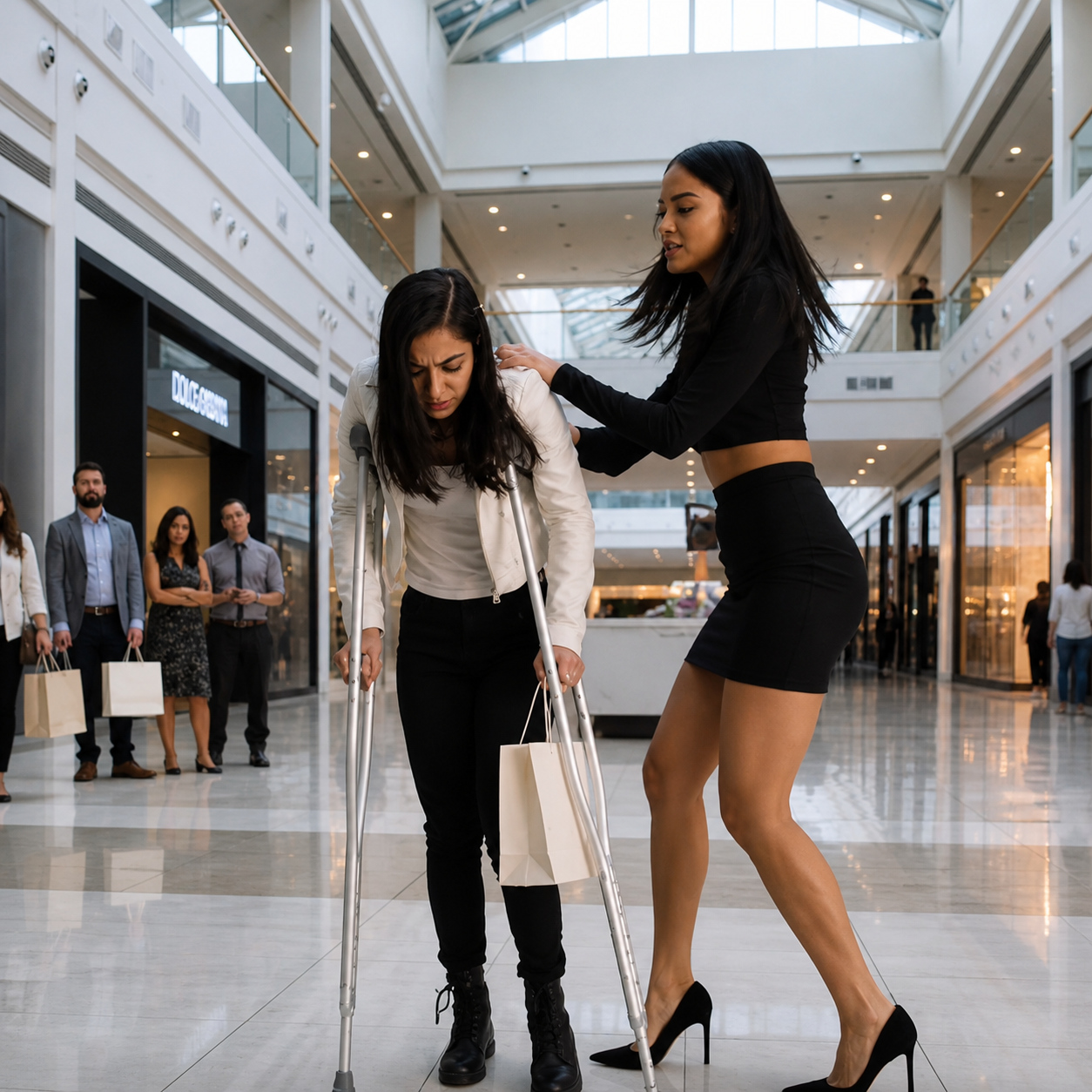
“Watch where you’re crawling.”
The words were sharp enough to make people stop. A wealthy young woman stood in the middle of the walkway, her luxury heels planted on the marble, her designer sunglasses still resting on her face though she was indoors. Her name was Vanessa Whitmore, and nearly everyone in that part of the city knew the name. Her father owned half the commercial properties downtown, her mother chaired charity galas where people paid thousands of dollars to be seen pretending to care, and Vanessa herself had built an online image out of vacations, handbags, champagne brunches, and carefully staged kindness. But there was no kindness in her face now.
At her feet, a woman lay on the floor, trembling. One hand was pressed against the marble as she tried to push herself up. Her two crutches had skidded several feet away. Her clothes were faded, her coat was thin, and the strap of her old cloth bag had torn open, spilling small things across the floor: a bottle of pain medicine, a folded receipt, loose coins, a worn handkerchief, and a small notebook with a cracked cover. The woman’s name was Anna.
Anna had not come to Westbridge Plaza to shop. She had not come to admire the glittering windows or pretend she belonged among the women carrying handbags worth more than her rent. She had come because the little tailor shop where she worked had sent her to deliver an altered evening gown to a client who refused to pick it up herself. Anna had nearly said no. Her leg had been hurting badly since morning, and cold weather always made the old injury worse. But the delivery fee meant groceries, and groceries meant she could make it through the week without asking anyone for help.
So she had taken the job. Now she was on the floor, in the middle of the most expensive shopping plaza in the city, while strangers stared at her as if her pain were an inconvenience. Vanessa looked down at her with a slow, cold smile. “People like you shouldn’t be out alone,” she said, loud enough for the crowd to hear.
Anna lowered her eyes. Shame burned across her face, though she had done nothing wrong. Vanessa had walked out of a jewelry store with her friends, laughing too loudly, looking at her phone instead of the path ahead. Anna had tried to move aside, but the crowd behind her had pressed too close. Vanessa’s shoulder struck her hard enough to knock her off balance. For a healthy person, it might have been nothing. For Anna, who depended on her crutches just to stand, it had been enough to send her crashing down.
The pain in her hip pulsed like fire. Her palms stung from hitting the floor. Her throat tightened, but she forced herself not to cry. She had learned long ago that crying in public rarely brought mercy. Sometimes it only gave cruel people more to enjoy. “I’m sorry,” Anna whispered, even though she was not the one who should have apologized. “I was just trying to pass.”
Vanessa let out a small laugh. “Trying to pass? Did you hear that?” she said, glancing at her friends. “Maybe next time the whole plaza should clear a lane for her.” A few of the girls with her laughed. Not loudly, not fully, but enough.
Anna reached toward one of her crutches. It was only a few feet away, but the distance felt impossible. Her leg shook when she tried to move. The marble beneath her palm was cold and slick. She swallowed hard and reached again. Vanessa stepped forward and placed the pointed toe of her heel on the crutch. Anna froze. The crowd watched. Nobody moved.
Some faces showed discomfort. One older man looked as though he wanted to step forward, but the woman beside him grabbed his sleeve. A security guard near the entrance shifted his weight, uncertain, then looked away. Several shoppers pretended to check their phones. One young woman lifted her phone as if to record, then lowered it again, perhaps afraid of getting involved. That was the cruelty Anna knew best — not the loud kind, but the quiet kind. The kind that filled a room when everyone saw something wrong and decided it was safer to do nothing.
“Please,” Anna said, her voice barely above a breath. “I need my crutch.” Vanessa tilted her head. “At least you know how to say please.” Then she lifted her foot and, with the same delicate motion she might have used to move a piece of trash out of her way, pushed the crutch farther across the floor.
A murmur passed through the crowd. Anna’s stomach twisted. She wanted to disappear. She wanted the marble to open beneath her and swallow her whole. But more than that, she wanted to be home, in her tiny apartment with the cracked window and the heater that worked only when it felt like it. That apartment was cold and lonely, but at least it did not stare at her. She tried again to push herself up. Her arms trembled. Her injured leg gave a sharp spasm, and she sank back down with a small sound she could not hold in.
Vanessa sighed, as if Anna’s suffering had become boring. “Honestly, this is embarrassing. Where is security?” Then came another sound. Boots. Heavy. Slow. Measured. The sound entered the space before the man did, cutting through the nervous whispers like a drumbeat. People began turning toward the far end of the walkway. A man was coming from the direction of the parking garage, moving with a calmness that made the crowd instinctively part for him.
He was tall, broad-shouldered, and dressed in a black leather biker jacket worn soft at the seams. His boots were dusty, his hands gloved, and his face carried the hard lines of a man who had spent more of his life surviving than resting. A faint scar crossed his jaw. His hair was dark, touched with gray near the temples. He did not look polished. He did not look wealthy. He looked like someone who belonged to roads, storms, engines, and long silences.
His name was Daniel Cross. Some people in the city knew him as the owner of a motorcycle garage on the south side. Others knew him as a former soldier. A few knew him as the man who had quietly helped people when the police arrived too late and the world looked the other way. There were rumors about him, of course. Men like Daniel always gathered rumors. But the truth was simpler and heavier: he was a man who had lost too much as a child and had spent the rest of his life protecting strangers because he could not save the one person who mattered most.
Daniel did not speak when he reached them. He did not look at Vanessa. He looked only at Anna. For one brief second, something shifted in his eyes. It was so quick that no one noticed, not even him. A strange ache passed through his chest, a pull of recognition without reason. Maybe it was the way she kept her head lowered, as if the world had trained her to make herself small. Maybe it was the way her hand shook against the marble. Maybe it was simply that Daniel had never been able to walk past someone who had been left on the ground.
He stepped around Vanessa and picked up the first crutch. Then he walked to the second one, bent down, and picked that up too. He brought both back to Anna and placed them beside her carefully, not dropping them, not tossing them, but setting them down as though he were returning something sacred. Then he lowered himself to one knee.
“Are you hurt?” he asked. Anna looked up just a little. His voice was rough, but there was no pity in it. That startled her more than anything. Pity she knew. Irritation she knew. Impatience she knew. But this man spoke to her as if her pain mattered. “I’m fine,” she whispered automatically. Daniel looked at her pale face, her shaking hands, the way she was holding her breath to control the pain. “You don’t have to pretend if you’re not.”
The words nearly broke her. Anna had spent years pretending. Pretending she was fine when her leg burned at night. Pretending she was not hungry when she had only enough money for one meal. Pretending she did not mind when people spoke slowly to her, ignored her, underestimated her, pitied her, dismissed her. Pretending was how she survived. But this stranger had seen through it in one sentence.
“I just need to sit up,” she said. Daniel offered his hand. “Hold on to me.” She hesitated. Accepting help had never been simple for her. Help often came with a price, with questions, with judgment, with the silent expectation that she should be grateful for scraps. But Daniel’s hand remained steady. He did not rush her. He did not grab her. He waited. At last, Anna placed her hand in his.
He helped her sit upright with such careful strength that the cruelty around them suddenly seemed even uglier. He gathered her things next: the medicine bottle, the coins, the handkerchief, the small notebook. One by one, he placed them back into her torn bag. Vanessa crossed her arms. She had been ignored too long, and she hated it.
“How touching,” she said. “What are you supposed to be? Some kind of hero?” Daniel did not answer. Vanessa’s mouth tightened. “I’m talking to you.” Still, Daniel said nothing. His silence was not nervous. It was not weakness. It was dismissal, and Vanessa felt it like a slap. “Do you know who I am?” she demanded.
Daniel continued collecting Anna’s belongings. He reached for the torn bag, but as he lifted it, something small slipped from an inside pocket and fell onto the marble. It made a soft metallic sound. A silver bracelet. Old. Worn. Darkened by time.
Daniel froze.
The whole plaza seemed to hold its breath without knowing why. The bracelet lay between them, catching the bright ceiling light. It was simple, almost cheap-looking, but Daniel stared at it as if it had reached out from a grave and touched him. Slowly, he picked it up. His gloved fingers turned it over. On the inside was an engraving, faint but still readable.
D & A.
Beneath it, in smaller letters: Never let go.
Daniel’s breath changed. A memory struck him so hard he nearly lost balance. Fire. Smoke. A child screaming. His own small hand gripping another hand in the dark. “Danny, don’t let go!” “I won’t! Anna, hold on!” Then heat. A crash. A beam falling. The world splitting open. Fingers slipping from his grasp. A scream swallowed by smoke.
Daniel had been eleven years old when the fire took his parents and tore his little sister away from him. For years, people had told him she was gone. For years, they told him to accept it. But Daniel never accepted it. Not completely. Some part of him had remained trapped in that burning house, still reaching for the tiny hand he had failed to hold.
He stared at the bracelet. “No,” he whispered.
Anna heard it. Something in his voice made her look at him more closely. At first, she saw only the biker who had helped her. A stranger. A strong man with tired eyes. But then she looked at the bracelet in his hand, and the world tilted. That bracelet was the only thing she had left from before the fire.
She did not remember everything. Trauma had broken her childhood into fragments: red light, smoke, a boy’s voice, someone calling her name, a promise not to let go. After she woke in a hospital, no one had been able to tell her much. She had been moved from one place to another, one temporary home to another. Her last name had been misspelled, then changed, then lost in paperwork. Adults told her she was lucky to be alive. Nobody understood that survival could feel like abandonment when you woke up alone.
For years, she had kept the bracelet because it proved something she could not explain. It proved there had once been someone who loved her. Someone whose initial was D. Someone who had promised never to let go. Her lips parted. She looked at Daniel’s face, searching through the years, past the beard, past the scars, past the hardness life had placed there. Under all of it, she saw something familiar. Not clearly. Not enough to trust. But enough to make her heart pound.
“Daniel…?” she whispered.
The name landed in the silence like thunder. Daniel lifted his eyes. For a moment, neither of them moved. The crowd faded. Vanessa faded. The marble floors, the luxury stores, the bright glass ceiling — all of it disappeared. There was only Daniel looking at Anna, and Anna looking back at him with eyes he had seen every night in his nightmares.
He slowly pulled off his glove. His wrist was weathered, the skin rough from work and years in the sun. But beneath it, clear as a mark carved by fate, was a scar. Curved. Pale. Old. It rested exactly where a bracelet had once cut into his skin during a desperate struggle in a burning house. Anna stared. Then, with shaking fingers, she pushed back the sleeve of her faded coat. On her own wrist was a scar of the same shape. Same place. Same curve.
A broken sound escaped her. “Danny?” Daniel’s face crumpled. No one had called him that in more than two decades. Not Daniel Cross. Not Cross. Not the garage owner. Not the biker. Not the man people crossed the street to avoid. Danny. Her brother. “Anna,” he said, and her name came out like a prayer and a wound at the same time.
She began to cry. Not the quiet tears of embarrassment she had fought back before, but deep, broken sobs from a place inside her that had been waiting too long. Daniel reached for her, then stopped, his hand hovering in the air. For all his strength, he was suddenly afraid. Afraid she would disappear if he touched her. Afraid he had no right to hold her after losing her. Afraid the universe was cruel enough to give him this moment and snatch it away.
Anna saw his hesitation. So she reached for him first. Her hand touched his. That was all it took. Daniel dropped to his knees and pulled her into his arms. He held her as if the world had vanished, as if he were holding the child he had searched for in every city, every record, every sleepless dream. Anna clung to his jacket and cried into his shoulder.
“I thought you died,” she sobbed. “I thought I was alone.” Daniel shut his eyes, and tears slid down his face despite every wall he had built around himself. “I looked for you,” he said, his voice breaking. “Anna, I swear to God, I looked for you. I never stopped.”
“I didn’t know where to go,” she cried. “I didn’t know our last name. I didn’t know if you were real. People told me maybe I made you up because I was scared.” Daniel held her tighter. “I’m real,” he whispered. “I’m here. I found you.”
Around them, the plaza had gone completely silent. The people who had watched Anna suffer now stood with their eyes lowered. Some looked ashamed. Some looked shaken. A few wiped away tears. Phones that had been lifted for entertainment now hung useless at people’s sides. Nobody was laughing anymore.
Vanessa stood frozen, her confidence draining from her face. Only minutes ago, she had looked at Anna and seen a poor disabled woman beneath her notice. She had seen someone safe to mock, someone without power, someone who could be humiliated without consequence. But now the story had changed in front of everyone. Anna was not an object of pity. She was not a nuisance. She was a lost sister. A survivor. A person with a history so painful that Vanessa’s cruelty suddenly seemed small and disgusting beneath the plaza’s bright lights.
Vanessa took a step back. “I… I didn’t know,” she said. Daniel slowly released Anna but kept one hand steady behind her back. Then he turned and looked at Vanessa for the first time. The effect was immediate. Vanessa stopped speaking.
Daniel’s stare was not loud. He did not shout. He did not threaten. But there was something in his eyes colder than anger. It was contempt, controlled and deep. “You didn’t know what?” he asked. Vanessa swallowed. “I didn’t know she was…” “My sister?” Daniel finished.
Vanessa said nothing.
Daniel stood. “So if she wasn’t my sister, it would have been acceptable?” The question struck harder than a raised voice. “If she had no one here to protect her,” Daniel continued, “would it have been acceptable to knock her down?” Vanessa’s face flushed. “If she were just a poor woman with crutches, would it have been acceptable to push her crutch away and make her crawl for it?”
The crowd shifted uncomfortably. Daniel stepped no closer, but Vanessa seemed to shrink where she stood. “If she were a stranger,” he said, each word steady, “would she deserve less dignity?”
Vanessa opened her mouth, but no excuse came out. Because the truth had nowhere to hide. She was not sorry because Anna had been hurt. She was sorry because Anna had turned out to be connected to someone she feared. Daniel looked at her for a long moment. “Apologize to her.”
Vanessa stiffened. Her pride fought the command, but the crowd was watching, and no one looked willing to rescue her from the humiliation she had created for herself. “I’m sorry,” she muttered. Daniel’s voice dropped. “Louder.”
Vanessa’s jaw tightened. She looked at Anna. “I’m sorry,” she said again, clearer this time. “I shouldn’t have said those things. I shouldn’t have moved your crutch.”
Anna looked at her through tear-filled eyes. There were many things she could have said. She could have demanded more. She could have thrown Vanessa’s cruelty back in her face. But Anna was tired. She had spent too much of her life fighting just to be treated like a person. In that moment, she did not want revenge. She wanted air. She wanted her brother. She wanted to believe that this impossible thing was real. So she said quietly, “Don’t do it to anyone else.”
The softness of the sentence made Vanessa lower her eyes. Daniel turned toward the security guard. “Call the plaza manager.” The guard, who had done nothing before, suddenly moved quickly. “Yes, sir.” Vanessa looked alarmed. “Is that necessary? I apologized.” Daniel looked back at her. “An apology is not an eraser.”
Soon the manager arrived with two security officers. Witnesses began to speak. One man admitted he had recorded Vanessa pushing the crutch away. A store employee said the security cameras would show the collision. Another shopper said she had seen Vanessa laugh while Anna was on the floor. The truth, which had been trapped under silence minutes earlier, finally began to rise.
Anna was taken to the plaza’s medical room while the staff reviewed the footage. Daniel stayed beside her the entire time. When a nurse offered to help Anna into a wheelchair, Anna looked instinctively toward him, afraid to be separated even for a second. Daniel understood. “I’m coming with you,” he said.
The words settled something in her chest. In the medical room, as the nurse checked her hip and knee, Anna kept glancing at Daniel. He noticed every time, and each time he said the same thing softly. “I’m still here.”
After the nurse stepped out to arrange transport to a hospital for a more thorough exam, Anna held the bracelet in both hands and stared at it. Daniel reached into the inside pocket of his jacket and pulled out a small piece of old silver attached to a broken chain. Anna’s breath caught. It was the matching bracelet. Bent, darkened, and worn almost smooth, but unmistakably part of the same pair.
“You kept it?” she asked. “Every day,” Daniel said. “When the chain broke, I kept it in my jacket. I used to think if I ever found you, I’d show it to you so you’d believe me.” Anna shook her head, tears spilling again. “I would have believed you.”
Daniel looked down. “I lost you.” “No,” she said. His jaw tightened. Anna reached for his hand. “No, Danny. You were a child.” Daniel closed his eyes.
For twenty-three years, he had lived with the same sentence burning inside him: I let go. Every birthday of hers he imagined. Every Christmas he spent alone. Every little girl he saw with brown eyes. Every hospital record that led nowhere. Every false lead. Every body found in old reports. Every door that closed. He had punished himself for surviving. But Anna was looking at him with no blame at all.
“You were a child,” she repeated. “The fire took us from each other. You didn’t choose that.” Daniel covered her hand with his. It trembled under his palm. “I should have found you sooner.” “You found me now,” she said. And somehow, that was both not enough and everything.
Daniel took Anna to the hospital that afternoon. Not on his motorcycle, as some people might have imagined, but in a truck driven by his closest friend, Marcus, who arrived without asking questions. Daniel sat beside Anna in the back seat because she would not let go of his sleeve. The city passed outside the window in gray and gold streaks of late sunlight, but neither of them cared.
At the hospital, doctors confirmed that Anna had not broken anything in the fall, though the impact had aggravated an old injury. Daniel listened carefully to every instruction. Anna watched him ask questions about treatment options, physical therapy, pain management, specialists. No one had ever done that for her before — not like this, not with the fierce attention of someone determined that she would no longer be overlooked.
When the doctor mentioned cost, Anna’s body tensed. Daniel noticed immediately. “Don’t,” he said gently. She looked embarrassed. “You don’t know how expensive this can get.” “I know.” “I can’t let you—” “You can,” Daniel said. “And you will.” There was no arrogance in his voice. Only certainty.
Anna’s eyes filled again. “I’ve been taking care of myself for a long time.” “I know,” he said. “But you don’t have to do it alone anymore.” She looked away, struggling with the words. Independence had been her armor. Poverty had taught her to count everything: money, meals, favors, minutes of warmth, doses of medicine. Letting someone help felt dangerous. But this was not charity. This was family. Finally, she nodded.
Later, in the quiet waiting area, they began telling each other the pieces of their lives they had missed. Daniel told her how he had woken up after the fire in a different hospital, calling her name until his throat bled. He told her how adults insisted she was gone, how records were confused, how he ended up with distant relatives who treated him like a burden. He ran away as a teenager, learned to fix engines, joined the military, came back harder and quieter, opened a garage, and kept searching.
Anna told him about the hospital, the foster homes, the years of being moved around, the way her last name disappeared in paperwork. She told him about the accident complications that left her dependent on crutches, about jobs she lost because employers saw her disability before her skills, about nights when she took out the bracelet and whispered the name Danny just to feel less alone. Daniel listened with his hands clasped tightly in front of him. Every word hurt. But he did not look away.
A week later, Anna visited Daniel’s garage for the first time. It stood on the south side of the city, far from the glass ceilings and luxury stores of Westbridge Plaza. The brick walls were old. The sign above the entrance was hand-painted. Motorcycles lined the front like sleeping animals. Inside, the air smelled of oil, metal, coffee, and rain-soaked leather. To Anna, it felt warmer than any rich place she had ever entered.
The people inside stopped working when she came in. For one nervous second, she tightened her grip on her crutches. Then Marcus, the broad man who had driven them to the hospital, wiped his hands on a rag and smiled. “So this is Anna,” he said. “We’ve been waiting a long time to meet you.” Anna glanced at Daniel. He looked uncomfortable. “Not that long.” Marcus snorted. “Twenty years is pretty long, brother.”
The garage filled with gentle laughter. Not mocking laughter. Warm laughter. The kind Anna had almost forgotten existed. A woman named Riley brought her a chair without making a fuss. Another mechanic offered tea. Nobody stared at her leg. Nobody asked rude questions. Nobody treated her like an interruption. They simply made space for her, and somehow that small kindness nearly broke her all over again.
Then she saw the wall. At the back of Daniel’s office was a board covered with papers, maps, photographs, and notes. Hospital names. Foster agency addresses. Old fire reports. Newspaper clippings. Lists of possible names. Dates. Crossed-out leads.
Anna stepped closer. One note read: Anna may have been renamed. Another: scar on right wrist. Another: silver bracelet, D & A, “Never let go.” She touched the paper with shaking fingers. Daniel stood in the doorway behind her. “I was going to take it down,” he said quietly. “I didn’t want it to hurt you.”
Anna shook her head. “Don’t take it down.” He said nothing. She turned to him, crying but smiling. “I want to know I was searched for.” Daniel’s face softened with a grief too old for words. “You were,” he said. “Always.”
In the months that followed, life did not become perfect. Real healing rarely does. Anna still had days when pain trapped her in bed. Daniel still woke from nightmares smelling smoke that was not there. Sometimes they sat together in silence because words were too heavy. Sometimes Anna got angry at all the years stolen from them. Sometimes Daniel got quiet because guilt had old roots. But now, when the darkness came, neither of them faced it alone.
Daniel turned the empty room above the garage into a place for Anna. He did not pressure her to move in. He simply handed her a key. “When you want it,” he said, “it’s yours.” The room was small, but the window caught morning light. There was a bed, a desk, a bookshelf, and a framed copy of an old photograph Daniel had found after years of digging through records: two children standing on a porch before the fire, a dark-haired boy with a crooked grin and a little girl holding a stuffed bear. On both of their wrists were silver bracelets.
Anna held the frame for a long time. “I don’t remember this day,” she said. Daniel stood beside her. “I do. You cried because your shoe was on the wrong foot.” Anna laughed through her tears. “That sounds like me.” “You made me switch mine too so we could both be wrong.” For the first time, the memory did not feel like a wound. It felt like a gift.
One month after the incident, Anna returned to Westbridge Plaza. This time Daniel walked beside her. She still had her crutches. Her bag was still old, though Riley had repaired the strap with strong stitching. She still moved slowly, but something about her was different. Her shoulders were no longer folded inward. Her eyes no longer stayed fixed on the floor.
At the entrance, the same security guard who had failed to help her that day stepped forward. His face was tight with shame. “Miss Anna,” he said, “I owe you an apology. I should have helped you immediately.” Anna studied him for a moment. She could have ignored him. She could have been cruel. But she had learned the difference between justice and bitterness. “Next time,” she said, “help before someone has to ask.” The guard nodded. “I will.”
Daniel said nothing. He did not need to speak for her. That mattered to Anna more than she could explain. They walked past the jewelry store where the bracelet had fallen. Anna stopped and looked down at the marble floor. It had been polished clean, as if nothing had happened there. Shoppers moved around them, carrying bags, laughing, rushing toward whatever mattered in their shining little worlds.
But Anna remembered. She remembered being on the floor. She remembered the crutch sliding away. She remembered the silence. And she remembered Daniel’s boots. Heavy. Slow. Measured. The sound of someone finally coming.
Daniel looked at her. “Are you okay?” Anna reached into her bag and touched the silver bracelet. Then she looked at him. “Yes,” she said. And for once, she meant it.
They continued walking together through the bright, indifferent plaza. Some people recognized them and moved aside. Others stared. Anna did not care. For years, she had believed she was alone in the world, a woman surviving on scraps of strength, carrying a bracelet from a past no one believed in. Now she had proof. She had a name that belonged to someone else’s memory. She had a brother who had searched for her through half a lifetime. She had a home above a garage that smelled of oil and coffee. She had people who waited for her to come downstairs in the morning.
Most of all, she had a hand beside her that would never willingly let go again. The woman Vanessa had mocked was not some nameless stranger on the floor. She was Anna Cross, a survivor of fire, loss, poverty, and silence. She was a sister. She was family. She was someone who had been loved even when she did not know it.
And the biker who stepped out of the crowd was not just a frightening man in a leather jacket. He was Daniel, the boy who had carried one promise through twenty-three years of guilt and grief. Never let go. He had failed once, not because he wanted to, but because the world had been cruel and the fire had been stronger than a child’s hands. But fate, after all its brutality, had given him one final chance.
This time, when Anna reached for him, Daniel was there. And this time, he held on.
![[FULL STORY] My wife screamed, "If you walk out that door, don't you dare come back!" I looked at her and, smilin](https://sa.greatgames.info/storage/thumbnails/1777364817_11.png)
![[FULL STORY] Before Going to a Show with Her Pals, I Heard My Girlfriend Giggle and Say: 'I Got a Full Body](https://sa.greatgames.info/storage/thumbnails/1777021211_T5.png)
![[FULL STORY] My Fiancée Said She Needed “Space to Think”... So I Shipped Her Stuff to Work Cash on Delivery](https://sa.greatgames.info/storage/thumbnails/1777001502_580201c2-e208-4eaa-964e-dfcf1c04421f.png)