
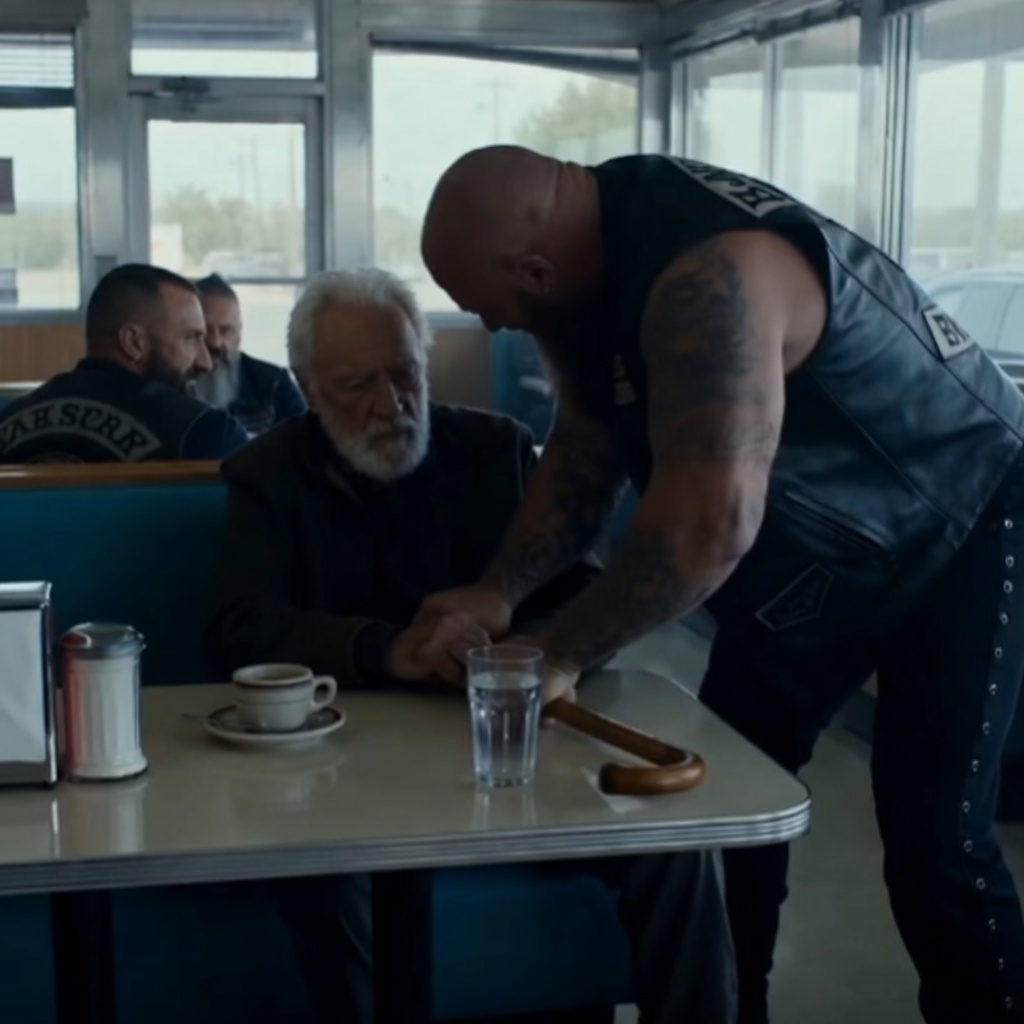
Near the front window, in a teal booth, an elderly man sat alone. His name was Thomas Whitaker, though no one in that diner knew it. To them, he was just an old man with white hair, a neatly trimmed beard, and a dark coat buttoned carefully over his chest. His coffee sat untouched in front of him. Beside him, his right hand rested around a wooden cane, not like an accessory, but like something that had stayed with him through years no one in that diner could understand.
The cane was old, polished dark from time and use. Its handle was carved into the shape of an eagle’s head, the eyes worn smooth beneath his thumb. It had belonged to his father before him. Then to his brother. Then, after the war, after the accident, after the hospital rooms and the months of learning how to walk again, it became Thomas’s. It had crossed deserts, airports, courtrooms, hospitals, funerals, and silent hallways where men twice his size moved aside without knowing why.
He didn’t look weak. He looked quiet.
Maybe that was why the biker chose him.
The biggest man in the group rose from the back booth. He was broad-shouldered, heavy in the neck, wearing a leather vest stretched tight over a stained gray shirt. His beard was thick, his knuckles scarred, and his grin looked one second away from violence. The men with him laughed before he even did anything, because men like that often travel with their own applause.
He walked down the aisle and stopped beside the old man’s table.
At first, the room barely noticed. Then he reached down and snatched the cane straight out of Thomas’s hand.
The old man’s fingers jerked from the force. The table shifted. A glass of water tipped, rolled, and shattered across the floor. For one sharp second, the diner flinched. Then the bikers exploded with laughter.
Thomas did not shout. He did not grab for the cane. He did not beg. He only looked down at the broken glass, the water spreading across the tile, and the empty space where his cane had been. Somehow, that silence felt heavier than anger.
The biker swung the cane through the air like a toy. “Look at this,” he called back to his friends. “Fancy old bird stick.”
More laughter followed.
A waitress froze with a coffee pot in her hand. A trucker at the counter lowered his eyes. A young couple in the corner stopped eating. No one moved. That was how public humiliation worked. It made cowards out of people who might have been kind in private.
The old man finally lifted his face, but not toward the biker. Toward the cane.
His expression held no fear.
Only something colder.
The biker strutted a few steps away, spinning the cane once, badly, then dropped it onto the floor.
Clack.
The sound cut through the diner. The laughter lasted one more second, then began to fade, because Thomas still had not reacted the way humiliated people were supposed to react. He did not look broken. He did not look embarrassed. He looked as if he were watching a door close inside himself.
The biker turned back, still smirking. “What, old man? You need your little stick?”
Thomas reached slowly into the inside pocket of his jacket.
No shaking.
No rush.
No performance.
The biker’s smile twitched. “What are you doing?”
Thomas pulled out a small black key fob. Plain. Simple. One silver button. He looked at it for a moment, as if he had just made a decision he had been avoiding. Then he pressed it.
Click.
That tiny sound seemed to empty the room.
The laughter died in pieces.
Thomas lifted the fob near his mouth and spoke in a calm voice that somehow reached every corner of the diner.
“It’s me. Bring them.”
The biker’s smile weakened. Not completely. Not yet. But enough. One of his friends stopped laughing and turned toward the windows. Another shifted in his seat. The waitress slowly set the coffee pot down.
Thomas still did not stand. He looked across the aisle at the man who had taken his cane, and finally raised his eyes to the biker’s face.
No rage.
No fear.
No pleading.
Only certainty.
Then, from outside, came the sound of an engine.
Low.
Heavy.
Close.
Then another.
And another.
The biker turned toward the windows. Headlights flared across the glass. One pair. Then three. Then more.
Thomas’s voice stayed even.
“You should’ve left the cane.”
Outside, black SUVs slid into the parking lot. Tires screamed against wet gravel. The whole diner went still. The biker stared through the window, his face slowly changing as he realized the joke had ended.
For the first time, he looked like a man who understood he had made a serious mistake.
The cane lay on the floor between them like a line that should never have been crossed.
Then the diner doors began to open.
The first man who entered wore a black suit under a raincoat. Not a cheap suit. Not a flashy one. The kind worn by men who knew how to disappear until they needed to be seen. Two more came behind him. Then four. Then six. They moved into the diner without rushing, but every step was controlled. Their eyes scanned the exits, the booths, the biker table, the broken glass, the cane on the floor, and finally the old man sitting quietly by the window.
The waitress took one step back.
The trucker at the counter whispered, “Jesus.”
The first man stopped beside Thomas’s table and lowered his head. “Sir.”
Thomas did not look at him. “No one touches him yet.”
The man’s jaw tightened, but he nodded. “Yes, sir.”
The biker tried to laugh. It came out wrong. “What is this? Some retirement home security team?”
No one answered.
That made it worse.
His friends were no longer laughing. One of them had gone pale. Another was staring at the men in suits, trying to decide whether he recognized something about their posture. Not police. Not exactly private security either. Former military, maybe. Federal, maybe. Something disciplined enough to make the air in the diner turn thin.
The biker pointed toward Thomas. “He started this.”
A silence followed.
Even his own men seemed ashamed by the stupidity of that sentence.
Thomas finally moved. Slowly, carefully, he shifted toward the edge of the booth. Without his cane, standing took effort. Pain moved across his face for one brief second, but he swallowed it before most people saw. The man in the suit stepped forward instinctively, but Thomas lifted one hand.
“No.”
He stood by himself.
Not quickly. Not gracefully. But fully.
The diner watched him rise, and something changed in the room again. He was old, yes. He was injured, yes. But he was not fragile. Fragile things break when struck. This man looked like something that had already survived being broken and had become harder in the repair.
He took one step toward the cane.
The biker, suddenly unsure, looked down at it too.
Thomas bent slowly, but before his hand could reach the cane, the first man in the suit crouched and picked it up with both hands. Not casually. Reverently. He wiped the handle with a clean cloth from his pocket, then offered it back.
Thomas accepted it.
Only then did he look at the biker.
“What’s your name?”
The biker swallowed. “Rick.”
“Full name.”
The man hesitated. “Rick Malloy.”
Thomas nodded once, as if filing it away somewhere Rick could not reach.
“Rick Malloy,” he said quietly. “You saw an old man sitting alone and decided that made him safe to humiliate.”
Rick’s face hardened with the last scraps of pride he had left. “It was a joke.”
Thomas glanced at the broken glass. “Jokes make people laugh.”
“My guys laughed.”
“Your guys were afraid not to.”
That hit the biker table harder than it should have. One of Rick’s friends looked down.
Rick’s mouth twisted. “You think you’re better than me?”
“No,” Thomas said. “I think I’ve had longer to become ashamed of the worst things I’ve done.”
That answer confused Rick. It was not the answer he expected from a rich old man with bodyguards. It carried weight. History. Regret.
Thomas tapped the cane once against the tile.
The sound was small, but everyone heard it.
“This cane belonged to my father,” he said. “He carried it after a factory accident crushed his leg. Then my brother carried it after a roadside bomb took part of his hip. I carried it after I came home with more scars than bones that worked properly. It has held up three generations of men who did not ask for pity and did not offer cruelty to make themselves feel tall.”
The diner was silent.
Rick’s eyes flickered, just slightly.
Thomas continued. “You did not take a stick. You took memory from an old man’s hand and turned it into a toy.”
The waitress lowered her eyes.
The trucker at the counter looked ashamed.
Rick shifted his weight. “Look, I didn’t know.”
Thomas’s voice stayed calm. “You didn’t ask.”
That was the truth, plain and unforgiving.
For a moment, Rick looked like he might apologize. Then pride rushed back, ugly and automatic. “So what now? You gonna have your little army beat me up because I messed with your cane?”
Thomas studied him.
“No.”
That surprised everyone.
Even the men in suits.
Thomas looked toward the back booth. “All of you. Stand.”
Rick’s friends hesitated.
The suited men did not move, but their stillness became a command. Slowly, the bikers stood.
Thomas pointed with the cane toward the broken glass. “You will clean that.”
Rick’s face flushed. “What?”
“The glass. The water. The mess you made.”
One of the bikers muttered, “Man, just do it.”
Rick snapped, “Shut up.”
Thomas looked at the waitress. “Do you have a broom?”
She nodded quickly. “Yes, sir.”
“No sir,” he said. “Just Thomas.”
The name moved through the diner.
Thomas.
Not yet the full truth.
But enough to make the suited men glance at each other.
The waitress brought a broom and a dustpan. Rick did not take them.
Thomas waited.
The room waited with him.
Finally, one of Rick’s friends, a thinner man with tattoos up his neck, stepped forward and took the broom. “I’ll do it.”
Thomas’s gaze did not leave Rick. “He didn’t break it.”
The thin man froze.
Rick’s jaw worked.
Then, with every eye in the diner on him, he grabbed the broom.
His hands shook with anger as he swept the glass. The sound of bristles against tile filled the diner. No one laughed now. No one dared. The humiliation had turned, but Thomas did not seem satisfied by it. His face remained grave, almost tired.
When the floor was clean, Rick shoved the broom back toward the waitress.
Thomas said, “Thank her.”
Rick stared at him.
Thomas did not blink.
Rick’s voice came out low. “Thank you.”
The waitress nodded, still pale.
Thomas looked at the biker table. “Now sit down.”
They sat.
Rick remained standing.
Thomas leaned on the cane, his body quietly protesting the strain. The first man in the suit noticed, but again did not intervene.
“Do you know why I was here tonight?” Thomas asked.
Rick said nothing.
“I came because my grandson liked this diner.”
That shifted something again.
Thomas looked toward the teal booth. “He used to sit there. Same seat. Ordered pancakes at midnight and pretended that was a normal dinner. He had a laugh that filled rooms. Too loud. Always too loud. I used to tell him he’d get himself in trouble because he didn’t know when to stop talking.”
The waitress’s face changed.
She knew who he meant.
A young man named Ben Whitaker had come through that diner for years. Laughing. Flirting badly. Leaving tips too large when he could afford it and apologetic notes when he couldn’t. He rode a motorcycle, though never with Rick’s crew. He had died eight months earlier on the highway outside town.
A drunk driver.
A rainy night.
A funeral too full of young faces.
Thomas swallowed once.
“This is the first time I’ve been able to come here since he died,” he said. “I sat in his booth because I wanted to remember him somewhere he had been happy.”
The diner’s silence deepened into something almost gentle.
Rick’s face changed, but Thomas did not give him the mercy of looking away.
“And you chose that moment to make me smaller.”
Rick looked down.
For the first time, shame entered him visibly. Not enough. Maybe not permanent. But real.
“I didn’t know,” he said again, quieter now.
Thomas’s answer was the same. “You didn’t ask.”
The door opened once more.
This time, a woman entered under a black umbrella, escorted by another suited guard. She was in her forties, with dark hair pulled back, wearing a long coat over hospital scrubs. Her face was tense with worry until she saw Thomas standing upright.
“Dad,” she said.
Thomas turned.
His expression softened in a way that made him look suddenly human after all the steel.
“Emily.”
She rushed toward him, then stopped herself before hugging him too hard. “What happened?”
He looked briefly at Rick. “Someone mistook quiet for weakness.”
Emily’s eyes moved to the biker, then to the broken water glass in the waitress’s bin, then to the cane in her father’s hand.
Her face went cold.
Rick took a step back.
Thomas noticed. “No, Emily.”
She looked at him. “Dad—”
“No.”
The authority in his voice was old and familiar. She closed her mouth, but her anger stayed.
The first man in the suit said softly, “We have the plate numbers, sir. Names are being verified.”
Rick’s head snapped toward him. “What for?”
Thomas looked at him. “Because men who bully the weak in public often do worse in private.”
Rick’s face darkened. “You don’t know anything about me.”
“I know enough to check.”
One of Rick’s friends swore under his breath.
Thomas turned to him. “And I’ll check all of you.”
The threat was not theatrical. It was administrative. Legal. Certain. It sounded like paperwork, courtrooms, phone calls, licenses revoked, warrants discovered, old debts awakened. For men like Rick, that was sometimes scarier than fists.
Rick finally asked the question sitting in everyone’s mouth.
“Who are you?”
Thomas did not answer immediately.
Emily did.
“Thomas Whitaker,” she said. “Former federal judge. Founder of the Whitaker Veterans Defense Fund. Former chair of the State Judicial Review Board.” Her eyes stayed on Rick. “And the man who has spent forty years putting men much smarter than you exactly where they belong.”
Rick went still.
The trucker at the counter whispered, “Damn.”
Thomas sighed. “Emily.”
“What? He asked.”
Rick looked suddenly sick.
A former judge.
Not a mob boss. Not a gangster. Not a rich fool calling thugs to protect his ego.
Something worse for a man with a record.
Someone who knew systems. Someone who knew consequences. Someone who had walked into the diner carrying grief, not power, and had been mocked by a man too stupid to see the difference.
Thomas turned back to Rick. “I’m retired.”
Rick exhaled slightly.
“Mostly,” Thomas added.
The suited men remained still.
Emily stepped closer to her father. “Are you hurt?”
“No.”
“Did he touch you?”
“He took the cane.”
Her jaw tightened.
Thomas placed one hand over hers. “I’m all right.”
But his voice trembled slightly on the last word.
Emily heard it.
So did the waitress.
So did Rick.
For the first time, the biker seemed to understand that the cane had not been about pride. It had been about a grieving grandfather trying to sit in his dead grandson’s booth without falling apart.
Rick looked at the floor.
Then, roughly, like the words were being dragged out of him, he said, “I’m sorry.”
Thomas studied him.
The room waited.
Rick continued, quieter. “I didn’t know about your grandson. I didn’t know about the cane.”
Thomas nodded slowly. “That apology is still about what you didn’t know.”
Rick looked up.
Thomas’s voice sharpened just enough. “Try again. Apologize for what you did know. You knew I was old. You knew I was alone. You knew I needed that cane. You knew people were watching. You knew taking it would humiliate me. Apologize for that.”
Rick’s face burned red.
For a moment, pride fought him hard. Everyone could see it. The old habit of cruelty, the need to look dominant, the fear of losing face in front of his friends.
Then something gave.
“I’m sorry,” he said, voice low. “For taking it. For making a joke out of you. For doing it because I thought you wouldn’t fight back.”
Thomas let the silence sit after the apology.
Then he nodded once.
“Better.”
Rick looked stunned, as if he had expected punishment but not instruction.
Thomas turned to Emily. “Pay the diner for the glass.”
The waitress immediately shook her head. “No, no, that’s not—”
Thomas looked at Rick.
Rick swallowed. “I’ll pay for it.”
“And the table cleanup.”
“Yeah.”
“And everyone’s coffee.”
Rick’s eyes widened. “Everyone’s?”
Thomas said nothing.
Rick muttered, “Fine.”
The waitress almost smiled.
Thomas returned carefully to the booth. Emily helped this time, and he allowed it. That small surrender seemed to cost him more than facing Rick.
The suited men remained stationed around the diner, but the immediate danger had drained from the room. Conversations did not resume right away. People were still processing the strange shape of what had happened: an old man humiliated, a button pressed, power arriving in black SUVs, and then instead of violence, a lesson.
Rick sat back with his group, but the table was different now. Smaller. Quieter. One of his friends would not look at him. Another kept glancing toward Thomas, not with fear anymore, but curiosity.
Emily sat across from her father.
“You shouldn’t have come alone,” she said.
Thomas looked out the rain-streaked window. “Ben came alone.”
Her expression softened painfully.
“Dad.”
He touched the eagle handle of the cane. “I thought if I could sit here, drink one cup of coffee, and leave, maybe the place would stop hurting.”
“Did it?”
He gave a faint, tired smile. “Not exactly.”
Emily reached across the table and covered his hand.
For a while, they sat like that.
The waitress came over with fresh coffee. “On the house.”
Thomas looked at her. “No. Rick is buying it.”
She blinked, then laughed despite herself.
It was small, but the diner needed it.
Rick heard from the back and grimaced, but he said nothing.
The night could have ended there.
It almost did.
Then the door opened again, and a young woman entered with a little boy asleep against her shoulder.
The waitress turned. “Mara?”
The woman looked exhausted, soaked from rain, and afraid. Her eyes went first to Rick’s table. Rick’s face changed immediately.
Thomas saw it.
So did Emily.
So did the first man in the suit.
Mara froze when she saw Rick. The boy in her arms stirred.
Rick stood halfway. “What are you doing here?”
Mara stepped back.
The whole diner felt the old pattern return. This was not joking now. This was something else. Something private, ugly, familiar.
Thomas watched Rick’s face and understood at once why he had told his men to check the biker’s life.
Men who enjoy humiliating strangers often practice first on people closer to them.
The waitress moved toward Mara. “You okay?”
Mara’s lips trembled. “I didn’t know he was here.”
Rick’s voice dropped. “Go outside.”
Thomas’s cane tapped once against the tile.
Rick turned.
Thomas looked at Mara. “Would you like to sit down?”
Rick snapped, “This has nothing to do with you.”
Thomas did not look away from the woman. “Ma’am?”
Mara hugged the sleeping boy tighter. Her eyes filled. “I just need to call my sister.”
Emily was already standing. “Come sit with me.”
Rick stepped into the aisle. “She’s not sitting anywhere.”
The suited men moved.
Not dramatically. Just enough.
Rick stopped.
Thomas’s voice was quiet. “You learned very little in the last ten minutes.”
Rick’s face twisted. “She’s my wife.”
Mara flinched.
Thomas looked at the boy in her arms. A bruise, faint but visible, marked the child’s wrist.
The old judge’s eyes went cold.
Emily saw it too. Her whole posture changed from daughter to doctor.
“Mara,” Emily said gently, “is he hurt?”
Rick slammed his hand on the table. “Don’t answer that.”
The sleeping boy woke and began to cry.
That sound did what the stolen cane had not done.
It moved the room.
The trucker at the counter stood. The waitress stepped in front of Mara. The young couple near the corner rose together. Even one of Rick’s biker friends pushed away from the back booth and said, “Rick, sit down.”
Rick turned on him. “Stay out of it.”
The friend shook his head. “No. I’ve stayed out of enough.”
Mara began crying silently.
Thomas looked at his lead security man. “Call Sheriff Alvarez. Ask for a domestic response unit. Tell him I’m requesting it personally.”
Rick went pale with fury. “You son of a—”
“Careful,” Thomas said.
One word.
Rick stopped.
Not because he had become good. Because the room was no longer his. The silence had turned against him. The laughter he had used as armor was gone.
Mara sat beside Emily, shaking. The little boy clung to her neck.
Thomas did not question her in front of everyone. He knew better. He had spent too many years in courtrooms listening to victims forced to explain their fear while abusers watched. Instead, he had Emily take her into the small office behind the counter. The waitress went too.
Rick tried to leave.
The suited men blocked the exits.
“You can’t hold me here,” Rick said.
Thomas looked tired now. Very tired. “No. But the sheriff is three minutes away, and if you run, every man in this room will describe it.”
Rick looked toward his friends.
None of them stood with him.
That broke something in his face.
The sheriff arrived with two deputies and a female officer who went straight to the back office. What followed was not loud. No dramatic fight. No overturned tables. Just questions, statements, a quiet examination of the little boy’s wrist, Mara’s shaking voice behind a half-closed door, and Rick Malloy slowly realizing that one cruel joke had pulled a thread that unraveled far more than he expected.
There was an outstanding warrant for Rick in another county.
There were prior complaints.
There were hospital visits explained away as accidents.
There were neighbors who had called before and then stopped because nothing changed.
Tonight, something changed.
When deputies cuffed Rick, he looked at Thomas with hatred. “You ruined my life.”
Thomas looked at the cane in his hand. “No. I interrupted it.”
Rick was taken out into the rain.
His biker friends remained seated, stunned and ashamed. One of them put his head in his hands. Another quietly asked the sheriff if he could give a statement.
Mara left through the back with Emily, the child wrapped in a diner blanket. Thomas watched them go, and the anger in him slowly drained into sorrow.
Emily returned twenty minutes later. “They’re going to a shelter tonight. I gave her my number.”
Thomas nodded.
“You okay?”
He looked toward the booth where Ben used to sit.
“No.”
She sat beside him instead of across from him.
“Me neither,” she said.
The black SUVs remained outside until closing. The diner never fully returned to normal that night. How could it? Something had been exposed there. Not just Rick’s cruelty. Everyone’s silence. The way people looked away until someone with power gave them permission to care.
Before Thomas left, he walked to the back booth where Rick’s friends still sat.
They stiffened.
He leaned on the cane and looked at each of them.
“You laughed when he took it.”
No one answered.
“You watched him scare a woman carrying a child.”
Still no answer.
“You are not boys. You are grown men. Start acting like it before the world mistakes you for the kind of men you follow.”
The thin one with neck tattoos looked up. His eyes were wet.
“I’m sorry,” he said.
Thomas nodded once. “Be useful with it.”
Then he turned and walked toward the door.
The waitress stopped him near the front. “Thomas?”
He looked back.
She held out a photograph taken from the wall near the register. Ben, grinning beside a plate of pancakes, middle finger raised at whoever had taken the picture. On the back, someone had written: Midnight breakfast king.
Thomas took it with shaking hands.
“I thought you might want it,” she said.
For the first time that night, his control failed.
Not completely. Just enough.
His eyes filled. His mouth trembled once.
“Thank you,” he said.
Outside, rain fell softly over the black SUVs and the motorcycles and the wet gravel. Emily walked beside him, one hand near his elbow but not touching unless needed.
At the car, Thomas paused.
The diner windows glowed behind him.
He looked at the cane.
“You know,” he said quietly, “for a moment, when he took it, I wanted them to hurt him.”
Emily looked at him. “I know.”
“I almost let that be the end of the story.”
“But you didn’t.”
Thomas watched the rain slide down the cane’s carved eagle head. “Ben would have laughed at me for being dramatic.”
Emily smiled through tears. “He would have said, ‘Grandpa, you called a convoy over a stick?’”
Thomas gave a broken laugh.
Then he looked toward the back of the diner, where Mara had left through the office door.
“Maybe the stick did what it came to do.”
Emily leaned her head briefly against his shoulder.
The next morning, the story spread through town. Not the true version, at first. People said an old man called in a private army because a biker stole his cane. Some laughed. Some exaggerated. Some made Thomas sound like a gangster, Rick like a fool, the diner like a movie scene.
Then the rest came out.
Rick’s arrest.
Mara’s escape.
The child taken to safety.
The old judge.
The dead grandson.
The cane.
After that, people stopped laughing.
A week later, Thomas returned to the diner.
This time, Emily came with him from the start. No black SUVs. No convoy. Just one car, one cane, one old man trying again to sit in the booth where his grandson had once eaten pancakes at midnight.
The waitress had reserved it.
On the table sat a fresh cup of coffee and a small plate of pancakes.
Thomas stared at them.
The waitress said, “Ben always ordered extra syrup.”
Thomas nodded, unable to speak.
As he sat down, a man approached from the back. The thin biker with tattoos up his neck. His name was Luis. He held his helmet in both hands and looked like he had not slept well in days.
“I don’t want to bother you,” Luis said.
Thomas looked up.
Luis swallowed. “I gave a statement. About Rick. About Mara. About things I saw.”
Thomas said nothing.
“I should’ve done it before.”
“Yes,” Thomas said.
Luis flinched, but nodded. “Yeah.”
Thomas looked at him for a long moment. “And now?”
Luis looked toward the window. “Now I’m trying to figure out how not to be the kind of man who laughs when someone else is cruel.”
Thomas stirred his coffee slowly.
“That’s a good place to start.”
Luis nodded, then turned to leave.
“Luis,” Thomas said.
He stopped.
“Help her if she asks. Leave her alone if she doesn’t.”
Luis nodded again. “Yes, sir.”
“No sir.”
A faint smile crossed Luis’s face. “Thomas.”
Life did not transform overnight. Rick’s case moved slowly, as cases do. Mara had hard days. The little boy had nightmares. Luis and two others from the biker group eventually cut ties with Rick’s circle and began showing up at community volunteer events with the awkward shame of men trying to become useful. Emily stayed in contact with Mara. Thomas pretended not to care, then paid quietly for legal support through his foundation.
The diner changed too.
Not much at first. But something in the air shifted. When a stranger walked in looking tired, people noticed differently. When an old man reached for a cane, no one smirked. When a woman seemed afraid, the waitress asked if she needed help before the room decided it was none of its business.
Near the front register, the owner hung a small sign.
Be careful who you choose to humiliate.
Under it, in smaller letters, someone had written:
And be quicker to help than to laugh.
Thomas saw it one evening and shook his head. “Subtle.”
The waitress grinned. “We considered naming the pancakes after you.”
“Don’t.”
“Too late. The Judge Special.”
Emily laughed so hard she had to sit down.
Months later, on the anniversary of Ben’s death, Thomas came to the diner alone. Not because Emily refused to come, but because he asked for one hour by himself. The booth was waiting. So was the coffee.
He placed Ben’s photograph on the table.
For a long time, he said nothing.
Then he touched the cane and whispered, “You would’ve liked the chaos.”
Outside, motorcycles passed on the highway, their engines low and fading into distance.
Thomas closed his eyes and remembered his grandson laughing.
Not dying.
Not gone.
Laughing.
That was why he had come in the first place. Not for revenge. Not for power. Not to prove an old man could summon black SUVs with one click. He had come to reclaim one small piece of memory from grief.
The cane had been taken.
The room had laughed.
And somehow, from that ugly moment, a woman and child had found a door out of fear.
Thomas did not believe everything happened for a reason. He had seen too much suffering to say something so easy. But he did believe that when cruelty revealed itself, people had a choice. Laugh. Look away. Or stand.
That night, the diner had almost chosen laughter.
Then it learned better.
Years later, people still told the story of the old man in the teal booth and the biker who made the mistake of stealing his cane. They told it with headlights and black SUVs, with engines roaring into the parking lot, with the old man pressing one silver button and saying, “Bring them.” They loved the drama of it. The reversal. The bully realizing he had chosen the wrong target.
But Thomas remembered the quieter parts.
The empty space in his hand when the cane was taken.
The sound of glass breaking.
The shame on the waitress’s face because she had wanted to help but froze.
The fear in Mara’s eyes when she walked in carrying her son.
The way the room finally stood when it mattered.
And the cane itself, lying on the floor between cruelty and consequence.
A line that should never have been crossed.
A line that, once crossed, forced everyone to reveal who they were.
Thomas kept carrying that cane until the end of his life. The eagle handle grew smoother under his palm. The wood gathered new scratches. One small mark near the base remained from the night it hit the diner floor.
Emily once offered to have it repaired.
Thomas said no.
“Some damage should be remembered,” he told her.
Because the cane was not just wood.
It was his father’s pain.
His brother’s survival.
His own stubborn walk back from ruin.
His grandson’s memory.
And, one rainy night in a loud diner, it became the thing that turned laughter into silence, silence into witness, and witness into action.
Rick Malloy thought he had taken a cane from a weak old man.
He had not.
He had grabbed the wrong end of a lifetime.
![[FULL STORY] The Man She Called a “Work Husband”](https://sa.greatgames.info/storage/thumbnails/1777065945_42ec3314-edb2-4d50-a40b-81cd230147b1.png)
![[FULL STORY] My Girlfriend Said She Could Walk Away Because Men Were Begging. I Pointed To The Exit. She Crumbled](https://sa.greatgames.info/storage/thumbnails/1777219897_C10.png)
![[FULL STORY] SHE DEMANDED “LOYALTY,” BUT A JUDGE LATER TOLD HER TO STOP SAYING MY NAME](https://sa.greatgames.info/storage/thumbnails/1777817906_686167112_994159736469562_4111554418760130434_n.jpg)
![[FULL STORY] I Saw One Text on My Fiancée’s Phone… So I Quietly Erased the Wedding Before She Knew It Was Over](https://sa.greatgames.info/storage/thumbnails/1777016785_77de71ac-df7a-424a-91a6-d493c604734c.png)
![[FULL STORY] She Brought Me to Her Friend’s Wedding We Danced, Snapped Photos, and Stayed Together All Night](https://sa.greatgames.info/storage/thumbnails/1777020919_S4.png)