
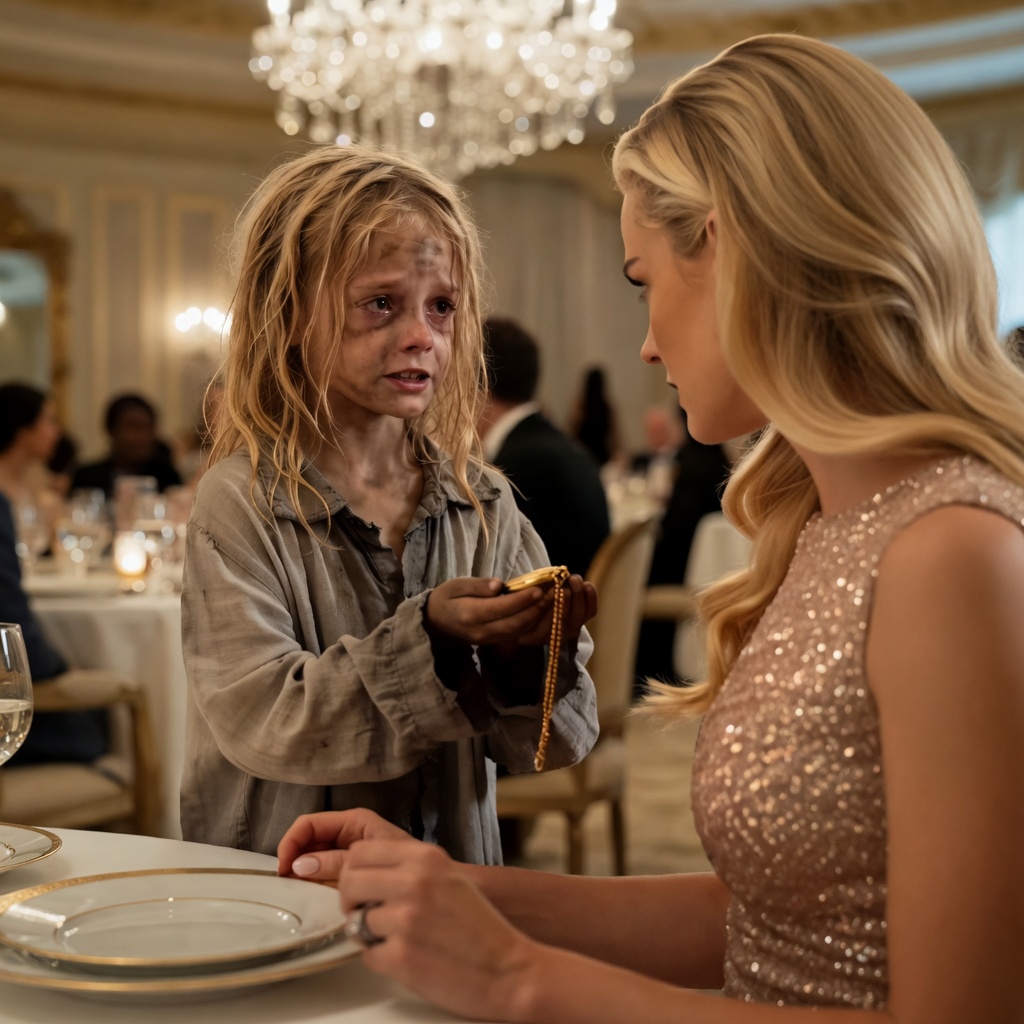
At one of the best tables near the window, a blonde woman sat alone.
Her name was Victoria Ashford.
To anyone watching, she looked untouchable. Her gown shimmered like liquid gold beneath the chandeliers. Diamonds flashed at her throat and wrists each time she lifted her hand. Her hair was swept into perfect waves, her posture straight, her expression calm in the practiced way of people who had learned never to reveal pain in public. The staff treated her with quiet respect. Other guests glanced at her and whispered, because everyone knew the Ashford name.
Old money. Old power. Old tragedy.
Victoria had grown used to the whispers. She had lived inside them for years. To the world, she was elegant, wealthy, composed. The kind of woman who never arrived late, never raised her voice, never let lipstick smudge on a wineglass. But composure was not peace. Sometimes it was only a beautiful locked door.
That evening, she had come to the restaurant because she could not bear to be alone at home. The Ashford mansion was too large, too silent, too full of rooms where memories waited. It was the anniversary of the night her younger sister disappeared, though nobody around her knew that. They thought she was dining alone because rich women could afford loneliness and call it privacy.
Victoria lifted her glass, but before she could drink, a tiny shadow stopped beside her chair.
At first, she noticed only movement near the edge of her vision. A small figure standing too close to the table. Not a waiter. Not a guest. Not a child who belonged to anyone in that room.
Victoria turned, annoyance already rising.
Then she saw the girl.
The child could not have been more than six or seven. She was blonde, but her hair was tangled into knots, damp at the ends from cold evening mist. Dirt streaked her cheeks. Her oversized shirt hung from one shoulder, thin and ragged, as if it had once belonged to someone much older. Her knees were bare beneath the hem, scratched and bruised. Her shoes did not match. One was too large. The other was split at the toe.
Every polished face in the restaurant seemed to turn toward her at once.
The girl stood frozen beside Victoria’s chair, both hands wrapped around something small and gold.
A waiter hurried over, face tight with alarm. “Miss Ashford, I apologize. I don’t know how she got in.”
The little girl flinched.
Victoria’s first instinct was irritation, sharpened by years of being approached for money, favors, photographs, sympathy, gossip. But the child’s hands were shaking. Not with boldness. With fear.
The girl lifted the object toward her.
“I think this is yours,” she whispered.
Victoria looked down.
It was a gold pocket watch.
Old. Beautiful. Familiar.
So familiar that her chest tightened before she even touched it.
The room around her seemed to blur at the edges. The clink of silverware faded. The murmur of wealthy diners thinned into a distant hum. Victoria reached out slowly, and when her fingers closed around the watch, a cold tremor traveled up her arm.
She knew the weight of it.
She knew the small scratch near the hinge.
She knew the tiny lily engraved on the back.
It had belonged to her father first. Then to her younger sister, Eva.
Victoria’s voice came out barely above a breath. “Where did you get this?”
The little girl’s lips trembled. She glanced at the waiter as if expecting to be dragged away.
“My mommy kept it.”
That word changed something in Victoria’s face.
Mommy.
Her fingers tightened around the watch.
The waiter shifted nervously. “Miss Ashford, shall I call security?”
“No,” Victoria said.
The word was quiet, but every waiter nearby stopped moving.
She pressed the latch.
Click.
The watch opened.
Inside, beneath the glass, was a tiny photograph. Time had faded the colors, but not enough. A young woman with bright blonde hair held a baby against her chest, smiling in that exhausted, glowing way new mothers smile when they have nothing left but love.
Victoria stopped breathing.
The young woman in the photograph was Eva.
Her sister.
Her lost sister.
Her dead sister.
At least, that was what Victoria had been told.
All the color drained from her face. Her fingers tightened so hard around the chain that the watch trembled. “No,” she whispered. “No…”
The little girl took half a step back, terrified now, like she had done something wrong just by bringing it. Tears welled in her eyes, cutting clean tracks through the dirt on her cheeks.
Victoria leaned closer, voice breaking. “Who gave this to you?”
“My mommy,” the girl whispered.
A tear slipped down her face.
“She said… find the lady in gold.”
Victoria looked down at herself.
The gold gown.
The diamonds.
The life of cold luxury she had worn like armor.
Eva had known.
Somehow, Eva had known what Victoria would become. Or maybe she had remembered what Victoria had loved as a young woman: gold dresses, gold ribbons, gold sunlight, gold watches ticking in their father’s palm while he told them that family was the only inheritance that mattered.
Victoria’s breath shook visibly. She looked from the photo to the child’s face, and suddenly she was not seeing a stranger anymore. She saw Eva’s mouth. Eva’s eyes. Eva’s stubborn little chin. Something painfully familiar in the way the girl was trying not to cry.
“What is your mother’s name?” Victoria asked.
The little girl swallowed hard. Her whole body shook.
Then she whispered the name.
“Eva.”
Victoria broke.
A soft, wounded sound left her mouth before she could stop it. Tears filled her eyes instantly. “Eva…” she breathed.
The little girl nodded, crying now. “Before she died, she told me to tell you something.”
Victoria leaned forward fast, desperate now, no longer elegant, no longer composed, no longer the untouchable woman at the best table.
The child’s voice came out tiny and cracked.
“She said… you’re my aunt.”
For a moment, Victoria did not understand the words. Not because they were unclear, but because they were too large. Too impossible. Too cruel and beautiful at once.
My aunt.
The room tilted.
Victoria reached for the edge of the table, but her hand closed only around the linen. The wineglass shook. A drop of red wine slid down the crystal stem like blood.
“What did you say?” she whispered.
The little girl hugged herself, terrified by the effect of her own words. “She said your name was Victoria. She said you had hair like mine. She said if anything happened to her, I had to find you. She said you would know the watch.”
Victoria stared at her.
The girl continued, struggling through tears. “She said… she was sorry she couldn’t come home.”
At that, Victoria covered her mouth.
For twelve years, she had believed Eva chose to disappear.
For twelve years, she had replayed their last argument until it became a punishment she carried inside her bones. Eva had been twenty-one, wild-hearted, impatient, in love with a man the family hated. Victoria, older by eight years, had tried to stop her. Their father had recently died, their mother was ill, and the Ashford estate was being handled by their uncle, Charles, who spoke of duty and legacy as if they were chains made of velvet.
Eva wanted to leave.
Victoria wanted her to wait.
That night, in the library, Eva had begged her sister to understand.
“I can’t breathe in this house,” she had said. “Charles watches every step I take. He decides who I see, where I go, what I sign. He says it’s for the family, but it feels like a cage.”
Victoria had been exhausted, grieving, and afraid. “You’re being dramatic.”
Eva’s face had changed.
That was the last clear memory Victoria had of her sister before everything shattered.
Dramatic.
A word spoken by someone too frightened to listen.
Two nights later, Eva vanished. Uncle Charles said she had run away with that man. Then months passed. Letters returned unopened. Private investigators found nothing. Years later, Charles told Victoria there had been an accident overseas. A body never recovered, but enough evidence to declare Eva dead.
Victoria had mourned with guilt so deep it hardened into silence.
Now a child stood beside her table, holding Eva’s watch and calling her aunt.
Victoria’s eyes moved over the girl again. The thin arms. The dirt. The torn shirt. The fear of being thrown out. Anger rose inside her so suddenly she could barely breathe.
“What is your name?” she asked softly.
“Lila.”
“Lila,” Victoria repeated, and the name broke something open in her chest. “Where have you been sleeping?”
Lila looked down.
Victoria’s heart sank.
“Sweetheart,” she said, softer now. “Where?”
The girl whispered, “Behind the old theater. Sometimes under the laundry stairs if Mr. Haines doesn’t find me.”
A murmur passed through the nearest tables.
Victoria turned her head slowly toward the guests. Phones lowered. Eyes shifted away. The rich diners who had been watching like this was an unexpected performance suddenly looked uncomfortable.
Victoria looked back at Lila. “Where is your mother?”
Lila’s face crumpled. “She died three days ago.”
The watch fell from Victoria’s hand onto the table with a dull thud.
Three days.
Eva had been alive three days ago.
Alive, somewhere in the same city or close enough for this child to walk through hunger and fear carrying a watch.
Victoria stood so quickly her chair scraped against the floor.
The waiter stepped forward. “Miss Ashford—”
“Get her food,” Victoria said.
“Yes, madam.”
“Not scraps. Not whatever is easiest. Soup first. Warm bread. Milk. Then whatever she can eat without hurting her stomach.”
The waiter nodded rapidly.
Victoria knelt in front of Lila. The entire restaurant watched the golden woman in diamonds lower herself onto the polished floor before a barefoot, dirty child.
“Lila,” she said, “are you hurt?”
The girl shook her head, then hesitated.
Victoria noticed. “Tell me.”
“My stomach hurts.”
“When did you last eat?”
Lila looked ashamed. “Yesterday.”
Victoria closed her eyes for one second.
When she opened them, they were no longer broken. They were bright with purpose.
“Do you have somewhere safe to go tonight?”
The child shook her head.
“Then you’re coming with me.”
Fear flashed across Lila’s face. “Mommy said not to trust cars.”
“She was right to tell you that.” Victoria’s voice trembled. “So you don’t have to trust the car. You can trust the watch. And you can decide every step. I won’t grab you. I won’t force you. But I am not letting you sleep outside again.”
Lila stared at her, trying to measure danger through hunger, grief, and exhaustion.
The waiter returned with soup and bread. Lila looked at it as if it might disappear. She did not sit until Victoria pulled out the chair beside her own and said, “This seat is yours.”
One of the guests whispered, “Is that really necessary?”
Victoria turned.
The woman who had spoken wore emerald earrings and a cold expression. Victoria knew her. Social circles were small among the rich. People smiled at charity galas and showed their true faces at dinner.
Victoria’s voice went icy. “A child is hungry.”
The woman flushed. “I only meant—”
“No,” Victoria said. “You meant she does not belong in this room. But she does. More than anyone who can watch a starving child and worry about the table setting.”
The woman looked down.
Lila ate slowly at first, then faster, then stopped suddenly as if remembering manners.
Victoria softened. “You can eat.”
“Mommy said don’t look greedy.”
“Your mommy wanted you to survive. Eat.”
Lila ate.
Victoria sat beside her, one hand near the watch, the other clenched in her lap. She wanted to ask a hundred questions. Where had Eva lived? What had happened? Why had she not come home? Who had kept her away? But Lila’s small shoulders shook between spoonfuls. She was a child who had buried her mother three days ago, or perhaps not even buried her. A child carrying one instruction through a city that had no mercy for children who looked poor.
Find the lady in gold.
So Victoria waited.
Only when Lila had finished half the soup and the color returned faintly to her lips did Victoria ask, “Did your mother give you anything else?”
Lila nodded. She reached into the oversized shirt and pulled out a folded piece of paper, soft from being opened and closed too many times. “She said give this after the watch.”
Victoria took it with trembling hands.
The letter was written in pencil.
Victoria,
If Lila finds you, it means I failed to stay alive long enough to do it myself. I don’t know what Charles told you. I don’t know if you hate me. I don’t know if you believed I abandoned you. I need you to know I tried to come home.
Victoria stopped, breath catching.
She forced herself to continue.
I wrote letters. They never reached you. I came to the gate once when Lila was two. Charles met me outside. He said Mother was dead, you had taken over the estate, and you wanted nothing to do with me. He said if I came near you, he would have me arrested for theft because of the watch. I was sick already. I was scared. I had Lila in my arms.
Victoria’s vision blurred.
I should have fought harder. I know that. But I had a child to protect, and every door I knew had been locked from the inside. Charles said you wore gold now, always gold, like you were trying to become the family portrait they wanted. So I told Lila: find the lady in gold. Find the watch’s other heart. You were angry with me once, but you loved me before that. I choose to believe love remains somewhere under all this time.
Please don’t let her disappear the way I did.
Eva.
Victoria pressed the letter to her mouth.
Charles.
Her uncle. Her guardian after her father died. The man who had advised her, managed the estate, controlled the family accounts, approved investigators, handled the death declaration, and stood beside her at Eva’s memorial with tears in his eyes.
The man who still lived in the Ashford mansion.
The man waiting at home.
Victoria looked at Lila.
“Did you ever meet a man named Charles?”
The child nodded slowly. “Mommy was afraid of him.”
Cold moved through Victoria.
“What did he do?”
Lila looked down. “Once, when I was little, he came to where we lived. Mommy hid me in a cupboard. He said if she talked, no one would believe a sick woman. He said Ashfords know how to erase mistakes.”
Victoria’s face went still.
Ashfords know how to erase mistakes.
She knew that phrase.
Charles had said it when she was twenty-three, after a cousin’s scandal. He had smiled then too, adjusting his cufflinks, saying families survived by controlling the story.
Now Victoria understood how many stories he had controlled.
She rose from the table.
“Lila, I need to make a call. You will stay where I can see you. The staff will bring you dessert. If anyone bothers you, you shout my name. Do you understand?”
Lila nodded, clutching the bread.
Victoria stepped only a few feet away and called her personal driver first. Then her attorney. Then a private security consultant her late husband had once used. She spoke quietly, but everyone near her felt the temperature of the room change.
“I need the estate secured before Charles is alerted,” she said. “No, not tomorrow. Now. And send someone to St. Agnes Charity Hospital. Search for records under Eva Ashford, Eva Lane, and any unidentified woman matching her description. Also, I need a child welfare attorney at my house within the hour. My niece is with me.”
My niece.
The word nearly broke her again, but she held steady.
When she returned to the table, Lila was staring at a chocolate cake as if it were a test.
“You don’t like chocolate?” Victoria asked.
“I do.”
“Then why aren’t you eating?”
Lila whispered, “Can I save it for later?”
Victoria sat down slowly.
Of all the things that had happened that night, that question nearly destroyed her.
“Yes,” she said. “But you can eat this one now. I’ll get another for later.”
Lila looked uncertain.
“I promise.”
“Mommy said promises are dangerous.”
Victoria swallowed. “Your mommy was right about many things.”
Lila studied her. “Are you dangerous?”
Victoria looked down at the watch, at Eva’s face in the tiny photograph, at the baby in her arms.
“To the people who hurt her,” she said softly. “Yes.”
Lila seemed to accept that.
Forty minutes later, Victoria left the restaurant with Lila beside her. Not behind her. Not carried like a charity case. Beside her. She wrapped her own cashmere coat around the child’s shoulders, ignoring the cold air that struck her bare arms. Her driver opened the car door, but Victoria stopped.
“Lila,” she said. “This is my car. George is my driver. He has worked for me for fourteen years. You can sit by the door. If you want to leave at any point, you tell me.”
George, a kind older man with gray hair, removed his cap. “Miss Lila.”
Lila blinked. Adults did not usually address her like that.
She climbed in slowly.
During the drive, she held the pocket watch in both hands. Victoria did not take it back. It had belonged to Eva. Then to Lila. Maybe one day Lila would choose to share it. Not tonight.
The Ashford mansion rose behind iron gates on the north side of the city, all pale stone, tall windows, and old trees that moved like shadows in the wind. Lila pressed herself back against the seat when she saw it.
Victoria noticed. “Too big?”
“Looks like a museum.”
“It feels like one too.”
“Do you live there alone?”
Victoria hesitated. “My uncle lives there.”
“The bad man?”
Victoria looked out at the approaching doors. Security lights glowed along the driveway. Two men from the private firm already stood near the entrance.
“Yes,” she said. “But not for much longer.”
Inside, the mansion smelled of waxed wood, lilies, and old money. Lila stood in the foyer, dwarfed by the staircase and portraits. Her bare knees trembled under Victoria’s coat.
A man appeared at the top of the stairs.
Charles Ashford.
He was in his late sixties, tall and silver-haired, dressed in a dark velvet house jacket. His face carried the calm superiority of a man who had spent his life entering rooms already certain they belonged to him.
“Victoria,” he said. “Security told me there was some confusion at the gate.”
Then his eyes dropped to the child.
For the first time in Victoria’s memory, Charles Ashford lost control of his expression.
Only for a second.
But she saw it.
Fear.
Then he recovered.
“Who is this?” he asked.
Victoria held up the gold pocket watch.
Charles’s face went pale.
The silence in the foyer grew sharp.
“This,” Victoria said, “is Lila. Eva’s daughter.”
Charles descended two steps, then stopped. “That is impossible.”
Lila shrank behind Victoria’s coat.
Victoria stepped slightly in front of her. “Careful.”
Charles’s gaze moved from the child to the watch. “Where did you get that?”
“Eva kept it.”
“Eva is dead.”
“Yes,” Victoria said. “Three days ago.”
Something flickered in his eyes.
Not surprise.
Calculation.
Victoria’s voice hardened. “You knew.”
Charles lifted his chin. “You are emotional.”
The word struck her like an old ghost.
Eva had told her he used that word.
Margaret in other lives, Cecilia in other rooms, Charles in this one — people like him always had the same weapon. Emotional. Dramatic. Unstable. Sensitive. Words designed to make pain sound like proof of weakness.
Victoria stepped forward.
“No. I am informed.”
Charles looked past her toward the security men. “This is a family matter. Leave us.”
No one moved.
Victoria’s mouth curved without warmth. “They work for me.”
His face tightened. “Everything in this house exists because I protected it.”
“No,” Victoria said. “Everything in this house survived because you controlled grieving women until they didn’t know who to trust.”
Charles laughed softly. “You have brought a street child into your home and let her fill your head with stories.”
Lila’s eyes filled.
Victoria felt the child trembling behind her.
“Say one more word about her,” Victoria said quietly, “and you will leave this house tonight without your shoes.”
Charles stared at her.
For the first time, he seemed to realize the woman in gold was no longer the young niece he had shaped through grief and fear.
The front door opened again. Victoria’s attorney entered with two associates. Behind them came a child welfare lawyer and another security officer carrying a sealed folder.
Charles looked around. “What is this?”
“The beginning,” Victoria said.
Her attorney stepped forward. “Mr. Ashford, we will need your access to estate records suspended pending review. There are serious allegations regarding fraud, interference with inheritance, unlawful intimidation, suppression of communications, and possible involvement in the concealment of Eva Ashford’s whereabouts.”
Charles’s face darkened. “Absurd.”
Victoria removed Eva’s letter from her bag.
“Read this,” she said.
“I will not dignify—”
“Read it.”
Her voice cracked like a whip.
Charles took the letter, scanned the first lines, and for a moment his face gave him away again. Not guilt in the moral sense. Charles did not seem capable of that. But fear of exposure.
Victoria saw it.
So did her attorney.
Lila whispered, “He’s the man from the cupboard.”
Every adult in the foyer went still.
Victoria turned slowly. “What?”
Lila’s small voice shook. “When Mommy hid me. He shouted. He said if she told you, you’d think she was crazy. He said he knew where we lived. I saw his shoes through the crack.”
Charles said sharply, “This is ridiculous. Children invent things.”
Lila flinched.
Victoria moved so fast that even Charles stepped back.
“She remembers hiding from you,” Victoria said. “She remembers your shoes. She remembers your voice. Do not stand in my house and call her a liar.”
“Your house?” Charles sneered.
Victoria looked at her attorney.
The attorney opened his folder. “Actually, Mr. Ashford, Miss Ashford is the primary legal owner of the estate. Your administrative authority remained active by family agreement, not ownership. That authority can be revoked.”
Charles’s jaw tightened.
Victoria said, “It is revoked.”
For a moment, the mansion seemed to hold its breath.
Then Charles smiled coldly. “You are making a mistake. That girl will cost you everything.”
Victoria looked back at Lila, still wrapped in the gold coat, clutching the watch like a lifeline.
“No,” she said. “She already returned what mattered.”
Charles was escorted to the east wing under security supervision while his rooms and office were sealed. He protested. Threatened. Claimed betrayal. Claimed illness. Claimed family loyalty. But the house no longer bent around his voice.
That night, Lila slept in Eva’s old room.
Victoria had not entered it in years.
Charles had insisted it be preserved as “a memorial,” but now Victoria wondered whether it had really been a trophy. Proof that he could freeze Eva in childhood while erasing the woman she became.
The room was dusty but beautiful. Pale blue walls. White curtains. A shelf of old books. A music box shaped like a swan. Lila stood in the doorway, hesitant.
“This was Mommy’s?”
“Yes.”
“Was she happy here?”
Victoria looked around. “Sometimes.”
Lila touched the edge of the bed. “She said she used to climb out the window.”
Victoria laughed through tears. “She did.”
“She said you helped her once.”
“I did. Then I got scared and told her not to do it again.”
Lila looked at her. “Were you mean to her?”
The question was innocent.
It still hurt.
Victoria sat on the bed. “Sometimes.”
“Did you love her?”
“Yes,” Victoria whispered. “More than I knew how to show at the end.”
Lila thought about that, then climbed onto the bed beside her. “Mommy said you would cry.”
Victoria wiped her face. “She knew me.”
“She said not to let you cry alone.”
That undid her.
Lila, who had lost her mother three days earlier, reached out with one tiny hand and patted Victoria’s arm because Eva had taught her tenderness even inside poverty.
Victoria pulled the child gently into her arms. Lila stiffened at first, then slowly melted against her.
“I’m sorry,” Victoria whispered into her tangled hair. “I’m so sorry I didn’t find you sooner.”
Lila’s voice was muffled against her dress. “Mommy said you were lost too.”
Victoria closed her eyes.
Of course Eva would say that.
Even dying, even betrayed, Eva had left room for mercy.
The next weeks were painful and relentless. Records were opened. Bank transfers were traced. Old investigators were questioned. Letters Eva had written but never mailed were found hidden in Charles’s locked cabinet. So were reports from private detectives he had hired not to find Eva for Victoria, but to monitor her and make sure she never reached the family again.
There were photographs: Eva outside a clinic, Eva carrying baby Lila near a bus station, Eva entering a cheap apartment building with a limp that made Victoria press her fist to her mouth. Beside each photograph were notes in Charles’s handwriting.
No contact with V.
Keep distance.
Subject financially unstable.
Child present.
Victoria read every page.
Each one was a knife.
She learned that Eva had worked in laundries, diners, and sewing rooms. She learned that illness came slowly after untreated complications, worsened by stress and poverty. She learned that Eva had tried to call the estate four times in one year and had been told Victoria was unavailable. She learned Charles had paid people to say Eva was delusional when she asked for help.
At night, Victoria sat beside Lila’s bed until the child fell asleep. Sometimes Lila woke crying for her mother. Sometimes she screamed from nightmares. Sometimes she hid food under her pillow, unable to believe there would be breakfast tomorrow. Victoria did not scold her. She simply placed a small basket on the bedside table and filled it with snacks every night.
One evening, Lila saw it and asked, “Are these mine?”
“Yes.”
“For when?”
“For whenever you need to know food will still be here.”
Lila stared at the basket. Then she began to cry.
Healing looked like that. Not grand. Not elegant. A basket of crackers. A nightlight. A locked door that made a child feel safe instead of trapped. A woman in gold learning how to sit on the floor and untangle a little girl’s hair without rushing.
Victoria did not become a mother overnight. She made mistakes. She bought dresses too fancy for school until Lila asked if she could please have “normal clothes.” She arranged tutors too quickly before realizing Lila needed rest more than lessons. She tried to replace lost years with action, then remembered that a child was not an empty room to be furnished.
Sometimes Lila became angry.
“You’re not Mommy,” she shouted once after Victoria suggested washing Eva’s old scarf.
Victoria went still.
Lila’s face crumpled immediately, afraid she had ruined everything.
But Victoria only knelt before her.
“No,” she said. “I’m not. And I won’t try to be.”
Lila cried harder.
Victoria held out the scarf. “We’ll keep it exactly as it is.”
Lila took it and clung to her.
Months passed. Charles was formally charged after investigators uncovered forged documents, withheld communications, intimidation, and financial misconduct connected to Eva’s inheritance. He denied everything, naturally. Men like Charles did not confess. They reframed. They blamed. They called truth hysteria until evidence pinned their hands to it.
The trial became public because the Ashford name was too famous to bury. Reporters gathered outside the courthouse. Headlines called Lila “the pocket watch child,” which Victoria hated. She shielded Lila from as much as she could, but the world had a way of turning pain into spectacle.
One day, before a hearing, Lila asked, “Why do people want pictures of me?”
Victoria crouched in front of her. “Because people are curious.”
“About Mommy?”
“Yes.”
“Do they care?”
Victoria hesitated. “Some do. Some only want a story.”
Lila looked down at the gold watch in her hands. “Mommy didn’t like being a story.”
Victoria’s throat tightened. “Then we won’t let them make her only that.”
When Victoria testified, she wore black, not gold. For the first time in years, she entered a public room without armor. She told the court about Eva. Not the scandal. Not the family shame. Eva. The girl who climbed windows, danced barefoot in kitchens, loved cheap street flowers more than imported roses, and once put sugar in Charles’s tea because he said sweetness was for weak people.
Then the evidence was shown.
Letters. Payments. Surveillance notes. False reports. Statements from former staff. A recording recovered from an old voicemail system where Eva’s voice, thin and desperate, said:
Vicky, please. I don’t know if you’ll ever hear this. I’m not dead. I have a daughter. Her name is Lila. I need you.
Victoria broke down in court.
Lila was not present for that part. Victoria had insisted. But later, when she came home, Lila climbed into her lap and said, “Did Mommy sound scared?”
Victoria answered honestly. “Yes.”
“Did she say my name?”
Victoria kissed her forehead. “Yes.”
Lila closed her eyes. “Good.”
A year after the night at the restaurant, Victoria took Lila back there.
Not as a test. Not for publicity. Just because Lila asked.
The restaurant looked the same: chandeliers, gold light, crystal glasses, soft music. But this time Lila wore a clean blue dress and a yellow cardigan she had chosen herself. Her hair was brushed but still wild at the ends because she hated sitting still. Around her neck hung the gold pocket watch.
The manager greeted Victoria nervously, then smiled warmly at Lila. “Welcome back, Miss Lila.”
Lila looked up at Victoria, surprised. “He knows my name.”
“He should.”
They sat at the same table.
For a while, Lila said nothing. She touched the edge of the table, then the chair, then the watch.
“This is where I found you,” she said.
Victoria smiled sadly. “I think you were the one who found me.”
Lila frowned. “You weren’t lost. You were eating fancy food.”
Victoria looked around at the glowing room, the glittering glasses, the diners wrapped in comfort.
“I was very lost.”
Lila considered this.
Then she opened the watch.
Eva’s photograph rested inside, preserved now behind new glass. Victoria had added another photo behind it: Eva as a teenager with her arm around Victoria, both sisters laughing in sunlight.
Lila touched the image. “Do you miss her?”
“Every day.”
“Me too.”
Victoria reached across the table. Lila took her hand.
The waiter brought dessert. Chocolate cake, wrapped separately in a small box too.
Lila smiled. “For later?”
“For later,” Victoria said.
That became their tradition.
Every year on the same date, they returned to the restaurant. They ordered soup, bread, and chocolate cake. They opened the watch. They spoke of Eva. Some years Lila cried. Some years Victoria did. Some years they laughed more than they expected.
The Ashford estate changed too.
Victoria opened part of the mansion as a legal aid foundation for women and children cut off from family resources by coercive relatives. She named it The Eva House. Not Ashford. Eva. Charles would have hated that, which made the name feel even more right.
The foundation helped mothers fleeing intimidation, children carrying documents no one believed, young women told they were unstable because they refused to obey. Lila sometimes helped arrange crayons in the children’s room. She told every new child, very seriously, “Snacks are in the basket, and you don’t have to ask first.”
Victoria kept wearing gold sometimes, but differently. Not as armor. Not as proof she belonged to the world that had failed Eva. Gold became memory. The watch. The dress. The light in Eva’s hair in old photographs. The color of the promise that led Lila through the restaurant doors.
Years later, when Lila was old enough to understand more of the story, she asked Victoria the question both of them had avoided.
“Do you think Mommy forgave you?”
Victoria was quiet for a long time.
They were sitting in Eva’s old room, now Lila’s favorite place to read. Rain tapped softly against the windows. The pocket watch lay open between them.
“I don’t know,” Victoria said finally. “I hope she knew I loved her. But love does not erase the fact that I failed to listen when she was afraid.”
Lila traced the edge of the watch. “She said love remains.”
Victoria’s eyes filled.
“She did.”
“Then maybe forgiveness is like that too. Not all at once. But somewhere.”
Victoria looked at the girl Eva had saved by memory, by instruction, by one gold watch.
“Maybe,” she whispered.
Lila leaned against her shoulder.
And for that evening, maybe was enough.
People would tell the story many ways after that. Some would begin with the poor little girl in the ragged shirt walking into a restaurant full of wealthy strangers. Some would begin with the gold pocket watch. Some would begin with the woman in diamonds who dropped to her knees when she realized the child before her was not a beggar, not an interruption, not an embarrassment, but blood.
But Victoria always remembered one sound most clearly.
Click.
The latch opening.
The watch revealing Eva’s face.
The past unlocking in her hand.
That tiny sound broke a silence that had lasted twelve years. It exposed a lie, returned a child, condemned a cruel man, and gave two lost people a way back to each other through the memory of the woman they had both loved.
And every night, before bed, Lila wound the watch carefully.
Tick.
Tick.
Tick.
A small golden heartbeat.
A reminder that even when a family is broken by fear, betrayal, and silence, love can leave behind one object, one sentence, one clue strong enough to guide a child through hunger and darkness toward the person who was meant to find her.
Find the lady in gold.
Lila did.
And when she found Victoria, she did more than deliver a watch.
She brought Eva home.


![[FULL STORY] My girlfriend told me not to be clingy before her "girls trip," so I blocked her when I saw another man in her photos.](https://sa.greatgames.info/storage/thumbnails/1777364332_8.png)

![[FULL STORY] My Fiancee Thought I Was A "Placeholder Husband" For Her Big Payday, So I Turned Our Pre-nup Into Her Worst Nightmare.](https://sa.greatgames.info/storage/thumbnails/1777303616_T2.png)
![[FULL STORY] At Our Wedding My Wife Said The Dance Was For The Man She’d Loved For Ten Years And Walked Past Me..](https://sa.greatgames.info/storage/thumbnails/1777186647_R13.png)