
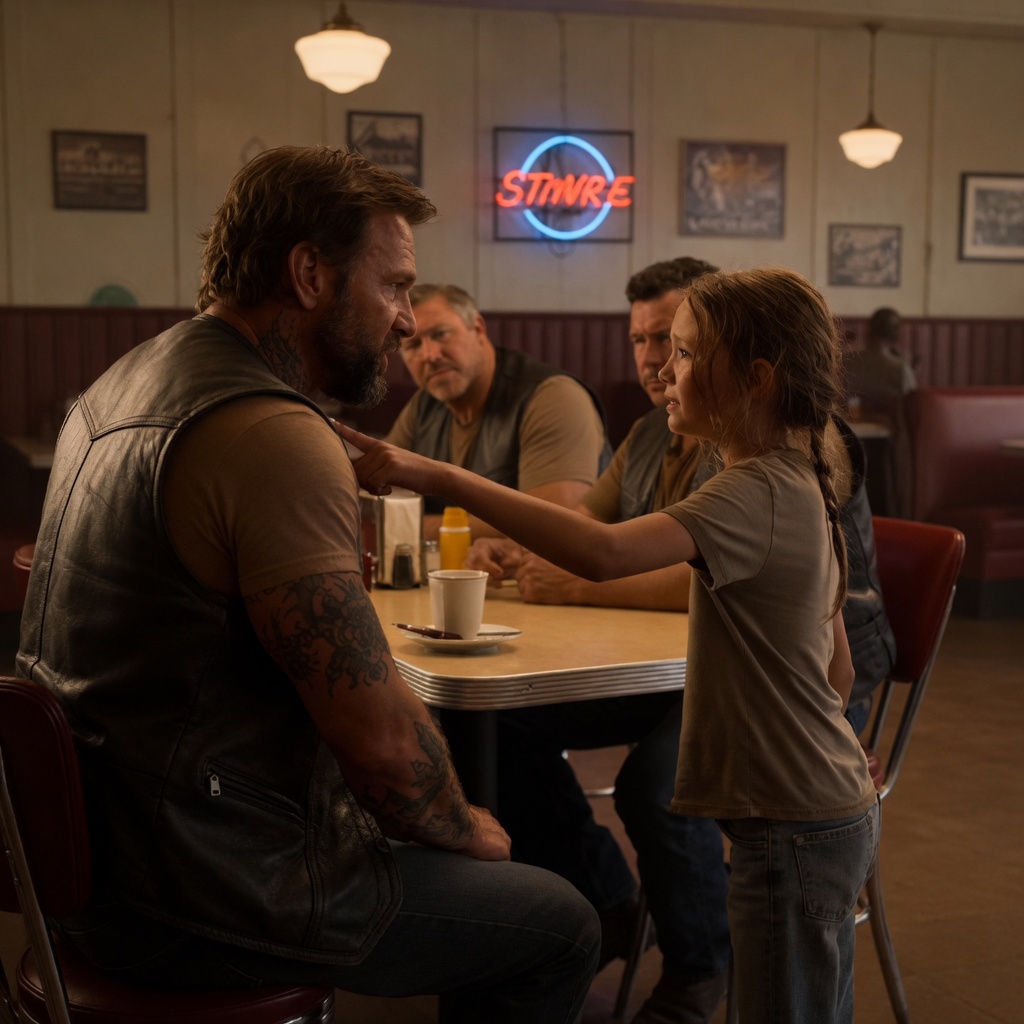
The diner sat off an old highway at the edge of town, half-hidden behind a gas station that had not changed its sign in twenty years. Red neon buzzed in the windows. The booths were cracked. The walls were covered with faded photographs, old license plates, and club patches from men who had either moved away, gone straight, gone missing, or died before anyone could say goodbye properly. Truckers came through when the weather was bad. Night-shift workers came in for eggs and coffee. But most nights, after ten, the back half of the diner belonged to the Iron Saints.
They were not saints.
Everyone knew that.
They were bikers. Older now, many of them, but still dangerous in the way men become when their reputations have had decades to harden. They wore leather vests with the club patch stitched across the back, rings on thick fingers, boots heavy enough to make the floorboards complain. Some had scars. Some had prison ink. Some had eyes that made younger men decide not to start fights.
At the center table sat the man no one interrupted.
Elias “Grave” Mercer.
Broad shoulders. Gray in his beard. Tattoos running down one arm. A face cut by weather, loss, and old violence. He did not have to speak loudly. He rarely spoke much at all. When he did, people listened because silence had taught them that his words usually came after he had already made a decision.
A half-empty coffee sat in front of him. His right hand rested beside it. The tattoo on his forearm showed a black road twisting through flames, with three small stars above it. The old club mark. Not the public patch. Something older. Something only a few men had earned, and even fewer still wore.
Across from him sat Mason, his second-in-command, a heavy man with a shaved head and a jaw that looked permanently clenched. To his left sat Red, named for the beard he no longer had. Beside him was Victor, quiet, narrow-eyed, always watching doors. Around them were six more men who had followed Grave for years, through runs, fights, funerals, prison visits, and things nobody in that diner spoke about when civilians were eating nearby.
Then the door slammed open.
BANG.
The bell above it rang violently, cutting through every conversation at once.
A waitress named Carla turned sharply from the coffee counter. “Hey—!”
But her voice died before it reached the room.
Because everyone had already seen the little girl standing in the doorway.
She was small. Too small to be alone in a place like that. No more than eight, maybe nine. Her clothes were dusty. Her hair was tangled from wind and running. One sleeve of her coat had torn near the cuff. Her cheeks were pale beneath streaks of dirt, and her chest rose and fell like she had been running for a long time. Her hands were shaking, but her eyes were steady.
That was what made the room go still.
Not the dirt.
Not the fear.
The steadiness.
Children who came into places like that usually cried, hid, or froze. This one looked terrified, yes, but she had come with a purpose. Her eyes did not search the room.
They locked onto one table.
The biker table.
Silence spread slowly at first, then all at once. Forks stopped moving. Chairs creaked. Men with scarred knuckles and leather vests turned to watch her as she walked forward, step by step, across the diner floor. Every footstep sounded too small in the heavy silence.
Carla moved as if to intercept her, then stopped when Grave lifted two fingers from the table.
The girl kept walking.
She stopped in front of him.
Too close.
Closer than anyone else would dare.
Mason’s hand shifted near the edge of the table, instinctive, protective. Grave did not move. He only looked at the child with those pale, unreadable eyes.
The girl lifted one trembling hand and pointed at the tattoo on his arm.
“My dad had this…”
The words were soft.
But the whole room felt them.
Grave did not move at first. Only his eyes changed. Slowly, he leaned back just enough to look at her properly. Her face was thin. Her lips were cracked. Her eyes were dark and too old for her age. She smelled faintly of rain, gasoline, and fear.
“What did you say?” he asked.
His voice was low. Controlled. But something underneath it had cracked.
The girl swallowed hard. Tears gathered in her eyes, but she refused to let them fall. “He said… you would remember him.”
A whisper came from somewhere behind them.
“No way…”
The air in the diner shifted. The danger was still there, but now it had changed shape. It was not aimed at the child anymore. It was circling the table.
Grave leaned forward, his eyes locked on hers. “What was his name?”
The question hung there.
Too long.
Too heavy.
The little girl took one breath.
“Daniel Hayes.”
A glass slipped from someone’s hand.
CRASH.
It shattered across the floor.
No one looked down.
No one moved.
Because the name had already done more damage than broken glass ever could.
Grave froze completely. His face hardened first, then drained of everything except recognition. For one moment, he looked older than he had seconds before. Older than his gray beard. Older than his scars. Older than every story the diner had heard about him.
“We buried him,” he said.
The words came out like a fact.
Like a door that had been closed for years.
But the girl shook her head.
Slowly.
Clearly.
“No… you didn’t.”
The silence tightened again, stronger this time. Men at the table shifted. Mason half-stood, then stopped. Red’s fingers curled around his mug until his knuckles whitened. Victor looked toward the door as if the night outside might suddenly come in armed.
Not with anger.
With fear.
The girl looked straight at Grave, and for the first time since she entered, the man everyone feared looked like he was no longer in control.
Her voice dropped.
“Because he told me what you did after.”
Everything stopped.
Carla stood frozen near the counter. The cook stared through the kitchen window. The bikers at the table no longer looked tough, only trapped.
Grave’s jaw worked once, but no sound came out.
Because Daniel Hayes was supposed to be dead.
Buried.
Forgotten.
And whatever this child knew was something the men in that diner had spent years making sure no one ever said out loud.
The girl reached slowly into her coat pocket.
Every man at the table watched her hand.
From inside, she pulled out a folded photograph, worn soft at the edges. She placed it on the table in front of Grave.
His hand moved toward it, then stopped.
In the photo was Daniel Hayes, younger, bruised, alive, standing beside the same little girl, holding up his wrist where the same tattoo marked his skin. Daniel’s face was thinner than anyone remembered, his beard longer, one eye swollen, but he was alive. Not a memory. Not a ghost. Alive.
On the back, written in rough black ink, were five words.
If I disappear, find them.
Grave stared at the message.
And the whole diner understood at once.
This was not a child looking for help.
This was a child carrying a confession.
A truth someone had tried to bury.
And now she had brought it straight to the men who feared it most.
Mason was the first to speak. His voice came out rough. “Where did you get that?”
The girl did not look at him. She kept her eyes on Grave. “My dad gave it to me.”
“Your dad,” Red repeated, almost under his breath.
She nodded.
Grave’s fingers finally touched the photograph. They trembled just slightly, not enough for most people to notice, but every man at that table saw it. He lifted the photo and stared at Daniel’s face.
Daniel Hayes had been twenty-two when he joined the Iron Saints. Too young, too reckless, too loyal for his own good. He had a laugh that made rooms warmer and a temper that made them dangerous. He was the kind of kid older men warned and women smiled at despite themselves. Grave had taken him under his wing, though he never admitted that was what he was doing. Daniel became a prospect, then a brother, then the closest thing Grave had to a son.
Then Daniel died.
That was the story.
Eight years ago, on a black stretch of highway outside Carson Ridge, Daniel’s bike was found twisted under a guardrail. There was blood. There was fire damage. There was a body burned beyond recognition. There was a funeral. There was a closed casket. There were club members standing in rain, fists over hearts, while Grave stared into the ground as if grief had turned him to stone.
After the burial, things changed.
Some men left.
Some men stayed quiet.
Some men drank too much.
And some men, the ones at the table now, learned to never say Daniel Hayes’s name unless they were ready to see Grave’s face go dead.
The little girl shifted on her feet.
Carla finally moved. She approached slowly, carrying a glass of water, her eyes soft but careful. “Honey,” she said, “what’s your name?”
The girl glanced at her, then back at Grave. “Maddie.”
“Maddie Hayes?” Grave asked.
She nodded.
Something in his face broke for half a second before he forced it back into place.
Daniel had a daughter.
Daniel had been alive.
Grave’s voice lowered. “Where is he?”
Maddie’s control cracked at the question. Her lips trembled. She tried to hold it in, but the tears that had been waiting finally spilled over.
“He’s gone,” she whispered.
Grave’s hand closed around the photograph.
“Gone how?”
Maddie looked toward the men around the table. Her fear sharpened. “He said if he ever disappeared, it would be because they found him.”
Mason pushed his chair back. “Who?”
Maddie took a step away from him.
Grave lifted a hand. “Sit down.”
Mason looked ready to argue.
Grave’s eyes cut to him.
Mason sat.
Grave looked back at Maddie, and when he spoke again, the sharp edge had left his voice. “No one here touches you. No one here makes you talk before you’re ready. But if Daniel sent you, we need to know what happened.”
Maddie wiped her cheeks with her sleeve. “He said I had to find the men with the road tattoo. But not all of them. He said find the one they call Grave.”
The nickname moved through the room like smoke.
Grave leaned back slowly.
“And he told you I would help?”
Maddie shook her head.
“He said you would either help me…” Her voice thinned. “Or you would kill me.”
Carla gasped softly.
Grave went completely still.
Mason swore under his breath.
The words were so ugly, so impossible coming from a child’s mouth, that no one knew what to do with them.
Grave looked at the photograph again. Daniel had written those words. If I disappear, find them. But what had he told his daughter? What had happened to make a man tell his child that his old brothers might be her only hope or her greatest danger?
Grave turned the photo over again, studying the writing.
The letters slanted hard. Daniel’s handwriting, no question. Grave remembered it from old repair logs, badly spelled notes, half-finished route maps.
His throat tightened.
“Why would he say that?” Grave asked.
Maddie looked down. “Because he said someone in the Saints sold him.”
The diner seemed to lose all air.
Red stood so fast his chair scraped backward. “That’s a lie.”
Maddie flinched.
Grave’s eyes flashed. “Sit.”
Red froze.
“Sit down,” Grave said again.
Red sat, breathing hard.
Maddie hugged herself. “He didn’t want to believe it either.”
Grave looked around the table. Mason, Red, Victor, the others. Men who had carried Daniel’s casket. Men who had toasted his name. Men who had looked Grave in the face at the graveside. Men who now stared at the child as if she had cracked open a tomb and pointed inside.
“What did he tell you exactly?” Grave asked.
Maddie swallowed. “He said he found something. Money. Names. A deal with a man called Crowley. He said he was going to tell you, but then the crash happened. Except he didn’t die. A woman pulled him out before the bike burned. He woke up far away. He said he couldn’t come back because if they thought he was dead, that was the only thing keeping us safe.”
“Us,” Grave repeated.
“My mom was pregnant,” Maddie said. “With me.”
Grave closed his eyes for one second.
Daniel had disappeared into a life nobody knew existed. A woman. A child. Eight years of hiding.
“Where’s your mother?” Carla asked softly.
Maddie’s face folded with grief. “She died when I was little.”
Carla pressed a hand to her mouth.
Grave opened his eyes. “Who raised you?”
“Dad.”
“And now?”
Maddie looked down at her shoes. One lace was broken, tied together in a knot. “Nobody.”
That answer hit the room harder than anything else.
Grave stood.
Every man tensed.
But he only took off his leather jacket and draped it around Maddie’s shoulders. The jacket swallowed her small frame. She looked up at him, startled.
“You eat today?” he asked.
She hesitated.
That was answer enough.
Grave turned to Carla. “Food.”
Carla was already moving. “Grilled cheese? Soup?”
Maddie whispered, “Anything.”
Grave’s jaw tightened. “Both.”
The cook disappeared from the window, shouting orders to himself like the kitchen had suddenly become a battlefield.
Maddie stood in the jacket, hands hidden inside the sleeves. Her eyes moved over the table again, landing on Mason, then Red, then Victor. She looked like she was trying to match faces to warnings.
Grave noticed.
“Did he give you names?”
Maddie nodded.
Every man at the table stopped breathing.
She reached into her coat again and pulled out a small envelope. The paper was dirty, folded many times, and sealed with black tape. She placed it beside the photograph.
“Dad said only open it in front of Grave.”
Mason’s face went pale.
Red stared at the envelope.
Victor’s hand drifted toward his pocket.
Grave saw.
“Victor,” he said softly.
Victor froze.
“Hands on the table.”
Victor’s eyes lifted.
For a second, something passed between them. Old loyalty. Old fear. Old knowledge.
Then Victor placed both hands flat on the table.
Maddie’s breathing quickened.
Grave looked at her. “You did good.”
“I don’t feel good.”
“No,” he said. “Truth rarely feels good at first.”
Carla brought water, then soup, then grilled cheese cut in triangles. Maddie sat only after Grave pulled out a chair beside him. She ate carefully at first, like someone trained not to take too much. Then hunger won, and she ate faster.
No one commented.
No one made a sound.
Grave opened the envelope.
Inside were three things: a folded letter, a small flash drive, and a second photograph.
The photograph showed Daniel with three men. Mason. Victor. Red. They were younger then, standing beside a row of bikes, laughing. On the back, Daniel had written:
One of them handed me over.
Grave’s eyes lifted.
Mason stared at the photo as if it had bitten him.
Red whispered, “No.”
Victor said nothing.
Grave unfolded the letter.
Grave,
If Maddie is reading this with you, I’m probably dead for real this time. Or close enough that running finally stopped working. I know what you were told. I know what you buried. It wasn’t me. The body was Eddie Rusk. Crowley’s people staged it after they pulled me from the wreck and realized I wasn’t dead yet. I escaped six months later. By then, everyone believed the lie.
Grave’s face hardened, but his eyes stayed on the page.
I wanted to come home. I swear on my daughter, I wanted to. But someone in our own table sold the route, the cargo, and me. Someone took money to let Crowley hit us. When I survived, they kept hunting. I couldn’t risk bringing that to you until I had proof. Now I have it.
The flash drive has records. Payments. Calls. Photos. If I disappear, protect Maddie first. Then burn the lie down.
And Grave… if you knew, I hope hell finds you slow. If you didn’t, I’m sorry I doubted you.
Daniel.
For a long time, Grave did not move.
The diner seemed to exist only around the sound of Maddie eating soup with a shaking spoon.
Then Grave placed the letter on the table.
His voice was quiet.
“Which one of you?”
Mason’s chair creaked. “You can’t believe this.”
“I asked a question.”
Red’s face was red with rage. “Daniel was my brother.”
Victor stared at the table.
Grave looked at him.
The silence sharpened.
Victor’s mouth tightened. “You’re looking at me because I’m quiet?”
“I’m looking at you because you reached for your pocket when she showed the envelope.”
Mason turned toward Victor.
Red’s eyes narrowed.
Victor laughed once, dry and ugly. “This is insane.”
Grave held up the flash drive. “Then you won’t mind us looking.”
Victor stood.
Mason stood too.
So did Red.
Around the diner, every Iron Saint rose.
Maddie stopped eating.
Grave did not look away from Victor. “Sit down.”
Victor’s hand moved fast.
Too fast.
He pulled a small pistol from inside his jacket.
Carla screamed.
But he never got it aimed.
Big Tommy from the next table slammed a chair into Victor’s arm. The gun flew, skidding across the floor. Mason tackled him against the booth. Red grabbed his wrist and twisted until Victor shouted. Two more men pinned him down.
Maddie dropped her spoon and curled into Grave’s jacket.
Grave picked up the gun from the floor and set it on the table, barrel away from everyone. His face had gone white with controlled fury.
Victor struggled, breathing hard. “You don’t understand.”
Grave stepped closer. “Then explain.”
Victor laughed bitterly. “Daniel was going to get us all killed. Crowley had cops, judges, half the county in his pocket. That cargo wasn’t worth dying over.”
“So you sold him.”
“I saved the club.”
Mason punched him.
Grave did not stop it.
Victor spat blood onto the floor. “You think you’re clean, Grave? You sent him on that run.”
The words hit.
Grave’s face tightened.
Victor saw it and smiled with bloody teeth. “Yeah. There it is. You sent your golden boy into the dark, and I just made sure the dark paid us back.”
Red grabbed Victor by the collar. “He was our brother.”
Victor snarled, “He was a liability.”
Maddie whimpered.
Grave turned sharply. Red released Victor at once.
The rage in Grave’s face shifted into something colder.
“Call Sheriff Grant,” he said.
Mason looked stunned. “Sheriff?”
“Now.”
Victor laughed. “Since when do we call law?”
Grave leaned down until his face was close to Victor’s.
“Since a child walked in carrying the truth we should’ve found ourselves.”
Mason made the call.
Within twenty minutes, flashing lights painted the diner windows red and blue. Sheriff Ellen Grant entered with two deputies, her face grim. She knew the Iron Saints. She knew Grave. She had spent years balancing the fact that some of them were criminals, some were protectors, and most were somewhere in between.
She looked at Victor pinned beside the booth, the gun on the table, Maddie wrapped in Grave’s jacket, and sighed. “Tell me this isn’t what it looks like.”
Grave handed her the letter.
“It’s worse.”
Grant read it. Her expression changed.
Then she looked at Maddie. “Are you Daniel Hayes’s daughter?”
Maddie nodded.
Grant crouched at a careful distance. “Did someone hurt your father?”
Maddie’s eyes filled again. “He told me to run if he didn’t come back by sunset.”
“When was that?”
“Yesterday.”
The diner went still again.
Grave’s voice turned dangerous. “Yesterday?”
Maddie nodded. “He went to meet someone. He said maybe the proof was enough now. He said maybe we could stop hiding.”
Grant stood. “Where?”
Maddie pulled a third item from her coat pocket: a folded map page with a circle drawn near an abandoned mill outside town.
Grave took one look and swore.
Mason said, “Crowley’s old place.”
Grant reached for her radio. “We move now.”
Grave said, “I’m coming.”
Grant looked at him. “No.”
Grave’s eyes went flat. “Daniel was mine.”
“And if he’s alive, storming in with half a biker club could get him killed.”
Maddie gripped his sleeve. “Please find him.”
That stopped him.
Grave looked down at her.
Not vengeance.
The child needed him to choose her father’s life over his own rage.
He stepped back.
Grant softened slightly. “Keep her here. Keep everyone here. If this flash drive has what the letter says, I need it copied and secured. And Grave?”
He looked at her.
“If Victor was part of this, there may be more.”
Grave’s gaze moved slowly across the room.
Every man felt it.
Grant left with her deputies. Two officers stayed behind. Victor was cuffed and taken out through the back, cursing until the door slammed.
Maddie sat at the table, no longer eating. Grave sat beside her. For the first time in years, he looked unsure what to do with his hands.
She looked up at him. “Are you mad at my dad?”
“No.”
“He said you might be.”
“I’m mad at myself.”
“Why?”
Grave stared at the photograph of Daniel.
“Because I believed a closed casket.”
Maddie did not understand all of that, but she understood guilt. Children who grow up hiding understand guilt too early.
“He said you loved him,” she said.
Grave swallowed.
“He said he was dumb and you loved him anyway.”
A sound that was almost a laugh broke from Grave’s chest, but it died quickly.
“He was dumb,” he said.
Maddie smiled faintly for the first time.
Then she whispered, “Is he dead now?”
Grave closed his eyes.
“I don’t know.”
She leaned against his arm, exhausted. “He told me if I got scared, to count engines.”
“Engines?”
She nodded. “He said bikes sound like monsters, but sometimes monsters guard doors.”
Grave looked toward the parking lot, where rows of motorcycles waited under the rain.
“Your dad had a way with words.”
“He said bad words too.”
“Yeah,” Grave said softly. “He did.”
Hours passed.
The diner did not close.
Nobody left.
Carla made coffee until her hands shook. Men checked phones, whispered, paced, prayed in ways they would deny later. Maddie fell asleep against Grave’s side, still wrapped in his jacket. He did not move for almost two hours.
Near dawn, Sheriff Grant returned.
Her face was tired.
There was blood on one sleeve.
Grave stood slowly, careful not to wake Maddie.
Grant looked at him.
“He’s alive.”
The words hit the diner like thunder.
Maddie woke at once. “Dad?”
Grant crouched. “He’s hurt, sweetheart. But he’s alive.”
Maddie made a sound no one in that diner would ever forget. A sob, a laugh, a cry that seemed too big for her small body.
Grave gripped the table.
Grant continued, “We found him at the mill. Bound. Beaten. Hypothermic. They left him for dead. Ambulance took him to County General.”
Grave’s voice was rough. “Crowley?”
“Two dead. Three arrested. Crowley fled before we arrived. We’ll find him.”
Mason said, “Victor?”
Grant looked at him. “Talking already.”
Red cursed softly.
Maddie tugged Grave’s sleeve. “Can I see Dad?”
Grant nodded. “Soon.”
Grave picked her up before he realized what he was doing. She weighed almost nothing. Too light. Daniel’s daughter should not have been that light.
He carried her to his truck.
At the hospital, Daniel Hayes looked like a ghost somebody had dragged back from the edge. His face was bruised. One arm was bandaged. Tubes ran from his body. His hair was streaked with gray now, his beard rough, his skin too pale.
Maddie ran to him.
“Daddy!”
Daniel’s eyes opened.
For one second, he seemed lost between pain and drugs.
Then he saw her.
“Maddie.”
A nurse tried to slow her, but Grave lifted a hand and the nurse hesitated. Maddie climbed carefully onto the edge of the bed, sobbing. Daniel moved his good arm around her with what little strength he had.
“You found him?” Daniel whispered.
Maddie nodded into his chest. “I found Grave.”
Daniel’s eyes moved past her.
He saw him.
Grave stood at the foot of the bed, unable to speak.
Eight years vanished and remained at the same time.
Daniel’s mouth twisted into something almost like a smile. “You got old.”
Grave’s eyes filled before he could stop them.
“You got dead.”
Daniel gave a weak breath that might have been a laugh. “Working on quitting.”
Grave stepped closer.
For a long moment, neither man spoke. The room held everything between them: the funeral, the lie, the years of hiding, the doubt in Daniel’s letter, the guilt in Grave’s bones.
Finally, Grave said, “I didn’t know.”
Daniel closed his eyes. “I wanted to believe that.”
“I didn’t know,” Grave repeated, voice breaking now. “But I should’ve dug deeper.”
Daniel looked at him. “I should’ve come back sooner.”
“You had her.”
Daniel’s arm tightened around Maddie. “Yeah.”
Maddie lifted her head. “Are you mad?”
Both men looked at her.
Daniel’s eyes softened. “No, baby.”
Grave shook his head. “No.”
“Good,” she said, exhausted. “Because I’m tired.”
Daniel kissed her hair.
Grave turned away, pretending to look out the window while tears ran silently down his face.
In the weeks that followed, the Iron Saints nearly tore themselves apart.
Victor’s confession opened wounds older than anyone wanted to admit. He had sold Daniel’s route to Crowley in exchange for money and protection. But he had not acted entirely alone. Two minor members had helped move information. One former associate had identified the wrong body after the crash. A corrupt deputy had signed off on paperwork too quickly. Crowley had used the confusion to stage Daniel’s death, torture him for information, and later hunt him when he escaped.
Grave cleaned house.
Not with reckless violence, though some expected that. With evidence. With law. With testimony. With every ugly truth laid bare. Men who had hidden behind patches were stripped of them. Men who had known pieces and stayed silent were forced to answer for it. The club that emerged was smaller, quieter, and changed.
Some called Grave weak for bringing police into club business.
He did not care.
A child had walked into a diner because outlaw silence had nearly buried her father twice.
That lesson stayed.
Daniel recovered slowly. His body had survived too much to heal cleanly. Some days he joked. Some days he stared at walls. Some nights he woke shouting. Maddie slept in a chair beside him until nurses insisted she needed a real bed. Grave found them a place to stay near the hospital, then later a small house three streets from his own.
Daniel resisted.
“I don’t need charity.”
Grave looked at him. “Good. Because it’s not charity. It’s me paying interest on eight years of failure.”
Daniel looked away.
Neither of them were good at softness.
But they learned.
Maddie became a regular at the diner. Carla kept coloring books behind the counter. The cook made pancakes shaped badly like motorcycles. Mason, still ashamed that Daniel had suspected him and wounded that the suspicion had not been impossible, taught Maddie how to check tire pressure. Red built her a wooden toy bike. Grave pretended not to enjoy any of it.
One evening, months after Daniel came home, Maddie stood at the same table where she had first placed the photograph.
She pointed at Grave’s tattoo again.
“Does it mean family?”
Grave looked at the black road, the flames, the three stars.
“It was supposed to.”
“What does it mean now?”
He thought about that.
Then he said, “A promise we have to earn back.”
Maddie nodded seriously.
“Daddy said promises are only real if people do them.”
Grave smiled faintly. “Your dad got smart while he was dead.”
Maddie giggled.
Across the diner, Daniel watched them from a booth, one arm still in a brace. His eyes were tired but alive. For years, he had trusted no one fully. He had taught his daughter escape routes before bedtime stories. He had lived in cheap rooms, changed names, hidden his face, and carried proof like a weapon he hoped never to use.
Now Maddie laughed in the open.
That felt like a miracle too fragile to name.
A year after the night she ran into the diner, the Iron Saints gathered at Daniel’s old grave.
The stone still stood in the cemetery, his name carved beneath dates that had become a lie. For a long time, nobody spoke.
Then Daniel stepped forward with Maddie’s hand in his.
“Well,” he said, looking at the headstone, “this is awkward.”
Red snorted.
Mason covered his mouth.
Even Grave laughed, though it came out rough.
They replaced the stone later with a new one, not in the cemetery but on the wall of the diner, near the old photographs and license plates. It was a plaque Daniel wrote himself:
For the brothers we buried too soon, the truths we buried too deep, and the children brave enough to dig them up.
Under it, Maddie taped a copy of the photograph.
Daniel bruised but alive.
Maddie beside him.
The tattoo visible on his wrist.
On the back of the original, still kept safe by Grave, were the five words that had changed everything.
If I disappear, find them.
Years later, people would tell the story of the little girl who slammed open the door of a biker diner and silenced a room full of dangerous men. Some would say she came looking for revenge. Some would say she came looking for family. Some would say she carried a dead man’s confession in her pocket and made the toughest men in town afraid of the truth.
But Maddie would remember something else.
She would remember being hungry, terrified, and cold, holding a photograph so tightly the edges bent in her fingers. She would remember the smell of coffee and grease. The sound of chairs creaking. The way every man looked at her when she said her father’s name.
And then she would remember Grave’s jacket around her shoulders.
Soup in front of her.
The moment danger turned into protection.
She had walked into that diner expecting to find either the men who killed her father or the only people left who could save him.
In the end, she found both.
She found betrayal.
She found guilt.
She found old men forced to face the truth they had buried.
But she also found a table that made room for her, a room that stayed open until dawn, and a man everyone feared who sat perfectly still for hours because a sleeping child needed his shoulder.
Daniel Hayes was supposed to be dead.
Buried.
Forgotten.
But the dead do not send daughters through rain with photographs in their pockets.
The forgotten do not leave messages strong enough to break a room.
And the truth, no matter how deep men bury it under loyalty, silence, fear, or blood, has a way of walking back through the door.
Sometimes it arrives with sirens.
Sometimes with a confession.
And sometimes, it arrives as a little girl in a dusty coat, pointing at a tattoo and saying:
“My dad had this.”
The biker diner was alive with noise. Low voices rolled between tables. Plates clinked against cheap white china. Coffee steamed in thick mugs. Grease hissed on the grill behind the kitchen window, and outside, motorcycles rumbled faintly in the parking lot, their engines fading into the night like distant thunder. It was the kind of place where strangers were noticed the second they walked in, where men did not ask too many questions unless they were ready for the answers, and where unexpected trouble usually did not last long.
The diner sat off an old highway at the edge of town, half-hidden behind a gas station that had not changed its sign in twenty years. Red neon buzzed in the windows. The booths were cracked. The walls were covered with faded photographs, old license plates, and club patches from men who had either moved away, gone straight, gone missing, or died before anyone could say goodbye properly. Truckers came through when the weather was bad. Night-shift workers came in for eggs and coffee. But most nights, after ten, the back half of the diner belonged to the Iron Saints.
They were not saints.
Everyone knew that.
They were bikers. Older now, many of them, but still dangerous in the way men become when their reputations have had decades to harden. They wore leather vests with the club patch stitched across the back, rings on thick fingers, boots heavy enough to make the floorboards complain. Some had scars. Some had prison ink. Some had eyes that made younger men decide not to start fights.
At the center table sat the man no one interrupted.
Elias “Grave” Mercer.
Broad shoulders. Gray in his beard. Tattoos running down one arm. A face cut by weather, loss, and old violence. He did not have to speak loudly. He rarely spoke much at all. When he did, people listened because silence had taught them that his words usually came after he had already made a decision.
A half-empty coffee sat in front of him. His right hand rested beside it. The tattoo on his forearm showed a black road twisting through flames, with three small stars above it. The old club mark. Not the public patch. Something older. Something only a few men had earned, and even fewer still wore.
Across from him sat Mason, his second-in-command, a heavy man with a shaved head and a jaw that looked permanently clenched. To his left sat Red, named for the beard he no longer had. Beside him was Victor, quiet, narrow-eyed, always watching doors. Around them were six more men who had followed Grave for years, through runs, fights, funerals, prison visits, and things nobody in that diner spoke about when civilians were eating nearby.
Then the door slammed open.
BANG.
The bell above it rang violently, cutting through every conversation at once.
A waitress named Carla turned sharply from the coffee counter. “Hey—!”
But her voice died before it reached the room.
Because everyone had already seen the little girl standing in the doorway.
She was small. Too small to be alone in a place like that. No more than eight, maybe nine. Her clothes were dusty. Her hair was tangled from wind and running. One sleeve of her coat had torn near the cuff. Her cheeks were pale beneath streaks of dirt, and her chest rose and fell like she had been running for a long time. Her hands were shaking, but her eyes were steady.
That was what made the room go still.
Not the dirt.
Not the fear.
The steadiness.
Children who came into places like that usually cried, hid, or froze. This one looked terrified, yes, but she had come with a purpose. Her eyes did not search the room.
They locked onto one table.
The biker table.
Silence spread slowly at first, then all at once. Forks stopped moving. Chairs creaked. Men with scarred knuckles and leather vests turned to watch her as she walked forward, step by step, across the diner floor. Every footstep sounded too small in the heavy silence.
Carla moved as if to intercept her, then stopped when Grave lifted two fingers from the table.
The girl kept walking.
She stopped in front of him.
Too close.
Closer than anyone else would dare.
Mason’s hand shifted near the edge of the table, instinctive, protective. Grave did not move. He only looked at the child with those pale, unreadable eyes.
The girl lifted one trembling hand and pointed at the tattoo on his arm.
“My dad had this…”
The words were soft.
But the whole room felt them.
Grave did not move at first. Only his eyes changed. Slowly, he leaned back just enough to look at her properly. Her face was thin. Her lips were cracked. Her eyes were dark and too old for her age. She smelled faintly of rain, gasoline, and fear.
“What did you say?” he asked.
His voice was low. Controlled. But something underneath it had cracked.
The girl swallowed hard. Tears gathered in her eyes, but she refused to let them fall. “He said… you would remember him.”
A whisper came from somewhere behind them.
“No way…”
The air in the diner shifted. The danger was still there, but now it had changed shape. It was not aimed at the child anymore. It was circling the table.
Grave leaned forward, his eyes locked on hers. “What was his name?”
The question hung there.
Too long.
Too heavy.
The little girl took one breath.
“Daniel Hayes.”
A glass slipped from someone’s hand.
CRASH.
It shattered across the floor.
No one looked down.
No one moved.
Because the name had already done more damage than broken glass ever could.
Grave froze completely. His face hardened first, then drained of everything except recognition. For one moment, he looked older than he had seconds before. Older than his gray beard. Older than his scars. Older than every story the diner had heard about him.
“We buried him,” he said.
The words came out like a fact.
Like a door that had been closed for years.
But the girl shook her head.
Slowly.
Clearly.
“No… you didn’t.”
The silence tightened again, stronger this time. Men at the table shifted. Mason half-stood, then stopped. Red’s fingers curled around his mug until his knuckles whitened. Victor looked toward the door as if the night outside might suddenly come in armed.
Not with anger.
With fear.
The girl looked straight at Grave, and for the first time since she entered, the man everyone feared looked like he was no longer in control.
Her voice dropped.
“Because he told me what you did after.”
Everything stopped.
Carla stood frozen near the counter. The cook stared through the kitchen window. The bikers at the table no longer looked tough, only trapped.
Grave’s jaw worked once, but no sound came out.
Because Daniel Hayes was supposed to be dead.
Buried.
Forgotten.
And whatever this child knew was something the men in that diner had spent years making sure no one ever said out loud.
The girl reached slowly into her coat pocket.
Every man at the table watched her hand.
From inside, she pulled out a folded photograph, worn soft at the edges. She placed it on the table in front of Grave.
His hand moved toward it, then stopped.
In the photo was Daniel Hayes, younger, bruised, alive, standing beside the same little girl, holding up his wrist where the same tattoo marked his skin. Daniel’s face was thinner than anyone remembered, his beard longer, one eye swollen, but he was alive. Not a memory. Not a ghost. Alive.
On the back, written in rough black ink, were five words.
If I disappear, find them.
Grave stared at the message.
And the whole diner understood at once.
This was not a child looking for help.
This was a child carrying a confession.
A truth someone had tried to bury.
And now she had brought it straight to the men who feared it most.
Mason was the first to speak. His voice came out rough. “Where did you get that?”
The girl did not look at him. She kept her eyes on Grave. “My dad gave it to me.”
“Your dad,” Red repeated, almost under his breath.
She nodded.
Grave’s fingers finally touched the photograph. They trembled just slightly, not enough for most people to notice, but every man at that table saw it. He lifted the photo and stared at Daniel’s face.
Daniel Hayes had been twenty-two when he joined the Iron Saints. Too young, too reckless, too loyal for his own good. He had a laugh that made rooms warmer and a temper that made them dangerous. He was the kind of kid older men warned and women smiled at despite themselves. Grave had taken him under his wing, though he never admitted that was what he was doing. Daniel became a prospect, then a brother, then the closest thing Grave had to a son.
Then Daniel died.
That was the story.
Eight years ago, on a black stretch of highway outside Carson Ridge, Daniel’s bike was found twisted under a guardrail. There was blood. There was fire damage. There was a body burned beyond recognition. There was a funeral. There was a closed casket. There were club members standing in rain, fists over hearts, while Grave stared into the ground as if grief had turned him to stone.
After the burial, things changed.
Some men left.
Some men stayed quiet.
Some men drank too much.
And some men, the ones at the table now, learned to never say Daniel Hayes’s name unless they were ready to see Grave’s face go dead.
The little girl shifted on her feet.
Carla finally moved. She approached slowly, carrying a glass of water, her eyes soft but careful. “Honey,” she said, “what’s your name?”
The girl glanced at her, then back at Grave. “Maddie.”
“Maddie Hayes?” Grave asked.
She nodded.
Something in his face broke for half a second before he forced it back into place.
Daniel had a daughter.
Daniel had been alive.
Grave’s voice lowered. “Where is he?”
Maddie’s control cracked at the question. Her lips trembled. She tried to hold it in, but the tears that had been waiting finally spilled over.
“He’s gone,” she whispered.
Grave’s hand closed around the photograph.
“Gone how?”
Maddie looked toward the men around the table. Her fear sharpened. “He said if he ever disappeared, it would be because they found him.”
Mason pushed his chair back. “Who?”
Maddie took a step away from him.
Grave lifted a hand. “Sit down.”
Mason looked ready to argue.
Grave’s eyes cut to him.
Mason sat.
Grave looked back at Maddie, and when he spoke again, the sharp edge had left his voice. “No one here touches you. No one here makes you talk before you’re ready. But if Daniel sent you, we need to know what happened.”
Maddie wiped her cheeks with her sleeve. “He said I had to find the men with the road tattoo. But not all of them. He said find the one they call Grave.”
The nickname moved through the room like smoke.
Grave leaned back slowly.
“And he told you I would help?”
Maddie shook her head.
“He said you would either help me…” Her voice thinned. “Or you would kill me.”
Carla gasped softly.
Grave went completely still.
Mason swore under his breath.
The words were so ugly, so impossible coming from a child’s mouth, that no one knew what to do with them.
Grave looked at the photograph again. Daniel had written those words. If I disappear, find them. But what had he told his daughter? What had happened to make a man tell his child that his old brothers might be her only hope or her greatest danger?
Grave turned the photo over again, studying the writing.
The letters slanted hard. Daniel’s handwriting, no question. Grave remembered it from old repair logs, badly spelled notes, half-finished route maps.
His throat tightened.
“Why would he say that?” Grave asked.
Maddie looked down. “Because he said someone in the Saints sold him.”
The diner seemed to lose all air.
Red stood so fast his chair scraped backward. “That’s a lie.”
Maddie flinched.
Grave’s eyes flashed. “Sit.”
Red froze.
“Sit down,” Grave said again.
Red sat, breathing hard.
Maddie hugged herself. “He didn’t want to believe it either.”
Grave looked around the table. Mason, Red, Victor, the others. Men who had carried Daniel’s casket. Men who had toasted his name. Men who had looked Grave in the face at the graveside. Men who now stared at the child as if she had cracked open a tomb and pointed inside.
“What did he tell you exactly?” Grave asked.
Maddie swallowed. “He said he found something. Money. Names. A deal with a man called Crowley. He said he was going to tell you, but then the crash happened. Except he didn’t die. A woman pulled him out before the bike burned. He woke up far away. He said he couldn’t come back because if they thought he was dead, that was the only thing keeping us safe.”
“Us,” Grave repeated.
“My mom was pregnant,” Maddie said. “With me.”
Grave closed his eyes for one second.
Daniel had disappeared into a life nobody knew existed. A woman. A child. Eight years of hiding.
“Where’s your mother?” Carla asked softly.
Maddie’s face folded with grief. “She died when I was little.”
Carla pressed a hand to her mouth.
Grave opened his eyes. “Who raised you?”
“Dad.”
“And now?”
Maddie looked down at her shoes. One lace was broken, tied together in a knot. “Nobody.”
That answer hit the room harder than anything else.
Grave stood.
Every man tensed.
But he only took off his leather jacket and draped it around Maddie’s shoulders. The jacket swallowed her small frame. She looked up at him, startled.
“You eat today?” he asked.
She hesitated.
That was answer enough.
Grave turned to Carla. “Food.”
Carla was already moving. “Grilled cheese? Soup?”
Maddie whispered, “Anything.”
Grave’s jaw tightened. “Both.”
The cook disappeared from the window, shouting orders to himself like the kitchen had suddenly become a battlefield.
Maddie stood in the jacket, hands hidden inside the sleeves. Her eyes moved over the table again, landing on Mason, then Red, then Victor. She looked like she was trying to match faces to warnings.
Grave noticed.
“Did he give you names?”
Maddie nodded.
Every man at the table stopped breathing.
She reached into her coat again and pulled out a small envelope. The paper was dirty, folded many times, and sealed with black tape. She placed it beside the photograph.
“Dad said only open it in front of Grave.”
Mason’s face went pale.
Red stared at the envelope.
Victor’s hand drifted toward his pocket.
Grave saw.
“Victor,” he said softly.
Victor froze.
“Hands on the table.”
Victor’s eyes lifted.
For a second, something passed between them. Old loyalty. Old fear. Old knowledge.
Then Victor placed both hands flat on the table.
Maddie’s breathing quickened.
Grave looked at her. “You did good.”
“I don’t feel good.”
“No,” he said. “Truth rarely feels good at first.”
Carla brought water, then soup, then grilled cheese cut in triangles. Maddie sat only after Grave pulled out a chair beside him. She ate carefully at first, like someone trained not to take too much. Then hunger won, and she ate faster.
No one commented.
No one made a sound.
Grave opened the envelope.
Inside were three things: a folded letter, a small flash drive, and a second photograph.
The photograph showed Daniel with three men. Mason. Victor. Red. They were younger then, standing beside a row of bikes, laughing. On the back, Daniel had written:
One of them handed me over.
Grave’s eyes lifted.
Mason stared at the photo as if it had bitten him.
Red whispered, “No.”
Victor said nothing.
Grave unfolded the letter.
Grave,
If Maddie is reading this with you, I’m probably dead for real this time. Or close enough that running finally stopped working. I know what you were told. I know what you buried. It wasn’t me. The body was Eddie Rusk. Crowley’s people staged it after they pulled me from the wreck and realized I wasn’t dead yet. I escaped six months later. By then, everyone believed the lie.
Grave’s face hardened, but his eyes stayed on the page.
I wanted to come home. I swear on my daughter, I wanted to. But someone in our own table sold the route, the cargo, and me. Someone took money to let Crowley hit us. When I survived, they kept hunting. I couldn’t risk bringing that to you until I had proof. Now I have it.
The flash drive has records. Payments. Calls. Photos. If I disappear, protect Maddie first. Then burn the lie down.
And Grave… if you knew, I hope hell finds you slow. If you didn’t, I’m sorry I doubted you.
Daniel.
For a long time, Grave did not move.
The diner seemed to exist only around the sound of Maddie eating soup with a shaking spoon.
Then Grave placed the letter on the table.
His voice was quiet.
“Which one of you?”
Mason’s chair creaked. “You can’t believe this.”
“I asked a question.”
Red’s face was red with rage. “Daniel was my brother.”
Victor stared at the table.
Grave looked at him.
The silence sharpened.
Victor’s mouth tightened. “You’re looking at me because I’m quiet?”
“I’m looking at you because you reached for your pocket when she showed the envelope.”
Mason turned toward Victor.
Red’s eyes narrowed.
Victor laughed once, dry and ugly. “This is insane.”
Grave held up the flash drive. “Then you won’t mind us looking.”
Victor stood.
Mason stood too.
So did Red.
Around the diner, every Iron Saint rose.
Maddie stopped eating.
Grave did not look away from Victor. “Sit down.”
Victor’s hand moved fast.
Too fast.
He pulled a small pistol from inside his jacket.
Carla screamed.
But he never got it aimed.
Big Tommy from the next table slammed a chair into Victor’s arm. The gun flew, skidding across the floor. Mason tackled him against the booth. Red grabbed his wrist and twisted until Victor shouted. Two more men pinned him down.
Maddie dropped her spoon and curled into Grave’s jacket.
Grave picked up the gun from the floor and set it on the table, barrel away from everyone. His face had gone white with controlled fury.
Victor struggled, breathing hard. “You don’t understand.”
Grave stepped closer. “Then explain.”
Victor laughed bitterly. “Daniel was going to get us all killed. Crowley had cops, judges, half the county in his pocket. That cargo wasn’t worth dying over.”
“So you sold him.”
“I saved the club.”
Mason punched him.
Grave did not stop it.
Victor spat blood onto the floor. “You think you’re clean, Grave? You sent him on that run.”
The words hit.
Grave’s face tightened.
Victor saw it and smiled with bloody teeth. “Yeah. There it is. You sent your golden boy into the dark, and I just made sure the dark paid us back.”
Red grabbed Victor by the collar. “He was our brother.”
Victor snarled, “He was a liability.”
Maddie whimpered.
Grave turned sharply. Red released Victor at once.
The rage in Grave’s face shifted into something colder.
“Call Sheriff Grant,” he said.
Mason looked stunned. “Sheriff?”
“Now.”
Victor laughed. “Since when do we call law?”
Grave leaned down until his face was close to Victor’s.
“Since a child walked in carrying the truth we should’ve found ourselves.”
Mason made the call.
Within twenty minutes, flashing lights painted the diner windows red and blue. Sheriff Ellen Grant entered with two deputies, her face grim. She knew the Iron Saints. She knew Grave. She had spent years balancing the fact that some of them were criminals, some were protectors, and most were somewhere in between.
She looked at Victor pinned beside the booth, the gun on the table, Maddie wrapped in Grave’s jacket, and sighed. “Tell me this isn’t what it looks like.”
Grave handed her the letter.
“It’s worse.”
Grant read it. Her expression changed.
Then she looked at Maddie. “Are you Daniel Hayes’s daughter?”
Maddie nodded.
Grant crouched at a careful distance. “Did someone hurt your father?”
Maddie’s eyes filled again. “He told me to run if he didn’t come back by sunset.”
“When was that?”
“Yesterday.”
The diner went still again.
Grave’s voice turned dangerous. “Yesterday?”
Maddie nodded. “He went to meet someone. He said maybe the proof was enough now. He said maybe we could stop hiding.”
Grant stood. “Where?”
Maddie pulled a third item from her coat pocket: a folded map page with a circle drawn near an abandoned mill outside town.
Grave took one look and swore.
Mason said, “Crowley’s old place.”
Grant reached for her radio. “We move now.”
Grave said, “I’m coming.”
Grant looked at him. “No.”
Grave’s eyes went flat. “Daniel was mine.”
“And if he’s alive, storming in with half a biker club could get him killed.”
Maddie gripped his sleeve. “Please find him.”
That stopped him.
Grave looked down at her.
Not vengeance.
The child needed him to choose her father’s life over his own rage.
He stepped back.
Grant softened slightly. “Keep her here. Keep everyone here. If this flash drive has what the letter says, I need it copied and secured. And Grave?”
He looked at her.
“If Victor was part of this, there may be more.”
Grave’s gaze moved slowly across the room.
Every man felt it.
Grant left with her deputies. Two officers stayed behind. Victor was cuffed and taken out through the back, cursing until the door slammed.
Maddie sat at the table, no longer eating. Grave sat beside her. For the first time in years, he looked unsure what to do with his hands.
She looked up at him. “Are you mad at my dad?”
“No.”
“He said you might be.”
“I’m mad at myself.”
“Why?”
Grave stared at the photograph of Daniel.
“Because I believed a closed casket.”
Maddie did not understand all of that, but she understood guilt. Children who grow up hiding understand guilt too early.
“He said you loved him,” she said.
Grave swallowed.
“He said he was dumb and you loved him anyway.”
A sound that was almost a laugh broke from Grave’s chest, but it died quickly.
“He was dumb,” he said.
Maddie smiled faintly for the first time.
Then she whispered, “Is he dead now?”
Grave closed his eyes.
“I don’t know.”
She leaned against his arm, exhausted. “He told me if I got scared, to count engines.”
“Engines?”
She nodded. “He said bikes sound like monsters, but sometimes monsters guard doors.”
Grave looked toward the parking lot, where rows of motorcycles waited under the rain.
“Your dad had a way with words.”
“He said bad words too.”
“Yeah,” Grave said softly. “He did.”
Hours passed.
The diner did not close.
Nobody left.
Carla made coffee until her hands shook. Men checked phones, whispered, paced, prayed in ways they would deny later. Maddie fell asleep against Grave’s side, still wrapped in his jacket. He did not move for almost two hours.
Near dawn, Sheriff Grant returned.
Her face was tired.
There was blood on one sleeve.
Grave stood slowly, careful not to wake Maddie.
Grant looked at him.
“He’s alive.”
The words hit the diner like thunder.
Maddie woke at once. “Dad?”
Grant crouched. “He’s hurt, sweetheart. But he’s alive.”
Maddie made a sound no one in that diner would ever forget. A sob, a laugh, a cry that seemed too big for her small body.
Grave gripped the table.
Grant continued, “We found him at the mill. Bound. Beaten. Hypothermic. They left him for dead. Ambulance took him to County General.”
Grave’s voice was rough. “Crowley?”
“Two dead. Three arrested. Crowley fled before we arrived. We’ll find him.”
Mason said, “Victor?”
Grant looked at him. “Talking already.”
Red cursed softly.
Maddie tugged Grave’s sleeve. “Can I see Dad?”
Grant nodded. “Soon.”
Grave picked her up before he realized what he was doing. She weighed almost nothing. Too light. Daniel’s daughter should not have been that light.
He carried her to his truck.
At the hospital, Daniel Hayes looked like a ghost somebody had dragged back from the edge. His face was bruised. One arm was bandaged. Tubes ran from his body. His hair was streaked with gray now, his beard rough, his skin too pale.
Maddie ran to him.
“Daddy!”
Daniel’s eyes opened.
For one second, he seemed lost between pain and drugs.
Then he saw her.
“Maddie.”
A nurse tried to slow her, but Grave lifted a hand and the nurse hesitated. Maddie climbed carefully onto the edge of the bed, sobbing. Daniel moved his good arm around her with what little strength he had.
“You found him?” Daniel whispered.
Maddie nodded into his chest. “I found Grave.”
Daniel’s eyes moved past her.
He saw him.
Grave stood at the foot of the bed, unable to speak.
Eight years vanished and remained at the same time.
Daniel’s mouth twisted into something almost like a smile. “You got old.”
Grave’s eyes filled before he could stop them.
“You got dead.”
Daniel gave a weak breath that might have been a laugh. “Working on quitting.”
Grave stepped closer.
For a long moment, neither man spoke. The room held everything between them: the funeral, the lie, the years of hiding, the doubt in Daniel’s letter, the guilt in Grave’s bones.
Finally, Grave said, “I didn’t know.”
Daniel closed his eyes. “I wanted to believe that.”
“I didn’t know,” Grave repeated, voice breaking now. “But I should’ve dug deeper.”
Daniel looked at him. “I should’ve come back sooner.”
“You had her.”
Daniel’s arm tightened around Maddie. “Yeah.”
Maddie lifted her head. “Are you mad?”
Both men looked at her.
Daniel’s eyes softened. “No, baby.”
Grave shook his head. “No.”
“Good,” she said, exhausted. “Because I’m tired.”
Daniel kissed her hair.
Grave turned away, pretending to look out the window while tears ran silently down his face.
In the weeks that followed, the Iron Saints nearly tore themselves apart.
Victor’s confession opened wounds older than anyone wanted to admit. He had sold Daniel’s route to Crowley in exchange for money and protection. But he had not acted entirely alone. Two minor members had helped move information. One former associate had identified the wrong body after the crash. A corrupt deputy had signed off on paperwork too quickly. Crowley had used the confusion to stage Daniel’s death, torture him for information, and later hunt him when he escaped.
Grave cleaned house.
Not with reckless violence, though some expected that. With evidence. With law. With testimony. With every ugly truth laid bare. Men who had hidden behind patches were stripped of them. Men who had known pieces and stayed silent were forced to answer for it. The club that emerged was smaller, quieter, and changed.
Some called Grave weak for bringing police into club business.
He did not care.
A child had walked into a diner because outlaw silence had nearly buried her father twice.
That lesson stayed.
Daniel recovered slowly. His body had survived too much to heal cleanly. Some days he joked. Some days he stared at walls. Some nights he woke shouting. Maddie slept in a chair beside him until nurses insisted she needed a real bed. Grave found them a place to stay near the hospital, then later a small house three streets from his own.
Daniel resisted.
“I don’t need charity.”
Grave looked at him. “Good. Because it’s not charity. It’s me paying interest on eight years of failure.”
Daniel looked away.
Neither of them were good at softness.
But they learned.
Maddie became a regular at the diner. Carla kept coloring books behind the counter. The cook made pancakes shaped badly like motorcycles. Mason, still ashamed that Daniel had suspected him and wounded that the suspicion had not been impossible, taught Maddie how to check tire pressure. Red built her a wooden toy bike. Grave pretended not to enjoy any of it.
One evening, months after Daniel came home, Maddie stood at the same table where she had first placed the photograph.
She pointed at Grave’s tattoo again.
“Does it mean family?”
Grave looked at the black road, the flames, the three stars.
“It was supposed to.”
“What does it mean now?”
He thought about that.
Then he said, “A promise we have to earn back.”
Maddie nodded seriously.
“Daddy said promises are only real if people do them.”
Grave smiled faintly. “Your dad got smart while he was dead.”
Maddie giggled.
Across the diner, Daniel watched them from a booth, one arm still in a brace. His eyes were tired but alive. For years, he had trusted no one fully. He had taught his daughter escape routes before bedtime stories. He had lived in cheap rooms, changed names, hidden his face, and carried proof like a weapon he hoped never to use.
Now Maddie laughed in the open.
That felt like a miracle too fragile to name.
A year after the night she ran into the diner, the Iron Saints gathered at Daniel’s old grave.
The stone still stood in the cemetery, his name carved beneath dates that had become a lie. For a long time, nobody spoke.
Then Daniel stepped forward with Maddie’s hand in his.
“Well,” he said, looking at the headstone, “this is awkward.”
Red snorted.
Mason covered his mouth.
Even Grave laughed, though it came out rough.
They replaced the stone later with a new one, not in the cemetery but on the wall of the diner, near the old photographs and license plates. It was a plaque Daniel wrote himself:
For the brothers we buried too soon, the truths we buried too deep, and the children brave enough to dig them up.
Under it, Maddie taped a copy of the photograph.
Daniel bruised but alive.
Maddie beside him.
The tattoo visible on his wrist.
On the back of the original, still kept safe by Grave, were the five words that had changed everything.
If I disappear, find them.
Years later, people would tell the story of the little girl who slammed open the door of a biker diner and silenced a room full of dangerous men. Some would say she came looking for revenge. Some would say she came looking for family. Some would say she carried a dead man’s confession in her pocket and made the toughest men in town afraid of the truth.
But Maddie would remember something else.
She would remember being hungry, terrified, and cold, holding a photograph so tightly the edges bent in her fingers. She would remember the smell of coffee and grease. The sound of chairs creaking. The way every man looked at her when she said her father’s name.
And then she would remember Grave’s jacket around her shoulders.
Soup in front of her.
The moment danger turned into protection.
She had walked into that diner expecting to find either the men who killed her father or the only people left who could save him.
In the end, she found both.
She found betrayal.
She found guilt.
She found old men forced to face the truth they had buried.
But she also found a table that made room for her, a room that stayed open until dawn, and a man everyone feared who sat perfectly still for hours because a sleeping child needed his shoulder.
Daniel Hayes was supposed to be dead.
Buried.
Forgotten.
But the dead do not send daughters through rain with photographs in their pockets.
The forgotten do not leave messages strong enough to break a room.
And the truth, no matter how deep men bury it under loyalty, silence, fear, or blood, has a way of walking back through the door.
Sometimes it arrives with sirens.
Sometimes with a confession.
And sometimes, it arrives as a little girl in a dusty coat, pointing at a tattoo and saying:
“My dad had this.”
![[FULL STORY] On My 30th Birthday, My Wife Said She Forgot And Went Out With Friends I Tracked](https://sa.greatgames.info/storage/thumbnails/1777869542_15-.jpg)
![[FULL STORY] At Dinner, My Fiancée's Friends Demanded I Prove My Worth By Paying Their $800 Tab](https://sa.greatgames.info/storage/thumbnails/1777870567_18-.jpg)
![[FULL STORY] The Ultimate Payback: Why I Served My Fiancée At The Airport Gate After Her 'Ex-Inclusive' Trip](https://sa.greatgames.info/storage/thumbnails/1777885938_V3.jpg)
![[FULL STORY] My Girlfriend Accidentally Texted Me That I Was A Failure Compared To Her Soulmate, So I Quietly Handed Her The Life She Deserved.](https://sa.greatgames.info/storage/thumbnails/1776917209_7.png)
![[FULL STORY] My Girlfriend Cheerfully Said, “I’m Grabbing Coffee With My Ex. Stay Home — We Need Space.” “Sure,”](https://sa.greatgames.info/storage/thumbnails/1777367570_27.png)