
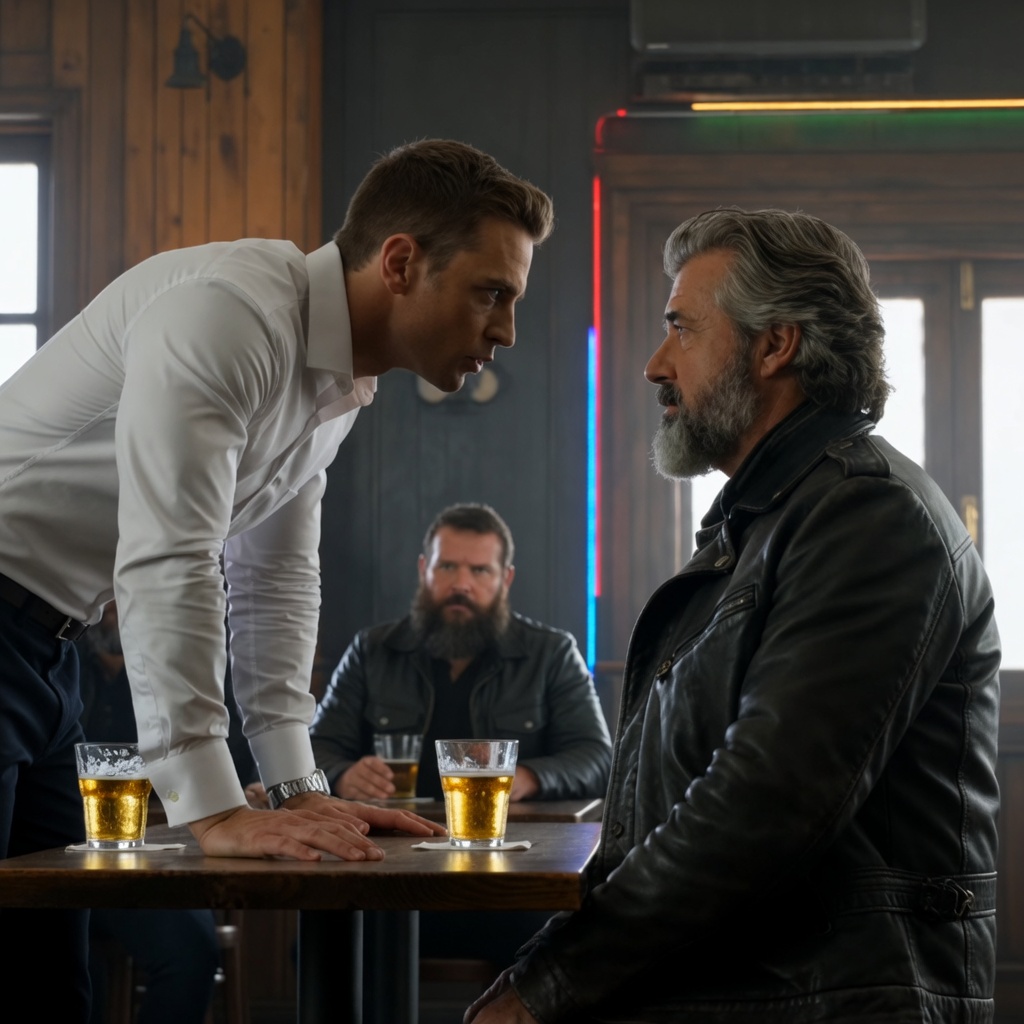
At the front table, an older man sat alone. His name was Frank Callahan. Gray hair. Heavy black leather jacket. Broad hands scarred from years of hard work and harder choices. He sat perfectly still with one hand resting on his knee and the other around a glass he had not touched in ten minutes. Everyone in the bar knew Frank. Nobody bothered him. Nobody asked about his past unless they wanted the room to go cold. He was the kind of man who looked like trouble had once tried him and decided to leave him alone.
Then the door burst open.
A tiny girl in a bright red hoodie ran inside, soaked from the rain, breathing so hard she could barely stand. She could not have been more than six or seven. Her jeans were muddy at the knees. One shoe was untied. Her face was pale with terror. For one second, she looked around the room full of strangers, men in leather, denim, and silence. Then her eyes landed on the space beneath Frank’s table.
Before anyone could speak, she crawled under it and curled between the old man’s boots.
Frank did not move. He did not look down. He only lowered his glass slowly to the table.
The bartender saw. Two men near the pool table saw. Everyone saw. But no one said anything, because the girl’s fear had entered the room before she did, and fear like that did not need an explanation to be understood.
Thirty seconds later, the door opened again.
A younger man stepped inside.
He was clean in a way that looked wrong in that bar. White button-down shirt. Expensive watch. Hair combed back with careless precision. His shoes were wet but polished. He glanced around the room with irritation, not fear, as if every person there were something he had to step over.
His eyes stopped on Frank.
The younger man walked straight to the front table and leaned forward hard, jaw tight, voice cold.
“Did a little girl run in here?”
Under the table, the child curled tighter around herself. Her breathing was so shaky it almost gave her away. Frank felt her small shoulder brush against his boot. He kept his eyes on the man in white.
He did not look down.
He did not move.
He only answered, quiet and flat, “Kids don’t run like that for no reason.”
The younger man’s expression hardened. “She belongs with me.”
Under the table, the girl’s fingers dug into the wet fabric of her hoodie. Her eyes widened with a terror that had memory in it. She pressed herself closer to Frank’s boots, trying to disappear.
Frank’s face did not change. “Funny way to say you’re looking for a scared child.”
“She’s my responsibility.”
“Not the same thing.”
The man in white leaned farther over the table, lowering his voice. “Old man, this isn’t your business.”
Around them, the bar seemed to sink into a deeper silence. The pool balls stopped clicking. A chair leg scraped once, then stilled. The bartender, Gus, kept one hand on the towel he had been using to wipe the counter, but his eyes had gone sharp.
Frank finally lifted his glass and took one slow drink. “Girl comes running into my bar looking like the devil himself is behind her, it becomes my business.”
“It’s not your bar.”
Frank looked briefly toward Gus.
Gus said, without missing a beat, “Tonight it is.”
The younger man’s jaw twitched.
He tried to look around Frank’s table, but Frank shifted his knee half an inch. Not enough to look obvious. Enough to block the view. Beneath the table, the little girl went completely still.
“Did you hear me?” the man in white said.
Frank’s fingers shifted once beside his knee, just enough to shield the child without anyone else noticing.
Then, from under the table, came a tiny broken whisper.
“Please… don’t let him take me.”
That changed everything.
The old softness that had been hiding somewhere behind Frank’s hard face vanished. His expression turned to stone. Every man in the room heard the whisper. Every man understood it. No child begged like that unless something had already taught her what being taken meant.
Frank looked straight into the younger man’s eyes and said, low and steady, “Then she stays.”
The room went quieter than before.
The younger man pushed his chair back and stood. “Move.”
At the bar behind them, the men in leather and denim straightened one by one. Big Ray, who had arms like tree trunks and a missing front tooth, stepped away from the jukebox. Miller, a retired long-haul driver, turned fully around on his stool. Two younger bikers near the pool table set down their cues. No one spoke. The silence itself became a threat.
The man in white noticed. His eyes flicked around the room, calculating. He was used to clean offices, locked doors, people who backed down because he sounded educated and looked like money. This place was different. Here, men did not care about his shirt, his watch, or the authority he was trying to wear.
Frank leaned back slightly. “Name.”
The younger man blinked. “What?”
“Yours.”
“Adrian Cole.”
Frank let the name sit for a second. “And hers?”
Adrian hesitated.
That hesitation was an answer.
Frank’s eyes narrowed. “You don’t know her name.”
“I know enough.”
Under the table, the girl’s trembling hand slipped something into Frank’s palm.
He glanced down.
A tiny silver bracelet.
Old. Worn. Real.
For a moment, Frank forgot the bar. Forgot Adrian. Forgot the rain on the windows and the men standing behind him. His fingers closed around the bracelet as if his hand remembered its shape before his mind could.
It was small. Child-sized. Tarnished from years of being carried, maybe hidden, maybe held in the dark for comfort. On the inside was an engraving so faint that he had to tilt it toward the neon glow.
M.C.
And beneath it, barely visible:
Always find your way home.
Frank’s breath stopped.
The room blurred.
He was no longer sitting in a dive bar with a frightened child beneath his table. He was standing twenty-eight years earlier in a hospital room, holding a newborn baby girl while his daughter laughed weakly from the bed.
“Dad, she’s too tiny for jewelry,” his daughter had said.
Frank had held up the little silver bracelet. “She’ll grow into it.”
“She’s three days old.”
“She’s a Callahan. She’ll grow into trouble first.”
His daughter had smiled then. Molly. His Molly. Bright-eyed, stubborn, full of fire. The only person who could make Frank Callahan feel both afraid and whole.
He had given that bracelet to Molly for her baby daughter.
Molly Callahan.
M.C.
Always find your way home.
But Molly had vanished before the child turned one.
Not vanished. That was the polite word people used when they did not know how to name loss. Molly had disappeared with a man Frank despised, a man who smiled too much and answered questions too smoothly. Frank had searched. He had fought. He had hired people he could barely pay. Then came the burned-out car two states away. A body too damaged to identify properly. A report. A closed case. A tiny coffin never found because the child was presumed lost too.
For years, Frank had lived with two ghosts: his daughter and the granddaughter he never got to hold again.
Now the bracelet sat in his palm.
His fingers started shaking.
Slowly, Frank turned his head toward the girl under the table, really seeing her now. Her frightened eyes. Her pale face. The way she clung to safety like she had never had it before. Damp curls stuck to her cheeks. Her hoodie swallowed her thin shoulders. She looked like a child who had learned how to hide before she learned how to trust.
Tears filled her eyes.
And in the smallest voice, she whispered, “My mom said… you’re my grandpa.”
The words struck Frank so hard his chest tightened.
For one second, no one in the bar moved.
Then Adrian lunged toward the table.
“She’s confused,” he snapped. “She doesn’t know what she’s saying.”
Frank’s hand shot out and caught Adrian’s wrist before he got anywhere near the child. The grip was not wild. It was controlled, crushing, final.
Adrian sucked in a breath.
Frank stood slowly.
When he rose, the room seemed to rise with him.
“Back up,” Frank said.
Adrian tried to pull free. Couldn’t. “You’re making a mistake.”
Frank looked at the bracelet in his other hand. “I made one years ago. Not tonight.”
He released Adrian with a shove just hard enough to send him stumbling back against a chair.
The little girl stayed hidden beneath the table, shaking.
Frank crouched slowly, careful not to startle her. His voice changed when he spoke to her. It became rougher, softer, almost broken.
“What’s your name, sweetheart?”
She swallowed. “Maisie.”
Frank closed his eyes.
Molly had once said if she had another daughter, she would name her Maisie after her grandmother. But this child was too old. Unless the first child had survived and Molly had named her later, or unless the bracelet had passed from one child to another. Frank’s mind raced, but his heart had already stepped ahead of him.
“Your mother’s name was Molly?” he asked.
Maisie nodded. Her lips trembled. “Molly Callahan.”
Frank pressed one hand against the table to steady himself.
Big Ray muttered, “Jesus.”
Frank asked, “Where is she?”
Maisie’s face crumpled.
The answer came before she said it.
“She died last week.”
Frank went still.
The pain did not arrive all at once. It entered him strangely, like cold water under a door. He had believed Molly dead for almost three decades, but belief was not the same as truth. Some hidden part of him had kept waiting. Now a child had walked into his life carrying proof that Molly had survived, suffered, and died somewhere without him.
His voice broke. “How?”
Maisie looked toward Adrian and shrank.
Frank followed her gaze.
Adrian lifted both hands. “I had nothing to do with that.”
Nobody believed him.
Frank stood again. “You know this man?”
Maisie nodded quickly. “He worked with my mom.”
Adrian snapped, “I took care of them.”
Maisie shook her head hard. “No.”
Frank’s eyes cut to Adrian.
The little girl’s voice shook. “Mommy cleaned rooms at his building. He said she owed money. After she got sick, he kept coming. He said if she didn’t pay, he’d take me. He said no one would believe her because she was just a maid.”
Adrian’s face darkened. “That is not what happened.”
Maisie pulled her knees tighter to her chest. “He took Mommy’s papers.”
Frank’s jaw tightened. “What papers?”
“The envelope. The one she said was for you.”
Frank looked down at Adrian’s shirt, his expensive watch, his polished shoes. “You took an envelope from a dying woman?”
Adrian’s voice sharpened. “She was delusional. She owed rent. She had no family. I was trying to get the child placed somewhere appropriate.”
“Appropriate,” Gus repeated from the bar, voice low.
Adrian glanced at him. “A bar full of drunks is not appropriate.”
The men in the room shifted.
Frank raised a hand slightly, and they stopped.
He looked at Maisie. “Did your mom tell you to come here?”
Maisie nodded. “She said if anything happened, run to the bar with the red horse sign. She said ask for Frank. She said you’d be scary, but safe.”
Frank’s eyes burned.
Scary, but safe.
That sounded like Molly. Even after everything, she remembered him that way.
Adrian took a step toward the door. “This is kidnapping. I’m calling the police.”
Frank smiled without warmth. “Good.”
Adrian paused.
“Call them,” Frank said. “Tell them you chased a little girl into a bar after taking papers from her dead mother.”
Adrian’s hand hovered near his phone.
Gus set a landline receiver on the counter. “Already dialing.”
That made Adrian’s face change.
Frank crouched once more. “Maisie, you don’t have to stay under there. Nobody here is going to let him touch you.”
She looked at him, then at the men behind him.
They were rough men. Scarred men. Men with criminal records, military medals, divorce papers, bad knees, worse tempers, and soft places they pretended not to have. One by one, they looked away so she would not feel stared at. Big Ray even turned his back, pretending to examine the jukebox.
Maisie crawled out slowly.
She was smaller than Frank expected. Too thin. Her red hoodie had a tear near the pocket. Her hands were dirty. One cheek was bruised faintly yellow, almost healed.
Frank saw the bruise.
So did everyone else.
The air in the bar changed again.
Adrian spoke quickly. “She falls. Kids fall.”
Maisie whispered, “Mommy fell too.”
Frank did not move for several seconds.
Then he removed his leather jacket and wrapped it around Maisie’s shoulders. It swallowed her whole. She clutched the edges like it was a blanket.
“You hungry?” he asked.
She nodded, then looked embarrassed.
Frank turned to Gus. “Soup.”
Gus was already moving. “And bread.”
“And milk.”
“We got cola.”
“Then find milk.”
Gus pointed at a young biker. “Denny. Store. Milk.”
Denny grabbed his jacket and ran into the rain without question.
Adrian let out a bitter laugh. “This is touching, but it changes nothing. I have temporary guardianship paperwork.”
Frank’s eyes sharpened. “Show it.”
Adrian reached into his coat and pulled out a folded document. He held it up but did not hand it over. “Signed by her mother.”
Maisie cried out. “No! Mommy said don’t let him use that!”
Frank’s face darkened. “Bring it here.”
Adrian shook his head. “Not to you.”
Gus said from behind the bar, “Police are on the way.”
Adrian folded the paper back quickly.
Frank noticed.
“You forged it,” he said.
Adrian smiled thinly. “Careful. Accusations can be expensive.”
Frank stepped closer. “So can mistakes.”
Before Adrian could respond, sirens sounded faintly outside.
Maisie grabbed Frank’s hand.
He looked down.
Her small fingers were ice cold.
“They’ll take me,” she whispered.
Frank knelt in front of her. “Listen to me. Nobody takes you without going through me.”
“But he said grown-ups always believe papers.”
Frank looked at Adrian. “Then we’ll show them better papers.”
Maisie shook her head. “He took them.”
Frank held up the bracelet. “He didn’t take this.”
The police entered a minute later, two officers shaking rain from their jackets. One was a woman named Officer Grant, known around the neighborhood for being hard to fool. The other was younger, Officer Lee, eyes alert as he took in the room: the child in the oversized leather jacket, the angry man in white, the silent wall of bikers and old bar regulars.
Adrian spoke first. “Thank God. This child is being unlawfully detained.”
Officer Grant looked at Maisie. Then at Frank. Then at Adrian. “Who called?”
Gus raised a hand. “I did.”
Grant nodded. “Start from the beginning.”
Adrian stepped forward. “The girl ran away from my care. I followed her here. These men refused to return her.”
Maisie hid behind Frank’s leg.
Grant noticed. “And who are you to her?”
Adrian produced the folded document. “Her legal guardian.”
Grant took it.
Frank watched her eyes move over the page. Her expression did not change, but her mouth tightened slightly.
“Mr. Cole,” she said, “this is not a court order.”
“It’s a guardianship authorization.”
“It appears to be a private agreement.”
“Signed by her mother.”
Maisie shook her head, crying. “Mommy couldn’t write at the end.”
Officer Grant crouched to Maisie’s level. “What do you mean, sweetheart?”
Maisie gripped Frank’s jacket. “Her hands were too weak. She couldn’t even hold the spoon. He made marks on papers and said it counted.”
Officer Lee looked at Adrian.
Adrian snapped, “She’s a grieving child. She doesn’t understand.”
Frank placed the silver bracelet on the table. “Her mother sent her to me.”
Grant glanced at it. “And you are?”
“Frank Callahan.”
Officer Grant’s eyes flickered with recognition. “Molly Callahan’s father?”
Frank’s chest tightened. “You knew Molly?”
“My mother did,” Grant said quietly. “Everyone knew when she disappeared.”
The room grew still.
Grant looked at Maisie again, more carefully this time. “Your mother was Molly Callahan?”
Maisie nodded.
Grant stood. “Mr. Cole, step away from the child.”
Adrian’s face flushed. “On what grounds?”
“On the grounds that she is afraid of you and your paperwork is questionable.”
“She belongs with me.”
Officer Grant’s voice went cold. “Children do not belong to adults.”
Frank’s eyes moved to her with something like respect.
Officer Lee spoke into his radio, requesting child protective services and a supervisor. Maisie’s grip tightened, but Frank stayed beside her. Gus brought soup. She ate with shaking hands while the officers questioned everyone.
Bit by bit, the story emerged.
Molly had worked as a cleaner in a residential building managed by Adrian Cole. When she became sick, behind on rent, and unable to work regularly, Adrian began showing up at her apartment. He offered help, then demanded repayment. He took documents “for safekeeping.” He told Molly that because she had no family, the state would take Maisie if she died. He pressured her into signing forms she did not understand. When Molly worsened, she told Maisie about Frank, the bar, and the bracelet.
Last week, Molly died in their apartment.
Adrian reported the death late.
Then he tried to take the child.
Maisie ran.
Frank listened without interrupting. Every word carved another wound into him.
Molly had been alive. Sick. Poor. Threatened. Three neighborhoods away. His daughter had died close enough that if the wind had blown right, he might have heard the ambulance.
He turned away for a moment, pressing his fist against his mouth.
Big Ray came to stand beside him. “Frank.”
Frank shook his head once.
Not now.
If he let the grief in now, it would drown him before he could protect the child.
Officer Grant eventually approached him. “Mr. Callahan, do you have documentation proving relation?”
Frank gave a bitter laugh. “I have a bracelet and a dead daughter.”
Grant’s face softened. “I know. But we need to move carefully.”
Frank nodded. “What happens to her tonight?”
Grant hesitated.
Maisie stopped eating.
Frank saw it and stood straighter. “No.”
Grant said gently, “A temporary placement may be required until family relation is confirmed.”
Maisie began to shake. “No. Please. Mommy said find him.”
Frank’s voice turned rough. “She stays with me.”
Grant lowered her voice. “I want that too. But I need legal grounds.”
Gus suddenly said, “Molly left an envelope.”
Everyone turned.
Frank stared at him. “What?”
Gus went behind the bar, unlocked a drawer, and pulled out an old metal cash box. “About three weeks ago, a woman came in when you weren’t here. Thin. Sick-looking. Hood up. I didn’t recognize her until after she left. She asked if Frank still came around. I said yeah. She gave me this and said only give it to you if a little girl came asking.”
Frank looked at the box as if it were alive.
“Why didn’t you tell me?”
Gus’s eyes filled with shame. “She said not to. Said it wasn’t time unless the girl came. I thought maybe it was trouble from the old days. I should’ve told you.”
Frank took the envelope with trembling hands.
On the front, written in uneven letters:
Dad.
He nearly dropped it.
Maisie whispered, “Mommy wrote that before her hands got bad.”
Frank opened the envelope.
Inside were documents. Maisie’s birth certificate. Molly’s birth certificate. A faded copy of Frank’s own name listed as Molly’s father. Medical records. A handwritten letter. And a photograph of Molly holding Maisie as a baby, the silver bracelet shining on the child’s wrist.
Frank’s eyes blurred.
Officer Grant examined the documents carefully. Her expression changed.
“This helps,” she said.
Frank unfolded the letter.
Dad,
If you’re reading this, I either found the courage too late or ran out of time. I’m sorry. I know you thought I died. I know because he told me. He said everyone believed the report, and maybe that was better. I was scared. I was young. I made mistakes. But I never stopped thinking of home.
Frank’s hands shook violently.
He forced himself to read.
His name was Victor. He lied about everything. By the time I understood, I was trapped. He kept me moving until I didn’t know how to come back. When he died, I had Maisie and nothing else. I tried to find you once, but I saw you outside the bar and lost my nerve. You looked so broken. I thought maybe I had already ruined enough.
A sound broke from Frank’s throat.
Maisie watched him with wide eyes.
The letter continued.
Maisie is good, Dad. She is brave and stubborn and hates carrots like I did. She deserves someone who will stand between her and the world when I can’t. I told her you are scary but safe. Please be safe for her.
I love you. I’m sorry I didn’t make it home.
Molly.
Frank pressed the letter to his chest.
For the first time in years, the men in the bar saw him cry.
Not loudly. Not dramatically. His shoulders barely moved. But tears ran down his weathered face, disappearing into his gray beard.
Maisie stepped toward him slowly. “Are you mad at Mommy?”
Frank looked at her, stunned.
“No,” he said, voice breaking. “No, sweetheart. Never.”
“She said sorry.”
Frank crouched and opened his arms just slightly, giving her the choice.
Maisie hesitated.
Then she walked into them.
Frank held his granddaughter for the first time since she was a baby, wrapped in his leather jacket, smelling of rain, soup, and fear. He held her like she was glass and bone and every second chance God had ever given him.
“I’m sorry,” he whispered. “I’m so sorry I didn’t find you.”
Maisie’s small hand patted his shoulder. “Mommy said you got lost too.”
Frank closed his eyes.
Molly had left him mercy he did not deserve.
With the documents in hand, Officer Grant was able to contact a judge for emergency kinship placement. Adrian protested, threatened lawsuits, accused everyone in the bar of intimidation. But his forged paperwork, Maisie’s statement, Molly’s letter, and the irregular timing of Molly’s death report were enough to detain him for questioning.
As Officer Lee led Adrian toward the door, Adrian looked back at Maisie. “You’ll regret this. He can’t take care of you.”
Maisie shrank.
Frank stood.
The entire bar stood with him.
Officer Grant stepped between them. “Mr. Cole, stop talking.”
Adrian’s face twisted. “This isn’t over.”
Frank’s voice was calm now, and somehow that made it worse. “No. It isn’t.”
The door closed behind Adrian.
Rain swallowed him.
The bar exhaled.
That night, Maisie did not go to a shelter. She did not go back to Adrian. She went home with Frank, riding in the passenger seat of his old truck, both hands wrapped around the warm cup of milk Gus had sent with her. She stared out the window at the rain-slick streets as if every turn might change its mind and betray her.
Frank noticed.
“Almost there,” he said.
“Is your house big?”
“No.”
“Do you have stairs?”
“Two porch steps.”
“Do I have to sleep in the dark?”
“No.”
“Do you lock doors?”
“Yes.”
She tensed.
“To keep bad people out,” he said. “Not to keep you in.”
She looked at him.
He added, “And you can keep the door open if you want.”
She nodded.
Frank’s house was small, old, and plain. A narrow porch. Peeling blue paint. A kitchen with yellow light. A living room with faded photographs on the walls, most of them turned slightly crooked. Maisie stopped in front of one photograph and stared.
It showed a young woman on a motorcycle, laughing, hair flying wild around her face.
“Mommy,” she whispered.
Frank stood behind her. “She was nineteen.”
“She looks happy.”
“She was.”
Maisie looked at him. “Before?”
Frank understood. Before pain. Before lies. Before sickness. Before disappearing.
“Yes,” he said. “Before.”
Maisie reached toward the photo but did not touch the glass. “Can I sleep where she slept?”
Frank swallowed. “Her room is still there.”
He had kept it closed for years. Not as a shrine exactly, but because grief had made him superstitious. If he left the room unchanged, some part of him could pretend Molly might open the door one day and complain about him touching her things.
Now he opened it for her daughter.
The room smelled faintly of dust and cedar. There was a narrow bed, a bookshelf, old band posters, a cracked lamp with painted flowers, and a blue quilt folded at the foot of the mattress. Maisie stood at the threshold, uncertain.
Frank turned on the lamp.
Warm light filled the room.
“This was hers,” he said. “It can be yours too. Or we can fix another room if you don’t like it.”
Maisie touched the quilt. “Did Mommy sleep here?”
“Yeah.”
“Did you say goodnight?”
Frank’s throat tightened. “Every night I was home.”
Maisie climbed onto the bed slowly, still wearing his jacket.
Frank stepped back. “I’ll be right outside.”
“Can you sit?”
He nodded immediately. “As long as you want.”
She lay down with Molly’s bracelet in her fist. Frank sat in the old chair by the door, the one he used to sit in when Molly was sick as a kid. Maisie fought sleep, eyes opening every few minutes to check if he was still there.
Each time, Frank said, “I’m here.”
Near dawn, she finally slept deeply.
Frank stayed awake.
The next days were a blur of paperwork, interviews, social workers, police statements, funeral arrangements, and grief that arrived in waves so violent Frank sometimes had to grip the kitchen counter until it passed. Molly was buried under a gray sky beside her mother. The whole bar came. Men who had not worn suits in twenty years showed up in dark jackets, standing stiffly around the grave like a wall.
Maisie held Frank’s hand through the service.
When the priest said Molly Callahan’s name, Frank heard the years collapse.
His daughter had been alive.
His daughter had been afraid.
His daughter had sent her child home.
After the burial, Maisie placed the silver bracelet on the coffin for one second, then took it back quickly.
“Mommy said it helps find home,” she explained.
Frank nodded, unable to speak.
Adrian Cole’s case unfolded slowly. Investigators found evidence that he had targeted vulnerable tenants, especially women with children and no support. He had forged signatures, withheld documents, and used fake debt records to pressure them into giving him control over property, benefits, or custody arrangements. Molly had been one of several victims. Her letter and Maisie’s testimony helped open the larger case.
Frank attended every hearing.
So did half the bar.
Adrian’s lawyer complained once about intimidation because twelve bikers sat behind Frank in silent rows. Officer Grant, who was also present, said dryly, “They’re allowed to sit.”
Maisie did not attend the hardest days. Frank would not let her pain become evidence unless absolutely necessary. When she did have to speak to investigators, Officer Grant brought crayons, snacks, and a stuffed dog. Frank sat beside her, letting her squeeze his hand until his knuckles ached.
At home, healing came slowly.
Maisie hid food in drawers. Frank found crackers under pillows, bread in socks, a granola bar behind the toilet tank. He never scolded her. He bought a small basket, placed it beside her bed, and filled it every night.
“You don’t have to hide it,” he said.
She looked suspicious. “It won’t go away?”
“No.”
“What if I eat it all?”
“I’ll refill it.”
“What if I eat that too?”
Frank almost smiled. “Then we’ll need a bigger basket.”
She considered this seriously. “Okay.”
She had nightmares. Sometimes she woke screaming for Molly. Sometimes she crawled under the kitchen table and would not come out. The first time it happened, Frank lay down on the floor beside the table, his old bones protesting.
Maisie stared at him through the chair legs.
“What are you doing?” she whispered.
“Keeping you company.”
“You’re too big.”
“Not my fault.”
After a long silence, she crawled into his arms.
Frank learned how to brush tangled hair. Badly at first. Gus’s wife eventually came over and taught him with the patience of a saint. He learned which cereal Maisie liked, which nightlight made shadows worse, which cartoons made her laugh, which words caused her to go quiet. He learned that she hated carrots like Molly, loved thunderstorms from under a blanket, and asked hard questions when adults least expected them.
“Did Mommy think you didn’t love her?” she asked one night.
Frank stared at the dishes in the sink.
Then he turned off the water and sat beside her.
“I think she was afraid I wouldn’t forgive her.”
“Would you have?”
“In a second.”
“Why didn’t she know?”
Frank looked at Molly’s photo on the wall.
“Because I didn’t tell her enough before she left.”
Maisie looked down at the bracelet.
“You tell me a lot.”
“I’m going to keep doing that.”
“Even when I’m bad?”
“Especially then.”
She nodded as if filing that away somewhere important.
Months passed. The bar changed too. What had once been a refuge for men escaping their own lives became, strangely, a place with juice boxes behind the counter and a coloring book under the register. Maisie visited sometimes after school, sitting at the front table where she had once hidden beneath it. At first, she kept close to Frank. Later, she learned everyone’s names.
Big Ray taught her darts with rubber tips. Miller helped with math homework, though he grumbled the new methods were “nonsense invented by people afraid of subtraction.” Gus made grilled cheese and pretended he hated children while cutting the sandwich into triangles exactly the way she liked.
The red horse sign outside the bar was repainted.
Under it, Gus added small letters:
Scary, but safe.
Frank pretended to hate it.
He did not ask him to remove it.
One year after Maisie ran into the bar, Frank took her there on a rainy evening. Not because he wanted her to relive it, but because she asked.
The same neon hummed. The same old wood smelled of smoke and time. The same front table sat near the window.
Maisie stood beside it, wearing a red hoodie again, this one new and warm.
“This is where I hid,” she said.
Frank nodded.
“You didn’t look down.”
“I knew you needed hiding more than questions.”
She slipped her hand into his. “Mommy was right.”
“About what?”
“You are scary but safe.”
Frank looked away.
His eyes burned.
Maisie climbed into the chair across from his. “Can I have soup?”
Gus called from the bar, “Already making it.”
She smiled.
That night, after she fell asleep at home, Frank opened Molly’s letter again. He had read it so many times the creases were soft. The words still hurt. But now they hurt differently. Less like a blade. More like a scar touched in cold weather.
Please be safe for her.
He was trying.
He would spend the rest of his life trying.
Years later, people in the neighborhood would tell the story of the little girl in the red hoodie who ran into a dive bar and hid under the table of the most dangerous-looking old man in the room. Some told it as a biker story. Some as a rescue. Some as justice served when Adrian Cole’s crimes finally dragged him into court. Some focused on the silver bracelet, the old engraving, the grandfather who discovered blood under a bar table.
But Frank remembered something smaller.
A whisper.
Please… don’t let him take me.
That was the moment the past stopped being a grave and became a responsibility.
He could not save Molly from the lies that carried her away. He could not bring back the years she spent surviving without him. He could not answer every unanswered call she never made, or hold her hand when sickness took her, or tell her before the end that home had never closed its door.
But he could save Maisie.
He could answer this child every time she called from the dark.
He could keep the basket full.
He could sit beside the bed.
He could stand between her and men who thought papers mattered more than fear.
He could be what Molly had remembered him as, even when he had forgotten himself.
Scary, but safe.
And every night, before bed, Maisie placed the silver bracelet on the small table beside her lamp. The engraving was still faint, but Frank had cleaned it carefully, enough for the words to catch the light.
Always find your way home.
Maisie had.
Through rain. Through fear. Through a bar full of silent men and one old grandfather who had thought his family was gone forever.
She found her way home.
And this time, Frank made sure the door stayed open.
![[FULL STORY] My “Mental Health Weekend” Was a Lie… So I Ended the Relationship While She Was Away](https://sa.greatgames.info/storage/thumbnails/1777146369_8d08d33d-2483-41d8-b7fa-ae7d8356ea4c.png)
![[FULL STORY] Post Surgery, My Fiancée Assumed I Was Still Sedated When She Told Her Friend, 'The Doctor](https://sa.greatgames.info/storage/thumbnails/1777019708_T1.png)
![[FULL STORY] “If You Love Me, You’ll Accept My Ex” — So I Let Her Plan It… Right Into Nothing](https://sa.greatgames.info/storage/thumbnails/1776864571_4543fe93-ef36-4d88-bc2c-be968d2fd342.png)
![[FULL STORY] She Slid the Divorce Papers Across the Table — She Thought I Would Sign Without Reading](https://sa.greatgames.info/storage/thumbnails/1777867507_b1f93303-f529-44f5-8e9d-b90e63a0b03c.png)