
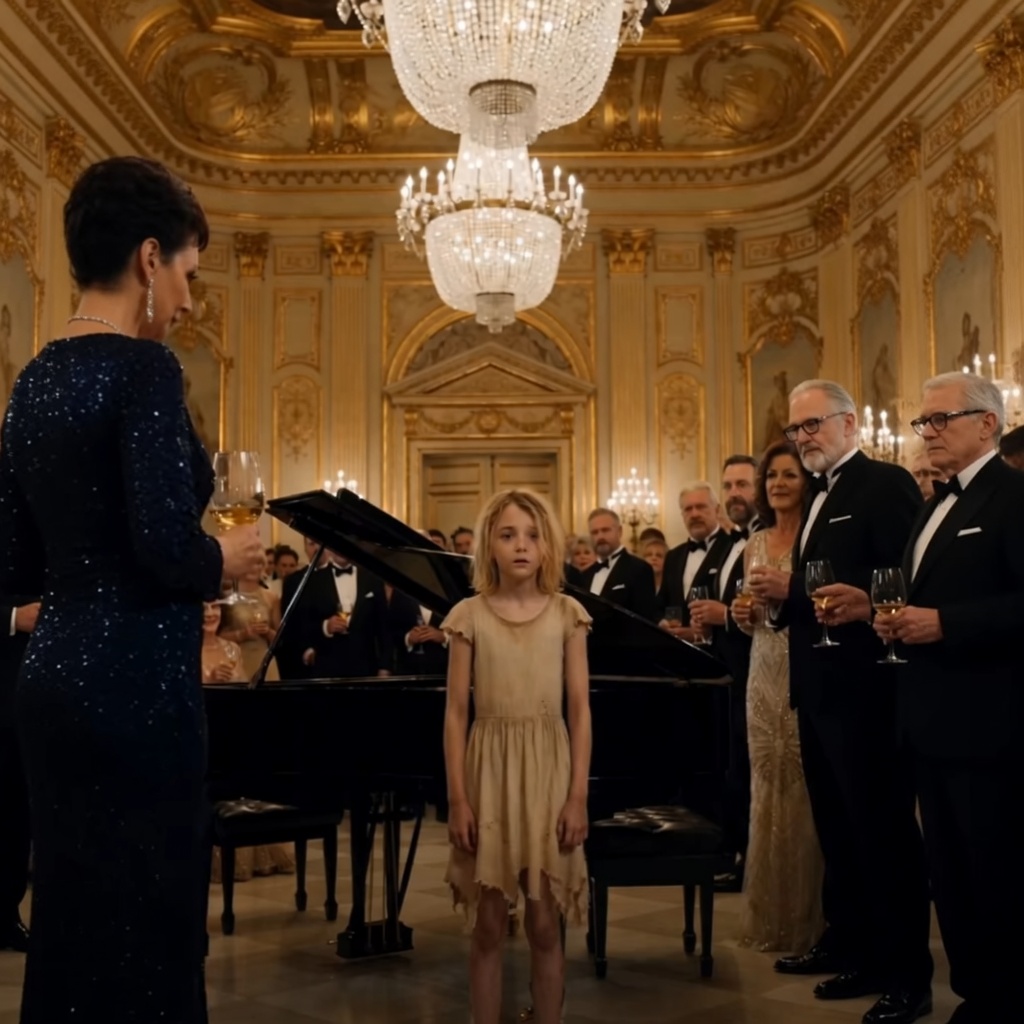
In the middle of all that luxury stood a barefoot little girl.
She was small, perhaps eight years old, though hunger made her look younger. Her beige dress was torn at the hem. Her blonde hair was tangled from wind and sleep and nights spent in places no child should have known. Her dirty toes pressed against the cold marble floor beside a black grand piano that looked almost taller than she was. Around her, the guests turned one by one, their laughter fading into curious silence.
The girl swallowed hard. Her stomach hurt so badly she had stopped feeling it as pain and started feeling it as emptiness, a deep hollow place inside her that made her hands shake. She looked toward the long banquet table near the wall, where untouched plates of roasted meat, fruit, bread, and little cakes sat under silver covers. There was more food in that room than she had seen in days.
Then, in a voice so small it barely reached the first row of guests, she asked, “May I play… for food?”
For one breath, the ballroom stayed silent.
Then the laughter began.
It came sharp and cruel, spreading through the enormous hall like broken glass. Women covered their mouths with jeweled fingers. Men in tuxedos looked her up and down, amused, as if a starving child had wandered in only to become part of the evening’s entertainment. Someone near the champagne tower murmured, “How did she get in?” Another guest laughed, “This city really does provide surprises.” A young woman in diamonds lifted her phone, not to help, but to record.
The girl flinched.
But she did not run.
Her name was Elsie.
For three nights, she had slept behind the old theater two streets away, curled beneath a torn curtain she had pulled from a trash bin. Before that, she had slept in a church basement until the doors were locked. Before that, she had slept beside her mother in a narrow rented room with peeling wallpaper, a broken heater, and a piano drawn in pencil on the wall because her mother said music could live anywhere, even where no instrument existed.
Her mother was gone now.
That was the reason Elsie was here.
Not because she understood wealth. Not because she knew who owned the mansion or why people had gathered beneath chandeliers. She was here because of a sentence her mother had whispered in the final hours of her life, when fever had made her voice thin and her hands too weak to hold Elsie’s properly.
“If you ever find a black piano in a golden room,” her mother had said, “play the song.”
Elsie had asked why.
Her mother had only cried.
So Elsie had remembered. Children who have nothing learn to protect instructions like treasure.
That evening, after following the smell of food through the iron gate and slipping in through a service door left open for caterers, she had seen it: the black piano beneath the gold ceiling. A black piano in a golden room. Just as her mother had said.
Now everyone was laughing.
Elsie turned toward the instrument and placed one small hand on the polished black surface. It was smooth and cold, so clean she could see the blur of her own frightened face reflected in it. She climbed carefully onto the bench. Her feet dangled above the marble floor. Her dirty fingers hovered over the perfect white keys.
A few people laughed again.
Then she played the first note.
Soft.
Broken.
Beautiful.
The sound moved through the ballroom like a breath no one expected.
The laughter weakened.
A second note followed, then a third. Slowly, the melody unfolded — fragile at first, hesitant, as though the child was afraid the piano itself might reject her. Then the sound deepened. Her fingers stopped trembling. Her shoulders lowered. The song rose from somewhere older than fear, filling the golden room with a sorrow too pure to mock.
Champagne glasses stopped halfway to mouths.
Whispers died.
The guests who had laughed moments earlier fell quiet. Their smiles faded. Some looked embarrassed. Others simply stared, unable to understand how something so beautiful could come from a child they had dismissed so easily.
Elsie kept playing.
She did not look at the crowd anymore. She looked only at the keys, the way her mother had taught her. “When people stare,” her mother used to say, “do not give them your fear. Give the piano your hands.” So Elsie gave the piano everything she had left: hunger, grief, cold nights, her mother’s voice, the memory of fingers guiding hers across an imaginary keyboard drawn on a wall.
Near the piano, an older man in a dark tuxedo turned slowly.
His name was Alistair Moreau.
He was the owner of the mansion, the host of the charity gala, and one of the richest men in the city. People feared his silence more than other men’s anger. He had built hotels, funded museums, bought newspapers, and buried scandals beneath money before breakfast. He stood among governors, bankers, and collectors with the calm arrogance of someone used to being obeyed.
But as the music filled the room, that arrogance vanished from his face.
His eyes fixed on the girl’s hands.
The melody had struck something in him. Something old. Something buried. Something he had not heard in years.
His daughter had written that song.
Clara.
Even thinking her name after so long made something tear inside him.
Clara Moreau had been the only person in his life who was not afraid of him. She had grown up inside that golden mansion and hated nearly every inch of it. She preferred the kitchen stairs to the marble staircase, street musicians to private concerts, ordinary bread to seven-course meals. She loved the piano more than anything. Not performance. Not applause. The piano itself. She said music was the only language in the house that never lied.
Alistair had wanted her to marry well, inherit properly, behave carefully, become the kind of daughter wealthy men displayed with pride. Clara wanted to teach music to children who could not pay. They fought often. Then she fell in love with a man Alistair considered beneath her — a violinist with no family name, no fortune, and too much tenderness in his face.
Alistair forbade the marriage.
Clara left.
For months, he told himself she would return once poverty cured her rebellion. Then came letters he refused to read. Then silence. Then news, delivered by his brother Victor, that Clara had died somewhere far from the city, sick and unreachable. Alistair never saw a body. Never saw a grave. He only received a small sealed envelope with one page inside: Clara is gone. She chose her life. Let her rest.
He had believed it because grief made anger easier.
Now a barefoot girl in a torn dress was playing the song Clara had written at sixteen, the song she had only ever played in this room.
Alistair stepped closer, his breathing uneven.
The guests around him began to whisper, but he did not hear them. He only stared at the child, at the way her fingers moved across the keys as if she were not just playing a song, but returning it to someone who had lost it.
His voice trembled when he finally spoke.
“That song…”
Elsie did not stop. She kept playing, small shoulders tense, face lowered toward the keys. The music grew softer, then stronger again, carrying a sorrow far too heavy for someone her age.
Alistair took another step forward, his face pale. “Where did you learn that?” he whispered.
Elsie’s fingers faltered for only a second.
Then she kept playing.
The entire ballroom held its breath, because now the laughter was gone. No one was looking at her torn dress anymore. No one was looking at her dirty feet. They were watching the old man, whose eyes had filled with tears.
He moved closer to the piano, barely able to speak. “That song belonged to my daughter,” he said, his voice breaking. “She wrote it before she disappeared.”
The final note faded.
Elsie lifted her eyes from the keys.
For the first time, the room saw that she was not only hungry.
She was afraid.
She looked at Alistair, then down at her hands, then back at him. In a small, shaking voice, she said, “My mother taught it to me.”
Alistair froze.
No one moved.
No one breathed.
Elsie clutched the edge of the piano bench as if she expected someone to punish her for speaking. Then she added, “She said if I ever found a black piano in a golden room… I should play it.”
Alistair’s hand went to his chest.
Around them, the wealthy guests stood silent now, their cruelty replaced by shame.
Elsie looked at the untouched plates of food along the banquet table, then back at him. “I was only hungry,” she whispered.
But Alistair was no longer looking at the food. He was looking at her face, her eyes, the shape of her mouth, the impossible echo of someone he had spent years grieving.
His voice came out barely louder than a breath.
“What was your mother’s name?”
Elsie hesitated.
The ballroom seemed to tighten around her answer.
Then she whispered the name.
“Clara.”
Alistair staggered as if the floor had vanished beneath him.
A woman near the front gasped. Someone dropped a fork. The sound rang once against porcelain and then disappeared into silence.
Alistair gripped the edge of the piano. “No.”
Elsie shrank back.
He saw her fear and forced himself to soften. “No, child. Not you. I’m not angry at you.”
Her lips trembled. “Mommy said you might be.”
The sentence struck him harder than the name.
“She knew me,” he whispered.
Elsie reached into the pocket of her torn dress and pulled out a folded piece of cloth. Inside was a small silver locket, scratched and darkened with age. She placed it on the piano bench between them.
Alistair stared at it.
He knew that locket.
He had given it to Clara on her fifteenth birthday. Inside, there had been a photograph of Clara as a baby and one of her mother, who had died too young. Clara used to wear it under her school uniform because she said it made her feel less alone.
With shaking fingers, Alistair opened it.
Inside was a new photograph, cut small to fit.
Clara, older than he remembered, thinner, tired, but unmistakably his daughter, holding a blonde baby against her chest.
On the other side was a folded slip of paper.
Alistair pulled it free.
The handwriting was Clara’s.
Father, if she finds you, it means I failed to make it home. Her name is Elsie. She is yours too, whether you forgive me or not. I never stopped loving you. I did stop waiting for you to choose love over pride.
Alistair covered his mouth.
His brother Victor, standing near the champagne table, went pale.
Only for a second.
But Alistair saw it.
Elsie saw it too.
Children who have lived around danger notice the face that fears truth.
Alistair slowly turned toward Victor. “You told me she was dead years ago.”
Victor straightened. “She was.”
Elsie shook her head. “No.”
Victor looked at the child with sudden sharpness.
Elsie’s voice trembled, but she continued. “She died last week.”
The ballroom erupted in whispers.
Alistair’s knees weakened.
Last week.
Clara had been alive last week.
Alive while he hosted dinners. Alive while he sat in boardrooms. Alive while he let grief harden into resentment because it was easier than regret. Alive, somewhere close enough for her child to find his house.
Victor stepped forward. “Alistair, this is obviously some sort of scheme. A hungry child, a locket anyone could have stolen, a song perhaps learned from—”
“The song was never published,” Alistair said.
Victor stopped.
Alistair’s voice changed. It became quiet, but the entire room heard the danger in it. “No one knew that song except Clara.”
Victor recovered quickly. “Then perhaps Clara taught it to someone before she died. That does not prove this child is—”
“Mine?” Alistair asked.
Elsie flinched at the coldness.
Alistair immediately looked back at her. “Not mine like property,” he said, voice breaking. “Mine like family.”
Her eyes filled.
“Did your mother tell you who I was?” he asked.
Elsie nodded. “She said you were my grandfather.”
A sound left him then, not quite a sob, not quite a breath.
The richest man in the room lowered himself to his knees beside the piano bench.
The guests stared.
A barefoot child sat above him, still dirty, still hungry, still shaking, and Alistair Moreau — the man they had feared, flattered, and obeyed for decades — knelt before her as if she were the only person in the world who mattered.
“What is your full name?” he asked.
“Elsie Moreau Lane.”
Lane.
Clara’s husband’s name.
Alistair closed his eyes.
“Where is your father?”
Elsie looked down. “He died before I remember.”
“And after that? Who cared for you?”
“Mommy.”
“Was she sick long?”
Elsie nodded.
“Did she ask for help?”
Elsie’s small hands tightened around the edge of the bench. “She wrote letters.”
Alistair opened his eyes.
The room sharpened.
“What letters?”
“To you,” Elsie whispered. “But the man with the silver cane took them.”
Every eye moved toward Victor.
Victor’s hand closed around the silver-headed cane he always carried.
He gave a short laugh. “This is absurd.”
Elsie’s breathing quickened. “He came to our room. Mommy hid me in the cupboard. He said if she came here, you would throw her out. He said she had already embarrassed the family enough. He said poor people invent children all the time.”
Alistair stood slowly.
His face had gone white.
Victor said, “Brother, listen to yourself. You are taking accusations from a child who entered this house barefoot asking to play for food.”
Alistair stepped toward him. “And why was my granddaughter barefoot?”
Victor’s mouth tightened.
Alistair turned to the head of security near the door. “Close the exits.”
The room froze.
Victor’s eyes flashed. “You cannot be serious.”
“I have never been more serious.”
Security moved at once. The atmosphere changed from gala to tribunal. Guests whispered nervously. Some tried to edge toward the walls. No one laughed now. No one lifted champagne. The child they had mocked had become the center of a family secret cracking open beneath chandeliers.
Alistair looked at the banquet captain. “Bring her food. Now. Warm food. Not scraps. Not leftovers. And find shoes, a blanket, and a doctor.”
The captain rushed away.
Elsie looked frightened by the sudden movement. Alistair lowered his voice. “No one will hurt you here.”
She stared at Victor.
Alistair followed her gaze. “Especially not him.”
Victor’s face hardened. “You are making a public fool of yourself.”
“No,” Alistair said. “I did that years ago when I let pride speak louder than my daughter’s letters.”
Victor leaned closer, voice low. “You do not know what Clara did. She stole from you. She humiliated this family. She chose that street musician over blood.”
“She was my blood.”
“She was a liability.”
The words landed like a confession.
Alistair stared at him.
“What did you say?”
Victor seemed to realize too late that anger had made him careless. He straightened. “I said she created liabilities.”
Alistair’s eyes moved to the locket, then to Elsie, then back to his brother.
“No,” he said softly. “You said she was one.”
Victor said nothing.
The doctor arrived first, a guest who happened to be a pediatric specialist. She knelt beside Elsie, asked permission before touching her, and gently checked her pulse, her temperature, the cuts on her feet. Elsie kept glancing at the food table until a waiter returned with soup, bread, milk, and a plate of soft potatoes.
The doctor said, “Let her eat slowly. She’s malnourished.”
The word made several guests look away.
Malnourished.
Not unfortunate.
Not dramatic.
Hungry because adults had failed her.
Elsie ate like someone trying not to be greedy. Each spoonful was careful. Painfully careful. Alistair sat beside her, not touching, not rushing, watching every movement as if witnessing both a miracle and an accusation.
A woman in emerald silk approached hesitantly. “Mr. Moreau, perhaps the child should be taken somewhere private. The guests are becoming uncomfortable.”
Alistair looked at her.
“Good.”
She blinked.
“They laughed when she asked for food,” he said. “Let them be uncomfortable while she eats.”
The woman stepped back, ashamed.
Victor tried again to leave, but security blocked him. By then Alistair’s attorney had been called from another table, and two staff members were sent to retrieve old records from the estate office. The gala had dissolved completely. Some guests left after giving statements. Others stayed, pulled by scandal or guilt. But the room no longer belonged to wealth. It belonged to truth.
When Elsie finished half the soup, she reached into her dress again and pulled out another folded paper.
“Mommy said give this after the song,” she whispered.
Alistair took it with both hands.
The letter was longer.
Father, Victor lied. He intercepted my letters. He came to the apartment three times. The last time, he told me you knew I had a child and called her a stain on the family. I did not believe him at first. Then every letter came back unopened, and I was too sick to fight. I am writing this because Elsie deserves the truth, even if I no longer get to hear it from you.
I named her Elsie after Mother. She loves music. She has your stubborn mouth and my terrible sense of rhythm, though she will deny it. If she reaches you, please feed her first. Explanations can wait.
Alistair stopped reading there because his vision blurred.
Please feed her first.
He looked at the child, who was still eating bread in tiny bites, as if afraid the plate might vanish.
His daughter had known him well enough to send music.
But not well enough to trust he would feed a hungry child before demanding proof.
That shame would stay with him forever.
The investigation began that night.
Victor had controlled many parts of the Moreau estate after Clara left. He managed correspondence, legal notices, private investigators, and public statements. He had told Alistair that Clara refused all contact. He had told Clara that Alistair disowned her. He had made sure each believed the other chose silence.
Why?
Money, at first. Then control.
Clara’s portion of her mother’s trust should have remained hers, even after she left. If she had returned with a child, Elsie would have had a claim. Victor had redirected funds, buried letters, and maintained the lie that Clara was dead. As long as Alistair grieved angrily, he would not investigate too closely.
But a song had survived.
A locket had survived.
A child had survived.
And Victor had not planned for a starving girl to walk barefoot into a golden room and play a melody no one could explain away.
By morning, police were involved. Victor was escorted from the mansion under suspicion of fraud, suppression of correspondence, intimidation, and financial misconduct. He still denied everything. Men like him always do. But old staff began to talk. A former housekeeper remembered seeing Clara’s letters locked in Victor’s drawer. A driver admitted taking Victor to a poor district years earlier. A clerk produced returned envelopes that had never been mailed properly. The wall cracked quickly once Alistair stopped protecting it.
Elsie slept that first night in Clara’s old room.
At first, she refused the bed.
“It’s too clean,” she whispered.
Alistair did not know what to say.
The doctor, kinder than most adults in the house had ever been, suggested placing a blanket on the floor beside the bed and letting Elsie choose. So they did. Elsie slept on the rug with the locket in one hand and a roll from dinner wrapped in a napkin under her pillow.
Alistair found it in the morning and had to leave the room before she saw him cry.
Over the next weeks, he learned that finding a grandchild was not the same as knowing how to love one. He made mistakes immediately. He bought too many dresses. Too many shoes. Too many toys that looked expensive and meant nothing to a child who wanted her mother’s old scarf, the locket, and permission to keep bread in her room. He arranged tutors before realizing Elsie first needed sleep. He asked questions too quickly and watched her shut down.
So he learned to slow down.
He learned to knock.
He learned to ask, “May I sit here?”
He learned that Elsie hated being watched while eating, loved warm milk, feared silver canes, and played piano only when she thought no one was listening.
One evening, he found her in the ballroom again.
The chandeliers were dim. The room was empty. Elsie sat at the black piano, one finger pressing a single key again and again.
Alistair stopped near the doorway.
She did not turn. “Mommy said you used to stand there.”
His throat tightened. “Did she?”
“She said when she played, you pretended not to listen.”
“I listened.”
“I know.”
He stepped closer slowly. “May I?”
Elsie shrugged.
He sat at the far end of the bench, leaving space between them.
“She wrote that song here,” he said. “After her mother died.”
Elsie looked at him.
“She was angry with me,” he continued. “I told her grief should be carried with dignity. She told me grief should be allowed to make noise. Then she played that song so loudly the staff stopped working.”
Elsie’s mouth curved faintly. “Mommy liked noise.”
“Yes.”
“Did you like her song?”
Alistair looked at the keys. “I loved it. But I never told her properly.”
“Why?”
He inhaled slowly. “Because I was a fool.”
Elsie considered that with grave seriousness. “Mommy said that too.”
For the first time in weeks, Alistair laughed. It broke into a sob halfway through, but Elsie did not look frightened. She only placed the locket on the piano between them.
“Can you play?” she asked.
“Badly.”
“That’s okay. I’m hungry less now, so I can teach you.”
And she did.
Not well. Not patiently. She scolded him for pressing too hard. She told him his fingers were “old and confused.” She sighed dramatically when he missed a note. And Alistair accepted every correction like a blessing.
Months passed.
Clara was buried properly beneath a tree in the Moreau family garden, though Alistair insisted the service be small. No society spectacle. No speeches by people who had ignored her when she was alive. Elsie placed the locket on the coffin for one minute, then took it back because her mother had told her to keep it. Alistair placed one white rose beside it and whispered the apology he had waited too long to say.
“I should have chosen you over pride.”
Wind moved through the branches.
No answer came.
But Elsie reached for his hand.
That was enough to keep him standing.
A year later, the ballroom opened again. Not for a gala of champagne and polished cruelty, but for the first concert of the Clara Moreau Foundation, created to feed, house, and teach music to children with nowhere else to go. The gold walls still shimmered. The chandeliers still glowed. The black grand piano still stood in the center of the room.
But the room felt different.
There were children in the front rows now. Some in donated coats. Some with foster parents. Some from shelters. Food was served before speeches because Elsie insisted.
“Explanations can wait,” she said.
Alistair agreed.
Elsie wore a simple blue dress, new but comfortable, and shoes she chose herself. Her hair was brushed but still escaped around her face. Around her neck hung Clara’s locket.
Before the concert began, she stood beside Alistair near the piano.
“Are they looking at me?” she whispered.
“Yes.”
“I don’t like it.”
“We can stop.”
She looked at the children in the front row, many of them watching the banquet table more than the stage.
“No,” she said. “They should hear Mommy’s song.”
Alistair knelt beside her, uncaring who watched.
“You do not have to earn food,” he said. “Not here. Not ever.”
Elsie touched the locket.
“I know.”
Then she climbed onto the bench.
Her feet no longer dangled barefoot above marble. They rested in little black shoes on a footstool made just for her. Her hands trembled, but not from hunger this time.
From memory.
The room waited.
Elsie played the first note.
Soft.
Broken.
Beautiful.
Alistair closed his eyes.
This time, no one laughed.
This time, the music did not have to beg for mercy from the room. It filled the hall freely, carrying Clara’s grief, Elsie’s hunger, Alistair’s regret, and something new beneath it all.
A beginning.
Years later, people would tell the story of the barefoot girl who walked into a golden ballroom and asked to play for food. Some would tell it as a miracle. Some as a scandal. Some as the night Alistair Moreau discovered his dead daughter had lived long enough to send home a child with a song.
But Elsie remembered something simpler.
She remembered being hungry.
She remembered the cold piano under her fingers.
She remembered laughter turning into silence.
She remembered a man with tears in his eyes asking her mother’s name.
And she remembered that, after all the cruelty, someone finally brought her soup.
Alistair remembered the sound of the locket opening. The tiny click that unlocked twelve years of lies. He remembered Clara’s handwriting, Elsie’s dirty feet on marble, Victor’s face when the truth found him, and the unbearable mercy of a daughter who had written, even at the end, I never stopped loving you.
The ballroom still had gold walls.
The chandeliers still shone.
The piano still stood black and beautiful beneath the light.
But near it, on a small brass plaque, were Clara’s words:
Please feed her first. Explanations can wait.
And beneath that, in smaller letters chosen by Elsie:
No child should have to perform to deserve kindness.
Whenever Elsie passed the plaque, she touched the locket at her throat.
Then, if the room was quiet enough, she played the song again.
Not for food anymore.
Not for proof.
But for the mother who had taught it to her, the grandfather who finally listened, and every hungry child who might one day walk into a room that looked too rich to welcome them — and learn that beauty, like bread, should never belong only to those who can pay.

![[FULL STORY] They Fired Me for Fraud — Not Knowing I Had Already Sent the Real Evidence](https://sa.greatgames.info/storage/thumbnails/1777886484_928ea46f-5e04-464e-8f81-5beb13f8992f.png)
![[FULL STORY] My Girlfriend Ditched My Birthday To Rescue Her "Crying" Ex, So I Shipped Her Entire Designer Wardrobe To His Doorstep.](https://sa.greatgames.info/storage/thumbnails/1777887358_B3.jpg)
![[FULL STORY] She Screamed I Was Suffocating Her At 3 AM So I Gave Her The Ultimate Space By Vanishing Forever.](https://sa.greatgames.info/storage/thumbnails/1777366713_22.png)

![[FULL STORY] I overheard my girlfriend whispering to her friends at the party: “He ought to count himself…](https://sa.greatgames.info/storage/thumbnails/1777358787_B25.png)