
She smiled when I stopped arguing.
That was how I knew she thought she had won.
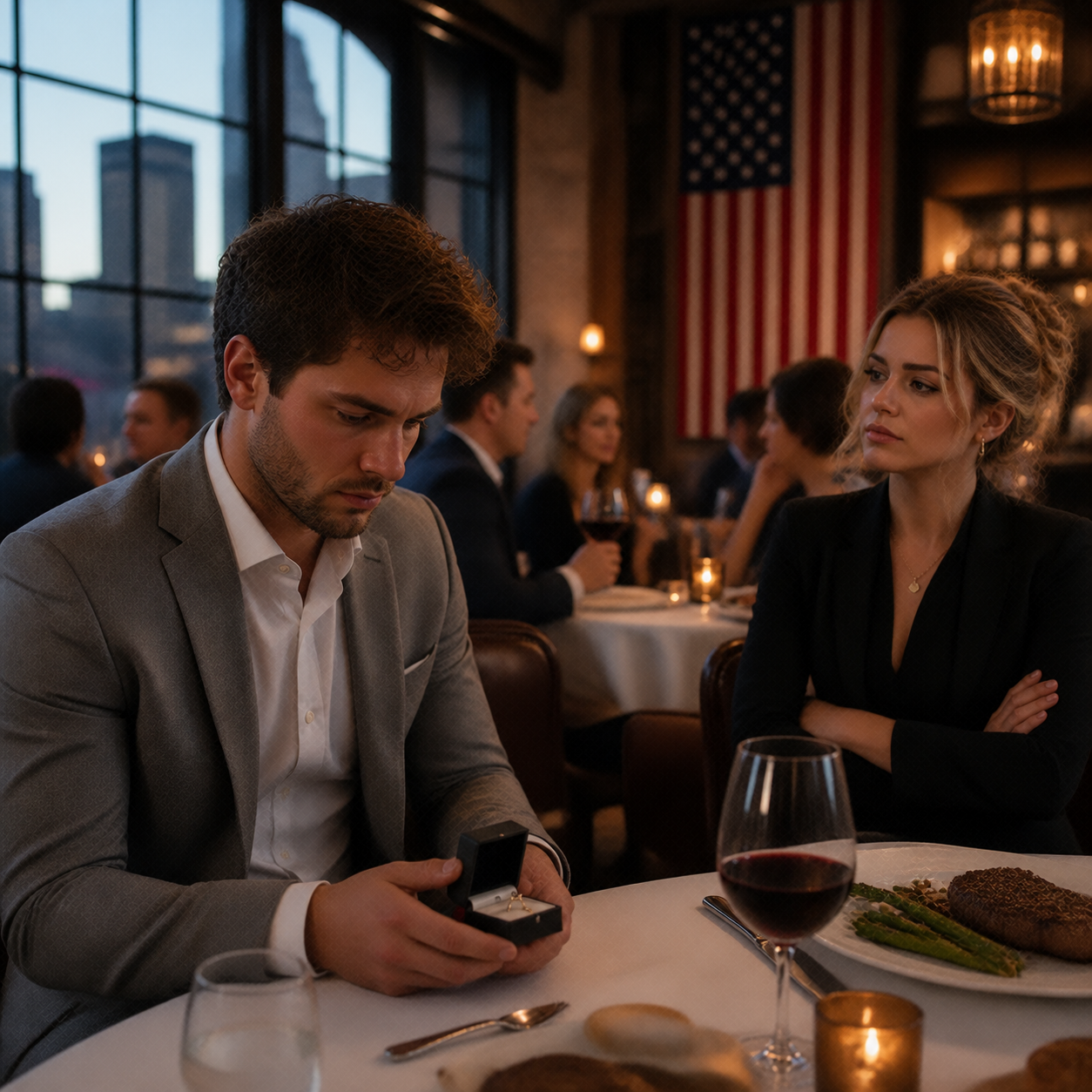
We were standing outside a restaurant on a cold Friday night, the kind of night where the air bites your face the second you step out the door. Her friends had already gone ahead, laughing too loudly as they climbed into a rideshare, still buzzing from the dinner that had turned into one long performance at my expense.
I stood near the curb with my hands in my coat pockets, looking at the wet pavement shining under the streetlights. My girlfriend, Natalie, stood a few feet away, arms crossed, chin slightly raised, waiting for me to apologize for embarrassing her.
That was the strangest part.
I had been the one mocked.
I had been the one laughed at.
I had been the one compared to her ex, her coworker, and some imaginary version of a man she claimed she deserved.
But somehow, in her mind, I had embarrassed her by refusing to keep smiling through it.
“You made tonight awkward,” she said.
I looked at her.
For almost three years, that sentence would have pulled me into the same old pattern. I would explain myself carefully. She would accuse me of being sensitive. I would try to make her understand. She would get colder. Eventually, I would apologize just to end the tension, even if I had done nothing wrong.
That night, I did not explain.
I did not defend myself.
I did not apologize.
I simply said, “Okay.”
She blinked.
That was not the reaction she wanted.
“What does that mean?”
“It means okay.”
Her expression tightened. “Don’t do that calm thing. You know I hate that.”
I almost laughed, but there was nothing funny about it anymore.
My calmness had once been the thing she loved. Now it was something she treated like an insult. I had learned that people who rely on emotional chaos hate calmness because calmness gives them nothing to control.
I nodded once and looked down the street for my ride.
She stared at me, waiting.
Waiting for the argument.
Waiting for the apology.
Waiting for the version of me that always came back toward her.
I gave her none of it.
And because she did not understand silence unless it served her, she smiled.
Small. Sharp. Victorious.
She thought she had won.
So I let her think that.
What she did not know was that by the time my car arrived, I had already made the decision that would change both our lives.
She had not won.
She had lost access.
My name is Adrian. I was thirty-two when this happened, working as a senior logistics analyst for a national retail company. My job was not glamorous, but it was demanding in a way most people never saw. When shipments arrived on time, no one thought about me. When something went wrong, suddenly everyone knew my name.
I was good at solving problems before they became disasters.
That skill helped my career.
It nearly ruined my relationship.
Because with Natalie, I did the same thing. I anticipated moods. Smoothed tension. Managed problems before they exploded. I watched her face, her tone, the way she moved through a room, and adjusted myself constantly to keep peace.
At first, I called that love.
Later, I learned it was survival disguised as patience.
I met Natalie at a charity fundraiser hosted by one of my coworkers. She worked in corporate events, which made sense because she understood rooms the way musicians understand rhythm. She knew when to laugh, when to lean in, when to touch someone’s arm to make them feel important. She was beautiful, confident, and socially effortless in a way I admired because I had never been like that.
I was quieter. More direct. The kind of man who would rather have one honest conversation than ten impressive ones.
She noticed me standing near a display table, reading the donor list because I had run out of small talk.
“Are you actually reading that,” she asked, “or are you hiding from people?”
I looked at her and said, “Both can be true.”
She laughed, and I was gone.
Our first six months felt easy. She brought color into my structured life. I brought stability into her unpredictable one. She liked that I remembered details, that I showed up on time, that I did what I said I would do. She said she had dated too many men who made everything feel uncertain.
“With you,” she told me one night, lying beside me with her head on my chest, “I don’t have to guess.”
I thought that meant she valued me.
Maybe she did then.
But people can value something before they learn to expect it. And once they expect it, they sometimes stop seeing it as a gift.
When Natalie moved into my apartment after her lease ended, the changes were immediate. She turned the place into something warmer and more stylish. New curtains, better lighting, plants I always forgot to water but she somehow kept alive. She had opinions about everything, and at first I loved that. I liked seeing her imprint on the space.
I paid more of the rent because I earned more. I handled utilities, repairs, groceries during slow months, and most of the long-term planning. She handled the look and feel of our life. Together, it seemed balanced.
Until it wasn’t.
The first sign was how decisions changed.
At first, we decided things together. Then she started deciding and informing me afterward.
“We’re going to Maya’s dinner Saturday.”
“I told my cousin she could stay with us next weekend.”
“I booked that resort for Memorial Day. It was expensive, but we deserve it.”
If I questioned the cost or timing, she acted wounded.
“I thought you liked doing things with me.”
“I do.”
“Then why does everything have to be a negotiation?”
That was how she reframed disagreement. Not as normal communication, but as resistance to loving her properly.
Over time, I stopped questioning smaller things.
Then medium things.
Then almost everything.
It happened slowly enough that I did not notice I was disappearing.
The second sign was how arguments ended.
No matter how they began, they somehow became my fault. If she was late, I was controlling for asking where she was. If she flirted too openly at a party, I was insecure for noticing. If she made a cruel joke about me in front of friends, I was too sensitive for feeling embarrassed.
And if I stayed quiet, she said I was emotionally unavailable.
There was no winning because winning had never been the point.
Control was.
Then came Marcus.
Marcus was not her boyfriend then. Not officially. He was a senior creative director at the agency her company hired for a major campaign. He dressed like a man who believed expensive shoes were a personality trait and spoke in confident fragments that people mistook for insight.
Natalie started mentioning him often.
“Marcus says most people settle because they’re afraid of being uncomfortable.”
“Marcus thinks ambition should be visible.”
“Marcus says men who avoid conflict usually avoid responsibility too.”
That last one was aimed directly at me, though she said it while scrolling through her phone, pretending it was casual.
I looked up from my laptop. “Does Marcus know me?”
She shrugged. “He understands people.”
I remember thinking that was the beginning of the end.
Not because Marcus was special.
Because she wanted him to be right about me.
After that, she became bolder. More dismissive. She would compare me to men who spoke louder, spent faster, risked more, performed confidence like a stage act. She called me steady when she was being kind and passive when she was not.
I tried to talk to her about it.
One night, after she made a joke at a party about me needing a spreadsheet before choosing a restaurant, I told her it bothered me.
She sighed before I even finished.
“Adrian, it was a joke.”
“It didn’t feel like one.”
“That’s because you take everything personally.”
“It was about me.”
“See? This is what I mean. You always make me feel like I have to manage your emotions.”
I stared at her, stunned by how cleanly she had reversed the situation.
I had come to her with hurt.
Somehow, I left feeling guilty for having it.
That was our relationship by then.
But the dinner on that Friday night was different.
It was Natalie’s promotion celebration. She had invited six friends, including Marcus. I did not know he would be there until we arrived and he stood up from the table to hug her.
Not shake her hand.
Hug her.
A familiar hug.
I saw it. She saw me see it. Then she smiled too brightly and introduced him.
“You remember Marcus.”
“I remember hearing about him.”
He grinned like he enjoyed that answer.
Dinner started politely enough. Drinks were ordered. Natalie was glowing from attention, and I was genuinely proud of her promotion. Despite everything, I wanted the night to go well for her.
Then Marcus made the first joke.
“So Adrian, Natalie says you’re the practical one. Every creative woman needs a house accountant.”
The table laughed.
I smiled lightly. “Someone has to keep the lights on.”
That could have ended it.
It didn’t.
Natalie added, “He’s not wrong. Adrian once built a budget for a weekend trip.”
More laughter.
I felt something tighten in my chest, but I let it pass.
Then her friend Maya said, “Honestly, that sounds useful.”
Natalie leaned back and said, “Useful, yes. Exciting, not always.”
The table got quiet for half a second before Marcus laughed, giving everyone permission to follow.
I looked at Natalie.
She avoided my eyes.
That was the moment that hurt most. Not the joke. Not Marcus. Her choice not to see me.
The rest of dinner became a slow humiliation disguised as teasing. My job was boring. My truck was too practical. My clothes were safe. My idea of a good weekend was apparently “filing taxes early,” even though I had planned half the trips Natalie bragged about online.
At one point, Marcus raised his glass and said, “To Natalie. Proof that some people are meant for bigger lives.”
Everyone toasted.
Natalie looked directly at me as she drank.
I understood the message.
And I finally stopped trying to earn a seat at a table where I was being served as entertainment.
When the bill came, Marcus made a show of reaching for it. Natalie touched his arm and said, “No, tonight is on me. I’m celebrating.”
Then she glanced at me and added, “Don’t worry, Adrian. I won’t make you budget it.”
More laughter.
I took out my wallet, placed cash for my meal and tip on the table, and stood.
Natalie’s smile faltered.
“Where are you going?”
“Home.”
The table went silent.
Marcus smirked. “Come on, man. We’re just having fun.”
I looked at him.
“You are.”
Then I turned to Natalie.
“Congratulations on your promotion.”
I left before she could respond.
Outside, she followed me.
That was when she accused me of making the night awkward. That was when I said okay. That was when she smiled because she thought my calmness meant surrender.
But it didn’t.
It meant the door inside me had closed.
The next morning, I woke before her.
She was asleep beside me, one arm across the pillow, makeup still faintly smudged around her eyes. There was a time when seeing her like that would have softened me instantly.
Not anymore.
I went to the kitchen, made coffee, and opened my laptop.
First, I changed the password to every account I paid for. Streaming services, shared cloud storage, grocery delivery, travel rewards, utilities. Then I removed her from the credit card authorized user list. Then I opened a separate savings account and moved the money that was mine out of our joint household fund, leaving her portion untouched.
I did not do it to punish her.
I did it to separate reality from illusion.
She had mistaken access for entitlement.
That ended.
Over the next week, I made quiet changes. I contacted the landlord and confirmed the lease terms. It was in my name because her credit had been damaged before we moved in together. I scheduled time with a financial advisor. I documented shared purchases. I packed away important documents and irreplaceable items.
Natalie barely noticed.
She was too busy enjoying what she thought was victory. She went out twice that week, once with coworkers, once supposedly with Maya. She came home late, kissed my cheek like nothing had happened, and acted as if my silence meant she had successfully trained me back into place.
That was fine.
Let her think she won.
On Thursday night, she discovered the first locked door.
“Why can’t I order groceries?” she called from the kitchen.
I was reading in the living room.
“What do you mean?”
“The account says the payment method is invalid.”
“I removed my card.”
She appeared in the doorway.
“Why?”
“Because I’m not paying for your personal orders anymore.”
Her mouth opened slightly.
“My personal orders? It’s groceries.”
“You added makeup, wine, and a two-hundred-dollar skincare set last time.”
She stared at me as if I had spoken a foreign language.
“You’re being petty.”
“No. I’m being accurate.”
Her eyes narrowed.
“What’s going on with you?”
I turned a page.
“Nothing.”
But of course something was going on.
She just had not understood it yet.
The next day, she realized she could no longer access my car insurance app, where she had been listed as an occasional driver. Then the travel points account. Then the shared calendar where I had managed every appointment, bill, deadline, and family event.
Each lost access point made her more unsettled.
By Sunday, she confronted me.
“You’re punishing me for one dinner.”
I closed the dishwasher slowly.
“No.”
“Then what is this?”
“This is me no longer providing boyfriend-level support to someone who treats me like an inconvenience.”
She crossed her arms.
“There it is. You’re still mad.”
“I’m not mad.”
“You’re obviously mad.”
“No, Natalie. I’m done.”
The word landed between us.
Done.
She blinked.
“What does that mean?”
“It means I’m ending the relationship.”
For the first time in a long time, she had no immediate response.
Then she laughed once, sharply.
“You’re ending the relationship because of jokes?”
“No. I’m ending it because the jokes revealed the truth.”
Her face hardened.
“You’re being dramatic.”
“Maybe.”
“You’ll regret this.”
“I might.”
I meant that honestly. I knew grief would come. I knew I would miss her. I knew lonely nights would make memory kinder than reality. But regret is not always a reason to return. Sometimes it is just the emotional cost of self-respect.
She left that night to stay with Maya.
Two days later, she called.
I did not answer.
Then texts came.
We need to talk.
You can’t just cut me off.
This is immature.
Marcus says you’re financially controlling.
That last one almost made me laugh.
Of course Marcus had an opinion. Men like him always do when they inherit the benefits of another man’s labor and call it liberation.
I replied once.
Your things will be packed by Friday. You can arrange a time with Maya to collect them.
Then I blocked her.
The first month was brutal.
Not because I doubted the decision, but because losing someone toxic still hurts when you loved them honestly. The apartment felt too quiet. Her absence lived in small places. The empty hook where her coat used to hang. The missing scent of her shampoo. The way I still reached for her favorite mug before remembering she was gone.
I started therapy because I did not trust myself to process everything alone. My therapist listened as I explained the relationship, the jokes, the comparisons, the dinner, the access.
Then she asked, “What did access mean to her?”
I frowned.
“Convenience, I guess.”
“And what did it mean to you?”
That question took longer.
Eventually, I said, “Love.”
There it was.
I had been giving love in the form of access. Access to my time, money, patience, planning, forgiveness, emotional availability. And somewhere along the way, Natalie stopped seeing it as love and started treating it like infrastructure.
Useful.
Invisible.
Expected.
Once I understood that, healing changed.
I stopped asking why she did not value me.
I started asking why I had continued giving premium access to someone who had downgraded my place in her life.
At work, I became sharper. Lighter. More direct. Without the constant emotional noise at home, I had energy to pursue things I had postponed. I applied for an internal leadership role overseeing process improvement across three regional offices.
The interview process was intense, but I was ready. For years, I had solved problems quietly. Now I learned to present those solutions with confidence.
I got the role.
Three months after the breakup, my salary increased, my responsibilities expanded, and my name started appearing in rooms where decisions were made.
Natalie heard, of course.
She emailed me from a new address.
I heard about your promotion. I’m proud of you. I always knew you had it in you.
I deleted it.
Not because I hated her.
Because I knew the difference between support and commentary after the fact.
Six months later, I saw her again at a mutual friend’s engagement party.
She looked beautiful. She always did. But she also looked tired, like life had become harder than she expected once the invisible systems disappeared.
Marcus was not with her.
I knew they had dated briefly after our breakup. I also knew it ended when he lost interest in the version of Natalie who needed actual support instead of public admiration.
She approached me near the balcony.
“Adrian.”
“Natalie.”
“You look good.”
“Thank you.”
The silence between us was not empty. It was crowded with everything we were not saying.
“I owe you an apology,” she said.
I waited.
“For the dinner. For letting them laugh at you. For laughing too.” Her voice shook slightly. “For making you feel small when you were the one holding so much together.”
That was the first time she had named it correctly.
I appreciated that.
“I accept your apology.”
Her eyes lifted quickly.
“You do?”
“Yes.”
A small breath escaped her.
“I’ve missed you.”
There it was.
The turn.
The hope.
The door she expected to find unlocked because it used to be.
I looked at her with more sadness than anger.
“I believe you.”
“Could we talk sometime? Really talk?”
“No.”
Her face fell.
“Why?”
“Because you don’t miss me the way I needed to be loved. You miss access.”
She flinched.
“That’s not fair.”
“It is.”
Her eyes filled with tears.
“I loved you.”
“I know,” I said. “But you loved me carelessly.”
That broke through whatever defense she had left.
For a moment, she looked like she might argue. Then she nodded slowly.
“I didn’t realize how much you did until you stopped doing it.”
“I know.”
“I wish I had.”
“So do I.”
We stood quietly for a few seconds. Then she wiped her cheek and whispered, “I really thought I won that night.”
I looked at her.
“I know.”
“That sounds awful now.”
“It was honest.”
She nodded again.
“And now?”
“Now I’m not playing.”
I left the party soon after.
Not dramatically.
No final speech.
No revenge scene.
Just a clean exit from a room that no longer held me.
A year after that dinner, my life looked nothing like I expected. I had a better role, a calmer home, stronger boundaries, and a kind of peace I once thought only came from being loved by someone else.
I learned that access is sacred.
Not everyone deserves your immediate replies.
Not everyone deserves your emotional labor.
Not everyone deserves the softest parts of you just because they once held them.
Love should open doors, yes.
But self-respect decides who keeps the key.
Natalie thought she won when I stopped arguing.
She thought silence meant surrender.
She thought my patience was weakness and my availability was permanent.
So I let her think she won.
Until she lost access.
And by the time she understood what that meant, I had already changed the locks on my life.

![[FULL STORY] She Said She Settled for Me… So I Let Her Face the Life She Chose](https://sa.greatgames.info/storage/thumbnails/1776758564_3e3a9d6b-d927-45e1-a04a-dc21749489dd.png)

![[FULL STORY] My Fiancée Gave Me An Ultimatum To Make Her Ex The "Man Of Honor" Or Cancel The Wedding, So I Canceled Everything In One Hour.](https://sa.greatgames.info/storage/thumbnails/1777005203_T4.png)