

She never said the word replaceable.
That would have been too honest.
Instead, she said things like, “I just need more than this,” and “You’re a good man, but good isn’t always enough,” and “Sometimes I wonder what my life would look like with someone who pushes harder.”
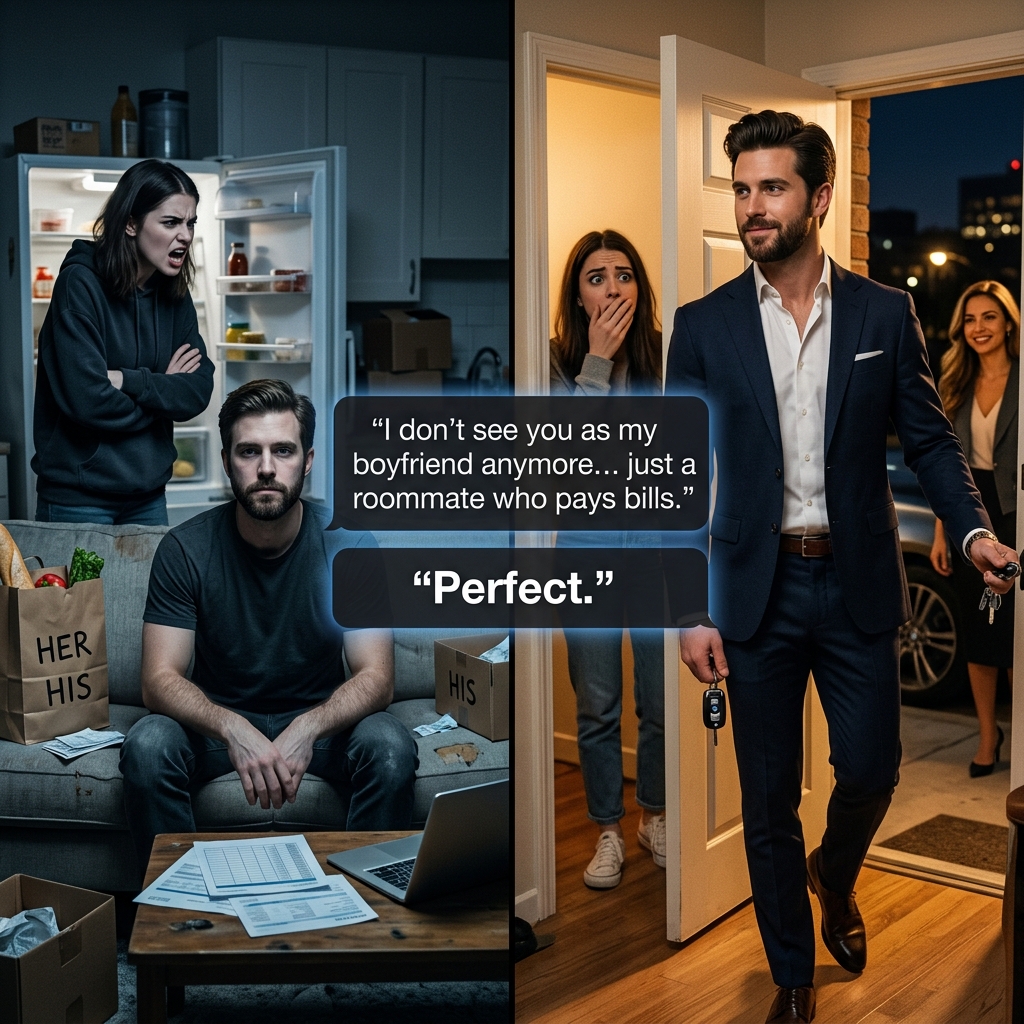
Each sentence came wrapped in softness, like she was trying not to hurt me, but the meaning was sharp underneath. She had started looking at me like I was a piece of furniture in a room she had outgrown. Useful. Familiar. Easy to take for granted. Something she assumed could be removed and replaced with something newer, brighter, more exciting.
The night she finally left, she stood in our bedroom with a suitcase open on the bed, folding clothes like this was a business trip instead of the end of four years. I sat in the chair near the window, watching rain slide down the glass, wondering how a person could look so calm while dismantling a life.
“I don’t want this to become ugly,” she said.
I looked at her then.
Her name was Marissa. She was beautiful in the way that made strangers look twice, with dark hair she always wore loose when she wanted to feel confident and sharp brown eyes that could make you feel like the only person in the world when they were kind. That night, they were careful.
“It’s already ugly,” I said quietly. “You’re just trying to make it quiet.”
She stopped folding for half a second.
Then continued.
“I don’t know what you want me to say.”
For a long time, I would have had a list. Tell me you’re confused. Tell me you still love me. Tell me there isn’t someone else. Tell me I wasn’t just the man you kept around until you found the courage to chase something more impressive.
But by then, I had already heard enough.
So I said, “Nothing.”
That bothered her more than anger would have.
I met Marissa at a bookstore café three and a half years before that night. I was thirty, working as a systems manager for a healthcare company, the kind of job that sounds boring until something breaks and everyone suddenly remembers you exist. She was twenty-seven, a freelance brand consultant trying to build her client list while working part-time at a design studio.
She was sitting at the next table, arguing with her laptop under her breath. I had been trying to read, but after the third frustrated sigh, I looked over and asked, “Are you fighting the computer, or is the computer winning?”
She looked up, annoyed at first, then laughed.
“The computer is cheating.”
I helped her recover a corrupted presentation file. She bought me coffee as payment. Coffee became conversation. Conversation became dinner. Dinner became the kind of night where you walk someone to their car and both of you keep finding new things to say because goodbye feels too soon.
In the beginning, she loved that I was steady.
That was her word.
Steady.
She said it when I showed up on time. She said it when I helped her build a budget for her freelance work. She said it when I held her through panic after a client rejected her proposal. She said it when her car broke down and I drove across town in the middle of a snowstorm to pick her up.
“You’re my steady place,” she whispered once, half asleep against my chest.
I carried that sentence like a promise.
When she moved in with me after a year, it felt natural. My apartment was plain before her. Functional, clean, forgettable. Marissa made it warm. She added plants, framed prints, textured blankets, little lamps that made the evenings softer. Friends came over and said the place finally had personality.
They were right.
But what they didn’t see was how much of that personality was supported by my structure. I paid the larger share of rent because her income fluctuated. I covered groceries during slow months. I helped her buy a better laptop when her old one died. I paid for a branding course she swore would help her land bigger clients. I did it all willingly, without keeping score, because I thought we were building toward the same future.
That was my mistake.
Not helping her.
Believing help automatically meant partnership.
For the first two years, things were good. We hosted dinners. Took weekend trips. Talked about marriage in that casual future tense couples use when they believe time is friendly. She wanted a small wedding somewhere outdoors. I wanted whatever made her happy, as long as it felt honest.
Then her business started growing.
At first, I was proud. She landed better clients, built a stronger portfolio, and started getting invited to events with people who talked about success like it was a personality trait. I encouraged all of it. I wanted her to win.
But success changed the rooms she entered, and the rooms changed what she admired.
She started coming home with new phrases.
“High-value people.”
“Growth mindset.”
“Power couple energy.”
“Playing bigger.”
At first, I smiled and listened. Then I noticed the way she used those phrases near me, not with me. Like she was holding our life up against a picture she had seen somewhere online and finding it lacking.
One evening, I was making pasta while she sat at the counter scrolling through photos from an event.
“Look at this,” she said, turning her phone toward me.
It was a man standing on a rooftop, holding a drink, wearing a cream-colored suit that probably cost more than my monthly car payment. He had one of those smiles that looked rehearsed but effective.
“That’s Adrian,” she said. “He owns a boutique marketing agency. He’s only thirty-four.”
“Good for him.”
She gave me a look.
“That’s all?”
“What do you want me to say?”
“I don’t know. It’s impressive.”
“It is.”
She stared at me for a moment, then looked back at the phone.
“He just has this energy. Like he knows exactly where he’s going.”
I stirred the sauce and said nothing.
That was how Adrian entered our relationship. Not as a man at first, but as a measurement.
Adrian took risks. Adrian traveled last-minute. Adrian invested in himself. Adrian didn’t settle for comfort. Adrian believed ordinary people stayed ordinary because they were afraid to demand more.
Soon, everything I did became evidence of what I lacked.
If I saved money, I was playing small.
If I planned carefully, I was afraid.
If I came home tired from work and wanted a quiet night, I lacked drive.
If I reminded her that debt was still debt even when used for “personal expansion,” I was limiting her.
The same steadiness she once called love had become a cage in her mind.
I tried talking to her.
Not once. Many times.
I told her I felt like she was comparing me to people who only showed her polished versions of themselves. I told her I had goals too, even if I did not announce them at every dinner party. I told her ambition did not always look loud.
She would listen, nod, sometimes even apologize.
Then two days later, Adrian’s name would appear again.
The first time I suspected something was happening between them, it was because of a necklace.
Marissa came home late from a networking dinner wearing a delicate gold pendant I had never seen before. It was simple, expensive-looking, the kind of jewelry she would normally tell me about immediately.
“That’s new,” I said.
She touched it too quickly.
“Oh. Yeah. A client gave it to me.”
“A client?”
“It was part of a gift bag.”
I nodded, though we both knew gift bags did not usually include personalized gold necklaces.
That night, she slept with her phone under her pillow.
The next few months were a slow education in being replaced before anyone admits you are being replaced. She withdrew emotionally but stayed physically. She let me cook, pay bills, fix problems, listen to her stress, and keep the apartment running while she invested her excitement somewhere else.
I became the background.
Adrian became the possibility.
The end came after a launch party for one of her campaigns. I attended because she asked me to, though by then I felt less like her partner and more like a polite guest in her public life.
The event was held in a converted warehouse with exposed brick, dramatic lighting, and too many people using words like disruptive and iconic. Marissa looked stunning in a black dress, the gold necklace resting at her collarbone.
Adrian was there, of course.
In person, he was exactly what I expected. Charming, polished, dangerous in the way people are when they know they can get away with being careless because everyone calls it confidence. He shook my hand and said, “Marissa has told me so much about you.”
I smiled.
“Funny. I can’t say the same.”
His smile thinned for half a second.
Later that night, I stepped outside to take a call from work. When I came back in, I saw them near the hallway by the restrooms. Marissa’s hand was on his chest. His head was lowered close to hers. They were not kissing, but they were standing in the kind of silence that comes right before or right after something happens.
She saw me.
Her hand dropped.
I did not walk over. I did not ask for an explanation. I did not make a scene in front of people who would have turned our pain into gossip before dessert.
I left.
She came home after midnight and found me sitting at the kitchen table.
For once, she looked afraid.
“Julian,” she said.
That is my name.
Julian.
I remember how strange it sounded in her mouth that night. Like something fragile.
I looked at the necklace.
“Was it a gift bag?”
Her eyes filled.
That was answer enough.
She sat across from me and started talking. Confused. Lost. Didn’t mean to hurt me. Adrian understood parts of her she felt I didn’t. She felt like she had changed. She felt like I was still the same.
That last part almost made me laugh.
Because I had changed. I had been changing for months. I had become smaller in my own home, quieter in my own relationship, more careful with my words, less open with my pain. She simply did not notice because my changes served her comfort.
“I think I need to see where this goes,” she said finally.
There it was.
The honest sentence hiding under all the soft ones.
I nodded.
“Then go.”
Her face shifted.
“What?”
“Go.”
“I didn’t mean tonight.”
“I know.”
She looked confused, almost offended, as if I had skipped the part where I was supposed to fall apart and beg her to reconsider.
“I still care about you,” she said.
“I know.”
“I don’t want to lose you completely.”
That was when I understood the real cruelty of it. She wanted to leave without losing access. She wanted Adrian’s excitement and my stability. She wanted the thrill of being chosen by someone flashy while keeping the comfort of someone loyal waiting nearby.
“No,” I said.
Her eyes widened.
“No?”
“You don’t get to replace me and keep me as emotional insurance.”
She flinched.
“I’m not replacing you.”
I looked at the necklace again.
“Yes, you are. You just don’t like how the word sounds.”
She cried then. I did not comfort her. That may sound cold, but there comes a point where comforting someone for hurting you becomes another form of self-abandonment.
The next morning, she packed enough for a week and went to stay with a friend. I knew it was not really a friend. Maybe not that first night, but soon. The details did not matter.
What mattered was what I did next.
At first, I expected the pain to destroy me.
It didn’t.
It hollowed me out, yes. I woke up reaching for someone who was not there. I made coffee for two by habit and poured one cup down the sink. I stood in the doorway of the room she had used as her office and stared at the empty chair where she used to sit with her headphones on, designing futures for other people while quietly erasing ours.
But destruction never came.
Instead, there was silence.
And inside that silence, I heard myself for the first time in years.
I had spent so long being useful to her that I had forgotten to be necessary to myself. My schedule revolved around her deadlines. My money supported her risks. My emotional energy stabilized her storms. My identity had become tied to being chosen by someone who no longer respected the choice.
So I stopped waiting for her to decide my value.
I started small.
I changed the apartment. Not everything. Just enough. I moved the couch. Took down artwork that felt more like her than us. Turned her office into a workspace for myself. Bought a desk I actually liked. Replaced the bedroom sheets because some memories should not be slept in.
I went back to the gym, not to transform overnight, but to feel my body belong to me again. I called friends I had neglected. I visited my sister and told her the truth. I sat with my parents on their porch one Sunday afternoon and cried in front of them for the first time since I was a teenager.
My father did not offer advice. He just put a hand on my shoulder and said, “You don’t have to earn someone’s loyalty by suffering quietly.”
That sentence stayed with me.
At work, I stopped hiding in competence. For years, I had been the person who fixed broken systems and let others present the results. That had felt humble. Now I wondered if it had also been fear.
So when our company announced a new internal leadership track, I applied.
The old version of me would have waited. Prepared longer. Asked three people if they thought I was ready.
This time, I applied before doubt could talk me out of it.
The interview process was difficult. Three rounds. A strategic presentation. A panel of senior leaders who asked direct questions and expected direct answers. I gave them that. Not perfectly, but honestly. I spoke with the calm I had always had, but now it had weight behind it because I was no longer apologizing for taking up space.
Two months later, I was promoted to Director of Systems Integration.
When the announcement went out, my phone filled with congratulations.
Marissa texted ten minutes later.
I saw the news. Congratulations, Julian. I always knew you were capable of big things.
I stared at that message for a long time.
Then I deleted it.
Not because it was cruel. Because it was convenient. She “always knew” only after everyone else did.
That was the difference now.
I no longer needed delayed belief.
As months passed, I heard things about her and Adrian through mutual contacts. I never asked, but information has a way of arriving when people think it will interest you.
At first, they looked perfect. Photos from restaurants, rooftop events, weekend trips. Captions about choosing passion and building boldly. The kind of public happiness that works very hard to prove it exists.
Then the cracks appeared.
Adrian’s agency lost two major clients. He took on debt to maintain appearances. He expected Marissa to help with unpaid creative work because they were “building something together.” He flirted openly because, apparently, charm was part of his brand. When she questioned him, he called her insecure. When she needed emotional support, he told her pressure was part of success.
The exciting man did not become steady when life required it.
He became more exciting in the worst possible way.
Chaotic.
Unreliable.
Expensive.
A year after she left, I saw Marissa at a charity dinner hosted by a local business group. I was there with colleagues. She was there alone.
For a moment, when our eyes met, I felt the old pull. Not love exactly. Memory. The body remembers people before the mind reminds it why they are gone.
She approached carefully.
“Julian.”
“Marissa.”
“You look good.”
“Thank you.”
She looked different too. Still beautiful, but less polished. Not broken. Just tired in a way makeup could not fully hide.
“I heard about your promotion,” she said.
I nodded.
“Thank you.”
“I meant what I texted. I’m proud of you.”
That word should have meant something.
It didn’t.
We stood near a tall table with untouched glasses of sparkling water between us. Around us, people laughed and networked, unaware that an entire history was standing quietly in one corner.
“Adrian and I aren’t together anymore,” she said.
I did not pretend surprise.
“I’m sorry to hear that.”
She smiled sadly.
“No, you’re not.”
“You’re right,” I said. “But I don’t wish you pain.”
Her eyes filled, though she blinked quickly.
“He wasn’t who I thought he was.”
I waited.
“I thought he was ambitious,” she continued. “But he was just reckless. I thought he was confident, but he needed constant attention. I thought he saw me, but he only saw what I could add to his image.”
I could have said something sharp.
I didn’t.
Life had already done that work.
Then she said, “I replaced something real with something loud.”
That one landed.
Not because it healed me, but because it confirmed what I had already learned without her.
“Yes,” I said quietly.
She looked down.
“I hate that I saw it so late.”
I looked at her and realized something important. There was no anger left. No need to punish. No desire to make her feel small. The pain had become history. A chapter, not a home.
“I’m sorry,” she said. “For making you feel replaceable.”
I took a slow breath.
“You didn’t make me feel that way alone. I helped. I kept showing up for someone who had stopped choosing me. That part is mine.”
She looked at me then, really looked, like she was seeing someone she had not expected to meet.
“You’ve changed.”
“Yes.”
“Could we ever…” She stopped, swallowed, then tried again. “Could we talk sometime? Not tonight. Just… sometime.”
There it was.
The door.
The old version of me would have wanted to walk through it just to prove I had been worth returning to.
But I did not need that proof anymore.
“No,” I said gently.
Her face tightened with pain.
“Because you hate me?”
“No.”
“Because you can’t forgive me?”
“I already have.”
“Then why?”
I thought about the apartment after she left. The first morning I made coffee for one. The gym. The therapy sessions I had not mentioned. The promotion. The quiet evenings that became peaceful instead of lonely. The slow discovery that I was not half of something broken, but whole in a way I had never allowed myself to be.
“Because I became someone I can’t abandon again,” I said.
She covered her mouth with one hand.
I continued, not cruelly, but clearly.
“I spent too long trying to be irreplaceable to you. Now I’m irreplaceable to myself. I won’t trade that for a second chance at something that taught me to disappear.”
She cried then.
Quietly.
I let her.
Not because I was cold, but because her emotions were no longer my responsibility to manage.
We said goodbye without touching.
That night, I went home to my apartment. My apartment. The walls were different now. The office was mine. The bed was mine. The silence was mine too, and it no longer scared me.
I made tea, sat by the window, and watched the city lights shimmer after rain.
For years, I thought being loved meant being chosen by someone else every day. I still believe that matters. But I learned something deeper after Marissa left.
You have to choose yourself first.
Not selfishly. Not arrogantly. But faithfully.
Because if you do not, you will confuse being needed with being valued. You will confuse being useful with being loved. You will let someone treat your loyalty like a backup plan and call it patience.
Marissa thought I was replaceable.
Maybe, in her life, I was.
Someone else could sit across from her at dinner. Someone else could hear her dreams. Someone else could be photographed beside her under better lighting.
But what she did not understand was that the goal was never to become impossible for her to replace.
The goal was to become impossible for me to lose again.
That was the real victory.
Not her regret.
Not my promotion.
Not the way she looked at me when she finally understood.
The victory was waking up one morning and realizing I no longer measured my worth by whether she came back.
She thought I was replaceable.
So I became irreplaceable to myself.
And once that happened, no one could take me from me again.
![[FULL STORY] I Found My Wife With Another Man in Our Bed — Then I Learned the Affair Was Only the Beginning](https://sa.greatgames.info/storage/thumbnails/1777878522_c799f1c5-9684-4bf5-8bd9-b91648cb6ae2.jpg)
![[FULL STORY] My Brother Tried to Steal My New Car… and Destroyed My Father’s Life Instead](https://sa.greatgames.info/storage/thumbnails/1777217459_9eba7da8-b156-444c-9101-7db3c585e959.png)
![[FULL STORY] Cops handcuffed a Black pastor on his own church steps before a funeral.](https://sa.greatgames.info/storage/thumbnails/1776851653_670669194_1494141348979537_9044190661368308001_n.png)
![[FULL STORY] My fiancé said to me one day, "I need to talk to you… and this won't be easy for you." I was surpris](https://sa.greatgames.info/storage/thumbnails/1777363809_5.png)