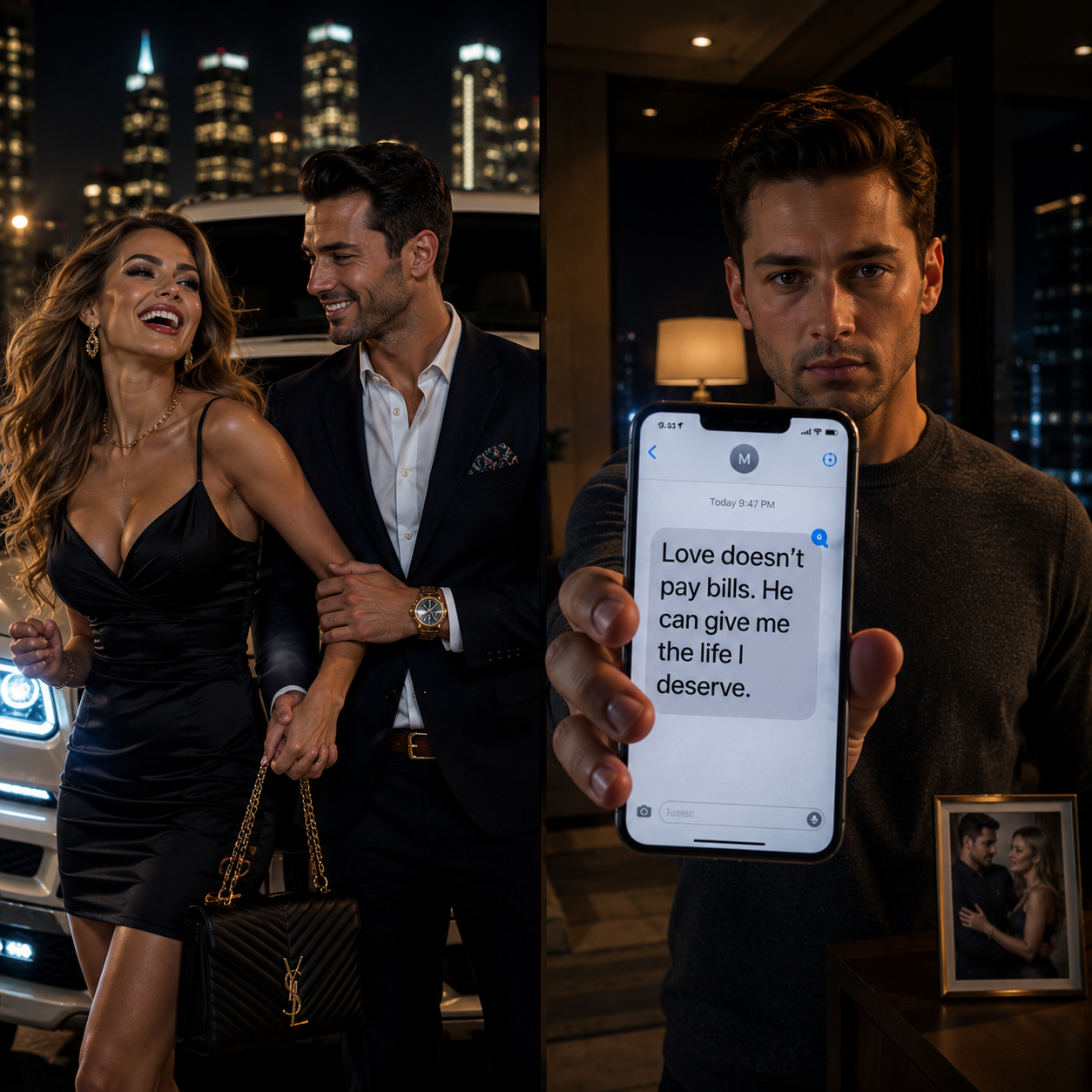

The first time Ava called me safe, I took it as a compliment.
We were lying on my couch on a rainy Sunday afternoon, two years before everything fell apart. She had her head on my chest, one hand tucked under my arm, and the television was playing some show neither of us cared about. I remember the rain tapping against the windows. I remember the smell of the soup I had made because she said her throat hurt. I remember how soft her voice sounded when she said, “You know what I love most about you, Mason?”
I smiled and asked, “My devastating good looks?”
She laughed and pressed her face into my shirt. “No. You make me feel safe.”
At the time, that felt like the best thing anyone had ever said to me.
I was thirty-two then, a financial systems consultant with a small but stable firm I had built from nothing. I was not flashy. I did not drive fast cars, wear loud watches, or turn every room into a performance. I liked budgets, quiet mornings, reliable plans, and people who meant what they said. I had spent most of my twenties building a life that did not require chaos to feel exciting.
Ava was the opposite. She was bright, beautiful, restless, and impossible to ignore. She worked in luxury hospitality marketing, which meant she knew every new restaurant before it opened and every person worth knowing before they became worth knowing. She could walk into a room full of strangers and leave with invitations, secrets, and someone offering her a job. She made life feel larger. I made life feel steady.
For a while, I thought that was balance.
I thought she brought color to my life and I brought peace to hers.
What I did not understand was that some people enjoy peace only after chaos has exhausted them. Once they recover, they start mistaking peace for boredom.
The shift happened slowly. It always does.
At first, safe meant loving. Then safe meant predictable. Then predictable became boring. Then boring became something she joked about. Then the jokes stopped sounding like jokes.
At dinner with her friends, she would say things like, “Mason is my emergency contact in human form.” Everyone would laugh, and I would smile because it sounded affectionate enough. At parties, she would introduce me by saying, “This is my fiancé, Mason. He’s the reason I have health insurance energy now.” People laughed at that too. Once, when her coworker asked what made me different from the men she used to date, Ava said, “Mason doesn’t make me cry in bathroom stalls. Growth, right?”
I laughed because everyone else did.
That is how people train themselves to accept small disrespect. You laugh the first time because the room does. You laugh the second time because you already laughed the first time. By the third time, your silence looks like permission.
The night she finally pushed too far was at her friend Serena’s birthday dinner.
It was one of those rooftop restaurants where the food came in portions too small to justify the price and every table had at least one person pretending not to take photos. Ava had spent two hours getting ready. She wore a deep red dress I had never seen before, the kind that made strangers look twice. I told her she looked beautiful. She smiled at herself in the mirror and said, “I know, but thank you.”
That should have warned me what version of her I was getting that night.
Serena’s friends were loud, stylish, and allergic to sincerity. I had met most of them before. They liked me well enough, in the way people like a comfortable chair in a room they rarely visit. I was useful when someone needed a ride, a restaurant bill split correctly, or calm advice after a bad decision. But I was not entertainment.
Ava was entertainment.
Halfway through dinner, after too much champagne, Serena started talking about an ex who had resurfaced and wanted “closure.”
“I know he’s terrible,” Serena said, laughing, “but terrible men are never boring.”
Ava lifted her glass. “Unfortunately true.”
Someone said, “That’s why you picked Mason, right? No offense, Mason.”
I looked up.
Ava leaned back in her chair, smiling.
“None taken,” I said, because apparently I had become fluent in swallowing things.
Serena grinned. “Come on, Ava. Be honest. Mason is the safe choice.”
Ava laughed.
Not softly.
Not defensively.
She laughed like the phrase delighted her.
“Oh, absolutely,” she said. “Mason is safe. That’s his brand.”
Everyone laughed.
I felt my face go warm, but I kept my expression neutral.
Ava turned toward me and touched my arm. “Babe, don’t look like that. Safe is good.”
“Is it?”
“Of course. Safe pays bills on time. Safe remembers oil changes. Safe brings soup when you’re sick. Safe doesn’t disappear for three days and then show up with a guitar and emotional damage.”
More laughter.
I knew exactly who she meant.
Derek.
Her ex.
The musician. The one with the motorcycle, the unpaid debts, the intense eyes, and the habit of calling at midnight when he was “in a dark place.” The man she swore she was done rescuing.
Serena raised her glass. “To safe men.”
Ava clinked her glass and said, “May every woman have one when she’s tired of being stupid.”
That one landed harder.
Not because it was the cruelest sentence in the world, but because of the timing. We were three months from the wedding. I had paid the venue deposit. I had helped her move out of an overpriced apartment when her lease ended. I had added her as an authorized user on my travel card because she wanted honeymoon points. I had covered her car repair two months earlier when she cried in my kitchen, saying she felt like her life was falling apart.
I had loved her in practical ways, and now she was making practicality sound like a consolation prize.
I set my fork down.
Ava noticed.
Her smile sharpened slightly. “Oh no. Mason’s doing his quiet face.”
Serena laughed. “What’s the quiet face?”
Ava put on a low, serious voice. “It means a spreadsheet is forming somewhere.”
The table laughed again.
I looked at the city lights beyond the rooftop glass and felt something in me pull back. Not break. Not explode. Just withdraw.
Ava touched my shoulder.
“Babe, come on. I’m joking.”
I looked at her.
She expected me to smile. She expected me to rescue the room from discomfort. She expected the safe man to do what safe men do: absorb the sharp edge and turn it into a joke so nobody else got cut.
So I smiled.
Small.
Controlled.
“Of course,” I said. “Safe is good.”
She relaxed.
She thought she had won.
But what she had actually done was teach me the difference between being someone’s peace and being someone’s backup plan.
After dinner, she was unusually affectionate in the car.
That was another pattern I had learned too late. When Ava knew she had gone too far, she became soft before I could become clear. She reached for my hand while I drove, laced her fingers through mine, and leaned her head against the seat.
“You know I didn’t mean it badly,” she said.
I kept my eyes on the road. “Didn’t you?”
“Mason.”
“Ava.”
She sighed. “I hate when you do that.”
“Do what?”
“Make me feel like I’m on trial.”
“I asked two words.”
“You know what I mean.”
I did.
What she meant was that my hurt was inconvenient.
“I don’t mind being safe,” I said. “I mind being talked about like safe is what you settled for.”
She turned toward the window.
“You’re overthinking it.”
Of course.
That phrase had become her favorite escape hatch.
“You always do this,” she continued. “You take a joke and make it heavy.”
“I’m not making it heavy. It was heavy when you said it.”
She laughed once, humorless. “Do you want me to apologize for appreciating you?”
“I want you to stop humiliating me and calling it appreciation.”
The car went silent.
When we got home, she took off her heels in the hallway and said, “Maybe if you were less sensitive, I wouldn’t have to walk on eggshells.”
Then she went upstairs.
I stood in the entryway for a long time, keys still in my hand.
Walk on eggshells.
That was what she called being asked not to mock me in public.
I went into the kitchen, poured a glass of water, and sat at the table. The house was quiet. My house. The one I had bought before I met her. The one she had started calling “our landing place” after the engagement. The one she planned to redecorate after the wedding because, according to her, it needed to feel “less bachelor-safe.”
There was that word again.
Safe.
I thought about everything safe had meant in our relationship.
Safe was me paying the emergency vet bill when her dog got sick before he passed.
Safe was me driving across town at midnight when she had a panic attack after Derek texted her.
Safe was me helping negotiate her salary when she was too anxious to ask for more.
Safe was me covering the last two months of her lease because she wanted to move in gradually.
Safe was me listening to her cry about chaotic men while never asking why she still answered them.
Safe was me believing that if I loved her consistently enough, she would stop mistaking instability for passion.
That night, I finally understood something.
Ava did not want safety as a home.
She wanted it as a station. A place to rest, refuel, and decide whether she missed the fire.
So I decided to show her what unsafe looked like.
Not danger. Not violence. Not cruelty.
Unsafe meant no more safety net.
No more quiet rescues.
No more emotional shelter.
No more money appearing when chaos arrived.
No more calm man standing behind her while she joked about him to people who would not show up when life got hard.
If she thought safe was boring, I would remove it completely and let her experience life without it.
I did not end things immediately.
That would have given her the dramatic scene she knew how to control. Ava was excellent in drama. Tears, speeches, accusations, public vulnerability, soft apologies that shifted blame without seeming to. If I left that night, the story would become, “Mason dumped me because I called him safe.”
She would leave out the pattern.
The disrespect.
Derek.
The bills.
The way she loved being protected but hated respecting the protector.
So I stayed quiet.
The next morning, I made coffee like usual.
Ava came downstairs wearing one of my sweatshirts.
She looked sleepy and soft, and for one second I hated myself for still loving her.
“Are you mad?” she asked.
“No.”
She studied me. “Really?”
“Really.”
She smiled, relieved, and kissed my cheek. “Good. I hate fighting with you.”
I almost said, “We didn’t fight. You insulted me and left.”
Instead, I said, “Me too.”
She poured coffee and began talking about wedding invitations.
I listened.
I nodded.
I let her think the safe man had reset overnight.
Then I started making quiet changes.
First, I separated the money.
Not illegally. Not cruelly. Just clearly.
We had a joint wedding account. I had contributed about eighty percent of it because Ava’s income was inconsistent after she left her hospitality job to freelance in brand consulting. She said freelancing gave her freedom. In reality, freedom often meant unpaid invoices and me covering groceries.
I opened the account history, downloaded every statement, and calculated contributions. Then I moved my exact remaining portion into a separate account titled “Wedding Hold.” I left hers untouched. I did not drain anything. I did not hide anything. I simply stopped leaving my money where her emergencies could reach it.
Second, I removed her from my credit card.
She was an authorized user on my travel card. I had added her for wedding expenses and honeymoon points. She had started using it for “shared future stuff,” which somehow included skincare, dresses, rideshares, and a $640 dinner with “potential clients” she never invoiced.
I called the bank.
“Remove authorized user?”
“Yes.”
“Do you want to cancel the card in her possession?”
“Yes.”
“Would you like a replacement card issued?”
“Yes.”
It took twelve minutes.
At 2:14 that afternoon, Ava texted.
“Did something happen to the card? It declined at Zara.”
I replied, “I removed you from it. We can discuss shared expenses through invoices going forward.”
Three dots appeared.
Disappeared.
Appeared.
Then she wrote, “Wow.”
Then, “That’s humiliating.”
Then, “It was for wedding outfits.”
I looked at the message.
Wedding outfits.
At Zara.
On a Tuesday.
I replied, “Send me the receipt if it is wedding-related.”
No response.
That night, she came home furious.
“You embarrassed me today.”
I was at the kitchen table reviewing vendor contracts.
“How?”
“My card declined in front of people.”
“My card declined.”
She blinked.
“What?”
“It was my card. You were an authorized user. I removed that access.”
Her eyes narrowed. “Because of one joke?”
“No.”
“Then why?”
“Because I’m cleaning up finances before the wedding.”
“That sounds like punishment.”
“It’s organization.”
“You’re being cold.”
“No. I’m being clear.”
She threw her purse onto a chair.
“I don’t like this version of you.”
I looked up.
“This version pays attention.”
Her face tightened.
For the first time, I saw uncertainty in her.
Good.
The second safety net I removed was emotional availability without accountability.
Derek texted her two nights later.
I knew because she told me, but only after I watched her smile at her phone and carry it into the laundry room.
She came back looking troubled.
“Derek’s going through something,” she said.
I closed my laptop.
“I’m sorry to hear that.”
“He says he’s in a really dark place.”
“That sounds like something he should discuss with a therapist.”
She stared at me.
“That’s harsh.”
“No. That’s appropriate.”
“Mason, he doesn’t have many people.”
“He has you?”
“He trusts me.”
“And you are engaged to me.”
Her expression shifted into wounded nobility.
“So I’m supposed to abandon someone who’s struggling?”
“No. You’re supposed to have boundaries.”
She crossed her arms.
“You used to understand this.”
“I used to mistake it for compassion.”
Her mouth opened slightly.
I continued, “If Derek is in danger, call emergency services. If he needs professional help, encourage that. But I’m not spending another night comforting you after you spend two hours emotionally caretaking your ex.”
She looked genuinely stunned.
“You’re jealous.”
“I’m tired.”
“That’s the same thing men say when they’re jealous but want to sound mature.”
I almost smiled.
“I’m going to bed.”
“You’re just going to leave me upset?”
“Yes.”
And I did.
That was the first night I did not follow her upstairs when she cried.
The world did not end.
The third safety net I removed was my labor.
Ava was terrible with logistics. Not because she was incapable, but because she preferred to be rescued from details. Her car registration. Health insurance paperwork. Tax documents. Vendor deadlines. Lease termination. Appointment scheduling. She called these things “life admin,” said they made her anxious, and somehow they always became mine.
So I stopped.
When the florist emailed asking for final approval on centerpieces, I forwarded it to Ava and wrote, “Please handle directly. You selected the design.”
When the caterer asked about menu revisions Ava wanted, I copied her and wrote, “Ava will confirm.”
When the hotel block deadline approached, I sent one reminder and did nothing else.
At first, she acted pleased.
“I’m glad you’re finally trusting me with wedding stuff,” she said.
“I am.”
By the end of the week, she was panicking.
“Mason, did you call the hotel?”
“No.”
“Why not?”
“You said you were handling guest accommodations.”
“I meant generally.”
“What does generally mean?”
She glared at me.
“You know weddings stress me out.”
“I do.”
“So why aren’t you helping?”
“I am helping. I’m letting you handle the parts you chose.”
“That’s not helping.”
“It’s not rescuing. There’s a difference.”
She stared at me like I had spoken another language.
Maybe I had.
For three years, my love had sounded like, “I’ll take care of it.”
Now it sounded like, “That’s your responsibility.”
She hated the translation.
Two weeks after the rooftop dinner, the real fracture appeared.
I came home early from a client meeting that ended sooner than expected. Ava was in the living room on speakerphone with Serena. She did not hear me enter.
Serena said, “So is safe boy still acting weird?”
Ava groaned. “Yes. It’s like I bruised his ego and now he’s trying to prove he’s not boring.”
Safe boy.
I stood in the hallway.
Serena laughed. “Honestly, I thought Mason would just apologize to you by now.”
“Same,” Ava said. “He usually does.”
There it was.
Not imagined.
Not insecurity.
Pattern, confirmed.
Serena asked, “What about Derek?”
Ava sighed. “I don’t know. He’s been texting more. It’s confusing.”
“Do you miss him?”
Silence.
Then Ava said, “I miss feeling wanted like that.”
I felt something sharp move through me.
Serena said, “Mason wants you.”
“Mason needs me,” Ava replied. “It’s different.”
That sentence did what the safe joke had started.
It ended the last argument inside me.
I walked into the living room.
Ava looked up and went pale.
Serena said, “Hello?”
I looked at Ava’s phone.
“Hi, Serena.”
Ava scrambled to turn off speaker. “Mason, I didn’t hear you come in.”
“I noticed.”
Serena hung up.
Ava stood quickly.
“That was taken out of context.”
“I didn’t say anything.”
“You’re looking at me like that.”
“Like what?”
“Like you’re judging me.”
“I am.”
That silenced her.
I had never admitted it before.
She swallowed. “You were eavesdropping.”
“I came home.”
“You listened.”
“Long enough.”
Her eyes filled. “Mason.”
“No.”
She froze.
“You don’t get to say my name like a reset button.”
Her face hardened.
“So what? You’re going to punish me again?”
“No. I’m going to clarify things.”
I walked to the dining table and picked up the folder I had prepared that morning.
Ava stared at it.
“What is that?”
“Records.”
She laughed nervously. “Of course. You and your records.”
“Yes.”
I opened the folder.
“Our wedding account. Contributions and balances. My credit card statements. Vendor contracts. The lease coverage I paid during your move. Your car repair. The freelance invoices I helped you collect. The emergency payments. The hotel block you missed. The florist deadline you missed. The card charges you called wedding-related.”
Her face changed with every sentence.
“Why are you doing this?”
“Because you keep calling me safe like it’s a weakness, but what you mean is useful. I’m showing you the structure underneath the life you keep mocking.”
“That sounds insane.”
“No. It sounds organized.”
“You’re making a spreadsheet out of our relationship.”
“You made a joke out of it first.”
She recoiled like I had slapped her.
I continued, “I’m ending the engagement.”
The room went silent.
Then she laughed.
Small. Disbelieving.
“No, you’re not.”
“Yes, I am.”
“Mason, stop.”
“I’ve already spoken with the venue. I know the cancellation terms. I’ve separated the wedding account based on contributions. I removed you from my credit card. You’ll have thirty days to move out. I’ll cover one month of storage because I don’t want chaos, but that’s it.”
Her mouth opened.
Nothing came out.
Then the tears.
“You’re doing this because I said safe?”
“No. I’m doing this because you meant it.”
“I didn’t.”
“You called me safe in public. You called me safe boy in private. You told Serena I need you. You keep Derek emotionally available while asking me to fund stability. You want the benefits of safety without respecting the man providing it.”
Her face twisted.
“I was venting.”
“You were honest.”
She stepped toward me.
“I love you.”
“I believe you love what I do for you.”
“That’s cruel.”
“No, Ava. Cruel is turning someone’s devotion into a punchline and then expecting them to keep showing up.”
She cried harder.
For once, I did not move to comfort her.
She noticed.
That hurt her more than the words.
“You’re really not going to hug me?”
“No.”
“You’ve changed.”
“Yes.”
“You’re unsafe now.”
I almost laughed.
“No,” I said. “I’m unavailable.”
She left that night to stay with Serena.
The next morning, the social campaign began.
Ava posted a vague story about men who punish women for choosing honesty. Serena posted something about emotionally fragile men confusing boundaries with control. Derek, apparently feeling brave, sent me a message saying, “You never deserved her if you could abandon her this easily.”
I screenshotted it and blocked him.
The vendor cancellations were painful but survivable. The venue kept a portion. The band was non-refundable. The florist, who had seen enough of Ava’s indecision to guess there was more to the story, refunded more than required. The honeymoon was mostly refundable because I had insisted on travel insurance. Safe, boring Mason had thought ahead.
Ava’s panic arrived in waves.
First, anger.
“You are humiliating me.”
Then bargaining.
“We can postpone instead of cancel.”
Then blame.
“You made me feel unsafe by changing overnight.”
Then desperation.
“I don’t know how to do all of this without you.”
That last one almost got me.
Almost.
Because I remembered the woman on my couch in the rain saying I made her feel safe. I remembered believing that meant she would protect that safety too. I remembered loving her with soup, spreadsheets, rides, money, patience, and the kind of loyalty that does not photograph well.
But then I remembered Serena’s voice.
Safe boy.
And Ava’s answer.
He usually apologizes.
So I did not reply.
I let my attorney respond where needed. I let the bank handle cards. I let vendors handle contracts. I let Ava experience the absence of the man she had mistaken for a background feature.
The first time she came back to the house, she looked exhausted.
No makeup. Hair tied back. Oversized sweater. She stood on the porch holding her keys like she was not sure they still worked.
“They don’t,” I said through the open door.
Her eyes widened. “You changed the locks?”
“After you moved most of your things and confirmed you were staying at Serena’s. Your remaining things are packed in the guest room. You can schedule a pickup.”
“This was my home too.”
“No. It was the place you lived while deciding whether safety bored you.”
She flinched.
“I deserved that,” she whispered.
That surprised me.
For the first time, she sounded less like she was performing and more like she had run out of performance.
I stepped onto the porch but did not invite her in.
She looked past me into the house. I had already started changing things back. The framed architectural prints she hated were back in the hallway. My old reading chair was in the living room again. The house looked less curated and more mine.
“You put that chair back,” she said.
“Yes.”
“I always thought it was ugly.”
“I know.”
A small, sad laugh escaped her.
“I was awful, wasn’t I?”
I said nothing.
She looked at me.
“I didn’t think of it that way when I said those things. I thought safe was good, but also… I don’t know. I think I resented needing it.”
“That doesn’t make it okay.”
“I know.”
I waited.
She swallowed.
“Derek is gone.”
“I’m not surprised.”
“He liked being the exciting option when you were the stable one. Once you left, he suddenly had opinions about my baggage.”
For the first time in weeks, I smiled. Not kindly, maybe. But honestly.
“That sounds like Derek.”
She wiped her eyes.
“I don’t know who I am without someone catching me.”
That was the most honest sentence she had ever said to me.
And that was the tragedy. Not that she was evil. Not that she had never loved me. But that she had built her identity around being rescued, then mocked the rescuer because needing him made her feel weak.
“I hope you find out,” I said.
Her face fell.
“You won’t help me?”
“No.”
“I don’t mean financially. I mean… as a person.”
“I know what you mean.”
“And?”
“I can’t be your safety net while you learn not to hate needing one.”
She cried then.
Quietly.
I let her.
Not because I wanted to hurt her, but because I finally understood that not every pain was mine to soothe.
She picked up her boxes two days later.
The house felt strange afterward. Bigger. Emptier. Mine.
For a while, I missed her constantly. That embarrassed me until my sister said, “You can miss a person and still be right to remove them.” I held onto that.
Three months later, my life looked boring from the outside.
Work. Gym. Dinner with my sister on Wednesdays. Sunday breakfast with my mother. Quiet evenings in the house Ava once called too safe. I repaired the back fence. I refinanced nothing. I booked a solo trip to Maine instead of the honeymoon in Italy. I read books in the ugly chair. I cooked meals that did not need to be photographed.
It was peaceful.
Peace feels boring when your nervous system is addicted to being useful.
Then, slowly, it starts to feel like freedom.
Ava emailed me six months after the breakup.
No drama. No excuses.
She wrote that she had started therapy. She apologized for turning my steadiness into something small because she did not know how to respect what she secretly depended on. She said the worst part was realizing that when things got hard after I left, the person she wanted to call was the same person she had taught to stop answering.
I read the email twice.
Then I replied with four sentences.
“I hope therapy helps. I appreciate the apology. I’m not angry anymore. Please take care of yourself.”
That was all.
Sometimes the cleanest ending is the one that does not reopen the door.
It has been a year now.
The wedding never happened. The house is mine again in every way that matters. The safe life I built is still standing, but it feels different because I no longer use it to shelter someone who laughs at the roof.
I used to think being safe was the highest compliment. Then Ava made it sound like a downgrade. Now I understand it is neither by itself. Safety is only beautiful when it is mutual. When one person provides it and the other person mocks it, safety becomes servitude.
She joked about me being safe.
So I showed her what unsafe looks like.
Not by hurting her. Not by becoming cruel. Not by turning into the chaotic men she used to call passion.
I simply removed the safety.
The money. The access. The rescue. The emotional shelter. The patient man who always stayed calm so she could fall apart. The fiancé who swallowed disrespect because he thought love meant being dependable no matter what.
I did not become dangerous.
I became unavailable.
And for Ava, that was the most unsafe thing of all.
![[FULL STORY] She Said “We’re Taking a Break” — So I Made It Permanent and Quietly Moved On](https://sa.greatgames.info/storage/thumbnails/1776693912_1.jpg)
![[FULL STORY] My Girlfriend Called Her Ex Her “Emotional Safe Place”… So I Let Him Keep Her](https://sa.greatgames.info/storage/thumbnails/1777712917_688066265_971849602202997_1023907789703165634_n.jpg)
![[FULL STORY] At Her Birthday Bash, My Girlfriend Got Tipsy, Tapped Her Glass, and Announced Loudly: 'Meet My](https://sa.greatgames.info/storage/thumbnails/1776920521_22.png)