

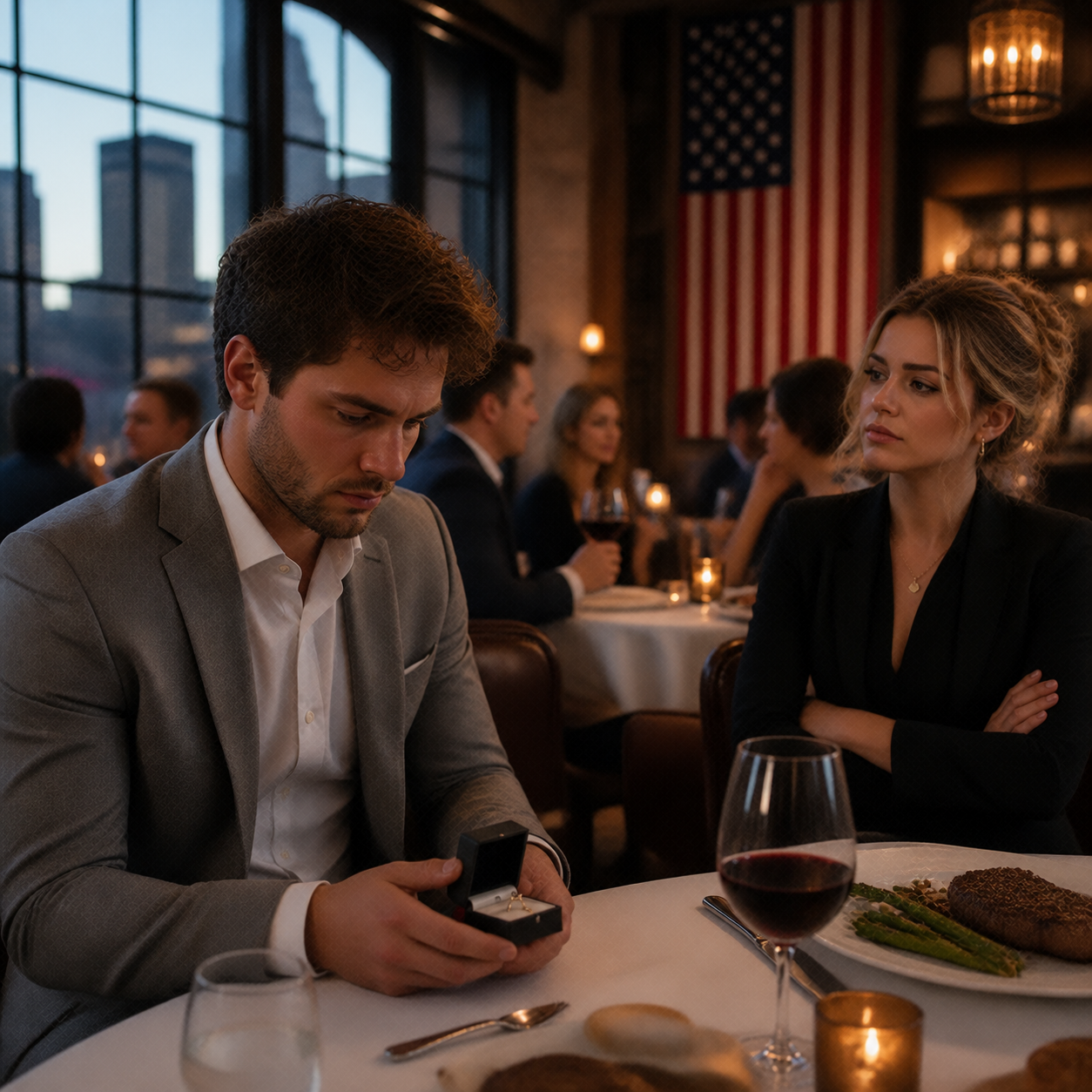
She called me replaceable at a dinner party I paid for.
That was the detail I kept coming back to later. Not the insult itself, not the laughter from her friends, not the way she leaned back in her chair afterward like she had just said something clever instead of cruel. It was the setting. My house. My dining room. My food. My wine. My name on the reservation for the private chef she insisted we hire because “presentation matters.” And there she was, sitting at the head of my table, smiling at six people who barely knew me, telling them I was replaceable.
It happened on a Friday night, three months before our wedding. My fiancée, Vanessa, had decided we needed to host what she called “an intimate pre-wedding gathering” for her closest friends. In normal human language, that meant a dinner where I cooked emotionally, paid financially, and performed socially. Vanessa worked in luxury event branding, which meant everything in her life had to look like it belonged in a magazine spread. Candles placed at uneven heights. Linen napkins folded casually but not actually casually. Music low enough to feel tasteful but loud enough that silence could never get comfortable.
I was thirty-four, a structural engineer, and I owned a small but growing firm that designed and inspected commercial renovations. Not glamorous work. Not the kind of job that made people lean forward at cocktail parties. But it paid well, it was honest, and it allowed me to buy the old brick townhouse Vanessa loved to describe as “ours” whenever people complimented it and “Adrian’s bachelor cave” whenever she wanted permission to change something.
We had been together four years, engaged for nine months. I loved her. That is important to say, because people hear stories like this and assume the ending was inevitable from the beginning. It never feels inevitable when you are inside it. Inside it, every red flag looks like a misunderstanding with good lighting.
Vanessa was beautiful, charming, and terrifyingly good at making people feel chosen. When we met, she made me feel like the quiet parts of me were interesting instead of awkward. She used to say she loved how steady I was. She loved that I did not chase attention. She loved that I could sit with discomfort instead of filling every room with noise. Later, those same qualities became evidence against me. Steady became boring. Quiet became passive. Private became socially underdeveloped. Reliable became predictable.
At dinner that night, everything was going well until her friend Lila started talking about marriage as if it were a corporate merger with better flowers.
“I just think women have to be careful,” Lila said, swirling her wine. “You can love someone and still make sure you’re not tying yourself to dead weight.”
Vanessa laughed. “Exactly.”
I looked up from pouring water.
Dead weight. That was a strong phrase to laugh at when your fiancé was standing three feet away.
Lila continued, “Not saying that’s Adrian, obviously.”
Obviously. The word landed too late.
Vanessa smiled over the rim of her glass. “Adrian is fine.”
Fine.
Her friend Marcus, not an ex, just one of those men who orbited her social circle like a decorative threat, grinned. “Fine? Three months before the wedding? Brutal.”
Everyone laughed.
I forced a smile because that was what I did. I softened sharp things so other people would not cut themselves on the truth.
Vanessa looked at me then, eyes bright with wine and performance. “Don’t worry, babe. You know I love you.”
“I wasn’t worried,” I said.
That should have been the end of it.
It wasn’t.
Lila leaned closer, delighted by the tension. “No, but seriously. Vanessa could have married anybody. You know that, right?”
Something moved through the room. A small shift. The kind that happens when everyone senses a joke has stepped too close to a cliff but no one wants to be the first to say so.
Vanessa did not step back.
She smiled.
“That’s why Adrian is lucky,” she said. “Men like him are replaceable. Women like me are not.”
There it was.
Clear.
Clean.
Public.
The sentence hit the table harder than if she had thrown her glass.
A few people laughed because they did not know what else to do. Marcus laughed the loudest. Lila covered her mouth, but her eyes were shining. Someone said, “Oh my God, Vanessa,” in the same tone people use when they want to condemn something without stopping it.
I stood there with the water pitcher in my hand and looked at the woman I was supposed to marry.
She looked back at me, still smiling, waiting for me to absorb the humiliation and turn it into a joke.
The old me would have.
The old me would have said something like, “Good thing I renewed my warranty,” and everyone would have laughed and the night would have continued. Vanessa would have squeezed my arm later and told me I was too sensitive if I brought it up. I would have apologized for making her feel criticized. Somehow, by morning, her insult would have become my insecurity.
But that night, something inside me shifted.
Not loudly.
Not dramatically.
It was more like a door closing somewhere deep in the house.
I set the pitcher down.
“Good to know,” I said.
Vanessa blinked. Just once.
Then she laughed lightly. “See? He gets my humor.”
I did not correct her.
I smiled enough to keep the room moving. I finished serving dessert. I poured coffee. I helped find coats. I thanked people for coming. Vanessa glowed again once she realized I was not going to ruin her evening by having feelings in public.
When the last guest left, she kicked off her heels in the living room and sighed. “That went well.”
I was loading glasses into the dishwasher.
“Did it?”
She turned. “What does that mean?”
“Nothing.”
“No, say it.”
I closed the dishwasher.
“You called me replaceable in front of your friends.”
She rolled her eyes. “Adrian.”
“That happened.”
“It was a joke.”
“Was it?”
“Yes. Obviously.”
“I didn’t find it funny.”
Her face changed, not into guilt, but irritation. “You’re really going to do this tonight?”
“Do what?”
“Turn one stupid comment into some emotional audit.”
I almost laughed. Emotional audit. That was such a Vanessa phrase. A polished label stuck over a bruise.
“I’m telling you it hurt me.”
She crossed her arms. “And I’m telling you you’re overreacting.”
I nodded slowly.
There it was. The familiar circle.
She says something cruel. I say it hurt. She says I’m too sensitive. I try to explain. She gets offended by the explanation. I apologize for the argument. She forgives me for reacting to her behavior.
Not tonight.
“Okay,” I said.
Her eyes narrowed. “Okay?”
“Okay.”
“That’s it?”
“Yes.”
She studied me like I was a machine making an unfamiliar sound.
Then she walked past me toward the stairs. “Fine. Sulk if you want. I’m exhausted.”
I waited until I heard the bedroom door close.
Then I sat at the dining table, surrounded by empty wine glasses and candle wax, and looked at the place where she had smiled while calling me replaceable.
It is strange what finally breaks you.
It was not the biggest insult. It was not the first disrespect. It was not even the worst thing she had ever said.
It was the audience.
She had wanted witnesses. She had wanted laughter. She had wanted the room to agree that my value came from her choosing me. And for the first time, I understood that she did not see me as a partner.
She saw me as a role.
Provider. Stabilizer. House owner. Problem solver. Social accessory when needed. Punchline when useful.
A role can be recast.
A man can leave.
So I decided to replace her role in my life completely.
Not with another woman. That would have been too easy and too messy. I replaced the functions she had convinced me only she could perform. The social calendar. The wedding planning. The emotional approval. The curated home. The version of myself that waited for her to decide whether I was enough.
I did not leave the next day. That would have been dramatic, and Vanessa understood drama. She knew how to win drama. Tears, accusations, public posts, carefully chosen words like “abandonment” and “emotional withdrawal.” If I left in anger, she would turn it into proof that she had been right about me all along.
So I stayed calm.
I woke up Saturday, made coffee, and asked if she wanted eggs.
She came downstairs in my sweatshirt, hair messy, face soft in the morning light. For a second, I saw the woman I had loved before she learned how much I would tolerate.
“Are you still mad?” she asked.
“No.”
She watched me carefully.
“Good. I hate when we’re weird.”
“We’re not weird.”
She smiled, relieved. “Thank you. I knew you understood.”
I set her coffee down in front of her.
“I do.”
And I did.
I understood perfectly.
The first thing I replaced was her control over the wedding.
Vanessa had taken over everything, which was fine at first because she was good at it. Then “good at it” became “entitled to decide everything.” My guest list shrank because my cousins were “too casual.” My mother’s dress color was rejected because it “clashed with the palette.” My best man’s speech had to be reviewed because Vanessa did not trust him to be “on tone.” Even my suit became a debate because she wanted me in ivory, and I wanted to look like a groom, not a decorative candle.
On Monday morning, I called the venue coordinator.
“Hi, this is Adrian Cole. I’m calling about the Cole-Lang wedding in June.”
“Oh, yes, Adrian. What can I do for you?”
“I’d like a full copy of all contracts, payment schedules, cancellation terms, and vendor contacts sent to my personal email.”
There was a pause.
“Of course. Is everything okay?”
“Just organizing my records.”
That phrase became my shield.
Organizing my records.
I called the florist. The photographer. The caterer. The band. The hotel block. The honeymoon resort. Every single vendor.
By Wednesday, I knew what Vanessa had signed, what I had paid, what was refundable, what was not, and which accounts were in my name.
Unsurprisingly, most of the expensive things were in my name because my credit was better and my card had a higher limit. Most of the design decisions were in hers because she cared about control more than liability.
The second thing I replaced was her control over my house.
When Vanessa moved in after our engagement, she described it as “bringing the house into its next chapter.” That meant my leather chair disappeared into storage because it was “visually heavy.” My father’s framed drafting tools came down because they made the hallway feel “like a museum.” The old dining table my grandfather built was replaced with a marble one that stained if water sat on it too long. She said she wanted the house to feel like us, but somehow us always looked like her.
I called my storage unit and had my chair delivered to my office.
Then I called a locksmith and scheduled a future rekey for the week after my planned exit.
Not immediate. Not yet.
Just scheduled.
I reviewed the deed. My name only. Purchased before the relationship. Paid by me. No shared ownership. No mortgage contribution from Vanessa. She had paid for some decor and half of utilities occasionally, but nothing that gave her a claim.
Still, I called my attorney, Mara Singh.
Mara had handled the purchase of my firm’s office space. She was sharp, direct, and allergic to romantic nonsense in legal contexts.
After I explained the situation, she said, “Do you intend to marry her?”
“No.”
There was a silence. Not surprised. Assessing.
“Does she know that?”
“No.”
“Good.”
That startled me.
“Good?”
“If she has already humiliated you publicly and depends on narrative control, telling her before you secure documentation will make your life harder. Gather records. Do not move shared money unfairly. Do not threaten. Do not destroy property. Do not lock her out illegally. Give proper notice if she lives there. And Adrian?”
“Yes?”
“Do not sleep with her again.”
I blinked.
“I wasn’t planning to.”
“Good. People make complicated mistakes when they confuse grief with tenderness.”
That sentence stayed with me.
The third thing I replaced was the emotional space she occupied.
That was hardest.
Vanessa had trained me to bring every question back to her. Did this shirt look right? Was this dinner too casual? Should I invite that client? Was I being too blunt in that email? Would people think less of me if I skipped an event? She called it helping. Maybe at first it was. But over time, her approval became the checkpoint I passed through before making decisions.
So I stopped asking.
I bought the gray suit I wanted for the wedding, knowing I would never wear it there. I put my father’s drafting tools back on the wall in my office. I invited my mother to dinner without asking Vanessa if we had plans. I told my assistant to stop forwarding nonessential event emails to Vanessa. I hired a part-time operations coordinator for my firm, something Vanessa had always opposed because she said I “liked feeling overwhelmed.”
The coordinator’s name was Priya. Within three days, she had reorganized my calendar better than Vanessa ever had and did it without making me feel incompetent.
That was when I realized something embarrassing.
I had mistaken criticism for support because both involved attention.
By the second week, Vanessa sensed something had changed.
Not enough to understand.
Enough to be annoyed.
“You’ve been different,” she said one night while scrolling on her phone in bed.
“How?”
“I don’t know. Detached.”
“I’ve been busy.”
“You’re always busy. This is different.”
I folded my shirt and placed it in the drawer.
She looked up. “Are you still upset about the dinner?”
“No.”
“Because I already told you it was a joke.”
“I know.”
Her eyes narrowed. “You’re doing that thing again.”
“What thing?”
“Acting calm when you’re actually judging me.”
I looked at her.
“I’m not judging you.”
That was not entirely true. I was judging her. I was simply finished announcing the verdict.
She sat up. “Adrian, if you’re going to be passive-aggressive for weeks because I made one joke, that’s not fair.”
“You’re right.”
That stopped her.
“I am?”
“Yes.”
She softened. “Then come here.”
Mara’s warning echoed in my head.
Do not sleep with her again.
I said, “I’m tired.”
Her softness vanished.
“Of course you are.”
I slept in the guest room that night.
The next morning, she was sweet. Too sweet. Pancakes, coffee, hand on my shoulder, kiss on my cheek. She told me she loved me. She told me wedding stress was making her sharp. She told me I was her safe place.
Safe place.
That phrase once would have melted me.
Now it sounded like storage.
The final straw came ten days after the dinner party.
I was in my office, reviewing a structural report, when my assistant knocked.
“Adrian,” she said carefully, “Vanessa is here.”
I looked up.
“She didn’t have an appointment?”
“No.”
Vanessa swept in before I could answer, wearing a cream blazer and carrying a tablet. She smiled at Priya with the kind of politeness that counts as aggression when done correctly.
“Hi,” Vanessa said. “You must be the new assistant.”
Priya smiled. “Operations coordinator, actually.”
Vanessa’s smile tightened.
I stood. “Vanessa, what are you doing here?”
“We need to talk about the wedding timeline. Also, I wanted to meet her.”
Her.
Priya looked at me once, understood more than I wanted her to, and said, “I’ll give you privacy.”
When the door closed, Vanessa set the tablet on my desk.
“You hired someone without telling me.”
“For my company.”
“You used to discuss staffing with me.”
“I used to be understaffed.”
Her eyes flashed.
“Don’t be cute.”
“I’m not.”
“She’s very polished.”
“She’s competent.”
“Is that what we’re calling it?”
I stared at her.
There it was. The implication. The pivot. If she could not control the role, she would contaminate the person filling it.
“Vanessa.”
“What? I’m allowed to notice when my fiancé suddenly hires a young woman and stops talking to me.”
“She is an employee. Don’t do that.”
“Do what?”
“Turn someone’s professionalism into your insecurity.”
Her mouth opened slightly.
I had never spoken to her that way before.
She recovered quickly. “Wow. So this is who you are now?”
“No. This is who I was before I kept shrinking to avoid your reactions.”
The room went silent.
For a second, I thought everything would happen there. The confrontation. The end. The explosion.
Then she laughed.
Cold.
Mean.
“There he is,” she said. “The brave little man with his new assistant.”
I felt nothing.
That was new.
She leaned over my desk. “You know what your problem is, Adrian? You think replacing little tasks means you can replace me. But you can’t. I built your life. I made you presentable. I made that house worth visiting. I made people take you seriously.”
I looked at her.
There it was again.
The belief that I existed properly only after she arranged me.
“You called me replaceable,” I said.
She rolled her eyes. “Are we still on that?”
“Yes.”
“It was a joke.”
“No. It was a confession.”
Her face hardened.
I opened my desk drawer and took out a folder. Not dramatic. Not thick. Just enough.
“What is that?” she asked.
“Records.”
She laughed once. “Of course.”
I placed the folder on the desk.
“I’m ending the engagement.”
The room became very still.
For the first time since I had known her, Vanessa had no immediate response.
Then she smiled.
Not happy. Dangerous.
“No, you’re not.”
“Yes, I am.”
“Adrian, don’t be ridiculous.”
“I’ve already contacted vendors. Anything in my name will be canceled today. Anything in yours, you can handle. Mara will send you formal notice about moving out of the house. You’ll have thirty days, which is more than legally required because I don’t want chaos.”
Her face changed color.
“You planned this?”
“Yes.”
“For how long?”
“Since the dinner party.”
Her voice sharpened. “So you’ve been lying to me.”
“I’ve been organizing my records.”
That sentence made her furious.
“You coward.”
“No.”
“You let me keep planning a wedding.”
“You kept planning a wedding after telling a table full of people I was replaceable.”
“It was a joke.”
“Then you should have apologized like it wasn’t funny.”
She stared at me.
I continued, “You were right about one thing. Roles can be replaced. You handled the social calendar. Priya handles it now. You controlled the wedding. Canceled. You curated my house. I’m restoring it. You decided my worth depended on how well I reflected on you. I’m done applying for approval.”
Her eyes filled with tears.
Not instant this time. Realer. Angrier.
“You can’t just erase me.”
“I’m not erasing you. I’m removing you.”
She slapped the folder off my desk. Papers slid across the floor.
Priya opened the door immediately.
“Everything okay?” she asked.
Vanessa turned on her. “Get out.”
I said, “Priya, please call building security.”
Vanessa looked at me like I had become a stranger.
“You would embarrass me like this?”
“You came to my office unannounced and insulted my employee.”
“She’s not your employee. She’s your replacement.”
I nodded once.
“In one sense, yes.”
That landed.
Security arrived three minutes later. Vanessa left without being touched, which I was grateful for, but not before saying loudly enough for the hallway to hear, “You’ll regret this when you realize nobody else will put up with you.”
That line stayed with me.
Not because it hurt.
Because it was her entire worldview in one sentence.
Love, to Vanessa, was someone putting up with you.
Not choosing you. Not respecting you. Not growing with you.
Enduring you, with good lighting.
The cancellation calls took four hours.
The venue coordinator was shocked. The florist was apologetic. The photographer asked if I was sure. The band kept the deposit. The honeymoon resort refunded sixty percent. Vanessa called twenty-nine times before I finished.
Then came the texts.
You are having a breakdown.
You are punishing me over one joke.
My parents are humiliated.
You owe me for the deposits.
You cannot make unilateral decisions about our wedding.
I did not respond.
Mara did.
By evening, Vanessa had posted online.
A photo of her hand without the ring, captioned: “Sometimes the person you love punishes you for being honest about what you need.”
I stared at it for maybe ten seconds.
Then I closed the app.
The old me would have wanted to defend myself immediately. The new me knew better. People who perform pain publicly are not always looking for truth. Sometimes they are looking for the first draft of sympathy.
Unfortunately for Vanessa, her dinner party had witnesses.
Lila messaged me the next morning.
“I’m sorry,” she wrote. “I should have said something when she called you replaceable. It wasn’t okay.”
I replied, “Thank you.”
Then Marcus messaged.
Not her ex Marcus. Her dinner party Marcus.
“Man, I think you’re overreacting. Vanessa talks big, but she loves you.”
I replied, “Then she can love me from elsewhere.”
He did not answer.
By noon, my mother called.
“Adrian,” she said, “Vanessa’s mother called me.”
I closed my eyes.
“What did she say?”
“That you blindsided Vanessa and canceled the wedding over a joke.”
“I didn’t.”
“I know.”
I opened my eyes.
“You do?”
My mother sighed. “Honey, I was at Christmas when she told your uncle you’d still be living like a graduate student if she hadn’t rescued your taste. I was at your birthday when she corrected how you told your own work story. I was there when she made you take down your father’s drafting tools because they ruined the hallway. I have been quiet because I thought you were happy.”
I sat down.
“I thought I was too.”
There was a pause.
Then my mother said, “Are you okay?”
For the first time in two weeks, I cried.
Not loudly. Not dramatically. Just the kind of crying that happens when someone finally asks the question you have been avoiding.
“No,” I said.
“Then come over for dinner.”
“I have calls.”
“Adrian.”
I laughed through tears.
“Okay.”
Dinner at my mother’s house was spaghetti, garlic bread, and no one asking me to be impressive. She did not tell me I was brave. She did not tell me Vanessa was evil. She just sat across from me and said, “Sometimes love becomes a habit before you notice it stopped being safe.”
That sentence saved me a little.
The next month was ugly in practical ways.
Vanessa refused to move out at first. Mara sent formal notice. Vanessa claimed she had contributed to the home’s value because she had “curated” it. Mara replied with receipts showing that I had paid for all renovations, repairs, mortgage, taxes, insurance, and major furnishings. Vanessa had purchased decor, removable art, bedding, and some light fixtures she was welcome to take.
She took all of them.
Including two lamps I hated and one mirror I loved. I let it go.
She tried to claim half the honeymoon refund because “the trip was for both of us.” Mara reminded her I paid for it. Vanessa then demanded reimbursement for emotional distress. Mara did not dignify that with more than one paragraph.
The social fallout was stranger.
Some people believed her. Some believed me. Some did not care but enjoyed the drama. I learned quickly that defending yourself to people committed to misunderstanding you is just unpaid labor.
So I stopped.
I focused on my firm. Priya turned out to be even better than expected. Within six weeks, my calendar was functional, my proposals were cleaner, and my client follow-up improved. I hired another junior engineer. We landed a contract I had been chasing for months. The house slowly transformed too. My leather chair returned to the living room. My grandfather’s dining table came out of storage. My father’s drafting tools went back on the hallway wall.
The first night everything was back in place, I stood in the doorway and stared.
The house looked less impressive.
It looked more like me.
That felt better.
Vanessa came by once after moving out. I was in the front yard, trimming the hedge she had always hated because it looked “too neighborly.”
She parked at the curb and got out wearing sunglasses too large for the weather.
“We need to talk,” she said.
“No, we don’t.”
Her mouth tightened. “I found a box of your things.”
“Leave it on the porch.”
“That’s it?”
“Yes.”
She took off the sunglasses.
For once, she looked tired instead of styled.
“You really replaced me.”
I set down the clippers.
“No. I replaced the things you used to control.”
“That’s the same thing.”
“It shouldn’t be.”
She looked toward the house. Through the front window, she could probably see the old dining table.
“You put that ugly table back.”
“Yes.”
“It makes the room look heavy.”
“It makes the room feel like home.”
Her eyes flashed, but the old power was gone. Insults need a listener who still wants approval.
She said, “You’ll miss me.”
“I already did.”
That confused her.
I continued, “I missed you while we were still together. I missed the woman who used to like me before she decided I was a project.”
For a moment, her face softened.
Then pride returned.
“I did improve your life.”
“You improved how it photographed.”
That one landed.
She put the sunglasses back on.
“You know, most men would be grateful for what I did.”
“Then find one.”
She laughed, but it shook at the edges.
“You’re colder than I thought.”
“No,” I said. “I’m warmer than you deserved. That was the problem.”
She left the box on the porch and drove away.
Inside were two sweaters, a book, and a framed photo of us from our engagement party. In the picture, she was laughing at something off camera. I was looking at her like she was the only person in the room.
I kept the frame for a week.
Then I took the photo out and threw it away.
The frame was nice.
No reason to waste everything.
It has been eleven months now.
The wedding never happened. Vanessa moved into a luxury apartment downtown and, according to mutual acquaintances, tells people we “grew apart because Adrian couldn’t handle a strong woman.” That is fine. If calling cruelty strength helps her sleep, that is between her and whatever mirror still believes her.
My life is smaller now in some ways. Fewer parties. Fewer curated dinners. Fewer people who know the right wine glass but not how to apologize.
It is larger in others.
Sunday dinners with my mother. Late nights in my office because I want to be there, not because I am avoiding my own house. Friends who sit on my mismatched furniture and laugh too loudly. A hallway that finally has my father’s drafting tools back where they belong.
Priya once asked if I regretted canceling everything so close to the wedding.
I thought about it.
The deposits. The embarrassment. The awkward calls. The empty side of the closet. The silence after Vanessa left.
Then I thought about the dinner party.
Men like him are replaceable.
Women like me are not.
“No,” I said. “I regret not believing her sooner.”
Because that is the thing about cruel honesty. Sometimes people tell you exactly how little they value you, and love convinces you to translate it into something softer.
I do not translate anymore.
If someone calls me replaceable, I believe them. Not because they are right about my worth, but because they have revealed the size of the place they made for me in their life.
Vanessa thought being irreplaceable meant being admired, desired, envied, impossible to lose.
She was wrong.
Being irreplaceable is not about how loudly someone claims they matter. It is about what remains better because they are there.
When Vanessa left, my life did not collapse. It exhaled.
The house became warmer. The business became stronger. My friendships became quieter and more honest. My mother smiled more when she visited. Even I changed. I stopped asking for approval before making ordinary choices. I stopped apologizing for liking what I liked. I stopped dressing my life for an audience that never loved me.
She called me replaceable.
So I replaced her role in my life completely.
Not with another woman. Not with revenge. Not with some dramatic upgrade meant to prove I had won.
I replaced her with peace.
And unlike Vanessa, peace never needed to insult me to feel important.
![[FULL STORY] My Fiancée Spent 2 Years Calling Me Forgettable — Then My Absence Exposed the Truth](https://sa.greatgames.info/storage/thumbnails/1776851976_c01fecb6-c928-4c72-960b-caf65fae018b.png)

![[FULL STORY] He Called My Daughter “Not Gifted”… My Grandfather Ended It in One Sentence](https://sa.greatgames.info/storage/thumbnails/1777707107_687999908_993338103218392_4846595946212261346_n.jpg)

![[FULL STORY] My Girlfriend Humiliated Me At Her Family Barbecue By Rejecting Marriage To My Face, So I Blocked Her And Handed Her The Ring Box In Front Of Her Entire Office.](https://sa.greatgames.info/storage/thumbnails/1776847485_10.png)