
My girlfriend Jessica did not have a normal relationship with photos.
Most people took a picture, checked if their eyes were open, maybe adjusted the brightness, and moved on with their lives. Jessica treated every photo like it was evidence in a trial where her beauty had to be defended before the entire internet. Nothing could be posted casually. Nothing could exist naturally. Every image had to be corrected, polished, reshaped, softened, sharpened, brightened, slimmed, smoothed, and approved by her before anyone else was allowed to see it.
At first, I thought it was harmless.
Everybody edited photos a little. Good lighting, a cleaner crop, maybe removing red eyes or fixing a weird shadow. That seemed normal enough. But with Jessica, it went far beyond normal. She used apps the way some people used mirrors. She would sit on the couch for twenty minutes after brunch, silently changing her own face while the food got cold and everyone else had already forgotten the picture existed.
She made her skin look like glass. She made her eyes bigger. She narrowed her nose, lifted her cheeks, sharpened her jaw, and slimmed her waist until she looked like a luxury perfume ad pretending to be a human being. Sometimes I would see her finished Instagram post and stare at it for a few seconds, not because she looked bad, but because she barely looked like Jessica anymore.
Her own mother once saw one of her photos and asked, “Who is that pretty girl with you?”
I thought she was joking.
She wasn’t.
“That’s Jessica,” I said.
Her mother leaned closer to my phone, squinting.
“No, it isn’t. Jessica’s face is rounder than that.”
“It’s edited,” I explained.
“What do you mean edited?”
“She uses an app. It changes her face a little.”
Her mother stared at me like I had just explained witchcraft.
“Why does she look like a Korean pop star?”
I didn’t know how to answer that without making everything worse.
For a while, I tried to ignore it. I loved Jessica, and I understood that social media could mess with people’s heads. She was beautiful without filters, but she didn’t believe it. Every time I told her she looked good naturally, she would laugh like I was being sweet but useless, the way people smile at a child who says something impossible.
Then her obsession started reaching me.
At first, it was subtle.
“Can you brighten this one? The lighting makes you look tired.”
Fine. Brightening was harmless.
Then it became, “Can you smooth your skin a little? Your pores are really visible.”
That felt strange.
Then came, “Your jawline looks soft here. Use the sculpt tool. Just a little.”
That was where I started getting uncomfortable.
“I don’t want to sculpt my face,” I told her.
She rolled her eyes. “It’s not a big deal. Everyone does it.”
“I don’t.”
“Well, maybe you should.”
I worked in IT. I stayed up late. I drank too much coffee. Sometimes I looked tired because I was tired. That was my face. I wasn’t trying to become an influencer. I wasn’t trying to convince strangers online that my skin had never seen a stressful email.
But Jessica cared.
If I posted a normal couple photo, she would text me within minutes.
Delete that.
Why?
You didn’t edit it.
I look fine.
You look exhausted. It makes the picture look bad.
Eventually, I stopped posting photos of us at all.
Then she started refusing to take them with me.
The argument that changed everything happened after dinner one Friday night. We took a selfie outside the restaurant under warm streetlights. I thought it was a nice picture. She looked happy. I looked like myself. Maybe a little tired, sure, but happy.
I went to post it.
She grabbed my wrist.
“Don’t post that.”
“Why?”
“You know why.”
“No, Jessica. I really don’t.”
She pointed at my face on the screen.
“You look too tired. Fix your face.”
I stared at her.
“My face is fine.”
“It’s not. Just smooth the skin and brighten your eyes.”
“I don’t want to.”
“Why are you being difficult?”
“Because I don’t want to edit myself until I look fake.”
She crossed her arms.
“Then I’m not taking photos with you anymore.”
I laughed once because I thought she was exaggerating.
She wasn’t.
“I’m serious,” she said coldly. “If you’re going to post pictures where you look bad, I don’t want to be in them. It makes me look bad by association.”
That sentence hit harder than I expected.
Not because it was dramatic, but because she meant it.
“You won’t take photos with me unless I use Facetune?” I asked.
“Correct.”
“Fix your face or you’re out?”
She lifted her chin.
“Basically.”
I nodded slowly.
“Fine,” I said. “I’ll fix it.”
She smiled like she had won.
But she had misunderstood me.
For the next three weeks, she refused to take pictures with me. Dinner with friends, no couple photo. Beach day, no photo. Her cousin’s wedding, where we were both dressed formally and standing in front of a professional photographer, still no photo.
“He refuses to use filters,” she told people, like I had committed some kind of social crime.
I let her say it.
The thing about being mocked long enough is that eventually your embarrassment turns into planning.
Her birthday was coming up on July 22nd. She was turning twenty-six, and according to Jessica, this birthday had to be “aesthetic.” That was the word she used for everything now.
The cake had to be aesthetic.
The restaurant had to be aesthetic.
The outfits had to be aesthetic.
Even the guests apparently needed to stand in places where the background looked expensive enough for Instagram.
She hired a professional photographer for the dinner. Eight hundred dollars just to capture her birthday in the exact way she wanted people online to believe it happened.
That gave me an idea.
A month before her birthday, we had gone to a food festival. Jessica had dressed perfectly for it, of course. Cute outfit, perfect makeup, camera ready. She planned to take photos with food trucks, flowers, string lights, anything that could become content.
At one point, she was eating a churro covered in powdered sugar. I pulled out my phone to take a quick candid photo.
Right as I clicked the button, she sneezed.
The photo was unbelievable.
Her eyes were squeezed shut. Her mouth was open. Her chin had folded from the angle. A little churro grease shined on her skin. Powdered sugar floated around her face like a cloud of chaos. Her hair had flown forward from the sneeze.
It was not beautiful.
It was better than beautiful.
It was real.
Jessica demanded I delete it immediately.
“Give me your phone.”
“No. Let me see it first.”
“Delete it.”
“It’s funny.”
“It’s hideous.”
She tried grabbing my phone, but I held it above my head. I was six-foot-two. She was five-foot-four. She jumped in the middle of the food festival while strangers watched us like street performers.
“Delete it now,” she hissed.
“Okay, okay.”
I opened my camera roll, showed her the photo, and deleted it in front of her.
She relaxed.
What she didn’t know was that I had already sent it to myself.
That photo was backed up in more places than my tax records.
When she started planning her birthday, I remembered it.
Two weeks before the party, I showed her the picture again.
Her face twisted with horror.
“You said you deleted that.”
“I did from my phone. It backed up.”
“Delete it again.”
“I want to use it for something on your birthday.”
“Absolutely not.”
“Come on. It’s funny.”
“It is not funny.”
“It’s human.”
She glared at me.
I pulled out a model release form. A real one from the billboard company I had already contacted.
“If you sign this, I’ll use it as a surprise. Could be a party decoration. Could be a slideshow. Could be a poster. I won’t post it on my own account.”
She hesitated.
“Nothing too embarrassing,” she said.
“Define too embarrassing.”
“No posting it online.”
“I won’t post it on my accounts.”
She signed.
Maybe she thought I was joking. Maybe she thought the surprise would be small enough to control. Maybe she had become so used to managing every image of herself that she forgot the world outside her apps didn’t come with a smooth tool.
I called the bakery first.
Jessica had ordered a perfect white fondant cake with gold accents and fresh flowers. I added the sneeze photo as an edible print in the center. The bakery hesitated until I sent them the signed release.
Then I called the photographer, Marcus.
“I want you to take candid photos,” I told him. “Real ones. No filters. No smoothing. High resolution.”
He paused.
“Is this going to cause problems?”
“Probably.”
“Am I going to get sued?”
“No. You’re hired as a party photographer. Candid photos are normal.”
He still sounded nervous, but when I offered to pay his full rate again as a bonus, he agreed.
Then came the main event.
Times Square.
A digital billboard company allowed short personal birthday messages. It was expensive, but not impossible. I booked a prime Saturday night slot at 8 p.m., right after Jessica’s birthday dinner, when I knew we would be walking through Times Square with her friends.
Thirty seconds.
Two loops.
Three hundred dollars.
For the initial approval, I sent a normal photo of Jessica with a simple birthday message.
Twenty-three hours before the display time, I updated the file.
Same birthday message.
Different photo.
The sneeze photo.
They approved it.
Her birthday dinner started beautifully.
Jessica looked stunning, exactly the way she wanted to look. Her dress was elegant. Her makeup was perfect. Her friends were taking pictures before the appetizers even arrived. Marcus moved around the room with his camera, capturing both posed shots and the unfiltered candids she didn’t know she had paid for twice.
Then the cake arrived.
White fondant.
Gold accents.
Fresh flowers.
And in the center, Jessica sneezing into immortality.
The table went silent.
Her sister was the first to laugh.
Then one of her friends covered her mouth.
Then another snorted.
Jessica stared at the cake like it had personally betrayed her.
“What is that?”
“Your birthday photo,” I said.
“Why is it on my cake?”
“I thought it was funny.”
“It is not funny.”
“It’s a little funny.”
Her face turned red.
“You ruined my cake.”
“The cake is fine. Just scrape off the fondant.”
She stormed to the bathroom.
Her friends tried to hold it together. They failed.
I thought maybe that would be enough.
It wasn’t.
After dinner, I suggested we walk through Times Square.
Jessica didn’t want to. She was still angry about the cake, but her friends convinced her. They thought the night needed fresh air and more photos.
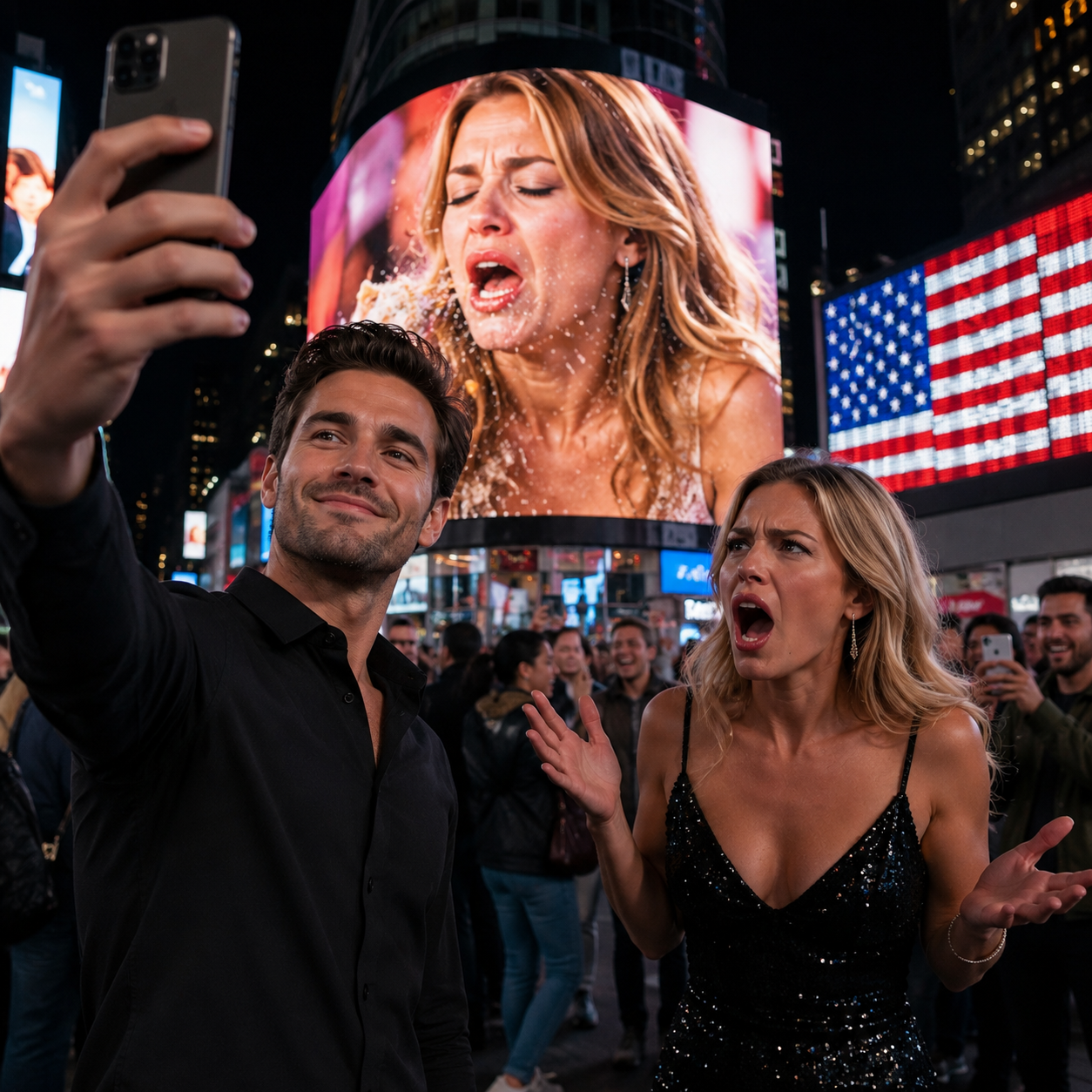
At 7:58 p.m., we were standing in the middle of Times Square, surrounded by flashing advertisements and tourists filming everything.
My heart was beating so hard I could feel it in my neck.
At exactly 8:00 p.m., one of the big screens went black.
Then Jessica’s sneeze photo appeared twenty feet tall.
Crystal clear.
Powdered sugar.
Double chin.
Churro grease.
The whole masterpiece.
Under it, in huge letters, was the message:
Happy 26th Birthday, Jessica. Love, your boyfriend who looks too tired.
For about two seconds, nobody understood.
Then the laughter started.
One tourist pointed.
Another pulled out a phone.
Jessica was looking down at her own screen until her friend Madison grabbed her arm and whispered, “Oh my God.”
Jessica looked up.
Her mouth fell open.
The billboard looped again.
Fifteen more seconds.
People clapped. Someone shouted, “Happy birthday, Jessica!” A woman nearby yelled, “Who’s the boyfriend?” and when I raised my hand, strangers actually applauded.
I gave a small bow.
That was probably not my smartest choice.
Jessica turned toward me slowly, shaking with anger.
“You did not.”
“I fixed it,” I said.
Her sister was already filming.
Her friends were laughing so hard they could barely stand. Madison was on the ground. Actual ground. In Times Square. Laughing like she had witnessed history.
Jessica’s sister posted the video that night.
By midnight, it had fifty thousand views.
By morning, it had passed two million across reposts.
By the end of the week, Jessica Morrison had become “Sneeze Girl.”
There were memes.
Side-by-side comparisons of her heavily edited Instagram photos and the billboard image.
Reaction videos.
Commentary videos.
People debating whether I was hilarious or cruel.
Both sides had a point.
Jessica deleted her Instagram within forty-eight hours.
She moved into her friend’s apartment and refused to speak to me except to send long angry texts about humiliation, betrayal, and how I had ruined her reputation.
I read them all.
Some of them I deserved.
Because the truth was, I had wanted to make a point, but I had also wanted her to feel what I had felt every time she looked at my face and treated it like a problem to fix.
That did not make what I did gentle.
It only made it understandable.
Two months passed.
The video kept resurfacing. Every time it slowed down, some new meme account posted it again. Jessica’s sister told me she had started therapy. Body image issues. Social media addiction. Anxiety. Shame.
I felt guilty sometimes.
Then I remembered her telling me she wouldn’t be seen with me unless I edited my face.
Both things were true.
She hurt me.
I hurt her back.
Neither of those truths canceled the other.
Three months after the birthday, Jessica texted me.
Can we talk?
We met at a quiet coffee shop on a rainy afternoon.
I almost didn’t recognize her at first.
No heavy makeup. No perfect blowout. No carefully chosen outfit. She wore jeans, a hoodie, and her hair in a ponytail. She looked tired.
And for the first time in a long time, she looked like herself.
“Hi,” she said softly.
“Hi.”
We sat in awkward silence before she finally spoke.
“I’ve been in therapy.”
“I heard.”
She nodded.
“The billboard destroyed me for a while.”
I looked down at my coffee.
“I know.”
“But it also forced me to see how bad I had gotten. I wasn’t just editing pictures anymore. I was editing my whole life. And I made you feel like your real face wasn’t good enough to be next to mine.”
Her voice cracked slightly.
“That was wrong.”
I nodded.
“Thank you for saying that.”
She took a breath.
“But what you did was cruel.”
“I know.”
“You planned it. You paid for it. You made it as public as possible.”
“I did.”
“You wanted to embarrass me.”
I didn’t lie.
“Yes.”
She looked at me for a long moment.
“I deserved a wake-up call. I didn’t deserve a public execution.”
That sentence hit me harder than I expected because she was right.
“I’m sorry,” I said quietly. “Not for wanting you to understand how it felt. But for making the whole world part of it.”
Her eyes softened just a little.
“I’m sorry too,” she said. “For every time I told you to fix your face.”
We didn’t magically repair everything that day. Real relationships don’t heal like movie scenes. There was no dramatic kiss in the rain. No instant forgiveness.
But there was honesty.
And that was new for us.
For a while, we started over slowly.
No public posts.
No staged couple shoots.
No filters on each other’s faces.
Jessica kept going to therapy. She admitted she still wanted to edit herself sometimes. She admitted posting unfiltered pictures made her anxious. But she also started laughing more easily. Real laughter. The kind that made her nose scrunch and her eyes disappear slightly.
The kind she used to delete from photos.
Six months later, she posted a picture of us on her private Instagram.
No filters.
No smoothing.
Just us sitting on her couch in sweatshirts with takeout containers on the coffee table.
The caption said:
Trying again. Real faces only.
Her sister commented first.
Proud of you, Sneeze Girl.
Jessica replied:
I hate you, but also yes.
Eventually, she changed her bio to:
Yes, I’m the sneeze girl. No, I don’t edit his face anymore.
We stayed together, but not because the billboard fixed us. It didn’t. Public humiliation does not fix insecurity. Revenge does not cure pain. What fixed us, slowly, was what happened after: the uncomfortable conversations, the apologies that actually named the damage, and the decision to stop performing perfection for people who barely knew us.
The sneeze photo still exists.
Jessica knows I have it.
She also knows I will never put it on another billboard.
Sometimes, when she gets too serious about a photo, I raise one eyebrow and say, “Times Square?”
She throws a pillow at me.
Then she usually posts the real one.
And honestly, she looks better that way.
Not because the lighting is perfect.
Not because her face is flawless.
But because for the first time since I met her, she finally looks free.
![[FULL STORY] The Day She Asked Me to Drive Her to Cheating](https://sa.greatgames.info/storage/thumbnails/1777236055_23e045a6-009c-44a8-9e17-08931fd70c61.png)
![[ FULL STORY ] My Siblings Fought Over Grandma’s Will… Until Her Lawyer Read What She Left Them](https://sa.greatgames.info/storage/thumbnails/1777577900_3aeb679a-0d54-49e9-9495-d5f96402bf15.png)
![[FULL STORY] My Wife Announced, "We're In An Open Marriage!" Right At Her Parents' Dinner Table. I Calmly Said,](https://sa.greatgames.info/storage/thumbnails/1776747835_5.png)
![[FULL STORY] The Cost of “My Money, My Rules”](https://sa.greatgames.info/storage/thumbnails/1777099776_b96d3da6-ad33-4120-93ee-ada50b4d328a.png)