The night before my wedding, my fiancée raised her champagne glass at our rehearsal dinner and smiled at my mother like she was telling the sweetest joke in the world.
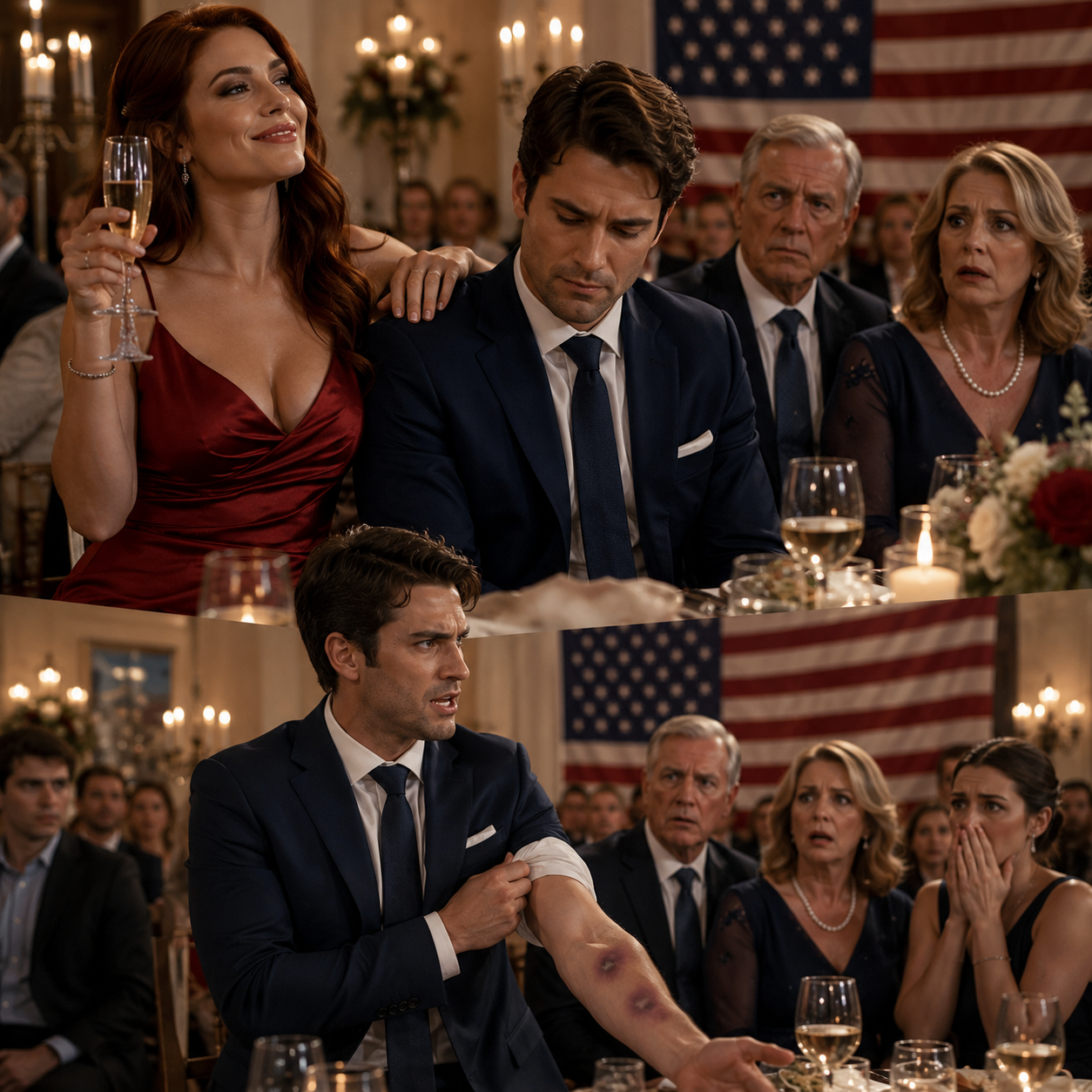
“Don’t worry, Mrs. Harlow,” Celeste said. “I only leave marks when he forgets who’s in charge.”
A few people laughed.
They thought it was playful. They thought it was one of those sharp little jokes couples make before marriage. They thought I was smiling because I found it funny.
My father did not laugh.
He looked at Celeste’s hand on my shoulder. Then his eyes dropped to the edge of my sleeve, where the purple bruise around my wrist had slipped into view. For one horrible second, neither of us moved. Then he looked back at my face, and I saw the exact moment my father understood that his son had been lying to him for almost a year.
My name is Nathan Harlow. I was thirty-one years old, a physical therapist in Portland, Maine, and until that night, I had become very good at hiding pain behind calm excuses. A split lip was from bumping into a cabinet door. A bruise across my ribs was from dropping a weight at the gym. Finger-shaped marks on my wrist were from being careless while moving furniture. Every injury had a story, and every story had one purpose: to keep everyone from asking the question I was too ashamed to answer.
Celeste Monroe was the kind of woman people admired before they truly knew her. She was polished, beautiful, confident, and impossible to ignore. She worked in public relations, which made sense because she could turn anything ugly into something acceptable. A cruel insult became honesty. A public humiliation became humor. A threat became passion. A slap became something I had somehow caused.
When we first met, I thought she was the most exciting person who had ever chosen me. She came into my clinic after a skiing injury, impatient with pain and irritated that healing required time. She teased me for being too gentle. She said I had the face of a man who had never raised his voice. At first, she told me that made her feel safe.
Six months later, she told me it made me weak.
The first time she hit me, we were in the kitchen. There was no dramatic storm outside, no broken glass, no warning music like in a movie. We were arguing about a party because she wanted to invite an ex-boyfriend she called “a useful business contact.” I told her I was uncomfortable with it. I was not shouting. I was not threatening her. I simply said I did not want our home to feel like one of her networking events.
She crossed the kitchen and slapped me across the mouth so fast I barely understood what had happened.
Then she looked at me and said, “Don’t talk to me like I’m one of your patients.”
I should have left that night. I should have called my sister. I should have driven to my parents’ house and told the truth while my lip was still bleeding.
Instead, I apologized.
That apology became the first bar of the cage.
After that, Celeste learned what worked. She never hurt me where people could easily see it. She never lost control in public. She knew when to cry afterward. She knew when to curl against me in bed and whisper that everyone she loved eventually abandoned her. She gave me a sad story for every cruel thing she did, and I let those stories confuse me.
I told myself I was bigger than her. I told myself I could stop her if I really wanted to. I told myself that because I was a man, it could not be what it looked like.
But fear is still fear. Pain is still pain. Shame does not care who is stronger on paper.
By the week of the wedding, I was living like a guest inside my own life. Celeste had planned every detail with perfect control: the coastal inn, the flower arch facing the gray Atlantic, the candles, the seating chart, the music, my tie, my haircut, even the way I was supposed to stand when I said my vows.
“Shoulders back,” she told me while fixing my collar the morning before the rehearsal dinner. Her fingers pinched my skin hard enough to hurt. “You always look apologetic. I don’t want our wedding photos looking like I married a substitute teacher.”
I laughed because silence was dangerous.
That evening, thirty people gathered for our rehearsal dinner. My parents had driven in from Vermont. My father, Grant, was a quiet furniture maker who believed anger was only useful when controlled. My mother, Elaine, was a retired teacher with soft hands and eyes that noticed everything. My younger sister, Brooke, was there too, seven months pregnant and already suspicious from the moment she hugged me.
“You look exhausted,” she said.
“Wedding week,” I answered.
She did not smile.
Celeste was glowing that night. Everyone saw what she wanted them to see. She moved through the room accepting compliments, touching shoulders, laughing brightly, playing the beautiful bride-to-be. Her parents watched her like she was royalty. Her father laughed at every joke. Her mother corrected the staff with a smile sharp enough to cut glass.
I sat beside Celeste with my left sleeve pulled low over my wrist. Two nights earlier, she had grabbed me during an argument over seating cards. Her nails had broken the skin. The bruises had darkened into ugly purple fingerprints, and I spent the entire dinner tugging my cuff down.
My mother noticed.
She always noticed.
Halfway through the meal, Celeste stood to give a toast. She lifted her champagne glass and thanked everyone for coming. She joked that I was lucky she loved me enough to handle all the planning. People laughed. I smiled because I knew I was expected to.
Then her eyes dropped to me, and I saw that little spark in her expression. The one she got when she found a weak spot and could not resist pressing it.
“Nathan is the kindest man I’ve ever known,” she said. “Sometimes too kind. Sometimes he needs reminders.”
My stomach tightened.
She placed her hand on my shoulder, her nails pressing through the fabric.
Then she looked at my mother and said the line that ended everything.
“Don’t worry, Mrs. Harlow. I only leave marks when he forgets who’s in charge.”
A few people laughed.
My father looked at my wrist.
My sleeve had slipped.
“Nathan,” he said quietly.
Celeste’s smile froze.
I pulled my sleeve down and whispered, “Dad, it’s fine.”
But it was not fine. The room had shifted. My mother’s eyes filled with tears. Brooke pushed her chair back slightly. Conversations died at the edges of the room.
Celeste leaned close to my ear, still smiling for everyone else.
“Fix your face,” she whispered.
That was the sentence that finally woke me up.
Not the slap. Not the bruises. Not the months of fear. That whisper. Fix your face. As if my pain were an inconvenience. As if my fear were bad lighting ruining her perfect event.
Something inside me went quiet.
I stood up.
Celeste’s fingers tightened on my shoulder, but I gently removed her hand.
Then I looked at the photographer, who had been hired to capture “candid moments.”
“Are you recording video?” I asked.
He blinked. “Some clips, yes.”
“Good,” I said.
The room went silent.
Celeste stared at me. “What are you doing?”
I looked at my parents, my sister, our friends, her family, and all the people who had expected me to smile through one more humiliation.
“I’m done lying,” I said.
My voice did not shake.
“For almost a year, Celeste has been hurting me. She has slapped me, grabbed me, thrown things at me, threatened me, and then apologized just enough to make me feel guilty for remembering.”
Celeste laughed sharply. “Oh my God, Nathan. Sit down.”
I rolled up my sleeve.
My mother made a sound I will never forget.
The bruises were clear. Fingerprints around my wrist. Red cuts where her nails had dug into my skin. I held out my arm, not as an accusation at first, but as a confession.
“This happened Tuesday,” I said. “She grabbed me because I changed the font on the place cards without asking her.”
Celeste’s face turned pale.
“That is not what happened,” she snapped.
I opened my phone and showed more photos. My ribs bruised from a mug she had thrown. My split lip from February. The mark on my shoulder from the night she told me no one would believe me because men like me were too embarrassed to admit they were scared of women like her.
My father stood slowly.
Not violently. Not dramatically. Just slowly, like he was holding back something enormous.
Celeste tried to switch tactics. Her eyes filled with tears. Her voice softened.
“I’m sorry everyone is seeing this,” she said. “Nathan has been under a lot of stress. He gets overwhelmed. He knows I would never actually hurt him.”
My mother stood.
She was not loud. She had never needed to be.
“Did you leave those marks on my son?” she asked.
Celeste blinked. “Mrs. Harlow, this is complicated.”
“Did you?” my mother repeated.
The silence stretched until Celeste’s mask cracked.
“He makes me crazy sometimes,” she said.
That sentence did more damage than any denial could have.
I reached into my jacket pocket and took out the engagement ring. It had belonged to my grandmother. Celeste had always complained it was too sentimental and not big enough for photos.
I placed it on the table between us.
“There won’t be a wedding,” I said.
Celeste stared at the ring like I had slapped her.
Then she whispered, “You don’t get to humiliate me.”
I looked down at my bruised wrist, then back at her.
“You did that yourself.”
The hour that followed was chaos, but not the kind Celeste wanted. She wanted screaming. She wanted me emotional enough to look unstable. She wanted my father angry enough to become the villain. But my family stayed calm. My sister called the wedding planner and canceled the ceremony. My father arranged separate rooms and made sure Celeste’s family could not get near us. My mother sat beside me, holding my hand, not asking why I had hidden it from her.
That question would come later.
For now, she just stayed.
By midnight, I was sitting in my parents’ hotel room while my mother cleaned the cuts on my wrist with supplies from her travel bag. Brooke sat in a chair crying quietly. My father stood by the window, staring out at the dark ocean.
Finally, he asked, “How long?”
I looked at the floor.
“Almost a year.”
My mother’s hand stopped moving.
“I thought I could handle it,” I said. “I thought if I stayed calm enough, if I loved her better, if I didn’t make things worse…”
My father turned around. His face looked older than it had that morning.
“Son,” he said, “you were not put on this earth to absorb someone else’s cruelty.”
That was when I broke.
Not loudly. Not dramatically. I just folded forward and cried like a man who had been holding his breath for eleven months. My mother wrapped her arms around me. Brooke held the back of my head. My father knelt in front of me with tears in his eyes.
“I’m sorry,” I kept saying.
My mother took my face in both hands.
“No,” she said. “Never apologize to us for surviving.”
The next morning, Celeste tried to control the story.
She posted a polished statement online saying she had decided to postpone the wedding after witnessing “deeply troubling instability” from me and “aggressive behavior” from my family. She asked for privacy. She implied I had frightened her. She spoke about mental health and healing as if she had not spent months using both as weapons.
It was perfect public relations.
For a few hours, people believed her.
Then the photographer called.
“I have the footage,” he said. “All of it. Her joke. Your statement. Her saying you make her crazy. Everything.”
My sister wanted me to post it immediately.
My father shook his head.
“Police first,” he said. “Lawyer second. Internet last.”
That advice saved me.
Celeste knew how to win public sympathy. She knew captions, timing, image, and emotional wording. But she did not know how to fight evidence.
I filed a police report that afternoon. I showed the photos. I showed the texts. There were messages where she apologized for slapping me, then blamed me for making her lose control. There was one where she told me to wear a blue sweater because it hid the mark better.
The officer read that message twice.
Then she looked at me and said, “Mr. Harlow, this is evidence.”
Evidence.
Not weakness. Not drama. Not embarrassment.
Evidence.
Over the next few weeks, the perfect life Celeste had built began to collapse. The photographer gave a statement. One of her bridesmaids admitted she had seen Celeste shove me during a trip months earlier. A former coworker sent screenshots of Celeste joking about “training” me and saying I was too loyal to ever leave.
The truth had been there in pieces. People had seen parts of it. Some had laughed. Some had looked away. Some had convinced themselves it was just Celeste being intense.
But once the whole picture appeared, no one could pretend anymore.
Celeste was charged. Her family hired an expensive attorney who tried to paint me as emotional, resentful, and unstable after a broken engagement. They said my bruises could have come from the gym. They said her comments were dark humor. They said I was embarrassed and wanted revenge.
Then the rehearsal dinner video leaked.
Not from me. Not from my family. Someone from her side had filmed part of the dinner and sent it around before realizing what it truly showed.
The clip spread quickly. Celeste smiling as she joked about leaving marks. My sleeve rolling up. The bruises. Her saying, “He makes me crazy sometimes.”
For the first time, Celeste could not rewrite the room.
Her job put her on leave, then quietly let her go. Friends who had defended her deleted their posts. Her parents stopped making public statements. The wedding guests who had laughed that night suddenly had to live with the sound of their own laughter on video.
Celeste tried calling me again and again.
I never answered.
Her final text said, “Look what you made happen.”
I forwarded it to the police.
The trial took months. During that time, I learned that leaving does not magically make fear disappear. I still flinched when someone touched my wrist unexpectedly. I still hated champagne glasses clinking together. I still felt sick when I saw a blue sweater in my closet.
But slowly, my life became mine again.
My father built me a dining table for my new apartment. He said every home needed a place where people could sit without fear. My mother brought food and pretended she was not checking whether I was eating. Brooke had her baby, a little girl named June, and the first time that tiny hand wrapped around my finger, I cried for a reason that had nothing to do with pain.
At trial, Celeste wore soft colors and cried carefully. She said she had been under wedding stress. She said she loved me too much. She said she panicked sometimes but never meant to hurt me.
Then the prosecutor showed the texts.
Wear the blue sweater. It hides the mark better.
The courtroom went still.
The video played next.
There was no way to make that joke sound innocent when everyone could see my father’s face change. There was no way to explain away the bruises, the photos, the witnesses, the messages, and Celeste’s own words.
When the verdict came, she was found guilty on several counts.
I thought I would feel victory.
I did not.
I felt exhausted.
Then my mother reached for my hand, and for the first time in a long time, I felt something close to peace.
Outside the courthouse, a reporter asked me what I wanted people to understand.
I looked at my family standing beside me.
Then I said, “Shame protects the wrong person.”
That sentence traveled farther than I expected. Strangers wrote to me afterward. Men and women. People who had hidden bruises under sleeves, makeup, jokes, silence, and fear. Some messages were long. Some only said, “Me too.”
I answered what I could until my therapist reminded me that surviving did not mean I owed the world my pain forever.
A year later, my life is quiet. I still live in Portland, but not in the place Celeste decorated like a magazine spread. I have a small house with uneven floors, pine trees outside the window, and my father’s oversized dining table in the middle of the room. My niece calls me “Nate-Nate,” which is ridiculous and somehow my favorite sound in the world.
Celeste sent an apology letter through her attorney once. It was well written, of course. She always knew how to make words behave. She said she regretted the harm she caused. She said she was working on herself. She said she hoped I could heal.
I folded the letter and put it in a drawer.
Not because I forgave her.
Not because I hated her.
Because her voice no longer deserved the center of my life.
People always remember the rehearsal dinner. The cruel joke. The sleeve. The moment everyone saw. They call it brave. They say I exposed her.
But when I think about the moment that saved me, I think about my father kneeling in front of me in that hotel room, crying without shame, telling me I was not born to absorb someone else’s cruelty.
For months, I believed staying calm made me strong.
I was wrong.
Strength was not enduring her.
Strength was telling the truth.
The night before my wedding, my fiancée laughed about my bruises in front of my parents. She thought everyone would laugh with her. She thought my silence belonged to her.
She was wrong.
A few people laughed.
Then everyone saw.
![[FULL STORY] She Sent One Text That Ended My Engagement — And Revealed Everything I Needed to Know](https://sa.greatgames.info/storage/thumbnails/1776883065_47f8b8ca-227b-4f71-b080-ad857ed96747.png)
![[FULL STORY] My girlfriend broke my heart during her graduation.She said, "Don’t come to my graduation because](https://sa.greatgames.info/storage/thumbnails/1776929189_26.png)

![[FULL STORY] My Girlfriend Laughed And Called Me Her “Safety Net” At Her Party, So I Cut Her Funding And Took My Apartment Back By Morning.](https://sa.greatgames.info/storage/thumbnails/1776933497_20.png)
![[FULL STORY] My Girlfriend of Five Years Told Me: 'I'm No Longer Attracted to You, I Want an Alpha Male ' I](https://sa.greatgames.info/storage/thumbnails/1777359728_B29.png)