
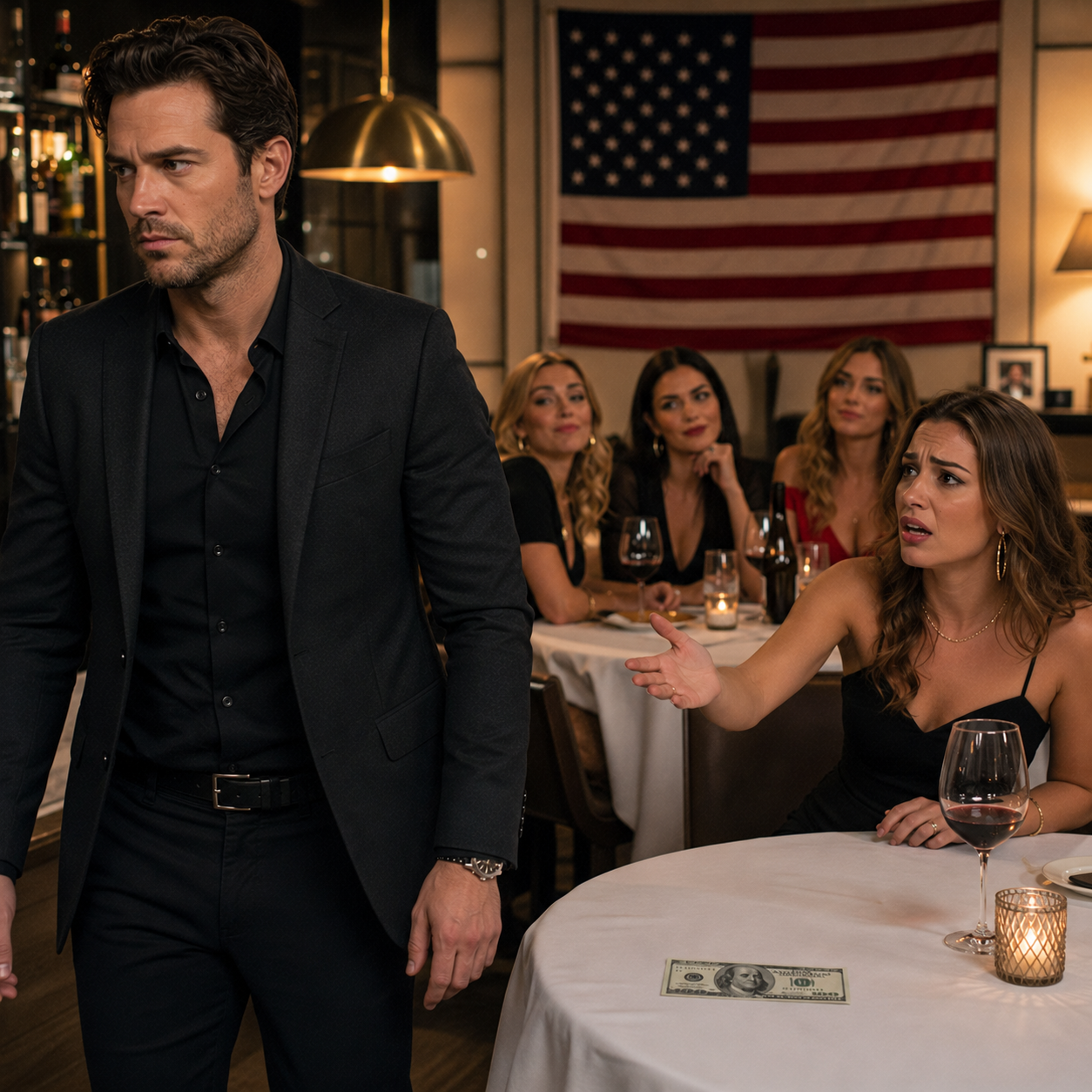
I didn’t say a word. I didn't yell, I didn't beg, and I certainly didn't "fight" for her. I simply reached into my pocket, pulled out a hundred-dollar bill, and placed it firmly on the white linen tablecloth next to a half-empty glass of expensive Merlot. I looked at Chloe—really looked at her—and saw not the woman I’d fallen for two years ago, but a puppet whose strings were being pulled by three people who weren't even in the room. Or so I thought. In reality, they were right there, vibrating in her palm.
"Liam? Where are you going? We aren't finished," she said. Her voice had this practiced, tremulous quality to it. It was the pitch of a woman who had been told exactly how a victim should sound.
"We were finished ten minutes ago, Chloe," I replied, my voice as steady as the code I write for a living. "I just took a little longer than usual to debug the situation."
I walked out of that Italian restaurant and into the cool evening air, leaving her sitting there with her phone glowing like a radioactive coal in her hand. At 34, I’ve learned that life is too short for "if-statements" that involve my dignity. I’m a systems architect; I build structures that are meant to last, and I’ve never had much tolerance for glitches—especially intentional ones.
When I met Chloe at a gallery opening two years ago, it felt like we were running on the same operating system. We talked about architecture, about the honesty of raw materials, and about the absolute necessity of trust. For the first year, it was effortless. We didn't need to check each other's phones or ask "where is this going?" because we were already there. We were a team.
But then, the "Committee" arrived.
Chloe had three best friends from her university days: Sarah, Mia, and Elena. On paper, they were successful, modern women. In practice, they were emotional arsonists. I remember the first time I sat down for drinks with them. Sarah, the "Alpha" of the group, spent twenty minutes explaining why she had just ghosted a guy she’d been seeing for three months.
"He was too available," Sarah had said, swirling her martini with a predatory grace. "If a man doesn't feel like he’s at risk of losing you every second, he stops valuing the prize. I didn't reply to his 'Good morning' text for three days just to see if he'd spiral. He didn't. He just asked if I was okay. Total beta move. I blocked him."
I looked at Chloe then, expecting her to roll her eyes. Instead, she was leaning in, nodding, her eyes wide with a sort of academic interest. That was the first yellow flag. I ignored it because I trusted Chloe’s judgment. I thought she was smarter than the "dating strategy" TikToks Sarah clearly lived by.
Then there was Mia. Mia was the "Researcher." She treated men like laboratory rats. She kept a mental—and rumors whispered, a literal—spreadsheet of every interaction. "He didn't pull the chair out at the third dinner, but he did at the first two. That’s a 33% decline in effort, Chloe. You have to watch for the patterns of complacency."
And finally, Elena. Elena was the "Empath," or so she claimed. She used the language of therapy to weaponize insecurity. She’d talk about "anxious-avoidant traps" and "healing the inner child," but she only used these terms to convince her friends that their boyfriends were secretly narcissists who needed to be "broken" to be truly "healed."
About 14 months into our relationship, the atmosphere began to shift. It was subtle at first. A dinner at Chloe's parents' house was the turning point. I’d brought a vintage bottle of Bordeaux and spent the afternoon helping her father, a retired engineer, fix a persistent leak in their irrigation system. We were getting along famously.
Then the girls showed up for dessert.
Within five minutes, Sarah had turned the conversation toward my salary expectations for the next five years. Chloe’s mother looked mortified, but Chloe just sat there, stirring her coffee, waiting for my answer. When I politely suggested that my career path was something Chloe and I discussed privately, Sarah scoffed.
"Chloe needs to know she’s being 'provisioned' for, Liam. It’s evolutionary biology. If you aren't willing to show the receipts, how does she know you’re the lead in this production?"
Mia chimed in, "It’s about the investment of resources. My last boyfriend bought me a Chanel bag just because I had a bad Tuesday. It wasn't about the bag; it was about the 'stress-test' of his commitment."
I caught Chloe’s sister, Rachel, looking at me from across the table. Rachel was the only one who saw through the nonsense. Later, while we were clearing plates in the kitchen, she leaned in and whispered, "Liam, get her away from them. They’ve burned down every relationship Chloe’s ever had. They think love is a hostage situation, not a partnership."
I should have listened. But I loved Chloe. I thought our foundation was poured in concrete. I didn't realize that Sarah and the others were already chipping away at it with hammers made of "empowerment" and "standards."
Over the next few months, Chloe changed. She started asking me bizarre "hypotheticals."
"Liam, if we were in a car accident and I lost my ability to walk, would you quit your firm to carry me around the house forever?"
"Chloe, that’s a very dark thing to think about. Of course I’d take care of you, but we’d hire a nurse, we’d adapt—"
"See! You’re thinking logically. Sarah says if you don't answer 'yes' immediately without thinking of the logistics, you don't actually love the soul, you just love the utility."
It was exhausting. Every conversation felt like a deposition. She’d cancel plans at the last minute, then wait to see if I’d show up at her door with flowers to "fight" for her time. When I didn't—because I respect her autonomy and don't believe in stalking—she’d tell me I was "emotionally unavailable."
The final straw started on a Tuesday night, a week before our anniversary. I’d come over to her place with some takeout, and she was staring at her phone with an expression of pure, unadulterated stress. It buzzed. I saw a notification from the "Inner Circle" group chat. Sarah’s message flashed: “He’s too comfortable. If he doesn't feel the sting of the ‘Grand Ultimatum,’ he’ll never put a ring on it. Do the Anniversary Script. Word for word.”
Chloe saw me see it. She didn't put the phone away. She just looked at me with this hollow, desperate expression and said, "Liam, we need to talk about whether we’re truly compatible on a spiritual level."
She started using words that weren't hers. "Passion," "Fighting for us," "The Chase." It was like listening to a bad AI try to write a romance novel. I realized then that she wasn't talking to me. She was performing for the invisible audience in her pocket.
I told her I was tired and went home. But as I lay in bed, I found an old voice note she’d accidentally sent to me months ago, meant for Sarah. I played it.
“I don't know, Sarah. Liam is so good to me. He’s kind, he’s stable... is it really necessary to push him this hard?”
And then I heard Sarah’s voice, sharp and cold: “Stability is just another word for stagnation, Chloe. If he loves you, he’ll crawl through glass to keep you. If he doesn't crawl, he’s just a roommate. Test him on the anniversary. If he lets you walk out that door, he was never yours to begin with.”
I sat there in the dark, the phone glowing in my hand. I realized that the woman I loved had agreed to a plan to intentionally break my heart, just to see if I’d try to glue the pieces back together.
But she didn't realize one thing about me. I don't fix things that people break on purpose. And as I started planning for our anniversary dinner at that Italian place, I knew exactly what was coming... but Chloe didn't know I had a script of my own.
![[FULL STORY] My ex-fiancée dumped me for a "proven winner" during my bankruptcy, but two years later, I’ve returned to buy out her family's failing empire.](https://sa.greatgames.info/storage/thumbnails/1777018464_d2.png)
![[FULL STORY] She Said She Settled for Me, Then Came Back When I Found Someone Who Didn’t](https://sa.greatgames.info/storage/thumbnails/1777913472_a5e547fc-386a-4a74-9991-bf455c9daf59.jpg)
![[FULL STORY] My Ex-Wife Tried to Triple Child Support to Save Her New Husband From Bankruptcy, So I Exposed His Secret Gambling Addiction In Court.](https://sa.greatgames.info/storage/thumbnails/1777180063_C5.png)

![[FULL STORY] The Dying Woman at My Door Told Me My Husband Built a Double Life](https://sa.greatgames.info/storage/thumbnails/1777279149_479c01aa-ab75-433f-bb56-47030ffa0e49.png)
![[FULL STORY] My Girlfriend Said My Career Only Exists Because of Her Connections. A Week Later, Her Biggest Client Called Me Instead of Her.](https://sa.greatgames.info/storage/thumbnails/1777283090_8712e5e0-ca23-4681-81e5-fcc4c3f78f3a.png)