
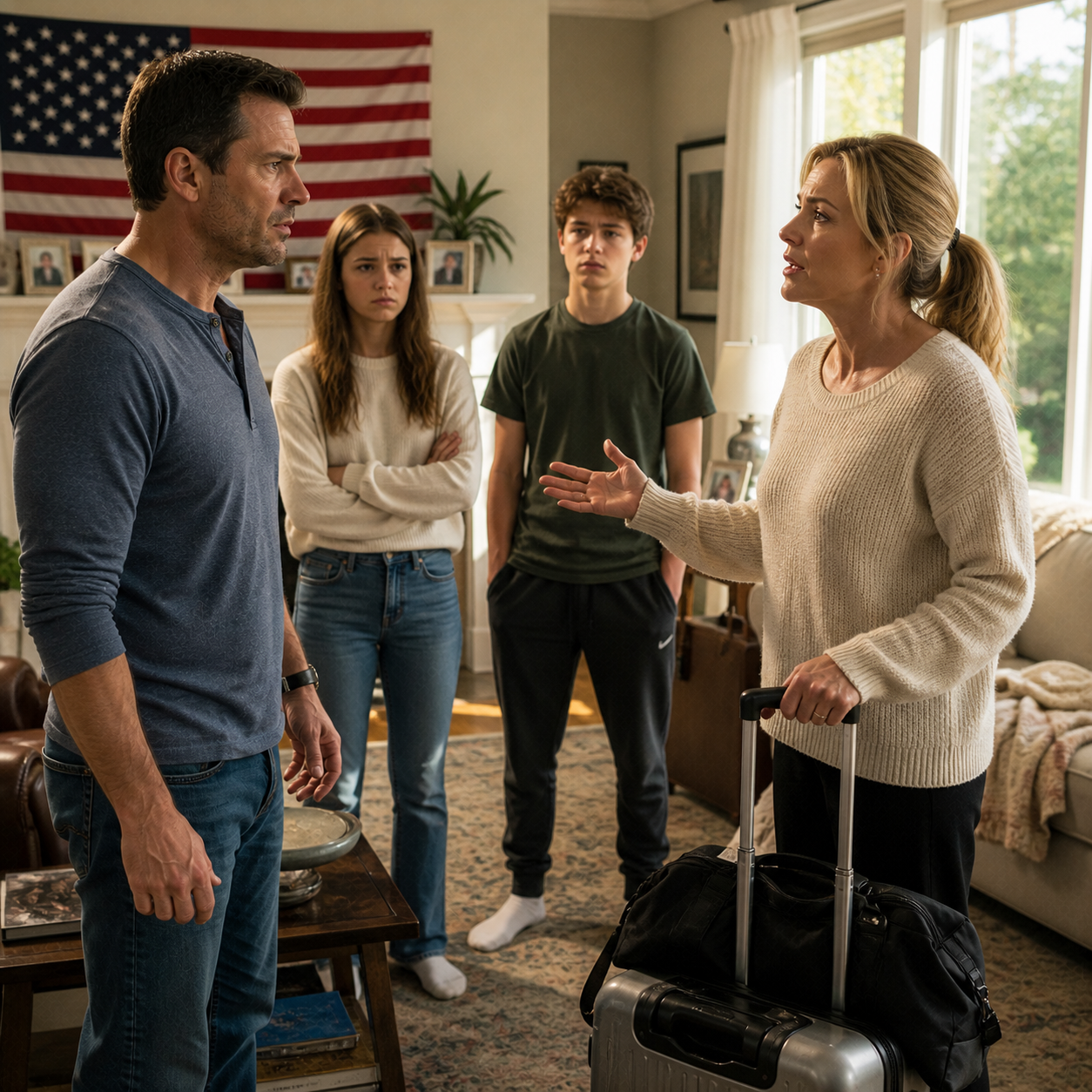
"I never asked you to save me."
Those seven words hit me harder than the concrete barrier that nearly took Rebecca’s life six months ago. We were sitting in our living room—the one I’d worked sixty-hour weeks to pay off early—and she was looking at me with a coldness I didn’t recognize. There was no gratitude. There was no "thank you for the months of physical therapy" or "thank you for draining your 401k so I could walk again." Just that sharp, clinical sentence.
My name is David. For twenty-three years, I thought I was a partner. I thought I was a protector. I met Rebecca in our sophomore year of college; she was a nursing student with a laugh that could clear a room, and I was a sales major who thought the world was mine for the taking. We built a life. We had Natalie, who’s now nineteen and away at university, and Mark, my sixteen-year-old who’s always been the quiet, observant type.
For two decades, our roles were set in stone. I was the engine—the provider. I handled the mortgage, the car notes, the college funds, and the insurance. Rebecca worked as a nurse for a few years before we decided she’d stay home to raise the kids. It felt like a fair trade at the time. But looking back, I realize I wasn't a partner; I was a utility. I was the safety net that she eventually started to resent.
The world tilted on its axis last March. It was a Tuesday, a grey, unremarkable morning. Rebecca said she was heading to her yoga class—a hobby she’d picked up about six months prior. I was in a meeting when my phone buzzed incessantly. It was the state police. Rebecca’s SUV had hydroplaned, flipped, and slammed into a bridge abutment.
The next few months were a blur of antiseptic smells and beeping monitors. The doctors told me she was lucky to be alive, but the road back would be grueling. Multiple surgeries to reconstruct her pelvis, internal hardware, weeks in the ICU, and months of specialized rehab.
"Do whatever it takes," I told the surgeons. I didn't even blink.
Our insurance was "good" by corporate standards, but the costs were astronomical. Between the $8,000 deductible, the 20% co-pays on half-a-million dollars of hospital bills, and the out-of-network specialists, the wall of debt started rising fast. I didn't care. I pulled from our joint savings first. Then the emergency fund. When the bills kept coming, I did the unthinkable: I liquidated my retirement account. I took the tax hit, the penalties, everything. I maxed out two credit cards to pay for the private nursing care she needed when she finally came home. I was working freelance gigs until 2:00 AM after spending the evening helping her into the shower and changing her bandages.
I did it because she was my wife. That’s what you do.
By the two-month mark, Rebecca was finally mobile. But as her body healed, her spirit seemed to sour. She became obsessed with her phone, claiming she was in "support groups" for trauma survivors. She’d flinch if I tried to hold her hand. I figured it was PTSD. I gave her space. I kept providing.
Then came that night in the living room. Natalie had come home for the weekend, and Mark was sitting on the stairs, listening.
"I want a divorce, David," Rebecca said, her voice steady. "The accident changed me. It made me realize I’ve been suffocating in this marriage for years. I need to find who I am without you."
I sat there, my hands calloused from the extra work, my bank account sitting at a literal zero. "Rebecca, I just spent every cent we have to keep you breathing. I’m working three jobs. And you’re telling me you want 'freedom'?"
That’s when she said it. "I never asked you to save me. You did that for yourself, to feel like a hero. It was pathetic, honestly."
Natalie stood up and put her arm around her mother. "Dad, don't be so selfish. Mom’s been through a trauma. She deserves to be happy, and you’re just making this about your money."
I looked at Natalie—the daughter whose tuition I was currently struggling to cover—and I felt something inside me snap. Not a loud, angry snap, but a quiet, cold realization. The mask had slipped.
"Get out," I said. My voice was a whisper, but it filled the room.
"Excuse me?" Rebecca asked, her eyes widening.
"You want to find yourself? Go find yourself somewhere else. You have one hour to pack a bag. Both of you."
Rebecca started to scream about her rights, and Natalie called me a monster. But as I watched them scramble to pack, Mark walked down the stairs. He didn't go to his mother. He sat down next to me on the couch and put a hand on my shoulder.
"I saw her phone, Dad," he muttered.
I looked at him, confused. He didn't say anything else then, but as the door slammed behind Rebecca and Natalie, Mark handed me an old tablet we used for the home security system.
"You need to see the messages she forgot to delete," he said.
I took the tablet, my heart hammering against my ribs. I opened the synced messaging app, and as I scrolled through the dates, I realized that the woman I had nearly bankrupt myself to save wasn't just leaving me—she had been planning my destruction long before the car ever hit that wall.
And the person she was messaging? I knew him.
![[FULL STORY] My Fiancée Rejected a Prenup — Then I Discovered Her Secret Divorce Plan](https://sa.greatgames.info/storage/thumbnails/1776413886_669637715_978717028013833_1609483322963371948_n.jpg)
![[FULL STORY] My Wife Announced “We’re Having A Baby” At A Backyard Party, So I Toasted Her Lover,Played The Audio](https://sa.greatgames.info/storage/thumbnails/1776397596_760b725a-0a55-42bd-8a9e-2d249fdbcc07.png)
![[FULL STORY] My girlfriend said she didn’t think I’d mind if her male best friend came along on the trip too.I](https://sa.greatgames.info/storage/thumbnails/1777361621_R2.png)

![[FULL STORY] My Girlfriend Accidentally Texted Me That I Was A Failure Compared To Her Soulmate, So I Quietly Handed Her The Life She Deserved.](https://sa.greatgames.info/storage/thumbnails/1776917209_7.png)
![[FULL STORY] She Demanded A Post-Nup To Protect Her Money — 5 Years Later, The Tables Turned](https://sa.greatgames.info/storage/thumbnails/1777368410_3.png)