
![[FULL STORY] I Came Home After 3 Years… And Found My Husband Living With My Best Friend In The House I Paid For](https://sa.greatgames.info/storage/thumbnails/1776734461_Wife_confronts_friend_202604201731 (1).jpeg)
I landed in Port Harrow just after nine at night with my heart beating like I was twenty-two again.
For three years, I had lived in Manchester, working twelve-hour shifts as a nurse, sleeping in a studio apartment with bad heating and a window that looked straight into another brick wall, telling myself every exhausted morning that it was temporary. One more shift. One more month. One more transfer back home. Every pound I saved had a purpose. Every sacrifice had a shape in my mind. It was a two-story cream house with a balcony and a front garden. It was my husband standing at the door in shock, then joy. It was him dropping whatever he was holding and pulling me into his arms.
I had told him I needed one more year.
I lied.
I wanted to see his face when he opened the door and found me standing there with a suitcase, a tired smile, and a wedding ring I had never once taken off.
My phone lit up the moment I switched it on after landing. Nine missed calls from my husband. Two messages.
Call me when you wake up.
Miss you.
I smiled at that. God help me, I actually smiled.
The driver I hired from the airport kept glancing at me through the rearview mirror like he recognized me but wasn’t sure how to ask.
“You sure you no wan make I call oga before we reach?” he asked finally. “So the surprise go sweet well well.”
“No,” I said, touching the bracelet on my wrist. “I want to see him before he sees me coming.”
I looked out the window as the city rolled past in flashes. Charcoal smoke from roadside grills. A kiosk still selling roasted corn at that hour. Young boys weaving between cars with phone chargers and bottled water. Music leaking out of a bar with blue lights. The humid air had a weight to it I had forgotten, but it also had memory. Every corner felt like another version of me waiting to be picked up.
I had missed this city.
I had missed home.
I had missed my husband.
The bracelet on my wrist was cheap gold, the kind that faded if you wore it in chlorinated water too often. He gave it to me the day I left. He had held my face in both hands outside the departure gate and said, “Go build our future. I’ll hold things down here.”
I believed him.
The gate to our compound came into view and my chest tightened with that sweet kind of fear that only comes when you are seconds away from getting everything you have been dreaming about. The house stood exactly where I had built it in my head through three winters abroad and two birthdays spent on video calls. Tall. Cream walls. Black gate. Balcony railing.
But then the details began to scratch at me.
The security light by the balcony was new.
The curtains were not the ones I chose.
The flower bed out front was planted with bright pink hibiscus instead of the white lilies I loved.
I told myself he had changed things for me. Maybe he wanted to surprise me too. Maybe he had finally learned that I hated sterile spaces and wanted color in a home. Maybe. Maybe. Maybe.
The driver honked.
A young security guard opened the gate. He was not the old one we used to employ before I left.
“Yes, madam?” he asked.
“I live here,” I said, stepping out with my suitcase. “Call Mr. Kellan.”
He hesitated.
“Madam, oga no dey house.”
My smile faltered. “What do you mean he’s not home?”
“Oga travel yesterday. Say e go back tomorrow.”
A small cold thing landed in my stomach.
“It’s fine,” I said quickly. “I have my key.”
I rolled my suitcase to the front door while the guard looked at me like I was some distant relative arriving at the wrong funeral. I pushed the key into the lock.
It didn’t turn.
I tried again.
Nothing.
For a second I thought I was using the wrong key. My own front door suddenly felt unfamiliar under my hand. I knocked once. Then harder.
Footsteps approached from inside.
Women’s footsteps.
I remember that sound more vividly than anything else about that night. The light pad of bare feet on tile, then on wood. Familiar enough to sound intimate. Confident enough to sound permanent.
The door opened.
And there she was.
Nia.
My best friend since university.
Nia in my silk navy robe with the cream piping I bought in London and never even wore because I was saving it for when I came home.
Nia barefoot.
Nia with her hair wrapped in my blue scarf.
Nia staring at me like I was the ghost.
For a few seconds, the world made no sense. It did not bend. It did not crack. It simply stopped obeying reason.
“What are you doing in my house?” I asked.
My voice was so calm that it scared me.
Her mouth opened. Closed. Opened again.
“Ada.”
Only she still called me that. Only she was close enough to use the soft name from university days, back when we split jollof rice in plastic bowls and swore we would raise each other’s children one day.
I looked past her.
That was when the second shock hit.
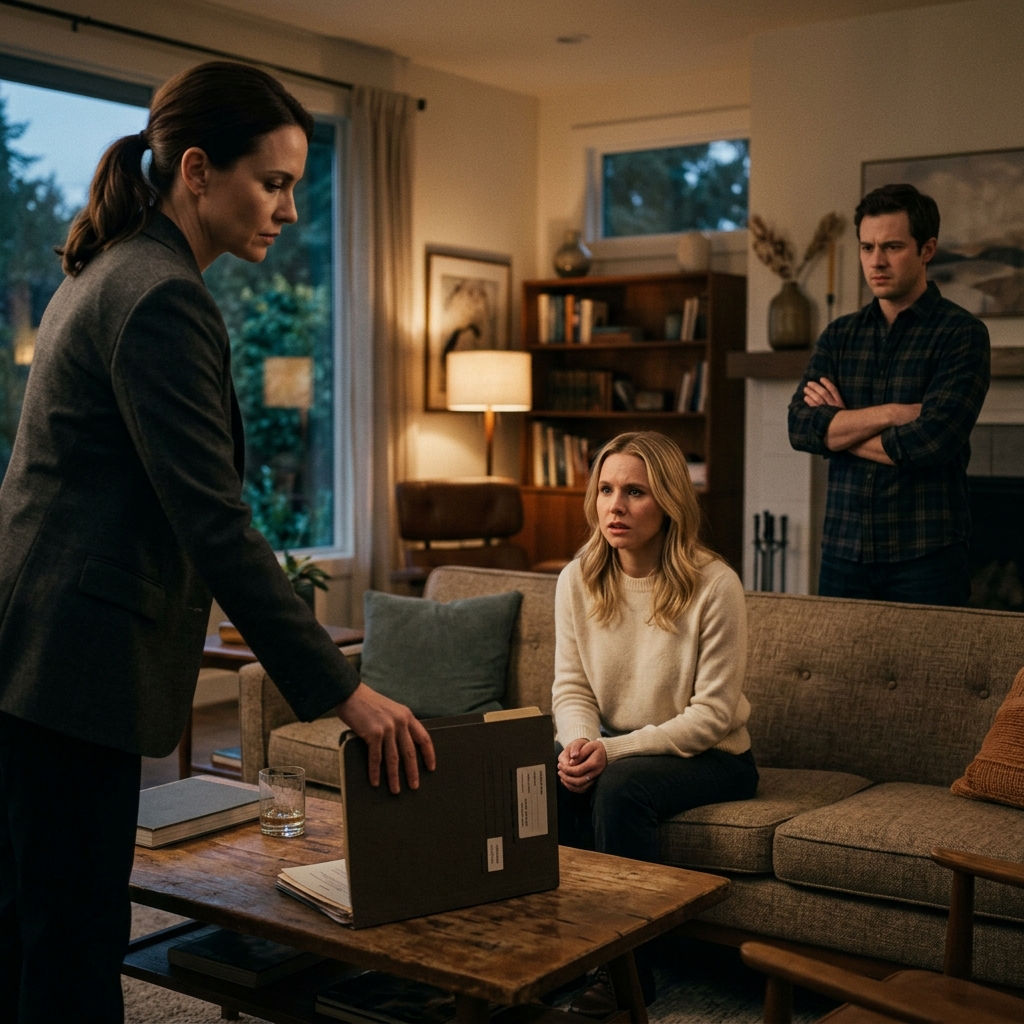
The living room was changed. My gray couches were gone. The art on the wall had been replaced. There were men’s loafers beside the staircase, not lined up the way I always arranged Kellan’s shoes, but kicked off in the careless way of a man undressing in a house where he feels completely at ease.
“This isn’t what it looks like,” Nia said quickly, stepping half outside and pulling the door behind her like she could block the evidence with wood.
A laugh rose in my throat and died there.
“Then what does it look like?”
“Please,” she whispered. “Lower your voice.”
“Lower my voice?”
My accent thickened the way it always did when emotion overtook control.
“You are standing in my house wearing my clothes and you want me to lower my voice?”
The guard at the gate looked away with the exaggerated concentration of a man who absolutely was listening.
Nia reached for my arm.
“Come inside. We can talk.”
I stepped back from her hand like it was heat.
“Where is my husband?”
She swallowed.
“He is not here.”
“That is not what I asked.”
Rain had not started yet, but the sky was swollen with it. The air felt electric. I could feel a storm coming in the same way I could feel a lie forming before somebody said it.
“Nia,” I said quietly, “tell me why you have keys to my house.”
She looked away.
That tiny movement did more damage than a confession.
I pushed past her.
She called my name but I was already inside, suitcase abandoned by the door, heart beating so hard I could hear it over the ringing in my ears.
The scent hit me first. Not mine. Something sweet and powdery and too floral for my taste. A perfume I had never worn. On the center table sat two wine glasses. One had a deep coral lipstick stain on the rim.
I walked to the staircase in a daze.
“Ada, please.”
I ignored her.
The master bedroom door was slightly open.
I pushed it.
The bed linens had been changed. Beige walls instead of white. Curtains tied back with gold cords I hated. On the dresser were framed photos.
Not of us.
Of Kellan and Nia.
At a beach.
At a rooftop restaurant.
At this house.
Not standing side by side like coworkers or cousins or old friends. Close. Easy. Intimate in the specific way that no cheating person in history has ever been as subtle as they believed.
My breathing changed.
That is the only way I can explain it. It stopped belonging to me.
Three years. Three years of extra shifts. Three years of sending money for “renovations.” Three years of transfers marked furniture, roofing, security, generator, plumbing. Three years of nightly calls where he told me he missed me. Three years of trusting my best friend when she visited me abroad and cried in my tiny apartment and said, “Any man would be lucky to be loved by you.”
Behind me, Nia started crying.
It was a small sound at first.
Then louder.
Like somehow I was making her suffer.
“It started small,” she said. “He was lonely. I was just helping.”
I turned so slowly it made her cry harder.
“Helping?”
My voice shook now. Not with weakness. With the effort it took not to scream.
“You were helping by sleeping in my bed?”
She covered her face.
“It’s not like that.”
“How is it then?”
She was still crying when my phone buzzed.
Kellan.
Both of us stared at the screen.
I answered.
“Hello,” I said.
His voice came cautious immediately.
“Ada. Where are you?”
I looked around the bedroom. At the photos. At my old dresser. At my husband’s new life.
“I’m home.”
Silence.
Then, carefully, “You should have told me you were coming.”
“I wanted to surprise you.”
Another pause.
“Listen,” he said, “we need to talk.”
I almost smiled.
“Yes,” I said softly. “We do.”
When the call ended, Nia whispered, “He’s on his way back.”
I walked to the mirror and looked at myself.
I looked like a traveler who took a wrong turn into another woman’s life.
No. Worse.
I looked like a wife who had come home late to her own replacement.
By the time his headlights cut through the rain outside, I had moved from shock into something harder. Not peace. Not yet. But shape. Betrayal had edges now. It was no longer a wound I could not name. It was a thing standing in front of me wearing my robe.
Kellan took the stairs slowly.
That told me everything.
An innocent man would have run.
A guilty man climbs toward consequences with caution.
He entered the bedroom and stopped.
For a second, guilt flashed across his face.
Then he tucked it away and replaced it with calculation.
“Ada.”
“Kellan.”
Nia made a move toward the door.
“I’ll go downstairs.”
“No,” I said. “Stay.”
She looked at him. He gave a small nod. She stayed.
I studied my husband as if I had never seen him before. He looked good. Too good. Better than a man supposedly struggling alone, holding down a household on one income and a prayer. His beard was neatly lined. His shirt was expensive. There was a watch on his wrist I had never seen before.
He looked comfortable.
“You changed the locks,” I said.
“Yes.”
“Why?”
He inhaled slowly, like a man preparing to explain something to a child.
“Because things changed.”
“Explain.”
He glanced at Nia and then back at me.
“Can we not do this in anger?”
“I am not angry,” I said. “I am listening.”
He swallowed once.
“You left.”
The simplicity of it was so obscene I laughed.
“I left to work.”
“You left me alone for three years.”
“I left to pay for this house.”
“You abandoned the marriage.”
There it was. The first full inversion. The classic move. Harm me, then accuse me of creating the conditions for harm.
I stepped closer.
“Did I stop calling?”
He said nothing.
“Did I stop sending money?”
Still nothing.
“Did I stop praying with you on video calls? Did I stop telling you I was counting down the months? Did I stop planning our future?”
He looked irritated now, which was somehow more insulting than shame.
“You changed,” he said. “You became distant. Every conversation was about work, shifts, money. You sounded tired all the time.”
I stared at him.
“I was tired.”
Nia spoke then, softly, and the betrayal doubled on impact because it came from her mouth.
“He thought you were ashamed of him.”
My head turned sharply.
“What?”
She twisted her fingers together.
“He said you didn’t want him abroad because he didn’t have qualifications. He said you were building a life there that didn’t include him.”
I looked back at my husband, and what stunned me was not just that he had thought it.
It was that he had preferred the version of events where I was a villain rather than the one where he admitted he was afraid.
“You could have asked me,” I said.
His jaw tightened.
“You could have communicated better.”
The rain hammered the windows then, hard and sudden, as if the sky had finally run out of patience.
“So instead,” I said, “you moved my best friend into my house.”
“I didn’t plan to fall in love with her.”
The sentence landed like open-handed violence.
Nia gasped softly. I don’t know whether because it was true, because it was finally spoken aloud, or because it sounded uglier in air than it had in secret.
I repeated, very quietly, “Love?”
“Yes.”
He actually lifted his chin when he said it, like honesty could purify treachery if spoken boldly enough.
“And she loves me.”
Nia whispered, “I care about him.”
I stood there looking at them and understood with perfect clarity that both of them had mistaken my softness for an inability to see.
“So,” I said, “the two of you built a relationship in my house with my money.”
“It is not your house,” Kellan said.
Everything in me went still.
“What did you just say?”
“It is in my name.”
I heard Nia inhale sharply.
My heartbeat turned thunderous.
“We agreed it would be in both our names,” I said. “You said it was easier to process paperwork while I was abroad and that we would update everything once I got back.”
“It was practical.”
“You forged documents.”
His silence was answer enough.
I remembered every transfer. Every message. Roofing. Security. Generator. Land title fees. Final payment. Every single one had come from my account after a shift spent cleaning vomit off scrubs and smiling at patients who thought nurses didn’t get tired.
The betrayal changed shape then.
This was no longer just adultery.
This was theft.
Fraud.
A long game played by a man who thought my love made me too trusting to audit him.
“You planned this,” I said.
He shook his head once.
“I adapted.”
I walked to the dresser and picked up one of the beach photos. He had a hand at her waist. She was leaning into him, unashamed, sunlit, relaxed. They looked absurdly happy.
“You look happy,” I said.
Neither of them answered.
I set the frame back down carefully, because rage makes people sloppy and I suddenly had no desire to be sloppy again.
“If I had not returned tonight,” I asked, “when were you planning to tell me?”
Kellan said nothing.
Nia, weak with crying, answered for him.
“He was going to file for divorce next month.”
I looked at him.
He did not deny it.
There is a point in some betrayals where pain becomes information. That was mine.
I walked downstairs, opened my suitcase, and pulled out a brown envelope from the hidden compartment under the lining.
Kellan’s expression shifted.
“What is that?”
I set it on the dining table.
“Proof.”
He opened it with the confidence of a man still convinced he understood the game. That confidence faded as he read.
There were bank statements. Wire transfers. Copies of property agreements. A notarized international asset protection filing. A cross-border marital property declaration registered before I left the country. Legal language I had barely remembered signing because at the time I trusted my husband more than paperwork. Thankfully, the attorney who handled my overseas contracts had been smarter than both of us and made me keep certified copies of everything.
Kellan’s face slowly lost color.
Nia leaned in.
“What is it?”
I spoke evenly.
“Before I left, I registered an international spousal asset protection agreement tied to all earnings transferred for real estate development and household investment. Every payment I sent for this house is documented as foreign-earned capital contribution. Which means if you contest ownership, it becomes a financial fraud investigation.”
He tried to recover fast.
“You cannot apply foreign law here.”
“I don’t need to,” I said, tapping the local filings. “Because the funds were declared here as investment contributions, not gifts. You lied in the acquisition trail. If my lawyer files the challenge, this becomes misrepresentation, marital asset fraud, and potential forgery.”
Nia’s mouth fell open.
Kellan looked at me like a stranger.
“You are bluffing.”
“Call your lawyer.”
Silence.
Thunder rolled away into the distance. The rain softened. It no longer sounded angry. Just steady. Like time.
“There is something else,” I said.
His eyes narrowed.
“What now?”
I took out my phone and placed it beside the envelope. Then I opened a folder.
Photos.
Videos.
Screenshots of transactions.
A video of him and Nia entering the compound at 11:48 p.m. on a date he told me he was in Owerri for business.
A photo of his hand on her lower back at a restaurant.
Screenshots of transfers from his account into one under Nia’s name.
Nia stared at the screen and then at me.
“Where did you get those?”
“Eight months ago,” I said, “someone started emailing me.”
Kellan’s jaw tightened.
“Who?”
“At first I thought it was blackmail. Then I realized it was evidence.”
I looked directly at Nia.
“I think you deserve to know who sent it.”
Her face changed before I even said it.
“It was your former fiancé.”
She gripped the back of a chair.
“What?”
“His name is Tunde.”
Kellan’s eyes snapped to her.
“You were engaged?”
Nia’s tears came fresh.
“It was before—”
“No,” I said. “It overlapped.”
She put both hands over her mouth.
“Tunde contacted me through social media after he followed you one night and saw you here. He investigated. He found the house records. He realized whose property you were living in. He started sending me what he had.”
Kellan looked furious.
“That man had no right.”
I stared at him.
“You had no right.”
The room went quiet in a way that felt permanent now. Not the fragile silence of shock. The heavy silence that comes when lies have nowhere left to hide.
Nia sat down heavily.
“I didn’t plan any of this,” she whispered. “When you left, I was lonely too. You were my only real friend. He started calling me to help with little things, repair issues, paperwork, checking on the house. He said you barely talked to him. He said you were changing.”
I did not interrupt.
“He said you made him feel small,” she said, crying harder. “That abroad changed you. That you didn’t need him anymore.”
Kellan flinched.
Nia looked at him with something close to hatred.
“You compared me to her,” she said. “You said I understood you better. You said she had become cold.”
He stayed silent.
That silence condemned him more thoroughly than argument.
“You both built this on lies,” I said. “And now you’re shocked it is collapsing.”
He finally snapped.
“Do not stand there and act like you are innocent in all this.”
I looked at him with genuine curiosity.
“Tell me my crime.”
“You left your marriage exposed.”
I nodded slowly.
“I left to secure our future. I trusted you to protect our present.”
He had no answer for that because there is no answer. Only confession or cowardice, and he had already chosen his language.
“I will file for divorce,” I said.
He stared.
“Just like that?”
I almost smiled.
“You ended it two years ago.”
Nia sobbed harder.
He looked from her to me, perhaps realizing for the first time that his control over the room was gone and not coming back.
I picked up the envelope and slid it back into my bag.
“I did not come back to beg for space in a life I built,” I said. “And I am not interested in competing with a woman who could move into her friend’s house while that friend worked herself to the bone to pay for it.”
Nia looked at me like I had slapped her. Good.
Because some women mistake being chosen second for victory until you name it correctly.
Later that night, I slept in the guest room.
I expected to cry.
I did not.
I lay awake listening to their voices downstairs rise and fall into argument. Their alliance, so thrilling in secrecy, was already decomposing in exposure. Affairs survive on fantasy. They often choke on daylight.
Sometime after two in the morning, I heard the front door slam.
At dawn I stepped onto the balcony. The air smelled clean after rain. Traffic had begun its daily song of impatience below. The city did not care that my marriage had died overnight. There was something comforting about that. Private devastation is rarely interesting to the world for more than a day. It forces you to build your own meaning instead of waiting for witnesses.
Footsteps came up behind me.
Kellan.
“Nia left,” he said.
I turned slowly.
“Where?”
“She packed at dawn.”
I nodded.
“And you?”
He looked exhausted.
“I made mistakes.”
“Yes.”
I let the word hang.
“I thought you were drifting away.”
“And instead of reaching for me, you replaced me.”
He lowered his gaze.
“I was insecure.”
“That is not an excuse.”
“I know.”
For a moment we stood in silence, not as lovers or enemies, but as two people finally stripped of all comforting lies.
“Is there any chance—” he began.
I raised a hand.
“Do not ask for something you did not protect.”
His eyes glossed with sudden tears.
That should have moved me.
It did not.
Because regret is often only selfishness after consequences arrive.
“We will handle the divorce properly,” I said. “Through lawyers. The house will be evaluated. The records will be examined. And you will not ever again mistake a woman’s sacrifice for weakness.”
He nodded once.
I went back inside without waiting for a response.
The legal process was ugly.
Not dramatic in the way people imagine. No glasses thrown. No courtroom speeches. Real dismantling happens through files, signatures, audits, calls at 7:13 a.m., women in neutral suits saying words like injunction and forensic accounting and adverse inference. His family intervened. Mine called from abroad and told me to come back and forget the whole thing. Cousins sent scripture. Friends sent gossip disguised as concern. For a few weeks, I was the story people lowered their voices to discuss.
Then I stopped being the story because I refused to behave like one.
I did not post cryptic quotes.
I did not beg for sympathy.
I met with my lawyer. I reviewed every transfer. I let the investigators do what they do best. The house could not be sold without my consent. The funds I contributed were undeniable. His forged convenience became his legal problem. He ended up settling far faster than he wanted because public court would have been ruinous for him.
I did not take the whole house.
That surprised everyone.
I took my share, with interest, penalties, and documented recovery.
Then I sold it.
People thought that meant I was weakly letting go of what was mine.
They misunderstood.
I did not want to spend one more night sleeping inside a structure built with my labor and their lies.
With my portion from the sale and the savings I had brought home, I opened a private healthcare consultancy in Port Harrow. Small at first. Two rooms above a pharmacy. Then a larger office. Then contracts. Then partnerships with clinics that wanted staff training, maternal health systems, better emergency procedures, and someone who understood both foreign standards and local realities.
It grew because I knew my work.
It grew because betrayal is a terrible thing, but it can also sharpen a woman into competence if she refuses to let it turn her bitter.
Months later I received one final email from Tunde.
I hope you are healing.
No signature. No extra line.
I did not reply.
Not out of cruelty.
Because he had served his purpose in my story and I no longer needed any man to pull me toward rescue. That chapter had closed.
The last time I saw Nia, she was crossing the street outside a shopping plaza two years after that night. She saw me first. Froze. Then pretended to examine her phone. She looked older, not because time had passed, but because guilt had settled badly on her face. For a second I considered walking over. Asking if she was happy. Asking if it had been worth it. Asking whether she ever thought about the airport hugs, the prayers, the cheap noodles in my London flat when she told me I deserved loyalty.
I kept walking.
Some people do not deserve closure from the people they betrayed. They only deserve the silence that follows being correctly left behind.
Five years later, I stood outside my office building at sunset watching the sky turn orange over the city and thought about the night I came home with hope in my chest and a suitcase in my hand.
If I could speak to that version of myself, I would not warn her to turn around.
I would tell her to walk through that gate exactly as she did.
To let the key fail in the lock.
To let the door open.
To let the worst truth arrive on time.
Because some homecomings do not restore you.
They reveal you.
And what I found on the other side of that door was not just betrayal.
It was the end of my confusion.
The end of my waiting.
The end of every lie I had been living inside.
Kellan moved to a smaller apartment across the city. I know because once in a while our paths crossed in rooms where adults conduct boring business and pretend history is impolite. He always looked at me one second too long. Not with hope anymore. With the strained, private expression of a man who finally understands the full cost of what he threw away and knows that understanding changes nothing.
That was enough for me.
Not because I needed him to suffer.
Because I no longer needed him to heal.
That is a different kind of freedom.
And when people asked, years later, how I got through it, I never told them I was strong.
Strength is too simple a word for what betrayal demands.
I told them the truth.
Distance does not destroy love.
Dishonesty does.
Sacrifice does not secure loyalty.
Character does.
And the most painful return of your life can become the doorway to the life that finally belongs to you.
The last time he tried to talk to me… I almost didn’t recognize him.
It was a Tuesday afternoon.
Hot.
Dust hanging low in the air like the city itself was tired.
I was walking out of a client meeting when I saw him standing across the street.
Kellan.
Not the man who used to lean against my kitchen counter with lazy confidence.
Not the man who told me I wasn’t enough.
This version looked… reduced.
Shirt slightly wrinkled.
Shoes no longer polished.
Shoulders curved inward like life had been pressing on him for too long.
He waited until I noticed him.
Then he crossed the street slowly.
Carefully.
Like I might disappear if he moved too fast.
“Ada.”
I didn’t stop walking.
He matched my pace.
“Just one minute.”
“No.”
“I just need to say something.”
I kept moving.
“If it’s about the past, I’m not interested.”
“It’s not,” he said quickly. “It’s about me.”
That made me pause.
Not because I cared.
Because I was curious.
I turned slightly.
He swallowed hard.
“I lost everything.”
I tilted my head.
“Yes.”
“My job… my reputation… people don’t trust me anymore.”
I said nothing.
Because that was not news.
That was consequence.
He looked at me like he was searching for something in my face.
Pity.
Regret.
Anything.
“I didn’t understand what I had,” he said.
There it was.
That sentence again.
Men like him always arrive there eventually.
Too late.
“I thought I needed more,” he continued, voice cracking slightly. “More status… more excitement… someone who looked like success.”
“And now?” I asked.
His laugh was hollow.
“Now I know I already had everything.”
Silence stretched between us.
Then I asked the only question that mattered.
“Do you miss me… or do you miss who I became after you lost me?”
That hit.
Hard.
He didn’t answer.
Because he couldn’t.
I nodded slowly.
“Exactly.”
He stepped closer.
“I can change.”
“No,” I said calmly. “You can improve. That’s not the same thing.”
“I’m not the same man anymore.”
“You shouldn’t be,” I replied. “The old one destroyed his own life.”
His eyes filled with something raw.
Desperation.
“I’m asking for another chance.”
That almost made me smile.
Not out of joy.
Out of clarity.
“You already had one,” I said.
“And you traded it.”
He closed his eyes.
Pain.
Real this time.
Good.
Not because I needed him to suffer.
Because he finally understood.
There was no reset button.
No rewind.
No version of reality where this story goes differently.
“Is there… anything left?” he asked quietly.
I looked at him for a long moment.
Really looked.
Not the man I married.
Not the man who betrayed me.
Just… a man.
Standing in the aftermath of his own decisions.
“There is,” I said.
Hope flashed in his eyes.
Then I ended it.
“A lesson.”
His face broke.
Not loudly.
Not dramatically.
Just… quietly.
The way something breaks when it knows no one is coming to fix it.
I turned.
Walked away.
And this time—
I didn’t feel heavy.
I didn’t feel angry.
I didn’t feel anything tied to him anymore.
That’s when I knew.
It was truly over.
That night, I sat alone on my balcony.
The city stretched out in front of me.
Alive.
Moving.
Indifferent.
I thought about the girl who left this place three years ago with hope in her chest and love in her hands.
I thought about the woman who came back and found nothing where her life used to be.
And I thought about who I was now.
Not broken.
Not bitter.
Not waiting.
Built.
Carefully.
Deliberately.
From truth instead of illusion.
My phone buzzed once.
A message.
Unknown number.
I opened it.
It was from Nia.
Just one line:
“I’m sorry.”
I stared at it for a few seconds.
Then locked my phone.
No reply.
Because some apologies…
are not bridges.
They are just echoes.
A few months later, I stood in my new office.
Glass walls.
Clean lines.
My name on the door.
Everything in that room was earned.
Not given.
Not borrowed.
Not built on someone else’s lie.
Outside, the city moved the same way it always had.
But I was different.
Stronger in ways no one could see.
Quieter in ways that meant something.
And finally—
free.
![[FULL STORY] They Said I Wasn’t “Family Enough” — Then the Bill Arrived in My Name](https://sa.greatgames.info/storage/thumbnails/1777447809_[FULL STORY] They Said I Wasn’t “Family Enough” — Then the Bill Arrived in My Name.png)
![[FULL STORY] My Son-in-Law Stole My Dead Father’s Clock—But Forgot the Cameras Were Watching](https://sa.greatgames.info/storage/thumbnails/1777105042_6c2409d2-ffd4-4e1e-b7de-35192b7a2649.png)
![[FULL STORY] My girlfriend booked a luxury romantic suite with my business partner behind my back, but her explanation changed my entire life forever.](https://sa.greatgames.info/storage/thumbnails/1777000661_R14.png)
![[FULL STORY] My Ex Left Me For A "More Exciting" Life, Then Tried To Sabotage My New Relationship When She Realized I Moved On For Good](https://sa.greatgames.info/storage/thumbnails/1777349536_B2.png)
![[FULL STORY] My Wife Announced, "We're In An Open Marriage!" Right At Her Parents' Dinner Table. I Calmly Said,](https://sa.greatgames.info/storage/thumbnails/1776747835_5.png)