
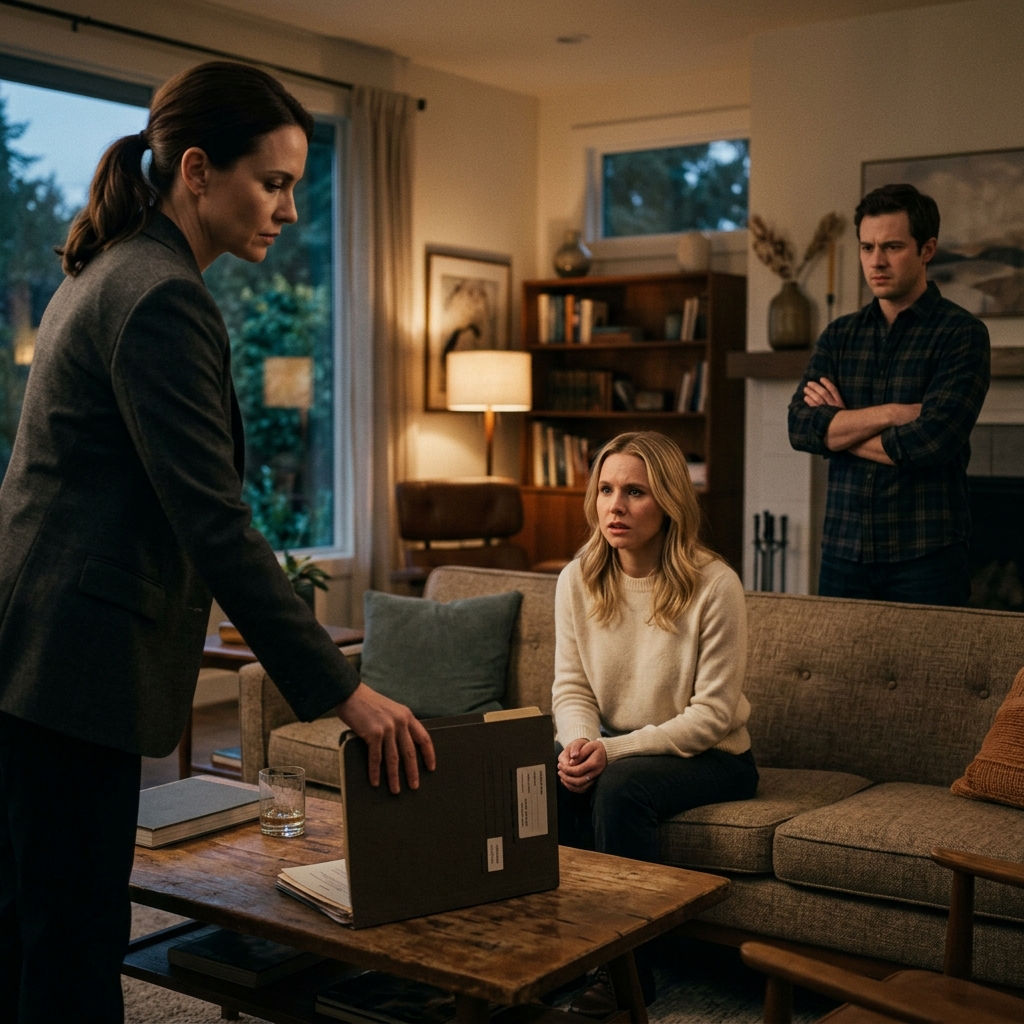
Naomi Adler did not raise her voice the day her husband asked for a divorce, and that was the first thing that unsettled Daniel, though he did not yet understand why. Most people expected anger, or at least a visible crack, something they could respond to, something that would make them feel justified. But Naomi simply sat on the edge of the sofa, her posture straight, her expression calm in a way that did not look like suppression, but like conclusion.
“You’ve become exhausting, Naomi,” Daniel said, his tone smooth, rehearsed, as if he had practiced saying it enough times to believe it. “Always busy, always somewhere else. I don’t feel anything in this house anymore.”
Naomi looked at him, then briefly at the woman beside him. Vanessa stood close, her hand lightly resting on his arm, her smile controlled but unmistakably victorious. She was already imagining herself in this space, that much was obvious. Naomi could see it in the way her eyes moved, quietly measuring the furniture, the walls, the life she thought she was stepping into.
“And her?” Naomi asked, her voice even.
Vanessa spoke before Daniel could answer. “We didn’t plan this,” she said, though the confidence in her tone suggested otherwise. “But sometimes you just find the right person.”
Naomi nodded slowly, as if acknowledging a fact that had already been processed long before this moment. Daniel took that as permission to continue.
“I want a divorce,” he said. “And I think it’s better if we don’t drag this out. Take your personal things. The car if you want it. I’ll handle the house.”
“The house,” Naomi repeated softly.
“Yes,” Daniel said, leaning forward slightly. “Vanessa and I will build something new here.”
Vanessa smiled again. “I’ve actually been looking at curtains. Something lighter. Maybe yellow. This place feels a bit heavy.”
Naomi’s lips curved just slightly, not quite a smile. “Yellow will definitely highlight the things you haven’t noticed yet.”
Daniel frowned. “There’s nothing to notice. It’s a house. You clean it, you live in it. That’s it.”
Naomi tilted her head, studying him with a quiet clarity that made him shift uncomfortably. “You think it’s a house,” she said. “It’s a system.”
Daniel let out a short, dismissive laugh. “There you go again. Overcomplicating everything.”
Naomi did not argue. She stood up, unhurried, walked to the side table, and picked up her bag. From it, she pulled out a folder and held it for a moment before placing it on the coffee table between them. The sound it made was not loud, but it carried weight.
“You want this life?” she asked, now looking directly at Vanessa. “The house, the family, the role. You’re sure?”
Vanessa crossed her arms lightly, her confidence still intact. “I already have it.”
Naomi nodded once. “Then you have this too.”
Vanessa glanced at the folder. “What is it?”
Naomi opened it and pulled out a laminated sheet, placing it flat on the table. The page was divided into three colors, carefully written, detailed.
“This is your starting point,” Naomi said. “Seven medications a day. Three different time windows. Blue is morning, red is afternoon, green is evening. Every dose has a condition. Every condition has a consequence.”
Daniel exhaled, already irritated. “You’re making this sound like a full-time job.”
Naomi looked at him. “It was.”
Vanessa leaned in despite herself. “Why is it so specific?”
“Because getting it wrong makes her sick,” Naomi replied calmly. “And getting it right is the difference between a stable week and a hospital visit.”
She pulled out another sheet. “Food interactions. Cream interferes with the afternoon medication. Too much potassium affects the morning dose. Oats must be slow-cooked, not instant. Half a banana, not a whole one.”
Vanessa blinked. “That’s… a lot.”
Naomi met her eyes. “That’s the part you can see.”
Daniel shifted his weight. “We’ll figure it out.”
Naomi did not respond to him. Instead, she placed a third sheet on the table. “Appointments. Every third Thursday. Blood pressure logged every morning before breakfast. The monitor is in the drawer beside the sink. There’s a notebook above it. Every reading for the past three years is there.”
Daniel’s expression tightened. “You’re exaggerating.”
Naomi’s voice remained steady. “You didn’t know the time of her evening medication.”
Silence.
“You didn’t know the water couldn’t be cold,” she continued. “You didn’t know she gets sharp between two and four because the pain rises. You didn’t know she needs a choice, not a solution, to feel in control.”
Vanessa’s confidence began to fracture. “I can learn,” she said quickly. “I just need time.”
Naomi closed the folder gently. “I hope your memory is better than your loyalty.”
Daniel’s jaw clenched. “That’s unnecessary.”
“No,” Naomi said quietly. “What’s unnecessary is pretending this will work without understanding what you just took on.”
She picked up her bag and walked toward the door. Daniel watched her, something uneasy forming beneath his irritation.
“That’s it?” he asked. “You’re just leaving?”
Naomi paused with her hand on the handle. For a brief moment, she looked almost weightless.
“I didn’t lose anything,” she said. “I stopped carrying it.”
Then she stepped out, and the door closed behind her with a finality that neither of them fully grasped yet.
The first few days felt deceptively easy. Vanessa moved through the house with energy, rearranging small things, adding decorative touches, replacing items Naomi had chosen with ones that felt brighter, more hers. The yellow curtains arrived and went up quickly, filling the room with a different kind of light that did nothing to soften the tension beneath it.
“It already feels better,” Vanessa said one afternoon.
Daniel nodded, distracted, though something about the house felt slightly off, as if a rhythm had been interrupted without him knowing what it was.
The problems began quietly. The internet stopped working, and neither of them knew the provider. A bill arrived marked overdue. The boiler warning light came on. A neighbor knocked about the trash being placed incorrectly. Each issue was small, manageable in isolation, but together they created a friction that neither of them had experienced before.
Then Helen called.
“Where is Naomi?” she asked.
Vanessa hesitated. “She moved out. I’m here now.”
A pause followed, long and unreadable. “Come on Saturday,” Helen said.
Vanessa dressed carefully that morning, choosing something she thought communicated respect. She brought a casserole, smiling as she stepped inside.
“I made this for you,” she said.
Helen looked at the dish, then at Vanessa, her gaze sharp and unyielding. “Sit down.”
Vanessa did. The room felt different, heavier, not because of the space, but because of the woman sitting across from her.
“Who is managing my medication?” Helen asked.
“I have the chart,” Vanessa replied quickly. “Naomi left it.”
“And what have you learned?”
Vanessa straightened. “Blue is morning, red is afternoon, green is evening.”
Helen nodded once. “And the evening dose?”
“Seven.”
“Six-thirty,” Helen corrected. “And why?”
Vanessa hesitated.
Helen’s voice remained calm, but it carried a quiet authority that made the silence uncomfortable. “Naomi didn’t learn this,” she said. “She noticed it.”
Vanessa felt something shift inside her, a small but undeniable crack.
“I can learn,” she said again, softer this time.
Helen’s gaze did not soften. “Time is the one thing you do not have enough of.”
She pointed to the casserole. “What’s in it?”
“Chicken, cream, mushrooms.”
“Cream,” Helen repeated. “I cannot have cream.”
Vanessa froze. “I didn’t know.”
“No,” Helen said. “You didn’t.”
That conversation marked the beginning of the unraveling.
Over the next weeks, the house began to reveal its complexity. The chart remained on the refrigerator, but slightly misaligned. The notebook was misplaced. The monitor was used incorrectly. The appointment on the third Thursday was missed entirely, leaving Helen waiting, dressed and ready, for a ride that never came.
Daniel began to feel it then, not as a single realization, but as a series of small failures that accumulated into something undeniable. One morning, he stood in front of the chart and read it line by line.
“Five forty-five,” he murmured. “Water, not cold. Wait thirty minutes.”
He had never known.
He had never asked.
“I thought she was just there,” he said quietly one evening, sitting at the kitchen table.
Vanessa didn’t respond immediately. She had been coming to her own understanding.
“I can’t do this,” she said finally.
Daniel looked up. “What do you mean?”
“This life,” she said, gesturing around them. “This isn’t what you said it was.”
His expression hardened. “So you’re leaving?”
Vanessa met his gaze, and for the first time, there was no performance in her voice. “I didn’t take your wife’s place. I walked into her workload.”
The words landed heavily.
“You didn’t build this life,” she continued. “She carried it.”
Daniel felt something inside him collapse, not violently, but completely.
Vanessa picked up her bag. “I thought I was choosing something better. But this was never yours to give.”
Then she left.
That night, the house was quiet in a way that felt unfamiliar. Daniel stood in the kitchen, staring at the refrigerator. He reached out and adjusted the chart, aligning it perfectly.
Then he read it again. Every line. Every note. Every detail he had ignored for years.
“I didn’t know,” he whispered.
And for the first time, he understood that not knowing had never been an accident.
Months later, Naomi sat by the window of her new apartment, sunlight stretching across the floor in a slow, predictable pattern. She held a cup of tea, waiting until it reached the exact temperature she preferred before taking a sip.
Her phone buzzed. A message from Daniel.
“I’m sorry.”
She looked at it for a moment, then set the phone down without replying. Not out of anger, but out of clarity.
Some truths did not require response.
She leaned back in her chair, watching the light shift, feeling something she had not felt in a long time.
Lightness.
Because for the first time in years, the only life she was holding together…
was her own.
![[FULL STORY] “She Said She Can’t Say No to Her First Love” — So I Stopped Saying Yes to Her Forever](https://sa.greatgames.info/storage/thumbnails/1776864909_2a20c344-b653-4cf8-8026-36471526142b.png)
![[FULL STORY] “At The Reunion, Tell Everyone We’re Just Friends—My Ex Will Be There.”](https://sa.greatgames.info/storage/thumbnails/1776660070_6b0fc02e-d41f-4bcf-8749-8296492afd16.png)
![[FULL STORY] My Fiancee Told Me To Get Out Of Her Way During Her "Survival Mode" While My Father Was In Surgery, So I Deleted Our Future.](https://sa.greatgames.info/storage/thumbnails/1777351613_B14.png)

![[FULL STORY] 8 Years After Our Divorce, I Saw My Ex Again—He Didn’t Expect What Happened Next](https://sa.greatgames.info/storage/thumbnails/1776744948_Woman_isolated_from_202604211113.jpeg)