
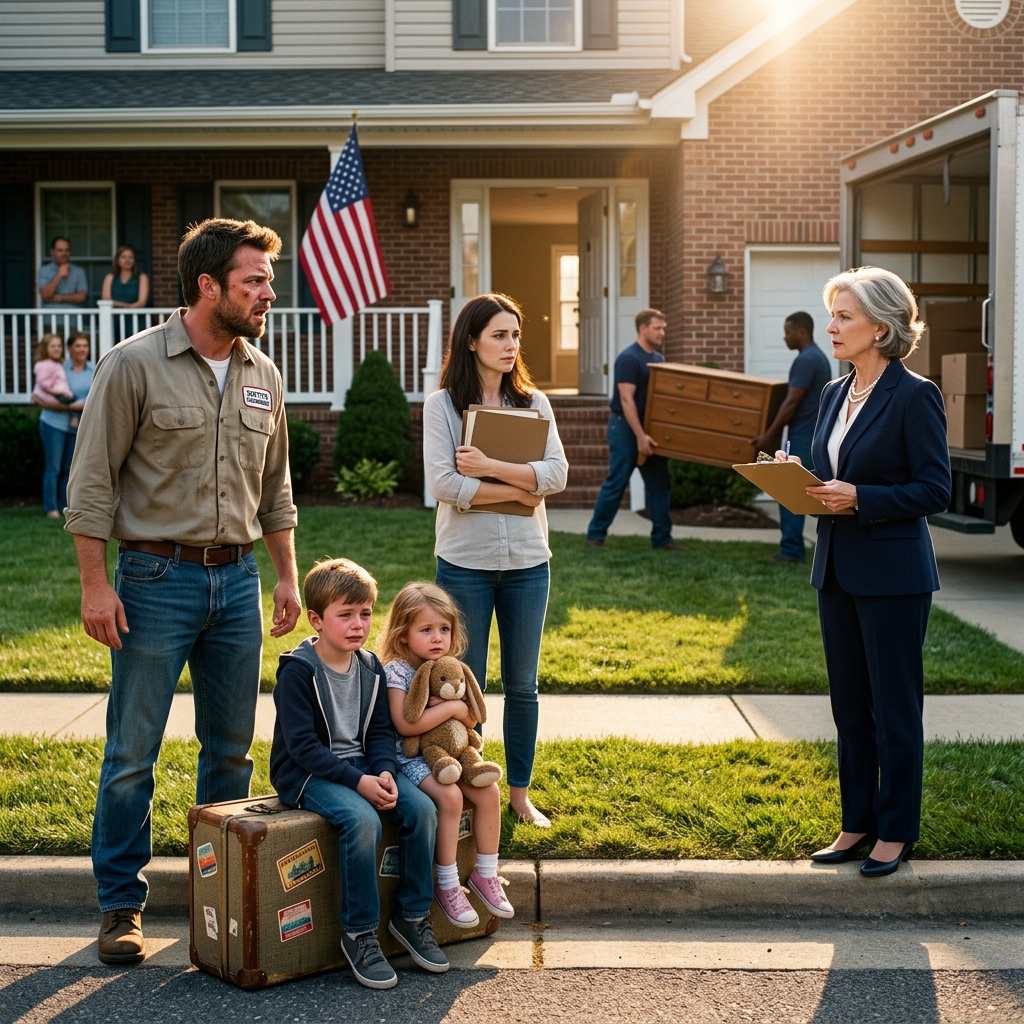
Why is my son sitting on the curb? Martin Cole stepped out of his car. His 6-year-old son sat on a suitcase near the mailbox. His 3-year-old clutched a stuffed rabbit beside cardboard boxes.
His wife stood motionless on the lawn, and his stepmother directed movers carrying furniture out of his house. He had come home 2 days early expecting an ordinary afternoon. He had no idea he was about to discover how much silence had cost his family. Hello lovelies, and welcome to her drama tales. Your place for stories that remind you the boundaries you fail to defend become the doors others walk through.
If you believe that protecting your family means more than providing for them, please hit that subscribe button and turn on notifications so you never miss a moment of the drama.
The street was quiet except for the scrape of furniture against the moving truck's ramp and the distant bark of a neighbor's dog.
Late afternoon sunlight cast long shadows across the lawn, turning the scattered belongings into something that resembled a yard sale organized by chaos. Martin didn't shout.
He didn't run. He walked with the measured pace of a man trying to process information that refused to arrange itself into logic. Caleb saw him first. The boy's face shifted from confusion to desperate hope, and he scrambled off the suitcase, sprinting across the grass. Dad. Martin caught him, lifting his son against his chest.
The boy's arms wrapped around his neck with the ferocity of someone who had been waiting for rescue without knowing when it would arrive.
Hey, I'm here.
Martin kept his voice steady, though nothing inside him felt steady. I'm right here. Lily toddled toward them, rabbit dragging on the ground, her small face uncertain. Martin crouched and gathered her, too, holding both children against him while his eyes swept the scene.
The front door hung open.
Through it, he could see bare walls where photographs had hung that morning. A lamp, Naomi's grandmother's lamp, sat near the curb beside a box labeled kitchen miscellaneous. Two movers emerged carrying a headboard, his headboard, from his bedroom. Naomi stood on the lawn like a woman carved from stone. She held a Manila folder against her chest, her phone gripped in her other hand. Her face was pale but composed, her posture rigid with the particular stillness of someone who had been holding themselves together through force of will alone.
And there, clipboard in hand, dressed in pressed slacks and a silk blouse as though supervising a charity event, stood Linda, his stepmother, his father's widow, the woman who had occupied his guest wing for 3 years while contributing nothing but commentary and complaints. Linda noticed him and smiled, the careful, calibrated smile she deployed when she wanted to appear reasonable. Martin, you're early. He set the children down gently. Caleb, take your sister and sit on the porch steps.
Don't move until I come get you.
But, Dad, porch steps.
Now. The boy obeyed, taking Lily's hand and leading her toward the house with the solemn responsibility of a child who understood that something was deeply wrong. Martin crossed the lawn toward Linda. The movers had paused, sensing a shift in atmosphere that their work order hadn't prepared them for. Explain.
There's nothing to explain. Naomi and I discussed the situation while you were away, and we agreed. We agreed to nothing. Naomi's voice cut through, quiet but sharp enough to draw blood. I have been telling you for 2 days that I am not leaving this house without speaking to my husband. Linda's smile tightened almost imperceptibly. She's been emotional. The children have been difficult. I was simply trying to manage. By putting my family on the street? By facilitating a transition that everyone knew was coming eventually. Martin stared at her.
Three years of small cruelties. Three years of comments designed to diminish, to undermine, to remind Naomi that she was a guest in a house that Linda considered rightfully hers. Three years of tension that Martin had noticed but never addressed because addressing it would require confrontation, and confrontation was exhausting, and surely things would settle on their own. They hadn't settled.
They had festered.
And now they had erupted. Everyone get out of my house, Martin said. His voice carried no volume, but the authority in it stopped the movers mid-step. Put down whatever you're carrying. Step away from the truck. No one removes anything else until I understand what happened here. The movers exchanged glances, then complied. Linda's expression flickered, loss annoyance quickly masked with practiced composure. Martin, you're overreacting. If you would just let me explain. You'll get your chance to explain. He turned to Naomi. But first, I want to hear from my wife.
The house on Millbrook Drive had belonged to Martin's father for 31 years. Thomas Cole purchased the property the summer before Martin was born.
A young contractor with more ambition than capital and a pregnant wife who believed in him fiercely. He built the addition himself, the sunroom, the back deck, the detached garage that eventually became his workshop.
Every board, every nail, every coat of paint carried his fingerprints.
When Martin's mother passed during his junior year of high school, Thomas preserved the house exactly as she had arranged it. Her curtains, her garden layout, her system for organizing the pantry.
He lived among her decisions like a man inhabiting a memorial, and Martin grew up understanding that homes carry weight beyond their walls. Thomas remarried late in life, 8 years after his first wife's death. Linda Vaughn was 15 years his junior, recently divorced, polished in ways that seemed sophisticated to a lonely widower and suspicious to his adult son. But Thomas was happy, or seemed happy, and Martin, consumed with building the construction company his father had nearly bankrupted through poor decisions, didn't have energy for skepticism.
The marriage lasted 6 years. Thomas died of a heart attack in the kitchen, collapsing beside the stove where he'd been making his morning coffee. Martin inherited the house, the company, and a stepmother with nowhere else to go. He offered Linda the guest wing indefinitely. It seemed like the right thing to do. His father would have wanted her cared for, and Martin's own guilt for the years he'd spent focused on work instead of family, for the phone calls he'd cut short, for the visits he'd postponed, made generosity feel like penance. Linda accepted with what appeared to be gratitude.
The gratitude didn't last.
Within 6 months, she began treating the guest wing as a base of operations rather than a kindness extended. She commented on household decisions she had no stake in. She questioned Martin's renovations, suggesting he was erasing his father's memory by updating the aging systems Thomas had neglected. She referred to our home in conversations with neighbors, positioning herself as co-owner rather than guest. Martin noticed. He told himself it didn't matter. Then Naomi arrived. They met at a construction industry conference, both reaching for the informational pamphlet about sustainable building materials. She laughed first, a warm, easy sound that made the crowded expo hall feel suddenly quiet. She was coordinating educational programs for a nonprofit that trained unemployed youth in construction skills. She was smart, patient, and possessed of a steadiness that Martin's chaotic professional life desperately needed. They married 14 months later. Caleb arrived the following year. Lily came 26 months after that. Linda's hostility toward Naomi began before the wedding. It started as questions. Where did Naomi grow up? What did her parents do? How had she and Martin met so quickly after his last relationship ended? The questions carried undertones of judgment, implications that Naomi was somehow insufficient, unvetted, a stranger who had inserted herself into a family she didn't belong to. Naomi handled it gracefully. She answered questions without defensiveness. She included Linda in holiday planning and birthday celebrations. She made space for a woman who refused to make space for her.
The hostility evolved. Linda began commenting on Naomi's housekeeping, suggesting the standards had slipped since Thomas's time. She questioned Naomi's decision to pause her career after Lily's birth, implying that depending on Martin financially was evidence of weakness rather than partnership. She observed loudly and often that Martin seemed tired and overwhelmed, the implication being that his family was the source of his exhaustion. She's difficult, Naomi told Martin once after a particularly pointed dinner conversation. But she's your family. I can handle difficult. Martin heard this as resolution. He should have heard it as warning. He told himself that tolerance was wisdom. He told himself that avoiding confrontation preserved peace. He told himself that Linda's behavior was annoying but not dangerous, uncomfortable but not threatening. He was wrong. The morning he left for a 4-day supplier negotiation in another state, he kissed his wife goodbye and promised to call when he landed. He hugged his children and told them to behave for their mother. He waved at Linda, who stood in the kitchen doorway with coffee in hand, and reminded her that Naomi would handle anything that came up. Linda smiled and said nothing. Martin drove away believing his household was stable enough to survive his absence. He had confused silence with safety.
He would not make that mistake again. The campaign began 12 hours after Martin's departure. Linda knocked on the master bedroom door at 6:45 a.m. before the children had woken, before Naomi had finished her first cup of coffee. She entered without waiting for invitation, settling into the reading chair near the window as though she belonged there. We need to discuss something, she said, about Martin. Naomi set down her coffee. What about him? He's struggling. Linda's voice carried the particular softness of someone delivering bad news they secretly relished. The company, the financial pressure, the demands of a young family, it's weighing on him. He mentioned it to me before he left. He's not sure he can sustain this much longer. Sustain what? All of it. Linda gestured vaguely at the room, the house, the life Naomi had built with her husband. The mortgage. The children's expenses. The stress of caring everyone. He loves you, of course, but love doesn't pay bills, and Martin is drowning. Naomi studied the woman across from her. Three years of observation had taught her to recognize when Linda was maneuvering.
And this had the texture of a prepared speech, rather than a spontaneous concern. If Martin is struggling, he would tell me himself. Would he? Linda tilted her head. He hates difficult conversations. You know that. He's been avoiding this one for months because he doesn't know how to say it without hurting you. She leaned forward. I'm telling you this as someone who cares about this family. The kindest thing you could do for him, for the children, for everyone, is give him space to breathe. Space. Time apart. A chance to reconsider what he actually wants from his life. Linda paused meaningfully.
Before the resentment becomes permanent. Naomi's hands remained steady around her coffee cup. I'm not leaving my home because you claim my husband is unhappy. It's not your home, Naomi. It's Thomas's home. Martin's home. You married into it three years ago. That doesn't make it yours. The words were a blade, but Naomi had been cut before. She didn't flinch. I'm going to call Martin and discuss this with him directly. He won't answer. Travel days are chaos for him. Meetings, logistics, disruptions. You know how it is. Linda stood, smoothing her blouse. I'm trying to help you handle this with dignity. Leaving quietly on your own terms is better than being asked to leave. Think about it. Think about what's best for everyone. She departed without waiting for response. Naomi called Martin immediately. The phone rang four times and went to voicemail. She texted, "Call me when you can. Urgent." No response came. She tried again at noon. Same result. Again at 3:00. Again at 7:00. His phone appeared to be off entirely, her messages disappearing into silence. She didn't know that Martin's phone had been damaged during a layover, that he was using a borrowed device with a different number, that her texts were accumulating in a queue he couldn't access. She only knew that her husband was unreachable, and her stepmother-in-law was circling like something patient and predatory. Linda returned the following morning with renewed confidence.
Have you reconsidered?
No.
Naomi.
The false softness had evaporated, replaced by something colder. I'm offering you an exit with your dignity intact. If you force this to become unpleasant, it will become unpleasant. And you will not win. I'm not leaving without speaking to Martin. Then you're making a mistake you'll regret. Linda departed again. But this time, Naomi noticed something different in her posture. Not frustration, but resolution. The look of someone who had finished asking and was preparing to act. That night, Naomi checked the locks twice before sleeping. She should have checked them three times. The movers arrived at 9:17 a.m. on day three. Naomi heard the truck before she saw it. The grinding downshift of a heavy vehicle, the hiss of air brakes, the metallic clang of a loading ramp deploying. She was in the kitchen with the children, Caleb eating cereal, Lily smearing yogurt across her high chair tray. An ordinary morning that was about to become anything but. She walked to the front window and felt her stomach drop. Two men in work uniforms stood near a moving truck parked in the driveway, consulting clipboards and gesturing toward the house. Linda met them on the front porch, folder in hand, dressed in pressed slacks and a blazer, as though conducting official business. Naomi stepped outside. What is this? A transition, Linda replied smoothly. I've arranged temporary storage for your belongings and reserved a hotel room in your name. Extended stay. Very reasonable rates. You have no authority to do this. I have every authority. Linda's confidence was absolute. This house belongs to Martin. I've lived here since before you arrived, and I'll remain long after you're gone. Martin wanted this handled while he was away. He asked me to manage it. So I'm managing it. The movers exchanged uncertain glances. The older one, weathered, experienced, clearly uncomfortable, spoke carefully. Ma'am, we were told this was a standard separation move. Voluntary relocation. Is that accurate? It's accurate, Linda said. It's not. Naomi's voice remained level despite the panic clawing at her chest. I am Martin Cole's wife. These are our children. No one has authorized this. The mover looked between them, clearly wishing he had called in sick that morning. Linda produced a document from her folder.
Something official-looking, covered in legal language and stamped signatures. The property is owned by Martin Cole. I am his designated household representative during his absence. This paperwork authorizes the temporary relocation of non-primary belongings. The mover examined the document. Whatever it contained was convincing enough, or confusing enough, to make him nod slowly. We'll proceed with the listed items. They entered the house. Naomi followed, phone in hand, trying Martin's number again. Still nothing. She texted, "Linda has called movers. She is removing our belongings. Please call immediately." The message sent. No reply came. The next three hours became a master class in calculated humiliation. The movers took furniture from the master bedroom first. The bed frame Martin had built himself. The dresser Naomi's parents had given them as a wedding gift. The nightstands, the lamps, the reading chair where she nursed both children during their first months of life. They moved to the children's rooms next. Caleb's bookshelf. Lily's changing table. Boxes of toys, clothes, blankets. Items that Linda had somehow inventoried in advance, designating them as non-essential, with the clinical efficiency of someone cataloging property, rather than disrupting lives. Linda supervised everything with eerie calm. She directed the movers to remove photographs from the walls, wedding pictures, family portraits, images of the children at various ages. She placed them in boxes labeled personal items, and had the boxes carried to the truck without ceremony. The children will adjust, she observed when she noticed Naomi watching. Children are adaptable. They forget faster than we expect.
What exactly are you telling them?
The truth.
Linda smiled.
That their father needs some space, and you're all going on a little trip together. Caleb understands. He's very mature for his age. Naomi found her son in his bedroom, sitting on his bare mattress, watching movers carry his bookshelf toward the stairs. His face carried the particular blankness of a child trying to process something too large for his understanding. Mom, are we in trouble? She crouched beside him, forcing her voice to remain steady. No, sweetheart. There's been a misunderstanding. We're going to wait for Daddy to come home, and he's going to fix everything. Grandma Linda said Daddy wants us to leave. The words hit Naomi like a physical blow. Not for herself, but for her son, who would carry this confusion whether the situation resolved or not. That's not true. Daddy loves us more than anything. He would never send us away. Then why is she taking our stuff? Naomi didn't have an answer that would make sense to a six-year-old. She barely had an answer that made sense to herself. I need you to be brave, she said finally.
Can you do that for me?
Be brave and take care of your sister until Daddy gets here. Caleb nodded solemnly, accepting responsibility no child should have to carry. Naomi returned to the living room, where Linda was instructing the movers to take the couch. The couch where Martin proposed, where they watched movies as a family, where Lily had taken her first steps. This is illegal, Naomi said quietly. You're removing belongings from a home without authorization from the legal owners. The legal owner is Martin. And Martin isn't here. Linda's voice carried the particular smugness of someone who believed they had already won. You can contest this later, of course. Hire lawyers. File complaints. Drag it through the courts for months while you live in a hotel room with two small children. She shrugged. Or you can accept reality and move on with some dignity intact. Naomi looked at the bare walls, the empty spaces where her life had been arranged just hours ago. I'll accept reality, she said calmly. Just not the one you're trying to create. She pulled out her phone and began recording. The footage accumulated over the next 47 minutes. Naomi documented everything. The movers carrying furniture. Linda giving instructions. The removal of personal photographs. The boxes stacked on the curb like evidence of a life being dismantled. She recorded a conversation between Linda and a curious neighbor who wandered over to investigate the commotion. Just a family transition, Linda explained cheerfully. Naomi and the children are relocating. Martin needs some space to focus on the business. You know how demanding these young wives can be. She recorded Linda approaching Caleb in the hallway and crouching to his level with manufactured warmth. Remember what I told you, sweetheart. Daddy loves you, but he needs grown-up time. You'll visit him on weekends once everything settles. She recorded the moment Linda realized she was being filmed, and her expression shifted from confidence to something harder. Put that phone away. No. You're embarrassing yourself. I'm protecting myself. And my children.
From what?
A voluntary relocation. We'll let Martin decide what to call it. The movers finished loading the truck shortly after noon. The house stood half empty, walls bare, rooms stripped of everything that made them feel like home. The children's belongings were gone. The bedroom furniture was gone. The photographs, the books, the accumulated objects of a shared life, all packed into a truck that Linda had summoned without authority or conscience. Neighbors gathered at the edges of their lawns, watching with the particular fascination of people grateful their own lives weren't being dismantled in public view. Naomi gathered her children, walked them to the curb, and sat down on a suitcase that contained the only belongings Linda hadn't managed to claim. Documents, medication, the children's comfort items, and evidence. She sent one final message to Martin. Linda is removing us from the house. I have video.
Please come home immediately. Then she waited. Martin arrived 43 minutes later. He had received Naomi's message during the final session of his supplier negotiation.
On a borrowed phone he'd barely learned to operate. He read the words three times, convinced he was misunderstanding something fundamental. Then he excused himself from the meeting, drove directly to the airport, and caught the first flight home. The taxi dropped him at the corner of his street. He paid without counting the change and walked toward his house, trying to reconcile what he was seeing with what he knew to be true. His children on the curb, his wife on the lawn, his furniture in a truck, his stepmother directing operations like she owned the property and everyone on it. He asked the only question that mattered.
Why is my son sitting on the curb?
And now, standing in his living room with Naomi's phone in his hand, he watched the footage that answered everything. Linda instructing movers, Linda removing photographs, Linda telling Caleb that his father wanted them gone, Linda calling Naomi temporary in conversation with neighbors, Linda methodically dismantling a family while their protector was hundreds of miles away and unreachable. 47 minutes of documentation. 47 minutes of evidence. 47 minutes of cruelty captured in high definition. Martin lowered the phone, put everything back. The movers moved immediately, grateful for clear direction after hours of uncomfortable ambiguity. Linda's composure cracked for the first time. Martin, you need to understand the context. I understand enough. She was going to leave eventually. Everyone could see it. I was simply accelerating. You were removing my wife and children from their home while I was unable to stop you. Martin's voice remained quiet, which made it somehow more devastating than shouting would have been. You told my son that his father wanted him gone. You told neighbors that my wife was a burden I needed space from. You packed our belongings into a truck and prepared to scatter my family across hotel rooms and storage facilities because you decided you had the authority. The house is in your name. She has no legal. She has every legal claim. Linda's expression froze. Three years ago, Martin continued, I refinanced the mortgage, updated the deed, added Naomi as co-owner with full survivorship rights. I did it because I wanted my wife and children protected regardless of what happened to me. He paused. I never imagined I was protecting them from you. The silence that followed was absolute. That's not Linda's voice faltered. You never mentioned. I never mentioned it because I never thought I needed to. I assumed that living in my home, benefiting from my labor, enjoying a lifestyle funded entirely by my income might inspire basic gratitude, basic respect for the family that welcomed you when you had nowhere else to go. Naomi stood near the doorway, Lily in her arms, Caleb pressed against her side. She hadn't spoken since handing Martin the phone. She didn't need to. The footage spoke for itself. I tolerated the comments, Martin said. The implications that Naomi didn't belong here. The suggestions that my marriage was a burden. That my children were complications. That my wife was somehow temporary despite the vows we exchanged and the life we built. He stepped closer to Linda. I tolerated it because my father loved you, and I wanted to honor his memory by extending you the benefit of doubt he would have extended. Thomas would never have allowed. Thomas is gone. And if he were here, watching what you did to his grandchildren today, he would be ashamed. The words landed with the weight of finality. You will move out by the end of the month, Martin continued. I will provide 30 days of assistance, first month's rent at a reasonable apartment, moving costs, a transition period to arrange your affairs. After that, you are responsible for yourself. This is my home. I have been here since. You have been a guest. A guest who mistook hospitality for ownership. A guest who confused my silence with permission. Martin's voice dropped to something barely above a whisper. You tried to remove my family from their home. You traumatized my children. You publicly humiliated my wife in front of our neighbors. And you did it believing you had the right because I never made clear that you didn't. He paused, and when he spoke again, the words were as much for himself as for Linda. That failure is mine. I should have set boundaries years ago. I should have addressed your hostility toward Naomi the first time I noticed it. I should have understood that tolerating disrespect doesn't preserve peace. It breeds entitlement. He met Linda's eyes. I won't make that mistake again. Linda stared at him for a long moment. Then something in her collapsed. Not dramatically, but completely, like a structure whose supports had finally given way. She gathered what remained of her composure and walked toward the guest wing without another word. The door closed behind her. The house fell silent. The movers finished returning everything within 2 hours. They worked quickly, efficiently, clearly eager to complete the job and escape a situation they had never signed up for. The older mover apologized quietly to Naomi as he repositioned the couch. We were told it was voluntary. Separation logistics. Happens all the time. He shook his head. Should have asked more questions. You couldn't have known. Maybe not, but I'm sorry anyway. By evening, the house had reassembled itself. Furniture stood in its proper places. Photographs hung on walls. The children's rooms contained their belongings again. From the outside, nothing appeared different, but everything had changed. Martin sat with Caleb on the boy's bed, trying to explain what had happened in terms a 6-year-old could process. Grandma Linda made a mistake, he said carefully. A big mistake. She thought she was allowed to make decisions that weren't hers to make. She said you wanted us to leave. That was a lie, buddy. I would never, ever want you to leave. You and Lily and Mom, you're my whole world. Nothing is more important to me than this family. Caleb considered this with the gravity children bring to serious conversations. Is Grandma Linda in trouble? She's going to live somewhere else now because what she did wasn't okay, and I need to make sure it never happens again. Will she say sorry? Martin hesitated. Some lies were meant to protect, and some truths were meant to prepare. I don't know, but even if she doesn't, we're going to be okay. I promise. Caleb nodded slowly, then wrapped his arms around Martin's neck. I was scared, Dad. I know. I'm so sorry I wasn't here. It's okay. Mom kept us safe. Martin held his son tighter, feeling the full weight of what had almost been lost. After the children were asleep, he found Naomi on the back deck, staring at the darkened yard with a glass of wine she hadn't touched. I keep replaying it, she said without turning. Every moment. Every word. Wondering if I could have stopped it somehow. You did stop it. You documented everything. You kept the children calm. You held the line until I could get here. I shouldn't have had to hold any line. Her voice cracked slightly. I shouldn't have had to defend my right to exist in my own home against a woman who resented me for 3 years while you She stopped, but the unfinished sentence hung between them. While I did nothing, Martin completed quietly. While I noticed the tension and told myself it would resolve on its own. While I prioritized avoiding conflict over protecting you. Naomi finally turned to face him. Her eyes glistened in the porch light. I thought I was managing it. I thought absorbing the disrespect was the mature thing to do. The thing that kept peace for everyone. I didn't want to burden you with complaints about your stepmother when you were already carrying so much. So we both stayed silent about things that needed words. Yes. That ends tonight. Martin reached for her hand. From now on, we talk about what's actually happening. We address tension before it becomes crisis. We defend boundaries before someone decides to test them. And Linda, she'll be gone by the end of the month. I'll help her transition because my father would have wanted that. But she will never have access to this family again. Not to our home. Not to our children. Not to anything that matters. Naomi was quiet for a moment. Then she set down her untouched wine and leaned into him, her head resting against his shoulder. I kept telling myself you would come. The whole time, while they were carrying our furniture out and she was telling the neighbors I was temporary, I kept telling myself you would come. I should have been here from the start. You couldn't have known. I should have known enough to prevent it. Martin's arm tightened around her. I should have understood that the woman living in my guest wing wasn't just difficult. She was dangerous. I missed it because I wasn't paying attention to the right things. And now, now I pay attention to everything. Linda moved out 17 days later. She attempted several strategies before accepting the inevitable. She contacted extended family, hoping to recruit allies who might pressure Martin into reconsidering. She consulted an attorney only to discover that her legal position was precisely as weak as Martin had described. She wrote lengthy letters explaining her perspective, her sacrifices, her right to remain in the home her husband had left behind. Martin read none of them. The moving truck arrived on a gray Tuesday morning. Linda supervised the packing of her belongings with rigid formality, refusing to acknowledge Naomi or the children as they moved through the house. When the final box was loaded, she paused at the front door. Your father would have handled this differently. My father would have noticed the problem before it exploded. I waited until the damage was done. Martin held the door open. I arranged 3 months of rent at an apartment complex on the other side of town.
After that, you're responsible for yourself. So, this is how it ends. After everything I did for this family. What did you do for this family, Linda? The question was genuine, not rhetorical. In 3 years, what did you contribute besides criticism and complaints? Did you help with the children? Did you support my wife? Did you make this house feel more like a home? She had no answer. Goodbye, Linda. She walked out without another word. Martin watched the moving truck disappear around the corner, then closed the door and returned to the kitchen where Naomi was helping Lily with a puzzle and Caleb was practicing letters at the table. Is she gone? Naomi asked. She's gone.
For good?
For good.
The words settled over the room like something warm and protective. For good.
Finally, permanently, completely. The months that followed required adjustment. The house felt different without the tension that had occupied it for 3 years. Emptier at first, then gradually lighter, as though the walls themselves were exhaling. The children stopped asking about Grandma Linda after a few weeks. Their memories of the crisis fading with the resilience that only children possess. Martin informed extended family of what had happened before Linda could shape the narrative. Some believed him immediately. Others required the video evidence that Naomi had preserved. A few defended Linda regardless, and Martin made note of their names for future reference. He and Naomi established new rhythms for their marriage. Weekly conversations about household dynamics, not just logistics. Explicit discussions about boundaries and expectations. A shared commitment to addressing friction early, while it remained friction, before it calcified into something more dangerous. I spent 3 years thinking I was protecting peace, Martin admitted during one of these conversations, but you can't protect something that doesn't exist. What we had wasn't peace, it was pressure building slowly, waiting for the right moment to rupture. And I spent 3 years absorbing that pressure because I didn't want to burden you. Naomi shook her head. We both failed. We both learned. Better late than never. Barely. He couldn't argue with that. Five months after Linda's departure, Naomi returned to work, remote consulting for the nonprofit where she had once coordinated programs. Part-time, flexible around the children's schedules, but meaningful in ways that reminded her she was more than a mother, more than a wife, more than the woman someone had tried to displace. The guest wing became a playroom. The photographs returned to the walls. The house filled with noise and chaos and the particular warmth that only functional families generate. One evening, Martin stood at the kitchen window watching Caleb chase Lily across the backyard while Naomi prepared dinner behind him. The scene was ordinary, unremarkably, wonderfully ordinary, and he found himself grateful for it in ways he hadn't been before. I keep thinking about what almost happened, he said quietly. Naomi looked up from the vegetables she was chopping. You mean what did happen? What almost became permanent. If I hadn't come home early. If you hadn't documented everything. If the legal situation had been what Linda believed it was. He turned to face her. I almost lost everything because I couldn't be bothered to defend it. You didn't know. I knew enough. I knew she resented you. I knew she treated the children like obstacles. I knew she felt entitled to a position in this family that she hadn't earned. He paused. I knew all of that, and I decided that addressing it was too uncomfortable. I chose my own convenience over your safety. Naomi set down the knife and walked toward him. We both chose wrong. We both thought silence was survival. We both learned that it's not. She took his hands. The difference is what we do now. How we protect this family going forward. What boundaries we establish and defend. No more tolerance without limits. No more peace without protection. Agreed. From the backyard, Lily's laughter rang out, bright, unburdened, the sound of a child who had already forgotten the worst day of her young life. Caleb's voice followed, teasing his sister about something only siblings understood. Martin looked at the scene, then at his wife, then at the home they had rebuilt from the ruins of someone else's resentment. I won't fail you again, he said. You didn't fail me. You failed to see what was coming. Naomi squeezed his hands. Now you see it. Now we both see it. And we're going to make sure nothing like this ever gets close to our family again. A home is not defined by the name on the deed or the history embedded in its walls. A home is defined by the people inside it and the boundaries that protect them. Martin Cole learned this the hard way, by watching his children sit on suitcases while a woman he had tolerated for too long tried to scatter his family to the wind. He had provided for his household faithfully. He had worked long hours to secure their financial stability. He had believed that being a good provider was the same as being a good protector. He was wrong. Providing is not protecting. Earning is not defending. Silence is not peace. A family requires more than income. It requires attention. It requires the willingness to recognize threats before they fully form. Even when those threats were familiar faces and live in guest wings and phrase their hostility as concern. Linda believed that Martin's silence was permission. She believed that his tolerance was surrender. She believed that because he never confronted her hostility directly, she was entitled to escalate it indefinitely. She was wrong, too. But her wrongness nearly cost a family everything. The boundaries you fail to defend become the doors others walk through. The disrespect you tolerate becomes the entitlement others claim. The silence you maintain to avoid discomfort becomes the permission others use to cause harm. Martin understood this now, and understanding it, truly, permanently understanding it, meant never making the same mistake twice. Some lessons arrive through crisis. Some boundaries get established only after they've been violated. Some protectors learn to protect only when they've seen what happens when they don't. The Cole family learned all of this on an ordinary afternoon that became extraordinary for all the wrong reasons. But they learned it, and they remembered it, and they built their future on the foundation of what they now knew to be true. A home is not secured by ownership papers alone. It is secured by the boundaries you defend, consistently, visibly, without apology, long before anyone thinks to test them. Hey, lovelies. We have come to the end of the story. I hope this journey reminded you that protecting your family means more than providing for them. It means seeing clearly what threatens their peace and refusing to let it grow in silence. If you believe that boundaries are acts of love and not acts of war, please leave a love in the comments. Like this story, share it with someone who needs to remember that their peace is worth defending, and subscribe to her drama tales so you never miss a moment of the drama. Until next time, remember, tolerance without limits is just permission waiting to be exploited. Guard what matters before someone else decides you won't.
![[FULL STORY] My girlfriend called me the janitor in front of 50 strangers in the house I own. What she didn't](https://social-media.rabedo.com/thumbnails/1777362822_1.png)




![[FULL STORY] I overheard my girlfriend whispering to her friends at the party: “He ought to count himself…](https://social-media.rabedo.com/thumbnails/1777358787_B25.png)