
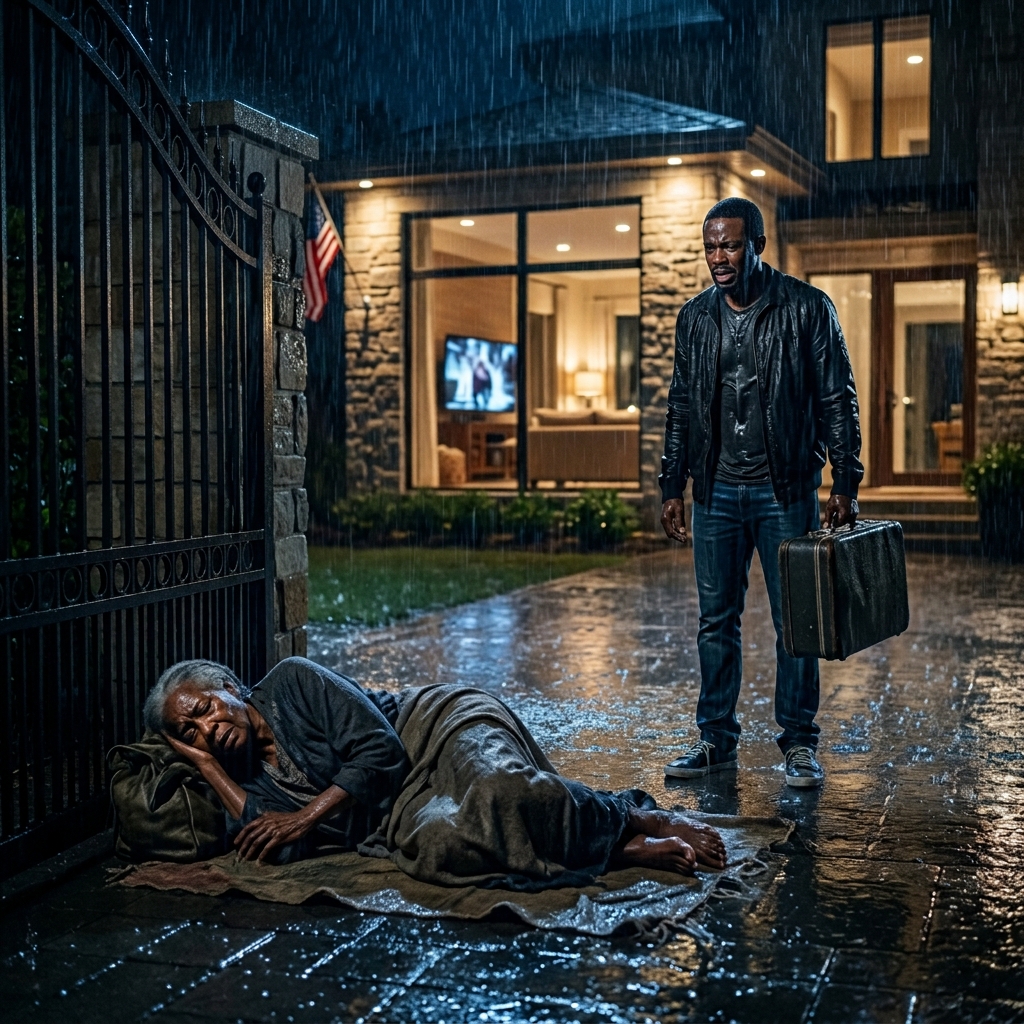
The rain in Lagos didn’t fall like something gentle.
It arrived with weight.
With persistence.
With a sound that filled every empty space and made silence impossible.
That night, it drummed relentlessly against the rusted edges of the gate, the concrete ground, and the thin sheet of corrugated metal that barely passed for shelter.
Chinedu stood across the street for a long time before he moved.
His suitcase sat beside him, untouched.
His phone buzzed once in his pocket, then went silent again.
He didn’t check it.
Because nothing on that screen mattered more than what he was seeing right now.
The house.
His house.
The one he had spent seven years paying for.
The one he had imagined every time he sent money home, picturing comfort, security, stability.
The lights were on.
Warm.
Bright.
Alive.
Exactly like the photos his wife had sent him.
Exactly like the life he believed he had built.
And just outside the gate—
his mother was lying on the ground.
At first, his mind refused to accept it.
It tried to adjust the image, to explain it away.
Maybe she had come outside for air.
Maybe she had just stepped out for a moment.
Maybe—
“Mom… why are you sleeping out here?”
The words came out before he could stop them.
Soft.
Unsteady.
The old woman stirred slowly, like someone waking from a sleep that had never been deep enough to rest.
Her eyes opened, unfocused at first, then slowly sharpening as they found his face.
“Chinedu…?”
Her voice was quiet, surprised, almost unsure.
“What are you doing here?”
He didn’t answer.
He stepped forward instead, his shoes splashing through shallow water, the rain soaking into his clothes instantly, but he didn’t feel it.
He only saw her.
The thin mat beneath her was already drenched.
The small bag beside her was tied tightly, like everything she owned had to fit inside it.
Her clothes were clean—but worn.
Not neglected.
But not cared for either.
“Mom,” he said again, his voice tightening.
“Why are you here?”
She pushed herself up slowly, her movements careful, practiced.
“I just came out for some fresh air,” she said.
“It’s cooler outside.”
Cooler.
The word sat wrong in the air.
Chinedu looked past her.
Through the gate.
Into the house.
The television was on.
A bright, colorful program playing.
Laughter echoed faintly through the walls.
Warm light filled every corner.
Everything looked comfortable.
Everything looked lived in.
Everything looked—
complete.
Except for her.
He turned back to her.
The rain ran down his face, but he didn’t wipe it away.
“How long?” he asked.
She smiled.
A small, tired smile.
“Not long.”
He shook his head slowly.
“No.”
He stepped closer, lowering himself in front of her so their eyes met.
“How long, Mom?”
She didn’t answer.
Her gaze dropped to her hands.
And that silence told him everything.
Something inside his chest tightened.
Seven years.
Seven years of believing.
Seven years of trusting.
Seven years of sending money every month, never missing one.
Every transfer labeled the same way.
For home.
For family.
For Mom.
And now—
this.
“I send money every month,” he said, his voice low.
“I never stopped.”
She nodded.
“I know.”
“Then where is it?”
She hesitated.
Not because she didn’t know.
Because she didn’t want to say it.
“In the house,” she said slowly.
“It’s… not convenient for me to stay.”
The words were gentle.
Careful.
Too careful.
As if she had repeated them so many times they had become easier to say than the truth itself.
Chinedu let out a quiet breath.
Not anger.
Not yet.
Something colder.
Something clearer.
He stood up.
Walked to the gate.
Pushed it open.
The hinge creaked softly.
He turned back.
“Come inside,” he said.
She shook her head immediately.
“No.”
“Mom—”
“I don’t want trouble.”
Her voice was almost pleading now.
“I don’t want to cause problems between you and your wife.”
That was the moment something inside him shifted completely.
Because even now—
she was protecting someone else.
Even now—
she was making herself smaller to keep the peace.
Chinedu stepped back toward her.
Bent down.
And lifted her gently into his arms.
She gasped softly.
“Chinedu, what are you doing?”
He didn’t hesitate.
“If this is my home,” he said quietly,
“then you don’t belong outside of it.”
He carried her through the gate.
Through the yard.
And into the house.
The difference hit immediately.
Warmth.
Light.
Comfort.
The smell of food.
Perfume.
Everything he had paid for.
Everything he had believed in.
And yet—
it felt wrong.
He placed her carefully on a chair near the entrance.
She sat stiffly, her hands folded tightly in her lap, as if she wasn’t sure she was allowed to touch anything.
“Chinedu?”
The voice came from the living room.
Confident.
Smooth.
Unbothered.
“When did you get back?”
Adisa stepped into view, her phone still in her hand, her expression relaxed.
Until she saw him.
Until she saw who he had brought inside.
The change was immediate.
Her smile froze.
Then disappeared.
Her eyes flicked between him and his mother.
Just for a second.
But it was enough.
“You didn’t tell me you were coming early,” she said.
He didn’t respond.
He just looked at her.
Really looked at her.
For the first time in a long time.
And everything he had ignored before—
he saw clearly now.
The polished nails.
The new jewelry.
The expensive shoes by the door.
All of it funded by him.
All of it existing while his mother slept outside.
“I just got here,” he said finally.
“And I found my mother at the gate.”
Adisa laughed softly.
A quick, controlled sound.
“You misunderstood,” she said.
“She likes sitting outside. It’s cooler.”
Cooler.
Again.
The same word.
Repeated.
Practiced.
Prepared.
Chinedu didn’t react.
Didn’t raise his voice.
Didn’t argue.
He just stood there.
Watching her.
Letting the silence stretch.
And slowly—
it started to break.
“She’s been sleeping out there for three months.”
The voice came from behind them.
A young girl stood near the kitchen entrance, her eyes wide, her expression nervous.
Adisa turned sharply.
“Be quiet.”
But it was too late.
“Three months?” Chinedu repeated.
His voice was still calm.
But something inside it had changed.
Something final.
He turned to his mother.
She didn’t deny it.
Didn’t defend it.
Didn’t explain.
She just sat there.
Silent.
And that silence confirmed everything.
Three months.
Ninety days.
Ninety nights.
While he sent money.
While he called.
While he believed.
He looked back at his wife.
Everything became simple.
Clear.
Unavoidable.
“Tomorrow,” he said quietly,
“you leave this house.”
Adisa blinked.
“What?”
“You heard me.”
Her eyes filled instantly.
“You’re throwing me out because of her?”
He didn’t answer immediately.
Because the answer didn’t matter.
The truth already existed.
Before he could speak, his mother stood up slowly.
“Don’t make this a big issue,” she said.
Her voice was still soft.
But there was something else in it now.
Something steady.
She walked forward.
Looked at Adisa.
“Did you think this house belonged to my son?”
Adisa frowned.
“What are you talking about?”
“He sent the money.”
“Yes,” the old woman said.
“He sent the money.”
She reached into her bag.
Pulled out an envelope.
Old.
Carefully kept.
She handed it to Chinedu.
“Open it.”
He did.
His eyes moved across the paper.
Then stopped.
Everything clicked into place.
He turned it toward Adisa.
Her face drained of color.
“This house,” his mother said calmly,
“is in my name.”
Silence filled the room.
Heavy.
Unavoidable.
“I bought it twelve years ago,” she continued.
“Before my son left.”
Chinedu looked at her.
“Why didn’t you tell me?”
She smiled gently.
“Because I wanted you to build your own life.”
Then she looked at Adisa.
“I let you live here.”
“I let you both live here.”
“Because I believed family was more important than ownership.”
Adisa took a step back.
Everything she had built—
collapsed.
Not slowly.
All at once.
No arguments followed.
No explanations.
No excuses strong enough to stand.
Because some truths—
don’t need to be defended.
They just exist.
…
The next morning, the rain had stopped.
The ground was still wet.
The air still heavy.
But something had changed.
Adisa walked out with a suitcase.
No shouting.
No drama.
No scene.
Just quiet footsteps.
The gate opened.
Then closed.
And with it—
seven years ended.
Chinedu stood on the porch beside his mother.
Two cups of tea between them.
Steam rising slowly into the morning air.
“I’m sorry,” he said.
She shook her head.
“You did what you thought was right.”
“I should have been here.”
She looked at him.
“You came back.”
He nodded slowly.
And for the first time—
that felt like enough.
He glanced toward the gate.
The mat was still there.
He walked over.
Picked it up.
Held it for a moment.
Then carried it inside.
Not to use.
But to remember.
Because some things—
only need to happen once—
to change everything.
![[FULL STORY] I Cancelled Our $60k Wedding After My Fiancée Was Caught Bragging About Her "Last Night of Freedom" With Her Coworker](https://social-media.rabedo.com/thumbnails/1776913233_16.png)
![[FULL STORY] My fiancé said to me one day, "I need to talk to you… and this won't be easy for you." I was surpris](https://social-media.rabedo.com/thumbnails/1777363809_5.png)