
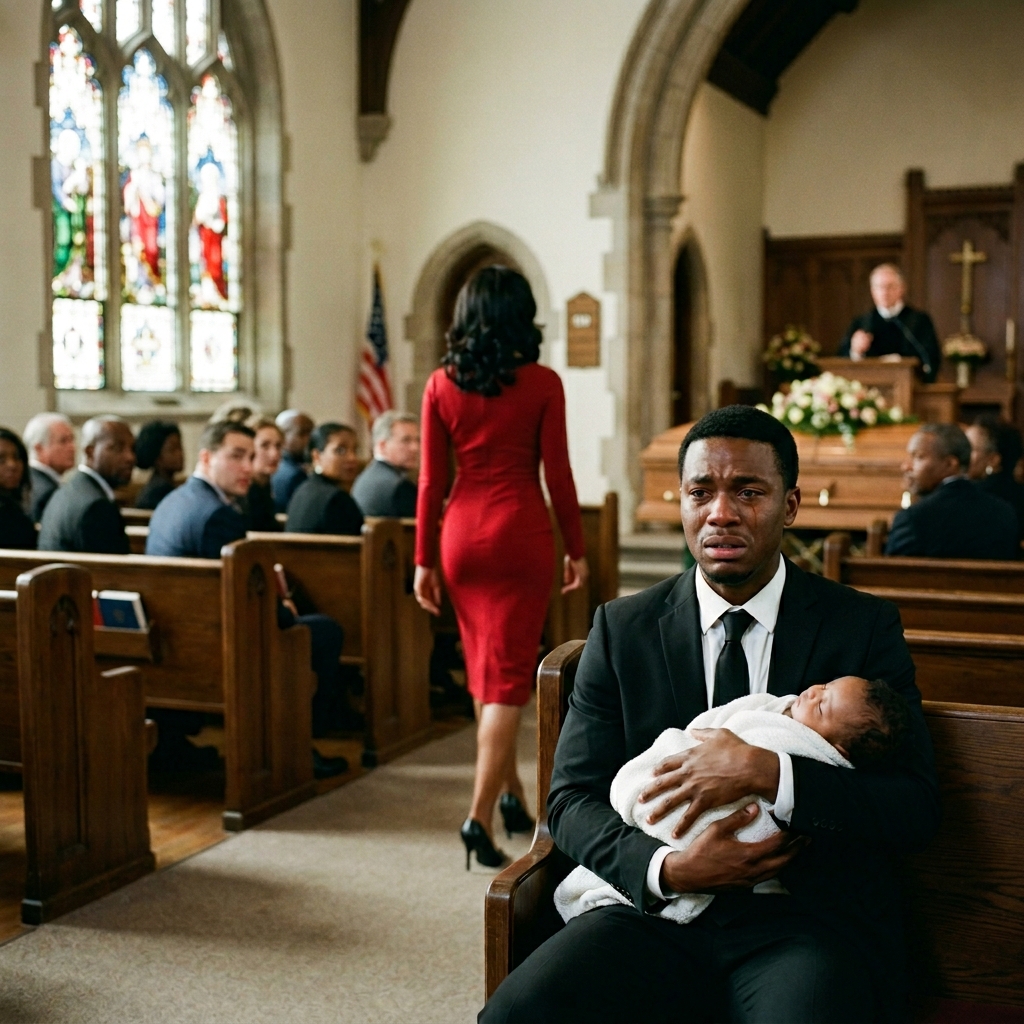
My name is Daniel Cross, and I can still hear the exact tone my wife used the day she ended our marriage.
It wasn’t loud.
It wasn’t emotional.
It wasn’t even angry.
It was precise.
Cold.
Final.
“I married below myself. I’m done.”
She said it while sitting beside me at my mother’s funeral.
Not before.
Not after.
During.
The pastor was halfway through a prayer over my mother’s coffin, his voice steady, gentle, carrying words about peace and rest and eternal life. My son, six months old, was asleep against my chest, his small weight pressing into me like something fragile I couldn’t afford to drop.
And beside me, my wife said those seven words like she was reading out a grocery list she had already decided not to follow.
Then she folded the funeral program carefully.
Neatly.
Too neatly.
Like she had practiced that motion.
She placed it beside me on the pew.
Stood up.
And walked out of the church.
Didn’t look back.
Didn’t hesitate.
Didn’t wait for a reaction.
And that was the moment I understood something I hadn’t allowed myself to see before.
This wasn’t sudden.
This wasn’t emotional.
This was planned.
She had already decided.
She had sat next to me through the first fifteen minutes of the service, waiting for the exact moment when I would be too broken to respond.
And she was right.
I didn’t chase her.
I didn’t call her name.
I didn’t even stand up.
I just held my son tighter, stared at my mother’s coffin ten feet in front of me, and made a decision so quietly that no one in that church heard it.
I was done too.
…
People think the hardest part of a marriage ending is the moment it breaks.
It isn’t.
It’s what comes after.
It’s 2:00 a.m. on a Tuesday when your son is crying so hard his whole body shakes and you’re standing in a kitchen that still smells like your wife’s perfume, wearing the same suit you buried your mother in because you haven’t had time to do laundry.
It’s formula powder spilled across the counter while you’re trying to read instructions through exhaustion.
It’s realizing there’s no one coming to help.
That was my life for four months.
Elijah had been born six weeks early.
Emergency surgery.
Three days where I didn’t know if either of them would make it.
I slept in a hospital hallway on a plastic chair, waking up every time a nurse walked past.
When they finally let me hold him, he was small.
Too small.
Angry at the world for pulling him into it too soon.
I held him and whispered the only thing I could promise.
“I’ve got you.”
And after she left—
that promise became everything.
…
I didn’t understand what had happened to my wife.
Not at first.
I saw the signs.
The distance in her eyes.
The way she held our son like he didn’t belong to her.
The silence between us growing slowly, like something spreading under the surface.
I thought it would pass.
I thought she just needed time.
I thought love would be enough.
I was wrong.
It had a name.
Postpartum depression.
But no one caught it.
Because she kept saying she was fine.
And I kept believing her.
Because I wanted to.
Her mother never believed me.
Gloria called every week.
Her voice always calm.
Always controlled.
Always precise.
“You’re still in that small flat, Daniel?”
I would hear those conversations from the other room.
Hear the way the words landed.
Hear the pauses.
The doubt.
The comparison.
I said nothing.
I thought my wife was stronger than her mother’s voice.
I was wrong again.
…
Three weeks after the funeral, my friend Marcus showed up at my door.
He didn’t knock long.
Just enough to announce himself.
When I opened the door, he looked past me into the apartment.
The bottles.
The laundry.
The feeding schedule taped to the fridge, stained with milk.
He didn’t say anything at first.
Just looked at me.
“Where is she?”
“She left.”
He stared at me for a long moment.
Then he nodded once.
“Can you help me figure out this car seat?” I said.
“I have to be somewhere in an hour.”
He walked inside without another word.
Picked up the manual.
Started reading.
That was the moment I understood something clearly.
People show you who they are in silence.
Not in speeches.
Not in sympathy.
In action.
…
The next day, Gloria came.
Not to apologize.
Not to check on her grandson.
To collect her daughter’s things.
She moved through the apartment like she was reclaiming property.
Folding clothes.
Packing bags.
Efficient.
Controlled.
Careful.
I stood in the doorway holding Elijah, still in the same clothes from the morning, watching her handle my wife’s belongings with more care than she had ever shown me in three years of marriage.
“Gloria,” I said.
She didn’t look up.
“She left a six-month-old baby.”
“My mother died yesterday.”
She stopped.
Turned slowly.
Like she had been waiting for the cue.
“My daughter is not a house girl, Daniel.”
The words landed exactly the way she intended.
“She married you thinking you were going somewhere.”
“You’re still in the same place.”
She zipped the bag.
Picked it up.
“Be thankful she left the baby.”
“That’s more than you deserved.”
Then she walked out.
And that was the moment everything changed.
Not the funeral.
Not my wife leaving.
That.
Those words.
You’re still in the same place.
They stayed with me.
Every morning.
Every decision.
Every late night.
For five years.
…
I rebuilt my life quietly.
Not for revenge.
Not for validation.
For stability.
For my son.
Every morning started at five.
Every night ended when the work was done.
I studied when he slept.
Worked when he played.
Learned everything I needed to learn to become the man they said I wasn’t.
Not loudly.
Not publicly.
Quietly.
Consistently.
Unstoppably.
…
Three years later, a letter arrived.
Handwritten.
I recognized the handwriting immediately.
Curved letters.
Careful strokes.
I opened it slowly.
“I was drowning.”
“I didn’t know how to tell you.”
“I know what I did was wrong.”
“Please let me see Elijah.”
There was a name at the bottom.
The man she had chosen.
The man with the finished life.
The car.
The confidence.
The illusion.
I folded the letter.
Walked into the kitchen.
Turned on the gas stove.
Held the paper over the flame.
Watched it burn.
Calmly.
Completely.
Like closing a transaction that had already been finalized.
…
Five years later, I stood at the gate of my son’s school.
He ran ahead of me, his bag bouncing, his energy impossible to contain.
I adjusted his collar.
“Speak clearly today.”
“Don’t rush your words.”
He grinned.
Ran inside.
And that’s when I saw her.
Standing near the gate.
Trying not to look like she was waiting.
She looked different.
Not worse.
Not better.
Just…
tired.
“Daniel,” she said.
I didn’t stop.
“His teacher’s name is Mrs. Ade.”
“He finishes at 2:30.”
I got in the car.
Drove away.
I watched her in the mirror for exactly three seconds.
Then I turned the corner.
And she was gone again.
…
Months later, we stood in a parking lot in the rain.
Elijah was in the car.
Waiting.
She stood in front of me.
“I’m not asking for anything,” she said.
“I just need to say it once.”
“I’m sorry.”
I looked at her.
For a long time.
And then I said the only thing that was true.
“I know.”
Not forgiveness.
Not anger.
Just truth.
Because forgiveness isn’t always loud.
Sometimes it’s quiet.
Final.
And for you.
Not for them.
…
I got in the car.
Elijah waved at her through the window.
She waved back.
I didn’t look again.
I didn’t need to.
Some doors don’t close with noise.
They close with certainty.
…
My mother used to say something when I was young.
“A man’s real character isn’t what he does in his best moments.”
“It’s what he builds in his worst ones.”
I built a life.
I built stability.
I built something that didn’t collapse when tested.
And most importantly—
I built a son who still waved at his mother.
Even when he had every reason not to.
And I think—
she would have been proud of that.