
Peter Lawson stood in front of the bedroom mirror and didn’t recognize the man staring back at him.
At seventy-one, he had always taken pride in looking like a man who still had control over his life. Clean shave every morning. Shirts pressed even on Sundays. Shoes polished with the same quiet discipline he had carried for decades. It was never about vanity. It was about dignity. A way of reminding himself that even as time moved forward, he hadn’t let himself fall apart.
Today, none of that existed.
The jacket hanging off his shoulders was stained and two sizes too large. The pants were torn at the knee, a tear he had widened himself with a small knife. The shoes had no laces, and even if they did, they wouldn’t have held.
He looked like a man the world had already given up on.
Behind him, the bathroom door opened.
Ruby stepped out.
And for a moment, Peter’s chest tightened in a way that had nothing to do with age.
His wife of forty-three years stood there like a stranger. The woman who had spent decades teaching piano, who had stitched costumes late into the night, who had written little notes and tucked them into lunchboxes—gone.
Her silver hair hung loose, tangled. The dress she wore had no shape. The cardigan barely held together.
“You look terrible,” Peter said quietly.
Ruby gave him a small smile.
“So do you.”
They stood there in silence.
Two people who had spent their entire lives building something they believed would last forever.
Two people who were about to test whether any of it had actually meant anything.
The idea had come to Peter three weeks earlier.
The night his birthday should have mattered.
Ruby had called each of their children herself.
Victoria, the cardiologist in Boston.
Richard, the attorney in Chicago.
Margaret, living in a glass house in California with more bathrooms than their old home had rooms.
Steven, the banker who spoke in numbers more than words.
And Daniel.
The one they had always quietly considered… the disappointment.
Victoria couldn’t make it.
Richard had work.
Margaret had plans.
Steven had a deal.
Only Daniel had said yes immediately.
Daniel, who drove ninety miles through a storm just to sit at the table with them.
Daniel, who brought a simple card and a bottle of wine he probably couldn’t afford.
That night, after the cake sat untouched, after the house went quiet again, Peter had done something he hadn’t done in years.
He cried.
And then he decided he needed the truth.
“Are you sure?” Ruby asked now, adjusting the worn strap of her bag.
Inside it were their medications, some cash, and a notebook.
“I need to know,” Peter said.
“And if it’s what we think?”
He took her hand.
“Then we stop pretending.”
They became strangers.
Peter and Ruby Miller.
Retired factory workers.
Lost everything to medical bills.
A simple story.
Because simple stories are the easiest to believe.
The first stop was Boston.
Twelve hours on a bus.
Watching the country pass through dirty glass.
Sitting among people who carried their lives in bags.
Ruby leaned on his shoulder and slept.
Peter stared at his reflection and wondered if his daughter would recognize him.
She didn’t.
Victoria opened the door with the same calm tone she used with patients.
“I’m sorry,” she said. “We don’t give handouts.”
She handed him twenty dollars.
Didn’t look at his face.
Didn’t hesitate.
Closed the door.
They stood on the porch.
“Didn’t recognize us,” Ruby whispered.
“No,” Peter said. “She didn’t even try.”
Chicago was worse.
Richard didn’t even come down.
A doorman spoke for him.
“He says he doesn’t know you.”
A number for homeless services was handed over like a solution.
No questions.
No curiosity.
No pause.
California was colder in a different way.
Margaret gave them leftover food.
Careful not to touch their hands.
Polite.
Distant.
Efficient.
Seattle didn’t open the door at all.
“Wrong apartment,” Steven said through the intercom.
And that was it.
Four children.
Four doors closed.
Peter felt something inside him breaking in pieces he couldn’t put back together.
The last stop was Daniel.
And for the first time, Peter wasn’t sure he wanted to know.
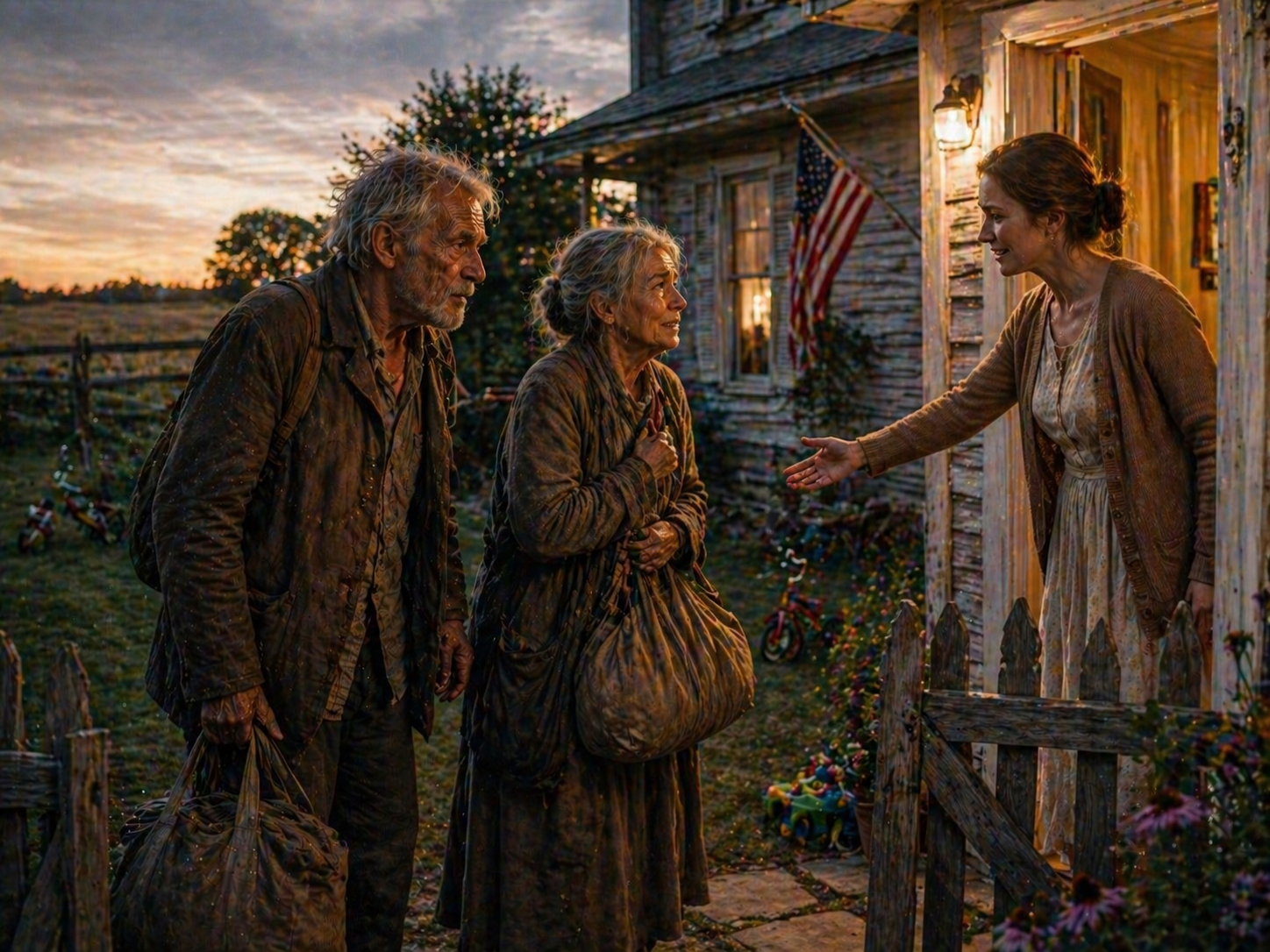
The farmhouse appeared at the end of a dirt road.
Simple.
Worn.
Alive.
A little girl stood on the porch.
“Are you lost?” she asked.
Peter couldn’t speak.
His granddaughter.
And she had no idea who he was.
Jenny came out moments later.
And everything changed.
She didn’t hesitate.
Didn’t question.
Didn’t measure them.
“Come inside,” she said.
“You look exhausted.”
She held Ruby like she mattered.
Fed them like they belonged.
Gave them warmth without asking for a reason.
Peter sat in that house and realized something he had never allowed himself to see.
This… this was real.
Not polished.
Not impressive.
But real.
Days passed.
Ruby got sick.
Jenny took care of her without complaint.
Without hesitation.
Without knowing—or maybe knowing everything.
Peter watched it all and felt something heavier than guilt.
He felt regret.
Deep, crushing regret.
Because they had been wrong.
About Jenny.
About Daniel.
About everything that mattered.
The fire came without warning.
The barn lit up against the night.
Animals screaming.
Daniel running in without thinking.
Peter followed.
Because some instincts don’t ask permission.
He didn’t remember much after that.
Just heat.
Smoke.
And pulling a terrified animal toward the light.
When he woke up, everything was different.
Not because of the fire.
Because of the truth.
“My name is Peter Lawson,” he said.
“And I’m your father.”
Silence.
Then anger.
“You lied to us.”
“We were wrong,” Peter said.
“We needed to know.”
“You needed to test us?”
“We needed to see who you had become.”
Daniel didn’t speak for a long time.
Jenny stepped forward.
“I knew,” she said quietly.
Peter looked at her.
“You knew?”
“Not at first. But I figured it out.”
“Why didn’t you say anything?”
“Because I wanted you to see.”
Silence settled again.
Different this time.
Not cold.
Not empty.
Just… heavy.
“I don’t know how to fix this,” Daniel said.
“We don’t either,” Peter answered.
“But we want to try.”
Daniel looked at Jenny.
Then back at them.
“There’s work to do,” he said.
“If you stay… you stay for real.”
“No more pretending.”
Peter nodded.
“No more pretending.”
Weeks passed.
The barn was rebuilt.
Slowly.
Piece by piece.
Just like the family.
Nothing was instant.
Nothing was easy.
But it was real.
And that made all the difference.
Six months later, Peter stood on the porch of a small cabin they now called home.
Not big.
Not impressive.
But theirs.
Daniel sat beside him.
“You know,” Daniel said, “I used to wish you understood me.”
Peter looked at him.
“I wish I had sooner.”
Daniel nodded.
“I see you now.”
Peter felt his throat tighten.
“That’s more than I deserve.”
Daniel smiled.
“Family isn’t about what you deserve.”
“It’s about what you choose.”
Peter looked out over the land.
The barn.
The house.
The life he almost missed.
And for the first time in years—
he wasn’t wondering anymore.
He knew.
Daniel didn’t forgive them that day.
That was the first truth Peter had to accept.
Nothing about what they had done could be erased with one confession, no matter how honest, no matter how painful. The silence that followed their revelation stayed in the house long after the words themselves faded. It sat in the corners of the rooms, in the space between conversations, in the way Daniel avoided looking at them for more than a few seconds at a time.
Jenny never treated them differently.
That, somehow, made everything harder.
She still brought tea in the mornings, still checked Ruby’s temperature without being asked, still moved through the house with the same steady warmth that had welcomed them when they were strangers. But now Peter noticed something else beneath it.
Distance.
Not coldness.
Not anger.
Just… careful distance.
As if she understood that kindness did not mean trust had already been restored.
Ruby felt it too.
One evening, as the sky turned soft orange behind the fields, she sat on the edge of the bed and stared at her hands for a long time.
“I don’t know how to fix this,” she whispered.
Peter leaned against the doorframe.
“You don’t fix it,” he said quietly. “You earn it.”
“How long does that take?”
Peter looked toward the window, where he could see Daniel repairing part of the fence, his movements steady, controlled.
“As long as it takes.”
…
The next few days were quieter.
Not uncomfortable, but not easy either.
Daniel spoke when necessary.
About work.
About tools.
About weather.
Never about the past.
Never about them.
Peter followed him everywhere.
Not because he had to.
Because he didn’t know any other way to begin again.
“Hold this,” Daniel said one morning, passing him a plank.
Peter adjusted his grip.
Like this?”
Daniel nodded.
They worked side by side for almost an hour before either of them spoke again.
“You didn’t have to come here,” Daniel said finally.
Peter didn’t look at him.
“I know.”
“You could have stayed with them. With the others.”
“I didn’t want to.”
Daniel let out a quiet breath.
“That’s new.”
Peter almost smiled.
“Yeah. It is.”
Silence returned.
But it wasn’t as heavy as before.
…
Ruby found her place in the kitchen.
At first, she just watched.
Jenny moved like someone who didn’t need to think about what she was doing. Every motion had purpose. Every step flowed into the next. There was no wasted energy, no unnecessary noise.
“Can I help?” Ruby asked one morning.
Jenny paused.
Just for a second.
Then she handed her a bowl.
“You can peel these.”
Simple.
No judgment.
No questions.
Ruby took the knife carefully, her hands slower than they used to be.
They worked in silence for a while.
Then Ruby spoke.
“I should have come to your wedding.”
Jenny didn’t look up.
“Yes,” she said simply.
“I thought… I thought Daniel was throwing his life away.”
Jenny set the knife down.
“And now?”
Ruby swallowed.
“I think he was the only one who understood how to live it.”
Jenny studied her for a moment.
Not with anger.
Not with softness.
Just… measuring.
Then she picked up the knife again.
“People don’t change because they realize they were wrong,” she said quietly.
“They change because they decide to do something different after that.”
Ruby nodded.
“I’m trying.”
Jenny didn’t respond.
But she didn’t pull away either.
And for now—
that was enough.
…
The call from Victoria came three days later.
Peter stared at the phone before answering.
“Dad, what is going on?” she demanded.
“We’ve been trying to reach you.”
“I know.”
“Where are you?”
“With Daniel.”
Silence.
Then—
“Why?”
Peter leaned back in his chair.
“Because I should have been here a long time ago.”
“That doesn’t make sense.”
“It does,” he said calmly. “You just don’t want it to.”
Victoria’s voice sharpened.
“Richard thinks something’s wrong. He wants to review the estate situation—”
Peter cut her off.
“No.”
“No?”
“No more meetings about money,” he said.
“If you want to talk about family, you come here.”
Another silence.
Longer this time.
“You’re serious.”
“Yes.”
…
They came.
Not all at once.
Not together.
But they came.
Victoria first.
She stepped out of her car like she was stepping into a place she didn’t belong.
Her eyes moved over everything.
The house.
The yard.
Daniel.
And finally—
Peter.
“You look…” she hesitated.
“Different.”
“I am.”
She didn’t smile.
“I didn’t know,” she said.
“That’s the problem,” Peter replied.
“You didn’t try to know.”
…
Richard arrived next.
Less emotional.
More controlled.
“This whole situation is unnecessary,” he said.
“We can resolve things logically.”
Peter looked at him.
“This isn’t about logic.”
“It’s about accountability.”
…
Margaret came with hesitation.
Steven came last.
And stayed quiet the longest.
They all sat at the same table.
The same table Jenny had used to feed strangers without question.
Now it held a family that didn’t know how to be one anymore.
“You tested us,” Richard said.
“Yes.”
“That’s manipulation.”
“No,” Peter said.
“That’s truth.”
Victoria shook her head.
“You’re judging us based on one moment.”
“No,” Ruby said softly.
“We’re seeing you based on the moment you thought didn’t matter.”
Silence fell again.
Then Daniel spoke.
“You don’t get to decide when it matters,” he said.
“You decided that years ago.”
No one argued.
Because no one could.
…
The conversation didn’t fix anything.
But it broke something open.
Something that had been sealed for years.
Excuses turned into admissions.
Defensiveness turned into silence.
And slowly—
very slowly—
understanding began to take shape.
Not complete.
Not clean.
But real.
…
That night, Peter sat alone on the porch.
The house behind him was quiet.
The land stretched out in front of him, calm and steady in a way his life had never been before.
Daniel stepped out and sat beside him.
They didn’t speak for a while.
Then Daniel said—
“You can stay.”
Peter looked at him.
“Not because you’re my parents,” Daniel added.
“Because you’re trying.”
Peter nodded slowly.
“That’s all we can do.”
Daniel leaned back, looking out at the dark.
“Then start there.”


![[FULL STORY] She Said “This Trip Is Just Me Time”… Then Posted Herself Kissing Another Man](https://social-media.rabedo.com/thumbnails/1777145425_4dc7f257-3de0-4bb2-a83a-95142cc97db9.png)
![[FULL STORY] She Said “Good Daughters Get Rewards”… So I Walked Out and Found the Family She Hid From Me](https://social-media.rabedo.com/thumbnails/1777667922_328ad42e-a3f1-40f7-9de8-a868e87f4940.png)