
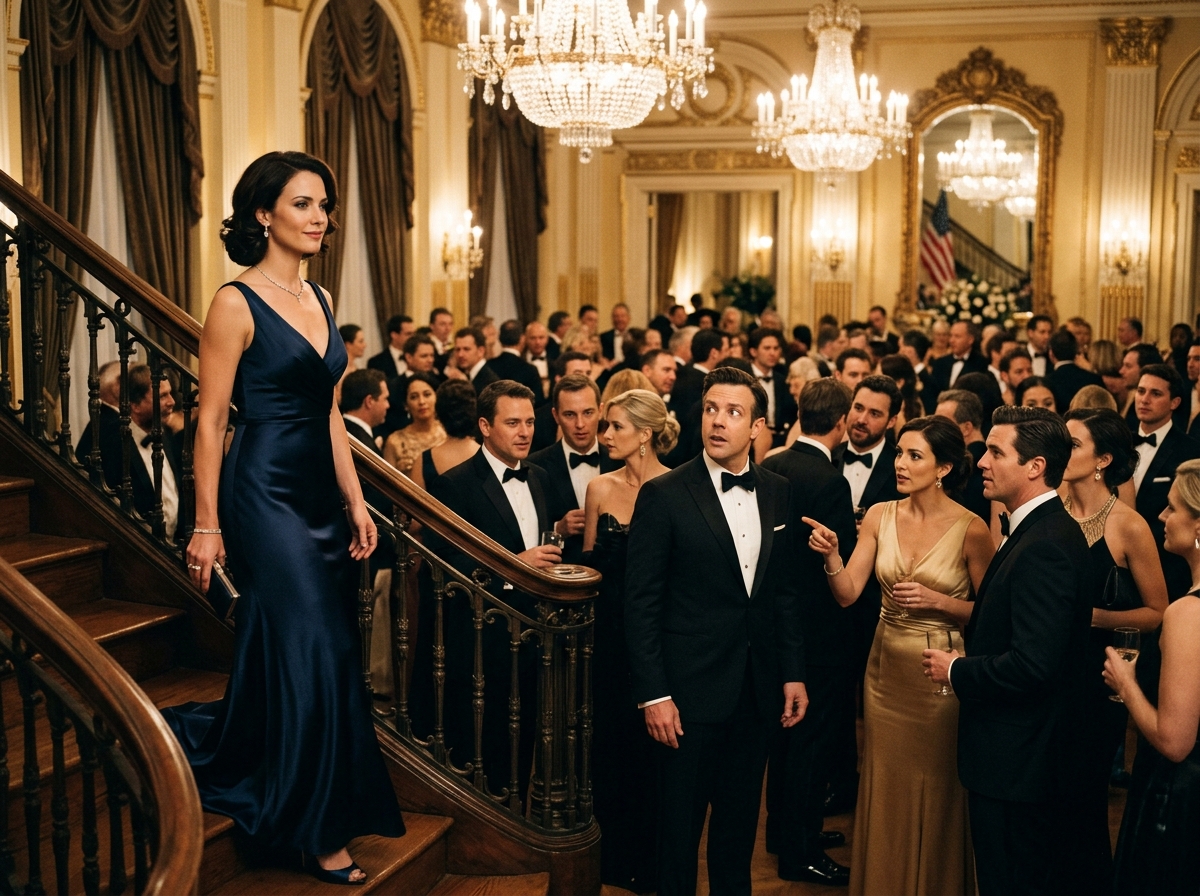
The text arrived at 6:47 in the evening, and Isabelle Voss read it twice, not because she didn’t understand it the first time, but because she wanted to be certain that what she felt in response was not anger, not grief, and not even surprise. She needed to confirm that the absence of those emotions was real, because that absence told her more about her marriage than anything the message itself contained. Don’t wait up. Business event. Take the card and order something. Fourteen words. Three years of marriage compressed into the language of maintenance, the tone of a man who no longer saw her as someone requiring presence, only management. Isabelle placed her phone face down on the marble counter of the townhouse on Lexington Row, a home that was technically hers but had never once felt like it belonged to her, and stood in the quiet that settled into spaces where someone was always expected to be grateful.
She picked up the phone again, not to reply to Marcus, but to call her sister.
“Dress,” she said the moment Clara answered.
There was a pause on the other end, not confusion, but recognition. Three years of watching her disappear condensed into a single word that meant she was done doing that.
“What kind?” Clara asked.
“The kind that stops a room.”
Another pause, then the sound of a car door slamming.
“Give me forty minutes.”
Isabelle hung up and walked to the guest room closet, not the master bedroom she shared with Marcus, because there were things she kept separate, not out of secrecy, but out of preservation. She opened a box that hadn’t been touched in three years. Inside, wrapped in tissue the color of faded champagne, was a dress from another life. Midnight charcoal, structured, precise, designed not to reveal or conceal but to command. She had bought it for an event she never attended because, at the time, it had felt more important to disappear. That had been the first disappearance. There had been many after.
She held the dress up to the mirror. The woman staring back at her was thirty-four, composed, striking in a way that didn’t require effort, and profoundly invisible in a way that had been practiced. Isabelle had learned to move through rooms without drawing attention, to occupy space without claiming it, to be present without being seen. It had been a strategy. It had kept her safe. It had also erased her.
Strategies, like marriages, had an expiration point.
She began to get ready.
Marcus Voss arrived at the Hartwell Foundation Gala exactly fourteen minutes late, which was not an accident, because Marcus did not believe in accidents. Every aspect of his public life was calibrated, from the cut of his suit to the timing of his entrances. Being late was not a failure of discipline, it was a display of it, a signal that his time operated on a different scale than everyone else’s. The ballroom held four hundred of the most powerful people in North America—senators, CEOs, billionaires, investors whose decisions shifted entire industries—and Marcus moved through them with practiced precision, collecting attention the way he collected deals.
Sienna Laurent was on his arm, elegant, poised, perfectly aware of her role in the evening’s composition. She was not a mistake. She was a decision. Marcus had always been clear about the difference.
He greeted Senator Callahan near the east wall, discussed regulatory strategy with the ease of someone who had memorized every possible outcome before the conversation began, then pivoted toward James Whitaker, whose endorsement would shift the next quarter’s projections in Marcus’s favor. He was mid-sentence when he felt it, not heard, not seen, but felt, the subtle shift in the room’s attention, like pressure changing before a storm.
Conversations slowed.
Eyes moved.
Silence spread in waves.
Marcus turned.
At the top of the marble staircase stood a woman in a gown the color of midnight charcoal. She did not rush. She did not hesitate. She descended with the quiet certainty of someone who had never needed to perform importance because she had always possessed it. The dress was structured, flawless, the fabric moving with controlled fluidity, her posture not practiced but inherent.
Her eyes found his immediately.
Not searching.
Knowing.
It took Marcus three seconds to recognize his wife.
Isabelle stepped onto the ballroom floor, and the space adjusted around her. Not dramatically, not loudly, but undeniably. She accepted a glass of champagne without breaking stride, acknowledged a woman near the bar with a brief touch to her arm, and moved forward with intention that did not require explanation.
She had not come for Marcus.
That was the first thing he understood.
Victor Hartwell crossed the room toward her. That was the second thing. Victor did not cross rooms. People crossed rooms for him.
“Isabelle Surell,” he said.
Not Mrs. Voss.
Not a question.
An acknowledgment.
“Victor,” she replied calmly.
“You look exactly the same.”
“You look like yourself,” he said carefully.
She smiled faintly.
They spoke for eleven minutes.
Marcus watched every second.
James Whitaker approached him first.
“Didn’t know Isabelle Surell was your wife,” he said casually.
Marcus smiled automatically.
“We don’t discuss work much.”
Whitaker laughed.
“That’s interesting. She nearly shut down one of our international projects last year with a compliance framework. Brilliant, but terrifying if you’re on the other side of it.”
Marcus’s smile didn’t move.
The second conversation came from Dr. Anika Patel, head of a global health initiative.
“Your wife’s foundation saved an entire region from collapse,” she said warmly. “The infrastructure work in East Africa… I’ve never seen anything like it.”
The Surell Foundation.
Marcus knew the name.
He had seen it in filings.
Reports.
Strategic briefs.
He had never connected it to the woman in his house.
Because he had never looked.
By ten o’clock, the picture was complete.
Isabelle Surell had built an international humanitarian network operating across continents. She had done it quietly, deliberately, without recognition, because recognition made her vulnerable. She had chosen invisibility. And Marcus had accepted it without question because it made his life simpler.
He found her near the terrace at eleven.
“You came,” he said.
“I did.”
They stood side by side, not facing each other, looking out over the city lights.
“I didn’t know you knew Hartwell,” he said.
“I know many people,” she replied. “You never asked.”
The truth landed clean.
“What is your relationship with him?”
“History,” she said. “And current business.”
He waited.
“He acquired my first company when I was twenty-nine,” she continued. “Hostile takeover. I didn’t know how to stop him then.”
“And now?”
She turned to him.
“Now I do.”
Silence.
“What does that mean?”
“It means,” she said calmly, “that Victor Hartwell has been attempting to acquire Voss Capital for seven months through shell corporations.”
Marcus’s breath slowed.
“And?”
“And I’ve been dismantling it for three.”
He stared at her.
“You knew?”
“I knew.”
“Why didn’t you tell me?”
She looked at him steadily.
“Because you told me not to wait up.”
The words were not angry.
They were precise.
They were final.
“And I wanted to see,” she added quietly, “if you would ever ask.”
He had no answer.
They left together.
The car ride was quiet. Not tense. Not distant. Just honest in a way their marriage had never been.
“Tell me everything,” he said finally.
She did.
Not as a confession.
As a fact.
She told him about Bosnia, about rebuilding systems where none existed, about building the foundation, about losing it, about learning to operate without being seen. About choosing invisibility because visibility had nearly cost her everything.
“I didn’t tell you,” she said, “because I didn’t think it mattered to you.”
He nodded slowly.
“I didn’t ask,” he admitted.
That was worse.
She reached into her bag and placed a document between them.
“A partnership agreement,” she said.
He looked at it.
“Not a divorce?”
“No.”
“A choice.”
He read it.
Carefully.
Slowly.
This wasn’t just business.
It was transparency.
Real partnership.
Something neither of them had ever actually attempted.
“If I sign this…”
“You know who I am,” she said.
“And you let me know who you are.”
He didn’t sign that night.
But he didn’t walk away either.
Eleven days later, the acquisition collapsed.
Marcus stood in the kitchen, holding the confirmation email, and looked at her.
“You stopped him.”
“I redirected him,” she corrected.
He nodded.
“Why now?”
She met his gaze.
“Because you finally asked.”
Silence settled between them, but it was different now. Not empty. Not distant.
Full.
Alive.
“There’s a conference in Geneva,” she said.
He looked up.
“You should come.”
“As your husband?”
“As my partner.”
A pause.
“Both.”
He didn’t answer immediately.
He didn’t need to.
She could see it forming.
The decision.
The shift.
The beginning.
Months later, they attended an event together. No performance. No distance. Just two people standing side by side, no longer invisible to each other.
At breakfast one morning, Marcus looked at her and said,
“I want to read everything.”
And for the first time in three years…
That meant something.
Marcus didn’t say yes to Geneva that morning, and Isabelle didn’t expect him to. That had never been how either of them worked. Decisions, real ones, required time, space, and the kind of silence that allowed truth to settle without being forced into shape too quickly. What changed was not the speed of his answer, but the fact that he did not dismiss the question. He didn’t deflect. He didn’t redirect. He stayed with it. And Isabelle, who had spent three years measuring his silences, understood that this one meant something different.
The house began to feel unfamiliar in the days that followed, not because anything physical had changed, but because awareness had entered it. Marcus noticed things he had never noticed before. The way Isabelle organized her work at the kitchen table, not scattered, not chaotic, but in layers, documents arranged with a precision that suggested not control, but clarity. The way she moved through rooms without hesitation, not as someone who lived there, but as someone who understood space instinctively. He noticed the absence of clutter, the deliberate simplicity of everything she owned, the way nothing in the house existed without purpose.
He also noticed the distance. Not physical. That had never been the issue. It was something else. Something quieter. The distance between two people who had coexisted without ever actually intersecting.
Marcus began to ask questions. Not all at once. Not aggressively. Carefully, like someone learning a new language.
“What happened in Nairobi?” he asked one evening, standing at the doorway instead of entering the room uninvited.
Isabelle looked up from her laptop.
“Security breach,” she said.
He waited.
She considered him for a moment, then closed the laptop.
“One of our regional partners mismanaged a contract. It exposed personnel data. Mine included.”
“What did that mean?”
“It meant I became visible in places where visibility was dangerous.”
Marcus absorbed that.
“And that’s when you disappeared.”
“Yes.”
She didn’t elaborate further, and for the first time, Marcus didn’t push. He understood something instinctively that he hadn’t before: information wasn’t withheld from him to create distance. It was withheld because he had never created space for it to exist.
Two days later, he asked another question.
“How many countries does your foundation operate in?”
“Fourteen,” she said.
He nodded.
“And how many people work for you?”
“Directly? Around eighty. Indirectly… significantly more.”
He didn’t comment on that number, but something shifted in his expression, not surprise, but recalibration.
He was beginning to understand scale.
The Geneva conference came up again a week later, not because Isabelle mentioned it, but because Marcus did.
“What’s the objective of the conference?” he asked over breakfast, his tone measured but direct.
“Policy alignment,” she replied. “Funding commitments. Infrastructure coordination between governments and private entities.”
“And your role?”
“I built the framework they’re using.”
Marcus paused, his coffee halfway to his lips.
“And they invited Voss Capital?”
“No,” she said. “I did.”
He set the cup down slowly.
“Why?”
“Because your reach can accelerate things my foundation can’t do alone.”
She met his eyes.
“And because if we’re going to build something together, it needs to be real.”
The word real lingered between them.
Marcus nodded once.
“I’ll come.”
It wasn’t dramatic.
It wasn’t framed as a decision.
It was simply stated.
And that, Isabelle realized, was exactly how it needed to be.
The flight to Geneva was quiet, but not empty. They sat side by side, not speaking constantly, but not avoiding each other either. Marcus reviewed briefing documents she had prepared. Detailed. Precise. Written in a way that assumed competence rather than demanded it. He recognized the style immediately. It was the same clarity she brought to everything.
“You wrote all of this yourself?” he asked at one point.
“Yes.”
“It’s… efficient.”
She glanced at him.
“That’s a compliment?”
“It’s a rare one.”
She nodded.
“I’ll take it.”
Geneva did not surprise Isabelle. It never had. The city operated with a kind of quiet authority that didn’t require performance. Marcus, however, was used to a different kind of power, louder, more visible, more competitive. What unsettled him wasn’t the scale of the conference, but the way Isabelle moved through it.
People deferred to her. Not out of obligation. Out of recognition.
They greeted her by name. Not her married name. Not Voss. Surell.
And every time it happened, Marcus felt something shift again. Not discomfort. Not resentment. Something more complex.
Respect.
He watched her in a meeting with three ministers and a private sector delegation, her voice calm, measured, her arguments precise, leaving no room for misinterpretation. She didn’t dominate the room. She didn’t need to. She guided it. Redirected it. Shaped it without ever raising her voice.
Afterward, they walked along the lake in silence for a while.
“You didn’t tell me any of this,” he said finally.
She didn’t look at him.
“You didn’t ask.”
He exhaled.
“That answer is starting to sound familiar.”
“It should.”
A pause.
“I’m not blaming you,” she added. “I’m explaining what happened.”
Marcus nodded slowly.
“And what happens now?”
She turned to him.
“That depends on whether you keep asking.”
The conference ended with commitments that would have taken Isabelle’s foundation years to secure alone. With Voss Capital’s involvement, timelines shifted. Resources aligned faster. Systems that would have taken months to negotiate moved forward in days.
On the flight back, Marcus didn’t open his laptop. He didn’t review documents. He didn’t check emails.
He looked at her.
“I built everything I have by controlling access,” he said. “Information. People. Opportunities.”
She listened.
“It worked,” he continued. “It still works.”
A pause.
“But it doesn’t work here.”
She didn’t interrupt.
“I didn’t lose you because I didn’t care,” he said. “I lost you because I didn’t look.”
That was closer.
Closer than anything he had said before.
Isabelle studied him, not critically, not defensively, just… honestly.
“And now?” she asked.
“Now I’m trying to.”
The simplicity of it mattered.
Not perfect.
Not complete.
But real.
They returned to New York to a city that had not changed, but a life that had. The townhouse no longer felt like a place Isabelle moved through. It felt like a place she occupied. Marcus no longer treated it like a staging ground between deals. He stayed.
He asked.
He listened.
He failed sometimes.
He corrected.
Weeks later, at another event, smaller, quieter, they stood side by side without effort. No performance. No calculation. Just presence.
A journalist approached, asking for a photo.
Marcus glanced at Isabelle briefly before responding.
“Yes,” he said.
Not because it was expected.
Because it was agreed.
The camera flashed.
The image that circulated afterward showed something different from before. Not a constructed pairing. Not a strategic alignment.
Two people who had finally chosen to see each other.
At breakfast the next morning, Marcus pulled a folder toward him.
“I started reading your files,” he said.
She poured coffee.
“All of them?”
“Not yet.”
A pause.
“But I’m not skipping anything.”
She nodded.
“That’s a good place to start.”
Outside, the city moved the way it always did. Fast. Unpredictable. Relentless.
Inside, something else had begun.
Not dramatic.
Not loud.
But deliberate.
And for the first time in three years, neither of them was invisible anymore.
![[FULL STORY] During the party, when she was dancing with another guy, she looked at me and said, "I also have the](https://social-media.rabedo.com/thumbnails/1776959342_45.png)