“Oh, look at her… this is priceless.”
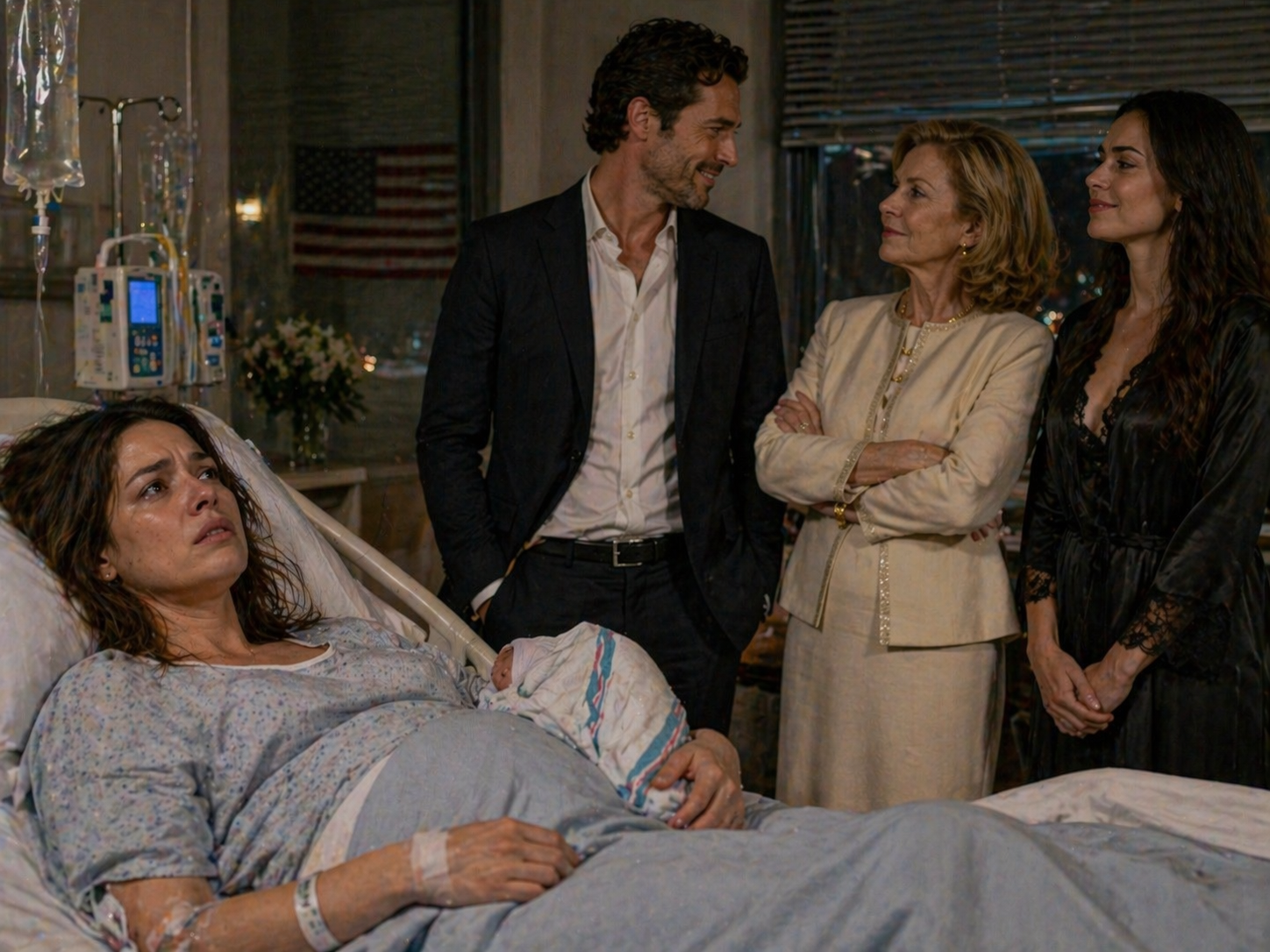
The voice was low but not low enough, drifting through the hallway outside Room 412 at Northbridge Medical Center sometime after three in the morning, the kind of hour when everything felt suspended between crisis and silence. Another voice followed, lighter, almost amused.
“I know, right?
She’s really milking it.”
A third voice cut in, sharper, pretending at decency.
“Excuse me, this is highly inappropriate.” Then laughter, quiet but real.
“Oh, lighten up. It’s just a bit of fun.”
A pause.
“Thank God it’s finally over.”
And then, softer, almost relieved.
“Now everything changes.”
Inside the room, machines told a different story. The monitor flatlined at 3:47 a.m., a long, steady tone cutting through the controlled urgency of the operating space. That was the moment everyone would remember differently, depending on what they had been hoping for. Dr. Leila Hassan had been on her feet for nineteen hours. She was thirty-five, a maternal-fetal medicine specialist who had delivered thousands of babies and carried every complication with her long after the shift ended. She was not the kind of doctor who walked away from a fight, and she was not the kind of doctor who gave up easily. The patient was Emily Carter, twenty-eight years old, thirty-nine weeks pregnant, admitted just after midnight with a placental abruption that escalated faster than anyone had predicted. Her blood pressure had been dropping since two. By three-thirty, the room had that specific tension that only medical teams recognize, the moment where everything becomes precise, urgent, and quietly desperate.
At 3:47, Emily’s heart stopped.
“Start compressions,”
Dr. Hassan said, her voice steady even as everything shifted around her. The crash team was there in seconds. Hands moved. Orders were given. Machines responded. It became a rhythm of survival, the kind that existed at the edge of possibility.
In the hallway outside, three people waited. They had been there long enough that the night shift nurses had noticed them, not because they were loud or disruptive, but because of the way they stood together. The man was Daniel Carter, thirty-two, tall, well-dressed, the kind of man who carried himself like he expected the world to move in his favor. He checked his phone often, not nervously, just habitually, like information mattered more than presence. When he had arrived earlier, he had kissed Emily’s forehead, held her hand briefly, and then stepped out to make calls. Beside him stood a woman in a fitted red dress, introduced as his sister, though the way his hand lingered at the small of her back when he thought no one noticed suggested something else entirely. On his other side stood his mother, Victoria Carter, impeccably dressed, posture perfect, expression composed in the way of someone who treated life like a controlled system rather than something unpredictable.
Dr. Hassan stepped out at 3:52, her face neutral in the way doctors train for, the kind of neutrality that carries weight before words do.
“We lost her heartbeat at 3:47,” she said.
“We’re working to bring her back. The situation is critical.”
Daniel’s face shifted, but something about the timing felt off, like the reaction arrived a fraction too late. The woman in red reached for his arm. Victoria’s voice came, precise and controlled.
“And the baby?”
“We’re doing everything we can for both of them,” Dr. Hassan said before turning back into the room.
At 4:01, Nurse Anika Patel, charting at the station just down the hall, heard something she wasn’t meant to hear. The hallway was quiet, and Daniel’s voice, though low, carried.
“If she doesn’t make it, the house goes back to joint ownership. I had the papers prepared months ago.”
Victoria’s reply was softer, but clear enough.
“About time.”
The woman in red said nothing. She adjusted the strap of her purse, her expression unreadable, her gaze fixed on the door to Room 412 as though waiting for something to conclude.
Anika paused, pen hovering over her chart. She looked toward the door, toward the room where Dr. Hassan was fighting for a woman whose family was discussing property. Then she continued writing. But she didn’t stop watching.
At 4:23, the monitor inside Room 412 changed. It didn’t happen dramatically. It rarely did. A flicker. A beat. Another. Then a rhythm, fragile at first, then steadier. Emily’s heart was beating again. Dr. Hassan didn’t allow herself relief immediately, but something inside her eased just enough to keep going. Emily was unconscious, her vitals unstable, but she was alive.
And then the ultrasound updated.
Dr. Hassan froze for a moment, studying the screen carefully before calling Anika over. They both looked. Then looked again.
“Does the family know?” Anika asked quietly.
“Not yet,” Dr. Hassan said.
Outside, at 4:31, Dr. Hassan stepped into the hallway again.
“She’s alive,” she said.
There was a pause, brief but telling. In that second, three faces rearranged themselves into something appropriate.
“Thank God,” Daniel said, just a little too late.
“Can we see her?” Victoria asked.
“She’s unconscious and will remain so for some time,”
Dr. Hassan replied.
“She needs rest. The situation is still delicate.”
“And the baby?”
Dr. Hassan looked at him for a moment.
“That’s what we need to discuss.”
She led them into the consultation room, a space designed for difficult conversations. Anika remained at her station, but from where she stood, she could see through the glass panel as the news landed. Faces shifted. Shoulders tensed. Silence stretched.
Because what Dr. Hassan told them was not what they expected.
Emily had not been carrying one baby. She had been carrying two. The second twin, smaller, positioned behind the first throughout the pregnancy, had remained hidden in a way that only careful monitoring could reveal. Both babies had been delivered during the emergency procedure. Both were alive.
Twin A, in the NICU, stable but requiring assistance.
Twin B, stronger, breathing independently.
And Emily…
Emily was expected to survive.
The silence that followed was heavier than anything that had come before. Daniel’s face didn’t show relief. It showed interruption. Victoria’s composure hardened. The woman in red looked away.
“I need the family’s full support,” Dr. Hassan said evenly.
The word family carried weight.
Daniel left first, heading not toward Emily’s room, but toward the elevator. The others followed, silent.
Anika watched them go. Then she walked to Room 412 and stood at the doorway, looking in at the woman on the bed, the steady monitor, the space where two bassinets would soon be filled.
Emily regained consciousness forty-one hours later. She didn’t know what had happened at first. She didn’t know how close she had come to dying. She didn’t know about the conversations in the hallway or the silence that followed her survival. What she knew was that Dr. Hassan was sitting beside her bed. Sitting, not standing. And that told her more than words ever could.
“There are some things I need to tell you,”
Dr. Hassan said gently.
“I’m going to tell you everything, and I’m going to stay with you while I do.”
She did.
The twins came next. The truth came next. Everything came, piece by piece, in a way Emily could hold. She listened quietly, her face still, not from shock, but from something deeper—something deciding what came next.
“I want to speak to a lawyer,” she said finally.
“Before I speak to my husband.”
Dr. Hassan nodded without hesitation.
“I can arrange that.”
Days passed. The babies grew stronger. Emily saw them for the first time in the NICU, holding one in each arm, their tiny bodies warm and alive against her. She didn’t speak for a long time.
“They were both there,” she said eventually.
“The whole time.”
“The whole time,” Dr. Hassan confirmed.
Emily looked at them, then at the light filtering through the NICU window.
“We have time,” she whispered.
Daniel came on the fifth day. Flowers in hand. Words prepared.
“Sit down,” Emily said calmly.
He did.
She told him everything. What she knew. What she had heard. What she had already done. Her voice never rose. It didn’t need to.
He spoke. Apologies. Explanations. Justifications.
She let him finish.
“I didn’t ask for that,” she said.
He left two hours later.
The flowers stayed.
Emily moved them to the window.
Her daughters—Nora and June—slept beside her. One breathing softly. The other watching the light like she had just arrived in a world she intended to understand.
Dr. Hassan came by every day. Sometimes briefly. Sometimes longer. Always present.
“You stayed,” Emily said once.
“Yes.”
“You knew.”
“I knew enough.”
Emily looked at her daughters.
“Thank you,” she said.
Dr. Hassan nodded.
“They’re going to be something,” she said softly.
“I think they already are,” Emily replied.
Some rooms go quiet at the wrong time. Some people leave when they should stay. But sometimes, in the middle of everything breaking, something else begins—messy, complicated, but strong enough to hold.
And what everyone thought was the end…
Becomes the beginning.
![[FULL STORY] She Told Me For Years That I Was Like A Brother To Her. So I Introduced Her To My New Girlfriend And](https://social-media.rabedo.com/thumbnails/1777223143_C18.png)

![[FULL STORY] “I Can’t Live In This Dump—Let’s Break Up,” My Girlfriend Said After Visiting My Parents’ 1970s](https://social-media.rabedo.com/thumbnails/1776412829_9e5f927e-074e-4255-bdab-d128e10e0e38.png)