
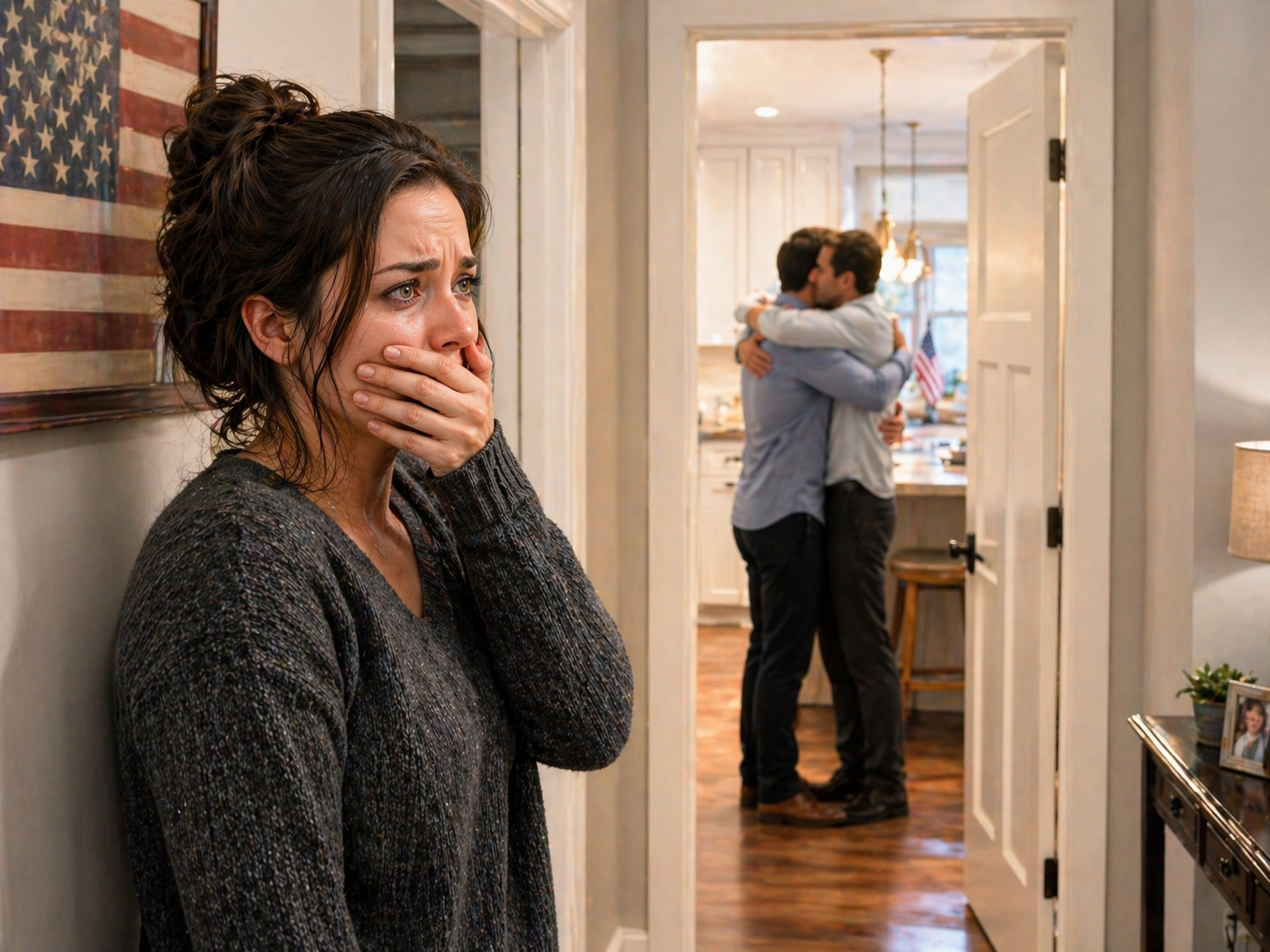
I smelled garlic and onions burning before I realized my life had already started to fall apart. That’s the detail that stayed with me more than anything else, more than the words, more than the moment itself. I had stepped away for four minutes to grab my phone charger from the bedroom. Just four minutes. When I came back down the hallway in my socks, phone in hand, I heard my husband’s voice coming from the kitchen. It was low, deliberate, controlled in a way that immediately set something off inside me. It was the kind of voice men use when they’re saying something they know they shouldn’t.
“She suspects nothing, and the papers are already signed, Dre.”
I stopped moving.
My body didn’t just freeze, it shut down. Breathing, thinking, everything paused at once as if the world had tilted slightly off its axis. Then I heard my brother-in-law Andre laugh, not nervously, not uncertain, but satisfied, like someone who had just executed a plan exactly the way he intended.
“You sure she’s not going to trip when she finds out?” Andre asked.
“By the time she finds out,” Eric replied, “it won’t matter.”
Four minutes.
I stood there for four full minutes, back pressed against the wall, one hand covering my mouth, tears already forming before I had consciously processed what I was hearing. Because somewhere deeper than logic, somewhere instinctive, I already knew. I didn’t understand the details yet, but I understood the truth.
My name is Naomi Carter. I’m thirty-four years old. I have a master’s degree in accounting, a stable career, a mortgage in my name, and a joint account I built over three years. I had a husband I trusted completely. And I was standing in my own house, realizing I was the only person in it who didn’t know my life was being dismantled.
The onions burned.
I didn’t move.
To understand how I got to that hallway, you have to understand who Eric Carter was when I met him, or more accurately, who I believed he was. We met at a cookout in the summer of 2017. He was tall, confident, wearing a crisp white shirt that made him stand out without trying too hard. He had a laugh that filled space, the kind that made you feel like you were the most interesting person in the room.
“You’re putting too much potato salad on that plate for someone who doesn’t know me yet,” he said.
I laughed.
And just like that, I was pulled in.
Within two months, we were inseparable. Within a year, he was in my mother’s kitchen in Decatur, charming her in a way that should have warned me. My mother, Lorraine Carter, did not like people easily. She observed, she measured, she waited. But she liked him.
“He’s polished,” she told me once, stirring her tea slowly. “But watch his hands. A man shows you who he is with his hands.”
I didn’t understand what she meant back then.
Eric worked in real estate, always talking about deals that were about to close, opportunities just around the corner, success that felt inevitable. I was the stable one. My job at a financial firm paid consistently, reliably. We moved in together in 2019, into an apartment I carried financially for eight months before he started contributing.
I told myself it was temporary.
That’s what love does.
It rewrites warning signs into temporary struggles.
He proposed in the kitchen, on a random Tuesday, the ring sitting next to the dish soap like it belonged there. I still said yes.
What no one tells you is that you should pay attention to a man’s brother. Because Andre Carter was everything Eric was, just less refined, more obvious, less patient about hiding it. Andre was four years older, ran a questionable business, lived fast, talked faster, and saw people in terms of what they could provide.
“Eric said you’re smart,” he told me the first time we met. “That’s good. Smart women are useful.”
Useful.
Not kind.
Not beautiful.
Useful.
I told Eric. He laughed.
“That’s just how Dre talks.”
But it wasn’t.
Andre started showing up more after we got married in 2021. Late-night calls. Weekend disappearances. Conversations that stopped when I entered the room. I asked questions, but I got answers wrapped in charm.
“Baby, I’m handling business. You want this life or not?”
I worked sixty-hour weeks.
Eric handled “business.”
Our joint account grew, mostly from my income. When we bought a house in 2022 in Stonecrest, it went under my name because his credit was still “being rebuilt.”
I thought I was building a future.
I didn’t realize I was building something someone else planned to take.
Andre always looked at me like I was a number on a page, something to be calculated, evaluated, eventually removed.
That night in the hallway, I didn’t confront Eric.
People always ask why.
Because I don’t react.
I audit.
And before I destroyed anything, I needed to understand exactly what was being done to me.
So I walked back into that kitchen, calm, composed, and said dinner was ready. I watched Eric kiss my cheek like nothing had happened. I watched Andre smile across the table like he already knew how this would end.
And I smiled back.
Then I started collecting evidence.
The next morning, while Eric was in the shower, I opened his laptop. Same password. Our wedding year. That hurt more than anything.
What I found wasn’t just betrayal.
It was strategy.
Emails between Eric and a woman named Tiffany Blake, a real estate attorney. Eight months of communication. Legal structuring. Asset transfers. My assets. The house. The investment account. Everything.
They weren’t just planning to leave me.
They were planning to erase me.
I sat there, laptop in my hands, realizing something I couldn’t unsee.
He didn’t marry me.
He invested in me.
And now he was cashing out.
I called my mother.
“Get a lawyer before sunset,” she said. “Don’t confront him. Don’t touch anything yet. Be smart.”
So I was.
Angela Pierce became my lawyer that morning.
And for seven days…
I lived with the man who was trying to destroy me.
Smiling.
Cooking.
Sleeping next to him.
Watching.
Waiting.
On day three, he threw a dinner party.
And he invited her.
Tiffany.
She walked into my house, shook my hand, looked me in the eye, and said she had heard so much about me.
I smiled.
And I memorized everything.
By day six, everything was in motion.
Accounts frozen.
Property secured.
Legal traps set.
By day seven, it collapsed.
Eric’s phone rang.
“What do you mean frozen?” he said.
Then he came into the kitchen.
“Naomi—”
“Don’t.”
I told him everything I knew.
Every detail.
Every plan.
Every lie.
“I’ve known for eight days.”
He didn’t apologize.
He didn’t break.
He just looked at me and said,
“You think you’re smart.”
“I know I am,” I replied.
And that was the moment everything ended.
Not when I heard the whisper.
Not when I found the emails.
But when I realized I was never the victim in this story.
Just the one who hadn’t finished writing it yet.
The silence after I said it wasn’t loud, but it filled the entire room. Eric stood there, still holding his phone, like he hadn’t fully caught up to what had just happened. For the first time since I had known him, he didn’t have control over the situation, and you could see it in the way his posture shifted, the way his eyes moved, searching for something to hold onto that wasn’t there anymore.
“You don’t understand,” he said finally, his voice lower now, trying to regain ground he had already lost.
“No,” I said calmly, “you don’t understand.”
Anna stood beside me, arms crossed, silent but present, the kind of presence that made it clear I wasn’t alone in this moment, even if I had been for most of the week.
“Everything you thought you were doing quietly?” I continued. “Every document, every email, every little plan you and Andre built? It’s already in the hands of my attorney.”
Eric’s jaw tightened.
“You went through my laptop?”
“I went through my life,” I said. “And I found you trying to take it.”
He exhaled sharply, pacing once across the kitchen like movement might fix something.
“This isn’t what it looks like.”
“It looks exactly like what it is.”
Andre’s name sat heavy in the room even though he wasn’t there.
“Andre pushed this,” Eric said, almost defensively. “You don’t know how he operates.”
“I know exactly how he operates,” I replied. “He just didn’t expect me to operate better.”
That was the first moment something flickered in Eric’s expression.
Not guilt.
Not regret.
Recognition.
He realized then that this wasn’t something he could talk his way out of.
“What do you want?” he asked.
That question told me everything.
Not how do we fix this.
Not I’m sorry.
What do you want.
“I want exactly what’s mine,” I said.
Two days later, his mother called.
I almost didn’t answer. I expected denial, excuses, maybe even blame. But when I picked up, her voice wasn’t defensive. It was tired.
“Naomi… I owe you an apology.”
I sat down slowly, the weight of that sentence unexpected.
“I knew Andre was pulling Eric into something,” she said. “I didn’t know what, but I knew it wasn’t right. And I said nothing.”
Her voice cracked slightly, not dramatically, but enough to make it real.
“I chose not to get involved because I didn’t want to lose my sons,” she continued. “And you paid for that.”
I didn’t respond right away.
Not because I didn’t have anything to say.
But because I wasn’t prepared for honesty.
“Eric is not a good man right now,” she said quietly. “But you are a good woman. And I will not sit in any room where your name is twisted into something it’s not.”
She paused.
“And if your lawyer needs a statement… I’ll give one.”
After we hung up, I cried.
Not the kind of crying that comes from pain.
The kind that comes from release.
From realizing that even in the middle of something ugly, something broken, there were still people who chose to be decent.
The legal process wasn’t dramatic.
It wasn’t fast.
It wasn’t satisfying in the way people imagine justice to be.
It was paperwork.
Meetings.
Deadlines.
Waiting.
Angela Pierce moved through it all with precision. Every document Eric thought would protect him became evidence against him. Every plan he made quietly became something that could be exposed clearly.
The accounts were frozen.
The property was secured.
The LLC structure Andre built collapsed under scrutiny.
The document Eric had me sign, the so-called business waiver, was identified as a limited power of attorney obtained under misrepresentation.
It didn’t hold.
Tiffany Blake cooperated when faced with losing everything she had built professionally. Her version of events unraveled quickly once the emails were presented.
“I was told it was mutual,” she said.
“It wasn’t,” Angela replied.
And that was the end of her defense.
Andre’s company was dissolved.
Funds were returned.
Eric filed for divorce two weeks later.
His attorney pushed for equal division.
Angela dismantled it.
Carefully.
Completely.
Sylvia’s statement.
His mother’s affidavit.
The emails.
The timeline.
Everything aligned.
And when it was over, there was no dramatic announcement.
Just a decision.
The house stayed with me.
The accounts stayed with me.
He walked away with what was his.
Nothing more.
Nothing extra.
Nothing he hadn’t earned.
The day it finalized, we stood outside the courthouse.
Eric stepped toward me, arms slightly open, like he didn’t know what gesture made sense anymore.
“I’m sorry,” he said.
I stepped back.
“I hope you find peace,” I replied.
And I meant it.
Not for him.
For me.
Because carrying anger longer than necessary is another kind of loss.
The first night I came back home, I stood in the kitchen for a long time.
It was quiet.
Still.
The same space where everything had changed.
I turned on the stove.
Garlic.
Onions.
The same smell.
The same moment.
But this time…
I didn’t walk away.
I stayed.
Six months later, the house felt different.
Not because it had changed.
Because I had.
My sister came over for dinner. My mother sat at the table, watching me in that way she always did, like she could see past everything I said into everything I didn’t.
“You good?” she asked.
I thought about it honestly.
Not the version people expect.
Not the easy answer.
“I’m not the same,” I said. “But I think I’m better.”
She nodded.
“That’s not loss,” she said. “That’s education.”
And she was right.
I lost a marriage.
Time.
Trust.
But I gained something Eric never understood.
And never could take.
The certainty of my own worth.
Sometimes I still think about that moment in the hallway.
“She suspects nothing.”
He was wrong.
I suspected everything.
I just needed four minutes to prove it.
And after that…
I didn’t react.
I rebuilt.
Quietly.
Legally.
Completely.
And what I built this time…
Was something no one else could take from me.


![[FULL STORY] My ex-fiancée dumped me for a "proven winner" during my bankruptcy, but two years later, I’ve returned to buy out her family's failing empire.](https://social-media.rabedo.com/thumbnails/1777018464_d2.png)
![[FULL STORY] Wife Said “Stop Asking Questions” – Then the DNA Results Changed Everything | A Shocking Paternity Story](https://social-media.rabedo.com/thumbnails/1776416111_674731482_1914926089460557_5062302606774426584_n.jpg)

![[FULL STORY] Her Male Best Friend Mocked Me: "We're So Close We've Even Slept Together -Does That Bother You?](https://social-media.rabedo.com/thumbnails/1776418444_0de9e09d-afd0-4bdb-b2e2-afafc76a8be0.png)