The crying wasn’t loud enough to be inside my house. That was the first thing I noticed, even before I was fully awake. It was 5:47 in the morning, the kind of hour where everything should still be quiet, the world not fully turned on yet. But the sound was real, sharp, desperate, and wrong in a way that made my body react before my mind caught up. It was outside. Too close to be a neighbor. Too small to be an animal. I sat up, listened again, and when the crying came back, louder this time, there was no doubt. I was already moving before I had time to think.
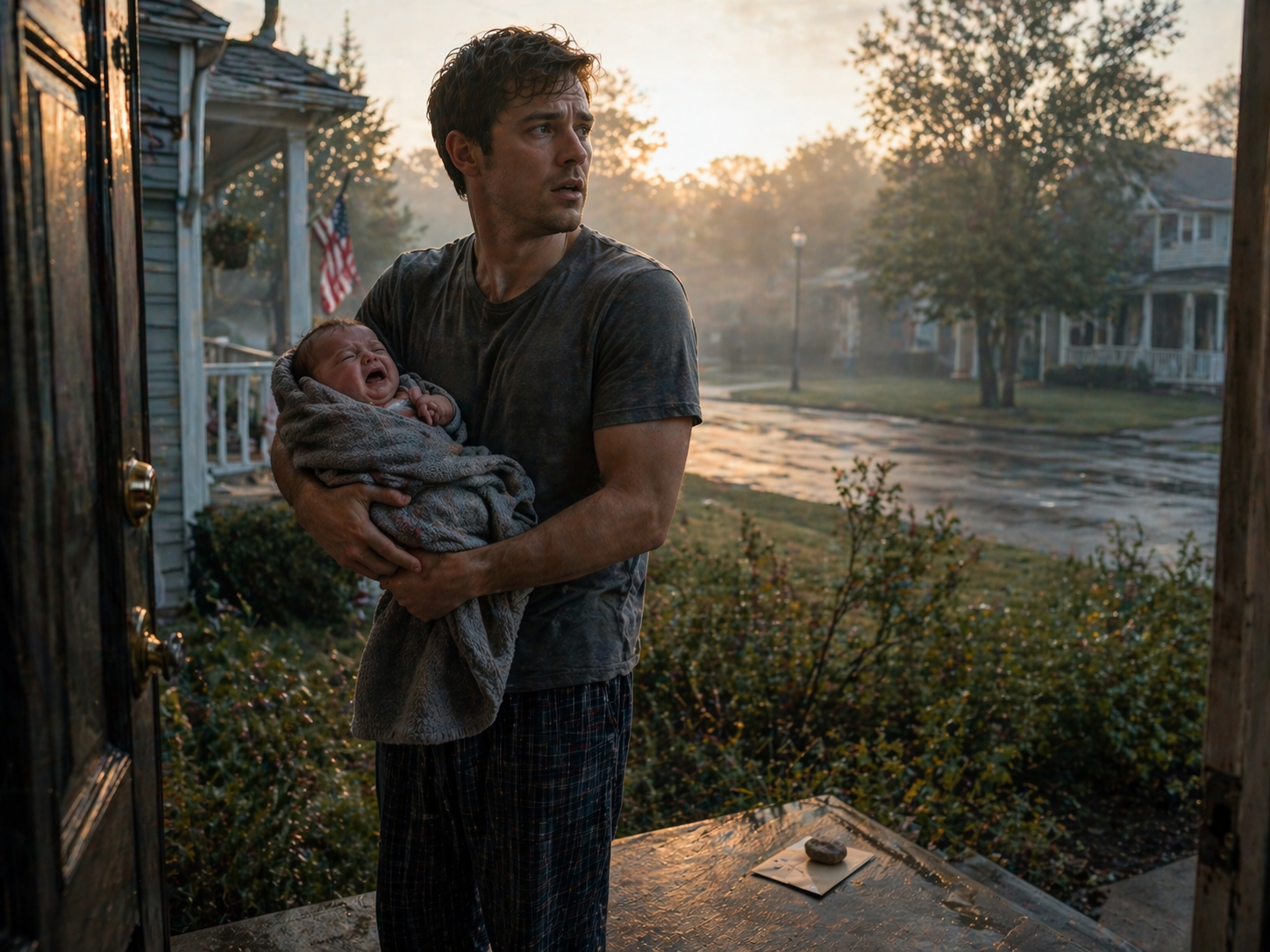
I got to the front door in seconds and opened it.
There was a baby on my porch.
She was wrapped in a gray knit blanket, lying on top of a folded towel like someone had tried to make it as comfortable as possible under the circumstances. She was screaming with full commitment, the kind of cry that had been going on long enough to be past panic and into something more determined. Next to her was a small note card, held down carefully with a stone so it wouldn’t blow away.
Two words.
One night, please.
I stood there in my socks, half awake, staring at a crying baby on my porch, and for a second, everything else disappeared. There was no confusion, no panic, just one clear thought cutting through everything.
Somebody trusted me with this.
My name is Owen Garrett. I’m thirty years old. I build custom furniture out of a workshop behind my house in a small town called Clover Creek, Virginia. About eight thousand people, give or take. The kind of place where people recognize your truck before they recognize you, where you wave at cars even when you don’t know who’s driving. My life was quiet, structured, predictable. I had a dog named Hatch, a steady stream of orders, and a waiting list that stretched out four months. I was not a father. I had no children. Nothing in my life had prepared me for what was happening on my porch.
I picked her up.
Not carefully, not the way someone who knows what they’re doing would, just instinctively, like you pick up something fragile that doesn’t belong on a cold porch floor. She was light, impossibly small, maybe two months old. She kept crying, her entire body working with it. I looked down the street in both directions. Empty. Fog sitting low over the grass. No cars pulling away, no footsteps, nothing.
I looked back at the note.
One night, please.
I brought her inside.
I’m not going to pretend the next twenty minutes were anything close to smooth. I had no idea how to hold a baby properly. Every adjustment I made was immediately corrected by her very loud feedback. I didn’t have formula. I didn’t have diapers. I had half a bag of dog food, three different kinds of hot sauce, and a drill press.
So I called the only person I knew who would answer at six in the morning and not panic before asking questions.
Patrice.
Sixty-one. Retired nurse. Raised four kids. Awake before the sun every day.
“I have a baby,” I said.
Silence.
“Owen?”
“On my porch. There’s a note. I don’t have anything. No formula. No—”
“I’ll be there in four minutes,” she said.
She arrived in three.
She walked in, took the baby from my hands with calm precision, and just like that, the crying stopped. Not completely, but enough that it felt like a miracle.
“How?” I asked.
“You were holding her like a two-by-four,” Patrice said.
She checked the baby quickly, efficient, practiced.
“She’s okay. Hungry. Needs a diaper. Whoever left her took care of her first.”
“Who does that?” I asked.
Patrice looked at me.
“Someone who didn’t have another option and knew you’d open the door.”
She left and came back with formula, diapers, and a look that said she was already thinking ahead. I sat at my kitchen table watching her feed the baby like this was a normal morning.
“You need to call child services,” she said.
“I know.”
“Today.”
“I will.”
I looked at the baby, now quiet, eyes half closed, her tiny hand opening and closing like she was testing the world.
“I just want to understand first.”
“Understand what?”
“Who left her.”
I picked up the note again.
“One night, please.”
“That sounds like someone planning to come back,” I said.
Patrice looked at me carefully.
“Maybe.”
“You don’t think so.”
“I think someone wrote the kindest lie they could before they walked away.”
I sat with that.
“Or,” I said.
“Or,” she agreed.
…“Or,” I said.
“Or,” Patrice agreed.
She left at 7:30, leaving the formula, two extra diapers, and that look over her shoulder that said I would need her again, and she already knew it. I stood in my kitchen with a baby I had known for less than two hours, trying to build a system out of nothing. I lined a laundry basket with towels. I moved slower than usual, careful without knowing exactly what I was being careful about. She had fallen asleep in the armchair at one point, surrounded by pillows I had arranged like a makeshift barrier, and I kept glancing over to make sure she was still breathing.
The note sat on the table.
One night, please.
I turned it over.
There was more.
Smaller writing, tighter, like it had been added after, like whoever wrote it had started to leave and then couldn’t.
Her name is Maya. She is 8 weeks old. She is healthy. She has not been vaccinated yet. She likes to be patted on the back, not rubbed. She is afraid of loud noises. She is not afraid of dogs. She is the best thing I have ever done and I cannot keep her safe right now. Please.
I read it once.
Then again.
Then a third time, slower.
There was nothing careless about those sentences. Nothing thrown together. It was specific in a way that only comes from attention, from knowing someone well enough to notice small things, the way they prefer to be comforted, what scares them, what doesn’t. I set the card down face up this time and went to check on Maya.
At 8:15, I called county child services. They told me someone would come between noon and four. Four to eight hours with a baby and no real supplies. I called Patrice again.
“I need backup,” I said.
“I know,” she replied.
She arrived twelve minutes later with a laundry basket lined with blankets, a borrowed bouncer seat, and enough formula for three days. She read the back of the note this time and didn’t speak right away.
“She loves her,” she said finally.
“I know.”
“This isn’t someone who didn’t want her baby.”
“I know that, too.”
“That makes it harder.”
“Yes.”
Maya was in the bouncer seat, staring at the ceiling with total focus, like whatever she saw up there mattered more than anything else in the room. I sat on the floor beside her because Patrice said babies needed a face nearby and the floor was the only place I could get to her level.
“You’re going to be fine,” I told her.
She didn’t react.
“I know that’s not very specific,” I added. “But it’s what I’ve got.”
Patrice watched me from the couch, something in her expression shifting slightly.
“What?” I asked.
“Nothing,” she said. “You’re already talking to her.”
“Is that bad?”
“No,” she said quietly. “Not bad at all.”
The caseworker arrived at 2:30.
Her name was Renee. She was efficient without being cold, the kind of person who had learned how to carry difficult situations without letting them show too much on the surface. She read the note carefully, both sides, her eyes slowing at certain lines.
“This is detailed,” she said.
“Yes.”
“She says she can’t keep her safe right now,” Renee continued.
“Not that she doesn’t want her,” I said.
“Not that she can’t raise her,” Renee added. “Right now matters.”
She asked me everything. How long I had lived there. If I knew anyone who might have left a child. If I had seen unfamiliar cars, strangers, anything unusual in the past few days. I answered honestly, which meant saying no to most of it, and that felt incomplete in a way I couldn’t explain. Clover Creek wasn’t big enough for something like this to be random. Someone had chosen my porch.
Renee made notes, checked Maya over, and then began preparing to leave.
I didn’t realize how attached I had already become until that moment.
“I’ll make sure she’s placed somewhere safe,” Renee said.
“I know,” I replied.
But knowing didn’t make it easier.
I watched her carry Maya out to the county vehicle, the gray blanket wrapped around her, the same one she had been left in. The door closed, the engine started, and just like that, the house was quiet again.
Too quiet.
I went back inside and stood in the kitchen, not doing anything useful, just standing there where the bouncer seat still sat on the floor. I left it there. It didn’t feel right to move it yet.
That evening, Patrice came over with soup. We ate without talking about it directly, which was exactly what I needed.
At 9:00, she set her spoon down.
“Are you going to try to find her?” she asked.
“The mother?”
“Yes.”
I had been thinking about it all day.
“It’s a small town,” I said.
“Owen.”
“I’m not going to do anything stupid,” I added. “I just want to understand.”
“You want to make sure she’s okay,” Patrice said.
“Both of them.”
I looked at the note again.
“She wrote please.”
Patrice didn’t respond.
“She didn’t leave a baby,” I said slowly. “She left a please.”
Three days later, Renee called.
“The mother came in voluntarily,” she said.
I sat down immediately.
“Is she okay?”
“She’s twenty-two. Her name is Cara. She’s been living in her car for about six weeks after losing her apartment. The father isn’t involved.”
I closed my eyes for a second.
“She chose your house for a reason,” Renee continued.
“What reason?”
“She bought a rocking chair from you eight months ago. You helped carry it to her car and asked if she needed help getting it upstairs.”
I remembered.
It had been nothing.
Routine.
“Let me know if you change your mind,” I had said.
Renee continued.
“She told us she drove past your house three times that morning before leaving Maya.”
At 5:00 in the morning.
Eight months later.
She had changed her mind.
“She’s been connected with housing assistance,” Renee said. “Maya is in temporary foster care nearby. Reunification is the goal.”
“Can you tell her something?” I asked.
“I can’t give her your information.”
“I don’t need that. Just tell her… someone is paying attention. That Maya didn’t disappear.”
There was a pause.
“I can do that,” Renee said.
“And tell her… right now doesn’t have to be permanent.”
“I’ll tell her.”
Seven months passed.
Cara got housing.
A small studio apartment.
She found a job.
The case was still open, but moving in the right direction.
Renee updated me occasionally, which she said wasn’t standard, but she understood.
Maya was eleven months old now.
I knew that because I asked.
I hadn’t met Cara.
I didn’t plan to unless she wanted that.
What I did have was the bouncer seat, still in the corner of my workshop. Hatch slept next to it sometimes, like it belonged there. I never moved it.
And I had something else.
The order record for the rocking chair Cara had bought.
Queen Anne style.
White oak.
Three weeks of work.
She had paid in installments.
I found the review she left.
“This is the most beautiful thing I own. I’m going to keep it forever.”
I read it again.
And thought about her.
About that morning.
About the choice she made.
Not between good and bad.
Between two impossible things.
And she chose the one that kept her baby safe.
Then she chose a porch.
A specific porch.
A man who had once said something small and forgotten it.
People remember small kindnesses longer than you think.
I’m going to remember that.
Because there’s a difference between giving something up…
And putting it somewhere safe until you can come back.
Cara knew the difference.
And I’m glad my door was the one she knocked on.
Even if she never actually knocked.
I’m glad I opened it.
![[FULL STORY] My Girlfriend Texted I'm Using Our 'Vacation Fund' To Bail My Ex Out Of Jail You](https://social-media.rabedo.com/thumbnails/1777545415_10.png)
.png)