I used to think loneliness was something that arrived all at once, like a storm rolling over the hills, dark and loud enough for everyone to see. But that isn’t how it came for me.
It came quietly.
It came in the empty chair across from mine at breakfast. It came in the second coffee mug I stopped taking down from the cabinet. It came in the way the house settled at night, groaning in the wind like it was trying to speak to someone who wasn’t there anymore.
My name is Ruth Ellen Whitaker, and I have lived most of my life in a small farmhouse outside Maple Hollow, Vermont, where the woods press close to the back pasture and the road into town bends around two old barns and a church with peeling white paint. When my husband, Henry, was alive, the place never felt small. There was always something to do, something breaking, something growing, something needing fed or fixed or carried inside before the rain came.
After he died, the same land felt too wide.
My children left long before that. I don’t say that with bitterness. Children grow up. That is what we raise them to do. My oldest, Mark, moved to Texas for work. My daughter, Caroline, married a man from Oregon and built a life near the coast. They called when they could. They sent pictures at Christmas. They said the same thing every time we hung up.
“We’ll come visit soon, Mom.”
Soon became spring. Spring became Thanksgiving. Thanksgiving became another year.
So I learned not to wait too loudly.
Every morning, I woke before sunrise, made tea, wrapped my gray hair into a loose bun, pulled on Henry’s old raincoat, and walked into the woods with a wicker basket on my arm. I had been gathering mushrooms since I was a young wife, when Henry taught me how to tell the good ones from the dangerous ones.
“Never trust beauty alone,” he used to say, turning a pale mushroom over in his hand. “Some pretty things can kill you.”
I still heard him sometimes when I walked beneath the pines. Not in a frightening way. More like memory had learned the shape of his voice and chose to keep me company.
I gathered chanterelles after warm rain, oyster mushrooms from fallen logs, morels in spring if I was lucky. On Saturdays, I took them into town and sold them at the farmers’ market from a folding table with a green cloth. People knew me there as the mushroom lady. Some smiled. Some chatted. Some asked how I was doing, and I always said the same thing.
“I’m getting along.”
That was true enough.
Getting along is not the same as living, but at my age, people accept it as an answer.
The day I found the puppy, the sky had been gray since morning. Not storm gray, exactly. Just tired gray. I almost stayed home because my knees ached when I stepped out of bed, and the air had that damp heaviness that made every old bone complain.
But I needed mushrooms for the weekend market, and staying home meant sitting in that kitchen listening to the clock tick.
So I took my basket and went.
The woods were quiet at first. Wet leaves clung to my boots. The smell of moss and earth rose around me. I moved slowly, bending when I found a good cluster, cutting carefully with Henry’s old pocketknife. By noon, my basket was nearly half full.
Then the wind shifted.
I looked up.
The clouds had thickened into a low black ceiling.
“Should’ve turned back sooner,” I muttered.
The first drops came hard and cold. Within minutes, the rain poured through the branches in heavy sheets. I pulled my coat tight, covered the basket with a cloth, and started toward home.
That was when I heard it.
At first, I thought it was a bird. A thin sound beneath the rain. Weak. Broken.
I stopped.
The forest roared around me.
Then I heard it again.
A whimper.
I turned slowly, listening.
“Hello?”
The sound came again, softer this time.
I stepped off the trail, pushing through wet brush. Branches slapped my sleeves. Mud sucked at my boots. The rain ran into my eyes, and I had to wipe my face with the back of my hand.
“Where are you, sweetheart?”
Another whimper.
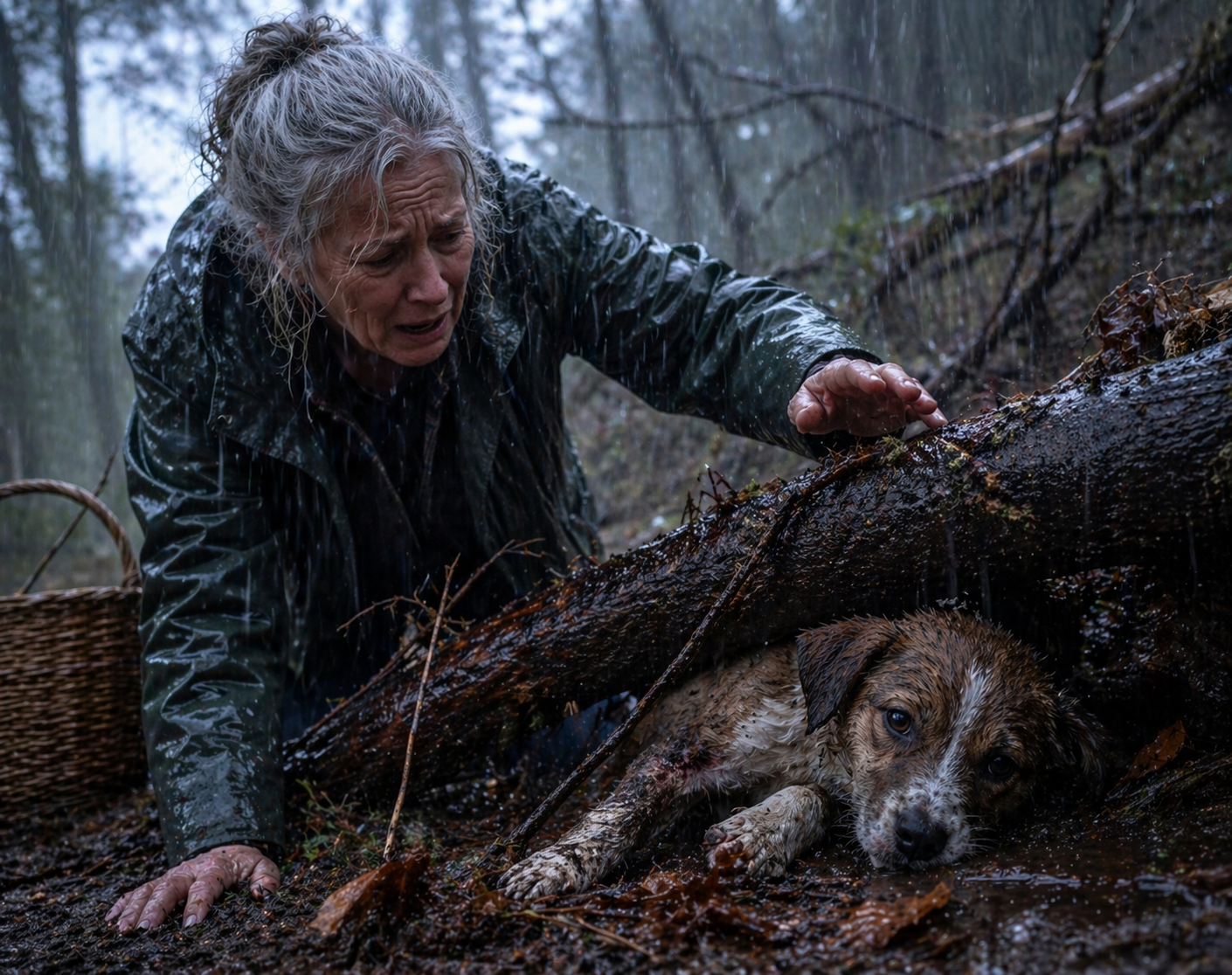
I followed it down a little slope toward a fallen maple. A storm must have split one of the branches days before, because it lay heavy across the ground, tangled with leaves and mud.
And beneath it, almost hidden, was a puppy.
He was small, maybe four or five months old, soaked through, his fur matted with dirt and leaves. The branch pinned him across his back legs. One paw was twisted at a terrible angle. His body trembled so hard I could see it even through the rain.
“Oh, Lord…”
I dropped to my knees beside him.
He tried to lift his head when he saw me. His eyes were dull with pain, but he looked at me like he had been waiting for someone, anyone.
“You poor baby.”
He made another sound, barely more than breath.
The ground around him was flattened. His fur was caked with dried mud beneath the fresh rain. There were little scratches in the earth where he must have tried to pull himself free.
He had not just fallen.
He had been there.
Maybe a day.
Maybe two.
My throat tightened.
“Who left you out here?”
Of course, he could not answer.
I slid my hands under the branch and pushed. It was heavier than I expected. Pain shot through my shoulder, and my boots slipped in the mud.
“Come on, Ruth,” I whispered to myself. “You’ve lifted worse than this.”
I pushed again, using my knees, my back, every bit of strength my seventy-two-year-old body had left. The branch lifted just enough.
With my other hand, I pulled him out.
He cried then, a sharp weak sound that nearly broke me.
“I know. I know. I’m sorry. I’m so sorry.”
I wrapped him in my coat and held him against my chest. He was frighteningly light. His heart beat fast beneath my hand, like a trapped bird.
“You’re coming home with me.”
The walk back was the longest mile of my life. My basket bumped against my hip. The rain blurred the trail. Twice, I nearly slipped. The puppy lay bundled in my arms, too exhausted to cry anymore.
“Stay with me,” I kept saying. “You hear me? Stay with me.”
By the time I reached the farmhouse, my hands were numb. I kicked the door shut behind me, dropped the basket on the kitchen floor, and carried him straight to the hearth. I built the fire high, then laid him on towels near the warmth.
Under the mud, he was a soft brown-and-white little thing, with floppy ears and a white patch on his chest shaped almost like a crooked heart.
His leg looked bad. Worse than bad. I didn’t have a vet nearby I could call in the middle of a storm, not one who would come all the way out to my place before morning. So I did what I could. I cleaned his wounds with warm water. I cut away bits of tangled fur. I wrapped his leg gently, though my hands shook the whole time.
He whimpered whenever I touched him, but he never snapped.
Not once.
“You’re a good boy,” I whispered. “A brave boy.”
He looked at me through half-closed eyes.
I warmed milk, mixed a little broth, and touched it to his mouth with my finger. At first, he did nothing. Then his tongue moved, weakly licking.
“That’s it.”
All night, I sat beside him.
The rain beat against the windows. The fire burned low, and I fed it log after log. Around midnight, he stopped shivering. At first, I thought that was good.
Then I noticed his breathing had slowed.
Too much.
I leaned closer.
“No.”
His chest barely moved.
“No, no, no.”
I put my hand against his side.
“Don’t you do this. Not after all that.”
His body was so still.
The kitchen around me blurred.
“I’m sorry,” I whispered. “I should have found you sooner.”
For one terrible moment, I thought he was gone.
Then his paw twitched beneath my fingers.
So small.
So slight.
But there.
I sucked in a breath and pressed my hand gently to his ribs.
“There you are,” I cried softly. “There you are.”
His chest rose again.
I bowed my head over him and wept harder than I had wept in months.
“You are not dying in my kitchen,” I told him. “You hear me? Not tonight.”
By morning, the storm had passed.
The puppy was still alive.
I named him Lucky.
It seemed like the only name that fit.
The vet in town said Lucky had been close to death when I brought him in. Dehydrated. Infected wounds. A badly sprained leg, maybe a fracture that would heal if we were careful. He shook his head when he examined him.
“Another day out there and he wouldn’t have made it.”
I looked at Lucky lying on the table, his eyes following me.
“Then it’s a good thing I was late coming home.”
The vet smiled gently.
“Maybe he was waiting for you.”
I didn’t answer, because something in my chest had already believed that.
The weeks that followed were hard, but they gave my days purpose in a way I had not felt in years. I cleaned his bandages. I fed him small meals. I slept on the sofa so I could hear him if he cried at night.
At first, he could barely stand. When he tried, his little body trembled, and he collapsed back onto the blanket with a frustrated whine.
“It’s alright,” I told him. “You don’t have to rush.”
But Lucky wanted to rush.
He had a stubborn soul.
By the third week, he dragged himself after me from the kitchen to the sitting room. By the fifth, he took three wobbly steps and looked so proud of himself that I clapped like he had won a prize at the county fair.
“Well, look at you!”
His tail thumped wildly.
After two months, he followed me to the porch.
After three, he followed me into the yard.
By spring, he followed me everywhere.
He was not a little puppy anymore. He was growing into a handsome dog, medium-sized, with soft brown fur, white paws, bright eyes, and one ear that always tipped forward as if he were listening for secrets. His limp remained, faint but visible when he was tired. I loved that limp. Not because it hurt him, but because it reminded me that he had survived.
He came with me into the woods once he was strong enough. At first, I tried to leave him home.
“You stay here,” I told him, pointing to the porch.
He stared at me.
“I mean it.”
He wagged his tail.
“No.”
He followed me anyway.
After that, I stopped arguing.
In the woods, he learned my paths. He sniffed ahead, then circled back to make sure I was coming. If I bent too long over a patch of mushrooms, he sat beside me like a guard. If I wandered near the slope where I had found him, he grew quiet.
The first time we passed that fallen maple, he stopped.
His whole body went still.
I knelt beside him.
“You remember?”
He pressed against my leg.
I rested my hand on his head.
“So do I.”
At the market, Lucky became more popular than my mushrooms. Children asked to pet him. Older women leaned down and called him beautiful. Men who never bought anything from me stopped just to ask about him.
“Found him in the woods,” I would say.
Then Lucky would look up at me, and I would add, “Or maybe he found me.”
The house changed because of him.
That is the only way I can explain it.
Before Lucky, I moved through rooms like a ghost. After Lucky, there were paw prints by the door, fur on the sofa, a bowl in the kitchen, a leash hanging beside Henry’s old coat. There was someone waiting when I came in from the garden. Someone who barked when the mail truck came. Someone who rested his head on my knee when evenings grew too quiet.
At night, he slept beside my bed.
Sometimes I woke to find him watching me.
“You checking if I’m still here?” I would whisper.
His tail would tap against the floor.
“Me too,” I’d say.
By summer, I had started talking to him more than I talked to anyone.
I told him about Henry. About the children when they were little. About the winter the pipes froze and Henry cursed so loud the pastor heard him from the road. About the time Caroline fell into the creek wearing her Easter dress. About Mark’s first baseball glove.
Lucky listened to all of it like every word mattered.
One evening, after dinner, I sat on the porch with a cup of tea while he lay at my feet. Fireflies blinked in the grass. The sky turned lavender behind the trees.
“You know,” I said, “I had forgotten what it felt like to be needed.”
Lucky lifted his head.
I smiled.
“Don’t look at me like that. It’s true.”
He stood, stretched, and rested his chin on my knee.
I placed my hand between his ears.
“You saved me too, little one.”
He closed his eyes.
For a while, life felt almost whole again.
Then came the knock.
It was late September, the kind of afternoon when the air smells like apples and woodsmoke. I had just finished sorting a basket of hen-of-the-woods mushrooms when Lucky suddenly lifted his head.
A truck pulled into the driveway.
I wiped my hands on my apron and looked through the window. A man stepped out, mid-thirties maybe, tall, with tired eyes and a folded paper in his hand.
Lucky barked once.
Not angry.
Excited.
The sound made my heart tighten before I understood why.
I opened the door.
The man removed his cap.
“Ma’am?”
“Yes?”
He looked past me.
Lucky stood behind my legs, tail wagging uncertainly.
The man’s face changed.
“Oh my God,” he whispered.
I felt something cold move through me.
The man unfolded the paper and held it out.
“I think… I think you have my dog.”
On the paper was a photo.
A small puppy with muddy paws, one ear tipped forward, a white patch on his chest shaped like a crooked heart.
Lucky.
Only smaller.
My hand went to the doorframe.
The man swallowed hard.
“His name was Scout. He disappeared during that bad storm back in March. We looked everywhere. Put up flyers. Called shelters. I thought…” His voice cracked. “I thought he was dead.”
Lucky took one step forward.
The man dropped to his knees.
“Scout?”
Lucky hesitated.
Then he moved toward him, slowly, sniffing, tail wagging harder.
The man touched his face and started crying.
I stood there watching, feeling something inside me fold in on itself.
Of course.
Of course he had belonged to someone.
A dog like Lucky did not fall from heaven just for me.
“I found him in the woods,” I said quietly. “Pinned under a branch. He was hurt badly.”
The man looked up at me, tears in his eyes.
“You saved him.”
I nodded, though the words barely reached me.
“I did what anyone would do.”
“No,” he said. “Not anyone.”
Lucky came back to my side then, leaning against my leg.
The man saw it.
So did I.
For a moment, no one spoke.
Then he said softly, “My little girl has been asking about him every week. She’s seven. She still keeps his collar on her nightstand.”
That was when I knew.
Whatever I felt, whatever Lucky had become to me, there was a child somewhere who had been waiting too.
I knelt slowly and cupped Lucky’s face.
He looked at me with those bright trusting eyes.
“You have a family,” I whispered.
His tail stopped wagging.
The man looked uncomfortable.
“Ma’am, I can pay you for everything. Vet bills, food, anything.”
I shook my head.
“You don’t pay someone for loving a dog.”
My voice trembled on the last word.
I stood and took Lucky’s leash from the hook by the door. My fingers fumbled with the clasp.
Lucky watched me.
“No,” I whispered, more to myself than him. “Don’t make this harder.”
But of course he did.
When the man gently took the leash, Lucky resisted. He sat down on the porch boards and looked back at me.
“Go on,” I said.
He did not move.
The man’s eyes softened.
“I can come back tomorrow if you need time.”
If he came back tomorrow, I would still need time.
If he came back next year, I would still need time.
I bent down and wrapped my arms around Lucky’s neck. He pressed into me, whining softly, his body trembling like it had that first night by the fire.
“You be good,” I whispered into his fur. “You hear me? You be good for that little girl.”
He licked my cheek.
I held him tighter.
Then I made myself let go.
“Go home, Lucky.”
He looked at me once more.
Then the man coaxed him gently down the steps.
I watched them drive away.
Lucky stood in the back seat, front paws on the window ledge, looking back until the truck turned onto the road and disappeared behind the trees.
After that, the house became quiet again.
Not the same quiet as before.
Worse.
Because now I knew what it sounded like with love in it.
PART 2
For the first few days after Lucky left, I kept forgetting.
I would set aside a piece of toast crust, then remember there was no warm nose waiting beneath the table. I would open the back door and expect him to push past my legs into the yard. I would wake in the night and hold still, listening for his breathing beside the bed.
There was only the clock.
Tick.
Tick.
Tick.
I told myself I had done the right thing.
I had.
A little girl had her dog back. A family had been made whole again.
That should have comforted me.
It did not.
At the market, people noticed immediately.
“Where’s your dog today, Ruth?”
I smiled because that was what people expected.
“He went home.”
A woman buying chanterelles touched my arm.
“Oh. I didn’t realize he wasn’t yours.”
Neither did I, I wanted to say.
Instead, I wrapped her mushrooms in brown paper and handed them over.
“No. He wasn’t mine.”
The words tasted strange.
Weeks passed.
Autumn deepened. The trees turned gold, then red, then brown. The paths disappeared beneath fallen leaves. I kept going into the woods because if I stopped, I feared I might not start again. My basket felt heavier without Lucky trotting ahead of me. The forest seemed larger. Less friendly.
One afternoon, I found myself standing by the fallen maple where I had first heard him cry. The branch was still there, though half buried now in moss and leaves.
I stared at the place beneath it.
“You made it,” I said softly.
The wind moved through the trees.
I did not cry.
I had cried enough.
Or so I thought.
Two days before Thanksgiving, Caroline called.
“Mom, I’m so sorry, but we can’t make it this year. Tom’s mother isn’t well, and flights are impossible.”
“It’s alright, honey.”
“We’ll come in spring. I promise.”
There it was again.
Soon, wearing a different coat.
After we hung up, I sat at the kitchen table for a long time. Outside, the first snow began to fall, light and soft, dusting the fence posts.
I made soup that night and poured half of it into a container before remembering there was no one to share it with.
Then I did something I had not done in years.
I took Henry’s old coat from the hook, pressed my face into it, and cried like a child.
Winter settled hard after that.
Snow closed the smaller roads. The market slowed. I went out only when I needed to. Some days, the cold kept me in until noon. I had always been independent, sometimes proudly so, but independence can become a cage when there is no one close enough to notice if you stop answering the phone.
The man who had taken Lucky came once in December.
His name was Daniel Price. He brought a tin of cookies his daughter had baked and a photograph of Lucky sitting beside a little girl in pink glasses.
“She wanted you to have this,” he said.
I took the photo with both hands.
Lucky looked healthy. Happy, even. His fur shone. His crooked-heart patch was bright against his chest. The little girl had her arms wrapped around him.
“She loves him,” Daniel said.
“I can see that.”
“He’s been good for her. She had nightmares after he disappeared. Since he came back, she sleeps better.”
I nodded.
“That’s good.”
Daniel studied my face.
“He misses you, I think.”
I looked down at the photo.
“Dogs adjust.”
“Maybe.”
Lucky had adjusted.
I would too.
That was what I told myself.
Before he left, Daniel hesitated at the door.
“You could visit him sometime.”
I smiled politely.
“That’s kind.”
But I knew I wouldn’t.
Some wounds hurt worse when you press on them.
Christmas came and went. Mark sent a gift card. Caroline sent a sweater. Both called. Both sounded rushed. I told them I loved them. I told them I was fine.
By late February, the snow began to soften around the edges. The air still bit, but there was water dripping from the eaves and mud beneath the ice. I started going deeper into the woods again, checking early spots out of habit more than hope.
That morning, the weather report said rain by afternoon.
I should have listened.
But there was a particular ridge where black trumpets sometimes appeared after a thaw, and I thought if I went early, I could be home before the sky opened.
I packed my basket, pulled on my boots, and stepped into the gray morning.
The woods smelled of wet bark and old snow. Patches of ice hid under leaves. I moved carefully, using Henry’s walking stick on the steeper parts. By noon, I had gathered enough to make the trip worthwhile.
Then thunder rolled.
Not close.
But close enough.
I turned back.
Rain began before I reached the lower trail. Cold rain. Heavy rain. The kind that finds the gap between collar and neck and runs down your spine.
I quickened my pace.
That was my mistake.
My boot hit a slick root hidden under leaves. My ankle twisted beneath me, and I went down hard.
Pain flashed white.
For a moment, I could not breathe.
When I tried to move, pain shot up my leg so sharply I cried out.
“No. No, no…”
I pushed myself up on my elbows.
My ankle was trapped at an angle beneath me. I tried to straighten it and nearly fainted.
Rain hammered the leaves overhead.
I reached for my phone.
My pocket was empty.
I remembered, with a sick drop in my stomach, that I had left it charging on the kitchen counter.
“Stupid old woman,” I gasped.
I tried to stand again.
Couldn’t.
The trail was not far, maybe twenty yards uphill, but it might as well have been twenty miles. The woods were empty. No hikers came this way in weather like this. No neighbor would think to look for me until maybe tomorrow. Maybe later.
The cold worked fast.
At first, I was angry.
Then frightened.
Then strangely calm.
I leaned against a wet log, breathing through the pain, rain dripping from my hair into my eyes.
“Well, Henry,” I whispered, “this is a fine mess.”
The wind answered.
An hour passed.
Maybe two.
Time became slippery.
I shouted until my throat burned.
“Help!”
Nothing.
My hands shook. My coat was soaked. The basket lay on its side, mushrooms scattered into the mud.
I thought of Mark and Caroline getting a call. I thought of them feeling guilty. I did not want that for them. I thought of Henry. I thought of Lucky curled at some little girl’s feet, warm and safe.
That was good, I told myself.
At least he was safe.
I closed my eyes.
Then I heard it.
At first, I thought it was rainwater running over stones.
A rushing sound.
Fast.
Uneven.
Then a bark split the woods.
My eyes flew open.
Another bark.
Closer.
Impossible.
“Lucky?”
My voice was barely a whisper.
Branches snapped. Leaves flew. And then he burst through the trees like a memory made real.
Brown fur soaked dark with rain. White paws muddy. One ear tipped forward. That crooked heart on his chest.
Lucky.
He ran straight to me, whining so loudly it sounded almost human. He shoved his face against mine, licking rain and tears from my cheeks, circling me, pressing his body against my chest.
I grabbed him with both hands.
“You came back,” I sobbed. “Oh, baby, you came back.”
He barked once, sharp and urgent, then turned and ran a few steps uphill. He looked back.
“Lucky, I can’t.”
He ran back to me, whining, nudging my shoulder with his nose.
“I can’t walk.”
He barked again.
Then he turned and disappeared up the slope.
“No,” I cried. “No, don’t leave me.”
But this time, a part of me knew.
He was not leaving.
He was doing what he had done once before.
He was getting help.
I don’t know how long it took. Ten minutes. Twenty. Time had lost meaning.
Then I heard voices.
“Ruth!”
A man’s voice.
“Mrs. Whitaker!”
Daniel came crashing through the trees with another man behind him. His face was pale with fear. Lucky ran ahead of them, barking and circling, as if scolding them for being too slow.
Daniel dropped beside me.
“Oh thank God.”
“How did you…”
“Lucky,” he said, breathless. “He lost his mind at the house. Barking, scratching at the door, wouldn’t stop. When I opened it, he took off into the woods. I followed him. He brought me here.”
I looked at Lucky.
He stood inches away, soaked and trembling, eyes locked on mine.
Daniel’s voice softened.
“He knew.”
They got me out just before dark.
My ankle was broken. I had mild hypothermia. The doctor told me another few hours in that weather could have ended very differently.
Daniel stayed until Caroline arrived two days later, frantic and tearful, smelling like airport coffee and guilt.
“Mom, why didn’t you call me? Why didn’t you tell me things were this hard?”
I looked at my daughter, really looked at her, and saw not the child who had left but the woman who had been trying to balance too many lives at once.
“I didn’t want to be a burden.”
Her face crumpled.
“Oh, Mom.”
She sat beside my hospital bed and held my hand the way she had when she was little.
For once, I did not say I was fine.
When I came home, Caroline stayed for two weeks. She stocked the freezer, arranged a check-in schedule with neighbors, bought me one of those emergency alert buttons I had refused for years, and cried when she found Lucky’s old bowl still in the pantry.
“You really loved him,” she said.
I looked away.
“Yes.”
Daniel visited the next afternoon.
Lucky was with him.
The second Lucky saw me, he pulled so hard that Daniel nearly lost his grip. Caroline opened the door, and Lucky came flying inside, sliding across the kitchen floor, whining like his heart had been waiting at the threshold.
He climbed carefully onto the sofa beside me, mindful of my cast, and tucked his head under my chin.
I held him and closed my eyes.
Daniel stood by the door, quiet.
His daughter was with him this time. A small girl with pink glasses and solemn eyes. She watched Lucky in my arms, and for a moment, guilt squeezed my chest.
“I’m sorry,” I said to her. “He’s just excited.”
The little girl shook her head.
“He missed you.”
Her name was Emma. She stepped closer, holding something in both hands.
It was Lucky’s collar.
“I told Daddy,” she said, looking down at it, “that Scout is happy with me. But he’s different when he hears your name.”
Daniel put a hand on her shoulder.
“We had a long talk,” he said.
I stiffened.
“No. Please don’t do this because you feel sorry for me.”
“We’re not,” he said.
Emma looked up at me.
“When he ran away to find you, I was scared. But Daddy said sometimes dogs know who needs them most.”
My throat tightened.
Daniel continued, “We love him. Emma loves him. But the truth is, he’s been trying to come back here since the day we took him home. Every walk, every ride in the truck, he pulls toward this road. When the storm came, he didn’t hesitate. He knew exactly where to go.”
Lucky sighed against my chest.
Daniel smiled sadly.
“I think he made his choice a long time ago.”
Emma held out the collar.
“Can he live with you?”
I could not speak.
Caroline covered her mouth.
I looked at the little girl.
“Oh, sweetheart, I can’t take your dog.”
Emma’s eyes filled with tears, but she smiled anyway.
“He can still be my friend. We can visit.”
Daniel nodded.
“If you’re willing. We’d like that.”
I looked down at Lucky.
He looked up at me, tail thumping once against the sofa.
Not begging.
Not asking.
Just waiting.
Like he had waited under that fallen branch.
Like he had waited beside my bed.
Like he had waited for me to admit what both of us already knew.
I reached for Emma’s hand and wrapped her fingers gently around Lucky’s collar.
“Then we share him,” I said.
Emma blinked.
“Really?”
“Really. But he sleeps here.”
For the first time, she laughed.
Lucky barked once, as if agreeing to the terms.
So that was how my life changed again.
Not all at once.
Quietly.
Daniel and Emma began visiting on Sundays after church. Emma helped me sort mushrooms in spring and apples in fall. Daniel fixed the loose step on my porch and repaired the back fence Henry had meant to fix years before. Caroline came more often after that, sometimes with her husband, sometimes alone. Mark visited in June and stayed long enough to repaint the kitchen.
And Lucky stayed.
He slept beside my bed again. Followed me from room to room again. Walked with me into the woods again, though not as far as before. Caroline insisted on that.
“No wandering deep alone,” she said.
“I have Lucky.”
“You also have a phone and that emergency button.”
“Yes, ma’am.”
Lucky’s limp grew more noticeable as he aged, and mine did too. We became slower together. People at the market called us a matched pair. I liked that.
On the anniversary of the day I found him, I walked with him to the fallen maple. The branch had rotted into the earth by then. Moss covered most of it. Tiny mushrooms grew along the bark.
Lucky sniffed the ground, then sat beside me.
I lowered myself carefully onto a dry stump.
“This is where you were,” I said.
He leaned against my leg.
“And this is where I was too, I suppose. Not pinned under a branch, maybe. But stuck all the same.”
The woods were bright with spring rain. Sunlight slipped through the trees in soft gold lines.
I ran my hand over his head.
“You cried and I found you,” I whispered. “Then I cried and you found me.”
Lucky looked up at me with those warm brown eyes.
Some people say animals don’t understand us.
Maybe not in the way people do.
They don’t need all our words. They don’t ask for explanations. They don’t care whether grief is old or new, whether loneliness makes sense, whether the world thinks you should be over something by now.
They simply know when a heart is hurt.
And if you are lucky, truly lucky, one of them will stay.
Lucky stayed through storms, through silence, through the long ache of an empty house becoming full again.
I found him broken in the rain.
But that was only half the story.
Because later, when I was the one lost in the woods, cold and afraid and nearly ready to stop calling for help, he found me too.
And this time, when he came home—
he never left again.
After Lucky left, the house felt different in a way I could not quite explain.
It wasn’t just quiet.
It was hollow.
Before him, the silence had been something I had grown used to, like an old ache in the joints you stop noticing after a while. But after Lucky, the silence felt fresh again, sharp in the edges, like something had been taken away that I didn’t even realize I still needed.
The first morning without him, I woke up and waited.
I don’t know why.
Maybe I expected to hear his nails tapping on the wooden floor. Maybe I thought he would come bounding into the room, tail wagging, eyes bright like nothing had changed.
But nothing came.
Just the sound of wind brushing against the windows.
I sat up slowly, my back stiff, my hands resting on my knees for a moment longer than usual.
“Well,” I said softly to the empty room, “it’s just us again.”
The words echoed more than I expected.
I went through the motions that day. Made tea. Ate toast. Put on my coat. Took my basket.
But everything felt slower.
Heavier.
In the woods, I kept turning around.
It was a habit I didn’t realize I had built—the quiet expectation that he would be just behind me, sniffing the ground, or running ahead and then circling back to check if I was still there.
Once, I even stopped and said, “Lucky, don’t go too far—”
Then I caught myself.
My throat tightened.
I stood there for a long time, staring at the path ahead.
“You’re not here,” I whispered.
The trees said nothing back.
At the market, people asked about him.
“Where’s your little partner today?”
“He went home,” I said, forcing a smile.
“Oh… well, that’s good, isn’t it?”
“Yes,” I replied.
It was good.
It had to be.
That was what I told myself over and over.
You did the right thing, Ruth.
But doing the right thing doesn’t always feel right.
Days turned into weeks.
The weather grew colder. The leaves fell. The world outside my window slowly drained of color.
Inside the house, I found myself talking less.
There was no one to listen.
No one to tilt their head at my voice or rest their chin on my knee when I paused too long between sentences.
At night, I started leaving the lamp on in the living room.
Not because I needed the light.
But because the darkness felt too complete.
One evening, I found Lucky’s old blanket tucked behind the chair where he used to sleep. I don’t remember putting it there.
I picked it up and sat down with it in my lap.
It still smelled faintly of him.
Warm.
Familiar.
My fingers tightened around the fabric.
“I hope you’re happy,” I said quietly.
And for the first time since he left—
I cried.
Winter came early that year.
Snow fell heavy and fast, covering the ground in thick white layers that swallowed the paths I had walked for years. The woods grew quieter, deeper, like they were holding their breath.
I went out less.
But not never.
Because staying inside too long made the walls feel closer.
One afternoon, I decided to go just a little way into the forest. Not far. Just enough to clear my head.
The sky was gray.
The air sharp.
I pulled my coat tight and stepped onto the familiar trail.
“You’re not going far,” I told myself.
The forest didn’t look the same under snow.
Everything was softened.
Hidden.
The roots I knew by heart disappeared beneath white.
The path I could once walk with my eyes closed now felt uncertain.
I moved slowly, carefully.
But not carefully enough.
My foot slipped.
There was a crack—
Sharp.
Loud.
Pain exploded up my leg.
I fell hard, the air knocked out of my lungs.
For a moment, I couldn’t think.
Couldn’t breathe.
Couldn’t move.
Then the pain settled in.
Deep.
Burning.
I tried to sit up.
My leg screamed in protest.
“No… no…”
I reached for a branch, tried to pull myself up.
Nothing.
My body refused.
The cold started to creep in almost immediately.
The kind of cold that doesn’t just sit on your skin—it sinks in, slow and steady, until it reaches your bones.
I looked around.
The forest stretched endlessly in every direction.
No movement.
No sound.
No one.
“Help!” I called out.
My voice echoed weakly.
Then faded.
I tried again.
“Help!”
Nothing answered.
My chest tightened.
Not from the pain.
From something else.
Something I hadn’t felt in a long time.
Fear.
Real fear.
I leaned back against the snow, breathing hard.
“Well,” I whispered, my voice trembling, “this is how it ends, isn’t it?”
I closed my eyes for a moment.
The world felt very far away.
Very quiet.
Then—
A sound.
Faint.
Distant.
Running.
Fast.
At first, I thought it was my imagination.
But then it came again.
Closer.
Closer.
My eyes snapped open.
Through the falling snow, I saw movement between the trees.
A shape.
A figure—
Then a bark.
Loud.
Sharp.
Familiar.
“Lucky…?” I whispered, barely daring to believe it.
He burst through the trees like a force of nature.
Snow flying beneath his paws, breath visible in the cold air, eyes locked onto me with a kind of urgency I had never seen before.
He reached me in seconds, whining, circling, pressing his body against mine like he was trying to make sure I was real.
My hands shook as I reached for him.
“You… you came back…”
He licked my face, his tail wagging so hard it knocked against the snow.
“How did you even—”
I couldn’t finish the sentence.
Because I didn’t need to.
Somehow, he had known.
He always knew.
“Help…” I whispered, my voice breaking.
He froze for a split second.
Then turned—
And ran.
My heart dropped.
“No… don’t leave…”
But he was already gone.
The forest swallowed him whole.
I lay there, the cold pressing in again, the silence returning.
But this time—
It didn’t feel the same.
Because now I knew.
He wasn’t leaving.
He was going to do exactly what he had done before.
He was going to bring someone back.
Minutes passed.
Or maybe longer.
Time didn’t feel real anymore.
My fingers were numb.
My breath shallow.
But then—
Voices.
Distant at first.
Then closer.
“Over here!”
“Ruth!”
Branches snapped.
Footsteps rushed through the snow.
And then—
They appeared.
A man.
Another behind him.
And Lucky, running ahead of them, barking wildly.
“Thank God,” the man said, dropping to his knees beside me.
I recognized him through the blur.
Lucky’s owner.
“I—he—” I tried to speak.
“He wouldn’t stop,” the man said, breathless. “Ran out of the house, straight into the woods. I followed him. Didn’t know why until now.”
I looked at Lucky.
He stood beside me, chest heaving, eyes fixed on mine.
And in that moment—
I understood everything.
The rescue was a blur.
Hands lifting me.
Voices calling.
The cold fading.
The pain returning sharper once I was safe.
At the hospital, they told me my leg was broken.
Another hour out there and things could have been much worse.
I lay in that bed, staring at the ceiling.
And all I could think about was him.
The next day, he came.
Lucky.
The moment he saw me, he pulled against the leash so hard the man had to let go.
He jumped onto the bed, whining, pressing his head against my chest just like he always did.
I wrapped my arms around him.
“You came back,” I whispered.
He didn’t move.
Didn’t pull away.
Just stayed.
Like he had always belonged there.
The man stood quietly at the foot of the bed.
“I think…” he said slowly, “he’s already made his choice.”
I looked up at him.
“You don’t have to—”
He shook his head.
“My daughter loves him. She really does. But… he hasn’t been the same since we took him home. He waits by the door. He listens for things that aren’t there.”
He paused.
“Yesterday, when he ran… I’ve never seen him like that. It wasn’t panic. It was… purpose.”
My throat tightened.
“He knew I was out there.”
The man nodded.
“I think he knew where he needed to be.”
A few days later, when I came home—
Lucky came with me.
No hesitation.
No confusion.
No looking back.
The house felt different again.
But this time—
It felt right.
That night, as I sat in my chair by the fire, Lucky curled up at my feet, I reached down and ran my hand through his fur.
“You found me,” I whispered.
His tail thumped softly.
“And I found you.”
People say animals don’t choose.
That they don’t understand love the way we do.
But I’ve lived long enough to know better.
Because once—
I found him broken in a storm, waiting to be saved.
And later—
when I was the one lost, cold, and alone—
He came back for me.
And this time…
he stayed.


![[FULL STORY] I Caught My Husband With My Sister On Our Anniversary, So I Opened The Vault That Destroyed Them Both](https://social-media.rabedo.com/thumbnails/1777821275_688000732_943620588515327_1790886156462189678_n.jpg)