
I hadn’t ridden a horse in twenty-three years.
Not since the morning my husband fell in the back field behind our house in western Montana. People always imagine something dramatic when they hear that—thunder, chaos, a wild horse—but it wasn’t anything like that. It was quiet. Too quiet. One moment he was standing there fixing a loose fence post, muttering to himself like he always did, and the next he was on the ground, still in a way that didn’t feel natural. I remember calling his name like it might pull him back. It didn’t.
After that, the farm didn’t feel like ours anymore. It felt like a place that kept echoing his absence. I sold most of the horses within the year. I told myself it was practical. Too much work for one person. Too many memories tied up in every hoofprint.
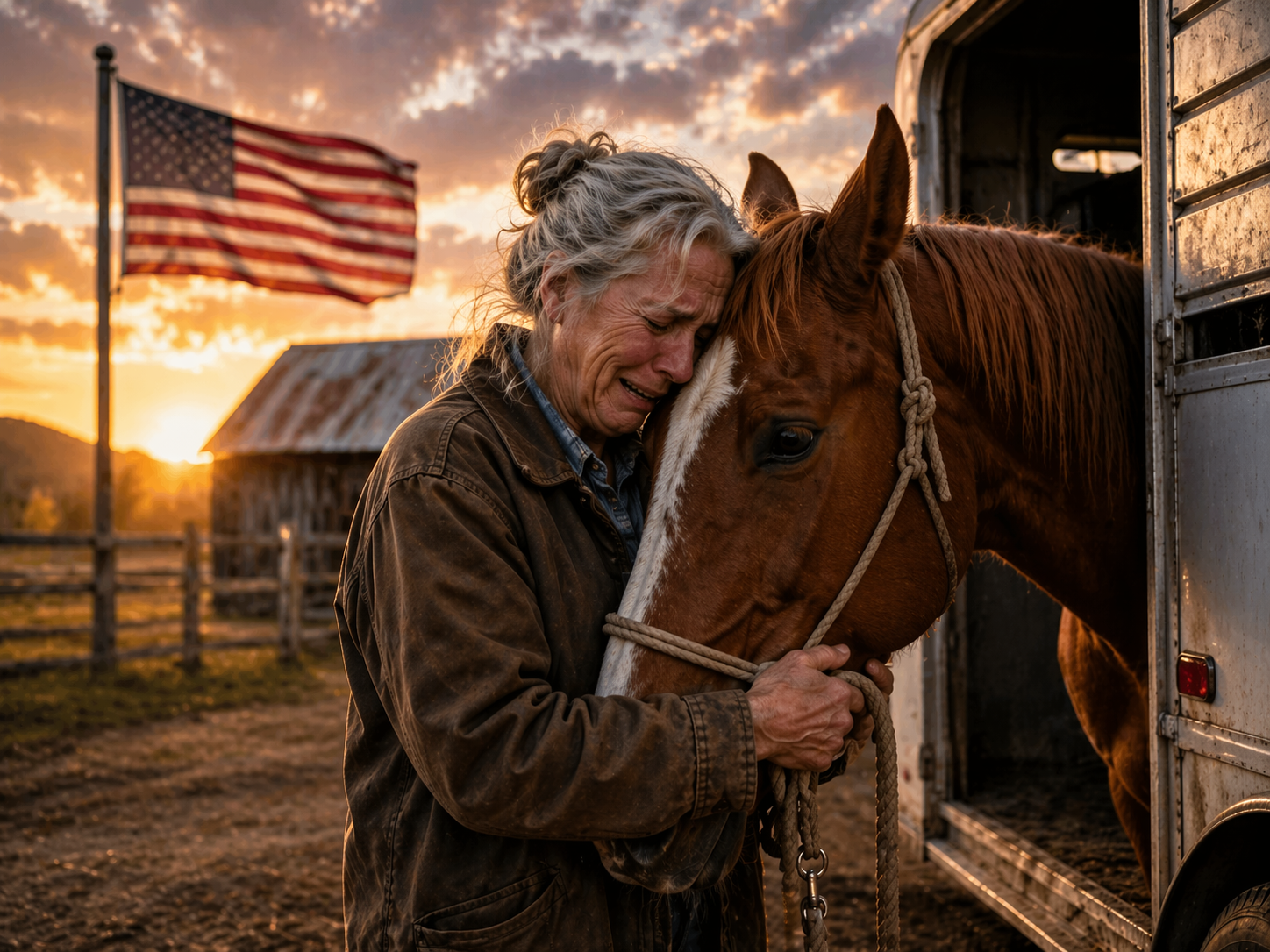
But I couldn’t sell Willow.
She had been his horse. A chestnut mare with a white streak down her nose and a stubborn streak to match. She used to follow him around the property like she understood every word he said. After he was gone, she stood by the fence for hours, staring toward the house. She barely ate for three days. I didn’t either.
We got through it the same way, I suppose—by staying.
Years passed. Quiet ones. The kind that stack up without you noticing until you look back and realize your life has shrunk into a handful of routines and a lot of empty space. My daughter called often, visited when she could, but she had her own life in Denver. I told her I was fine. People our age learn how to say that without meaning it.
It was her idea that I should ride again.
“Mom, it might help,” she said one afternoon over the phone.
“Help what?” I asked.
She didn’t answer right away.
“Everything,” she said softly.
I almost laughed. Grief doesn’t like being helped. It settles in like an old piece of furniture—you stop noticing it’s there, but you still walk around it every day.
Still, a week later, I found myself standing in the barn, staring at Willow like she might have an opinion about all this.
“You’re getting old too,” I murmured, running a hand along her neck.
She flicked her ear back at me, like she always did when she was listening.
“I suppose we both are.”
The first time I tried to climb onto her, my hands were shaking so badly I had to stop halfway and breathe. It wasn’t just the physical part. It was everything that came rushing back—the smell of hay, the creak of leather, the way the world looks from just a little higher off the ground.
“Easy, girl,” I whispered.
She stood perfectly still.
I pulled myself up, slower than I used to, less graceful than I wanted to admit. For a moment, I just sat there, not moving, letting the feeling settle in.
Then I gave the slightest nudge.
She started walking.
At first, it was fine. Just the two of us moving through the familiar paths around the barn, the fence line, the small hill that overlooked the back field. The air was cool, the kind of crisp that makes you feel like you’re waking up after a long sleep.
And then we reached the old fence.
The same one.
The same spot.
My chest tightened before I even understood why. My breath came short, sharp, like it had nowhere to go. The world tilted just a little, enough to make everything feel wrong.
“I can’t…” I whispered, gripping the reins tighter than I meant to.
The memory hit all at once—him on the ground, the stillness, the silence that followed.
“I can’t do this.”
I tried to guide her forward, to get past it, to prove to myself it didn’t have power over me anymore.
But Willow stopped.
Not slowed.
Stopped.
Completely.
I nudged her again.
Nothing.
“Come on,” I said, a little sharper this time.
She didn’t move.
I pulled the reins, frustrated now, embarrassed at how quickly everything was unraveling.
“Willow.”
Still nothing.
She stood there, solid as the earth beneath us, refusing to take another step.
And then something in me gave way. Not all at once, but enough.
I slid off her back, my legs weak, my hands trembling.
And as I stood there, trying to catch my breath, it hit me in a way I hadn’t expected.
She remembered.
Not the way we do, maybe. Not in pictures or words. But she knew this place mattered. She knew it wasn’t somewhere I should be forced through.
She had stopped for me.
Not because she couldn’t go on.
But because I couldn’t.
That was the first time I cried out there in years.
Winter came early that year, heavy and unforgiving. The kind of cold that settles into your bones and stays there. I moved slower. Everything did. The days felt shorter, quieter.
One evening, I stepped out onto the back porch to bring in some firewood. It was nothing unusual. Something I’d done a thousand times before.
I didn’t see the ice.
My foot slipped, and suddenly I was on the ground, the air knocked out of me in a way that made the world go white for a second. Pain shot through my hip, sharp and immediate.
I tried to sit up.
I couldn’t.
“Damn it…” I muttered, my voice thinner than I expected.
The cold seeped in fast. It always does when you’re not moving. The sky was already dimming, the last of the light fading behind the hills.
I tried to push myself up again.
Nothing.
That’s when it hit me—not the pain, but the realization.
There was no one there.
No one to hear me.
No one coming.
And for the first time since my husband died, a thought crept in that I hadn’t let myself think before.
Maybe this is it.
“Willow…” I called out, my voice barely carrying past the porch.
It felt foolish even as I said it. She was out in the pasture, too far away, too busy being a horse to notice something like this.
Still, I said it again.
“Willow…”
For a moment, there was nothing.
Just the quiet.
Then I heard it.
Hoofbeats.
Fast.
Closer.
I turned my head as much as I could.
She came running straight toward the house, her breath visible in the cold air, her movements sharp and urgent. She reached the fence, paced along it, snorting, restless.
“I’m here,” I whispered, relief washing over me in a way that almost hurt.
I reached out a hand toward her, though she was still too far.
“Help…”
I didn’t expect anything.
Didn’t expect understanding.
Didn’t expect action.
But she stopped.
Looked at me.
And then she turned and ran.
For a second, panic flared.
“No—come back,” I said, my voice breaking.
But she was already gone.
The yard fell silent again.
And I lay there, the cold creeping deeper, wondering if I had imagined the whole thing.
Ten minutes later, headlights cut through the dark.
A truck pulled up fast, tires crunching against the gravel.
My neighbor, Tom, jumped out, already halfway to me before the engine even stopped.
“Jesus, are you alright?” he said, kneeling beside me.
“How did you—”
“Your horse,” he said, breathless. “She came to my fence, wouldn’t stop slamming into it. I knew something was wrong.”
I closed my eyes for a second, the relief overwhelming.
“She came for you?” I whispered.
He nodded.
That night, lying in a hospital bed with the steady beep of machines around me, I stared at the ceiling and let the truth settle in.
She hadn’t left me.
She had gone to get help.
Recovery was slow. Pain has a way of teaching you patience whether you want to learn it or not. The doctor was kind, but firm.
“You should consider not riding anymore,” he said. “At your age, another fall could be serious.”
I nodded like I understood.
Like I agreed.
People start saying “at your age” a lot once you pass sixty. Like it explains everything. Like it decides things for you.
When I got home, Willow was waiting by the fence.
She had always waited.
Every morning, every evening, like she had nowhere else she needed to be.
I stood there for a long time, watching her.
“You deserve better,” I said quietly. “More than this.”
I had already made the call.
A younger family, a bigger property, people who could give her the life I wasn’t sure I could anymore.
It was the right thing to do.
At least, that’s what I told myself.
The trailer arrived two days later.
The man was polite, professional. He held the lead rope loosely, giving her space.
“Ready?” he asked.
I nodded, though my chest felt tight in a way I couldn’t explain.
I walked Willow up to him, my hand resting on her neck, memorizing the feel of her.
“Be good,” I whispered.
He gave a gentle tug on the rope.
“Come on, girl.”
Willow didn’t move.
He tugged again, a little firmer this time.
Still nothing.
“She’s just being stubborn,” he said with a small laugh.
“She always is,” I replied, though my voice didn’t quite match the words.
He stepped closer, trying again.
“Easy now.”
Willow shifted.
For a moment, I thought she would follow.
Instead, she stepped sideways.
Then turned.
And walked straight back to me.
Before I could react, she pressed her head against my chest, steady and warm, like she had done so many times before.
Just like she used to do with my husband.
My hands came up instinctively, holding her there.
And something inside me broke open.
“No,” I said, my voice shaking. “No… I’m not done.”
The man paused, looking between us.
“You sure?” he asked.
I took a breath, long and unsteady.
“Yeah,” I said. “I’m sure.”
He nodded, respectful, and stepped back.
“I’ll give you a minute.”
I didn’t need a minute.
I needed to stop lying to myself.
That evening, as the sun dipped low behind the hills, I led Willow out to the open field. The same one I had avoided for so long.
My heart pounded as I placed my foot in the stirrup.
“You’re going to have to help me,” I murmured.
She stood still.
Steady.
Waiting.
I pulled myself up, slower than before, careful of the pain that still lingered.
For a moment, I just sat there.
Breathing.
Remembering.
Afraid.
“Alright,” I whispered.
I gave the smallest nudge.
She took a step.
Then another.
We didn’t go far.
We didn’t need to.
The wind moved softly through the grass, the world quiet in a way that didn’t feel empty anymore.
And as we moved together, slowly, carefully, I realized something I hadn’t let myself believe before.
I wasn’t alone out there.
I hadn’t been for a long time.
People say animals don’t understand us.
That they don’t remember.
That they don’t choose.
But I’ve lived long enough to know better.
Some of them don’t just stay.
They watch you.
They wait for you.
They hold the pieces of you together when you start to fall apart.
And sometimes…
they refuse to let you give up—
even when you’re ready to.
![[FULL STORY] The Moment My Girlfriend Called Me Needy And Told Me She Would Call Whenever She Felt Like It Was The Day I Finally Set Myself Free](https://social-media.rabedo.com/thumbnails/1777877049_C3.JPG)
![[FULL STORY] At Breakfast My Dad Said They’d Booked Italy For Everyone Except Me. I Nodded. That Night I Got Bank](https://social-media.rabedo.com/thumbnails/1777187984_R17.png)