
“Yeah. Big event coming up.”
Mom nodded, but her eyes softened in that way mothers have when they know more than you have said. “You doing okay, honey?”
I opened my mouth to give the usual answer.
Fine.
Busy.
Everything’s good.
Instead, I looked through the kitchen window at the yard where I had grown up and said, “I don’t know.”
My father was in the doorway. He did not speak for a moment. Dad was not a man who rushed feelings. He turned them over like lumber, checking for cracks.
Finally he said, “A person who loves you can be proud of where they’re going without being ashamed of where you came from.”
I carried that sentence home with me like a stone in my pocket.
The charity ball became the thing that cracked everything open.
It was called the Magnolia Children’s Foundation Annual Governor’s Ball, though everyone just called it the charity ball. It was the biggest social event in the state outside political fundraisers. Every year, it raised money for rural pediatric clinics and mobile medical units. The governor attended. Business leaders attended. Cameras attended, which meant everyone else attended for the chance to be seen attending.
Madison had been obsessed with it for months.
She chaired the décor committee, then somehow became part of the executive planning circle. She talked about flower installations, donor walls, seating charts, media angles, and “optics” until the whole house seemed to vibrate with her ambition.
I did not mind.
Actually, I cared about this one.
Rural pediatric clinics mattered to me. My younger sister, Anna, had nearly died when we were kids because the nearest emergency pediatric specialist was two counties away. She survived because a mobile clinic happened to be visiting our area that week and the nurse recognized the symptoms fast enough to get her airlifted. Our family never forgot that.
So when the foundation’s finance director reached out months before the ball through one of my business partners, I listened.
They had lost a major corporate sponsor at the last minute. Quietly. The kind of loss that would embarrass the board if people found out. They needed a donor to underwrite the rural clinic expansion program, not just the ball. The number was large enough that most people would want a building named after them.
I asked what the money would do.
They sent me a proposal.
Three mobile pediatric units. Updated diagnostic equipment for clinics in five counties. Telehealth stations for schools. Transportation vouchers for parents who could not afford to drive two hours for follow-ups. Training grants for rural nurses.
I read the entire packet twice.
Then I wired the money through the Whitaker Family Rural Health Trust, a charitable fund I had set up after my company started doing well. I asked for anonymity until the event because I did not want Madison thinking I was trying to buy my way into her world.
That sounds foolish now.
At the time, I thought I was protecting her pride.
The foundation director, Evelyn Price, called me personally.
“Mr. Whitaker,” she said, voice thick with emotion, “this donation changes the next decade for us.”
“Use it well,” I said.
“We’d like to recognize you at the ball.”
“I’d rather keep it quiet.”
“At least let the governor know. This is significant.”
“If you need to for protocol, that’s fine. But I don’t want a fuss.”
She paused. “Your wife is on the planning committee, correct?”
“Yes.”
“Does she know?”
“No,” I said. “Not yet.”
Evelyn was quiet for another beat, polite enough not to ask the obvious question.
I should have told Madison.
I know that.
Secrets, even generous ones, have a way of growing teeth.
But every time I thought about mentioning it, she was busy criticizing my tie, my haircut, my posture, my way of speaking. I began to feel strange about handing her a truth that might suddenly make me useful again.
I wanted to see if she would choose me before she knew.
That was my mistake.
The week of the ball, Madison became unbearable.
She treated our home like a backstage dressing room and me like a piece of furniture that kept getting in the way. Dresses arrived in garment bags. Shoes came in boxes stacked near the staircase. Her friend Celeste practically moved into our kitchen with a laptop and three phones, managing seating arrangements like she was coordinating a royal wedding.
One evening, I came home from checking a warehouse site two hours away. I was tired, dusty, and hungry. Madison stood in the foyer wearing a champagne-colored dress that probably cost more than my first truck.
She looked stunning.
I said so.
She gave me a quick glance. “You’re tracking dirt.”
I looked down at my boots. “Sorry. Long day.”
Celeste, sitting at the kitchen island, gave a little laugh. Not loud, just sharp enough.
Madison’s cheeks colored. “Caleb, please. We have people coming over in twenty minutes.”
“I didn’t know.”
“I told you.”
“You told me you had a call.”
She exhaled, annoyed. “Same thing. Just go change.”
I went upstairs without arguing.
Through the bedroom vent, I heard Celeste say, “He’s sweet, I guess. Very… grounded.”
Madison laughed softly. “That’s one word for it.”
Celeste said, “You’re really bringing him Saturday?”
There was a pause.
Then Madison said, “I haven’t decided.”
I stood in the bedroom with one boot half-off, feeling something inside me go very still.
That night, after Celeste left, I asked Madison directly.
“Do you want me at the ball?”
She was at her vanity removing earrings.
“Of course,” she said, too quickly.
“Madison.”
She stopped. “What?”
“Tell me the truth.”
Her shoulders tightened. “I just don’t want you to feel uncomfortable.”
“That’s not what I asked.”
She turned around then, and for the first time, I saw not just irritation in her face, but resentment.
“Fine,” she said. “No, Caleb. I don’t know if I want you there.”
Even though I had expected it, hearing the words still hit hard.
“Why?”
“Because this event matters to me.”
“And I would ruin it?”
“I didn’t say that.”
“You didn’t have to.”
She stood. “You don’t understand how these things work. You think being nice and writing checks is enough, but it isn’t. There’s a way to behave, a way to talk, a way to fit into a room like that.”
I stared at her. “And I don’t fit.”
She rubbed her forehead. “You don’t try.”
“I run a company that does business in four states. I negotiate contracts with hospital networks and state agencies. I think I can survive a ballroom.”
“That’s not the same thing.”
“No,” I said quietly. “Apparently not.”
Madison’s voice lowered, but it did not soften. “I have worked too hard to be taken seriously just to spend the whole night managing people’s impression of my husband.”
There it was.
Not concern.
Embarrassment.
I nodded once. “Thank you for being honest.”
She looked startled, like she had expected me to fight. “Caleb—”
“No. I get it.”
“Don’t do that.”
“Do what?”
“Act wounded so I feel guilty.”
I almost laughed. “You think this is an act?”
She folded her arms. “I think you like playing the humble country boy because it makes everyone else seem shallow.”
I looked at my wife, really looked at her, and wondered when admiration had turned into contempt.
Then she said the sentence I would remember for the rest of my life.
“You are too small-town for my charity ball.”
My charity ball.
Not ours.
Not the foundation’s.
Hers.
I did not sleep much that night.
Madison did not apologize in the morning. She moved around the kitchen briskly, already on calls, already discussing floral arches and press placement. I drank my coffee and watched sunlight cut across the marble counters I had paid for.
At noon, she sent me a text.
Madison: I think it’s better if you skip Saturday. We’ll talk after.
I read it three times.
Then I called Evelyn Price.
“Mr. Whitaker,” she said warmly. “Are you ready for Saturday?”
“That’s why I’m calling.”
Her tone changed. “Is everything all right?”
“I will attend.”
“Wonderful.”
“But I need you to keep my involvement exactly as planned. No changes. No warning to my wife.”
A quiet pause.
“I understand,” she said carefully.
“I don’t think you do.”
“Perhaps not.”
I looked out my office window at trucks lining up by the loading docks. “Saturday night, when the governor recognizes the main donor, I want it done formally. Full name. No hiding.”
Another pause.
Then Evelyn said, “Mr. Whitaker, are you sure?”
“No,” I said honestly. “But do it anyway.”
Saturday arrived clear and bright.
Madison spent the entire day preparing as if she were going to war. Hair stylist at ten. Makeup at noon. Dress fitting at two. By four, the house smelled like perfume, hairspray, and anxiety.
I stayed out of her way.
At five-thirty, I showered, shaved, and put on a custom black tuxedo I had ordered weeks earlier. Not because Madison told me to. Because I had intended to stand beside my wife at an event that mattered.
When I came downstairs, Madison was in the foyer.
She wore a deep burgundy gown with a fitted bodice and a slit that revealed one leg when she moved. Diamonds at her ears. Hair swept back. Perfect.
For a second, the old instinct rose in me—the desire to tell her she was beautiful and mean it without pain underneath.
Then she saw me.
Her face changed.
“What are you doing?” she asked.
“Going to the ball.”
“I told you I thought it was better if you didn’t.”
“I heard you.”
“Caleb.”
The way she said my name was a warning.
I picked up my cufflinks from the console table. “Madison.”
“You can’t just show up.”
“I have a ticket.”
Her eyes narrowed. “From who?”
“The foundation.”
She gave a short, disbelieving laugh. “Why would the foundation send you a ticket?”
That was the moment I knew there was no going back.
I could have told her then. I could have spared her the public shock. I could have said, “Because I am the donor keeping your precious ball from collapsing.” Maybe a better man would have.
Instead, I said, “I suppose you’ll find out.”
Her expression hardened. “Don’t embarrass me tonight.”
I looked at her for a long second. “I was about to say the same thing.”
The car ride was silent.
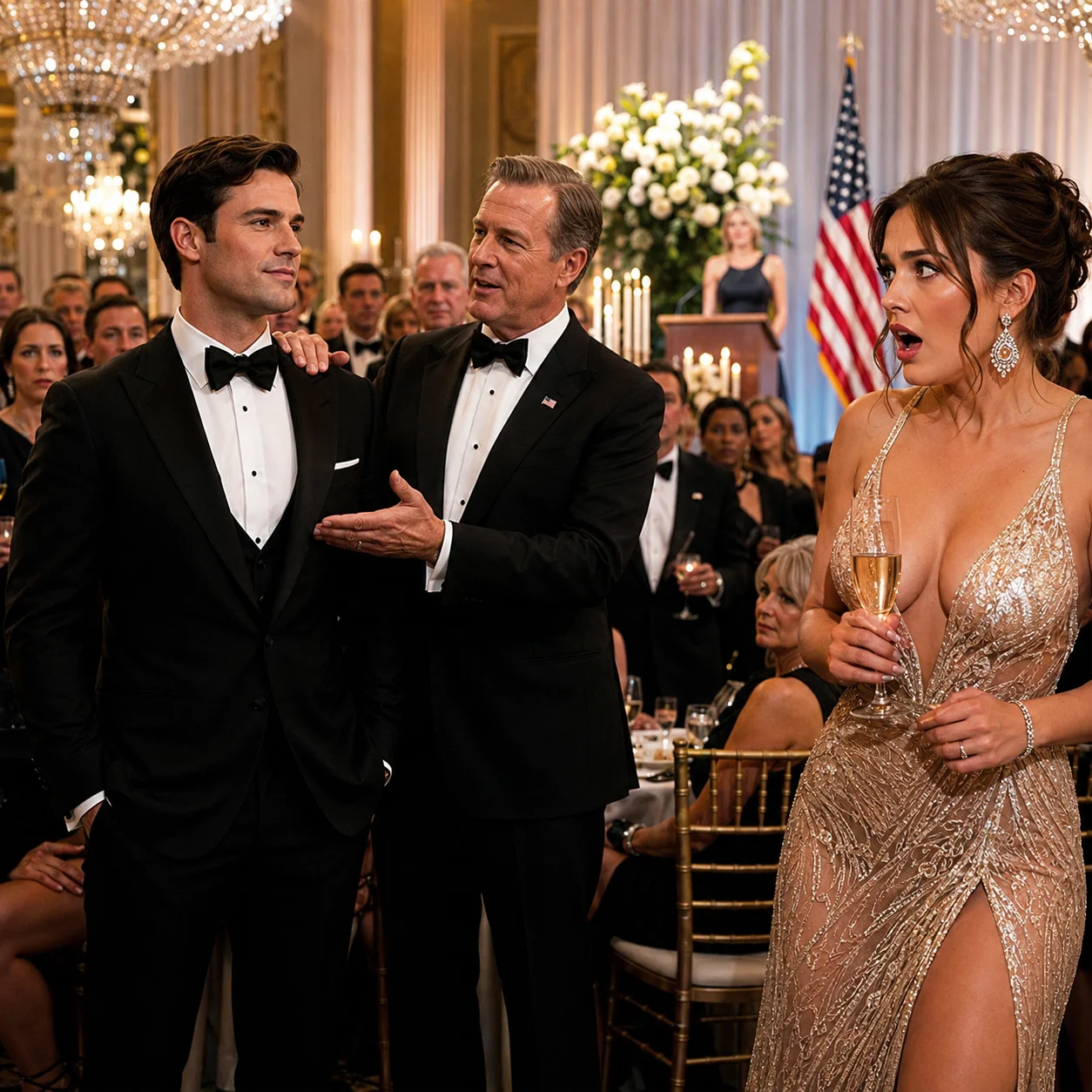
The ball was held at the Harrington Grand Hotel, an old limestone building downtown with gold elevators, crystal chandeliers, and a lobby full of people pretending not to look at one another while looking at everything. Photographers stood near a wall of white roses. Women in gowns floated across the marble floor. Men in tuxedos laughed too loudly beside donor banners.
Madison transformed the second we stepped inside.
Her spine straightened. Her smile appeared. Her hand slipped from my arm so smoothly no one else would have noticed.
But I noticed.
Celeste rushed over in silver satin, air-kissing Madison on both cheeks.
“You look incredible,” Celeste said. Then her eyes flicked to me. “Oh. Caleb. You came.”
“I did.”
“How… nice.”
Madison’s smile tightened. “We’re just going to check in.”
At the registration table, a young volunteer looked up.
“Name?”
Before I could answer, Madison said, “Madison Whitaker. Planning committee.”
The volunteer checked a list and handed her a packet. “Of course, Mrs. Whitaker. You’re seated at table four.”
Madison glanced at me, then back at the volunteer. “And my guest?”
The volunteer checked again. “I’m sorry, I don’t see a guest listed under your name.”
Madison’s face flushed, not with embarrassment for me, but annoyance that the inconvenience existed.
I reached into my jacket and handed over my own invitation.
The volunteer looked at it.
Then looked up.
Her posture changed immediately.
“Oh. Mr. Whitaker. Yes, sir. Welcome. We have you at table one.”
Madison blinked. “Table one?”
The volunteer smiled professionally. “Yes, ma’am.”
“That must be a mistake,” Madison said.
The volunteer hesitated. “I don’t believe so.”
I accepted my packet. “Thank you.”
Madison grabbed my arm once we stepped away. Her nails pressed lightly through my sleeve.
“What is going on?”
“I’m attending the ball.”
“At table one?”
“Apparently.”
“Caleb, this is not funny.”
“No,” I said. “It really isn’t.”
Across the lobby, Evelyn Price spotted us. She was a poised woman in her fifties with silver-blond hair and the calm authority of someone who had spent years asking wealthy people for money without losing her dignity.
She came directly to me with both hands extended.
“Mr. Whitaker,” she said warmly. “I’m so glad you’re here.”
Madison’s eyes sharpened.
“Evelyn,” she said, stepping in with a bright smile. “Everything looks wonderful.”
“It does,” Evelyn said politely. “Your committee did beautiful work.”
Madison waited for more praise.
Evelyn turned back to me. “The governor arrived ten minutes ago. He’s looking forward to speaking with you before dinner.”
Madison went very still.
“The governor?” she asked.
Evelyn looked between us, realizing perhaps that the evening had already become more complicated than she wanted.
“Yes,” she said. “There are a few people he wanted to greet personally.”
Madison laughed lightly. “Caleb, did you meet him through a trucking contract or something?”
The words were dressed as a joke, but they landed ugly.
Evelyn’s expression cooled by one degree.
I said, “Something like that.”
We moved into the ballroom.
It was beautiful. I had to give Madison that. White flowers climbed the columns. Candles flickered along mirrored tables. A stage had been set at the front with the foundation logo projected behind the podium. Along one wall stood large displays showing photographs of children in rural clinics, nurses unloading supplies from vans, parents sitting in waiting rooms with tired faces and hopeful eyes.
I stopped in front of one photo longer than the others.
A little girl in a pink coat sat on an exam table while a doctor listened to her lungs. She looked about six. Same age Anna had been.
Madison noticed me looking and mistook my silence for discomfort.
“Just stay near me during cocktail hour,” she murmured. “And please don’t start telling people about your hometown unless they ask.”
I turned to her slowly.
“Madison, do you hear yourself?”
She smiled at someone over my shoulder while whispering through her teeth. “Not now.”
That was the theme of our marriage by then.
Not now.
Not here.
Not in front of these people.
As if respect were something she could postpone until we were alone.
Cocktail hour became a performance.
Madison introduced me selectively and vaguely.
“This is my husband, Caleb.”
Not Caleb Whitaker, founder of Whitaker Regional Logistics.
Not Caleb, who helped secure the emergency shipping for last year’s flood relief.
Not Caleb, whose family trust had just saved the foundation’s expansion program.
Just Caleb.
And sometimes, when she thought she could get away with it, she added things like, “He’s from a tiny town outside Knoxville,” as if she were explaining a charming defect.
One man in a navy tuxedo asked what I did.
Before I could answer, Madison said, “Transportation. Rural routes mostly.”
The man nodded with polite disinterest.
I smiled. “That’s part of it.”
Madison stepped lightly on my shoe.
I did not react.
Then Celeste drifted over with two women I recognized from Madison’s social media posts.
“Madison,” Celeste said, already tipsy, “we were just talking about how far you’ve come. I mean, remember when you first married Caleb and we all thought you were going to disappear into some little town and start canning peaches?”
The women laughed.
Madison laughed too.
I looked at her, waiting.
She did not defend me.
Celeste touched my arm. “No offense, Caleb. You know what I mean.”
“I usually do,” I said.
Madison shot me a warning look.
Celeste tilted her head. “Oh, don’t be sensitive. Small towns are adorable.”
I said, “So are people who confuse cruelty with sophistication.”
The laughter died.
Madison’s face went pale with fury.
Celeste blinked. “Excuse me?”
“You’re excused,” I said.
I walked away before Madison could stop me.
At table one, I found my name card between Evelyn Price and a retired pediatric surgeon named Dr. Helena Morris. The governor’s seat was two chairs away. Madison’s table, I noticed, was across the room near the side—not bad, but not central.
She saw it too.
When she approached, her smile was sharp enough to cut glass.
“Caleb,” she whispered, “we need to talk.”
“We’ve needed to talk for months.”
“Not here.”
“There it is again.”
Her eyes flashed. “You are making a scene.”
“I’m sitting at my assigned table.”
“You know exactly what I mean.”
Before I could answer, a man’s voice said, “Mr. Whitaker?”
Madison turned.
Governor Alan Reeves stood behind us with two aides nearby. He was taller than I expected, silver-haired, camera-ready, with the practiced warmth of a politician who had shaken a hundred thousand hands and remembered just enough names to be dangerous.
He extended his hand.
“Caleb Whitaker. Finally good to meet you.”
I shook his hand. “Governor.”
Madison froze beside me.
The governor smiled at her. “And you must be Mrs. Whitaker.”
Madison recovered quickly. “Governor Reeves, it’s an honor. Madison Whitaker. I’m on the planning committee.”
“Yes, I know,” he said. “You and your team did excellent work.”
She glowed. “Thank you.”
Then he turned back to me.
“I was just telling Evelyn that men like you make public service easier. We can approve programs all day, but without private partners who understand rural communities, too many families fall through the cracks.”
Madison’s smile faltered.
The governor continued, “I grew up in a town not much bigger than yours. People forget small towns until election season or disaster season. You didn’t.”
I felt Madison looking at me.
“Thank you,” I said. “This cause is personal.”
“So I heard,” he said. “Your sister’s story moved my staff quite a bit.”
Madison’s lips parted.
She had never asked much about Anna’s medical scare beyond the version suitable for dinner conversation.
Then came the sentence that ended the marriage I thought I still had.
The governor glanced at Madison, friendly and confused, and said, “I have to admit, Mrs. Whitaker, I was surprised not to see your husband more involved publicly, considering he’s the main donor tonight. Is there a reason you kept him hidden?”
The ballroom did not go silent.
Real life is worse than that.
People kept laughing. Glasses kept clinking. Music kept playing softly from the quartet near the windows.
But in the small circle around us, silence dropped like a curtain.
Madison stared at the governor as if he had spoken another language.
“Main donor?” she repeated.
Governor Reeves looked from her to me, realizing he had stepped into something personal.
Evelyn appeared at his side, graceful but tense.
“Mr. Whitaker’s family trust underwrote the rural clinic expansion,” she said carefully. “It’s the largest private gift the foundation has received in six years.”
Madison turned to me.
For once, she had no polished expression ready.
“You?” she whispered.
I said nothing.
Celeste had drifted close enough to hear. So had two board members, Madison’s committee friend Elise, and the navy tuxedo man who had dismissed “transportation.”
The governor, trying to recover, said, “Well, we’ll be recognizing him during the program. A remarkable contribution.”
Madison’s face changed in stages.
Confusion.
Shock.
Humiliation.
Then something colder.
Not remorse.
Calculation.
She stepped closer and lowered her voice. “Why didn’t you tell me?”
I looked at her. “Would it have changed how you treated me?”
“That’s not fair.”
“No,” I said quietly. “It’s not.”
Evelyn touched my elbow. “Mr. Whitaker, they’re ready for photos with the governor.”
Madison immediately shifted. “Of course. Caleb, we should—”
I gently removed my arm from her reach.
“I think they asked for me.”
The words were not loud.
They did not need to be.
Madison stood there while I walked to the donor photo area beside the governor, Evelyn, Dr. Morris, and three clinic directors from rural counties. Cameras flashed. The governor shook my hand again. One of the clinic directors, a woman named Teresa Hall, gripped my hand with both of hers and said, “My county has been begging for mobile equipment for nine years. You have no idea what this means.”
“I might,” I said.
Her eyes softened. “Then thank you.”
For the first time that night, I felt like I belonged in that room.
Not because of the tuxedo.
Not because of the governor.
Because the work mattered, and I had helped make it possible.
Dinner began.
Madison did not sit at her assigned table. Somehow, she managed to get herself moved beside me, displacing a junior board member who looked terrified to refuse her. She sat down with a bright smile that fooled everyone except me.
“Caleb,” she said softly, “we need to present a united front.”
I looked at the salad plate in front of me, then at her.
“A united front?”
“People are watching.”
“They have been all night.”
Her jaw tightened. “Please don’t punish me publicly.”
I almost laughed at the blindness of it.
“You punished me publicly for years. You just called it etiquette.”
Her eyes shone, but I did not know if it was emotion or anger.
“I made mistakes,” she whispered.
“No,” I said. “You made choices.”
The program started before she could respond.
Evelyn spoke first. She talked about the foundation’s mission, about children born far from major hospitals, about parents choosing between gas money and medication, about nurses doing heroic work with outdated equipment. Then Dr. Morris spoke about preventable emergencies and the quiet dignity of rural families who were used to being told to wait.
I listened with my hands folded, throat tight.
Then the governor took the stage.
He was good at this part. Warm. Measured. Convincing. But when he spoke about rural communities, there was something genuine in his voice.
“Tonight,” he said, “we recognize not only generosity, but memory. The kind of memory that does not forget where it came from.”
Madison stared straight ahead.
The governor continued. “Our leading donor this evening asked for no spotlight. In fact, he resisted it. But the scale of this gift, and the lives it will touch, deserve public gratitude.”
A screen behind him changed to show the Whitaker Family Rural Health Trust logo.
Around the room, heads turned.
I heard Celeste inhale sharply.
“Thanks to a transformative donation from Caleb Whitaker and the Whitaker Family Rural Health Trust,” the governor said, “the Magnolia Children’s Foundation will launch three new mobile pediatric units, expand diagnostic access across five rural counties, and provide transportation support for families who have too often been left behind.”
Applause rose.
At first, it felt distant.
Then Evelyn touched my arm and whispered, “Stand.”
I stood.
The applause grew louder.
People turned in their chairs. Some smiled. Some looked stunned. Some looked like they were recalculating every dismissive thought they had ever had about me.
Madison remained seated beside me, clapping mechanically, her face pale under perfect makeup.
The governor gestured toward me. “Mr. Whitaker, would you join me?”
I walked to the stage.
I had negotiated contracts worth millions. I had spoken at industry conferences. I had stood in warehouses during storms and made decisions with trucks stranded across three states. But standing under those lights with my wife watching from below, I felt more exposed than I ever had.
The governor shook my hand and handed me a glass award.
“Say a few words,” he murmured.
I had not planned to.
I looked out at the ballroom.
At Madison.
At Celeste.
At the donor wall.
At the photos of children who deserved better than being reduced to social currency by people in expensive clothes.
Then I leaned toward the microphone.
“My sister Anna was six when she got sick,” I said. “My parents knew something was wrong, but the nearest specialist was too far away, and like a lot of rural families, they were used to being told to wait. A mobile clinic nurse saw her that day and decided waiting was not good enough.”
The room was quiet now.
“That nurse saved my sister’s life. Not because our family was important. Not because our town was impressive. Not because anyone there knew the right people. She saved Anna because every child deserves medical care close enough to reach them in time.”
I paused.
“My hometown is small. The roads are rough in places. The diner still closes early on Sundays. People know your business whether you want them to or not.”
A few people chuckled softly.
“But small does not mean insignificant. Rural does not mean backward. And where someone comes from should never be mistaken for the size of what they can give.”
Madison looked down.
I did not say it for her.
But I knew she heard it.
“I’m grateful to help this foundation reach families like mine. And I hope everyone in this room remembers that charity is not about being seen caring. It’s about caring when no one sees.”
When I stepped back, the applause was different.
Not louder, exactly.
Deeper.
Afterward, people came to speak with me.
Clinic directors. Board members. Business owners. A state senator. A hospital executive who wanted to discuss logistics for distributing equipment. People asked about my company, my hometown, my sister. They listened when I answered.
Madison hovered nearby, trying to slide back into position beside me.
Each time someone praised the donation, she smiled as if she had known all along.
“My husband is very private,” she said once.
I looked at her. “That’s true.”
She glanced at me, relieved.
Then I added, “Though lately, privacy and exclusion have become easy to confuse.”
The woman speaking with us looked politely away.
Madison’s smile trembled.
By the time dessert was served, she was unraveling.
Not publicly. Madison would never give people that satisfaction. But I knew her tells. The tight grip on her champagne flute. The quick blinking. The way she laughed half a second too late.
On the ride home, she finally broke.
“You humiliated me.”
I looked out at the city lights passing over the windshield.
“That’s what you want to talk about?”
“You let me walk into that room not knowing.”
“You told me not to come.”
“I was trying to protect my reputation.”
“At least you’re honest tonight.”
She turned toward me. “You enjoyed it.”
“No,” I said. “That’s the worst part. I didn’t.”
She scoffed. “Please.”
I faced her then. “Do you think I wanted my wife to be shocked that I mattered? Do you think I wanted to stand in a ballroom and realize strangers were more willing to respect me than the woman who promised to love me?”
Her anger flickered.
“Caleb—”
“You were embarrassed by my boots. My accent. My parents. My hometown. You turned my life into something you had to edit out of yours.”
“I was under pressure.”
“From who?”
She opened her mouth.
No answer came.
I nodded. “Exactly.”
When we got home, Madison followed me into the kitchen.
“I made mistakes,” she said again, softer now.
I took off my cufflinks and set them on the counter. “Why did you marry me?”
Her face crumpled slightly. “Because I loved you.”
“Loved?”
“Love,” she said quickly. “I love you.”
“What do you love about me?”
She seemed offended by the question. “Caleb.”
“What do you love?”
“You’re kind. You’re stable. You’re generous.”
“Those are benefits.”
“That’s not fair.”
“You keep saying that.”
She wrapped her arms around herself. “I loved that you were different from the men I grew up around. You were real. You didn’t play games. You made me feel safe.”
“And then you punished me for being exactly that.”
Tears filled her eyes. “I got caught up.”
“No. You got ashamed.”
She started crying then, the careful kind at first, then harder when she realized careful would not work.
“I don’t want to lose you,” she said.
I wanted that sentence to move me the way it once would have.
It didn’t.
Or rather, it moved something old in me, something tired and tender, but not enough to overcome what I had seen.
“Madison,” I said, “you didn’t start wanting me back until other people wanted to know me.”
“That’s not true.”
“It is.”
She stepped closer. “We can fix this.”
“Maybe.”
Hope flashed in her eyes.
“But not tonight,” I said. “And not like this.”
I moved into the guest room.
For three days, Madison became the wife I remembered.
Coffee made before I came downstairs. Soft apologies. Texts asking if I needed anything. She called my mother and left a voicemail saying she missed her biscuits. She suggested visiting my hometown that weekend.
It might have worked if it had been grief.
But it felt like strategy.
On Wednesday, Celeste called me.
I almost did not answer.
Curiosity won.
“Caleb,” she said, voice sugary and nervous. “I just wanted to clear the air. I think things got awkward at the ball, and I would hate for you to think I don’t respect you.”
“I don’t think about you enough to hate anything.”
Silence.
Then, “Right. Well. Madison is devastated.”
“I’m sure.”
“She really does love you.”
“Did she ask you to call?”
A pause too long.
“No.”
“Goodbye, Celeste.”
I hung up.
That afternoon, Evelyn Price sent a handwritten note to my office, thanking me again and enclosing photos from the ball. In one picture, I stood beside the governor shaking hands. In the background, slightly out of focus, Madison watched with an expression I could not name.
Not love.
Not pride.
Maybe fear.
That evening, I asked Madison to sit with me in the living room.
She arrived wearing jeans and one of my old university sweatshirts, a costume of humility.
I hated that I noticed.
“I’m not making any decisions tonight,” I said. “But I need to say some things clearly.”
She nodded, eyes wet already.
“I won’t be hidden again. Not at your events, not in your friendships, not in your version of our life.”
“I know.”
“I won’t let you treat my family like a quaint inconvenience.”
“I won’t.”
“And I won’t stay married to someone who only respects me when the room approves of me first.”
She flinched.
I placed a folder on the coffee table.
Her eyes dropped to it.
“What is that?”
“Information for a marriage counselor. And a separate consultation with an attorney.”
Her face drained. “An attorney?”
“I’m not filing today. But I need to understand what separation would look like.”
“Caleb, please.”
“This is not punishment. This is reality.”
She covered her mouth.
I continued, “If we try counseling, it will not be to teach me how to fit into your world. It will be to find out whether you are capable of respecting mine.”
She nodded quickly. “I am.”
“I hope so.”
But hope, I had learned, was not a plan.
We started counseling the next week.
For the first two sessions, Madison performed.
She cried beautifully. She used words like “pressure,” “identity,” “social anxiety,” and “unresolved insecurity.” All of them may have been true. None of them changed what she had done.
The counselor, a calm woman named Dr. Patel, listened carefully before asking one simple question.
“Madison, when did you first decide Caleb was someone you needed to manage rather than someone you needed to honor?”
Madison went silent.
For almost a minute, no one spoke.
Then she said, “When people started assuming I married down.”
The words sat in the room like smoke.
I looked at her.
She would not look at me.
Dr. Patel asked, “Did Caleb make you feel that way, or did other people?”
Madison whispered, “Other people.”
“And who paid the price?”
Madison began to cry.
Not pretty tears this time.
Real ones.
Mine came later, in the truck on the way home, where she could not see them.
For a while, I thought maybe we could rebuild.
Madison visited my parents and apologized. My mother accepted with grace but not warmth. My father shook her hand instead of hugging her. That hurt Madison more than anything, I think.
She came with me to my hometown and tried. She sat at the diner. She listened more than she spoke. When Mrs. Colby asked if she still liked cinnamon rolls, Madison cried right there by the counter.
But shame is not the same as change.
Three months after the ball, I found out Madison had been telling people we were “stronger than ever” and that the whole donor reveal had been “a funny misunderstanding.” She gave an interview to a local lifestyle magazine about the ball and described herself as “part of the team that helped secure transformative rural health funding.”
She did not name me once.
I read the article at six in the morning with coffee going cold beside me.
When Madison came downstairs, I slid the magazine across the counter.
She looked at it, then at me.
“I can explain.”
Those three words exhausted me more than anger ever could.
I said, “I know you can.”
Her lips trembled. “The editor cut things.”
“Did the editor add that line about you securing funding?”
She looked down.
There it was.
The end did not arrive like thunder.
It came quietly, with sunlight on marble counters and my wife unable to answer a simple question.
I moved out two weeks later.
Not dramatically. No yelling. No thrown clothes. I leased an apartment downtown near my office and packed what mattered. Madison cried in the doorway while movers carried boxes past her.
“Are you filing?” she asked.
“Yes.”
She gripped the doorframe. “So that’s it?”
I looked around the house we had built on appearances and avoidance.
“No,” I said. “That was it a long time ago. This is just me finally admitting it.”
The divorce took seven months.
Madison fought at first, mostly over the house, then over public perception, then over things she did not even want because losing gracefully was not a skill she had practiced. But the house had been purchased mostly with premarital assets and protected through agreements her father had once praised as “sensible planning.” In the end, she received a fair settlement, enough to start over comfortably, but not enough to maintain the fantasy that my life had been small and hers had made it bigger.
The charity foundation continued its work.
I stayed involved, but quietly when I could. The first mobile pediatric unit launched in Anna’s name. My sister, now a pediatric nurse herself, cut the ribbon outside a rural school while my parents stood beside me trying not to cry.
Governor Reeves attended that one too, but there were no chandeliers, no champagne, no women in gowns measuring one another’s worth.
Just kids climbing into a bright clean medical van, nurses organizing supplies, parents asking questions, and my mother holding my hand like I was still ten years old.
After the ceremony, my father looked at the mobile unit and said, “That’s better than any ballroom.”
He was right.
A year after the divorce, I ran into Madison at a café downtown.
She looked different. Still beautiful, but less polished at the edges. Her hair was shorter. Her clothes simpler. She was alone, reading something on her tablet. When she saw me, she stood too quickly.
“Caleb.”
“Madison.”
For a moment, we were two people standing in the wreckage of who we had been.
She smiled sadly. “You look good.”
“You too.”
“I saw the article about the mobile unit in Anna’s name. That was beautiful.”
“Thank you.”
She looked down at her coffee. “I wanted to write to your parents, but I didn’t know if I had the right.”
“They’d read it.”
She nodded.
Then she said, “I’m sorry.”
No performance this time. No tears. No audience.
Just the words.
“I know I said that before,” she continued. “But back then, I think I was sorry I got exposed. Now I’m sorry I became the kind of person who needed exposing.”
That landed somewhere deep.
I did not forgive everything in that moment. Life is not that clean. But I believed her more than I had in a long time.
“Thank you,” I said.
She swallowed. “Were we ever real?”
I thought about the girl in my pickup with her feet on the dashboard. The woman who made biscuits badly with my mother and laughed until flour dusted her cheek. The wife who later looked at me like I was an accent she wanted to erase.
“Yes,” I said. “At first.”
Her eyes shone.
“What happened?”
I looked through the café window at people moving along the sidewalk.
“You started loving the version of yourself you thought other people admired more than the life we actually had.”
She closed her eyes briefly.
“That’s fair.”
“I wish it wasn’t.”
She gave a small, broken laugh. “Me too.”
We parted gently.
No hug.
No promise.
No door left open.
Just peace where bitterness used to be.
Two years after the charity ball, the foundation held another gala. Evelyn invited me, as she always did. This time, I attended with no wife to hide me and no anger to prove anything.
I wore a tuxedo, shook hands with donors, spoke briefly about rural healthcare, and left before dessert because my niece had a school play the next morning in my hometown.
As I walked out through the hotel lobby, I passed a group of young committee members posing near the flower wall. One of them glanced at my boots—polished black, formal, but still boots—and whispered something to her friend.
I almost smiled.
Outside, my truck waited beneath the valet lights between a black Mercedes and a silver Bentley.
The valet handed me my keys and said, “Have a good night, Mr. Whitaker.”
I tipped him well and drove away from the chandeliers, out of the city, toward dark roads, open fields, and the little town my wife once thought made me small.
The truth was, I had spent years trying to prove I could belong in her world.
But I never needed to.
The people who mattered had always known exactly who I was.
And the place Madison looked down on had taught me the one thing no ballroom ever could: a man’s worth is not measured by how well he fits into a room full of people pretending to be bigger than they are.
It is measured by what he carries with him when he walks out.

![[FULL STORY] My girlfriend introduced me as the "janitor" to 50 guests in my own mansion, unaware I just signed a seven-figure cyber-security deal.](https://social-media.rabedo.com/thumbnails/1777363022_2.png)



![[FULL STORY] She Said “I’m Not in Love With You” — So I Became the Most Efficient Roommate She’d Ever Had](https://social-media.rabedo.com/thumbnails/1776660960_5dec6338-263c-4f3a-8a40-32d371e2b5ce.png)