Meredith drifted up beside him, wearing a silver dress and the kind of expression that suggested she had never once worried about a bill arriving before a paycheck.
“Did Cassandra tell you about the gift table?” she asked me.
“No.”
“Oh, it’s in the library. Daddy’s friends went a little overboard this year.”
Grant leaned closer. “You should see the Cartier box from Uncle Richard. It has its own gravitational pull.”
Cassandra laughed.
I smiled politely.
The envelope in my jacket felt heavier.
For the first hour, I did what I always did at Whitmore events. I listened more than I spoke. I answered questions carefully. I accepted small insults disguised as curiosity.
“So what is it you do again?”
“Property restoration and acquisitions.”
“Oh, like contracting?”
“Not exactly.”
“Do you flip houses?”
“Sometimes.”
“How entrepreneurial.”
That word always sounded different coming from people who inherited money. When they said entrepreneurial, they meant unstable.
Cassandra floated through the room, glowing under her family’s approval. She looked beautiful, and for a while I let myself remember why I had fallen for her. She laughed with her whole face. She touched my back when she passed me. Once, when no one was watching, she leaned close and whispered, “You okay?”
I nodded.
Then Grant raised his glass and said it was time for gifts.
Everyone moved toward the library.
The Whitmore library was my favorite room in the house, though I had never said that out loud. Dark wood shelves, leather chairs, a huge fireplace, framed maps, and French doors leading to the back terrace. But that night, the room had been turned into a stage.
A long antique table near the windows was covered in gifts.
Not normal birthday gifts. Not sweaters, books, or bottles of decent whiskey. These were status declarations wrapped in paper.
A rare signed first edition from a senator. A platinum fountain pen. A set of antique cufflinks. A framed invitation to some private golf retreat in Scotland. A watch box. A crystal decanter older than half the people in the room. Someone had even given Harold a model of a building he had once tried to buy, mounted under glass.
Cassandra saw my eyes move across the table.
She leaned close. “This is what I meant.”
“I know what you meant.”
Her jaw tightened. “Daniel, please tell me you brought something else.”
“I brought what I brought.”
She closed her eyes for half a second.
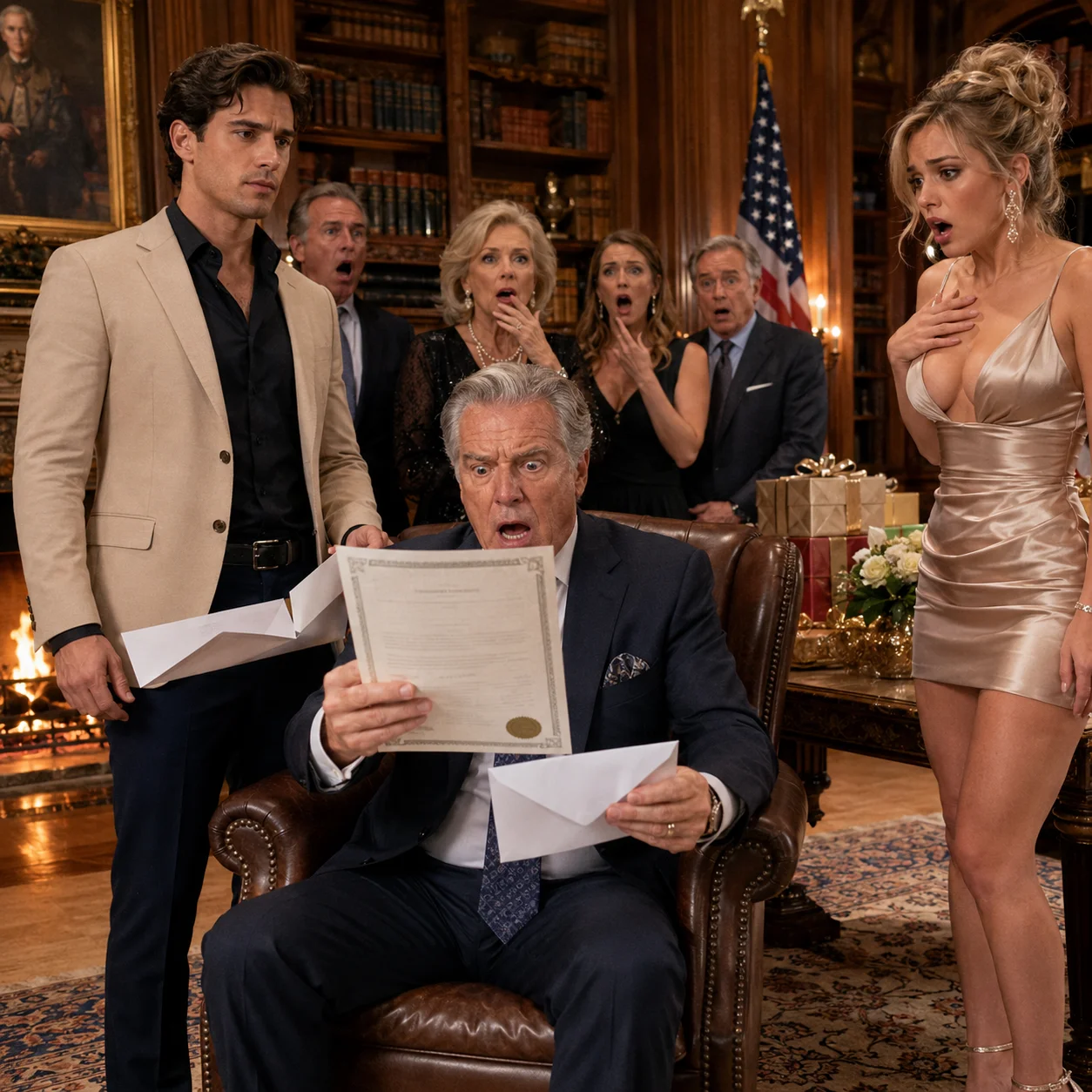
Harold sat in the large leather chair near the fireplace while everyone gathered around. Evelyn stood beside him, naming each gift and who it came from like she was announcing donations at a museum gala.
The first few gifts drew polite applause.
Harold smiled. Nodded. Made dry comments. Everyone laughed at the right moments.
Then Meredith gave him a handcrafted chess set from Italy. Grant gave him a trip package to a private fishing lodge in Montana. Evelyn presented him with a restored pocket watch that had belonged to his grandfather.
The room softened at that one.
For a brief moment, Harold looked genuinely moved.
Then Evelyn’s eyes landed on me.
“And Daniel,” she said.
The room turned.
Cassandra’s shoulders stiffened beside me.
I reached into my jacket and took out the envelope.
It looked even plainer under the chandelier light.
A few people smiled before they could stop themselves.
Grant’s eyebrows rose.
Meredith actually covered her mouth, not to hide shock, but laughter.
I walked forward and handed the envelope to Harold.
“Happy birthday, Mr. Whitmore.”
He took it and glanced at the front.
No one spoke for one long second.
Then Grant said, “Careful, Dad. Might be a gift card.”
A ripple of laughter moved through the room.
Cassandra’s face flushed.
Meredith tilted her head. “To where? Home Depot?”
More laughter.
I felt Cassandra’s fingers dig into my sleeve.
Evelyn gave a soft, elegant laugh. “Now, now. Sometimes the smallest gifts are the most heartfelt.”
It should have sounded kind. It didn’t.
Someone near the back murmured, “Maybe it’s a handwritten coupon.”
Grant lifted his glass. “One free oil change.”
The laughter got louder.
Cassandra looked at me, and for one heartbreaking second, I thought she might defend me.
Instead, she smiled tightly at the room.
“I told him not to be too practical,” she said.
That was the moment something inside me went quiet.
Not angry. Not yet.
Just quiet.
Because there it was. Clear as glass. When the room laughed at me, Cassandra did not stand beside me. She stepped away without moving.
Harold turned the envelope in his hands.
To his credit, he wasn’t laughing. His expression had changed slightly. Not suspicious, exactly. More curious. Like something about my handwriting or the weight of the envelope had touched a memory.
He slipped a finger under the flap and opened it.
Grant was still smiling when Harold pulled out the folded document.
The room began to settle, mostly because watching someone read legal paperwork is rarely entertaining.
Harold unfolded the papers.
His eyes moved over the top page.
Then stopped.
The smile left his face.
Completely.
The room changed before anyone knew why. It happened in layers. Harold’s posture straightened. Evelyn’s smile faltered. Grant stopped mid-sip. Cassandra looked from her father to me, then back again.
Harold turned to the second page.
His hand tightened slightly.
“Daniel,” he said.
His voice was different.
“Yes, sir.”
He looked up at me slowly. “Where did you get this?”
The room went still.
Grant frowned. “What is it?”
Harold didn’t answer him.
His eyes stayed on mine.
“Where did you get this?” he repeated.
“I bought it.”
Evelyn let out a small laugh, brittle and confused. “Bought what?”
Harold lowered the papers just enough for her to see the heading.
She leaned in.
Her face went pale.
Grant stepped forward. “Dad?”
Harold swallowed once.
“It’s the deed,” he said.
No one moved.
Meredith laughed nervously. “The deed to what?”
Harold looked at his family.
“To this house.”
The silence that followed was so complete, I could hear the logs shifting in the fireplace.
Cassandra’s hand slipped off my arm.
Grant stared at me like I had changed species in front of him.
“That’s not possible,” he said.
I said nothing.
Harold looked back down at the document. “This is a recorded quitclaim transfer from Ashbourne Holdings.”
“Yes.”
His eyes sharpened. “You own Ashbourne Holdings?”
“No,” I said. “I own the trust that acquired its residential assets.”
Grant laughed once, hard and fake. “Okay, this is ridiculous.”
Evelyn grabbed the papers from Harold’s hand, scanning them with increasing panic. “Harold?”
He didn’t look at her.
Cassandra whispered, “Daniel, what is going on?”
For the first time that evening, everyone waited for me to speak.
I could have made it cruel. I had more than enough ammunition. I could have reminded them of every comment, every laugh, every little performance of superiority. But the truth was, I hadn’t bought the deed to humiliate them.
I bought it because Harold Whitmore was about to lose his home.
And none of his children knew.
I looked at Harold. “I need to know how much you want said in front of everyone.”
That changed his face more than the deed had.
Because suddenly, he knew I knew everything.
Evelyn lowered the papers.
“Harold,” she said carefully. “What is he talking about?”
Harold’s jaw worked.
Grant looked irritated now, not frightened. “Dad, this is obviously some misunderstanding. There’s no way Daniel owns this house.”
“Grant,” Harold said quietly, “stop talking.”
Grant actually flinched.
I turned slightly toward the room. “Mr. Whitmore, we can discuss this privately.”
“No,” Evelyn said. Her voice was thin. “No, if this involves my home, it can be said here.”
Harold looked at her, and I saw the old exhaustion there. The kind that comes from carrying a secret too long.
“It’s not your home anymore,” he said.
Evelyn stared at him.
The room seemed to tilt.
Cassandra’s lips parted. “Dad?”
Harold sat back slowly in the chair, still holding the deed like it weighed a hundred pounds.
Three months earlier, I had received a call from a man named Peter Lang, an attorney I knew through a property restoration deal in Providence. Peter handled distressed residential portfolios, usually the ugly kind no one wanted to talk about at dinner parties. Tax liens. Private loans. Quiet foreclosures. Families with famous names and empty accounts.
“There’s an asset coming up that might interest you,” he told me.
“What kind?”
“Residential. Historic. Complicated.”
That was attorney language for expensive and emotionally messy.
He sent me the file.
The address made me sit back in my chair.
The Whitmore estate.
At first, I thought it had to be a mistake. Harold Whitmore was not the sort of man people imagined in financial trouble. He wore custom suits and donated to hospitals. His name was on plaques. He owned buildings, or so everyone believed.
But paper doesn’t care about reputation.
The estate had been used as collateral years earlier when one of Harold’s major developments stalled. Then came lawsuits, cost overruns, bad refinancing, and a silent partner who stopped being silent. The debt had been moved, sold, bundled, and hidden behind entities until Ashbourne Holdings acquired the note. Harold had been fighting it quietly, making partial payments, buying time.
But time had run out.
Ashbourne had the right to force a sale.
The house was days from being taken.
I had stared at that file for nearly an hour.
Cassandra had been asleep in my bedroom at the time, curled under one of my old blankets, her makeup washed off, looking younger and softer than the woman who corrected my grammar around her friends.
I could have ignored it.
Honestly, maybe I should have.
Instead, I made calls.
I had money, though not in the way Cassandra’s family understood money. I didn’t wear it. I didn’t talk about it. I didn’t belong to clubs where people congratulated one another for owning things. My grandfather had been a carpenter who bought neglected houses one at a time. My father expanded that into small apartment buildings. I grew it quietly after they died, specializing in distressed properties and historic restorations. I still drove my truck because I liked it. I still lived in a modest apartment because I didn’t need rooms I never used.
By the time I met Cassandra, I owned pieces of thirty-two properties across four states through trusts and holding companies.
She knew I worked in property.
She never asked what that meant.
And after a while, I stopped offering details.
Not because I was hiding. Because every time I tried to explain my work, she translated it into something smaller.
Contractor.
Handyman.
House flipper.
Practical route.
So when I saw the Whitmore estate in that file, I did what I knew how to do. I negotiated.
I acquired the note.
Then I acquired the deed through a structured settlement that stopped the foreclosure. Harold knew someone had intervened, but because of the entities involved, he didn’t know it was me. Not until that night.
The “cheap” envelope was not a flex.
It was a way out.
I had intended to hand it to him privately after dinner, explain that I didn’t want repayment immediately, and set terms that allowed him and Evelyn to remain in the house while he untangled the rest of his debts.
But Cassandra insisted gifts were public.
Her family insisted value had to be seen.
So now they were seeing it.
Harold rubbed a hand over his face.
“I was going to lose it,” he said.
Evelyn gripped the back of his chair. “Lose what exactly?”
“The house.”
“No.”
“Yes.”
Grant shook his head. “That doesn’t make sense. We have assets.”
Harold looked at his son with tired contempt. “We have appearances.”
Meredith whispered, “Dad…”
“The North Pier project collapsed,” Harold said. “The insurance litigation dragged too long. The banks wouldn’t extend. I borrowed against the estate to keep the company alive.”
Grant’s face hardened. “Why didn’t you tell me?”
“Because every time I tried, you told me you had your own investors to impress.”
That landed.
Grant looked away.
Evelyn’s voice trembled. “How long?”
“Two years.”
Two years.
The room absorbed that slowly.
The Whitmores, who laughed at people for bringing the wrong wine, had been living inside a house they no longer fully controlled.
Cassandra turned to me. “You knew?”
“I found out three months ago.”
“And you didn’t tell me?”
“It wasn’t my secret to tell.”
Her eyes filled with something that looked almost like betrayal, but not quite. Betrayal would have required trust.
“You bought my family’s house,” she said.
“I stopped your family’s house from being taken.”
Grant snapped his head toward me. “Don’t act noble. People like you don’t just buy debts out of kindness.”
People like you.
There it was again.
Harold stood.
“Grant,” he said sharply.
“No, I want to know.” Grant stepped closer, face flushed. “What’s the play, Daniel? You get to sit here and pretend you’re some quiet hero while holding my father’s house over his head?”
I looked at him calmly. “The terms are in the packet.”
“What terms?”
“Your father can remain here under a life occupancy agreement. No immediate payment required. No interest for the first year. After that, there’s a repayment schedule tied to the sale of two commercial assets already listed in the settlement appendix.”
Harold stared at the papers again, reading faster now.
Evelyn whispered, “Life occupancy?”
“It means no one can remove you from the house as long as the terms are followed,” I said.
Meredith looked confused. “So you’re giving it back?”
“No,” Grant said bitterly. “He’s making himself the landlord.”
I turned to Harold. “I’m protecting the property from creditors who would have forced a sale within thirty days.”
Harold looked up.
His eyes were wet.
Not openly crying. Harold Whitmore was not a man who cried in rooms full of people. But the emotion was there, controlled and humiliated and relieved all at once.
“Why?” he asked.
That was the question I had avoided asking myself.
Because I loved your daughter.
Because I respected what this house meant to you.
Because my grandfather lost his home once, and I still remember my father’s face when he talked about it.
Because I know what it feels like when rich people decide your pain is just poor planning.
I said only, “Because family homes shouldn’t be swallowed by paperwork if there’s another way.”
The room stayed silent.
Then Meredith, who had laughed the loudest at the envelope, sat down slowly on the arm of a chair.
Evelyn covered her mouth.
Grant looked like he wanted to punch me but couldn’t decide whether that would make him look worse.
Cassandra hadn’t moved.
Her face had gone pale in a way I had never seen before. Not frightened exactly. Exposed.
“Daniel,” she said softly. “Can we talk?”
I almost laughed then.
Not because it was funny.
Because only ten minutes earlier, she had let them laugh at me. She had added her own little line to make it clear she had warned me not to embarrass her. Now the room had shifted, and suddenly she wanted privacy.
Harold looked between us.
For the first time since I had known him, he seemed unsure of his daughter.
“Yes,” I said. “We can talk.”
Cassandra led me out of the library and into a narrow hallway near the back staircase. The music from the sitting room still played faintly, absurdly cheerful.
She turned on me as soon as we were alone.
“How could you not tell me?”
I stared at her. “That’s what you want to start with?”
“My family was laughing at you!”
“I noticed.”
“You let them.”
“Yes.”
“Why?”
“Because I wanted to see what you would do.”
Her mouth closed.
That was the truth, and it hurt both of us.
I hadn’t planned it that way at first. But the moment she saw the envelope in my apartment, the test began without me naming it. I needed to know whether Cassandra would stand with me when she thought I had nothing impressive to offer.
She hadn’t.
Her eyes flashed. “That’s not fair.”
“No?”
“You know how my family is.”
“Yes. I also know how you are with them.”
“That’s different.”
“It isn’t.”
She folded her arms tightly, defensive now. “You don’t understand the pressure. My parents have expectations. My whole life, everything has been about not giving them a reason to look down on me.”
“And tonight you gave them a reason to look down on me instead.”
She looked away.
The silence between us was worse than any argument.
“I was nervous,” she said finally.
“I know.”
“I didn’t want them to think I was dating someone who couldn’t even bring a proper gift.”
“A proper gift.”
“You know what I mean.”
“I do,” I said. “That’s the problem.”
Her eyes shone. “Daniel, I didn’t know.”
“Would it have mattered?”
She opened her mouth.
Nothing came out.
That was my answer.
If she had known the envelope contained the deed, she would have been proud to stand beside me. She would have smiled. She would have touched my arm and watched everyone’s reaction like she had backed the winning horse.
But when she thought it was just a plain envelope from a man with a truck and a modest apartment, she let me stand alone.
I reached into my pocket and took out her apartment key.
She looked down at it.
“What are you doing?”
“I’m going home after this. Alone.”
“Daniel.”
“I need space.”
“This is insane. You’re breaking up with me because of one awkward moment?”
“No,” I said. “I’m stepping back because tonight showed me something I can’t unsee.”
Her voice cracked. “I love you.”
I wanted that to fix something.
God, I wanted it to.
But love that only stands tall after the room changes is not love you can build a life on.
“I loved who you were when you weren’t ashamed of me,” I said.
She flinched.
Behind us, the library door opened.
Harold stepped into the hallway holding the packet. He looked older than he had thirty minutes earlier. Not weaker. Just stripped of performance.
“Cassandra,” he said, “go help your mother.”
“Dad—”
“Now.”
She stared at him, then at me.
For once, no one rescued her from the discomfort.
She walked back into the library.
Harold waited until she was gone.
Then he looked at me.
“I owe you an apology.”
“You don’t.”
“I do,” he said. “I judged you.”
I said nothing.
He gave a humorless smile. “Not as loudly as my children, perhaps. But I did.”
“That’s your business.”
“No, apparently my business has been everyone’s business but mine lately.”
He looked down at the deed again.
“I thought Ashbourne was going to gut me.”
“They would have.”
“And you won’t?”
“No.”
“Why not?”
“Because I know what the house is worth financially, but I also know what it’s worth emotionally. Those are different numbers.”
He studied me carefully. “You’re younger than I expected.”
“I get that a lot.”
“And quieter.”
“I get that more.”
For the first time, Harold almost smiled.
Then his face tightened again. “My family humiliated you in my home.”
I glanced toward the library door. “Technically, my home.”
He stared at me.
Then, to my surprise, he laughed.
Not loudly. Not happily. But genuinely.
“Fair enough,” he said.
When we returned to the library, the energy had completely changed.
People who had been laughing at me twenty minutes earlier now avoided my eyes. The Cartier box still sat on the table. The antique cufflinks. The decanter. All those beautiful gifts suddenly looked like props in a play whose ending had been rewritten.
Evelyn stood by the fireplace, one hand pressed against her pearls.
Grant was on his phone, probably trying to verify the deed through some contact who would tell him what he already knew.
Meredith looked like she might cry.
Cassandra stood near the bookshelves, arms wrapped around herself.
Harold cleared his throat.
“I’m afraid the evening has taken a personal turn,” he said. “Those of you outside the immediate family, thank you for coming. Evelyn and I appreciate your kindness. We’ll continue another time.”
It was the politest dismissal I had ever heard.
People began leaving in waves, whispering behind careful faces. Coats were collected. Glasses set down. Cheeks kissed. Nobody looked at the envelope anymore.
Within twenty minutes, only the Whitmores and I remained.
Grant was the first to speak.
“I want my attorney to review everything.”
“You should,” I said.
He looked annoyed that I agreed.
“And until then,” he continued, “we shouldn’t sign anything.”
Harold gave him a cold look. “There is no ‘we.’”
Grant straightened. “This affects the family.”
“This happened because I spent years letting this family confuse comfort with competence.”
Grant’s face darkened.
Evelyn whispered, “Harold.”
“No,” Harold said. “We’re done pretending. Daniel just did more to preserve this house than my own son, my board, and half the men I called friends.”
Grant looked like he’d been slapped.
Meredith’s tears finally spilled over.
“Dad, are we poor?”
It was such a Meredith question that even I felt bad for her.
Harold softened slightly. “No. But we are not what we pretended to be.”
That sentence filled the room.
Cassandra looked at me, but I looked away.
There were practical matters to discuss. Harold and I moved into his study while the rest of the family remained behind in stunned silence. He read every page. Asked sharp questions. Challenged two clauses. Suggested one change that was actually smart. By the time we finished, the old developer in him had returned a little.
He was not stupid. He had made desperate decisions, proud decisions, secretive decisions, but not stupid ones.
Near midnight, he signed the occupancy and repayment agreement.
I signed as trustee.
Peter Lang had already prepared everything. The deal was legal, clean, and fair.
When it was done, Harold sat back and stared at his signature.
“I spent forty years acquiring properties,” he said quietly. “Never imagined I’d be grateful to keep living in one.”
“Life has a sense of humor.”
“A cruel one.”
“Sometimes.”
He looked toward the closed study door. “What happens with Cassandra?”
“That’s between Cassandra and me.”
“Is it over?”
I didn’t answer immediately.
Through the door, I could hear low voices in the hall. Evelyn. Meredith. Cassandra.
“I don’t know,” I said.
Harold nodded slowly. “She’s not heartless.”
“I know.”
“But she is vain.”
That honesty surprised me.
He looked ashamed saying it.
“I raised them to understand value,” he said. “Somewhere along the way, I taught them to worship price instead.”
I thought about the envelope. The laughter. Cassandra’s face.
“That’s not only on you.”
“No,” he said. “But enough of it is.”
When I left the study, Cassandra was waiting near the foyer.
Her coat was draped over her arm. Her makeup had faded around her eyes.
“Can you drive me home?” she asked quietly.
I hesitated.
Then I nodded.
The ride back was silent for the first ten minutes.
Snow had begun falling lightly, dusting the edges of the road. Cassandra sat with her hands folded in her lap, staring out the window as if the world outside had become unfamiliar.
Finally, she said, “I’m sorry.”
I kept my eyes on the road.
“I don’t mean just tonight,” she continued. “I mean all of it. The comments. The way I acted around them. The way I let you shrink so I wouldn’t feel small.”
That sentence was the first honest thing she had said all night.
I glanced at her.
She was crying now, quietly.
“I did love you,” she said. “I do. But I think I loved you privately and performed something else publicly.”
“That’s not enough for me.”
“I know.”
We pulled up outside my apartment building.
Not her place. Mine.
She noticed.
“You’re not coming in?” she asked.
“No.”
She swallowed. “Are you ending this?”
I sat with both hands on the wheel for a moment.
Then I turned off the engine.
“I’m ending what we were,” I said. “I don’t know if there’s anything better underneath it.”
She closed her eyes.
“What do I do?”
“Figure out who you are when no one wealthy is watching.”
That hurt her. I saw it.
But she nodded.
I got out, came around, and opened her door. She stepped onto the sidewalk, clutching her coat around herself.
“Daniel,” she said.
I looked at her.
“If I had defended you tonight… would you have told me?”
“Yes.”
She wiped her cheek. “And if I had defended you before tonight?”
I didn’t answer.
Because that version of us belonged to a life we hadn’t chosen.
For the next three weeks, I didn’t see Cassandra.
She texted twice. I answered once.
Not cruelly. Not warmly.
I had work to bury myself in, and I did. A commercial roof in Worcester needed emergency repairs. A four-unit building in Hartford had a plumbing disaster. A tenant in Providence lost heat during a cold snap, and I spent two days coordinating contractors and temporary lodging.
Problems I understood.
Pipes burst. Roofs leaked. Deals failed. Wood rotted.
People were harder.
Harold called me once after his attorney reviewed the agreement.
“You were fair,” he said.
“I told you I would be.”
“My attorney said the same thing, with more billable words.”
I smiled despite myself.
Then he paused.
“Cassandra moved out of her apartment.”
That surprised me.
“Where?”
“Small place downtown. Her own lease. No family help.”
I didn’t know what to say.
“She also resigned from the foundation board Evelyn put her on,” Harold added. “Took a job with an arts nonprofit. Entry level.”
“Why are you telling me this?”
“Because I’m her father,” he said. “And because, for once, I’m trying not to manipulate the outcome. Just giving you information.”
“I appreciate it.”
“She misses you.”
I closed my eyes.
“Harold.”
“I know. Not my place.” He exhaled. “But if it matters, she’s embarrassed. Not because she lost you. Because she recognized herself.”
That did matter.
I hated that it did.
A month later, I saw Cassandra again by accident.
At least, I think it was by accident.
I was at a small coffee shop near one of my restoration sites, wearing jeans, work boots, and a jacket with sawdust on one sleeve. I was reviewing estimates when someone stopped beside my table.
“Hi.”
I looked up.
Cassandra stood there holding a paper cup.
No designer dress. No diamond earrings. No performance. She wore a simple gray sweater, black pants, and her hair loose around her shoulders. She looked tired.
She also looked more real than I had ever seen her.
“Hi,” I said.
“Can I sit?”
I gestured to the chair.
She sat carefully, like she knew she no longer had the right to assume comfort.
“I didn’t know you came here,” she said.
“I’m working nearby.”
She nodded.
For a moment, neither of us spoke.
Then she reached into her bag and took out an envelope.
Plain white.
My chest tightened despite myself.
She slid it across the table.
“What’s this?”
“Not a deed,” she said, with a sad little smile. “Don’t worry.”
I opened it.
Inside was a handwritten letter.
Not typed. Not printed on expensive stationery. Just her handwriting, several pages, folded neatly.
“I’m not asking you to read it now,” she said. “And I’m not asking you to take me back. I just wanted to say it properly. Without crying in your truck. Without trying to make you comfort me.”
I looked down at the letter.
“I started therapy,” she continued. “That sounds like something people say when they want applause, but I don’t. I just… I needed to understand why I could love someone and still be so cowardly when it mattered.”
That word stayed between us.
Cowardly.
She didn’t soften it. Didn’t excuse it.
“I also apologized to my dad,” she said. “And to Meredith, strangely. We’ve all been awful in different ways.”
“What about Grant?”
She gave a faint smile. “Grant is considering the possibility that he might someday become self-aware.”
I laughed before I could stop myself.
Her eyes warmed at the sound, then dimmed again.
“I miss you,” she said. “But I know missing you doesn’t entitle me to you.”
I studied her face.
There was no dramatic plea. No tears arranged for impact. No polished speech about destiny.
Just Cassandra, sitting across from me in a crowded coffee shop, looking ashamed and hopeful and afraid.
“I read once,” she said, “that love is what you defend when it costs you something. I didn’t defend you because I thought it would cost me status. Then I found out the status was fake anyway.”
I folded the letter carefully.
“That’s a good start,” I said.
She nodded, accepting the smallness of it.
“It’s not enough,” she said.
“No.”
“I know.”
We sat there for almost an hour.
We didn’t get back together that day.
That would make the story too clean, and real life is rarely clean.
But we talked.
About her family. About my habit of letting people underestimate me until resentment hardened into proof. About money, shame, pride, and the strange ways people hide behind whatever they have too much or too little of.
When she left, she didn’t ask for a hug.
I gave her one anyway.
Two months later, Harold invited me to the estate again.
This time, not for a party.
For breakfast.
I almost said no, but curiosity got the better of me.
The house looked different in daylight without dozens of people performing wealth inside it. Quieter. Older. More human. A gardener was repairing stonework near the drive. One of the shutters needed paint. The grand estate was still grand, but now I could see the cracks.
Harold met me in the kitchen, not the library.
That alone felt significant.
He wore a sweater instead of a suit and was making coffee badly.
“Evelyn fired the household manager,” he said, noticing my surprise. “Or rather, we could no longer pretend we needed a staff large enough to run a boutique hotel.”
“Coffee smells dangerous.”
“It is.”
We sat at the kitchen table.
No silver trays. No audience.
He pushed a folder toward me.
“I’ve accepted an offer on the Westbrook commercial building,” he said. “Funds clear next month. First repayment will be on schedule.”
“I expected nothing less.”
He gave me a look. “Don’t flatter me. You expected complications.”
“I always expect complications.”
“Smart.”
We went through the numbers. He was organized, precise, and far less defensive than before. Losing the illusion had made him better at facing reality.
Before I left, he walked me to the foyer.
Cassandra came down the stairs as I reached the door.
We both stopped.
She looked surprised to see me, then glad, then nervous.
“Hi,” she said.
“Hi.”
Harold looked between us and wisely disappeared into the hall.
Cassandra smiled faintly. “He’s learning boundaries at sixty.”
“Impressive.”
“I’m here helping my mom sort through things for donation.”
“That’s good.”
She nodded toward the sitting room. “Do you have a minute?”
I did.
We walked into the room where people had once whispered about my shoes.
Now there were cardboard boxes everywhere. Books, old decorative plates, coats, framed prints. The Whitmore house was shedding excess.
Cassandra picked up a crystal vase.
“My mother said this was priceless,” she said. “Turns out it’s from a catalog in 1998.”
“Still pretty.”
“That’s what I said.”
We stood beside a box labeled DONATE.
She looked at me.
“I’m different,” she said. Then she winced. “No. That sounds like I’m trying to sell you something.”
“A little.”
“I’m trying to become different,” she corrected.
“That sounds more believable.”
She smiled.
For the first time in months, I felt the old pull toward her. Not the fantasy. Not the private version I had protected in my mind. Her. Flawed, ashamed, trying.
“I don’t know what happens with us,” I said.
“I don’t either.”
“But maybe we can have dinner.”
Her face changed so quickly it almost hurt to see.
“Really?”
“One dinner,” I said. “Somewhere normal. No evaluations. No performances.”
“No gift tables?”
“No gift tables.”
She nodded. “I’d like that.”
We went to a diner the next Friday.
She wore jeans.
I drove my truck.
No one valet parked it. No one commented on it. No one cared.
Over pancakes and coffee, Cassandra told me about her nonprofit job, about messing up the copier, about taking the bus because parking downtown was too expensive and she refused to ask her father for help. I told her about a restoration project in a neighborhood her family would once have called “up and coming” only after investors arrived.
We were awkward at first.
Then less awkward.
Trust did not rush back. It returned like an injured animal, cautious and easily startled.
There were moments I almost pulled away.
There were moments she almost tried too hard.
But slowly, we built something without the old audience.
Three months after Harold’s birthday, Cassandra came with me to one of my properties, a weathered three-family house with peeling paint and good bones. I showed her the original banister, the water damage, the old brick hidden behind drywall.
She ran her hand along the wood.
“You really love this,” she said.
“Yes.”
“I used to think you just bought old buildings.”
“I know.”
She looked embarrassed, but she didn’t defend herself.
“What do you see when you look at them?” she asked.
I considered that.
“Possibility,” I said. “And responsibility. If you own something, you owe it care. Doesn’t matter if it’s a house, a company, a relationship, or someone’s trust.”
She looked at me for a long time.
Then she said, “I understand.”
And for the first time, I believed she might.
A year later, Harold held another birthday dinner.
Smaller this time.
No gift table.
Just family, a few close friends, and me.
The estate was still legally under my trust, though Harold had repaid nearly half the settlement ahead of schedule. He had sold assets, restructured his company, and done the unthinkable in his social circle: admitted publicly that he had overextended himself.
Some people admired him for it.
Some quietly disappeared.
He seemed happier without them.
Grant was there too, humbled by a failed fund and newly employed under someone who did not care about his last name. Meredith had started working with Evelyn on actual charity operations, not just gala seating charts. Evelyn herself had changed the least outwardly, but even she had stopped using kindness as a weapon.
Cassandra and I arrived together.
Not engaged. Not perfectly healed. But together.
That evening, after dinner, Harold raised his glass.
“I was given many gifts last year,” he said. “Most of them expensive. One of them looked cheap.”
A few people chuckled softly.
Cassandra reached under the table and took my hand.
Harold looked at me.
“It turned out to be the most valuable gift I have ever received. Not because of the house, though I am grateful for that beyond words. But because it revealed the truth. About my finances. About my pride. About the family I raised. And about the man I had underestimated.”
The room was quiet.
He lifted his glass slightly.
“To Daniel,” he said. “Who gave me back my home, and more importantly, forced me to live honestly inside it.”
Everyone drank.
Cassandra squeezed my hand.
Later, as we stood on the back terrace under warm string lights, she leaned against the railing beside me.
“I keep thinking about that envelope,” she said.
“The cheap one?”
She smiled. “The cheap one.”
“What about it?”
“I think that was the night I realized I didn’t know the difference between looking valuable and being valuable.”
I looked through the windows at her family inside the house. Harold laughing with Meredith. Evelyn clearing plates despite everyone telling her not to. Grant listening more than he talked.
“That’s a hard lesson,” I said.
“Yes.”
She turned to me. “Thank you for letting me learn it without hating me forever.”
“I came close.”
“I know.”
The honesty between us no longer felt like danger. It felt like foundation.
She slipped her hand into mine.
“I’m not ashamed of you,” she said.
“I know.”
“And if anyone ever laughs at you again…”
I looked at her. “Yes?”
She smiled, but her eyes were serious.
“I’ll be the first one standing beside you.”
That was all I had wanted from the beginning.
Not admiration. Not applause. Not a family name suddenly softened by financial convenience.
Just someone who would stand beside me when the envelope looked empty.
Because anyone can love you after the room realizes what you’re worth.
The real test is who loves you before they know.


![[FULL STORY] She Humiliated Me in Front of Her Friends — Then Came Back Crying When She Saw Who Replaced Her](https://social-media.rabedo.com/thumbnails/1777386170_04397289-deb0-48b3-85b9-ce8bf34882e9.png)