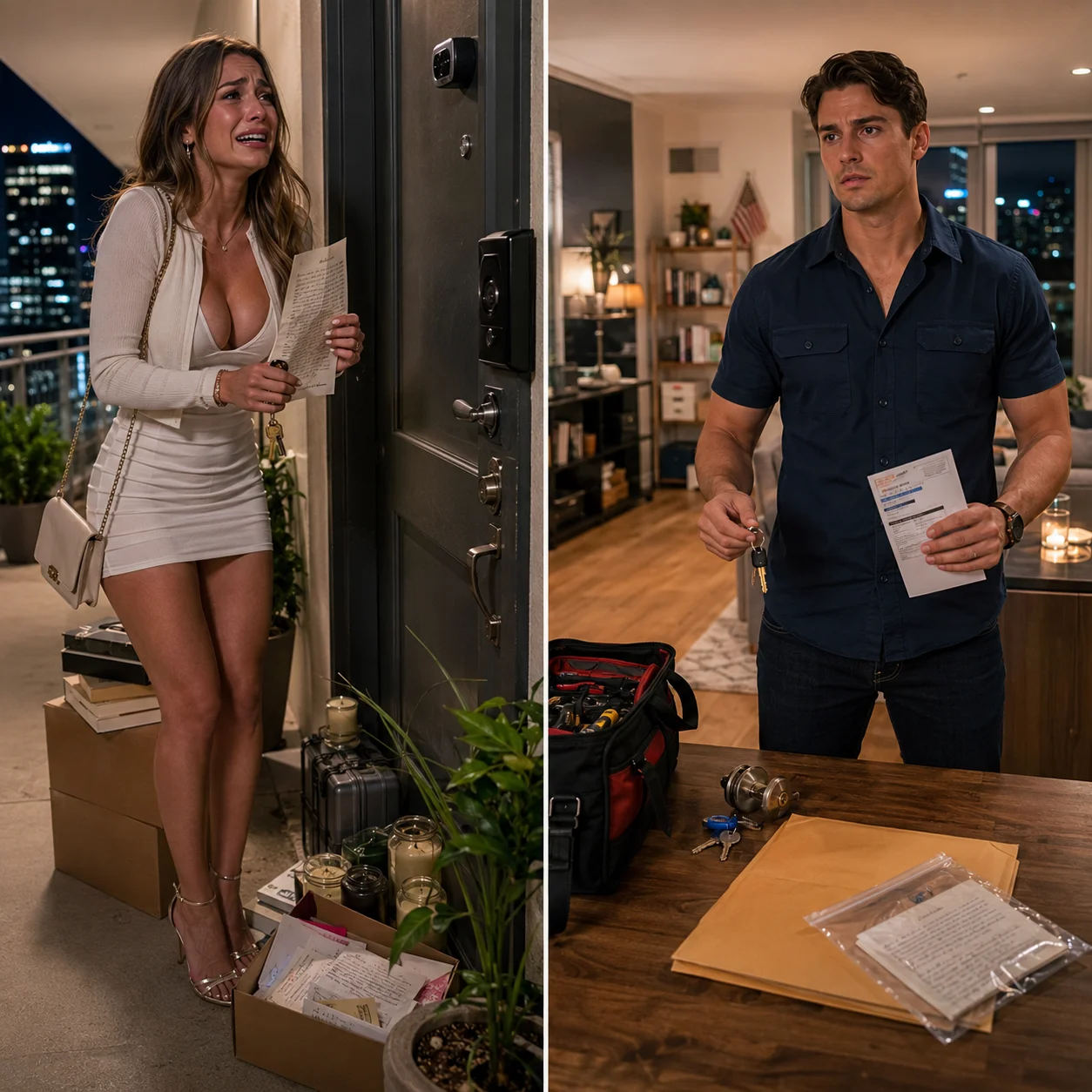
My girlfriend left me a letter.
“Don’t come looking for me.”
I replied, “I won’t.”
She expected me to chase her across town like every other time. Instead, I packed her things, changed the locks, and mailed the rest of her letters back.
By morning, her family called me cruel.
My name is Graham. I’m thirty-four. My girlfriend, Riley, was twenty-nine. We had been together almost three years and had been living together for eight months in Charlotte, North Carolina. I worked as a logistics planner for a regional food distributor. Riley worked as a preschool assistant at a private daycare across town.
The apartment was mine before Riley. My lease. My deposit. My furniture. My parking spot. She moved in after saying she wanted something serious, stable, and adult.
For a while, I believed her.
Then she started using letters.
Not normal letters. Not sweet notes on the fridge or little reminders tucked beside a coffee mug. Dramatic letters. If we had an argument, she would not talk like an adult. She would disappear into the bedroom, write three pages, fold them carefully, and leave them somewhere obvious.
On my pillow.
Under my coffee mug.
Taped to the bathroom mirror.
The letters always had the same shape.
First paragraph: how hurt she was.
Second paragraph: how I had failed to understand her.
Third paragraph: how maybe she needed space.
Final line: something designed to make me panic.
The first time, I chased her.
She had gone to her friend Avery’s apartment. I drove there at midnight, apologized for things I barely understood, and brought her home.
The second time, I chased her again. She sat in her car outside a coffee shop for two hours, waiting for me to prove I cared.
By the fourth time, I realized the letters were not communication.
They were traps with handwriting.
The final letter came on a Friday.
I got home around 6:20 p.m. after a long inventory meeting. The apartment was too quiet. Her shoes were gone from the entryway. Her tote bag was missing from the chair. On the kitchen counter, there was a white envelope with my name written in blue ink.
I knew before I opened it.
Inside were four pages.
She wrote that she felt unseen. She wrote that I had become too comfortable. She wrote that love should feel like pursuit, not routine. She wrote that she had spent the whole afternoon crying because I did not text her enough during work.
I had texted her twice.
Once to ask if she wanted tacos for dinner.
Once to say I might be late because of the inventory meeting.
Then came the line.
“Don’t come looking for me.”
I stood there in my work shirt, holding those four pages, and felt something inside me finally get tired.
Not angry.
Tired.
Then my phone buzzed.
A text from Riley.
“Did you read it?”
I replied, “I won’t.”
She sent back, “Won’t what?”
I wrote, “Come looking for you.”
Three dots appeared.
Disappeared.
Appeared again.
Then she called.
I did not answer.
She called three more times.
I still did not answer.
Then Avery texted me.
“Graham, she’s really upset. This is when you’re supposed to show up.”
I replied, “She asked me not to.”
Avery wrote, “You know what she meant.”
And that was the problem.
I did know what she meant.
She meant chase me.
Beg me.
Panic.
Apologize first, ask questions later.
Prove love by accepting emotional punishment.
I looked around the apartment. Her plants on the windowsill. Her coat on the hook. Her books mixed with mine. Her half-used candles on every flat surface. Her letters in drawers, in boxes, folded inside old birthday cards in the nightstand.
I started with the letters.
I gathered every one I could find.
Eleven total.
Some folded.
Some sealed.
Some with tear stains that now felt staged in hindsight.
I put them in a shoebox.
Then I started packing.
I did not destroy anything. I did not throw her clothes into trash bags or dump her makeup in a drawer. I folded clothes, wrapped mugs, put her makeup in small plastic bags so nothing leaked, packed books spine-up so they would not bend, and took photos of every box.
By midnight, her life in my apartment was stacked neatly by the dining table.
Seven boxes.
Two suitcases.
One laundry basket.
One shoebox full of letters.
Saturday morning, I called the leasing office. Riley was not on the lease. She was listed only as an approved occupant. They removed her with one email.
The lock change cost $180 and happened that afternoon.
Then I rented a small storage unit near Matthews. Five by ten. Climate-controlled. Ninety-four dollars a month, first month half off. I paid for two months.
By Sunday, everything was inside.
I mailed the shoebox of letters to Avery’s apartment, where Riley was staying. Certified mail. Signature required. Cost me $17.35.
Inside, I added one note.
“You wrote these. You can keep them. I’m done reading instructions for how I’m supposed to suffer.”
That was all.
Four days later, the flying monkeys started circling.
Avery texted first. She said Riley had been sobbing since the box arrived. She said mailing the letters back was psychologically cruel. She said Riley wrote those letters from pain and I had weaponized them.
I replied, “She used them to make me chase her. I returned her property.”
Avery said, “You’re acting like she’s some manipulator.”
I did not answer.
Sometimes silence is the cleanest yes.
Then Riley’s brother Mason called from a number I did not recognize.
He started with, “Man-to-man, this is embarrassing.”
I said, “For who?”
“For you. My sister leaves one letter, and you throw her whole life in storage?”
“Ask her how many letters.”
Silence.
I continued, “Ask her how many times she left and expected me to chase her.”
Mason said, “That’s not what she told us.”
Of course it was not.
People like Riley never show the whole stack.
They show one page.
Tuesday night was the scheduled pickup. I had emailed Riley the storage facility address, unit number, gate code, and prepaid end date. I told her she could transfer the unit into her name or remove everything before the paid period ended.
She replied with one sentence.
“I can’t believe you made our love transactional.”
I did not respond.
That night, she showed up at my apartment anyway.
The new lock stopped her.
The doorbell camera caught her trying the old key, pausing, then trying again. Then she looked straight into the camera and said, “Graham, open the door. I know you’re home.”
I was home.
I was eating cereal for dinner.
I did not open the door.
She knocked for twelve minutes, then slid a new letter under the door.
I waited until she left.
Then I picked it up using two fingers like it was evidence, because it was.
I did not read it.
I put it in a gallon freezer bag, wrote the date on it, and placed it in a folder labeled Riley.
The next morning, I emailed her once.
“Do not come to my apartment again. Your belongings are in storage. Future visits will be documented.”
She replied, “You don’t get to silence me.”
I wrote, “I’m not silencing you. I’m not reading you.”
That one made her angry.
By lunch, Avery had added me to a group chat with four of Riley’s friends: Avery, Madison, Brooke, and Tessa.
The chat title was “please be an adult.”
Madison wrote, “She just wants closure.”
Brooke wrote, “You can’t discard a person.”
Tessa wrote, “Returning her letters was evil.”
I sent one message.
“She wrote, ‘Don’t come looking for me.’ I respected that. Her things are safe, prepaid, and available. Do not contact me again.”
Then I left the chat and blocked all four.
That night, my mom called.
She said, “Riley called me.”
I closed my eyes. “Of course she did.”
“She said you abandoned her after she wrote you a vulnerable letter.”
“What did you say?”
Mom paused.
“I asked if she told you not to come looking for her.”
I waited.
“She said yes, but you should have known better.”
I laughed once.
Mom said, “I told her you finally did know better.”
That was the first time I felt lighter.
Not happy.
Not healed.
Just lighter.
Three weeks later, Riley changed tactics.
The letters became digital.
First came an email titled, “The Letter You Refused to Read.”
It was long.
Very long.
Sixteen paragraphs.
It started with how much she loved me and ended with how disappointed she was that I had become cold, avoidant, and emotionally unsafe.
I saved it to the folder and did not respond.
Then came another email.
Subject: “You Don’t Get to Erase Me.”
Saved.
No response.
Then she sent a PDF attachment called “Final Letter.”
I did not open it.
I forwarded it to my brother Devin, who worked as a paralegal in Columbia.
Devin replied, “Stop engaging entirely. Keep everything. Also, the fact that she names documents like a villain is incredible.”
That helped.
A few days later, Riley showed up at my job.
The receptionist called my desk and said, “There’s a Riley here. She says she’s your partner and needs to give you an envelope.”
I said, “She is not my partner. Please ask security to escort her out.”
Riley refused to leave at first. She told the receptionist I was having a mental health crisis and she was trying to help.
That was new.
My manager, Dana, asked me what was going on. I told her the short version. Ex-girlfriend used letters as manipulation, moved out, belongings in storage, now showing up at work.
Dana looked at me for three seconds and said, “Send HR everything.”
So I did.
Screenshots.
Doorbell footage.
Storage receipt.
Certified mail receipt.
Emails.
Group chat screenshot.
Work lobby report.
HR documented it as a personal harassment issue and told the front desk not to allow Riley upstairs.
That same afternoon, Riley posted online.
White background. Black text.
“Some people call it drama when a woman finally writes the truth.”
Under it, she wrote about how letters used to be sacred, how people used to fight for love, how modern men want convenience instead of commitment.
I got messages from two mutual friends before dinner.
One said, “I don’t want to get involved, but are you okay?”
That one I answered.
“Yes. I ended a pattern. That’s all.”
The other was from her cousin Jordan.
“You seriously mailed her letters back? That’s messed up.”
I replied with a photo of the certified mail receipt and the storage email.
“She told me not to come looking. I didn’t. She kept contacting me. I returned her letters.”
Jordan replied, “She said you dumped her stuff outside.”
I sent a photo of the storage unit with the boxes neatly stacked.
Jordan wrote, “Okay, that is not what she said.”
They never say what happened.
They say what helps.
Then came the fake crisis.
At 1:08 a.m., I got a call from an unknown number.
I did not answer.
Then a text came through.
“Riley left a final letter. We’re scared. If you care, call her.”
My stomach dropped.
Even when someone has hurt you, words like that still hit the emergency part of your brain.
I called Mason.
He answered half asleep and annoyed until I read him the message.
Then he went quiet.
I said, “Is she safe?”
I heard movement. A door opening. Muffled voices.
Mason came back and said, “She’s asleep on my couch.”
“Who sent that message?”
“Avery has been with her all night.”
“Tell Avery that fake emergency messages become police reports.”
Mason sighed.
“Yeah,” he said. “I’m sorry. This is getting weird.”
That was the first honest thing anyone from her side had said.
I filed a police report the next morning. The officer said it might not be enough for charges, but the pattern mattered. He told me to keep documenting and consider a cease and desist.
So I paid Devin’s attorney friend $390 to send one.
No contact.
No third-party contact.
No showing up at my apartment or workplace.
No letters.
No emails.
No fake emergency messages.
No social media tagging.
Clear.
Simple.
Boring.
The letter that mattered was finally one she did not write.
During all of this, life kept moving.
I got promoted to routing supervisor after a project I had been working on saved our department almost nine percent in fuel costs. Dana told me I handled pressure well.
I did not tell her pressure had been sliding envelopes under my door.
I also started having coffee with a woman named Paige. She worked for one of our vendor partners. Nothing serious at first. Just coffee after a client meeting, then lunch, then dinner.
She texted like a normal person.
She said what she meant.
No riddles.
No tests.
No handwritten emotional subpoenas.
It felt strange at first.
Then it felt peaceful.
Two months later, the cease and desist worked for twenty-six days.
Then Riley mailed a letter to my office.
Not to me directly.
To Dana.
The envelope was addressed to “Graham, Supervisor.”
Inside was a three-page letter explaining that I was emotionally unstable, retaliatory, and unsafe around women who expressed feelings. She wrote that she was concerned my behavior could affect my workplace judgment.
That was the dumbest thing she could have done.
Dana called me into her office, handed me the letter in a clear sleeve, and said, “I assume this is part of the issue we documented.”
I said, “Yes.”
She nodded. “We’re forwarding this to HR and legal.”
I apologized.
Dana said, “Don’t. You didn’t mail it.”
HR added it to the file.
Devin’s attorney told me to file for a protective order.
The hearing was three weeks later at the Mecklenburg County Courthouse. Riley arrived with Avery. I arrived with Devin and my folder.
Riley looked different. Soft sweater. Minimal makeup. Hair pulled back. She had a notebook in her lap, which felt on brand and mildly threatening.
The judge asked why I wanted the order.
I kept it boring.
I explained the pattern. Letters after arguments. Disappearances. The final letter telling me not to come looking. My decision not to. The storage unit. The returned letters. The apartment visit. The workplace visit. The fake emergency message. The cease and desist. The letter mailed to my supervisor.
No insults.
No emotional speeches.
Just dates and paper.
Riley said she was only trying to communicate. She said I had punished her for being expressive. She said returning the letters was cruel. She said I made her feel erased.
The judge asked, “Did you write, ‘Don’t come looking for me’?”
Riley said, “Yes, but that was emotional context.”
The judge asked, “Did he come looking?”
Riley said, “No.”
The judge said, “So he did what you asked.”
Riley started crying.
Then the judge asked about the letter to my supervisor.
Riley said she was worried about my mental health.
The judge looked at the evidence.
“After a cease and desist told you not to contact him or his workplace?”
Riley had no good answer.
The protective order was granted for one year.
No direct contact.
No indirect contact.
No letters.
No workplace contact.
No apartment contact.
No social media contact.
Three hundred feet.
Outside the courtroom, Avery glared at me.
“I hope you’re proud.”
Devin said, “He should be.”
I did not say anything.
A month later, Riley transferred the storage unit into her name and picked up the rest of her things.
Mason texted once.
Just one sentence.
“Sorry for not asking more questions earlier.”
I replied, “Thanks.”
That was it.
I still have the first letter she slid under the door after I changed the locks. Still unread. It is in the folder with everything else. I keep it because evidence matters, not because her words do.
Paige and I are still taking things slowly. She knows the story. Once, after dinner at my place, she left a note on my kitchen counter.
“Dinner was great. Text me when you get home tomorrow.”
I stared at it for way too long.
Then I laughed because that is what a normal note feels like.
Light.
Clear.
Kind.
Not a hostage situation in cursive.
Here is what I learned.
Letters can be beautiful. They can hold love, apology, memory, truth. But in the wrong hands, a letter becomes a weapon. A way to talk without listening. A way to accuse without being interrupted. A way to leave instructions for someone else’s guilt.
Riley did not write to be understood.
She wrote to control the ending.
The day I stopped reading was the day I stopped obeying.
And when she told me not to come looking, I finally loved myself enough not to.