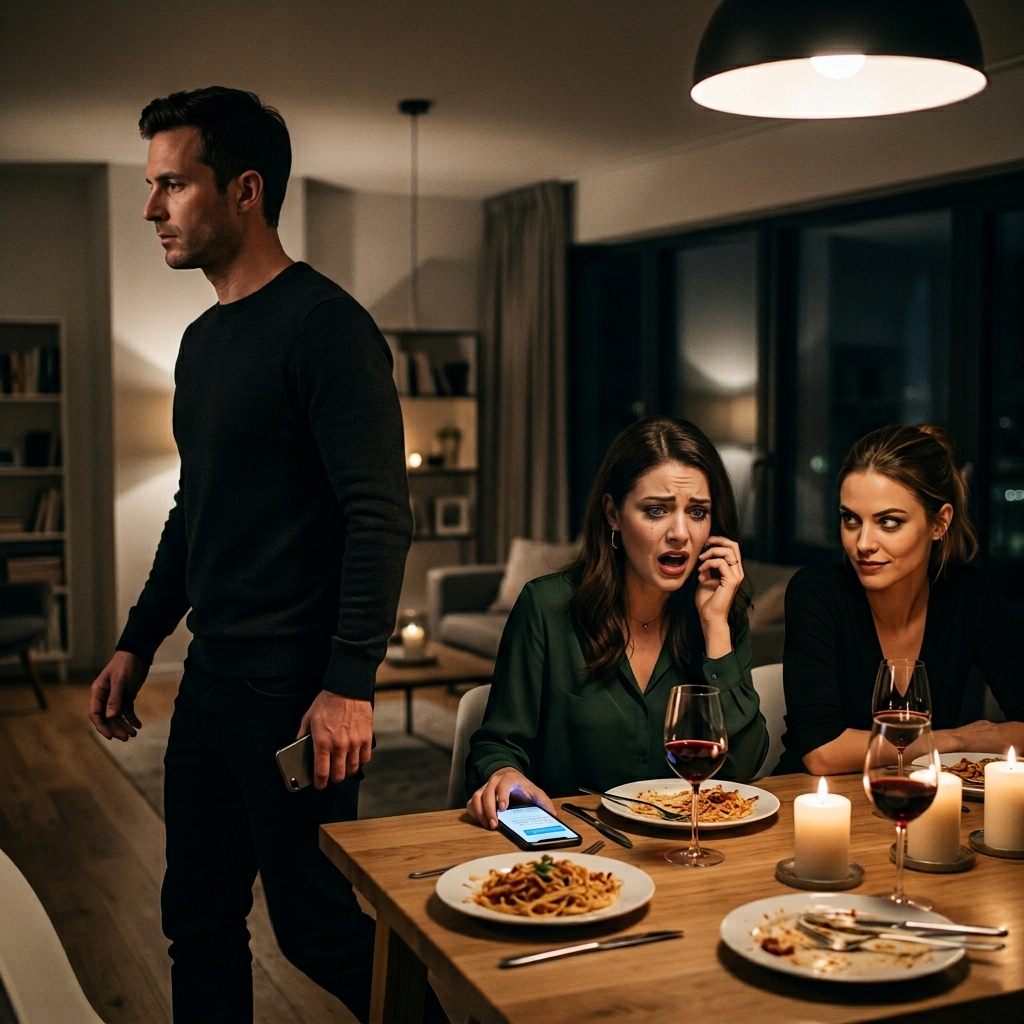
Adrian Vale was a real person.
He owned a boutique commercial real estate firm in Charlotte. He was forty-four, handsome in a polished, old-money kind of way, with silver beginning at his temples. His company biography said he graduated from Northlake University in the same year as Rachel. There were alumni board photos, charity event pictures, and one old article from the university archives.
The article was from twenty-two years earlier.
The headline read: Northlake Winter Royalty Announced at Annual Formal.
I clicked.
There she was.
Rachel, at twenty-one, glowing in a silver dress, standing beside Adrian Vale. He held her hand high like they had just won something together. The article described them as “longtime campus sweethearts.”
Campus sweethearts.
Not ex-boyfriend.
Not someone she dated briefly.
Longtime campus sweethearts.
I sat back in my chair, trying to remember every conversation Rachel and I had ever had about college. She had mentioned roommates. Professors. A friend named Melissa who once got arrested for stealing a street sign. A terrible apartment with mold in the bathroom. But never Adrian.
Not once.
Sixteen years of marriage, and she had never said his name.
At 1:07 a.m., another email arrived from the stranger.
This one had two attachments.
The first was a photo from what looked like a reunion display table. Old yearbooks, framed pictures, alumni memorabilia. Someone had taken a close-up of a scrapbook page.
In the center was a photo of Rachel and Adrian standing under an arch of white flowers.
Rachel wore a cream dress.
Adrian wore a tux.
They were kissing.
Below the photo, handwritten in silver marker, were the words:
Rachel Barrett & Adrian Vale — Engagement Party, 2004.
The second attachment was worse.
It was a fresh photo from that night.
Rachel and Adrian were dancing.
His hand was on the small of her back. Her face was tucked close to his neck. Her eyes were closed.
I did not sleep.
I sat in the dark living room until dawn, holding my phone like it was evidence from a crime scene. Around 6 a.m., Sophie came downstairs in pajama pants and one of my old college sweatshirts.
“Dad?” she mumbled. “Why are you awake?”
I closed the laptop too quickly.
“Couldn’t sleep.”
She narrowed her eyes. Sophie had her mother’s ability to read rooms and my inability to pretend convincingly.
“Is Mom okay?”
The question hit me harder than it should have.
“I think so,” I said.
She stood there for a second, unconvinced. Then she went to the cabinet for cereal.
“When’s she coming back?”
“Tomorrow afternoon.”
Sophie poured cereal into a bowl, then looked over her shoulder. “She seemed weird before she left.”
My fingers tightened around my coffee mug.
“What do you mean?”
“I don’t know. Like… intense. She came into my room Thursday night and hugged me for a long time.”
Rachel loved Sophie, but she was not usually sentimental without warning. Sophie was at an age where she tolerated affection with dramatic sighs, and Rachel respected that most of the time.
“What did she say?” I asked carefully.
Sophie shrugged. “Just that she was proud of me. And that no matter what, I should remember she loves me.”
My stomach dropped.
No matter what.
I forced myself to nod like this was not a sentence that had just rearranged my entire understanding of the weekend.
“She probably just got emotional about seeing old friends,” I said.
Sophie looked at me for a moment longer.
“Dad, you’re doing the face.”
“What face?”
“The face where you pretend everything’s fine and make it worse.”
I tried to smile. It came out badly.
“I’ll tell you if there’s something to tell.”
She did not look satisfied, but she took her cereal upstairs.
At 8:32 a.m., Rachel finally called.
I let it ring twice before answering.
“Hey,” she said softly.
Her voice was hoarse, like she had been crying or drinking or both.
“Hey.”
There was a pause.
“You said it was important?”
I almost laughed. The calmness of her voice felt obscene.
“Yes,” I said. “It is.”
“What’s wrong?”
I opened the laptop again. The photo of her wearing the ring was still on the screen.
“Who is Adrian Vale?”
Silence.
Not confusion. Not surprise.
Silence.
That was how I knew.
“Rachel,” I said. “Who is Adrian Vale?”
When she finally spoke, her voice was smaller.
“Where did you hear that name?”
“Answer the question.”
“He was someone I knew in college.”
“Someone you knew?”
Another pause.
“Daniel, I can explain.”
Those four words are never as comforting as people think they are. They do not mean the truth is innocent. They mean the lie has finally been caught without preparation.
“Were you engaged to him?”
She inhaled sharply.
“Who told you that?”
“Were you engaged to him?”
“Yes,” she whispered.
I closed my eyes.
One part of me had already known. Another part still broke when she confirmed it.
“Were you married to him?”
“No,” she said quickly. “No, Daniel. I swear to God, we were never legally married.”
“Legally,” I repeated.
“That’s not what I meant.”
“What did you mean?”
She was quiet again.
I could hear muffled voices in the background. A hotel hallway, maybe. Music somewhere far away.
“We had a ceremony,” she said at last. “It wasn’t legal. It was stupid and young and dramatic. We were twenty-two.”
I stood up because sitting suddenly felt impossible.
“A ceremony.”
“It was symbolic.”
“Rachel.”
“I know.”
“No, I don’t think you do.” My voice was shaking now. “I don’t think you understand what it feels like to find out from a stranger that my wife had a symbolic wedding with a man she never mentioned once in sixteen years.”
“It wasn’t a wedding.”
“There’s a photo of you in a white dress kissing him under flowers.”
She made a small broken sound.
“Someone sent you pictures?”
“Yes. Someone sent me pictures. Including one from last night.”
She did not speak.
“The ring,” I said. “Tell me about the ring.”
“Daniel—”
“Tell me about the ring.”
“It was his grandmother’s,” she said, barely audible. “He gave it to me when we were engaged.”
“And why were you wearing it last night?”
Her breathing changed.
“Because everyone was joking about it.”
I stared at the wall.
“Try again.”
“I’m serious. It was part of an old memory. People remembered us as this big campus couple, and someone brought up the ring, and Adrian had it, and—”
“Adrian had your old engagement ring at the reunion?”
“Yes.”
“Convenient.”
“It wasn’t like that.”
“Then what was it like?”
She did not answer.
I looked at the photo again. Rachel smiling beside him. Rachel leaning into him. Rachel wearing a ring from a life she had buried before me, now resurrected in a ballroom full of witnesses who apparently knew more about my wife than I did.
“I want you to come home,” I said.
“I’m flying back tomorrow.”
“No. Today.”
“Daniel, there’s a brunch this morning. People are expecting—”
“I don’t care who’s expecting you.”
The anger finally cracked through my voice.
She went quiet.
“I’ll look for a flight,” she said.
“No,” I said. “Don’t look. Book one.”
I hung up before she could say anything else.
For the next three hours, I moved through the house like a ghost pretending to be a man with tasks. I washed dishes that were already clean. I took out trash that was barely full. I answered one work email with such formal politeness that my boss wrote back asking if everything was all right.
Rachel texted at 10:16.
Flight at 1:40. Land at 3:05.
I did not reply.
At noon, the stranger emailed again.
She’ll tell you it was nostalgia. Ask why she reserved a room under both names.
Attached was a screenshot.
It appeared to be a hotel booking confirmation for the reunion weekend. The room was listed under:
Adrian Vale & Rachel Barrett-Vale
My vision narrowed.
Barrett-Vale.
Rachel had never used Adrian’s last name with me. She had become Rachel Mercer when we married. Before that, she was Rachel Barrett.
But somewhere, somehow, in a hotel system connected to this weekend, she was Rachel Barrett-Vale.
I replied immediately.
How did you get this?
The answer came back:
I work the alumni desk. I saw the check-in list. I thought it was a mistake until I saw them together. I’m sorry.
I wanted to ask more, but I stopped myself. I had enough to confront her. Too much, maybe.
At 3:47 p.m., Rachel walked through our front door.
She looked beautiful and terrified.
That was the first thing I noticed, and I hated myself for noticing it. Her hair was pulled back loosely. She wore jeans, a cream sweater, and sunglasses pushed onto her head. She had no makeup on, which made her look younger and more vulnerable than she deserved to look in that moment.
Her suitcase rolled softly behind her.
I was standing in the living room. Sophie was at a friend’s house because I had asked her to go, using the excuse that her mother would be tired from travel.
Rachel closed the door.
For a few seconds, neither of us moved.
Then she whispered, “Daniel.”
I held up my phone.
“Were you registered at the hotel as Rachel Barrett-Vale?”
Her face went pale.
That answer was enough.
She set down the suitcase slowly.
“It wasn’t my doing.”
“Of course it wasn’t.”
“I’m telling the truth. The alumni office pulled old records. Back then, people used to call me that as a joke after the ceremony.”
“As a joke.”
“I know how it sounds.”
“Do you?”
She flinched.
I stepped toward the coffee table, where I had printed everything. The photo of the ring. The old engagement party picture. The hotel screenshot. The article calling them campus sweethearts.
Rachel stared at the pages like they were alive.
“Sit down,” I said.
“Daniel, please.”
“Sit down.”
She sat.
I remained standing because some part of me believed if I sat too, I might collapse.
“Start at the beginning.”
Her hands twisted in her lap.
“I met Adrian freshman year,” she said. “We were friends first. Then we dated. By junior year, everyone thought we’d get married.”
“Did you love him?”
She looked up at me, eyes shining.
“Yes.”
The honesty landed like a slap.
I nodded slowly, even though my chest felt hollow.
“Go on.”
“He came from money. Not just comfortable money. Family-name-on-buildings money. His parents were involved with the university. He was charming and ambitious and… intense. When he loved you, it felt like being chosen by the sun.”
I said nothing.
“But he was controlling,” she continued. “Not at first. At first it felt romantic. He wanted to know where I was because he cared. He hated certain friends because they were ‘bad for me.’ He wanted me at every event because we were a team. By senior year, I didn’t know where I ended and he began.”
“Yet you got engaged.”
“I was twenty-two. I thought love was supposed to swallow you whole.”
She wiped at her cheek.
“The ceremony wasn’t legal. It was after graduation, before we were supposed to move to Charlotte. His family had an estate outside town. They threw what they called an engagement blessing. Everyone treated it like a wedding, but no license was filed. I wore a dress. We exchanged vows. It was humiliatingly dramatic.”
“And then?”
“And then I left.”
I frowned.
“What do you mean?”
“I mean three weeks later, I packed two bags while he was in Atlanta, emptied what little money I had, and left. I stayed with my aunt in Maryland for two months. I changed my number. I cut everyone off.”
“Why?”
She looked at the floor.
“Because he hit me.”
The room changed.
I had been angry, and I still was, but those words moved something beneath the anger. Not enough to erase it. Not enough to excuse sixteen years of silence. But enough to make the ground less simple.
Rachel’s voice was barely above a whisper.
“It was one time. That’s what I told myself. One time during a fight after I said I didn’t want to move into his family’s guesthouse. He grabbed me, I pushed him, and he slapped me so hard I fell against the dresser. The next day he cried. Bought flowers. Said he was terrified of losing me. I almost stayed.”
She swallowed.
“But my aunt had always told me that if a man hits you once, believe him the first time. So I left.”
I sat down across from her slowly.
“Why didn’t you tell me?”
Her face crumpled.
“Because I wanted to be someone else with you.”
“That is not an answer.”
“I was ashamed.”
“Of being hurt?”
“Of going along with all of it. Of wearing the dress. Of letting everyone believe I belonged to him. Of missing him even after he hurt me. Of being stupid enough to think that kind of love was special.”
“Rachel.”
“I know,” she said quickly. “I know I should have told you. I know.”
“No, you don’t.” My voice hardened again. “Because if this was only about an abusive ex you escaped, I would be hurt you didn’t tell me, but I could understand shame. What I cannot understand is why you went back to a reunion, danced with him, wore his ring, and let the hotel list you under his name.”
She closed her eyes.
There it was.
The part she had hoped we would not reach.
“I didn’t plan to wear the ring.”
“You keep saying that.”
“It’s true.”
“Then explain it.”
She took a shaky breath.
“When I arrived Friday, I saw him at check-in. I hadn’t seen him in eighteen years. I thought I was prepared, but I wasn’t. He looked older, obviously, but he spoke to me like no time had passed. He apologized.”
“For hitting you?”
“For everything. For how his family treated me. For controlling me. For letting people believe I ruined his life when I left.”
“Did he say he still loved you?”
She looked away.
“Yes.”
The word hung between us.
“And what did you say?”
“I said I was married.”
“That’s not what I asked.”
Her mouth trembled.
“I said part of me would always care about him.”
I stared at her.
There are sentences that do not sound violent, but still break bones.
“Did you kiss him?”
She started crying then. Not dramatic sobbing. Quiet tears, exhausted and guilty.
“Once.”
I leaned back as if distance could protect me.
“When?”
“Friday night.”
I nodded, jaw tight.
“Before or after you texted me that you were going to bed?”
She covered her face.
“Before.”
I let out a breath that sounded almost like a laugh.
“So you kissed him, then texted your husband goodnight.”
“I stopped it.”
“You stopped it after it happened.”
“Yes.”
“And Saturday?”
“He asked me to talk. He said there were things he needed to say. We walked around campus. He took me to the old chapel.”
“The chapel where you had your symbolic wedding?”
She nodded miserably.
“And then?”
“He had the ring.”
I looked at the printed photo on the table.
“He just happened to have it.”
“He said he had kept it because he never stopped regretting losing me.”
“Very touching.”
“I know how awful this sounds.”
“No, Rachel. Awful is too small a word.”
She lowered her hands.
“He asked me to put it on one last time. He said not as a proposal, just closure.”
“Closure,” I repeated.
The word had become one of those modern lies people used to make betrayal sound therapeutic.
“I shouldn’t have done it,” she said. “The second it was on my finger, I knew I had crossed a line. But then people saw us. They started clapping and joking. Someone took pictures. I panicked. I smiled because I didn’t know what else to do.”
“You didn’t know what else to do?”
“I froze.”
“You could have taken it off.”
“I know.”
“You could have called me.”
“I know.”
“You could have told him no before any of it happened.”
Her tears kept falling.
“I know.”
Silence settled heavily between us.
I wanted to shout. I wanted to demand more details and punish myself with every one. I wanted to believe her and not believe her at the same time.
“Did you sleep with him?” I asked.
She looked at me directly.
“No.”
I studied her face.
Once, I would have known whether she was telling the truth. That was the worst part. Not knowing if she was lying was painful, but realizing I no longer trusted my own ability to read her was worse.
“The hotel room?”
“My room,” she said quickly. “My room was only mine. The name issue was from old alumni records. I swear to you, he never stayed there.”
“Why did the reservation list both names?”
“I don’t know. Maybe because he helped sponsor the reunion and the alumni office grouped old couples for events. I don’t know, Daniel.”
“You expect me to believe that?”
“No,” she whispered. “I don’t expect anything.”
I looked at the woman across from me. My wife. Sophie’s mother. The person who knew how I took my coffee, who held my hand when my father died, who once drove three hours in the snow because I had food poisoning on a work trip and she did not want me alone in a hotel room.
And now she was also the woman who had kissed an ex-fiancé she never told me existed, worn his ring, danced with him, and lied to me in real time.
Both women were true.
That was the cruelty of it.
“Where is the ring now?” I asked.
She reached into her purse with shaking hands and pulled out a small velvet box.
She placed it on the table.
I did not touch it.
“Why do you have it?”
“He told me to keep it.”
I laughed then, a short bitter sound.
“Of course he did.”
“I was going to mail it back.”
“When? After brunch?”
Her face twisted.
“That was unfair.”
“So was wearing another man’s engagement ring while married to me.”
She went silent.
I stood.
“I need you to stay somewhere else tonight.”
Her head snapped up.
“Daniel.”
“I can’t look at you right now.”
“What about Sophie?”
“She’s at Olivia’s. She thinks you’re tired from travel.”
Rachel pressed a hand to her mouth.
“I don’t want her dragged into this.”
“She’s already in it. She just doesn’t know.”
“I’ll tell her whatever we decide.”
“No,” I said. “We will tell her the truth in an age-appropriate way when there is truth to tell. Not a version that makes you comfortable.”
She nodded, crying harder.
“Where am I supposed to go?”
“I don’t know.”
The words came out colder than I intended, but I did not take them back.
Rachel packed a smaller bag while I stood in the hallway. She moved slowly through our bedroom, gathering toiletries, clothes, a charger. I watched her remove her wedding band from the bathroom counter, where she had placed it before leaving for the reunion, and slip it back onto her finger.
The sight made something inside me recoil.
She saw my face and froze.
Then, quietly, she took it off again and placed it on the dresser.
“I don’t know what to do,” she whispered.
“For once,” I said, “neither do I.”
She left at 6:12 p.m.
The house felt different after she was gone. Not empty, exactly. Contaminated.
I walked into our bedroom and saw the indentation of her suitcase on the carpet. Her perfume still hung in the air. On the dresser, my wedding ring sat in a small ceramic dish beside hers. I had taken mine off without remembering doing it.
That night, I told Sophie her mother was staying with a friend because we needed to talk through some adult things.
She stared at me from across the dinner table.
“Are you getting divorced?”
The question was too direct to dodge.
“I don’t know.”
Her eyes filled, but she blinked hard.
“Did Mom do something?”
I took a breath.
“Your mom and I are dealing with something from her past that she wasn’t honest about. I’m not ready to say more, and I don’t want you carrying adult problems. But I won’t lie to you and say everything is fine.”
Sophie looked down at her plate.
“Is she safe?”
The question gutted me.
“Yes,” I said immediately. “She’s safe.”
“Are you?”
I had no answer for that.
Over the next week, Rachel stayed at a hotel. She texted every morning asking about Sophie. She did not ask to come home. That was either respect or strategy, and I hated that I had to wonder which.
On Wednesday, a package arrived.
Inside was a folder.
No return address.
My hands went cold before I even opened it.
There were printed emails. Old ones, from years earlier, between Rachel and Adrian.
The first was dated eight years into our marriage.
Eight years.
Not eighteen years ago. Not college. Not before me.
Eight years ago.
The email from Adrian read:
I heard you moved near Richmond. I think about you more than I should. I hope he knows he got the best part of my life.
Rachel’s reply was short.
Please don’t write again. I’m married and happy.
Relief hit me so quickly I nearly sat down.
But there were more.
Five years ago, after Rachel’s mother died, Adrian had written again.
Your mom always liked me. I know I have no right, but I’m sorry.
Rachel replied:
Thank you. Please respect my life.
Then three years ago.
Adrian:
Northlake reunion committee is trying to reach you. I told them I didn’t know if you’d come. I wish you would. I owe you a real apology.
Rachel:
I’m not interested in reopening that chapter.
Then six months ago.
Adrian:
Twenty-year reunion. One weekend. No pressure. I’ll be there. I’m not the man I was.
There was no printed response from Rachel.
At the bottom of the folder was a handwritten note.
He has been chasing her for years. That doesn’t excuse her. But you should know he planned this.
No signature.
I sat at my desk for a long time, reading those pages.
The picture became more complicated.
Adrian had not been a random old flame who appeared out of nowhere. He had been circling for years, testing doors, waiting for weakness. Rachel had pushed him away more than once.
And then, for reasons I still did not understand, she had finally opened the door.
That did not make her innocent.
But it did make Adrian dangerous in a way I had not fully considered.
I called Rachel.
She answered on the first ring.
“Daniel?”
“Did Adrian contact you before the reunion?”
Silence.
“Yes,” she said.
“How many times?”
“A few.”
“Try again.”
She exhaled shakily. “Over the years? Several.”
“Why didn’t you tell me?”
“Because every time, I shut it down.”
“Except the last time.”
She did not respond.
“What changed?” I asked.
Her voice broke.
“My mother’s birthday.”
I closed my eyes.
Rachel’s mother had died five years earlier. Every year around her birthday, Rachel became quieter, more distant. I knew grief did that. I had never connected it to anything else.
“He wrote me in January,” she said. “He said he had found old photos of my mom from graduation weekend. Pictures I’d never seen. I told myself I was only answering because of that.”
“And then?”
“He sent the photos. Then we talked about my mom. Then about college. Then about how badly everything ended.”
“How often did you talk?”
“At first, once. Then a few emails. Then texts.”
“Texts.”
“Yes.”
“For how long?”
“Two months.”
I gripped the phone.
“Were you emotionally involved with him before the reunion?”
She started crying again.
“I was confused.”
“That means yes.”
“I didn’t want to leave you.”
“That is not what I asked.”
“Yes,” she whispered. “Part of me was emotionally involved.”
I felt the final plank beneath me give way.
The kiss, the ring, the dance—that was not one bad night of nostalgia. It was the visible part of a much longer betrayal.
“Thank you for finally saying something true,” I said.
“Daniel, please. I know I destroyed your trust. I know. But I was going to tell you.”
“When?”
“When I understood what was happening.”
“You understood enough to hide it.”
She sobbed once, sharply.
“I’m so sorry.”
“I believe that you’re sorry,” I said. “I don’t yet know what you’re sorry for.”
That night, I called a lawyer.
Her name was Marianne Cho, and she had been recommended by a colleague who had gone through a divorce two years earlier. She was calm, precise, and did not waste words.
“Do you want to file?” she asked after I explained the situation.
“I don’t know.”
“Then don’t make an emotional legal decision today,” she said. “But you do need information. Assets, accounts, mortgage, retirement, college savings, any debts. Truth first. Decisions second.”
Truth first.
That became my anchor.
For the next week, I gathered documents. Bank statements. Phone records. Credit card bills. Hotel charges. I did not find proof that Rachel had slept with Adrian. I did find calls and texts between them starting in January, increasing in March, becoming almost daily by May.
Some were short. Some lasted nearly an hour.
All of them happened while I was at work, asleep, or driving Sophie to practice.
I also found a charge from a jewelry repair shop in Charlotte, made on Adrian’s card but shipped to Rachel’s office. That was how the ring had been cleaned and resized before the reunion.
When I confronted Rachel with that, she looked physically sick.
“He said he wanted it restored before returning it to me,” she said.
“And you gave him your ring size?”
“I shouldn’t have.”
“No. You shouldn’t have.”
She began therapy the next day.
I did not ask her to. I did not applaud her for it either. It was not a heroic act to clean up the glass after throwing the bottle.
Two weeks after the reunion, Rachel and I sat in a marriage counselor’s office for the first time.
The counselor, Dr. Elaine Porter, was in her sixties, with silver hair and the kind of steady gaze that made lying feel pointless.
Rachel told the story first.
To her credit, she did not minimize as much as I expected. She admitted to the secret contact. The emotional attachment. The kiss. The ring. The dance. She admitted that she had built a private fantasy around Adrian’s apology because it let her revisit a younger version of herself who had never healed properly.
Then Dr. Porter turned to me.
“What do you want, Daniel?”
I laughed softly, without humor.
“I want my wife to have never done this.”
“That’s not available.”
“No,” I said. “It isn’t.”
“What else?”
I looked at Rachel. She was staring at her hands.
“I want to know whether the woman I married exists,” I said. “Or whether she was just the version Rachel created after Adrian.”
Rachel looked up, devastated.
Dr. Porter nodded.
“That is the right question.”
For the first time, Rachel did not try to reach for me, did not try to defend herself, did not say my name like it was a plea.
She just whispered, “I don’t know how to answer that yet.”
The honesty hurt, but it was cleaner than any comfort she could have offered.
Months passed like that.
Not dramatic months. Not the kind with shouting in the rain or cinematic apologies under streetlights. Real months. Ugly months. Logistics and therapy and silence. Sophie learned enough to be angry, but not enough to carry details she did not deserve.
Rachel moved into a short-term apartment ten minutes away. We told Sophie the truth carefully: that her mother had been dishonest with me, that it involved someone from her past, that we were trying to decide whether our marriage could be repaired.
Sophie did not scream. She did not choose sides.
She simply stopped asking Rachel for advice about boys.
That broke Rachel more than anything I said.
Adrian, meanwhile, did not disappear.
At first, he sent Rachel long messages about how I was punishing her. She showed them to me and blocked him. Then he emailed from another account. Then flowers arrived at her apartment with a card that read:
Some loves survive because they were always real.
Rachel threw them in the dumpster and sent me a photo.
I did not respond with warmth. I only wrote:
Document everything.
Then Adrian made his biggest mistake.
He emailed me directly.
The subject line was:
Man to man.
The message was long, polished, and condescending. He said Rachel and I were both “victims of unresolved history.” He said their connection predated me and therefore had a “spiritual priority.” He said I should not trap her in a life she chose out of fear after leaving him.
Then he wrote the sentence that made my decision clear.
If you truly love her, you will step aside and let her return to the life she was meant to have.
I forwarded the email to Rachel, Marianne, and Dr. Porter.
Rachel called me ten minutes later, crying so hard she could barely speak.
“I see it now,” she said.
“What?”
“How he still thinks I belong to him.”
I sat in my car outside my office, looking through the windshield at the gray afternoon.
“Yes,” I said. “He does.”
“I’m so sorry I brought that back into our life.”
“Our life,” I repeated quietly.
She went silent.
“I didn’t mean to assume.”
“I know.”
But I had noticed the phrase.
Our life.
It was what she wanted back.
The question was whether I did.
Three months after the reunion, Rachel asked if she could come over to talk. Sophie was at a sleepover. I agreed.
She arrived wearing simple black pants and a gray sweater, no makeup, no jewelry except a thin silver necklace Sophie had made her in middle school.
She looked tired in a way I had never seen before.
Not travel tired. Not work tired.
Soul tired.
We sat at the kitchen table, the same place where I had opened the photo.
Rachel placed a folder between us.
“I wrote everything down,” she said.
I looked at it.
“What is this?”
“Full timeline. Every contact with Adrian. Every call. Every text I could recover. What I felt. What I told myself. What I hid from you.”
I did not touch the folder at first.
“Why?”
“Because I kept saying I wanted to rebuild trust. Dr. Porter said trust doesn’t rebuild on emotion. It rebuilds on verifiable truth.”
That sounded like Dr. Porter.
Rachel continued.
“I also wrote a letter to Sophie. Not to give her now. Maybe not ever. But someday, if she asks why we separated, I don’t want to hide behind vague words.”
I studied her face.
“And what does it say?”
“That I betrayed her father’s trust. That my trauma explains some of my weakness but does not excuse my choices. That I was wrong to confuse old pain with unfinished love.”
I swallowed.
That was the first apology that felt like it was not trying to rescue her.
Then Rachel reached into her bag and took out the velvet box.
Adrian’s ring.
I stiffened.
“I thought you mailed it back.”
“I didn’t.”
My expression must have changed because she quickly said, “Not because I wanted to keep it. Because returning it felt like another private exchange between us. I didn’t want that.”
She pushed the box toward me.
“I want to sell it and put the money into Sophie’s college fund. Or donate it. Or throw it into the river. I don’t care. I just don’t want it to be romantic anymore.”
I opened the box.
The diamond caught the kitchen light.
For weeks, that ring had been a symbol of everything I was not: not first, not enough, not part of the secret language Rachel and Adrian shared. But sitting there in its box, stripped of ceremony and nostalgia, it looked smaller.
Just a piece of metal.
Just a stone.
Just an object people had given too much power.
“We’ll sell it,” I said.
Rachel nodded.
“Okay.”
“Not for Sophie’s college fund.”
She looked surprised.
“No?”
“No. I don’t want Adrian Vale funding any part of our daughter’s future.”
Her eyes filled.
“You’re right.”
“We’ll donate it to a domestic violence shelter.”
She covered her mouth and nodded.
“That’s perfect.”
It was not perfect. Nothing about it was perfect. But it was right.
The ring sold for more than I expected. We donated the money anonymously to a shelter in Maryland, near the aunt who had helped Rachel leave Adrian all those years ago. Rachel cried when the receipt came.
I did not comfort her.
But I sat beside her.
That was where we were then. Not together. Not apart in the final sense. Sitting beside each other in the wreckage, occasionally recognizing the person underneath.
Six months after the reunion, Adrian showed up at Rachel’s apartment.
She called the police before she called me.
That mattered.
By the time I arrived, he was standing near the parking lot, speaking smoothly to two officers as if he were a misunderstood gentleman and not a man who had crossed state lines to confront a woman who had blocked him.
Rachel stood near the building entrance, pale but steady.
When Adrian saw me, he smiled.
“Daniel,” he said, like we were old colleagues.
I ignored him and went to Rachel.
“You okay?”
She nodded. “I didn’t let him inside.”
One officer asked if she wanted to file a report for harassment. Rachel said yes immediately.
Adrian’s face changed then. Just slightly. The charm did not vanish, but something colder appeared beneath it.
“Rachel,” he said softly, “don’t make this ugly.”
She looked at him for a long moment.
Then she said, “You made it ugly twenty years ago. I just finally stopped decorating it.”
That was the first time I saw her fully separate him from the myth.
Not from me.
Not for me.
For herself.
After that, Rachel filed for a protective order. With the documented emails, flowers, alternate accounts, and apartment appearance, it was granted temporarily, then extended for one year.
The hearing was small and sterile, nothing like the dramatic courtroom scenes people imagine. Adrian wore an expensive suit. Rachel wore navy. I sat behind her, not as her husband exactly, but as someone who had chosen to witness the truth.
When the judge ordered Adrian to have no contact with her, Adrian looked more insulted than ashamed.
Outside the courthouse, Rachel turned to me.
“Thank you for coming.”
I nodded.
“I came because he needed to see you weren’t alone.”
Her eyes softened.
“And because I still care?”
I looked across the parking lot.
“Yes,” I said after a moment. “Because I still care.”
That was the most dangerous truth.
Caring did not mean reconciliation. Love did not automatically repair damage. Sixteen years of marriage did not entitle Rachel to forgiveness, and betrayal did not erase every good thing we had built.
There was no clean math for any of it.
A year after the reunion, Rachel and I still lived separately.
People found that strange. Friends wanted a decision. Family wanted a label. Sophie wanted stability, though she was kind enough not to demand answers faster than we could find them.
We had dinner as a family on Sundays. Rachel and I attended therapy every other week. Sometimes we talked easily. Sometimes I looked at her and remembered the photo so vividly that I had to leave the room.
She accepted that.
Not happily. But without complaint.
That was one of the reasons I kept showing up.
The Rachel who had first come home from the reunion had wanted relief. The Rachel a year later wanted accountability, even when it cost her comfort.
She gave me passwords without being asked. She changed her phone number. She wrote disclosure letters. She stopped using shame as a hiding place. She talked to Sophie honestly when Sophie finally asked, “Did you cheat on Dad?”
Rachel cried, but she answered.
“I betrayed him emotionally, and I kissed someone else. I did not protect our family the way I should have. Your father did not deserve it, and neither did you.”
Sophie did not forgive her that day.
But she did not walk away either.
That became the pattern of our lives. Nobody was magically healed. Nobody got a perfect ending wrapped in music. We got small choices. Hard ones. Repeated ones.
Then, on the anniversary of the email, I received another message.
For a second, seeing an unknown sender made my body react before my mind could catch up. My hand actually shook when I opened it.
But this time, the email was from the person who had first warned me.
I never told you my name. It’s Melissa Grant. Rachel was my roommate sophomore year. I’m sorry for sending those photos the way I did. I panicked. I watched Adrian pull her back into that old performance and I knew someone needed to break the spell. I hope you’re okay. I hope she is too.
Melissa.
Rachel had mentioned a Melissa from college. The one who stole the street sign.
I stared at the name for a long time.
Then I replied.
Thank you. You hurt me, but you also told me the truth. I needed that.
Melissa wrote back once.
Sometimes truth arrives like a brick through a window. Still better than dying in a locked room.
I printed that sentence and kept it in my desk drawer.
Not because it was comforting.
Because it was accurate.
A month later, Rachel asked me to meet her at Northlake.
I almost said no.
The university was four hours away, and I had no interest in walking through the museum of her secrets. But Rachel said she needed to do something there, and she wanted me to witness it if I could.
So I went.
We drove separately.
Northlake was beautiful in that polished old way some private universities are, all brick pathways, oak trees, white columns, and plaques with donor names. Adrian’s family name was on one of the buildings. Rachel did not look at it as we passed.
She led me to a small chapel near the edge of campus.
The chapel from the photos.
Inside, sunlight fell through stained glass onto wooden pews. It was quiet enough that our footsteps sounded intrusive.
Rachel walked to the front, where she had once stood in a cream dress and exchanged symbolic vows with a man who thought love meant possession.
She held a folded piece of paper.
“What is that?” I asked.
“My vows to him,” she said. “I found a copy in an old memory box at my aunt’s house.”
Something tightened in me.
“You kept them?”
“My aunt kept the box. I couldn’t look at it after I left.”
She unfolded the paper.
Her hands shook, but her voice did not.
“I’m not reading them,” she said. “I just wanted to bring them here and say out loud that they are finished.”
Then she tore the paper in half.
And again.
And again.
The sound was small, almost disappointing. Not dramatic enough for what it represented. But maybe real endings were like that. Not thunder. Just paper splitting under human hands.
Rachel placed the pieces in an envelope.
“I’m taking them to the shelter donation office,” she said. “They have a program where survivors can burn letters during support groups. I asked if I could add this.”
I nodded.
We stood there in silence.
Then Rachel turned to me.
“I don’t expect you to renew anything with me,” she said. “I don’t expect you to trust me because I made progress. I just need you to know I’m not his anymore. And I’m sorry I made you wonder if I was ever fully yours.”
The old me might have said something romantic. The wounded me wanted to say something cruel. The honest me said the only thing I could.
“I don’t want you to be mine like property, Rachel.”
Her eyes filled.
“I know.”
“I wanted us to belong to each other by choice.”
“That’s what I want too.”
I looked around the chapel, at the place where her past had once disguised itself as destiny.
“I’m not ready to move back in together.”
She nodded.
“I know.”
“I’m not ready to wear my ring.”
“I know.”
“But I’m willing to keep trying.”
Rachel pressed her lips together, tears slipping down her face.
“Thank you.”
“Don’t thank me yet,” I said softly. “Trying is not promising.”
“I understand.”
And for once, I believed she did.
Two years after the reunion, Rachel moved back home.
Not all at once. Not with a dramatic suitcase in the doorway and swelling music. It happened gradually, practically. First, she stayed over after Sophie got the flu. Then she spent weekends. Then one drawer became hers again. Then a toothbrush. Then a shared grocery list.
One evening, I noticed her apartment keys sitting on the counter.
“Lease ended?” I asked.
She nodded.
“Today.”
I looked at the keys.
“You didn’t say anything.”
“I didn’t want to pressure you.”
I appreciated that more than any speech.
Sophie was sixteen by then. She had become taller, sharper, more guarded in some ways, but not bitter. One night, after Rachel had gone upstairs, Sophie sat beside me on the porch.
“Are you and Mom okay now?” she asked.
I watched moths circle the porch light.
“We’re better.”
“That’s not the same.”
“No,” I said. “It’s not.”
She nodded thoughtfully.
“I’m still mad at her sometimes.”
“Me too.”
Sophie leaned her head on my shoulder, something she had not done in years.
“But she’s different.”
“Yes,” I said. “She is.”
“Are you different?”
I smiled faintly.
“Yes.”
“Good different or sad different?”
I thought about it.
“Honest different.”
She accepted that.
On our twentieth wedding anniversary, Rachel did not plan a surprise dinner. She did not post a glowing tribute online. She did not pretend our marriage had survived because love conquered all.
Instead, she handed me a letter.
It began:
I used to think the worst thing I could be was a woman with a shameful past. I was wrong. The worst thing I became was a woman willing to hide parts of herself from the people who loved her most. Thank you for not letting me confuse secrecy with survival anymore.
I read the whole thing alone in the backyard.
When I came back inside, Rachel was standing by the kitchen sink, visibly trying not to watch my face.
I walked to the ceramic dish on the dresser where our wedding rings had sat for two years.
Mine was still there.
I picked it up.
Rachel saw me and went completely still.
“I’m not putting this on because everything is fixed,” I said.
Her eyes filled.
“I know.”
“I’m putting it on because I know what I’m choosing.”
She nodded, crying silently.
“And because if I ever take it off again,” I said, “you’ll know exactly why.”
A small broken laugh escaped her.
“That’s fair.”
I slid the ring onto my finger.
It felt strange. Familiar, but not innocent. Maybe nothing real ever returned to innocence. Maybe the best you could hope for was something tested, scarred, and still chosen without illusion.
Rachel did not reach for her own ring.
Instead, she looked at me and asked, “May I?”
That question mattered.
I nodded.
She put her ring on slowly.
We stood there in our bedroom, older than we had been when we married, no longer protected by the comforting lie that love meant never hurting each other deeply. We knew better now. Love could be damaged. Trust could be broken. People could be both victims and perpetrators of pain. Forgiveness, when it came, was not a door swinging open. It was a long hallway you walked with the lights on.
I never found out whether Adrian truly believed Rachel belonged with him or whether he simply could not tolerate being refused. Maybe both. The protective order expired, and he never contacted her again. His family’s name remained on the Northlake building, but to me, it no longer felt like a monument. It felt like a warning carved in stone.
As for Melissa, Rachel eventually wrote to thank her.
Melissa replied with a picture of a street sign from their college days and one sentence:
Still causing trouble for the right reasons.
Rachel laughed until she cried.
Sometimes, I still think about that first photo.
The ballroom. The golden lights. My wife’s hand on another man’s chest. The ring that was not mine.
For a long time, that image was the ending of us in my mind.
But life, I learned, is rarely merciful enough to end at the most dramatic moment. It keeps going. It makes you wake up the next morning, answer your daughter’s questions, call lawyers, sit in therapy, sign checks, read timelines, decide whether truth hurts less than uncertainty.
Rachel did not win me back with tears.
She won the chance to try again by telling the truth when lying would have been easier, by accepting consequences without demanding comfort, and by becoming someone who no longer needed a secret past to explain herself.
And I did not forgive her because I was weak.
I forgave her because, after all the anger, all the evidence, all the nights I slept alone in a house full of memories, I realized I did not want a marriage built on pretending nothing happened.
I wanted one built on knowing exactly what happened and choosing what came next with open eyes.
So yes, my wife went to her college reunion and came home with another man’s ring in our marriage.
But that ring did not end up on her finger.
It became shelter money for women trying to escape men who called possession love.
And my ring, the one I eventually chose to wear again, did not mean we returned to who we were before.
It meant we had stopped living in the dark.
Sometimes that is not the fairy-tale ending people want.
But it is the only kind of ending that can survive the truth.
![[FULL STORY] My Brother Secretly Married My Girlfriend — Then My Family Demanded I Forgive Them](https://social-media.rabedo.com/thumbnails/1777386370_21313a5c-8efd-4312-8821-45bc0c70d8c6.png)
![[FULL STORY] My Wife Wanted a “Trial Separation” — While I Kept Funding Her Entire Life. So I Agreed Quietly.](https://social-media.rabedo.com/thumbnails/1777025649_46682cfb-7286-4c7e-a8f4-e605f0c0468d.png)