She called me controlling.
That had become her favorite word for me. Controlling. Judgmental. Cold. The son who thought he was better than everyone because he had a steady job, no divorce, and no debt collectors calling at dinner.
The truth was simpler. I was tired.
Tired of cleaning up messes I didn’t make. Tired of watching my mother defend the daughter who kept hurting her. Tired of pretending my father’s kindness hadn’t been used against him.
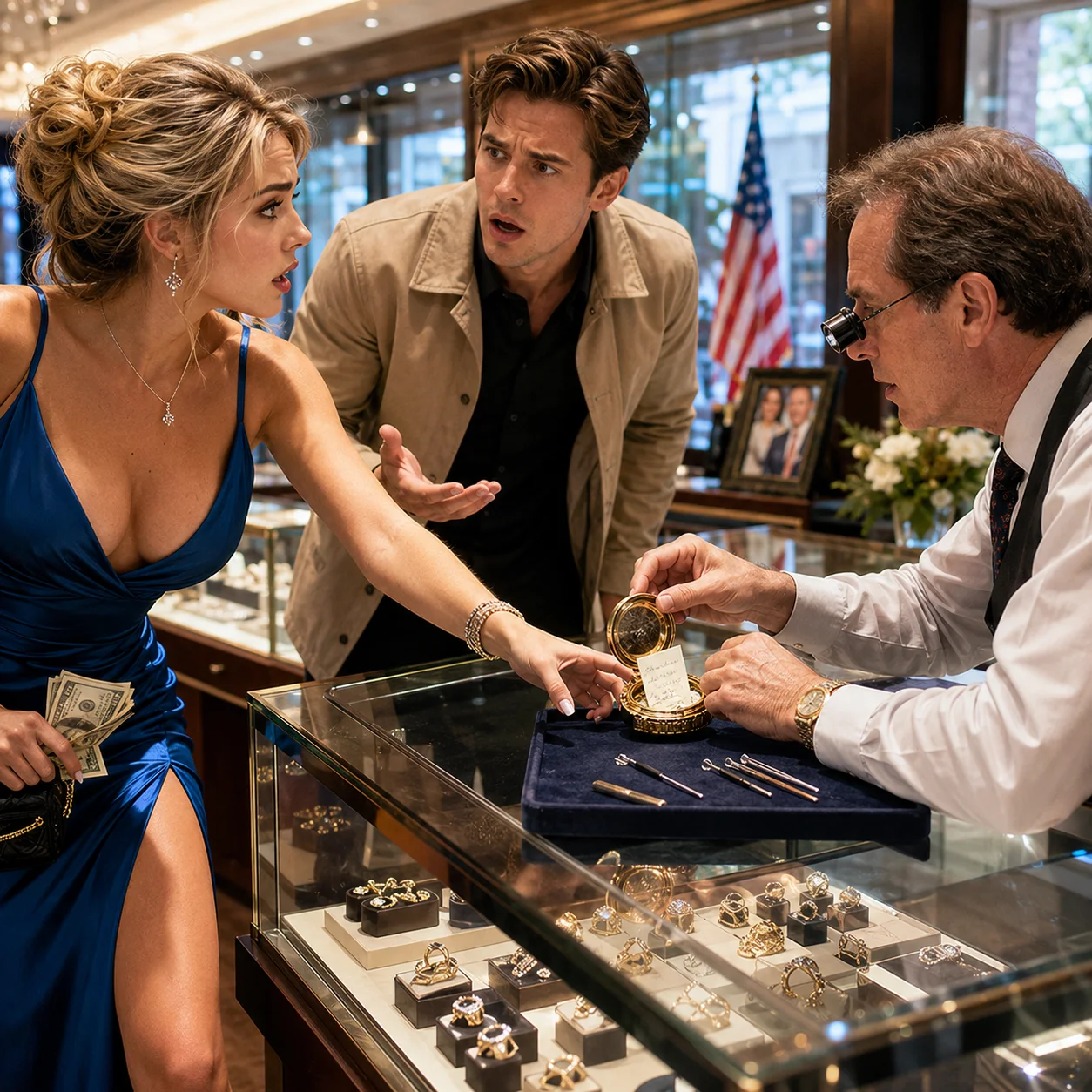
And now she had sold his watch.
Or tried to.
Walter gave me a small office in the back so I could read the letter privately. I sat in a leather chair beside a desk stacked with repair envelopes and watch catalogs. The rain tapped softly against the window. For a moment, I just held the paper.
Then I unfolded it.
My father’s handwriting was shakier than I remembered, but it was his. Every curve. Every uneven line.
My children,
If you are reading this, then either I found the courage to give it to you while I was alive, or time did what time always does and carried me where I could not come back from.
I hope it is the first one. Knowing myself, it is probably the second.
I laughed once through my nose, and tears came before I could stop them.
There are things a father says easily when his children are small. Brush your teeth. Wear your coat. Don’t run into the street. There are things he says badly when they are grown. I have said many things badly. I have avoided some things altogether. For that, I am sorry.
Daniel, you became the steady one before you should have had to. I watched you grow into a man who carries weight quietly, and I was proud of you, but I also leaned on that steadiness too much. I let you become the wall everyone else hit when they were falling. That was not fair to you.
I wiped my face with the heel of my hand.
Emily, my little storm, I loved you from the moment you arrived angry at the world. You felt everything loudly. Joy, fear, shame, want. I tried to soften the world for you, and in doing so I may have taught you that love means rescue. That was my mistake. Love is not rescue. Love is truth with open arms.
My throat tightened.
The watch you are holding is not valuable because of gold or gears. It belonged to my father before me, and his father before him. Every Harper man who wore it was imperfect, stubborn, proud, and scared more often than he admitted. I wore it when I married your mother. I wore it when both of you were born. I wore it the day I found out I was sick. I wore it because it reminded me that time is borrowed, not owned.
There is something else you need to know.
I stopped breathing for a second.
Years ago, after your grandfather died, I discovered that he had left more than the family knew. Not money exactly. Land.
The old five-acre parcel near Briar Creek, the one your grandmother always called useless woods, was never sold. Your grandfather transferred it into my name before he passed. I kept it because I could not bring myself to part with the last thing he touched, even when we needed money. Over the years, developers asked about it. I said no.
Last winter, before my diagnosis became impossible to ignore, I was contacted again. This time the offer was serious. Very serious. I did not sign. I wanted the choice to belong to both of you, but only if you could make it together.
I have placed the deed and related documents in a safe deposit box at First County Bank. The key is inside the lining of the old blue toolbox in the garage. Daniel, you know the one. Emily, you always hated that garage, but I hope you go anyway.
The property is to be held equally by both of you unless one of you tries to sell family property without the other’s knowledge. If that happens, I have instructed my attorney, Margaret Ellis, to place the parcel into a trust managed for your mother’s care first, and only after her passing may the remainder be divided.
This is not punishment. It is protection.
My hands began to tremble.
Daniel, do not become so hard that you mistake peace for victory.
Emily, do not sell what you have not taken time to understand.
Both of you, remember this: your mother is the home I built my life around. Take care of her. Take care of each other if you can. If you cannot, at least do not destroy what I left trying to make you whole.
I love you more than I ever knew how to say.
Dad
For a long time, I sat there staring at the last word.
Dad.
Not Thomas Harper. Not the man in the casket. Not the name on the funeral program. Dad.
I read the letter again. Then a third time.
By the time I stepped out of Walter’s office, I felt like the room had shifted around me. My anger at Emily was still there, hot and sharp, but underneath it was something worse. Sadness. Not just for what she had done, but for how completely she had misunderstood the man who loved her.
Walter looked up from the counter. “Are you all right?”
“No,” I said. “But thank you for calling me.”
“I had a feeling your father intended that letter to be found by family, not melted down with the case.”
I looked at the watch. “Can I take it?”
“Of course. I documented the condition and the compartment in case you need proof.”
“Proof?”
He hesitated. “Your sister was very insistent that the watch was hers to sell. She may not accept this quietly.”
That was the kindest warning anyone had ever given me.
I called Emily from the parking lot.
She answered on the fourth ring, breathless and annoyed. “What?”
“Where are you?”
“Busy.”
“Are you busy spending the money you didn’t get from Dad’s watch?”
Silence.
Then, “Oh my God. That old man called you?”
“That old man has more respect for Dad than you do.”
She scoffed. “Don’t start with me, Daniel. It was just a watch.”
I closed my eyes, my fingers tightening around the steering wheel. “Just a watch?”
“Yes. Just a watch. Dad is gone. He doesn’t need it. Mom doesn’t need it. You don’t even wear watches.”
“It was his.”
“And I’m his daughter.”
“You stole it from Mom’s house.”
“I did not steal it. I took something from my father’s belongings.”
“You took it without asking because you knew nobody would say yes.”
Her voice sharpened. “You don’t get to control everything just because you’re the responsible son.”
“There’s a letter.”
That stopped her.
“What?”
“There was a letter hidden inside the watch. From Dad. Addressed to both of us.”
For once, Emily didn’t have an immediate answer.
“What did it say?” she asked.
“You can come to Mom’s house tonight and hear it with her.”
“No. Tell me now.”
“No.”
“Daniel.”
“No,” I repeated. “You don’t get Dad’s final words over the phone like a bill reminder.”
She cursed under her breath. “You are so dramatic.”
“And you tried to pawn his watch.”
“I needed money.”
“You always need money.”
“You don’t know anything about my life.”
“I know you had enough gas to drive downtown and sell something that didn’t belong to you.”
She hung up.
I sat in the parking lot for several minutes, letting the rain drum against the roof.
Then I called my mother.
She answered softly, the way she had since Dad died, as if every sound in the world had become too loud.
“Hi, sweetheart.”
“Mom,” I said, and my voice cracked so hard I had to stop.
“What happened?”
“I found Dad’s watch.”
A tiny gasp. “I thought it was in his dresser.”
“It was. Emily took it.”
There was pain in her silence, but not surprise. That hurt more than if she had cried.
“She tried to sell it,” I said.
“Oh, Emily.”
“Mom, there was a letter inside.”
“What?”
“From Dad.”
This time she did cry.
I went to her house before evening. It was the same house I had grown up in, a pale yellow ranch with white shutters and a maple tree in the front yard that Dad had planted when Emily was born. The porch light was on even though the sun had not fully set. My mother did that now. She turned on lights early, like she was trying to keep absence away.
Inside, the house smelled like lemon cleaner and old grief. Dad’s coat still hung by the back door. His boots were lined up on the mat. Mom hadn’t moved them. I hadn’t asked her to.
She was sitting at the kitchen table when I walked in, wearing one of Dad’s cardigans over her blouse. She looked smaller than she had at the funeral.
I put the watch on the table.
She touched it with two fingers and broke.
I knelt beside her chair and held her while she cried into my shoulder. I was thirty-five years old, and for the first time in my life, I felt like the parent and the child at the same time.
“I didn’t know she took it,” Mom whispered.
“I know.”
“I should have checked.”
“Mom, no.”
“She has been asking about money again.”
Of course she had.
“How much?”
Mom looked away.
“How much, Mom?”
“She said she was behind on rent.”
“She owns a condo.”
“She said the association fees went up.”
I stood slowly. “Did you give her money?”
“Only a little.”
“How much?”
“Two thousand.”
I exhaled through my nose, trying not to sound angry at her. “Mom.”
“She was crying.”
“She cries because it works.”
My mother flinched, and guilt hit me immediately.
“I’m sorry,” I said. “I didn’t mean it like that.”
“Yes, you did,” she said quietly. “And you’re not wrong.”
That was new.
Before Dad died, my mother had defended Emily reflexively. After he died, she seemed too tired to argue with reality.
At seven-thirty, Emily arrived without knocking.
She came into the kitchen wearing a cream coat, high boots, and the expression of someone prepared to be offended before anyone spoke. Her dark hair was curled perfectly. Her eyes went straight to the watch on the table, then to the letter beside it.
“You had no right to keep that from me,” she said.
I stared at her. “Hello to you too.”
Mom wiped her face. “Emily, sit down.”
“I don’t want to sit down. I want to know why Daniel is acting like Dad made him king.”
I picked up the letter. “Dad wrote this to both of us.”
“Then read it.”
“I will. But first, you need to apologize to Mom.”
Emily blinked. “For what?”
“For taking Dad’s watch from her house.”
“It was not hers.”
“It was in her home,” I said. “In her bedroom. In Dad’s dresser.”
Emily rolled her eyes. “So now we’re pretending Mom was going to wear it?”
Mom’s face crumpled.
That was it for me.
“Get out,” I said.
Emily turned on me. “Excuse me?”
“You heard me. Get out if you’re going to talk to her like that.”
“This is exactly what I mean,” Emily snapped. “You think you’re Dad now.”
“No,” I said. “Dad had more patience.”
Her mouth tightened.
Mom raised a shaking hand. “Please. Both of you. Please don’t do this.”
Emily looked at her, and for one brief second, something like shame crossed her face. Then it was gone.
“Fine,” she muttered. “I’m sorry I took the watch.”
Mom closed her eyes. “Thank you.”
It wasn’t enough. It wasn’t close. But I read the letter.
I read every word.
At first, Emily stood with her arms crossed, chin lifted, like she was listening to a parking ticket being explained. But when I reached the part addressed to her, the part where Dad called her “my little storm,” her face changed. She looked younger. Almost like the sister who used to follow me around the backyard barefoot, shouting that she could climb trees too.
Then I reached the part about the land.
Her head snapped up.
“Wait,” she said. “What land?”
I kept reading.
When I finished, the room was completely still.
Even the refrigerator hum seemed too loud.
Emily stared at the letter. “How much is the land worth?”
I laughed once, not because it was funny, but because I couldn’t believe she had made it to that question so fast.
Mom whispered, “Emily.”
“What?” Emily said defensively. “You’re telling me Dad secretly owned land and nobody thought to mention it?”
“He mentioned it,” I said, holding up the letter. “Right after explaining that trying to sell family property behind each other’s backs would put it into a trust for Mom.”
Emily’s eyes narrowed. “That’s convenient.”
“What is?”
“That you found the letter after the jeweler called you. That you read it first. That suddenly there’s some rule that punishes me.”
“Dad wrote it before he died.”
“Prove it.”
The words landed like a slap.
Mom pushed back from the table. “Emily Rose Harper.”
Emily’s face flushed. “I’m just saying! Daniel has always acted like he deserves more because he stayed close and did all the good-son stuff.”
“The good-son stuff?” I repeated. “You mean taking Dad to chemo? Fixing Mom’s furnace? Handling funeral paperwork while you argued with the florist about refunding flowers?”
“I was grieving!”
“So was everybody else.”
“You don’t get to decide how I grieve.”
“No. But I do get to notice when your grief looks exactly like theft.”
She recoiled like I had hit her.
For a moment, I felt cruel.
Then she said, “I needed that money because my account is frozen.”
Mom looked alarmed. “Frozen? Why?”
Emily didn’t answer.
I stared at her. “What happened?”
“Nothing.”
“Emily.”
She grabbed her purse. “I’m not doing this.”
“You came here for the letter.”
“I came here because you made it sound like Dad left some beautiful message, not a trap.”
“A trap?” Mom whispered.
Emily pointed at the letter. “He knew I needed help. He knew Daniel would use this against me. And he still wrote that?”
Something in me went cold.
“No,” I said. “He knew one of us might try to turn grief into cash. He hoped we wouldn’t.”
Emily’s eyes shone, but she refused to let tears fall. “You’ve hated me for years.”
“I have loved you and been exhausted by you at the same time.”
That silenced her.
Mom covered her mouth.
Emily looked from me to Mom, then down at the watch.
“I only took it because I thought nobody cared about it but me,” she said, but the lie was tired even before it left her mouth.
I shook my head. “No, you took it because you thought nobody would catch you.”
She left without another word.
The next morning, I found the key exactly where Dad said it would be.
The old blue toolbox sat on a shelf in the garage beneath jars of screws, paint thinner, and a stack of Christmas lights Dad never threw away because “you never know.” The lining was torn at one corner. Inside, taped flat beneath the felt, was a small brass safe deposit key and a business card for Margaret Ellis, Attorney at Law.
I called her office from the garage.
Margaret Ellis was seventy if she was a day, with a voice like she had smoked cigarettes in a courtroom for forty years and won every argument she cared about. She agreed to meet that afternoon.
Her office was above a title company near the courthouse. Old law books lined one wall, and a framed photograph of her with my father sat on a side table. I hadn’t known they were friends.
“Your father was a stubborn man,” she said after shaking my hand. “I liked him.”
“That sounds right.”
“Did you bring the letter?”
I handed it to her.
She read it slowly, her expression unreadable. Then she removed a file from her desk drawer.
“He came to me six months before he passed,” she said. “He was already sick, but still sharp. He wanted the property handled carefully.”
“How much is it worth?”
Margaret slid a paper across the desk.
I looked at the number and sat back.
The offer from the developer was for $1.8 million.
For five acres of “useless woods.”
My father had sat in his recliner wearing slippers and an old flannel shirt, quietly holding a secret that could have changed all our lives.
“Why didn’t he tell us?” I asked.
“Because he was afraid money would finish breaking what illness had already cracked.”
I looked down.
Margaret continued. “The developer wants to build luxury townhomes. Your father refused their first offers. The latest is still active, but unsigned. He structured the property so that you and your sister inherit equal beneficial interest after your mother’s lifetime care is secured. However, there is a conduct clause.”
“The one in the letter?”
“Yes. If either beneficiary attempts to sell, transfer, conceal, or liquidate family property without disclosure to the other and to your mother, control of the parcel moves into a trust for your mother’s sole benefit during her lifetime. After her passing, any remaining proceeds can be divided, but with deductions for documented misconduct.”
I rubbed my forehead. “Does the watch count?”
“It may.”
“It wasn’t the land.”
“No, but it was family property specifically tied to the disclosure letter. Your father anticipated emotional items being sold before practical ones. That watch was not just a watch. It was the trigger for revealing the rest.”
I stared at her. “So what happens now?”
“That depends on what you want.”
“What I want is for my sister to stop bleeding my mother dry.”
Margaret leaned back. “Then we document everything properly. No threats. No family shouting matches. Receipts, statements, dates. You’ll need your mother’s consent if we are to protect her accounts.”
“Mom hates conflict.”
“Most people do until conflict starts taking their house.”
That sentence stayed with me.
I drove back to Mom’s house with copies of documents in a folder and a headache behind my eyes. She was in the living room, folding Dad’s shirts into a plastic bin. Not giving them away yet. Just folding them because she needed something to do with her hands.
I told her everything.
The land. The offer. The trust. The clause. The money she had given Emily. The need to protect her bank accounts.
At first, she looked overwhelmed. Then she looked ashamed.
“I thought I was helping,” she said.
“You were trying to love her.”
“What if those are the same thing to me?”
I sat beside her. “Then Dad was right. Love can’t only be rescue.”
She touched the folder in my hand. “He really wrote that?”
“Yes.”
“I wish he had said it to her when he was alive.”
“So do I.”
Mom looked toward the hallway, where Dad’s photograph sat on a narrow table. “He tried. She would cry. He would stop.”
I didn’t say anything.
Because that was the Harper family pattern in one sentence.
Over the next week, everything Emily had tried to keep hidden started surfacing.
Her condo association fees weren’t the problem. She was three months behind on her mortgage. Her car was two payments from repossession. She had taken out a personal loan in Mom’s name the year before, claiming Mom had co-signed, though the signature looked wrong enough that Margaret asked for copies immediately. She had opened a store credit card using Mom’s address. She had borrowed from two cousins and told both that I had promised to pay them back after “Dad’s estate cleared.”
My phone became a battlefield.
Emily called me forty-three times in two days. When I didn’t answer, she texted.
You’re turning Mom against me.
Dad would be disgusted with you.
You only care because now there’s money.
I hope you enjoy being alone with your perfect little conscience.
I didn’t respond.
Margaret told me not to unless necessary. “Silence is cheaper than litigation,” she said.
But silence did not stop Emily from coming to Mom’s house on Sunday morning.
I was there changing the filter in the furnace when I heard shouting upstairs.
By the time I reached the kitchen, Emily was standing by the table with her purse open, while Mom stood near the sink looking pale.
“What are you doing?” I asked.
Emily spun around. “Of course you’re here.”
I looked at the purse. “What’s in the bag?”
“None of your business.”
Mom’s voice shook. “She wanted your father’s cufflinks.”
Emily threw up her hands. “Because they’re mine too! Everything in this house is half mine eventually, isn’t it?”
“No,” I said.
She laughed bitterly. “Right. I forgot. Saint Daniel gets to decide.”
“Put them back.”
“You’re insane.”
“Put them back, or I call Margaret and the police. Your choice.”
Mom whispered, “Daniel, please.”
I didn’t look away from Emily. “No, Mom. Not this time.”
Emily’s eyes filled with tears. Real ones, maybe. Weaponized ones, maybe. At that point, it didn’t matter.
“I am drowning,” she said. “Does that mean nothing to you?”
“It means you need help,” I said. “But stealing from our dead father and our grieving mother is not help.”
“I was going to replace them.”
“With what money?”
Her face twisted. “You like this. You like seeing me low.”
“No,” I said quietly. “I hate it. I hate that you turned yourself into someone I have to protect Mom from.”
That landed harder than yelling would have.
Emily reached into her purse, pulled out Dad’s cufflinks, and slammed them onto the table. One rolled toward the edge. I caught it before it fell.
Then she broke.
Not the dramatic crying she used when she wanted someone to soften. Not the sharp, angry tears that came with blame. This was different. Ugly. Collapsing. She sank into a chair, covered her face, and sobbed like a child.
Mom took one step toward her.
I gently caught her arm.
“Wait,” I said.
Mom looked at me, torn in half.
Emily cried for a long time. When she finally spoke, her voice was small.
“I thought he loved you more.”
The room went still.
I looked at her.
She stared at the table, mascara running down her cheeks. “Dad trusted you with everything. The bills. The doctors. The house. Mom. He told you things. He asked you for things. He looked relieved when you walked into a room.”
My anger shifted, not gone, but forced to make room for something older.
“He looked relieved because I showed up,” I said.
“I didn’t know how.”
“You knew how to ask for money.”
She flinched.
I regretted it, but not enough to apologize.
Emily wiped her face. “When he got sick, I panicked. Every time I saw him, he looked less like Dad. I couldn’t stand it. So I made everything about errands and bills and stupid problems because if I needed something, he still got to be Dad. He still got to fix it.”
Mom began crying again, silently this time.
Emily looked at her. “I’m sorry.”
Mom pressed a hand over her mouth.
“I’m sorry,” Emily said again. “I know that doesn’t fix it.”
“No,” I said. “It doesn’t.”
Emily looked at me. “What do you want me to do?”
For the first time in years, the question sounded real.
I sat across from her.
“I want you to admit everything to Margaret. Every loan. Every account. Every dollar Mom gave you. I want you to sign paperwork agreeing not to remove anything else from this house. I want you to meet with a debt counselor. And I want you to stop using Dad’s death as an excuse to take whatever you can reach.”
Her face hardened out of habit, but only for a second. Then it broke again.
“And if I don’t?”
“Then I will protect Mom legally, even if it ruins what’s left between us.”
She looked at Mom.
Mom’s voice trembled. “I love you, Emily. But I can’t keep paying for you with pieces of your father.”
Emily closed her eyes.
That was the first honest day.
It did not magically heal us.
Real life is not that generous.
Emily did meet with Margaret. She admitted to taking the watch, attempting to sell it, taking money from Mom, and opening one credit account that Margaret immediately flagged for investigation. The personal loan was more complicated. Emily insisted Mom had verbally agreed. Mom insisted she had not understood what she was signing. Margaret handled it with the bank, and after weeks of paperwork, the loan was restructured away from Mom’s primary accounts.
The developer’s offer on the land remained open, but Margaret advised waiting. If sold too quickly, it would feel like Dad’s fear had come true. If held carefully, it could become what he intended: security for Mom, not a prize for us to fight over.
So the parcel went into a trust.
Mom’s care came first. Her house repairs, medical expenses, taxes, and living costs would be protected. Emily and I would not receive direct distributions unless Margaret and the trustee approved them according to Dad’s instructions.
Emily was furious at first.
Then embarrassed.
Then quiet.
Quiet was new for her.
She sold her condo before foreclosure and moved into a small apartment across town. Not glamorous. Not the life she posted online. She got a job managing reception at a dental office, which she complained about for three weeks and then, strangely, became good at. She started sending Mom small payments every month. Not enough to erase what she had done. Enough to prove she understood there was something to repay.
For months, we existed carefully.
We had Sunday dinners again, but they were different. Mom no longer slipped Emily cash in the laundry room. I no longer cleaned up every problem before anyone felt discomfort. Emily no longer walked into the house and took things from drawers.
The watch stayed with Mom at first.
She kept it on Dad’s bedside table, beside his reading glasses and a photograph of the four of us from a beach trip in 2001. In the photo, Emily was missing a front tooth, I had sunburned shoulders, Dad looked young enough to be immortal, and Mom was laughing at something outside the frame.
One evening, almost a year after Dad died, Mom called me and asked me to come over.
Emily was already there when I arrived.
That still made me tense sometimes, but less than before.
Mom had made coffee. The good kind, not the instant she drank when she was alone. On the kitchen table sat Dad’s watch.
My chest tightened.
Mom looked at both of us. “I’ve been thinking.”
Emily smiled faintly. “That usually means we’re about to be assigned something.”
Mom almost laughed. Almost.
“I don’t want this watch sitting in a drawer forever,” she said. “Your father wore it. His father wore it. Things like this are meant to carry time, not gather dust.”
She looked at me.
“Daniel, I want you to have it.”
Emily lowered her eyes.
I shook my head. “Mom—”
“No,” she said gently. “Listen. I want you to have it. Not because you earned more love. Not because Emily earned less. Because you will keep it safe.”
Emily swallowed.
Mom reached across the table and took her hand. “And I want you to be part of that, Emily. When Daniel’s son or daughter gets it someday, if that happens, they should know the whole story. Not just the pretty parts.”
Emily nodded, tears shining in her eyes. “Okay.”
I picked up the watch carefully.
It felt heavier than I remembered.
Mom also handed me the letter, now sealed in a protective sleeve.
“Keep them together,” she said.
“I will.”
Emily looked at the watch for a long moment. “Can I say something?”
I braced myself.
“I used to think Dad gave you responsibility because he trusted you more,” she said. “Now I think he gave it to you because you accepted it. And he kept rescuing me because I kept asking him to. That wasn’t fair to any of you.”
No one spoke.
Then she looked at me. “I’m sorry I sold it.”
“Tried to sell it,” I said.
She gave a small, sad laugh. “Fine. Tried to sell it.”
I looked down at the scratched gold case, at the initials Thomas J. Harper, at the tiny hidden seam where Dad had tucked his final words.
“I’m sorry too,” I said.
Emily blinked. “For what?”
“For becoming so angry that I stopped seeing anything else.”
She nodded slowly. “You had reasons.”
“So did you,” I said. “They just weren’t excuses.”
For the first time in a long time, we understood each other perfectly.
Not healed.
Not fixed.
But understood.
That summer, we visited the Briar Creek property together.
The three of us drove out on a warm Saturday morning, past subdivisions and shopping centers, until the road narrowed and the trees thickened. The land didn’t look like $1.8 million. It looked like shade, weeds, birds, and silence. A broken fence leaned near the entrance. Wild blackberries grew along the edge. Somewhere deeper in, a creek moved over stones with a sound so soft it felt private.
Mom stood beside the car, looking around with tears in her eyes.
“Your father brought me here once,” she said. “Before you were born. He said someday he’d build me a house with a porch facing the trees.”
“Why didn’t he?” Emily asked.
Mom smiled sadly. “Life got expensive. Then children got expensive. Then dreams became grocery lists.”
Emily reached for her hand.
We walked the property slowly. I wore Dad’s watch for the first time that day. It didn’t fit perfectly. The strap was old, and the case sat heavy on my wrist, but every few minutes I felt it there and thought of his letter.
Time is borrowed, not owned.
Near the creek, Emily stopped.
“What if we don’t sell it?” she asked.
I looked at her. “Ever?”
“I don’t know. Maybe not yet.”
Mom looked surprised. “You were the one asking what it was worth.”
Emily crouched near the water and picked up a smooth stone. “I know.”
She turned it in her palm.
“I spent so much time wanting whatever Dad left behind to fix my life,” she said. “But maybe he left this because he knew we needed one thing we couldn’t cash out immediately.”
The old Emily would never have said that.
Or maybe she would have, if we had all stopped rescuing and accusing long enough to let her become someone else.
A few months later, with Margaret’s help, we leased a small portion of the land to a local conservation program and used part of the income for Mom’s house repairs. The rest stayed protected. The developer came back with a larger offer. We declined.
Not forever.
Just for now.
On the first anniversary of Dad’s death, we gathered at Mom’s house. No big memorial. No speeches. Just dinner, coffee, and one of Dad’s favorite apple pies from the bakery downtown.
After dinner, Emily brought out a small box.
She placed it in front of Mom.
“What is this?” Mom asked.
“Open it.”
Inside were Dad’s cufflinks, professionally cleaned and polished.
Emily’s hands twisted nervously in her lap. “I know cleaning them doesn’t erase what I did. But I wanted them restored. Properly. Not sold. Not hidden.”
Mom touched them, then touched Emily’s cheek.
“Thank you.”
Emily cried quietly.
I looked down at Dad’s watch on my wrist.
It was ticking.
That sound used to make me think of loss. Of hospital rooms and funeral flowers. Of all the words my father had not said until he had to hide them inside a watch and trust fate to deliver them.
But sitting there with my mother smiling through tears, my sister trying in imperfect but real ways, and my father’s final letter safely tucked in my desk at home, the ticking sounded different.
Not like time running out.
Like time continuing.
A year earlier, I thought Emily selling that watch was the final proof that my family was broken beyond repair. I thought the jeweler’s call would be the beginning of another fight, another mess I had to clean up, another reason to harden my heart.
In some ways, it was all of that.
But it was also the last gift my father gave us.
He knew us well enough to fear what grief and money might do. He knew Emily might reach for cash before memory. He knew I might choose control before mercy. He knew my mother might keep giving until nothing was left of her. So he hid the truth where only a moment of carelessness could uncover it.
Inside the watch.
Inside the thing Emily tried to sell.
Inside time itself.
And because Walter Reeves had been honest, because my father had been wise, and because one final letter said what none of us had been brave enough to say aloud, we did not lose everything.
Emily did not become perfect. Neither did I. Families don’t heal like movie endings, all at once under golden light. They heal in receipts repaid, in doors knocked on instead of barged through, in apologies that come without excuses, in mothers who finally learn that love can have boundaries, and in siblings who sit across from each other at a kitchen table and choose not to destroy what is left.
Sometimes I still take the watch off at night and turn it over in my hand.
The initials are fading now.
Thomas J. Harper.
My father.
A man who made mistakes. A man who loved too softly sometimes and rescued too often. A man who left behind land, a letter, and one final lesson none of us wanted but all of us needed.
Some things are worth more than what anybody will pay you for them.
And some inheritances are not money at all.
They are warnings.
They are second chances.
They are the sound of an old watch still ticking after everyone thought the time had run out.

![[FULL STORY] My Influencer Girlfriend Threatened To Leave Me For A Richer Man, So I Opened The Door And Helped Her Pack](https://social-media.rabedo.com/thumbnails/1777220021_R10.png)