“Loose ends,” she said.
I did not press. Grandma believed in privacy, and I respected that.
On the drive home, she watched the fields pass by the window. It was late October, the trees half-bare, the sky low and gray.
After a while, she said, “Danny, promise me something.”
“Anything.”
“When I’m gone, do not let them convince you that love has to be loud to be real.”
I glanced at her. “What does that mean?”
“It means some people perform grief because they did not practice love.”
I swallowed hard. “Grandma…”
She reached over and rested her hand on mine. Her fingers were thin, cool, and still steady.
“You were there,” she said. “That is enough.”
Those were not her last words to me, but they were the ones that stayed.
She died on a Tuesday morning before sunrise.
Patricia called me at 5:42 a.m. I remember because I stared at the number on my phone like it might change if I looked hard enough. I drove to the farmhouse in darkness, wearing yesterday’s jeans and one shoe untied. Grandma was in her bed by the window, the quilt pulled up to her chest, her face strangely calm. The room smelled faintly of lavender lotion and the coffee Patricia had made but not touched.
I sat beside her and cried like I had not cried since my father died.
For twenty minutes, there were no cousins, no inheritance, no family politics. Just me, my grandmother, and the terrible silence that comes after the last person who truly knew your childhood is gone.
Then Uncle Richard arrived.
He walked into the room in a wool coat, looked at Grandma, sighed heavily, and said, “We need to start making arrangements.”
Not “my mother is gone.” Not “Daniel, are you all right?” Not even a pause long enough to let the room breathe.
Just arrangements.
By noon, the family machinery had started. Richard took charge of the funeral home. Marlene coordinated flowers. Brittany designed a memorial slideshow. Olivia posted a black-and-white photo of herself holding Grandma’s hand with a caption about “losing my best friend,” even though she had visited three times that year and once left after fifteen minutes because the house “smelled old.”
I stayed quiet at first. Grief made me slow. Or maybe I was just too tired to argue.
Then I found out they had scheduled the funeral for Saturday without telling me.
Patricia mentioned it by accident when I called to ask about Grandma’s medications.
“I assume I’ll see you at St. Matthew’s on Saturday,” she said gently.
I froze. “Saturday?”
A pause.
“Oh, Daniel. They did tell you, didn’t they?”
No. They had not.
I called Uncle Richard. He did not answer. I called Uncle Paul. No answer. I texted Brittany.
She replied twenty minutes later.
“Everything is being handled. Service is private family only.”
I stared at those words until they blurred.
Private family only.
I typed back, “I am family.”
Her response came quickly.
“Please don’t make this difficult. Grandma wouldn’t want drama.”
I almost laughed. Grandma hated drama, yes. But she hated cruelty more.
I called Margaret Ellis, the lawyer, because Grandma had once written her number on a card and told me to keep it somewhere safe. I did not even know why I called. Maybe I wanted someone outside the family to confirm that I was not losing my mind.
Ms. Ellis answered personally.
“Daniel,” she said, and her voice softened in a way that told me she already knew. “I was going to contact you this afternoon. I’m sorry about your grandmother.”
“Thank you,” I said, gripping the phone. “Did you know they made the funeral private?”
There was a silence.
“No,” she said carefully. “That surprises me.”
“They didn’t tell me until I asked.”
“Your grandmother left instructions regarding her service,” Ms. Ellis said. “My office has a copy. She specifically requested that you be included.”
My chest tightened. “Can you tell them that?”
“I already sent documentation to the funeral home yesterday,” she said. “I will send it again.”
For the first time in two days, I could breathe.
But I underestimated my cousins.
Saturday morning came cold and bright, the kind of winter sunlight that makes everything look sharper than it should. I wore my only black suit, the one I had bought for my father’s funeral fifteen years earlier and had altered twice since. In my breast pocket, I tucked a white rose from Grandma’s garden. The bushes had no business blooming that late, but one small flower had survived near the porch railing. I clipped it carefully before driving to the church.
St. Matthew’s sat on a hill at the edge of town, built from pale stone with red doors and stained-glass windows. My grandparents had been married there. My father was baptized there. Grandma had attended Christmas Eve services there for more than sixty years.
When I pulled into the lot, I saw my cousins near the entrance in dark coats, standing together like a security team.
Brittany noticed me first.
Her expression changed so quickly that I almost missed it. Surprise, then irritation, then a polished sadness she probably practiced in mirrors.
“Daniel,” she said as I walked up the steps. “What are you doing here?”
I stopped. “Attending my grandmother’s funeral.”
Grant stepped slightly in front of the door. He was tall, broad-shouldered, wearing a navy suit and a watch that flashed every time he moved. “This is immediate family only.”
I looked from him to Brittany to Olivia. “Then move.”
Olivia folded her arms. “Don’t be disrespectful.”
Something inside me went still.
“Disrespectful?” I repeated. “I spent the last year taking her to cardiology appointments while you asked her about jewelry. Do not talk to me about respect.”
Brittany’s face hardened. “This is exactly why we didn’t want you here. You always make everything about yourself.”
“I found out about the funeral from her nurse.”
“Because arrangements were complicated,” she said.
“No. Because you tried to exclude me.”
Grant leaned closer and lowered his voice. “Listen, nobody wants a scene. Just go home. We’ll send you a program.”
A program.
Like I was a distant coworker. Like I had not held Grandma’s hand through nights when she was too frightened to sleep.
I reached for the door handle.
Grant blocked me.
“Move,” I said.
His mouth tightened. “You’re not on the list.”
I stared at him. “There is a list for Grandma’s funeral?”
Brittany looked away.
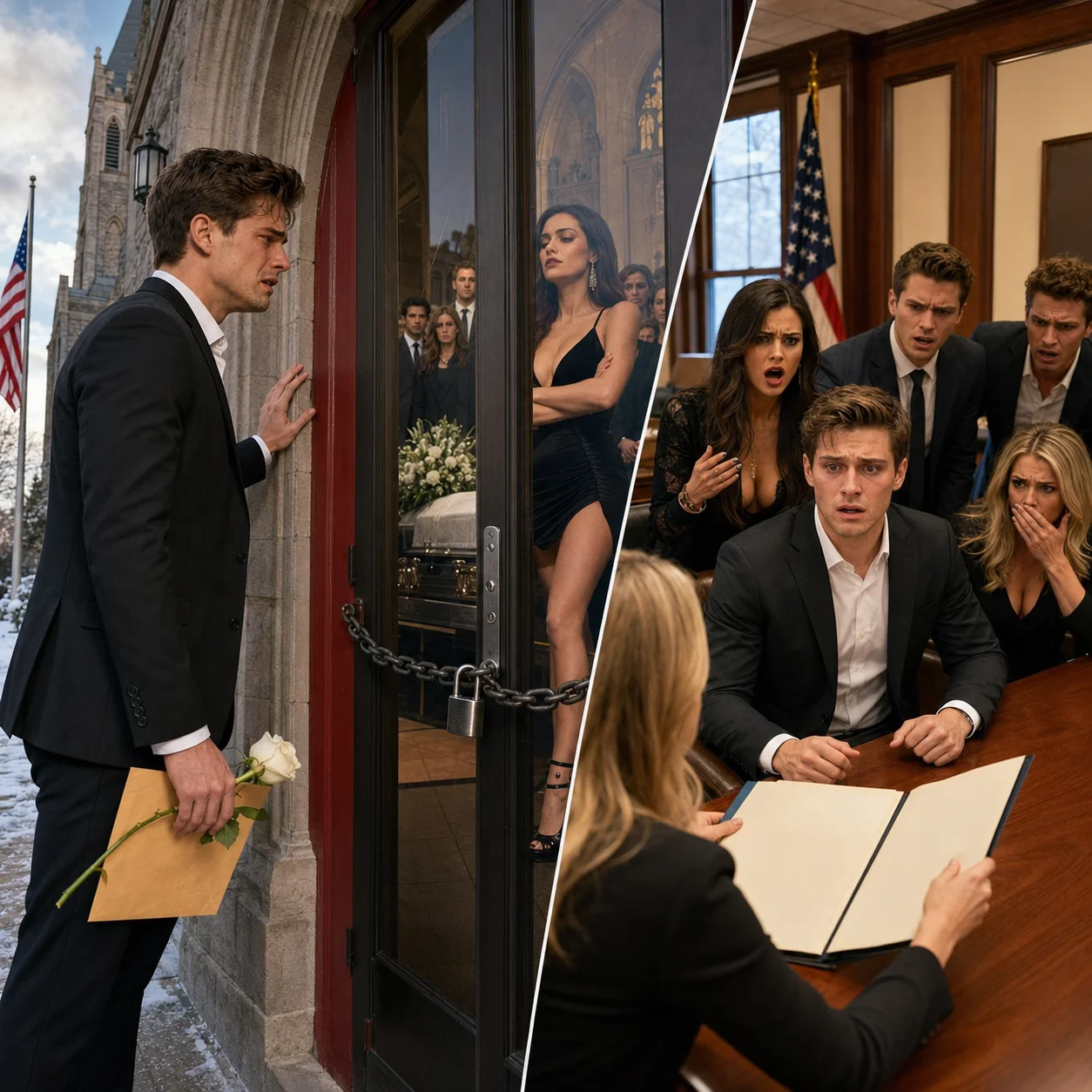
That was when I saw Marlene inside the vestibule, speaking to an usher. She glanced through the glass, saw me, and made a small cutting motion with her hand.
The usher locked the inner door.
The sound was soft. Almost polite.
But it went through me like a gunshot.
For a moment, I could not move. People were arriving behind me. Old neighbors. Church ladies. A few of Grandma’s friends from the garden club. Some looked uncomfortable. Some pretended not to see. Others watched with the helpless curiosity people have when cruelty happens in public but does not require them to intervene.
Mrs. Gable, Grandma’s neighbor from across the road, stepped forward with tears in her eyes.
“Daniel?” she said. “Why aren’t you inside?”
Brittany turned quickly. “There’s been a misunderstanding. Daniel agreed to join us later.”
“I did not,” I said.
Grant’s voice dropped to a whisper. “You need to leave before you embarrass yourself.”
That was the moment the grief cracked open and something hotter came through.
“I am not the embarrassment here,” I said.
Brittany’s eyes flashed. “Grandma would be ashamed of this.”
I looked at her for a long second.
“No,” I said quietly. “She would recognize it.”
Then the organ began inside.
The service was starting.
And I was still outside.
I could have forced the issue. I could have called Ms. Ellis. I could have yelled loud enough that every person in the sanctuary heard me. But I looked through the glass and saw Grandma’s casket at the front of the church, covered in white flowers, and I suddenly knew I could not turn her funeral into a battlefield. Not because they deserved my restraint, but because she deserved my dignity.
So I stepped back.
Mrs. Gable put a trembling hand on my arm. “Honey…”
“It’s okay,” I said, though nothing was okay.
I walked down the steps and stood beside the church garden, where a small statue of St. Francis watched over a bed of frozen leaves. Through the stone walls, I could hear muffled music. I could not hear the eulogies, but later I learned Brittany gave one. She apparently cried beautifully while talking about Grandma’s “generous spirit” and “the importance of family.” Grant read a poem he found online. Olivia placed a hand on the casket and whispered something dramatic enough for the front row to notice.
I stood outside for the entire service.
The white rose in my hand bent from how tightly I held it.
At one point, snow began to fall lightly, not enough to cover anything, just enough to make the air look full of static. I watched my breath appear and disappear. I thought about Grandma’s kitchen, her blue teapot, her laugh when I burned the first batch of peach jam, the way she called every stray cat “sir” or “ma’am” as if manners applied to all living creatures.
When the church doors finally opened, people streamed out slowly.
Some avoided me. Some touched my shoulder. Mrs. Gable hugged me hard and whispered, “Your grandma loved you most honest, Danny. Don’t you forget that.”
Then my family emerged.
Uncle Richard looked annoyed to see me still there.
Marlene’s eyes flicked to the rose. “Daniel, this really wasn’t necessary.”
I almost asked what she meant. My presence? My grief? My refusal to vanish on command?
Instead, I walked past her toward the hearse.
Brittany moved to block me again. “Family is riding together.”
I looked at the casket being loaded into the car. “I’m going to the cemetery.”
Grant scoffed. “In what car? There’s no room in the procession.”
That was a lie. I could see three empty seats in Uncle Paul’s SUV.
But I did not argue. I drove behind the procession at a distance, without the little orange funeral sticker on my windshield, following like a shadow they had failed to shake.
At the cemetery, they could not lock me out. I stood at the back while the minister read prayers into the wind. My uncles stood in front. My cousins clustered near the casket. Brittany cried into a lace handkerchief. Olivia leaned against Marlene. Grant stared at the ground like someone trying to look solemn for a camera.
When the minister invited family to place flowers on the casket, no one turned toward me.
So after everyone else stepped back, I walked forward alone and placed Grandma’s white rose on top.
“Thank you,” I whispered.
Brittany muttered something under her breath. I did not catch it. I did not need to.
The burial ended. People left for a reception at Richard’s house. No one invited me.
I went to Grandma’s farmhouse instead.
The house was quiet in a way that felt unnatural. Without the hum of her oxygen machine, without the kettle, without the television murmuring old detective shows in the den, it felt like the building itself was holding its breath. I let myself in with the key Grandma had given me years earlier, expecting maybe to sit in the kitchen for a few minutes and say goodbye privately.
But the moment I stepped inside, I knew someone had been there.
Drawers were open. Cabinet doors hung wide. The hallway closet had been emptied onto the floor. In the living room, Grandma’s photo albums were stacked carelessly on the couch. The glass cabinet where she kept Grandpa’s military medals was unlocked and half-empty.
My grief turned cold.
I walked room to room. Her jewelry box was gone. The antique clock from the mantel was gone. Several framed photos were missing, including the one of my father holding me as a newborn. In Grandma’s bedroom, her dresser drawers had been searched. Someone had even pulled up the corner of the rug, as if expecting cash underneath.
They had robbed her house before she was even fully buried.
I took pictures of everything.
Then I called Ms. Ellis.
She arrived forty minutes later in a gray coat, her face grim. Behind her came a man named Officer Reynolds, who looked tired in the way small-town police officers often do when they already know every family involved.
Ms. Ellis stood in Grandma’s living room, looking at the open drawers and scattered memories.
“Your grandmother anticipated conflict,” she said softly. “But I hoped they would at least wait.”
Officer Reynolds took my statement. I gave him names, times, photos. I told him who had keys, who had talked about items, who had access. He did not promise anything dramatic, but he did say, “Do not touch anything else until we document it.”
Ms. Ellis walked me onto the porch while the officer photographed the living room.
“Daniel,” she said, “the will reading is Monday at ten. My office.”
I nodded.
“I need you to be there.”
“I’ll be there.”
She studied my face. “I also need you to understand that what happens Monday may be difficult.”
I let out a humorless laugh. “More difficult than being locked out of Grandma’s funeral?”
Her expression did not change.
“Yes,” she said. “Possibly.”
That answer stayed with me all weekend.
On Sunday night, Brittany sent a group text to the family, accidentally including me or intentionally wanting me to see it. I still do not know which.
“Reminder: Will reading tomorrow. Let’s stay united and not allow outside influences to twist Grandma’s wishes.”
Outside influences.
That was me. The grandson who had fixed the ramp. The grandson who had slept in hospital chairs. The grandson who had stood outside the church because they decided grief required permission.
I did not respond.
Monday morning, I arrived at Margaret Ellis’s office fifteen minutes early. It was on the second floor of a brick building downtown, above an insurance agency and across from a coffee shop. The waiting room smelled like paper, lemon polish, and old radiators.
Ms. Ellis’s assistant, a young man named Kevin, offered me coffee. I declined because my stomach felt like stone.
At 9:58, the elevator opened.
My family arrived together.
Uncle Richard led them in, wearing a charcoal suit and the expression of a man arriving to collect something already his. Marlene followed with a leather folder tucked under one arm. Uncle Paul and Teresa came next. Brittany, Grant, Olivia, Connor, and Blake trailed behind, dressed like mourners at a luxury brand photoshoot.
Brittany saw me and stopped.
“What is he doing here?” she asked.
Ms. Ellis appeared in her office doorway. “Mr. Harper is a named party. Please come in.”
Brittany’s eyebrows pulled together. “Named party?”
Ms. Ellis did not answer. She turned and walked into the conference room.
The room had a long mahogany table, twelve chairs, and a wall of shelves filled with legal books that probably existed mostly to intimidate people. A pitcher of water sat in the center of the table with glasses no one touched.
I sat near the end. My relatives filled the opposite side as if forming a jury.
Ms. Ellis took her seat at the head of the table and opened a folder.
“Before we begin,” she said, “I want to make clear that this office represents the estate of Evelyn Margaret Harper. My role is to administer her documented wishes, not to negotiate what anyone believes those wishes should have been.”
Uncle Richard gave a small smile. “Of course.”
Ms. Ellis looked at him over her glasses. “I also want to state that Mrs. Harper updated her estate documents several times in the last decade, most recently three weeks before her passing. At each meeting, I found her to be mentally clear, consistent, and fully aware of her assets and family relationships.”
Marlene shifted in her chair.
Grant whispered something to Brittany. She shushed him.
Ms. Ellis continued. “The will includes a personal statement from Mrs. Harper. She requested that it be read before the distribution clauses.”
She unfolded a sheet of paper.
The room went still.
Ms. Ellis began.
“To my family, if you are hearing this, then I have gone where none of you can follow yet. I hope you came to this room with love in your hearts, but I know some of you came with expectations in your hands.”
Uncle Paul looked down.
Ms. Ellis read on.
“I have lived long enough to understand that inheritance can reveal what grief politely hides. I do not wish for my death to become a marketplace. I do not wish for my home to be picked clean before my body is cold. I do not wish for anyone to confuse blood with loyalty.”
My pulse thudded in my ears.
Brittany’s face had gone pale.
Ms. Ellis turned to the next page.
“There is one person among you who showed up without asking what he would receive. One person who came when there was no audience. One person who knew the pharmacy schedule, the loose porch board, the tea I liked, the stories I repeated, and the pain I tried to hide. That person is my grandson, Daniel Harper.”
Every head turned toward me.
I could not move.
Ms. Ellis continued, her voice steady.
“Danny, you were the keeper of my quiet days. You were your father’s son in every way that mattered. If my love ever failed to protect you from the coldness of this family, let this document do what I could not do loudly enough while I lived.”
Brittany made a small sound, somewhere between disbelief and anger.
Ms. Ellis lowered the page briefly. “Shall I continue?”
No one answered.
She continued.
“I leave my farmhouse, the surrounding twelve acres, all structures upon the property, and all contents not otherwise specifically designated, to my grandson, Daniel Harper.”
The room exploded.
“What?” Grant snapped.
Brittany stood halfway out of her chair. “That’s impossible.”
Uncle Richard’s voice cut through the room. “Margaret, there must be a misunderstanding.”
“There is not,” Ms. Ellis said.
Marlene leaned forward. “The house was supposed to stay in the family.”
“It is staying in the family,” Ms. Ellis replied. “With Daniel.”
Grant pointed at me. “He manipulated her.”
I finally found my voice. “I never asked her for anything.”
“That’s the act,” Brittany said, eyes sharp with hatred. “Poor, humble Daniel. Always helpful. Always hovering.”
Ms. Ellis tapped the document once on the table. “Mrs. Harper anticipated that accusation.”
The room quieted again.
Ms. Ellis read from another section.
“If anyone claims Daniel influenced me, ask them where they were on the nights he slept in the den because I was afraid I would not wake up. Ask them who learned how to change the filter in my oxygen concentrator. Ask them who paid for the ramp when others discussed curb appeal. Ask them who visited when there were no holidays, no photographs, and no witnesses.”
My throat closed.
I stared at the table because if I looked at anyone, I would break.
Uncle Richard’s jaw tightened. “This is emotional manipulation from beyond the grave.”
Ms. Ellis looked at him calmly. “It is a personal statement attached to a legally valid will.”
She continued with the distributions.
Grandma left Uncle Richard one dollar and a handwritten note. Uncle Paul received the same. Their wives received nothing. Each cousin received a sealed envelope containing a personal letter and one item Grandma had chosen for them.
Brittany received a recipe card box.
Grant received Grandpa’s old measuring tape.
Olivia received a pressed flower Bible bookmark.
Connor received a fishing lure from a trip he had once taken with Grandpa as a child.
Blake received a small wooden box of old buttons.
No one spoke at first.
Then Blake laughed once, harsh and ugly. “Buttons?”
Ms. Ellis’s eyes flicked to him. “Your grandmother wrote that you used to play with them on her kitchen floor when you were three.”
Blake’s face reddened. “I don’t care what I did when I was three.”
“That,” Ms. Ellis said quietly, “may be why she chose them.”
Brittany’s hands shook as she opened her envelope. She scanned the letter, then slammed it onto the table.
“This is cruel.”
Grant grabbed his envelope but did not open it. “We’re contesting.”
“You are entitled to consult counsel,” Ms. Ellis said. “However, I will remind you that Mrs. Harper included a no-contest clause. Anyone who challenges the will and fails forfeits any gift made to them.”
“What gift?” Connor muttered. “A fishing lure?”
Ms. Ellis looked at him. “Sentimental items are still gifts.”
Uncle Richard stood. “Mother was not in her right mind.”
Ms. Ellis folded her hands. “Your mother passed two cognitive evaluations within the last eight months. I have copies. Her primary physician also signed a statement three weeks ago confirming capacity.”
Marlene’s voice was thin. “This is because of him.”
Everyone looked at me again.
I did not feel victorious. That surprised me. I had imagined, in some distant childish corner of my mind, that being proven loved would feel like winning. It did not. It felt like standing in the wreckage of something that should have been a family.
Uncle Richard leaned across the table.
“You think you’ve won?” he said to me. “You think because an old woman got sentimental, you own our history?”
I looked at him, and for the first time in my life, I was not afraid of his disappointment.
“No,” I said. “I think Grandma made a choice.”
“She was our mother.”
“She was my grandmother.”
“We built this family.”
I shook my head. “No. She did.”
The silence after that felt sharp enough to cut skin.
Ms. Ellis moved to the next matter.
“There is also the issue of property removed from the farmhouse after Mrs. Harper’s death and before the estate inventory.”
Brittany went still.
Grant looked at Marlene.
Ms. Ellis removed several photographs from another folder and placed them on the table. My photographs. Open drawers. Empty shelves. Missing cabinet contents.
“Mrs. Harper’s home was entered after her passing,” Ms. Ellis said. “Items appear to have been removed. As the farmhouse and its contents now pass to Daniel under the will, those items must be returned immediately. Failure to do so may result in civil action and, depending on circumstances, criminal referral.”
Marlene’s face flushed. “Are you accusing us of stealing?”
“I am stating that property belonging to the estate is missing.”
Olivia’s voice rose. “We took keepsakes.”
Ms. Ellis turned to her. “Without authorization.”
“They were Grandma’s things,” Olivia snapped.
“And now legally they are Daniel’s unless specifically designated otherwise.”
That sentence landed like a slap.
Brittany stared at me with pure fury. “So now he owns Grandma’s wedding ring too?”
Ms. Ellis checked a page. “No. Mrs. Harper’s wedding ring was specifically left to Daniel with instructions.”
My breath stopped.
Ms. Ellis removed a small velvet box from her drawer and placed it in front of me.
I did not touch it.
“Mrs. Harper wrote,” Ms. Ellis said, “‘Give this to Danny when the room becomes too loud. Tell him love is not proven by volume.’”
I covered my mouth.
For a few seconds, I was not in that conference room anymore. I was back in Grandma’s kitchen, watching her twist that ring around her finger while telling me stories about Grandpa dancing badly in their living room. I had never imagined it would be mine. I had never wanted it to be mine. But the fact that she had chosen me to keep it felt like her hand reaching through the cold.
Brittany pushed back her chair so hard it struck the wall.
“I’m not sitting here for this.”
“Then you may leave,” Ms. Ellis said.
One by one, they did.
Uncle Richard paused at the door and looked back at me.
“This family is done with you,” he said.
I believed he meant it as a punishment.
Instead, it felt like release.
After they left, the room became quiet enough to hear the radiator ticking.
Ms. Ellis closed the folder. “I am sorry, Daniel.”
“For what?”
“For the way they behaved. At the funeral. Here. Before.”
I looked down at the velvet box.
“She knew they might lock me out,” I said.
Ms. Ellis hesitated. “She feared they would try.”
That hurt more than I expected. Not because Grandma had doubted them, but because she had known them clearly and still had to leave me protection in paper form.
“What do I do now?” I asked.
“First, you breathe,” Ms. Ellis said. “Then we secure the property.”
That afternoon, with Ms. Ellis’s guidance, I changed the locks on the farmhouse. I installed two cameras at the entrances. Officer Reynolds stopped by to check the inventory report. Mrs. Gable came over with a casserole and a hug that almost broke me open again.
“You should’ve been inside that church,” she said fiercely.
“I know.”
“Your grandma would’ve raised hell.”
I smiled faintly. “Maybe this was her version.”
Mrs. Gable nodded toward the house. “Then don’t waste it.”
The first week after the will reading was chaos.
My phone lit up with messages from relatives who had ignored me for years.
Uncle Paul wrote, “Your grandmother never intended to divide the family. Please be reasonable.”
Teresa wrote, “There are items in the home that mean a lot to all of us.”
Connor wrote, “Can I at least get the truck? You don’t even know what to do with it.”
Blake wrote, “This is messed up. Nobody likes you, you know.”
Brittany did not text. She posted.
Her first post was vague: “It’s heartbreaking when grief brings out greed in people you thought you knew.”
By evening, half the town had commented with prayer hands and sympathetic messages.
The next day, she posted a photo from the funeral. She cropped it carefully so I was not visible outside the church doors.
The caption read, “We honored Grandma with dignity, surrounded by the family who truly loved her.”
That one hurt.
Not because it was true, but because enough people might believe it.
I almost responded. I drafted three versions. One angry. One factual. One devastating. Then I deleted all of them.
Instead, I went to the farmhouse.
The house needed work. Not cosmetic work for resale, but living work. The gutters were clogged. The back fence leaned. The pantry needed clearing. Grandma’s den still held the hospital bed. Every room contained her absence like furniture.
For days, I sorted carefully. I made piles. Items specifically listed in the will. Items clearly belonging to others. Items that had no financial value but held memories too fragile to throw away. I found my father’s sketchbooks in a cedar chest upstairs. I found letters my mother had written Grandma after marrying Dad. I found birthday cards I had made as a child, tied with blue ribbon.
In the bottom drawer of Grandma’s desk, I found a folder with my name on it.
Inside were receipts. The ramp. Medical supplies. Grocery trips. Plumbing parts. Every time I had spent money on her house or care, she had written it down, even when I told her not to worry about it.
On the first page, in her handwriting, she had written:
“Danny gives without keeping score. I kept score for him.”
I sat on the floor and cried until the light changed in the room.
Three days later, Ms. Ellis called.
“Some items have been returned,” she said.
“Some?”
“The jewelry box was left anonymously at the police station. Several pieces are missing. The mantel clock was returned by Grant’s wife. She claimed she thought it was assigned to them.”
“Grant isn’t married,” I said.
Ms. Ellis paused. “Girlfriend, perhaps.”
I almost laughed despite everything.
The missing items became a second battlefield. Olivia returned two bracelets but insisted Grandma had “verbally promised” her the sapphire brooch. Marlene returned photo frames but not the photos inside. Richard claimed the medals belonged to “the Harper sons,” not the estate, until Ms. Ellis reminded him that Grandpa’s written note left them in Grandma’s possession.
The worst was the photo of my father holding me.
It did not come back.
I asked everyone directly. No one admitted having it.
That loss haunted me more than the jewelry. The money did not matter. The antiques did not matter. But that photograph had sat on Grandma’s hallway table for as long as I could remember. Dad was twenty-eight in it, laughing at something off-camera, one arm wrapped around baby me like I was the most important thing in the world.
I wanted it back.
Two weeks after the will reading, I got a message from Olivia.
“I need to talk.”
I almost ignored it.
Then she sent another.
“It’s about the photo.”
We met at a coffee shop in town. Olivia looked different without the family around her. Smaller somehow. Less polished. She wore a gray coat and no makeup, her hair pulled back messily.
She slid an envelope across the table.
Inside was the photo.
My fingers froze on the edge.
“Where did you get this?”
She looked down. “My mom took it.”
“Marlene?”
“She said Aunt Linda didn’t belong in Grandma’s display anymore.”
Aunt Linda. My mother. Dead eighteen years, still treated like an intruder.
I swallowed the anger because the photo was in front of me and I did not want to damage the moment by letting rage own it.
“Why bring it back?”
Olivia’s eyes filled with tears. “Because I read my letter.”
I said nothing.
She wiped under one eye quickly. “Grandma wrote that I spent so much time wanting beautiful things that I forgot to become beautiful to people. She said if I still had any softness left, I should start by returning what was never mine.”
For a moment, she looked like the little girl who used to follow me around Grandma’s garden before her parents taught her I was beneath her.
“I’m sorry,” she said.
I wanted to reject it. I wanted to tell her sorry was too small. Sorry did not unlock church doors. Sorry did not erase years of being treated like a beggar at my own family table.
But Grandma’s voice rose in my memory.
Soft things survive.
So I said, “Thank you for bringing it back.”
Olivia nodded, crying silently.
“I didn’t know they were going to lock you out,” she whispered.
“You stood there.”
Her face crumpled.
“I know.”
That was all. Not forgiveness. Not reconciliation. Just truth sitting between us, bare and uncomfortable.
After that, the family fractured in strange ways.
Uncle Richard hired an attorney to challenge the will. Two months later, his attorney withdrew after reviewing the medical records, the no-contest clause, and the video Ms. Ellis had recorded of Grandma calmly explaining her decisions. I did not know about the video until Ms. Ellis showed me. Grandma sat in the same conference room, wearing her blue cardigan, speaking clearly.
“I am leaving my home to Daniel,” she said on the recording. “Not because he asked. Because he stayed.”
Richard dropped the challenge within a week.
Brittany never apologized. She doubled down online until Mrs. Gable, of all people, ended it.
Under one of Brittany’s posts about “family betrayal,” Mrs. Gable commented:
“Daniel stood outside the church because you blocked him from his grandmother’s funeral. I saw it. Many of us saw it. Evelyn would be ashamed of that, not of him.”
The comment spread through town faster than gossip had any right to travel.
By the next morning, Brittany had deleted the post.
Grant came by the farmhouse once, demanding to walk the land “for sentimental reasons.” I told him no. He called me paranoid. I pointed to the camera above the porch. He left.
Uncle Paul sent one final message asking if we could “move forward as family.” I replied with one sentence.
“Family does not lock family outside in the snow.”
He did not answer.
Spring came slowly.
At first, I planned to sell the farmhouse. It seemed too large, too full of ghosts, too heavy for one person. I had a life in Columbus, an apartment, a job, a routine. But every time I met with a realtor, something inside me resisted.
Then one Saturday in April, I found Grandma’s garden notebook.
It was tucked inside a tin box in the pantry, filled with years of notes about planting dates, weather, soil, and little observations written in the margins.
“Danny likes the yellow tomatoes best.”
“David’s rose bloomed again.”
“Brittany came today, did not stay for tea.”
“Olivia cried in the kitchen when she was twelve. Must remember she has a tender heart under all that shine.”
“Grant broke the birdbath in 1999 and blamed Daniel. Daniel never told.”
That last one made me laugh out loud.
I had forgotten that birdbath.
Grandma had not.
In the back of the notebook, on the final pages, she had sketched an idea. She wanted the farmhouse garden turned into a community space one day. A place for children to learn planting. A place for older neighbors to sit. A place where people without much family could feel welcome.
At the top of the page, she had written:
“When the house is quiet, fill it with life.”
That decided it.
I did not sell.
I moved in that summer.
I kept my job partly remote and commuted when I had to. I repaired the porch. I painted the shutters the same blue Grandma loved. I restored the garden beds and planted tomatoes, basil, lavender, and roses. Mrs. Gable helped me organize the first community garden day, and twelve people showed up. By the end of summer, there were thirty.
We named it Evie’s Garden.
At the opening, I placed a small framed photo of Grandma on a table under the maple tree. Beside it, I placed the picture of my father holding me.
Olivia came.
I did not expect her to. She arrived alone, carrying a tray of lemon bars made from Grandma’s recipe. She looked nervous standing at the edge of the yard.
For a moment, I considered pretending not to see her.
Then I waved her in.
She walked over slowly. “I wasn’t sure if I should come.”
“Grandma would want people fed,” I said.
A small smile broke through her nerves. “She really would.”
She helped serve lemonade for two hours. No speeches. No dramatic apology. Just work. Quiet, useful work.
Sometimes that is where repair begins—not with tears, but with someone finally doing the thing they should have done years ago.
Brittany did not come. Grant did not come. Richard and Marlene certainly did not come. That was fine. The garden did not need everyone. It needed the right people.
Near sunset, after the last visitors left, I sat on the porch steps with Mrs. Gable and watched fireflies blink over the grass.
“She’d like this,” Mrs. Gable said.
“I hope so.”
“She would,” Olivia said softly from behind us.
I turned. She was holding Grandma’s recipe box, the one she had received in the will.
“I started reading the cards,” she said. “Some have notes on the back.”
I nodded. “She did that.”
Olivia hugged the box to her chest. “There’s one for peach jam. It says, ‘Daniel burns the first batch but pretends it’s caramelized.’”
Mrs. Gable laughed so hard she had to wipe her eyes.
I smiled too, and for once the memory did not hurt as much.
A year after Grandma’s funeral, I returned to St. Matthew’s.
Not for a service. Not for my cousins. For myself.
I stood outside the same red doors where Grant had blocked me. It was a clear morning, warmer than the day of the funeral, with sunlight catching in the stained glass. For a while, I simply stood there, remembering the cold, the locked door, the organ music muffled by stone.
Then I went inside.
No one stopped me.
The sanctuary was empty except for an elderly woman arranging hymnals. I walked to the front pew and sat down. I imagined Grandma’s casket where it had been. I imagined the flowers. I imagined the family performing grief while I stood outside holding a rose.
For months, I had thought the wound was being denied entry.
But sitting there, I understood something else.
They had not kept me away from Grandma. They had only kept me away from their performance.
Everything real between Grandma and me had already happened in quieter rooms. In kitchens. In hospital chairs. In garden rows. In late-night cups of tea. In the ordinary hours no one applauded.
The funeral was theirs.
The love was mine.
Before I left, I placed another white rose near the front of the church. Not because anyone asked. Not because anyone saw.
Because Grandma would know.
That afternoon, I went home to the farmhouse. The garden was full of children pulling carrots from the soil, neighbors trading recipes, and Olivia arguing gently with Mrs. Gable about whether lemon bars needed extra zest. The porch railing was sturdy under my hand. The blue shutters shone in the sun. The house no longer felt like it was holding its breath.
On the mantel, Grandma’s wedding ring sat in its velvet box beside the photo of my father and me. I did not wear it. I did not hide it. I kept it where morning light could touch it.
Sometimes people ask if inheriting the house was worth losing the family.
I always tell them the truth.
I did not lose my family in that lawyer’s office. I lost the illusion of one outside a church, when my cousins locked the doors and called it dignity.
The will did not destroy us. It revealed us.
And Grandma, quiet as she had always been, got the final word.
![[FULL STORY] While out with her friends, she chuckled, "He's too afraid to ever walk away; he'd crumble](https://social-media.rabedo.com/thumbnails/1776925765_9.png)
![[FULL STORY] "My girlfriend said mockingly, ‘Stop being so needy. I’ll talk to you whenever I feel like it.’I](https://social-media.rabedo.com/thumbnails/1776995633_1.png)
![[FULL STORY] She Dumped Me For Her Wealthy Boss And A Diamond Bracelet, But The Paternity Test And A Call To His Wife Turned Her Corporate Dream Into A Living Nightmare.](https://social-media.rabedo.com/thumbnails/1776847014_9.png)
![[FULL STORY] The Wedding Day Betrayal: How My Fiancee and Best Friend’s Scheme For My Software Empire Backfired Spectacularly](https://social-media.rabedo.com/thumbnails/1777888226_B5.jpg)