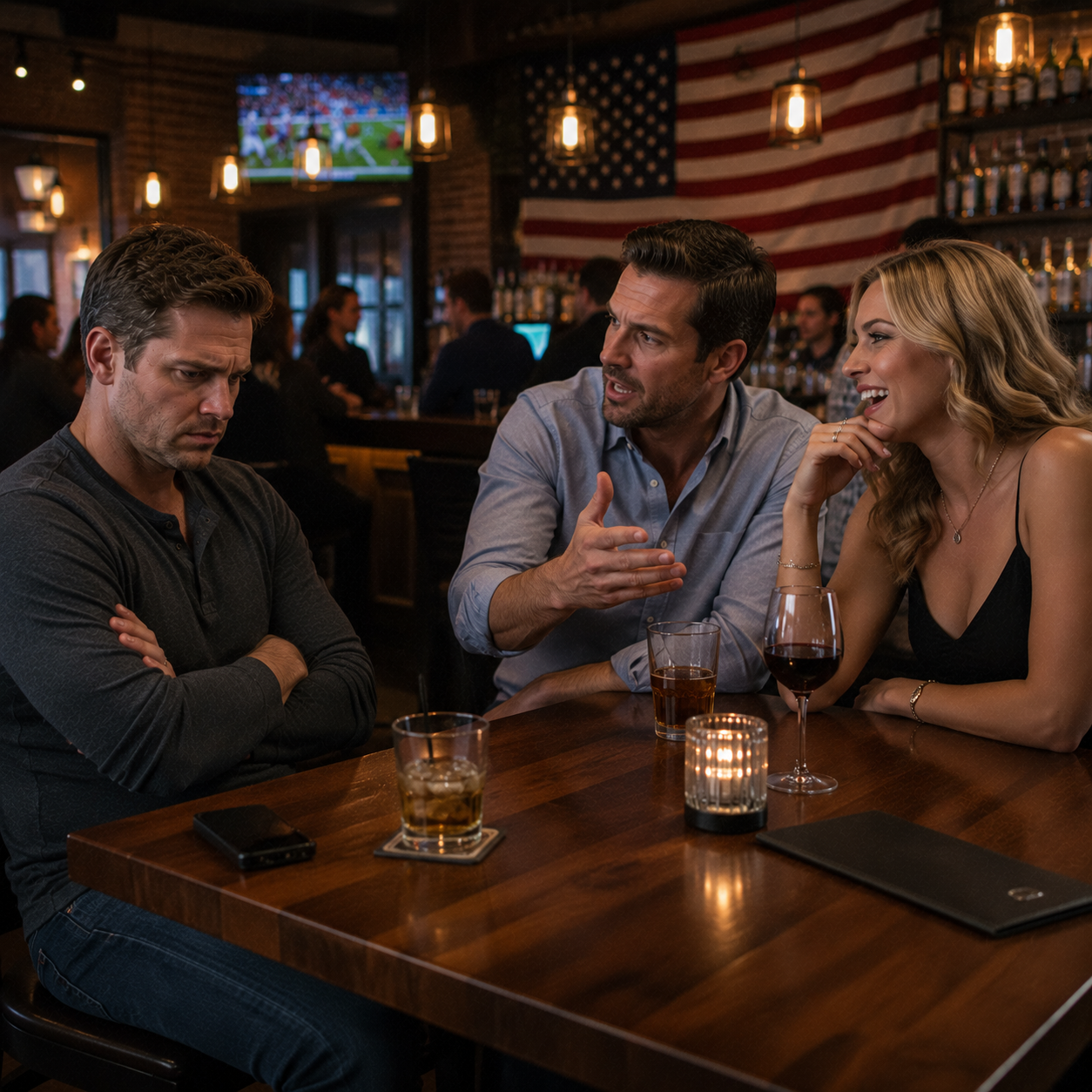
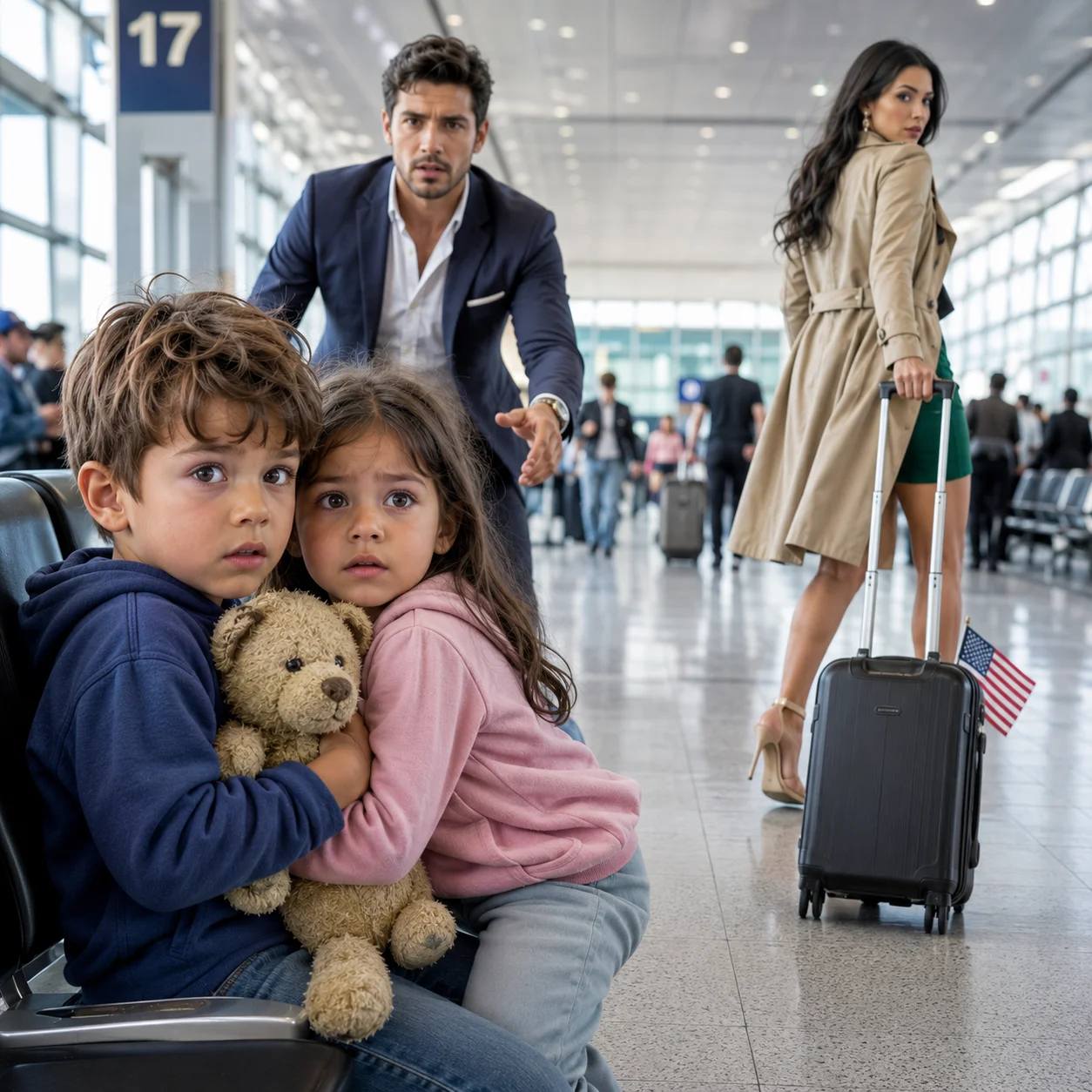
The girl pulled out a USB drive wrapped in plastic.
“Papa said if she left us alone, we should give this to a man with a scar on his hand.”
Santiago looked at his own hand.
A burn scar from the night in the flaming truck crossed over his fingers.
Marco stopped breathing.
Santiago took the USB carefully.
“What is on this, Lucía?”
The girl held her brother’s hand.
“The truth about how Papa died.”
Before Santiago could answer, Marco’s phone rang.
He listened for three seconds.
Then his face changed.
“Boss,” he said quietly. “Rebeca missed the flight to Madrid.”
Santiago stood.
“Where is she?”
Marco looked at the twins, then lowered his voice.
“At the domestic exit. And she is with two armed men.”
Marco did not need to finish the sentence.
Santiago Fierro was already on his feet, the USB closed in his fist, his eyes on the private lounge door.
Mateo woke fully.
Lucía hugged the old teddy bear against her chest, even though it was now empty.
“Did she come back?” the girl asked.
Santiago looked at her.
She was five years old, but she did not ask the way a child asks for a hug.
She asked like someone hearing footsteps in the dark.
“Yes,” he said. “But this time, she does not get to decide anything.”
Marco moved toward the lounge window. Through it, part of the corridor was visible. People with suitcases. Families buying coffee. An older woman carrying a box of sweet bread. Airport employees walking quickly with radios in their hands.
And then Rebeca appeared.
Her beige coat was no longer loose and elegant. She held it tight against her body, as if hiding something.
A man walked on either side of her.
They did not look like tourists.
They were not watching screens or boarding gates.
They were watching exits.
They were watching cameras.
They were watching children.
Santiago crouched in front of the twins.
“Listen to me carefully. No one is going to touch you. No one. But I need you to stay with Marco.”
Mateo shook his head quickly.
“Don’t leave us.”
The words struck Santiago harder than a blow.
For years, he had heard men beg without moving a muscle.
But that small voice made him lower his eyes.
“I am not leaving you,” he said. “I am only going to stand between you and her.”
Lucía took one step toward him.
“Papa said bad men make pretty promises.”
Marco swallowed.
Santiago did not take offense.
He removed his jacket and placed it over the girl’s shoulders.
“Then do not believe me because of what I say,” he told her. “Watch what I do.”
The lounge door opened hard.
Rebeca entered first.
Her smile arrived before her voice.
“There are my children.”
Lucía stepped back.
Mateo hid behind Marco.
Santiago turned slowly.
Rebeca stopped when she recognized him.
She did not know him personally.
But in Mexico, some names did not require introductions. Some faces moved through old news stories, restaurant whispers, warnings from chauffeurs and lawyers.
Santiago Fierro was one of those faces.
“Señor Fierro,” she said, her voice changing instantly. “How embarrassing. There has been a misunderstanding.”
Santiago looked at the two men behind her.
“Misunderstandings do not arrive armed.”
One of the men slipped a hand toward his jacket.
Marco moved before he could finish.
He did not draw a weapon.
He simply raised his voice.
“There are cameras, there is National Guard twenty meters away, and there are two minors present. Think carefully.”
The man froze.
Rebeca laughed nervously.
“They are escorts. I am their legal guardian.”
“You abandoned two children in front of a boarding gate.”
“I went to the restroom.”
Lucía spoke from behind Marco.
“Lie.”
Rebeca’s eyes snapped toward her.
It lasted only a second.
But Santiago saw it.
There was no worry in that look.
Only rage.
“Lucía,” Rebeca said with false sweetness, “come to mama.”
The girl clutched Santiago’s jacket.
“You are not my mama.”
Rebeca’s smile cracked.
“They are traumatized children. Their father died recently. They say things.”
Santiago lifted the USB.
“Tomás said things too.”
Rebeca went pale.
The men behind her tensed.
They were no longer watching the children.
They were watching the USB.
That was when Santiago understood.
Lucía had not handed him a memory.
She had handed him a sentence.
“Give that to me,” Rebeca said.
“It is not yours.”
“It belongs to my stepchildren.”
“Then they decide.”
Mateo peeked out from behind Marco.
“It is Papa’s.”
Rebeca took a step forward.
“Mateo, come here right now.”
The boy began to tremble.
He did not cry.
That was the worst part.
He trembled like a child who had already learned that crying only made things worse.
Santiago stepped in front of him.
“One more step,” he said, “and I start calling everyone by their full name.”
Rebeca narrowed her eyes.
“What are you talking about?”
Santiago looked at Marco.
Marco already had his phone to his ear.
“Rebeca Olvera,” Marco said. “Property sale this morning at a notary office in Lomas de Chapultepec. Buyer: a shell company created three months ago. Tickets purchased for Madrid, but not boarded. Switch to domestic departure with private connection. Two minors abandoned in a restricted airport zone.”
Rebeca stopped pretending.
“You do not understand.”
“I understand enough,” Santiago said.
“You do not know what Tomás left behind.”
Santiago took one step closer.
“Tomás left two children.”
She laughed with contempt.
“Tomás left debts, problems, and documents that could ruin very powerful people.”
“Including you.”
Her eyes brightened with hatred.
“Including you too, Señor Fierro.”
Marco ended the call.
The corridor outside began to move differently.
Two airport security officers approached.
Then others.
Most travelers had not noticed yet, but the air had changed.
Santiago lowered his voice.
“Better people than you have tried to bury me.”
Rebeca clutched her purse.
“Those children belong to me until a judge says otherwise.”
“Children do not belong to anyone.”
“I am legally their guardian.”
“You legally abandoned them in an airport.”
Rebeca glanced toward the door.
Her men did the same.
They were calculating exits.
Santiago did not move.
He did not need to run.
His whole life had been spent being chased by larger ghosts.
“Marco,” he said, “take the children to Licenciada Robles.”
“DIF personnel and the prosecutor’s office are on their way,” Marco replied.
Rebeca’s eyes widened.
“You called DIF?”
Santiago looked at her coldly.
“I wanted to protect them, not buy them.”
The sentence left Marco still.
No one expected to hear that from Santiago Fierro.
Not even Santiago himself.
Lucía only released his jacket when a woman in an institutional vest entered the lounge with a social worker and two agents.
The woman crouched before the twins.
She did not touch them.
She spoke softly.
“My name is Adriana. I am here to listen to you.”
Mateo looked at Santiago.
“Can we go with him?”
The social worker glanced at the most feared man in the room.
For a second, she did not know what to say.
Santiago answered first.
“You will go with whoever can take good care of you. But I will not disappear.”
Rebeca lunged toward Lucía.
“Lucía!”
One of her men tried to block the agents.
Everything happened in three seconds.
Marco shoved a table aside.
A glass shattered.
A guard shouted.
People in the corridor turned.
Rebeca managed to grab Lucía’s arm.
The girl let out a small cry.
Not loud.
Not dramatic.
But it was enough for Santiago.
He caught Rebeca’s wrist and forced her to let go.
He did not strike her.
He did not need to.
He only applied enough pressure to make her understand that this time she was not locking children inside an empty house.
This time, there were witnesses.
“Never again,” Santiago said.
Rebeca looked at him with tears of fury.
“You do not know what they are capable of.”
“Yes, I do,” Santiago said quietly. “That is why I chose not to do the same.”
The agents took the men first.
Rebeca began shouting that it was abuse, that she knew judges, that she would sue everyone in that room.
But the more she shouted, the smaller she looked.
The same woman who had abandoned two children without looking back now demanded that everyone look at her.
Lucía did not look.
Neither did Mateo.
The twins sat together on the sofa in the private lounge, holding the opened teddy bear between them.
Santiago asked for a computer.
He did not want to hand over the USB without seeing what was on it first.
Not because he distrusted Tomás.
Because he knew truth, when it arrived late, could still kill.
Licenciada Robles agreed to review the content there, in front of her and the agents.
A folder appeared on the screen.
Videos.
Contracts.
Construction photographs.
Audio recordings.
Then one file with a simple name:
For Santiago Fierro.
Marco stopped breathing again.
Santiago did not want to open it.
For the first time in years, his hand trembled.
He pressed play.
Tomás Cárdenas appeared on the screen, seated in a humble kitchen, dark circles under his eyes, wearing a denim shirt. Behind him was a refrigerator covered in children’s drawings held up by colorful magnets.
His voice was tired.
“Señor Fierro, if you are watching this, it means my children found you. I wish it had not come to this.”
Mateo moved closer to the screen.
“Papa…”
Lucía covered her mouth with both hands.
Santiago wanted to stop the video, but the girl shook her head.
Tomás continued.
“I know you are not a saint. I am not stupid. But that night on the road, when I pulled you out of the fire, I saw a man who did not want to die. Today I am asking you to look at my children the same way.”
Santiago felt the scar on his hand burn.
“Rebeca did not marry me for love. I let her close because my children needed a woman in the house. Mateo and Lucía’s mother died giving birth to them. I was alone. Tired. And I made the mistake of confusing company with family.”
Lucía cried without making a sound.
Mateo hugged the teddy bear to his chest.
“Six months ago, I discovered that the Santa Fe construction project was using cheaper materials while reporting false costs. There are signatures, deposits, names. Rebeca was linked to the office moving the money. When I tried to report it, they told me to think about my children.”
The video cut for a second.
Then Tomás appeared in another place.
A car.
Rain beat against the windshield.
“If something happens to me, it was not an accident. And if she keeps my children, she will sell the house, collect the insurance, and make them disappear with whatever story serves her best. Do not let her take them.”
Santiago closed his eyes.
Tomás had known he was going to die.
And still, with his last strength, he had left pieces of truth behind.
The final clip was shorter.
Tomás looked straight into the camera.
“Mateo, Lucía, if one day you see this, forgive me for not coming back. I wanted to come back. I always wanted to come back.”
Mateo made a sound that was neither a word nor a sob.
Santiago caught him before he collapsed.
The boy clung to his shirt.
“My papa did not leave us.”
“No,” Santiago said, his voice broken. “Your papa fought until the end.”
The investigation began that same afternoon.
Not like in the movies.
Not with gunfire.
Not with burning trucks.
It began with copies, stamps, statements, and two children drinking hot chocolate from paper cups while outside the private lounge, the airport kept announcing flights to Cancún, Mérida, Hermosillo, and Los Cabos.
Life did not stop.
But Rebeca’s lie did.
The agents discovered that the Madrid ticket had been a distraction. Rebeca had planned to move through Guadalajara and then reach a private airstrip in Jalisco. She had false documents prepared for the twins, but something had gone wrong.
The USB was not in their backpack.
Not in their clothes.
Not in the medical folder she searched before leaving.
She never imagined Tomás would hide it inside an old teddy bear.
She never imagined Lucía would remember a scar.
She never imagined that of all men in Mexico, Santiago Fierro would be the one who looked long enough at Gate 17 to realize two children had been abandoned.
That night, DIF did not allow Santiago to take the twins with him.
And they were right.
He was not family.
He was not their legal guardian.
He was not a clean man.
Santiago did not argue.
That surprised everyone.
He only asked where they would be taken and demanded, through his lawyer, that Rebeca have no contact with them without supervision.
Lucía held his hand before leaving.
“You said you would not disappear.”
Santiago knelt in front of her.
“Tomorrow, I will be wherever they allow me to be.”
“And if they do not allow you?”
He looked at the social worker.
Then back at the girl.
“Then I will knock until someone opens the door.”
Mateo handed him the teddy bear.
“Take care of him.”
Santiago held it like a relic.
“I will give him back.”
“Promise.”
“I promise.”
The twins left in an official vehicle.
Santiago stood by the window, watching the airport lights reflect across the shiny floor.
Marco approached him quietly.
“Boss, this is going to bring trouble.”
Santiago did not look away.
“We have been in trouble for years.”
“That is not what I mean. I mean construction companies, notaries, lawyers. There were powerful names in that USB.”
“Then let them fall.”
Marco stared at him as if he no longer recognized him.
“You always said debts are paid with money or blood.”
Santiago held the old teddy bear.
“This one is paid with life.”
Over the following weeks, the name Tomás Cárdenas began appearing in files many people would have preferred to keep buried.
His accident at the construction site had not been a simple fall.
Logs had been altered.
Schedules changed.
Camera footage deleted.
Photographs that never reached the first report showed Tomás’s safety harness had been cut.
Rebeca had collected insurance money, sold the house, and requested documents to move the children out of the country.
The notary office was temporarily closed.
An engineer fled.
An accountant testified.
And several men who believed themselves untouchable discovered that sometimes truth did not need an army.
Sometimes it needed two children, one teddy bear, and a hidden USB drive.
Santiago attended every hearing he was allowed to attend.
Always in a dark suit.
Always silent.
Mothers of other children stared at him with distrust in the family court hallways.
He did not blame them.
He distrusted his own reflection too.
One day, the social worker told him, “The children ask about you.”
Santiago lowered his eyes.
“I am not good for them.”
The woman adjusted the papers in her hands.
“That is not what I asked.”
“I have done things that should not be near children.”
“Then do something different when you are near them.”
The words stayed with him.
Like Tomás’s words seven years before.
Do something good for someone someday.
The process did not give custody to Santiago.
Not at first.
The twins were temporarily placed with an elderly maternal great-aunt in Puebla, Doña Rosario, a white-haired woman who sold mole on Sundays near Cholula and had no idea Tomás had listed her as an emergency contact in an old file.
When they found her, she arrived at court with a rebozo over her shoulders, a bag of sweet bread in her hands, and trembling fingers.
“I thought there was no one left from my girl,” she said when she saw the twins.
Lucía looked at her cautiously.
Mateo hid behind Santiago.
Doña Rosario did not take offense.
She only placed the bag on a bench.
“You do not have to love me today,” she said softly. “I only came so you would know there is someone.”
That was what convinced Santiago to let go.
Not because it did not hurt.
But because he understood that protecting someone did not always mean keeping them beside you.
Sometimes protecting meant making sure someone better could hold them.
Months later, Rebeca was formally charged with child abandonment, fraud, document forgery, and participation in the cover-up of Tomás’s death.
When they brought her down the courthouse hallway in handcuffs, she looked at Santiago.
“You think this cleans you.”
Santiago did not smile.
“No,” he said. “But it saves them.”
She spat on the floor.
“Those children are not yours.”
Santiago thought of Mateo sleeping against an old teddy bear. He thought of Lucía asking if he was bad. He thought of Tomás climbing into a burning truck to save a stranger.
“No,” he said. “They belong to themselves. That is what you never understood.”
A year passed.
For Santiago, the airport became again a place of noise, flights, and people running toward doors.
But every time he saw Gate 17, something inside him stopped.
One December afternoon, an envelope arrived from Puebla.
Inside was a drawing.
Two children.
A teddy bear.
A house with a red roof.
A woman in a rebozo cooking mole in a huge pot.
And beside them, a man in a black suit with a scar on his hand.
Underneath, in Lucía’s handwriting, were the words:
You came back.
Santiago stared at the paper for a long time.
Marco found him in his office, sitting by the window, his eyes wet.
He said nothing.
He only placed a coffee on the desk.
“Boss.”
Santiago folded the drawing carefully.
“Repair Tomás’s house.”
“The one Rebeca sold?”
“Recover it legally. If that is impossible, buy another one near Doña Rosario. Put it in the children’s names. My name does not appear anywhere.”
Marco nodded.
“Anything else?”
Santiago looked at the scar on his hand.
For years, he had seen it as the memory of an ambush.
Now he saw it as a door.
“Yes. Find a serious foundation that works with abandoned children in terminals and bus stations. No photographs. No speeches. No family name.”
Marco almost smiled.
“Tomás would be surprised.”
Santiago shook his head slowly.
“Tomás would be taking care of his children.”
He placed the drawing in the highest drawer of his desk, beside the old teddy bear Mateo had once given him and later refused to take back.
“So you do not forget,” the boy had said.
Santiago did not forget.
Never.
Because the most dangerous man in Mexico had seen many things fall.
Houses.
Names.
Empires.
Men who believed they were eternal.
But nothing had ever broken him the way two children sitting outside an airport gate had, waiting for a woman who never intended to return.
And nothing had ever changed him as much as discovering that some debts are not paid by destroying enemies.
Sometimes they are paid by making sure two children can sleep without fear.
Mateo and Lucía learned, slowly, that not all adults leave.
Some arrive late.
Some arrive broken.
And sometimes, even a man with too many shadows can stand in front of a closed door and decide not to look away.
Santiago Fierro never called himself good.
He did not forgive himself that easily.
But every December, he traveled to Puebla. He sat at a table covered with a plastic cloth, ate mole with red rice, and listened to two children talk about school, drawings, and a father who had wanted to come home.
Whenever Mateo asked about the scar on his hand, Santiago always answered the same way.
“Your father gave me this the day he saved my life.”
Lucía, more serious than her brother, would add, “And then you saved us.”
Santiago would look at the old teddy bear on the shelf.
Then he would look at the twins.
And although he never said yes, he never denied it either.
Because some truths do not need to be spoken loudly.
They only need to stay.
![[FULL STORY] SHE DEMANDED “LOYALTY,” BUT A JUDGE LATER TOLD HER TO STOP SAYING MY NAME](https://social-media.rabedo.com/thumbnails/1777817906_686167112_994159736469562_4111554418760130434_n.jpg)
![[FULL STORY] I Came Home Early and Found My Wife Wearing My Shirt — But I Had Already Ended It](https://social-media.rabedo.com/thumbnails/1777867089_c8a5a6f3-dec4-4299-88de-257f3dca198e.png)