

Phone died.
It was plausible. Completely plausible. So why did it feel like a note taped over a broken window?
She flew home Sunday evening. I picked her up at the airport at 7:30. She looked exhausted but beautiful, wearing leggings, boots, and the beige coat. Her hair was pulled back, and she had that pale, stretched look people get after a weekend of too much wine and too little sleep.
I kissed her when she got into the car.
“Good trip?”
She looked out the windshield. “Yeah. Weird. But good.”
“Define weird.”
She exhaled. “Just… seeing old versions of myself reflected back at me.”
“That sounds either poetic or alarming.”
“A little of both.”
I waited for her to say more.
She didn’t.
That night, she unpacked immediately, which was unusual. Rebecca normally left suitcases half-open on the bedroom floor for days. But this time, she emptied everything, put her clothes into the laundry, slid her suitcase into the closet, and took a long shower. When she came out, she was quiet.
I thought maybe the reunion had stirred up old insecurities. Rebecca rarely talked about college in detail. I knew she had struggled there at first, surrounded by kids with family money and confidence that looked genetic. I knew she had dated someone for a while, some guy named Nathan or Nolan. I couldn’t remember. She had mentioned him once early in our relationship and then never again.
I didn’t push.
Monday morning, life resumed. Work. Emails. Coffee. Bills. Grocery list. The ordinary machinery of marriage.
Then Tuesday at 3:22 p.m., while I was in my office reviewing a bridge inspection report, I received an email from an address I didn’t recognize.
The sender name was blank.
The subject line was: You should see what your wife wore Saturday night.
At first, I thought it was spam. Some disgusting scam email that had somehow scraped my personal information. I almost deleted it.
But the preview line froze me.
Ask Rebecca who gave her the ring.
My hand went cold on the mouse.
I opened it.
There was no message in the body. Just one attachment.
A photo.
I clicked it.
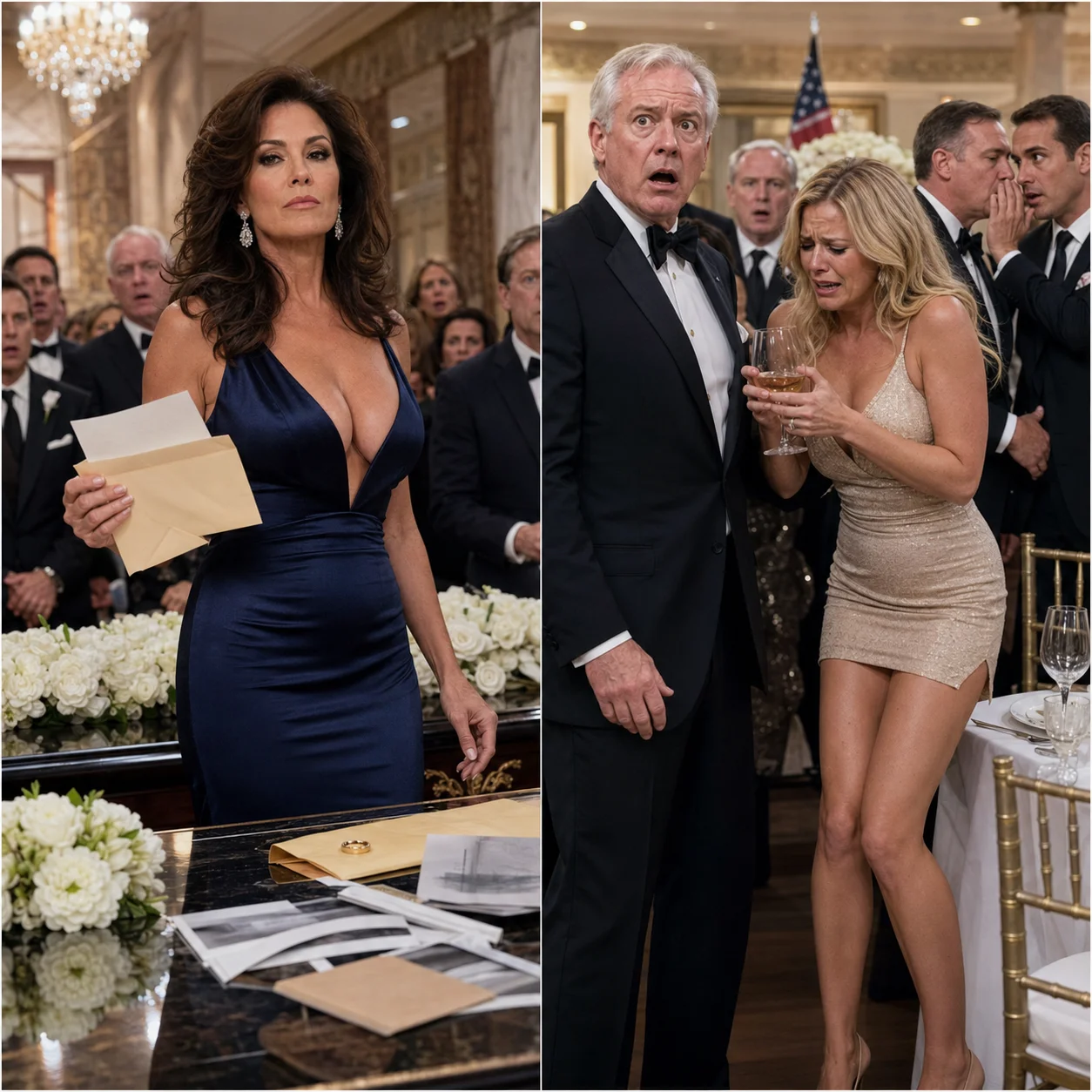
For a moment, my brain refused to understand what I was looking at. It was Rebecca, standing in a hotel ballroom under warm gold lights. She was wearing the emerald dress. Her hair was down, her face flushed, her smile wide and unguarded in a way I hadn’t seen in months.
Beside her stood a man I didn’t know.
Tall. Dark hair. Navy suit. One arm around her waist.
But it wasn’t his face that made my stomach drop.
It was her hand.
Rebecca’s left hand was resting on his chest, fingers spread slightly, and on her ring finger was not the diamond wedding ring I had given her.
It was a different ring.
Large. Antique-looking. Gold band. Emerald center stone surrounded by smaller diamonds.
A ring I had never seen before.
A ring that looked expensive.
A ring that looked deliberate.
My first thought was absurdly practical: Maybe the image is fake.
My second thought was worse: Her wedding ring isn’t there.
I zoomed in until the photo pixelated. Her actual wedding ring was gone. In its place was that emerald ring, glowing under the ballroom lights like something out of another life.
I leaned back in my chair.
The office noise around me blurred: phones ringing, keyboards clicking, someone laughing in the hallway. I stared at the photo until my eyes burned.
Then I checked the email details. The address was a random string of letters and numbers at Proton Mail. No name. No signature. Nothing.
I called Rebecca.
No answer.
I texted her: Call me when you can.
She replied eight minutes later.
In a meeting. Everything okay?
I stared at that message for almost a full minute.
I typed: Yes. Just call me after.
Then I deleted “Yes.”
I typed: We need to talk tonight.
Three dots appeared. Disappeared. Appeared again.
Okay, she wrote.
That was it.
That tiny “Okay” told me she already knew.
I left work early. Not because I had a plan, but because my body refused to keep sitting in that chair pretending the world was normal. I drove home in silence, the photo open on my phone at every red light. By the time I pulled into our driveway, my hands were shaking.
I didn’t confront her immediately when she came home. That surprised even me.
Rebecca walked in at 6:12 p.m., carrying her work tote and wearing a cream blouse tucked into gray trousers. She looked composed until she saw my face.
“What happened?” she asked.
I held up my phone.
Her eyes flicked to the screen.
Then all the color drained from her face.
She didn’t ask where I got it. She didn’t ask what I thought it meant. She didn’t do any of the innocent-person things people do when they’re blindsided.
She just whispered, “Oh my God.”
I felt something inside me crack.
“Who is he?”
Rebecca set her tote slowly on the floor. “Daniel—”
“Who is he?”
She swallowed. “His name is Adrian.”
Adrian.
Not Nathan. Not Nolan. Adrian.
The name landed between us like a third person entering the room.
“And why are you wearing his ring?”
Her eyes filled with tears immediately, which somehow made me angrier. Not because she was crying, but because the tears arrived before the truth, as if she wanted grief to soften the impact of whatever she had done.
“It’s not what it looks like,” she said.
I laughed once. It came out sharp and ugly. “You’re standing in a ballroom with another man’s arm around you, wearing another ring on the same finger where my wedding ring belongs. So please, Rebecca, tell me what it looks like.”
She pressed her hands over her mouth.
“Where was your ring?”
“In my purse.”
“Why?”
“Because…” Her voice broke. “Because I made a mistake.”
“You don’t accidentally remove your wedding ring and put on another man’s.”
She closed her eyes.
That silence was the first confession.
I walked into the kitchen because I needed space, though there was nowhere in that house far enough away from her. She followed me slowly.
“How long?” I asked.
“It’s not an affair.”
I turned around. “That is not what I asked.”
She flinched.
“How long?”
Rebecca gripped the back of a chair. “I saw him again six months ago.”
Six months.
My brain began rearranging the past half-year in violent flashes. Late nights. Quiet moods. Password changes. The weekend trip to visit Hannah in May. The sudden obsession with Pilates. The charity gala where she came home smelling like cigar smoke and said a donor had been smoking outside.
“Six months,” I repeated.
“We weren’t sleeping together.”
I stared at her.
“I swear,” she said quickly. “Not at first.”
Not at first.
There it was. Another door opening to a darker room.
I sat down because my knees felt unsteady. “Start talking.”
She looked at me like she wanted mercy.
I gave her none.
So she talked.
Adrian Cole had been her college boyfriend. Not just a boyfriend, as it turned out. The boyfriend. The one she had almost married at twenty-two. His family had money. Real money. Old Boston money. He had proposed during their senior year with that emerald ring, his grandmother’s ring, and Rebecca had said yes.
I had never known that.
She had told me she dated someone in college. She had not told me she had been engaged.
“Why didn’t you tell me?” I asked.
“Because it ended badly.”
“That’s not an answer.”
She wiped her face. “Because I was ashamed.”
“Of what?”
She looked down.
And somehow, before she said it, I knew there was more.
“I left him two months before the wedding,” she said. “I panicked. His family hated me. They thought I was beneath him. I felt like I was disappearing into their world, like I was becoming this version of myself I didn’t recognize. So I left.”
“That sounds painful,” I said coldly. “But it doesn’t explain Saturday.”
“He contacted me earlier this year. His father died. He said it made him think about old things. Unfinished things. I shouldn’t have replied.”
“But you did.”
“Yes.”
“And then?”
She cried harder. “At first it was just emails. Then calls. Then coffee when he was in D.C. for business.”
“How many times did you see him?”
“I don’t know.”
“Try.”
“Four. Maybe five.”
“Before the reunion.”
She nodded.
My chest felt hollow. “And at the reunion?”
“He was there.”
“Convenient.”
“He’s alumni too.”
“And the ring?”
She covered her face. “He brought it.”
Of course he did.
“He said he had kept it all these years,” she whispered. “He said he never stopped wondering what our life would have been. He said seeing me again made him feel like maybe we’d made the biggest mistake of our lives.”
“We?”
She looked up.
“You said we,” I said. “Not he.”
Rebecca didn’t answer.
I stood up so fast the chair scraped against the floor. “Did you sleep with him?”
She sobbed once.
I didn’t move.
“Answer me.”
“Yes,” she whispered.
The word was so small. Almost gentle. But it destroyed the room.
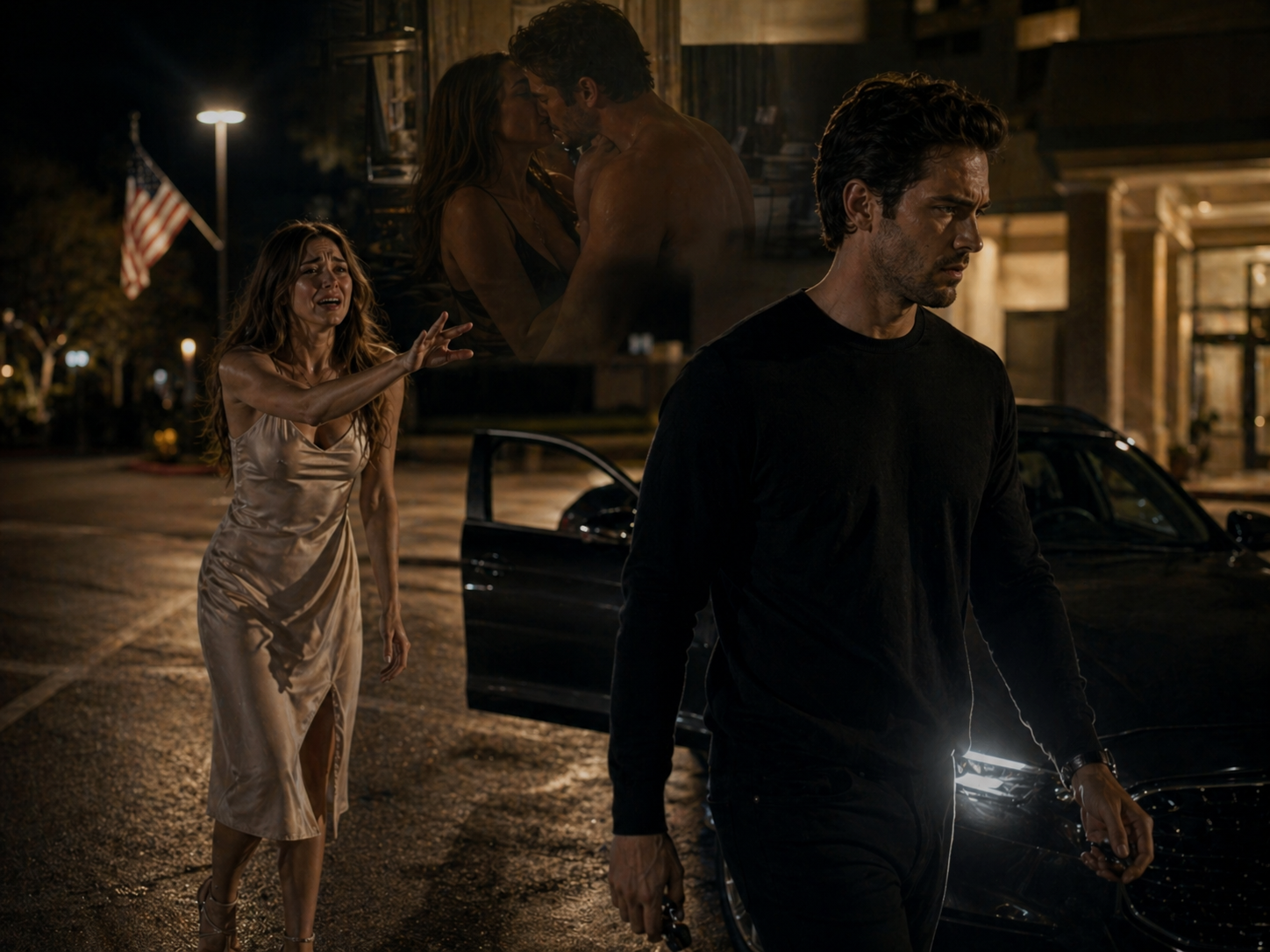
I nodded slowly, as if she had confirmed something minor, like a dinner reservation. Then I walked out the back door and stood on the deck in the cold October air until my lungs hurt.
She followed me after a few minutes but stayed inside the doorway.
“Daniel,” she said.
I stared at the dark yard.
“I’m sorry.”
I laughed again, quieter this time. “Don’t.”
“I am.”
“No, you’re sorry there’s a photo.”
She didn’t deny it.
That night, I slept in the guest room. Or rather, I lay in the guest room staring at the ceiling while Rebecca cried behind our bedroom door. Around 4 a.m., I got up and opened the photo again. I studied Adrian’s face. He didn’t look guilty. He looked proud. Possessive. Like the photo was not a mistake but a message.
Ask Rebecca who gave her the ring.
Who had sent it?
A jealous classmate? Adrian’s wife? A friend of Rebecca’s? Hannah?
At 6:30 a.m., I checked Rebecca’s phone while she was asleep.
I am not proud of that. But betrayal turns morality into a room with no lights. You bump into things you used to know how to avoid.
Her phone password had changed.
That told me enough.
When she woke up, I was sitting at the kitchen table with coffee I hadn’t touched.
“I want your phone,” I said.
She froze.
“No.”
The answer came too quickly.
I smiled without humor. “Then we’re done.”
“Daniel, please don’t do this like that.”
“Like what?”
“Like I’m some criminal.”
“You lied to me for six months, slept with your ex, wore his engagement ring in public, and came home to our house like nothing happened.”
She sat across from me, pale and shaking. “There are things you don’t understand.”
“I’m sure there are. That’s why I want the phone.”
She stared at me for a long time.
Then she placed it on the table.
The password was her old dorm room number. I knew because she had once told me the story of how she and Hannah painted the door frame pink and got fined by campus housing.
There were no messages from Adrian in her regular texts.
No emails in her main account.
No Instagram DMs.
Rebecca watched me silently as I searched, and for a second, I wondered if she had cleaned everything already.
Then I found the app.
Signal.
Hidden in a folder labeled “Utilities.”
There were only two conversations. One with Hannah. One with Adrian.
The messages with Adrian went back months.
I did not read all of them. I couldn’t. There are forms of pain the brain rejects like poison. But I saw enough.
I miss the person I was with you.
Daniel is good. He’s kind. That’s what makes this impossible.
I still dream about your mother’s house in Maine.
Sometimes I feel like I married the safe life instead of the real one.
Adrian had written: Then stop pretending.
She had replied: It’s not that simple.
He had written: It is if you choose me.
There were photos. Dinner tables. Hotel lobbies. A picture of two wine glasses on a balcony. A close-up of the emerald ring in his palm.
Then Saturday night.
Adrian: Wear it for one dance.
Rebecca: Don’t ask me that.
Adrian: I waited thirteen years. Give me one dance with the life we almost had.
Rebecca: That’s cruel.
Adrian: No. Cruel is going home to him after this.
My hand tightened around the phone until my knuckles hurt.
I opened the conversation with Hannah.
That was worse.
Because Hannah knew everything.
Hannah: You need to decide before you destroy both of them.
Rebecca: I know.
Hannah: Daniel doesn’t deserve to be your backup plan.
Rebecca: Don’t say that.
Hannah: Then stop treating him like one.
I looked up at my wife.
Her face collapsed.
“Backup plan,” I said softly.
“No.”
I turned the phone toward her. “That’s what your friend called me.”
“She was angry.”
“Was she wrong?”
Rebecca didn’t answer.
That was the second confession.
I handed her phone back, stood, and walked upstairs. I packed a duffel bag with clothes, my laptop, medication, and the folder from the safe that contained our house deed, insurance policies, and financial documents. Rebecca followed me room to room, crying, begging me not to leave.
“Where are you going?”
“Mark’s.”
“Daniel, please. We need to talk.”
“We did.”
“No, we reacted. That’s not the same thing.”
I turned around in the doorway of our bedroom. “You had six months to talk. You chose a secret messaging app.”
That stopped her.
I stayed with my younger brother Mark for three nights. He and his wife, Elise, didn’t ask many questions at first. They just gave me the basement guest room, clean sheets, and the kind of silence that doesn’t demand performance.
On the second night, I told them everything.
Mark paced his living room like he wanted to punch someone. Elise, who was a family law attorney, sat very still with her hands folded in her lap.
“Do you want reconciliation,” she asked carefully, “or do you want out?”
The question should have been complicated.
It wasn’t.
“I want out.”
Saying it felt like stepping off a burning porch.
Elise nodded. “Then you need to stop communicating emotionally and start communicating strategically.”
She wasn’t my attorney because she was family, but she gave me the names of three divorce lawyers. I called one the next morning from my car. Her name was Marjorie Bell, and she had the calm, surgical voice of someone who had watched love turn into paperwork for twenty-five years.
“Do not threaten,” Marjorie told me. “Do not empty accounts. Do not destroy property. Do not post anything. Do not confront the other man. Preserve evidence. Screenshot everything. Write a timeline while your memory is fresh.”
So I did.
I wrote down dates. Trips. Lies. Screenshots. The anonymous email. The photo metadata, which showed it had been taken at 10:48 p.m. Saturday in the hotel ballroom. I saved Rebecca’s Signal messages, not by forwarding them, but by photographing them with my phone while she sat beside me crying and saying, “Please don’t make this uglier.”
That phrase stayed with me.
As if ugliness began when evidence appeared, not when betrayal happened.
Rebecca called constantly the first two days. Then she switched to long texts.
I’m not asking you to forgive me overnight.
I know I broke something sacred.
Adrian was about the past, not the future.
I chose wrong because I was confused, not because I don’t love you.
Please come home.
But tucked between the apologies were little threads of blame.
After the miscarriage, I felt like we stopped seeing each other.
You buried yourself in work.
I didn’t know how to tell you I felt lonely.
Adrian made me feel remembered.
I read those messages in Mark’s basement and felt myself harden.
Because the miscarriage had broken me too. I had held her on the bathroom floor while she sobbed. I had gone to every appointment. I had painted the nursery back to neutral because she couldn’t bear to look at the pale yellow walls. I had sat in my truck outside Home Depot and cried so hard I couldn’t drive.
But I hadn’t used grief as a doorway into another woman’s bed.
On Friday, I went home with Mark to collect more clothes.
Rebecca was there.
The house smelled like coffee and vanilla candles, which made me irrationally angry because it felt like she was trying to make betrayal smell domestic.
She looked smaller somehow, wearing leggings and a sweater, her hair unwashed, eyes swollen.
“Can we talk alone?” she asked.
Mark stood behind me like a wall.
“No,” I said.
Her mouth trembled. “You don’t trust me at all?”
I looked at her.
She realized what she had said and lowered her eyes.
“I ended it with Adrian,” she whispered.
“Congratulations.”
“I mean it. I called him. I told him it was over.”
I walked past her toward the stairs.
She followed. “He doesn’t matter.”
I stopped.
“That is the most insulting thing you’ve said yet.”
She blinked. “What?”
“If he doesn’t matter, then you destroyed our marriage for nothing.”
Her face crumpled.
I packed in silence. As I was leaving, she said something that made me turn around.
“I didn’t know he was married.”
The hallway went still.
Mark muttered, “Jesus Christ.”
I stared at her. “Adrian is married?”
Rebecca covered her mouth like she had accidentally spilled another secret.
“How did you find out?”
“She called me.”
“Who?”
“His wife.”
That was when I learned the stranger who emailed me the photo was not Hannah, not a classmate, not some random person.
It was Adrian’s wife.
Her name was Claire.
She had been married to Adrian for nine years. They had two children. Seven and four.
I sat down on the bottom stair because the room tilted.
Rebecca whispered, “I didn’t know. I swear to God, Daniel, I didn’t know until after.”
“After what?”
She looked away.
“After what?”
“After the reunion.”
I felt cold all over. “He brought you his old engagement ring while he had a wife and two children at home.”
She nodded, crying silently.
“And you wore it.”
“I was drunk.”
“No. You were willing.”
She had no answer.
That afternoon, I replied to the anonymous email.
Who are you?
Five hours later, the response came.
My name is Claire Cole. I’m Adrian’s wife. I’m sorry. I thought you deserved to know.
My hands shook as I typed back.
Can we speak?
She replied with a phone number.
I called her from Mark’s backyard, standing under a maple tree dropping red leaves into the grass.
Claire’s voice was steady but tired.
“I’m sorry for sending it that way,” she said. “I didn’t know how else to reach you.”
“How did you find me?”
“Adrian had your wife’s name in his messages. I searched public records. Your wedding announcement came up.”
I closed my eyes.
“Did you know about them before the reunion?”
“I suspected. He said he had business trips in D.C. that didn’t make sense. Then I found messages. He deleted most of them, but not everything.”
“Why send the photo?”
Claire was quiet for a moment. “Because I was there.”
I opened my eyes.
“At the reunion?”
“Yes. Not as his guest. I followed him.”
The sadness in her voice was so controlled it felt more devastating than crying.
“I saw him give her the ring,” she said. “I watched her put it on. I watched them dance. I watched them leave together.”
My stomach turned.
“They left together?”
“I’m sorry.”
I gripped the fence until the wood bit into my palm.
“How long were they gone?”
“About forty minutes.”
Forty minutes.
Not enough time to build a life.
Enough time to destroy one.
Claire continued, “I took the photo before they left because I thought maybe if I had proof, I wouldn’t let him explain it away again.”
“Again?”
“There have been others,” she said. “Your wife may not know that. Or maybe she does. I don’t know anymore.”
I almost laughed at the horror of it. Rebecca had not been the great lost love. She had been one chapter in a pattern.
“Why not confront them there?” I asked.
“Because my children were asleep upstairs with my mother. Because I knew if I started screaming in that ballroom, I would become the spectacle, and he would become the man everyone pitied.”
That sentence stayed with me.
Claire and I spoke for twenty-six minutes. We did not comfort each other exactly. We just stood on opposite sides of the same wreckage and confirmed the shape of it.
Before hanging up, she said, “I don’t know what you’re going to do. But don’t let her turn this into nostalgia. It wasn’t nostalgia. It was a choice.”
The next week moved with strange, brutal efficiency.
I filed for divorce.
Rebecca was served at her office on a Thursday morning.
She called me seventeen times.
I did not answer.
Then she showed up at Mark’s house.
Elise opened the door before I could. She stood there in a navy blazer, barefoot, holding a mug of tea, looking like the calmest threat in Virginia.
“This is not appropriate,” Elise said.
“I need to see my husband.”
“He has counsel now. You should contact him through his attorney.”
Rebecca’s eyes flicked past her and found me in the hallway.
“Daniel,” she pleaded. “Please. Don’t let lawyers decide our marriage.”
I stepped forward. “You let Adrian into it first.”
She flinched as if I had slapped her.
“I ended it,” she said. “I told him I choose you.”
I felt something twist in my chest. Not love exactly. Not hatred either. Maybe grief wearing both faces.
“You chose me after he got caught by his wife.”
“That’s not fair.”
“No. What’s not fair is that I had to learn the truth from a stranger while you came home and put your wedding ring back on like it meant something.”
She started sobbing on Mark’s porch.
A neighbor walking his dog slowed down.
I lowered my voice. “Go home, Rebecca.”
“Our home,” she whispered.
I looked at her for a long moment.
Then I said, “Not anymore.”
Divorce is not one dramatic event. It is a thousand humiliating details. Passwords changed. Accounts separated. Friends informed. Furniture photographed. Statements downloaded. Email threads with attorneys. The cold language of “marital assets” and “temporary arrangements” replacing words like “our bedroom” and “Christmas plans.”
Rebecca wanted mediation. Marjorie advised it would be faster and cheaper if we could keep emotion out of it.
Emotion, of course, was everywhere.
Rebecca tried several strategies over the next two months.
First came remorse.
She wrote me a twelve-page letter about shame, grief, and losing herself after the miscarriage. It was beautifully written. Rebecca had always known how to make pain sound meaningful. She said Adrian represented the version of her life where she never lost a baby, never struggled with money, never became ordinary. She said wearing the ring felt like stepping into a ghost.
I read it twice.
Then I put it in the folder with the rest of the evidence.
Next came anger.
She accused me of abandoning her when she was emotionally vulnerable. She said I was punishing her instead of fighting for the marriage. She said people make mistakes and strong couples survive them.
I responded through Marjorie.
Then came fear.
She realized Adrian was not leaving Claire.
That news reached me through Claire herself, in a short text three weeks after the filing.
He’s begging for counseling. Says Rebecca meant nothing. I thought you should know in case she tries to tell you something different.
I stared at that message for a long time.
Rebecca had burned down our marriage for a man who was already trying to rebuild his own.
There was a time when that would have made me feel vindicated.
Instead, it just made everything sadder.
In December, Rebecca asked to meet in person before mediation. Against Marjorie’s advice, I agreed, but only in a public place.
We met at a coffee shop halfway between our house and Mark’s. She arrived wearing the camel coat I had bought her for our fifth anniversary. I hated that I noticed.
She looked tired. Not messy. Rebecca never allowed herself to look messy in public. But something polished had cracked. Her face was thinner. Her eyes older.
“Thank you for coming,” she said.
I nodded.
For a while, neither of us spoke.
Then she slid something across the table.
The emerald ring.
I stared at it.
“Why do you have that?”
“Adrian gave it to me after the reunion. I tried to give it back, but he told me to keep it until I decided.”
My jaw tightened.
“I didn’t keep it because I wanted him,” she said quickly. “I think I kept it because I didn’t want to admit what I’d done. Like if it was still unresolved, then maybe I hadn’t destroyed everything yet.”
I looked at the ring. It was beautiful. That made me hate it more.
“Why show me?”
“Because I’m giving it back to him. Or mailing it. I don’t know. But before I do, I wanted you to know I’m done lying.”
“Are you?”
She looked down.
I leaned back. “Rebecca.”
Her eyes filled.
“There’s one more thing,” she whispered.
Of course there was.
The human heart is foolish. Even after everything, some part of me had hoped there were no more rooms in the house of betrayal. But there is always another door.
“What?”
She twisted a napkin between her fingers. “The night before our wedding, Adrian called me.”
I said nothing.
“He asked me not to marry you.”
I felt the coffee shop recede around us.
“You told me you went to bed early that night.”
“I know.”
“You spoke to him the night before our wedding?”
She nodded.
“What did you say?”
“I told him I loved you.”
That should have helped.
It didn’t.
“And then?”
“He said if I ever changed my mind, he’d be there.”
I looked toward the window. Outside, people moved along the sidewalk carrying shopping bags and coffee cups, living in a world where my marriage was not quietly collapsing over a small table.
“Were you ever fully mine?” I asked.
Rebecca made a wounded sound. “Daniel.”
“It’s a real question.”
“Yes,” she said, crying now. “Yes. I loved you. I love you now.”
“But you left a door open.”
She covered her face.
That was the final truth. Not the sex. Not the ring. Not the reunion.
The door.
For our entire marriage, some part of Rebecca had kept a hidden door open to another life. Maybe she rarely looked at it. Maybe years passed when she forgot it was there. But when Adrian knocked, she didn’t tell me. She didn’t lock it. She opened it.
And I could not spend the rest of my life wondering who else might be waiting outside.
Mediation happened in January.
The house had been purchased after our marriage, but I had contributed the down payment from an inheritance from my grandfather. Rebecca did not fight dirty, which surprised me. Or maybe she was too ashamed. We agreed to sell the house and split the equity after accounting for my separate contribution. She kept her retirement. I kept mine. No alimony. No dramatic courtroom scene. No screaming.
Just signatures.
The day we met at the house to divide personal belongings, snow was falling lightly. It made the whole neighborhood look gentle, which felt offensive.
Rebecca packed books, kitchen items, framed prints, winter clothes. I packed tools, records, my father’s old watch, the coffee mugs I cared about more than I expected. Every object became a small negotiation with memory.
At one point, I found our wedding album on the living room shelf.
We both saw it at the same time.
Neither of us reached for it.
Finally, Rebecca said, “You take it.”
“I don’t want it.”
Her lips trembled. “I don’t either.”
That broke something in me—not anger this time, but the pure sorrow of realizing even our happiest evidence had become unwanted.
“We can put it in storage,” I said.
She nodded.
Near the end, she stood in the doorway of the empty nursery. We had never changed the room after painting it neutral. It had become a place for boxes and things we didn’t want to deal with.
“I think this is where I lost myself,” she said quietly.
I stood behind her, not close enough to touch.
“I lost myself here too,” I said. “But I stayed.”
She closed her eyes.
“I know.”
For the first time, her apology did not come with explanation.
“I’m sorry,” she said. “For all of it. Not because I got caught. Not because Adrian didn’t choose me. I’m sorry because you were good to me, and I made you feel like goodness was not enough.”
That was the closest thing to healing she ever gave me.
I nodded.
“I hope you get better,” I said.
She looked at me, tears slipping down her face. “Do you hate me?”
I thought about it.
“No,” I said honestly. “But I don’t trust you with my life anymore.”
She accepted that like a sentence she had already heard in her own head.
The divorce was finalized in April.
By then, the house was under contract, Rebecca had moved into an apartment near her office, and I had rented a townhouse fifteen minutes from Mark. Claire filed for separation from Adrian around the same time. She texted me once after her filing.
I hope someday this is just something that happened to us, not the thing that defines us.
I replied: Me too.
I never spoke to Adrian. Not once. There were days I wanted to. I imagined telling him he was pathetic, that he collected women’s uncertainty like trophies, that he had mistaken destruction for romance. But eventually I understood that confronting him would only make him more important in my story than he deserved to be.
The last time I saw Rebecca was in late May, outside the title company after the house sale closed.
She was standing by her car holding a folder, wearing sunglasses even though the sky was cloudy. For a second, she looked like the woman I had driven to the airport months earlier. Beautiful. Composed. Almost familiar.
“Daniel,” she said.
“Rebecca.”
We stood there awkwardly, two people who had once known the exact shape of each other’s sleep and now didn’t know whether to shake hands.
“I mailed the ring back,” she said.
I nodded. “Good.”
“He tried to contact me after.”
I said nothing.
“I blocked him.”
I nodded again.
She gave a small, sad smile. “You probably don’t care.”
“I care,” I said. “Just not in the way I used to.”
That landed. I saw it.
She looked down at the folder in her hands. “I’m starting therapy.”
“I’m glad.”
“I should have done it years ago.”
“Probably.”
She laughed once through her nose, almost a sob. “You’re allowed to be less honest.”
“I don’t think we need more pretending.”
“No,” she whispered. “I guess we don’t.”
A silence passed between us. Not comfortable. Not cruel. Just final.
Then she stepped forward and hugged me.
I stiffened at first. Then, slowly, I hugged her back. Not as a husband. Not as forgiveness. As a goodbye to the version of us that had been real before it became ruined.
When she pulled away, she was crying.
“I did love you,” she said.
“I know.”
And I did know.
That was the hardest part.
People want betrayal to simplify love. They want the cheater to have been evil all along, the marriage to have been fake, the victim to walk away cleanly into a brighter chapter with no grief attached. But real life is crueler than that. Rebecca had loved me. She had also betrayed me. Both things were true, and neither erased the other.
I watched her drive away.
Then I got into my own car and sat there for a minute, breathing.
A year later, my life looks nothing like I thought it would.
I live in a smaller place now, but it is mine in a way the old house stopped being. I cook more. Badly, at first. Better now. I see Mark and Elise every Sunday. I go to therapy twice a month, where I have learned that trust is not stupidity and betrayal is not proof that love was foolish.
Sometimes people ask if I’m dating.
The answer is not seriously.
There is a woman named Nora in my building who has a golden retriever and a laugh that carries down the hallway. We’ve had coffee twice. I don’t know where it will go. I don’t need to know yet.
The anonymous email is still saved in a folder on my laptop, though I don’t look at it anymore. The photo too. For months, that image controlled me: Rebecca in emerald satin, Adrian’s arm around her waist, another man’s ring on her finger. It was the moment my marriage ended, captured in perfect lighting.
But I see it differently now.
That photo did not destroy my marriage.
It revealed where the destruction had already begun.
The real ending happened later, in quieter ways. In the moment I stopped begging my mind to explain what my heart already knew. In the moment I realized forgiveness and reconciliation were not the same thing. In the moment I understood that being someone’s safe choice is not love if they keep dreaming of escape.
Rebecca once told me Adrian made her feel remembered.
I spent a long time wondering why I had not been enough to make her feel present.
Now I know that was never my job alone.
A marriage cannot survive on one person’s loyalty while the other keeps a secret door open to the past. Love can be patient, but it should not be blind. It can be forgiving, but it should not be foolish. And no ring, no matter how beautiful, can mean anything when it is worn as a lie.
My wedding ring sits in a small box in my desk drawer. I haven’t sold it. I haven’t thrown it away. Maybe someday I will.
For now, it reminds me of something I had to learn the hardest way possible.
A ring is not a promise.
The promise is what someone does when no one is watching.
And when someone finally shows you the truth, even through a stranger’s email, you owe it to yourself to stop pretending you didn’t see it.

![[FULL STORY] My girlfriend mocked my struggling startup at a family BBQ with a "Jobless" sign, so I moved her entire life out while she slept.](https://social-media.rabedo.com/thumbnails/1777016407_M3.png)