
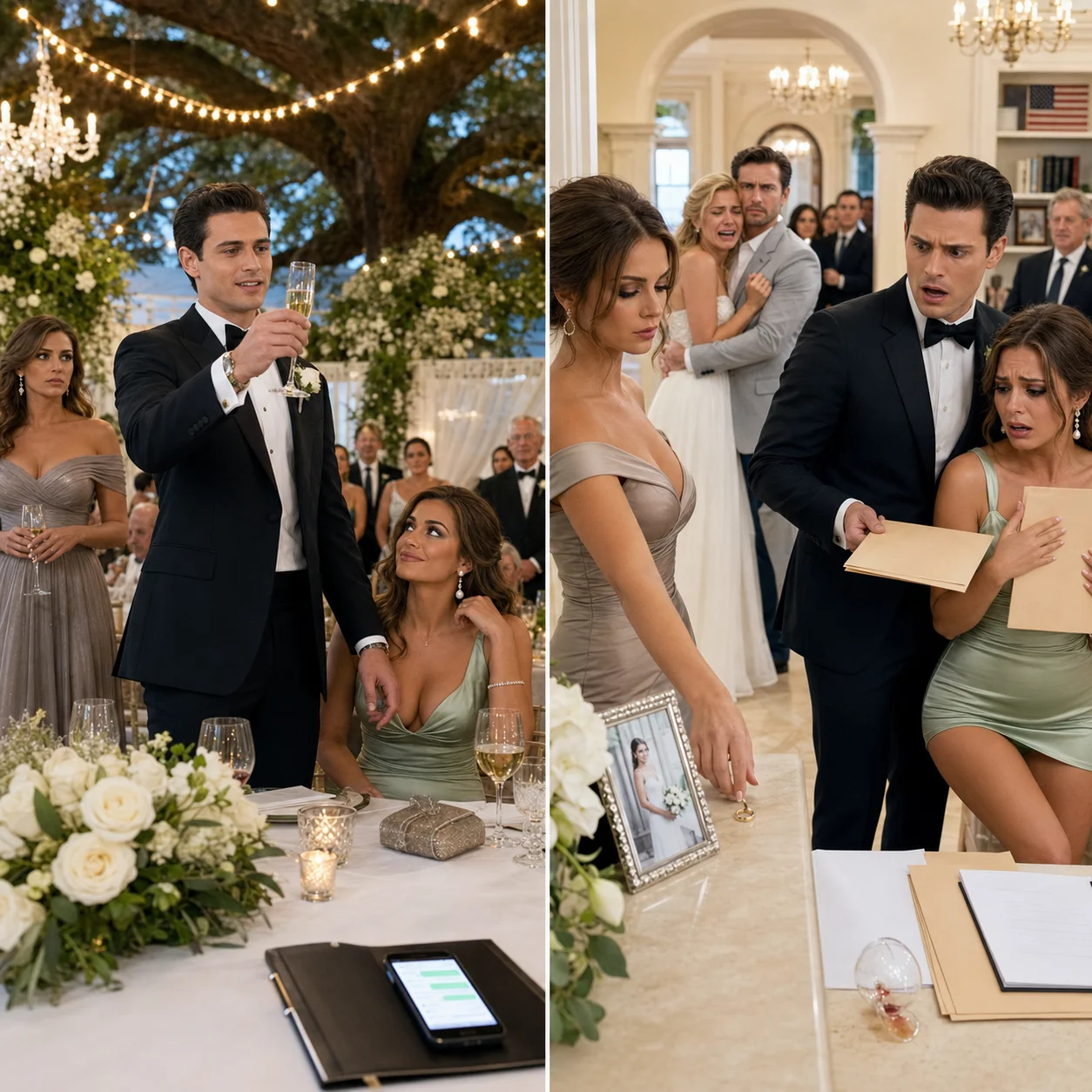
My husband didn’t want to leave me before our daughter’s wedding.
He wanted the pictures first.
That was the part I couldn’t stop thinking about later. Not the affair. Not the lies. Not even the fact that the woman he planned to leave me for had spent nine months helping me choose linens, flowers, seating charts, and the exact shade of ivory ribbon for our only daughter’s bouquet.
It was the pictures.
Richard wanted one last perfect family portrait for the wall. One final image of us standing together in the courtyard of the Lowndes House in Charleston, smiling beneath the live oaks while our daughter, Emily, glowed in her wedding dress between us. He wanted the illusion preserved in satin, sunlight, and professional photography.
Then, after the champagne was gone and the guests had flown home, he planned to sit me down like a business problem and tell me our thirty-one-year marriage had “run its course.”
His words.
Not mine.
I found out four days before the wedding because Richard had never learned how to delete voicemails from his iPad.
That sounds ridiculous for a man who built a regional logistics company from two delivery vans and a warehouse with a leaking roof, but Richard had always been careless with little things. Receipts left in jacket pockets. Passwords written on the backs of business cards. Reading glasses abandoned in every room of the house. Half-finished cups of coffee turning cold in places they didn’t belong.
For most of our marriage, I thought his carelessness was charming.
By the end, it saved my life.
It was a Tuesday afternoon, hot and heavy the way Charleston gets in late May, when I went into his study looking for the final vendor binder. The wedding planner had asked me to confirm the transportation schedule one last time, and Richard had taken the binder after dinner the night before, pretending he wanted to “help.”
Richard almost never wanted to help with domestic details.
He wanted to approve things. Pay for things. Make speeches about things.
But he did not want to help.
The binder wasn’t on his desk, but his iPad was there, propped beside a half-empty coffee mug. The screen lit up when I brushed it with my hand. A voicemail transcription was open.
At first, I thought it was from one of his drivers or maybe a client.
Then I saw the name.
Marla Vance.
My friend.
Our wedding coordinator.
The woman I had trusted with my daughter’s wedding.
The transcription was imperfect, as those things often are, but the meaning was clear enough.
Richard, don’t get sentimental on me now. You promised after the wedding. You said once Emily was married, there would be no more excuses. I can sit through one more weekend of watching you play devoted husband, but after Sunday brunch, I need to know you’re actually choosing me. And don’t forget, I want to be at the family table for the reception. I’ve earned that much.
I read it once.
Then again.
Then I sat down slowly in Richard’s leather chair, the one I had given him for his fiftieth birthday, because my knees had gone unsteady.
Marla.
Of all people.
If you had asked me a month earlier what betrayal looked like, I might have imagined lipstick on a collar, hotel charges, or some young assistant with perfume too sweet for the office.
I would not have imagined a fifty-two-year-old widow in tasteful linen pants, pearl earrings, and a voice smooth enough to make cruelty sound like etiquette.
Marla had been in our circle for years. She coordinated charity luncheons, historical society galas, retirement dinners, rehearsal dinners, and weddings for people who still cared which fork went where. She was polished, discreet, and very good at making wealthy Southern women feel as if their anxieties were reasonable.
When Emily got engaged, Marla was the obvious choice.
“She knows everyone,” Richard had said.
I remembered that now.
He had said it too quickly.
I sat in his chair with the late afternoon sun falling across the Persian rug and felt my life separate into two parts: before that voicemail, and after.
Then, as if the universe wanted to make sure I did not cling to denial, Richard’s iPad chimed with a new message.
Marla again.
I know Claire is stressed, but don’t let her guilt you into backing out. You’ve given her thirty years. After this weekend, it’s our turn.
Our turn.
I stared at those words until they stopped looking like language.
My first instinct was not rage.
That came later.
My first instinct was to protect Emily.
My daughter was four days away from marrying a good man named Daniel Fisher. She had spent a year planning this wedding. She had chosen the courtyard because she said the oaks made her feel like generations were watching over her. She wanted peach garden roses because my mother had carried them. She wanted her father to walk her down the aisle because, despite his flaws, she adored him.
I was not going to let Richard and Marla turn her wedding into the site of their confession.
I was not going to scream in the study.
I was not going to throw the iPad across the room.
I was not going to call Emily and hand her my pain like a burden.
I stood up, took a picture of the voicemail transcription with my phone, sent it to myself through a secure folder, then began searching.
I am not proud of that part.
But I am not ashamed either.
Thirty-one years of marriage gives you a lot of shared access. Richard knew my passwords. I knew his. We had built a life on the assumption that neither of us had anything to hide.
He had broken that assumption.
I simply stopped honoring it.
His messages with Marla went back almost a year.
At first, they were subtle. Thank you for helping with the donor dinner. You looked beautiful tonight. Wish I could have stayed longer.
Then they became familiar. I miss you. Last night was impossible to forget. Claire has no idea how far away from her I already am.
Then practical. After Emily’s wedding, I’ll tell her. The timing is clean. No need to upset our daughter before the ceremony.
Then financial.
That was when my grief sharpened into something colder.
Marla had not only been sleeping with my husband.
She had been advising him.
You need to separate the River Street property before filing.
Make sure Claire doesn’t know about the valuation.
If she thinks the Charleston office is struggling, she won’t ask the right questions.
Talk to Wallace again about moving the proceeds through the consulting entity.
Wallace.
That name mattered.
Wallace Brenner was Richard’s outside corporate attorney. Not our family lawyer. Not the estate attorney who had handled our wills, trusts, and property documents. Wallace was the kind of lawyer Richard used when he wanted things done aggressively and quietly.
I kept reading.
Richard had been planning not just a divorce, but a financial ambush.
He believed I was still the same woman I had been at twenty-six when we married. A schoolteacher with a modest salary, soft manners, and a tendency to let him handle the complicated things because he liked feeling necessary.
He had forgotten who balanced the books during the first five years of Donovan Freight.
He had forgotten who worked nights grading essays while answering phones for his dispatchers after his first office manager quit.
He had forgotten whose father loaned us the money for the first warehouse.
He had forgotten whose inheritance bought the River Street property he now wanted to “separate.”
And most importantly, he had forgotten that I had signed every major document in our marriage only after reading it twice.
By six o’clock, I had found enough to understand the outline of his plan.
Richard intended to wait until after the wedding, then tell me he wanted a divorce. Before that, he was quietly trying to move or undervalue several assets, especially the River Street property, which had appreciated wildly over the past decade. He had also routed large payments to a consulting company called Vance Strategic Events.
Marla’s company.
Payments that looked, on paper, like wedding and event-related consulting fees.
But the amounts were absurd.
Eighty thousand dollars.
Forty-five thousand.
Twenty-two thousand.
For “logistics support,” “venue coordination,” and “executive hospitality planning.”
I had planned enough nonprofit galas to know what those services cost.
Richard was not just having an affair.
He was paying his mistress with marital money while preparing to argue that certain assets were not as valuable as they truly were.
I put the iPad back exactly where I found it.
Then I walked into the kitchen and made tea.
That may sound strange, but I needed something ordinary in my hands. I needed the kettle, the cup, the small spoon stirring honey into hot water. I needed proof that the world still had rules.
Richard came home at seven-thirty carrying a garment bag over his shoulder.
“Tux finally fits,” he said, kissing my cheek.
I smelled Marla’s perfume on his collar.
Not strong.
Just enough.
I smiled.
“Good,” I said. “Emily will be happy.”
He poured himself bourbon and talked for twenty minutes about transportation delays at one of the Savannah terminals. I listened. I nodded. I even asked questions.
All the while, I watched his face and wondered how long he had practiced being two men.
The husband who kissed my cheek.
The lover who promised another woman “after Sunday.”
That night, when Richard fell asleep, I lay beside him in the bed we had shared for most of my adult life and stared at the ceiling fan.
I cried silently once.
Only once.
Then I got up, went downstairs, and called my brother.
Thomas was sixty-two, a retired judge in North Carolina, and the only person in my family who could hear catastrophe without immediately making noise.
He answered on the third ring.
“Claire?”
“Tom,” I said, my voice steadier than I felt, “I need a divorce lawyer, a forensic accountant, and someone who understands corporate transfers.”
There was a pause.
Then he said, “Is Emily safe?”
That was my brother.
Straight to what mattered.
“Yes.”
“Are you safe?”
“Yes.”
“Then tell me everything.”
So I did.
I spoke for nearly an hour in the laundry room with the door shut while the dryer hummed beside me. I told him about the voicemail, the messages, the payments, the planned divorce after the wedding.
Thomas did not interrupt except to clarify names and dates.
When I finished, he exhaled slowly.
“Do not confront him before the wedding,” he said.
“I wasn’t going to.”
“Good. He’ll either destroy evidence or try to provoke you into looking unstable.”
“I know.”
“Forward everything to me. I’ll connect you with Meredith Shaw. She’s in Charleston. Family law, high-net-worth divorce, corporate overlap. She’s not cheap, but she’s worth it.”
“Money isn’t my concern.”
“It will be Richard’s soon enough,” Thomas said.
That was the first time I almost smiled.
By Wednesday morning, I was sitting in Meredith Shaw’s office overlooking Broad Street.
Meredith was in her early fifties, silver-blonde, calm, and so precise with her words that even her greetings sounded billable. She wore a navy suit, no jewelry except a watch, and had the deeply reassuring quality of a woman who had seen every version of betrayal and no longer found any of them surprising.
She reviewed the screenshots and messages without visible reaction.
When she finished, she folded her hands on the desk.
“First,” she said, “you were right not to confront him.”
I nodded.
“Second, the wedding complicates the emotional timeline but not the legal one. If your priority is protecting your daughter’s day, we can work around that.”
“It is.”
“Third, the financial misconduct may matter more than the affair.”
“Because of the transfers?”
“Because of the transfers, the apparent attempt to mischaracterize assets, and the fact that marital funds may have been routed to the affair partner under questionable business purposes.” She tapped one page with her pen. “Also, you mentioned the River Street property came from your inheritance?”
“My father left me the money. We bought the property six months after he died.”
“Do you have records?”
“Yes.”
“Good.”
She looked at me for a long moment.
“Mrs. Donovan, I want you to understand something. Men like your husband often mistake courtesy for ignorance. If you remain calm this weekend, he may continue making that mistake. That gives us room.”
“What do you need me to do?”
“Act normal. Gather nothing illegally. Do not access anything you do not have shared permission to access. Do not threaten him. Do not warn the mistress. Do not discuss this with your daughter yet unless there is an immediate reason. And if he says anything incriminating, do not interrupt.”
“Let him talk,” I said.
“Exactly.”
Meredith gave me a list.
Bank records. Property deeds. Trust documents. Tax returns. Corporate distributions. Payments to Marla’s company. Communications about asset transfers. Vendor contracts for the wedding.
Then she said, “One more thing.”
“Yes?”
“You said Marla wants to sit at the family table?”
“She said she earned that much.”
Meredith’s mouth tightened slightly. It was not quite a smile.
“Let her.”
I stared at her.
“You’re serious?”
“Very. If your husband is foolish enough to publicly elevate his affair partner during a family wedding weekend while financial misconduct is under review, let him create witnesses.”
That sentence stayed with me all weekend.
Let him create witnesses.
So I did.
I let Marla sit at the family table.
I let Richard adjust his bow tie in the mirror while humming like a man beginning a new life.
I let Emily hug him on the morning of her wedding, unaware that her father had been planning to fracture our family the moment she left for her honeymoon.
And I let myself become very, very still.
The wedding weekend began Friday evening with the rehearsal dinner in a private room above a restaurant near the Battery. Warm lights. White tablecloths. Shrimp and grits served in little cast-iron dishes because Emily thought tourists loved that sort of thing and Daniel’s family was from Ohio.
Marla arrived in a pale blue dress, elegant and understated, with a pearl comb in her hair.
She kissed my cheek.
“Claire,” she said softly, “you look beautiful. How are you holding up?”
I looked into her eyes and wondered what kind of woman could ask that while carrying my husband’s promises under her skin.
“Tired,” I said. “But happy.”
She squeezed my hand.
“After Sunday, you can finally breathe.”
The cruelty of that almost impressed me.
Richard appeared behind her with two glasses of champagne.
One for her.
One for me.
He handed mine over without hesitation.
“Ladies,” he said warmly.
Marla looked at him a second too long.
I pretended not to notice.
That became the rhythm of the weekend.
Pretending not to notice.
Pretending not to notice when Richard touched the small of Marla’s back near the bar.
Pretending not to notice when she corrected wedding details with the confidence of a woman who believed she would soon inherit my role.
Pretending not to notice when he laughed more easily with her than he had with me in years.
But I noticed everything.
So did Meredith’s investigator, a quiet woman named Dana who attended as a temporary assistant for the photography team. She had been recommended by Meredith and cleared by the venue under a legitimate staffing arrangement. Her job was not to spy on private moments. Her job was to document public interactions, seating, timelines, and anything relevant to the financial and social context Richard seemed determined to create.
Richard was too pleased with himself to see her.
Men often miss women who do not ask to be seen.
Saturday morning, I woke before dawn and found Emily sitting on the porch of the bridal suite wrapped in a white robe, her hair in loose rollers, watching the sun rise over the garden.
For a second, my heart broke so sharply I had to hold onto the doorframe.
She looked twelve and thirty at the same time.
“Mom?” she said. “You okay?”
“Yes, sweetheart.”
She patted the chair beside her. “Sit with me.”
I sat.
For a while, neither of us spoke.
Then she leaned her head on my shoulder.
“Do you think Dad’s proud of me?”
The question nearly undid me.
“Of course he is.”
“He’s been strange lately.”
I kept my breathing even.
“Weddings make fathers strange.”
She laughed softly. “Maybe.”
Then she looked down at her hands.
“I’m scared.”
“Of getting married?”
“Not exactly. Daniel is the best person I know. I’m scared of how much life can change after one promise.”
I closed my eyes for a moment.
“Yes,” I said. “It can.”
“How do you know if you’re making the right choice?”
I turned to her.
“You don’t know because the wedding is beautiful. You don’t know because people clap or because the flowers are perfect. You know in the quiet parts. You know by how someone treats you when nobody is giving them credit for it. You know by whether they protect your dignity when they could easily embarrass you. You know by whether they tell the truth when lying would benefit them.”
Emily studied my face.
“That sounds important.”
“It is.”
She squeezed my hand.
“Did Dad do that for you?”
There are moments in life when honesty and mercy stand on opposite sides of the same room.
I chose mercy.
“Your father and I had many good years,” I said carefully. “And you came from the best of them.”
That was true.
Not the whole truth.
But true.
At three o’clock that afternoon, Richard walked our daughter down the aisle beneath the live oaks.
I watched from the front row in a soft gray dress Emily had chosen because she said it made my eyes look “wise and dangerous.” Richard looked handsome in his tuxedo, silver hair trimmed neatly, posture proud, Emily’s arm looped through his.
For one painful moment, I remembered the man I married.
The twenty-eight-year-old with ambition bigger than his bank account. The man who cried when Emily was born. The man who once drove through a hurricane warning because my mother had fallen and I was too scared to drive myself.
That man had existed.
I needed to believe that.
Otherwise, I would have to accept that I had spent three decades loving a ghost.
Richard kissed Emily’s cheek at the altar and placed her hand in Daniel’s.
Then he sat beside me.
His shoulder brushed mine.
I did not move away.
During the vows, Daniel cried first. Emily laughed through her tears and whispered, “I knew you would,” loud enough for the first two rows to hear. Everyone chuckled, including me.
For a little while, the day belonged only to them.
That is the part I want people to understand.
I did not spend my daughter’s wedding plotting revenge.
I spent it protecting joy.
I fixed her veil. I danced with my new son-in-law. I hugged Daniel’s mother in the ladies’ room when she got emotional about “gaining a daughter.” I watched Emily throw her head back laughing when the band played Motown and all the older guests flooded the dance floor.
I let the beauty of that day exist untouched.
Richard and Marla did not deserve the power to ruin it.
At the reception, Marla sat at the family table exactly as she had requested.
Emily was too kind to question it. She thought Marla deserved a good seat after months of work. Daniel probably thought the same. Richard looked satisfied, almost triumphant, when he saw Marla seated just three chairs away from him.
I saw Dana, the investigator, take note from across the room.
I sipped champagne.
Then came the toasts.
Daniel’s father spoke first, charming everyone with a story about Daniel trying to bake a cake for his mother at age eight and accidentally salting it instead of sugaring it. My brother Thomas spoke next on behalf of my late parents and made Emily cry within thirty seconds.
Then Richard stood.
He tapped his glass, smiling broadly.
The room quieted.
I knew that smile. It was his public smile. The one he used for donors, clients, board dinners, ribbon cuttings, and newspaper interviews. Warm but controlled. Emotional but never messy.
“My beautiful daughter,” he began, turning toward Emily, “when your mother and I brought you home from the hospital, I remember standing over your crib and thinking no man would ever be good enough for you.”
Soft laughter.
Emily wiped her eyes.
“But Daniel, I’ll admit, you’ve made a strong case.”
More laughter.
Richard continued smoothly, telling stories from Emily’s childhood. Her first bicycle. Her stubborn refusal to quit piano even though she hated practicing. Her decision to become a pediatric occupational therapist because she wanted to help children “feel capable in their own bodies.”
It was a good speech.
That hurt most of all.
He was capable of sounding like a loving father. He was capable of making people cry. He was capable of saying true things beautifully.
Then his gaze shifted.
“To everyone who helped make this weekend possible,” he said, “Claire and I are grateful beyond words.”
Claire and I.
As if we were still a team.
His eyes moved to Marla.
“And I would be remiss if I didn’t give special thanks to Marla Vance.”
People turned toward her.
Marla lowered her eyes with perfect modesty.
Richard raised his glass.
“Marla, you have been more than a planner. You have been a steady hand, a calm voice, and, in many ways, the person who helped this family step gracefully into its next chapter.”
Next chapter.
I felt Thomas go still beside me.
He knew.
He had flown in that morning pretending to be just the proud uncle, but he knew everything. When Richard said next chapter, Thomas’s hand tightened around his water glass.
Marla smiled up at Richard.
A private smile.
A wife’s smile.
Not yet, I thought.
Not here.
Richard finished by toasting Emily and Daniel.
The room applauded.
Marla dabbed one eye delicately with her napkin.
I let her have that moment.
I let my husband toast his mistress at our daughter’s wedding reception in front of two hundred people.
Then I stood for my turn.
Richard looked surprised.
He shouldn’t have been. I was the mother of the bride.
But men like Richard often forget that women they underestimate still have voices.
I took the microphone from the bandleader and turned first to Emily and Daniel.
“I promise not to keep everyone long,” I said.
The room laughed kindly.
I looked at my daughter.
“When you were little, Emily, you used to ask me why people cried at weddings. You thought it was strange that everyone dressed up, ate cake, danced, and then cried into expensive napkins.”
Emily smiled through fresh tears.
“I told you then that people cry at weddings because love makes time visible. We look at the bride and remember the baby. We look at the groom and imagine the old man he might become. We look at two people at the beginning and pray they will be gentle with one another all the way to the end.”
The room grew quiet.
Richard watched me carefully now.
He sensed something.
Not enough.
I continued.
“Marriage is not sustained by flowers or photographs or good manners at dinner parties. It is sustained by the choices people make when they are tired, tempted, disappointed, or unseen. It is sustained by honesty when dishonesty would be convenient. By loyalty when novelty looks exciting. By protecting the person beside you even when they do not know they need protection.”
Emily was crying.
Daniel had his arm around her.
I looked only at them.
“My wish for you is not that life never tests you. It will. My wish is that when it does, you do not turn away from each other in secret. That you never make a plan for your own future that requires betraying the person who trusts you most.”
The silence deepened.
Richard’s face had gone pale.
Marla was no longer smiling.
I let the room sit in that silence for one breath.
Then I lifted my glass.
“To Emily and Daniel,” I said. “May your home be built on truth, may your love be protected by courage, and may neither of you ever mistake someone’s trust for weakness.”
People applauded.
Some stood.
Emily came to me and wrapped her arms around my waist. She didn’t know everything yet. But she felt enough. Daughters often do.
“You always know what to say,” she whispered.
I kissed her hair.
“Not always.”
I handed the microphone back.
And I let the wedding continue.
That was my gift to her.
Not the flowers. Not the dress. Not the check we had written for the venue.
The gift was restraint.
Richard avoided me for the next hour. Marla avoided me too. I danced with Thomas, then Daniel, then two of Richard’s old business partners who complimented my toast with the careful tone of men wondering whether they had just witnessed a warning shot.
They had.
Sunday brunch was held at our house.
Emily and Daniel were leaving for their honeymoon that afternoon, so the brunch was meant to be casual. Coffee, fruit, biscuits, smoked salmon, leftover cake, guests drifting in and out before heading to the airport.
Richard had insisted Marla attend.
“She worked hard,” he said Saturday night in our bedroom, while removing his cufflinks without looking at me. “It would be rude not to include her.”
“Of course,” I said.
He glanced up, suspicious.
“You’re being quiet.”
“It was an emotional day.”
His expression softened in that patronizing way I had grown to hate.
“I know. We’ll talk after Emily leaves.”
“Yes,” I said. “We will.”
He slept poorly.
I slept not at all.
At eight-thirty Sunday morning, Meredith Shaw arrived at our house wearing a cream suit and carrying a leather folder. She came through the back entrance with Thomas, who had stayed in the guest room. Dana arrived ten minutes later and waited in the sunroom. A process server named Mr. Hanley sat in a car down the street until called.
Everything was legal.
Everything was timed.
Everything was calm.
At ten, the house filled with family.
Emily came downstairs in a white sundress, glowing with that strange softness brides have the morning after their wedding. Daniel carried their luggage to the foyer while relatives teased him about finally being responsible for someone else’s sunscreen.
Richard performed beautifully.
He hugged guests. Poured mimosas. Played the proud father. Kissed Emily’s forehead. Told Daniel to “take care of my girl” in a voice thick with emotion.
Marla arrived at ten-thirty.
She wore pale green.
She brought orchids.
For me.
“Claire,” she said, offering the arrangement, “for a flawless weekend.”
I took them.
“How thoughtful.”
Her eyes searched mine.
For the first time, I saw uncertainty.
Good.
At eleven-fifteen, Richard tapped his spoon against his champagne flute.
“Before the newlyweds escape,” he said, “I’d like one final toast.”
Of course he would.
Richard loved final words.
Everyone gathered loosely in the living room and around the dining room archway. Emily and Daniel stood near the fireplace. Marla stood to Richard’s left, close enough to be noticed but not close enough to be questioned.
I stood near the stairs with Thomas.
Meredith remained in the hall, out of sight.
Richard raised his glass.
“To Emily and Daniel,” he said. “Your wedding reminded us all that life moves in seasons. Your mother and I have had the privilege of raising you, loving you, and watching you begin your own family. Now, as you step into your next chapter, all of us are reminded that new chapters await us too.”
His eyes flicked to Marla.
Subtle.
But not subtle enough.
He continued.
“I also want to thank Marla again. She didn’t just coordinate a wedding. She helped guide this family through a transition.”
There it was again.
Transition.
Marla’s chin lifted slightly.
She believed this was the beginning of her public introduction.
She believed Richard was choosing her.
She believed I was simply standing there, dignified and doomed.
Richard smiled at her.
“To Marla,” he said, raising his glass. “For seeing what this family needed before we did.”
A few people clapped politely, confused but agreeable.
I waited until he drank.
I wanted him to toast her first.
I wanted witnesses to remember it.
Then I set my untouched glass on the table.
“Richard,” I said, “that was beautifully put.”
He turned toward me, startled by my tone.
The room quieted.
I walked to the center of the living room.
“Since we’re speaking of transitions and new chapters,” I said, “there are a few things that should be handled before Emily and Daniel leave.”
Emily frowned slightly.
“Mom?”
I looked at her, and my face softened.
“Sweetheart, I am sorry for the timing. I waited until after your wedding because yesterday belonged to you. Completely. But there are truths adults sometimes hide under the tablecloth because they’re afraid of ruining the meal.”
Richard’s voice sharpened.
“Claire, this is not the time.”
I turned to him.
“No, Richard. This is exactly the time you chose.”
His mouth closed.
Marla took one step back.
I looked toward the hall.
Meredith entered.
Richard’s expression changed instantly.
A man knows a lawyer when one walks into his house carrying silence like a weapon.
“Who is this?” he demanded.
Meredith did not look at him.
She looked at me.
I nodded.
Mr. Hanley came in behind her.
“Richard Paul Donovan?” he asked.
The room froze.
Richard’s face darkened.
“What is this?”
“You are being served,” Mr. Hanley said calmly.
He handed Richard the envelope.
For a moment, Richard did not take it.
Then Thomas said, “Take the papers, Richard.”
The sound of my brother’s judge voice moved through the room like a gavel.
Richard took the envelope.
Marla whispered, “Oh my God.”
Meredith handed a second envelope to Marla.
“Marla Vance?”
Marla’s hand shook as she accepted it.
“What is this?” she asked.
“A preservation notice,” Meredith said. “Regarding payments made to Vance Strategic Events, communications with Mr. Donovan, and any records involving marital funds, asset transfers, or consulting arrangements related to Donovan Freight and affiliated properties.”
Marla looked at Richard.
He did not look back.
That was the first crack in her fantasy.
Not the papers.
Not the witnesses.
The fact that when the danger came, Richard protected only himself.
Emily’s voice was small.
“Dad?”
Richard turned toward her, and for the first time all weekend, he looked old.
“Emily, honey, this is between your mother and me.”
“No,” I said. “It became more than that when you planned your divorce around her wedding and brought your mistress into our family photographs.”
A sound moved through the room.
Shock has a sound. It is not always a gasp. Sometimes it is the collective absence of breath.
Emily stepped back as if Richard had physically touched her.
Daniel put an arm around her.
Marla’s face went white.
Richard pointed at me.
“You don’t know what you’re talking about.”
“I know about the voicemail,” I said. “I know about the messages. I know you promised Marla you would leave me after Sunday brunch. I know you planned to wait until Emily’s wedding was over because you wanted the optics clean.”
“Claire,” he said through clenched teeth, “stop.”
“I know about Vance Strategic Events receiving marital funds under questionable consulting invoices. I know about Wallace Brenner and the River Street valuation. I know you discussed separating assets before filing. I know enough that my attorney has already filed for temporary financial restraints.”
Richard looked at Meredith.
Meredith spoke evenly.
“Mr. Donovan, as of this morning, you are restrained from transferring, encumbering, concealing, or disposing of marital assets outside ordinary business operations. Donovan Freight’s board has also received notice concerning potential unauthorized related-party payments.”
That hit him harder than the divorce papers.
His company.
His temple.
His real marriage.
“You contacted my board?” he said.
“No,” I said. “My attorney contacted the appropriate parties regarding financial preservation. There’s a difference.”
Marla found her voice.
“Richard told me you knew the marriage was over.”
I looked at her.
“Did he also tell you I approved the payments to your company?”
She said nothing.
“Did he tell you the River Street property came from my father’s inheritance?”
Nothing.
“Did he tell you he was trying to make sure I didn’t ask the right questions?”
Her mouth trembled.
Richard snapped, “Marla, don’t say anything.”
Too late.
Everyone saw it.
Everyone understood.
Emily started crying then, not loudly. Just one hand pressed to her mouth while tears slipped down her face. Daniel held her, looking at Richard with the kind of controlled disgust good men reserve for cowards.
I turned to my daughter.
“I am so sorry,” I said. “I wanted you to have your wedding day. That’s why I waited.”
She nodded through tears.
“I know,” she whispered. “I know, Mom.”
Richard tried to move toward her.
“Emily, please listen to me.”
She stepped back.
“No.”
One word.
It broke him more than anything I had said.
He looked around the room, searching for allies. His sister avoided his eyes. His oldest friend stared at the floor. Daniel’s father folded his arms. Thomas stood beside me like a wall.
Marla set her glass down on the nearest table.
“I’m leaving,” she whispered.
Richard turned sharply.
“Marla.”
But she was already moving toward the door, clutching the envelope Meredith had given her. Dana followed at a discreet distance, not interfering, simply documenting that Marla left with notice in hand.
Richard watched her go.
Then he looked at me with hatred.
“You planned this.”
“Yes,” I said.
His laugh was ugly.
“There she is. The real Claire. Cold. Calculating.”
“No, Richard. The real Claire is the woman who let her daughter have a beautiful wedding while her husband and his mistress smiled for the photographer. The real Claire is the woman who protected your dignity for thirty-one years. The real Claire is the woman you mistook for weak because she chose not to embarrass you.”
His face reddened.
“You think this makes you look noble?”
“No,” I said. “I think it makes me finished.”
The room was silent.
I removed my wedding ring.
Not dramatically. Not with trembling fingers. I had worn it for three decades. It took a moment. My knuckle resisted, as if even my body had become accustomed to the lie.
Then it slipped free.
I placed it on the mantel beneath Emily’s bridal portrait.
“This marriage ended when you made a plan that required my humiliation,” I said. “Today I’m only making the paperwork catch up.”
Richard stared at the ring.
For a second, I thought he might cry.
Instead, he said the one thing that confirmed I had made the right decision.
“What about the company?”
Not our daughter.
Not our marriage.
Not the woman leaving through the front door with orchids still sitting on the hall table.
The company.
Meredith stepped forward.
“All further communication should go through counsel.”
The brunch ended quickly after that.
People murmured, hugged Emily, avoided Richard, and left in stunned clusters. Daniel’s parents took the newlyweds to the airport themselves. Before Emily left, she came upstairs to my bedroom where I had gone to breathe.
She stood in the doorway in her white dress, no longer looking like a bride.
Just my daughter.
“How long have you known?” she asked.
“Since Tuesday.”
Her face crumpled.
“You carried that through my wedding?”
I nodded.
She crossed the room and hugged me so hard I almost lost my balance.
“I’m sorry,” she sobbed. “I’m so sorry.”
“No,” I said, holding her. “You do not apologize for your father’s choices.”
“I don’t want to leave you.”
“Yes, you do,” I said gently. “You want to get on that plane with your husband. You want to swim in the ocean and eat too much pasta and begin your marriage without carrying mine in your suitcase.”
She pulled back, crying.
“How can I do that?”
“By knowing I am not alone.”
She looked toward the hallway, where Thomas was speaking quietly with Meredith.
“Uncle Tom?”
“Uncle Tom, Meredith, and thirty-one years of learning where every document is kept.”
That made her laugh through tears.
I brushed hair away from her face.
“Emily, listen to me. Your father broke my heart. He did not break me.”
She nodded slowly.
“I love you, Mom.”
“I love you too.”
She hesitated.
“Was any of it real? You and Dad?”
That question hurt worse than the affair.
“Yes,” I said. “Some of it was very real. You were real. The family we built was real. His betrayal does not get to erase every good thing that came before it.”
She took that in.
Then she said, “But it changes him.”
“Yes,” I said. “It changes what we know about him.”
She wiped her face, took a breath, and straightened her shoulders.
My daughter.
My brave girl.
“I’m going to go on my honeymoon,” she said.
“Good.”
“And when I come back, I’m going to be very angry at him.”
“That is also good.”
She hugged me one more time.
Then she left.
After the house emptied, Richard and I stood in the living room alone for the first time.
He held the envelope in one hand.
He looked smaller.
Not humbled.
Just cornered.
“Claire,” he said, quieter now, “we don’t have to make this ugly.”
I almost laughed.
“That choice passed when you brought Marla to our daughter’s wedding.”
“I didn’t mean for it to happen like this.”
“How did you mean for it to happen?”
He rubbed a hand over his face.
“I was going to talk to you privately.”
“After the wedding.”
“Yes.”
“After the photographs.”
He looked away.
“Don’t make it sound so cruel.”
“It was cruel.”
His jaw tightened.
“I was unhappy.”
“So was I sometimes. I didn’t build a financial exit strategy with another man.”
“You stopped seeing me,” he said suddenly.
There it was.
The oldest trick.
Turn neglect into permission.
“No, Richard. You stopped being honest. Those are not the same thing.”
He sank into a chair.
“I love her.”
For the first time, the sentence did not hurt the way I expected.
Maybe because by then I had seen what his love looked like when consequences arrived. Marla had walked out with a legal notice in her hand, and he had not followed.
“No,” I said. “You love how she made you feel before she became expensive.”
His eyes flashed.
“That’s beneath you.”
“So was sleeping with the wedding planner.”
He had no answer.
The following months were not clean or easy.
Stories like mine often make revenge sound like a single scene, a perfect dramatic reversal, then freedom.
Real life is more paperwork.
Richard fought at first. Of course he did.
His attorneys claimed the payments to Marla were legitimate event consulting fees. Meredith requested documentation. What came back was thin, repetitive, and sloppy. Several invoices had been created after the fact. One listed planning meetings on dates when Marla and Richard had actually been together in Asheville, according to hotel records Richard had charged to a corporate card.
Wallace Brenner tried to distance himself from the River Street valuation discussions. Then Meredith obtained emails showing he had warned Richard that moving too aggressively before filing could “create optics issues.”
Optics.
That word appeared often in Richard’s world.
Not ethics.
Optics.
The board of Donovan Freight opened an internal review. Richard stepped down temporarily, then permanently after two longtime board members informed him they would resign rather than defend related-party payments to his mistress’s company.
He kept equity, but he lost control.
That punished him more than any alimony figure ever could.
Marla tried to save herself by cooperating.
I learned that from Meredith, who took no pleasure in reporting it. Marla provided emails, texts, and calendar records showing Richard had represented the consulting payments as “future security” for her once the divorce began.
In other words, he had lied to both of us differently.
To me, Marla was a planner.
To Marla, I was a soon-to-be ex-wife already emotionally discarded.
To himself, Richard was the tragic hero of a late-life love story.
The records suggested something else.
He was a man trying to make betrayal financially efficient.
The divorce settlement came nine months later.
I kept the River Street property.
I kept my inheritance assets.
I received half of the marital investment accounts and a significant settlement tied to the improper transfers. Richard kept a reduced share of Donovan Freight, though without operational control. The marital home was sold. I did not want it.
Too many rooms had learned to lie.
Emily did not cut Richard off completely, but she changed with him. Their calls became shorter. Her voice cooled. She invited him to lunch once after returning from her honeymoon, and according to Daniel, she asked him one question.
“Did you bring Marla to my wedding because you loved her, or because you wanted Mom to feel replaced?”
Richard apparently cried.
Emily did not.
That was when I knew my daughter would be all right.
As for Marla, she left Charleston before Christmas. Her business never recovered. People will forgive many things in polite society if they are quiet enough, but they do not forgive being made to look foolish at their own events. Every woman who had ever hired Marla to manage a family milestone suddenly wondered what else she had been managing behind the scenes.
I did not celebrate that.
But I did not mourn it either.
Richard moved into a condo near the marina and grew a beard that did not suit him. He sent me one letter through Meredith six months after the divorce finalized.
Claire,
I have had time to understand the harm I caused. I was selfish, vain, and afraid of aging into a life where I no longer felt admired. That is not an excuse. It is only the truth I have now. You deserved honesty. Emily deserved better from me. I am sorry for bringing shame into her wedding weekend. I know you may never forgive me, but I hope someday you believe I did love you for much of our life.
I read it twice.
Then I placed it in a drawer.
Not because I wanted to preserve it.
Because I no longer felt the need to burn anything.
By then, I had moved into a smaller house on James Island with a screened porch, blue shutters, and a kitchen that caught the morning light. I bought new dishes. New sheets. New towels. At fifty-seven, I learned the strange pleasure of choosing furniture without negotiating anyone else’s taste.
Thomas visited often. Emily and Daniel came for Sunday dinners. I joined the board of a literacy nonprofit and started teaching one morning a week again, not because I needed money, but because I missed the clean honesty of helping someone understand a sentence.
One evening, almost a year after the wedding, Emily brought over the album.
I had avoided it.
She knew that.
We sat on my porch with sweet tea and opened it together.
There she was beneath the oaks.
There was Daniel crying at the altar.
There was Thomas dancing badly.
There was Richard walking her down the aisle.
There was Marla at the family table, smiling like a woman who thought she had already won.
And there I was.
Standing in my gray dress beside Richard in the formal family portrait, my smile soft, my eyes clear.
Emily touched the photograph.
“You knew,” she said.
“Yes.”
“You don’t look broken.”
I looked at the woman in the picture for a long time.
“No,” I said. “I don’t.”
And I realized it was true.
Richard had wanted the pictures before the divorce because he thought photographs could preserve the version of our family he preferred. He wanted proof that he had left cleanly. That he had honored the wedding. That the transition had been graceful.
But the camera had captured something else.
It had captured the last day I protected his image.
It had captured the final performance of a wife who knew the script and chose not to ruin her daughter’s scene.
It had captured a woman standing beside betrayal and already moving beyond it.
Emily leaned against my shoulder, just as she had on the porch the morning of her wedding.
“Are you happy now?” she asked.
I looked out at the marsh grass turning gold in the evening light.
Happiness is a complicated word after a long marriage ends. It is not fireworks. Not at first. It is not waking up healed or suddenly young again. It is quieter than that.
It is opening your bank statement without fear.
It is sleeping through the night.
It is hearing a car in the driveway and not bracing for the mood of the person walking in.
It is realizing nobody in your house is secretly planning your humiliation.
It is peace.
“Yes,” I said. “I am.”
A few weeks later, I ran into Richard at a fundraiser downtown.
He was alone.
For a second, we simply looked at each other across the gallery. He seemed older than his sixty years. Not ruined. Not destroyed. Just diminished in that particular way people become when the story they told about themselves no longer works.
He approached slowly.
“Claire.”
“Richard.”
“You look well.”
“I am.”
He nodded, absorbing that.
“I heard Emily’s expecting.”
I stiffened slightly. Emily had told him then. Good. That was her choice.
“She is.”
His eyes softened.
“A grandchild.”
“Yes.”
“I hope…” He stopped. Started again. “I hope I’m allowed to be part of that.”
“That will be Emily and Daniel’s decision.”
“I know.”
For once, he did not argue.
We stood there amid paintings and wineglasses and people pretending not to watch us.
Then he said, “I think about your toast often.”
“At the wedding?”
“Yes.”
“What part?”
His mouth twisted faintly.
“Trust is not weakness.”
I said nothing.
“I thought you didn’t see me anymore,” he said. “But the truth is, you saw me too clearly. I think that’s what I resented.”
It was probably the most honest thing he had said to me in years.
“I hope you do better with the truth now,” I said.
He nodded.
“I’m trying.”
Then we parted.
No hug.
No tears.
No reconciliation scene for people to whisper about later.
Just an ending with clean edges.
When Emily’s daughter was born that winter, I held my granddaughter in the hospital room while snow fell softly beyond the window. Emily looked exhausted and radiant. Daniel hovered with the helpless devotion of a new father who wanted to be useful and had no idea how.
Richard came the next day.
He brought flowers and asked before entering.
That mattered to Emily.
It mattered to me too, though I did not say so.
He held the baby carefully, tears slipping down his face. Emily watched him with guarded tenderness. Forgiveness, I have learned, is not a door swinging open. Sometimes it is a window cracked slightly for air.
I stood near the bed, watching three generations breathe in the same room, and felt no desire to punish anyone further.
Richard had lost what he needed to lose.
Marla had lost the life she tried to step into.
I had lost the marriage I thought I had.
But I had not lost myself.
That is what I wish someone had told me years ago. There are betrayals that feel, at first, like they have taken everything. Your past. Your dignity. Your confidence in your own judgment. Even your memories become suspect, every anniversary and vacation suddenly dragged under a harsh new light.
But betrayal does not get the final edit unless you hand it the pen.
Richard wanted a divorce after our daughter’s wedding.
He wanted the photographs, the applause, the graceful transition, and the mistress waiting politely near the family table.
So I let him have his toast.
I let him raise a glass to the woman who thought she was replacing me.
Then I raised my own to truth.
And in the end, that was the toast everyone remembered.

![[FULL STORY] My Girlfriend Accidentally Called Me While Admitting I Was Just A Placeholder For Her Ex, So I Replaced Her Within Hours.](https://social-media.rabedo.com/thumbnails/1777013701_M4.png)