
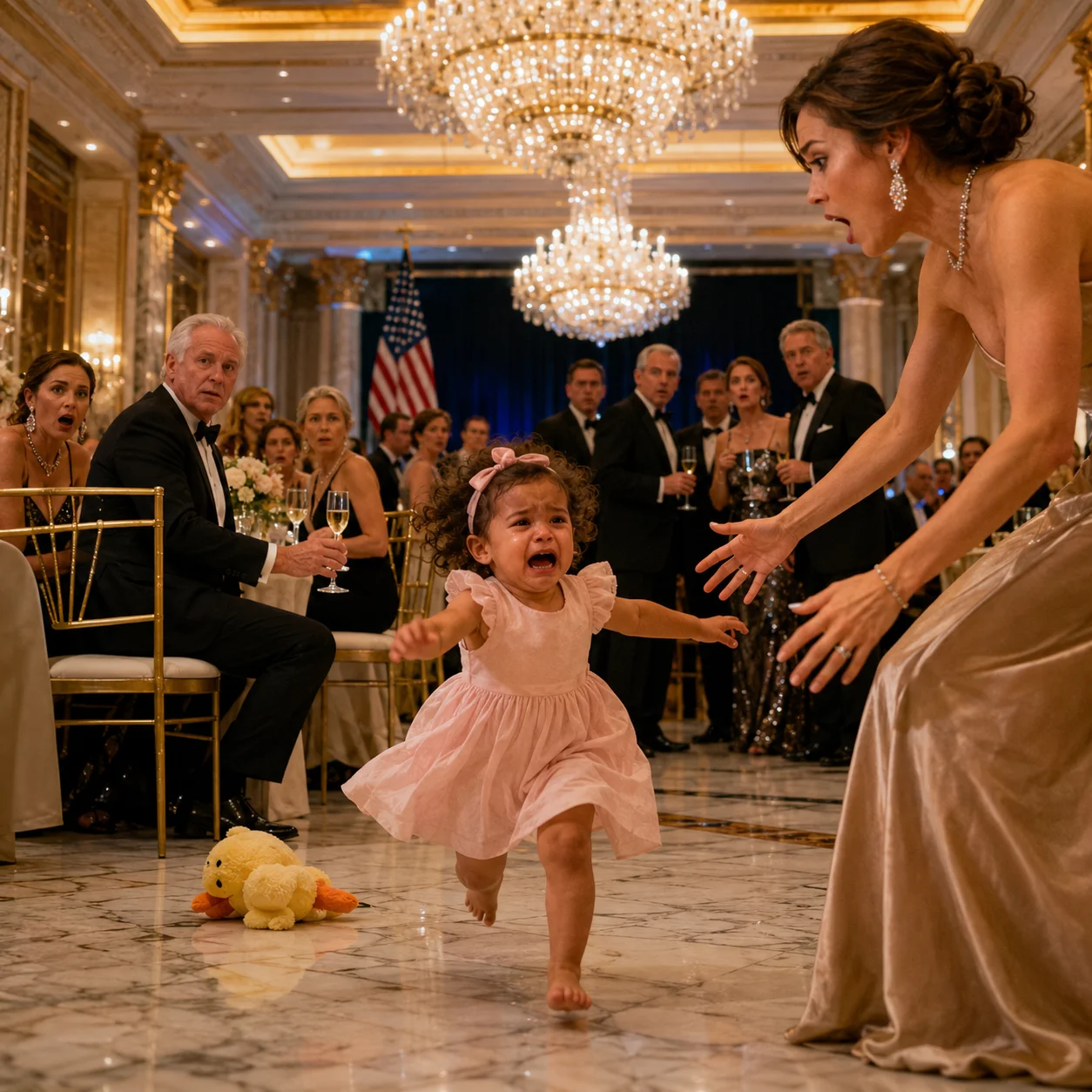
The first time I saw the little girl, she was standing barefoot on the polished marble floor of the Fairmont Hotel ballroom, clutching a stuffed yellow duck against her chest like it was the only thing keeping her from falling apart.
She could not have been more than two years old. Maybe two and a half. Her dark curls were tied unevenly with a pink ribbon, one sock was missing, and her cheeks were wet from crying. Around her, adults in tailored suits and evening gowns moved past with champagne glasses, laughing too loudly under chandeliers that made everything look expensive and unreal.
I noticed her because she looked so out of place.
A child did not belong in that ballroom, not at nine o’clock at night, not at a black-tie charity auction where the cheapest plate cost more than most families spent on groceries in a month.
I was about to step toward her when she looked past me.
Her entire face changed.
The crying stopped. Her eyes widened. Then, with a tiny broken gasp, she dropped the stuffed duck and ran.
Not toward security. Not toward one of the hotel staff. Not toward any of the women kneeling nearby with fake concern.
She ran straight into my fiancée’s arms.
“Mommy!”
The word cut through the music so sharply that people turned.
My fiancée, Madison Vale, froze.
For one second, she did not move at all. Her champagne flute stayed lifted halfway between her waist and her lips. Her smile, the perfect social smile she had worn all night, cracked like glass.
Then the toddler crashed into her legs, wrapped both tiny arms around her knees, and buried her face into the silk of Madison’s pale blue gown.
“Mommy,” the little girl sobbed again. “You came back.”
Every sound around me seemed to fade.
The string quartet kept playing. Someone laughed near the dessert table. A waiter passed behind me carrying a tray of oysters. But all I could hear was that little voice and the sudden rush of blood in my ears.
Madison looked down at the child as if she had seen a ghost.
Then she looked at me.
“Ethan,” she said quickly, her voice thin. “I don’t know this child.”
The toddler clung harder.
Madison’s hand hovered in the air, trembling slightly, as if some instinct inside her wanted to touch the little girl’s hair before her brain forced her not to.
“I have never seen her before,” Madison said louder, turning toward the people watching us. “She must be confused.”
But the child was not confused.
She was crying into Madison’s dress like she had been waiting for this woman for a very long time.
My name is Ethan Cole. I was thirty-three years old then, a commercial architect in Boston, and until that moment, I believed I was six months away from marrying the woman I knew better than anyone.
Madison and I had been together for almost three years. She was beautiful in a way that made strangers forget what they were saying. Dark blonde hair, soft green eyes, delicate features, the kind of quiet elegance that made every room rearrange itself around her. She worked as a development director for a children’s nonprofit, which was one of the things I had loved most about her in the beginning.
She remembered donors’ birthdays, organized toy drives, visited hospitals with gift baskets, and cried during adoption videos. She was the kind of woman people described as “born to be a mother,” and whenever they said that, Madison would smile gently and squeeze my hand.
We had talked about children often.
Or at least, I thought we had.
She told me she wanted two, maybe three. She told me she wanted to wait until after the wedding, after we bought a house with a yard, after life felt more settled. She said her own childhood had been complicated and she wanted to do motherhood “the right way.”
I never pushed. I loved her. I trusted her. I thought we were building something honest.
That night, we had been invited to the annual Bright Harbor Foundation gala, a charity event for foster care support and family services. Madison had helped coordinate it before changing jobs earlier that year, so half the room knew her. I had donated a custom design package for the silent auction, mostly because Madison asked me to.
The evening had felt ordinary at first.
Madison was radiant. She introduced me to donors, board members, former colleagues, wealthy couples with names engraved on plaques. She laughed when she was supposed to laugh and touched my arm when she wanted me to stay near her.
But looking back, there were signs.
She had been nervous before we arrived. Not normal event nervous. Something sharper.
At home, while fastening her earrings in the mirror, she had asked three times if we really needed to go.
“It’s your old foundation,” I reminded her. “You said showing up would be good politics.”
“I know,” she said, staring at her reflection. “I just don’t want to be trapped in small talk all night.”
“That’s every gala.”
She smiled, but it did not reach her eyes.
In the car, she kept checking her phone. At the hotel entrance, she paused before walking inside, her fingers tightening around her clutch. When I asked if she was okay, she kissed my cheek and said, “Of course.”
Now, standing in the ballroom with a toddler crying against her, I understood that her fear had not been about small talk.
A hotel staff member hurried over, followed by a woman wearing a black blazer and a security badge.
“Is this your child, ma’am?” the woman asked Madison.
“No,” Madison said instantly. Too instantly. “No. I don’t know her.”
The little girl lifted her face, confused and devastated.
“Mommy?” she whispered.
Madison looked away.
That look did something to me. It was not the look of a woman being mistaken for a stranger’s parent. It was not shock. It was not concern.
It was panic.
I crouched beside the child, keeping my voice soft.
“Hey, sweetheart,” I said. “What’s your name?”
She stared at me with huge wet eyes, then pressed closer to Madison.
Madison stepped back.
The child stumbled a little, and I caught her before she fell.
Madison flinched as if my hand on the child’s shoulder had burned her.
The security woman looked uncomfortable. “We found her near the service corridor. We’re trying to locate her guardian.”
“I’m sure her mother is nearby,” Madison said quickly. “Maybe she saw me and got confused.”
The little girl shook her head hard. “No. Mommy Maddy.”
The nickname landed between us like a dropped knife.
Mommy Maddy.
No stranger guessed that.
Madison’s face drained of color.
I stood slowly.
“What did she just call you?” I asked.
Madison’s eyes flashed. “Ethan, don’t do this here.”
“Do what?”
“Turn this into something humiliating.”
I almost laughed. Humiliating? A lost child was sobbing for her in a ballroom, calling her Mommy, and Madison was worried about being embarrassed.
The security woman cleared her throat. “Ma’am, do you have any identification? We need to document—”
“I said I don’t know her,” Madison snapped.
Several people nearby went silent.
The toddler started crying again, softer this time, like she had learned the kind of crying adults ignored.
I looked down at her small hand wrapped around the edge of Madison’s gown. Her fingers were shaking.
Then I noticed something on her wrist.
A plastic hospital-style bracelet, faded but still intact, with a small laminated tag clipped to it. Not medical. More like temporary identification from a daycare or emergency shelter.
I bent closer.
The tag read: LILY R.
Under it was a phone number and the name Harbor House Family Center.
My stomach tightened.
Harbor House was one of the programs connected to Madison’s old nonprofit.
I looked at Madison.
She had seen the bracelet too.
“Ethan,” she said quietly. “Please.”
It was the first honest word she had spoken all night.
Please.
Not “I don’t know her.” Not “this is a mistake.”
Please.
The security woman radioed someone. A manager approached. The gala coordinator appeared, whispering into her headset. People pretended not to watch while watching everything.
I picked up the stuffed duck from the floor and handed it to Lily.
She took it from me but kept staring at Madison.
“Where’s Nana?” Lily asked.
Madison closed her eyes for half a second.
That was all I needed.
“You know her,” I said.
“No.”
“Madison.”
She leaned closer and lowered her voice. “Not here.”
The toddler heard her voice and reached out again.
“Maddy, up.”
Madison’s jaw tightened. She looked around the ballroom, at the donors, the board members, the polished people whose opinions mattered to her.
Then she made the coldest choice I had ever seen.
She stepped behind me, putting my body between herself and the child.
“I’m sorry,” she told the security woman, voice suddenly composed. “But my fiancé and I need to leave. This is clearly a sensitive situation, and I don’t want to interfere.”
Lily screamed when Madison turned away.
Not cried. Screamed.
It was a raw, terrified sound that made the entire ballroom stop pretending.
“Mommy! Don’t go!”
Madison kept walking.
I did not.
For three years, I had loved that woman. I had planned a wedding with her. I had chosen flowers, tasted cakes, argued about guest lists, and imagined her walking toward me in white. I had trusted her with my family, my home, my future.
But I could not follow her while a child screamed for her.
I stayed.
Madison turned at the doorway and realized I was not behind her.
Her expression changed from panic to anger.
“Ethan,” she said.
I looked at Lily, then back at her.
“Go home,” I said. “I’ll call you later.”
Her eyes widened. She was not used to me speaking to her like that.
“Are you serious?”
“Very.”
“Ethan, you don’t understand what you’re doing.”
“No,” I said quietly. “I think I’m finally starting to.”
She stood there for another second, beautiful and furious under the chandelier light. Then she turned and disappeared into the hallway.
Lily broke down in my arms.
I did not know what else to do, so I held her.
The security team took us to a small conference room near the lobby. Someone brought apple juice, crackers, and a blanket. Lily sat on a chair too big for her, her stuffed duck tucked under her chin, hiccuping between tears.
The hotel manager, a calm woman named Denise, contacted the number on Lily’s bracelet. While we waited, I called Madison.
She did not answer.
I called again.
Nothing.
Then she texted me.
Do not get involved. Come home. I will explain.
I stared at the message until the words blurred.
A few minutes later, the conference room door opened, and a woman in her late fifties rushed in wearing jeans, a cardigan, and the frantic expression of someone who had been terrified for hours.
“Lily!”
The toddler jumped from the chair.
“Nana!”
The woman scooped her up and held her so tightly I thought she might collapse.
“Thank God,” she whispered, rocking her. “Oh, thank God.”
Denise explained where Lily had been found. The woman kept apologizing. Her name was Ruth Alvarez. She was not Lily’s biological grandmother, but Lily called her Nana because Ruth had been caring for her for most of the past year through Harbor House Family Center.
“She slipped out during intake chaos,” Ruth said, wiping her eyes. “We were helping two new families tonight. I turned around for one minute, and she was gone. I thought she got into the elevator. We searched everywhere.”
“How did she get into the gala?” Denise asked.
Ruth shook her head. “The service corridor connects to the community wing. She must have followed the music.”
Lily was calmer now, but she kept looking at the door.
“She saw someone she knew,” I said carefully.
Ruth looked at me.
I had not told her Madison’s name yet.
The moment our eyes met, I saw recognition.
“You were with Madison,” Ruth said.
My body went cold.
“You know Madison?”
Ruth’s mouth tightened. She looked at Lily, then at Denise, then back at me.
“I think you should ask Madison.”
“I did,” I said. “She told me she had never seen this child before.”
Ruth’s expression hardened in a way that told me she had expected nothing better.
Lily rested her head on Ruth’s shoulder and murmured, “Mommy Maddy left again.”
Again.
I sat down because my legs suddenly felt unreliable.
Ruth closed her eyes.
“She shouldn’t have called her that,” she whispered.
“But she did,” I said. “Why?”
Ruth hesitated. “I cannot disclose confidential client history without authorization.”
“I’m marrying Madison in six months.”
Ruth looked at me with something close to pity.
“Then you need to have a very serious conversation before you do.”
That was all she would say.
It should have been enough to send me home demanding answers. But I had spent years designing buildings; I believed in foundations. When something cracked, you did not paint over it. You inspected the load-bearing walls.
So I started asking questions.
Not to strangers. Not publicly. I was not interested in humiliating Madison. I wanted the truth.
First, I drove home.
Madison was sitting in the living room when I arrived, still in her gala dress, her shoes kicked off, a glass of wine untouched on the coffee table.
“You had no right to stay,” she said before I even closed the door.
I stared at her.
“That’s what you want to start with?”
Her face crumpled for a second, then hardened. “You embarrassed me in front of everyone.”
“A child thought you were her mother.”
“She’s confused.”
“She called you Mommy Maddy.”
Madison stood. “Children attach to people. I worked with families. Some of them became attached. That doesn’t mean anything.”
“She said you left again.”
Her mouth closed.
I stepped farther into the room. “Tell me the truth.”
“I am.”
“No. You’re managing me.”
Her eyes narrowed. “Don’t use that tone.”
“What tone should I use when my fiancée lies to my face in front of a crying toddler?”
“She is not my daughter,” Madison snapped.
I had not asked that yet.
The silence afterward was enormous.
Madison realized her mistake at the same time I did.
I slowly set my keys on the side table.
“Why would you say that?”
She turned away. “Because I know where your mind is going.”
“My mind is going where you’re pushing it.”
She rubbed her forehead. For the first time, she looked exhausted rather than angry.
“Lily was part of a family case I worked on,” she said. “Her mother was unstable. I helped coordinate placement. Lily got attached to me. That’s all.”
“Then why deny knowing her?”
“Because people misunderstand things. Because donors gossip. Because my old job had confidentiality rules. Because I didn’t want a scene.”
I wanted to believe her. God help me, part of me did.
But there was still that image of Madison stepping away from a child reaching for her.
“What happened to Lily’s mother?” I asked.
Madison’s shoulders stiffened.
“I don’t know.”
Another lie. Smaller, maybe, but obvious.
“You don’t know?”
“I left the foundation months ago.”
“Madison.”
She spun around. “Why are you interrogating me like I committed a crime?”
“Because you acted like that child was dangerous to you.”
Her eyes filled suddenly with tears, and for a second, I saw the Madison I loved. Fragile. Wounded. Human.
“I had a life before you,” she said.
“I know that.”
“No, you know the edited version. Everyone edits.”
“Did you have a child?”
Her tears vanished.
“No.”
“Did you ever foster Lily?”
“No.”
“Were you responsible for her?”
“No.”
“Then why did Ruth Alvarez look at me like she felt sorry for me?”
Madison went still.
“You talked to Ruth?”
“She came to pick Lily up.”
Madison laughed once, sharp and bitter. “Of course she did.”
“What does that mean?”
“It means Ruth loves drama. She always has.”
“That woman was terrified. She did not look dramatic. She looked like someone protecting a child.”
Madison grabbed her wine glass, then set it down without drinking. “I am not doing this tonight.”
“We are absolutely doing this tonight.”
“No,” she said, voice rising. “You don’t get to drag my past into our home because some child had a meltdown.”
“Some child?”
Her face twisted. “Don’t.”
“You’re the one who said it.”
Madison looked away.
I took a breath. “Wedding planning stops until you tell me the truth.”
Her head snapped back.
“What?”
“The wedding stops.”
“You cannot be serious.”
“I am.”
“Because of a toddler?”
“Because of you.”
Her lips parted.
I had never seen Madison truly afraid before. Not nervous, not emotional, not annoyed. Afraid.
Then she did something that confirmed everything.
She walked to the bookshelf, pulled a small silver key from behind a framed photo of us, and opened the bottom drawer of her desk.
I had lived in that apartment with her for almost a year. I had never seen that drawer unlocked.
From inside, she removed a folder.
Not thick. Not dramatic. Just a plain manila folder with bent corners.
She held it against her chest for a moment.
“I was going to tell you after the wedding,” she said.
I felt something inside me sink.
“Tell me what?”
She sat on the sofa and opened the folder.
The first page was a legal document from Massachusetts Probate and Family Court.
My eyes found the words before my brain wanted to understand them.
Temporary guardianship.
Minor child: Lily Rose Alvarez.
Petitioner: Madison Claire Vale.
I looked up.
Madison was crying silently now.
“She wasn’t mine biologically,” she said. “But for eight months, legally, she was under my guardianship.”
The room seemed to tilt.
“You told me you had never seen her before.”
“I panicked.”
“You said she was confused.”
“I know.”
“You walked away from her.”
“I know!” Madison shouted, then covered her mouth.
I stared at the papers. Guardianship orders. Case notes. Medical forms. A photo of Madison holding Lily when Lily was much younger, maybe one year old, both of them asleep on a couch.
My throat tightened.
“Why didn’t you tell me?”
Madison wiped her face. “Because I lost her.”
“How?”
She did not answer.
I looked back at the folder.
There were more documents. A petition. A review hearing notice. A termination of temporary guardianship. I read enough to understand that Madison had not simply “lost” Lily.
She had surrendered her.
“You gave her up,” I said.
Madison flinched.
“It was more complicated than that.”
“Then explain it.”
She pulled her knees toward her chest, suddenly looking younger than thirty-one.
“Lily’s mother, Serena, was in recovery. I met her through Harbor House. She had no family support. Ruth was helping, but she couldn’t take Lily full-time then. Serena asked me to help temporarily. It was supposed to be for six weeks.”
“But it became eight months.”
Madison nodded.
“Where was I?”
“We had just started dating. It was casual. You were traveling for the Seattle project.”
I remembered that period vaguely. Madison had been hard to schedule. She said work was consuming her life. We saw each other maybe twice a month for dinners, weekends, nothing serious yet.
“You hid a child from me.”
“I wasn’t hiding her from you. You weren’t in that part of my life yet.”
“And later?”
She looked down.
Later. When we became serious. When I met her friends. When she met my parents. When she moved in. When I proposed.
Every single day, she chose not to tell me.
“What happened?” I asked again.
Madison swallowed. “Serena relapsed. Then disappeared. Lily started calling me Mommy because I was the one feeding her, bathing her, taking her to daycare. I didn’t encourage it.”
“But you didn’t stop it.”
Her silence answered.
“I loved her,” Madison whispered. “I loved her so much it scared me.”
I sat across from her, unable to speak.
“She was difficult,” Madison continued. “Not bad. Just traumatized. Night terrors, screaming, separation panic. I stopped sleeping. I missed work. Donors started complaining because I cancelled meetings. My mother said I was throwing away my future for another woman’s child. My supervisor said the boundaries were inappropriate. Everyone kept telling me temporary meant temporary.”
“So you gave her to Ruth.”
“Ruth wanted her.”
“Did Lily?”
Madison broke.
She covered her face and sobbed into her hands.
I did not comfort her. I could not.
“When Ruth took her,” Madison said through tears, “Lily screamed for me for forty minutes. I sat in my car outside and listened until I couldn’t anymore. Then I drove away.”
The image hit me so hard I had to stand.
A toddler screaming for the only mother she knew while Madison drove away.
“And tonight,” I said, voice low, “you did it again.”
Madison looked up at me, ruined.
“I was ashamed.”
“You should be.”
The words came out before I could soften them.
She recoiled as if I had slapped her.
Maybe another man would have held her. Maybe another man would have focused on her pain, her trauma, her shame. But all I could see was Lily’s hand reaching for the silk of Madison’s dress and Madison stepping away.
“How could you talk about wanting children with me?” I asked.
Madison’s face crumpled again. “Because I do want them.”
“Children who come clean? Children without trauma? Children who don’t inconvenience donors?”
“That’s cruel.”
“No. What you did was cruel.”
She stood, shaking. “You think I don’t know that? You think I don’t wake up hearing her? You think I kept that folder because I don’t care?”
“I think you kept that folder because guilt feels better when it’s private.”
She stared at me.
I had never spoken to her like that before. Maybe because I had never had reason to.
“I made one terrible choice,” she whispered.
“No,” I said. “You made it every day you lied to me. You made it tonight when she ran to you. You made it again when you called her confused.”
Madison collapsed back onto the sofa.
The apartment was quiet except for her crying.
I slept in the guest room that night. Not because I wanted drama, but because I could not lie beside her. Every time I closed my eyes, I saw Lily standing barefoot under chandeliers.
The next morning, Madison tried to repair things the way she repaired everything: beautifully, strategically, with just enough vulnerability to make refusal feel cruel.
She made coffee. She wore my sweatshirt. Her eyes were swollen. She placed the guardianship folder on the kitchen island between us like an offering.
“I want to fix this,” she said.
“What does fixing it mean?”
“I’ll call Ruth. I’ll apologize.”
“To Ruth or Lily?”
Her mouth tightened. “Both.”
“And then?”
She looked confused.
“What do you mean?”
“I mean what responsibility do you think you still have?”
Madison folded her arms. “I don’t have legal responsibility anymore.”
“That’s not what I asked.”
She looked away.
There it was. The limit of her remorse.
She wanted absolution without obligation. She wanted to feel forgiven without having to enter the part of the story where Lily still existed.
I went to work, but I did not work. I sat in my office staring at building elevations while my phone buzzed with messages from Madison.
I’m sorry.
Please answer.
I was scared.
You’re punishing me.
I love you.
By noon, I called Ruth Alvarez.
I told her Madison had shown me the guardianship documents. I told her I did not want confidential details. I only wanted to know if Lily was safe.
Ruth was quiet for a long time.
“She is safe,” she said finally. “But safe and unhurt are not the same thing.”
That sentence stayed with me.
Ruth told me Lily had been moved between temporary arrangements after Madison surrendered guardianship. Ruth eventually got approved as a long-term foster caregiver, but the damage had already been done. Lily had severe abandonment panic. She did not trust bedtime. She screamed when women with blonde hair left rooms. She carried that yellow duck because Madison had given it to her.
I gripped the phone so hard my fingers hurt.
“Why was Lily at the hotel?” I asked.
“Harbor House has offices in the community wing,” Ruth said. “We were there for emergency placement intake. The gala was on the other side of the building.”
“Does Madison know Lily kept asking for her?”
Ruth gave a tired laugh. “Madison blocked everyone connected to the case after she left.”
My stomach turned.
“She blocked you?”
“She said she needed a clean break.”
A clean break.
From a child.
That evening, when I got home, Madison was waiting with dinner from our favorite Thai place, candles lit, soft music playing. The engagement ring I had given her sparkled under the kitchen lights.
It felt obscene.
“I spoke to Ruth,” I said.
Madison’s face changed.
“You had no right.”
“She told me you blocked them.”
“I had to.”
“No. You wanted to.”
Her eyes flashed. “You don’t know what it was like. Everyone expected me to destroy myself for a child who wasn’t even mine.”
“She thought you were her mother.”
“I was twenty-eight!” Madison shouted. “I was alone. I was drowning. I didn’t know how to be what she needed.”
“Then why lie about her afterward?”
“Because I knew you would look at me exactly like you’re looking at me now.”
“How am I looking at you?”
“Like I’m a monster.”
I wanted to deny it.
I could not.
Madison stepped closer, desperate now. “Ethan, listen to me. I did something awful. I know I did. But I am not that person anymore. I want a family with you. A real one. Our children. Our future.”
Our children.
I thought about what that meant. Children were not vows in pretty rooms. They were fever at three in the morning. Tantrums in grocery stores. Trauma you did not cause but still had to hold. Messy, inconvenient, terrifying love.
Madison wanted motherhood as long as it came wrapped in a life she could control.
“What happens if our child isn’t easy?” I asked.
She looked offended. “That’s not fair.”
“What happens if they have nightmares? If they need more than you expected? If motherhood damages your career, your sleep, your image?”
“Stop.”
“What happens if they embarrass you in a ballroom?”
Her hand flew up and slapped me.
The sound cracked across the kitchen.
For a second, neither of us moved.
Madison stared at her own hand, horrified.
“Ethan,” she whispered.
I touched my cheek slowly.
Something inside me went very still.
I walked to the bedroom, took an overnight bag from the closet, and began packing.
Madison followed me, crying now. “I’m sorry. I didn’t mean to. Please, I’m sorry.”
I packed clothes, laptop, passport, the folder of wedding vendor contracts from my desk.
She grabbed my arm. “Don’t leave.”
I gently removed her hand.
“I need space.”
“No. You’re going to cancel the wedding.”
“I don’t know what I’m going to do.”
But we both knew.
I stayed that night at my brother Caleb’s house. Caleb was older than me by four years, married with two sons, and the kind of man who listened before speaking. His wife, Naomi, made me tea and did not ask questions until I was ready.
When I finished telling them, Caleb sat back in his chair.
“Damn,” he said quietly.
Naomi’s eyes were wet. “That poor little girl.”
That poor little girl.
Not poor Madison. Not poor Ethan. Lily.
It told me everything about where my focus should have been.
Over the next week, my life split into before and after.
Before, Madison and I had venue appointments, tasting menus, honeymoon plans, a registry filled with things for a home we had not yet bought.
After, I called vendors and asked about cancellation policies. I slept in Caleb’s guest room. I met with a therapist because I could feel myself swinging between rage and grief so violently it scared me. I ignored Madison’s calls, then answered a few, then regretted it every time.
She moved through phases.
First came remorse.
I ruined everything. I hate myself. Please let me fix it.
Then came blame.
You’re abandoning me for a child you met once.
Then bargaining.
I’ll go to therapy. I’ll volunteer again. We can postpone, not cancel.
Then anger.
You think you’re morally perfect? You have no idea what I survived.
That was the thing. I did not think I was perfect. I knew fear could make people selfish. I knew shame could twist memory into something survivable. But I also knew that trust was not broken by one secret alone.
It was broken by the instinct to protect yourself at the expense of the vulnerable.
Two weeks after the gala, Ruth called me.
“I hope this isn’t inappropriate,” she said. “Lily has been asking about the man who gave back her duck.”
My throat tightened.
“She remembers me?”
“She remembers kindness.”
I did not know what to say.
Ruth continued carefully. “I’m not asking you to enter her life. That would be unfair unless you meant it. But she drew a picture. She wanted me to give it to you.”
We met at a small park near Harbor House. Not with Lily at first. Ruth said sudden adult appearances and disappearances could hurt her more, and I respected that.
She handed me a folded piece of construction paper.
The drawing was mostly scribbles. A yellow duck. A tall man. A woman in blue. A tiny girl with big hair.
Under it, Ruth had written Lily’s words.
The nice man stayed.
I sat in my car afterward and cried so hard I could barely breathe.
That drawing did not make me a hero. I had done the smallest decent thing. But to Lily, it mattered because the person she expected to stay had not.
I called Madison that night and asked her to meet me at our apartment.
She arrived hopeful. I could see it in the careful way she had dressed, in the way she wore her engagement ring turned outward, in the way she had done her makeup to look softly devastated.
I hated that I still loved her.
Love does not vanish just because truth arrives. Sometimes it sits beside disgust and grief and memory, making everything harder.
She stepped inside.
“Thank you for seeing me,” she said.
I nodded toward the sofa.
We sat across from each other, the same way we had the night she opened the folder.
“I need to ask you something,” I said.
“Anything.”
“If Lily had not run to you at the gala, would you ever have told me?”
Madison’s eyes filled.
She looked down.
That was the answer.
“Maybe after we had children,” she whispered.
I closed my eyes.
“After?”
“I was afraid you’d think I was damaged.”
“I don’t think you’re damaged because you loved a child and failed. I think you’re unsafe because you turned that child into a secret to protect your image.”
She flinched.
“I’m in therapy,” she said quickly. “I had my first session yesterday. I told Ruth I want to apologize.”
“Did you talk to Lily?”
“Ruth said not yet.”
“Good.”
Madison stared at me. “Good?”
“You don’t get to use Lily for closure. If professionals say contact helps her, fine. If not, you leave her alone.”
Her face hardened slightly. “So now you’re deciding what’s best for her?”
“No. Ruth and her therapist are. That’s the point.”
Madison looked away.
I removed my wedding binder from the coffee table and placed it between us.
“I cancelled the venue today.”
She went pale.
“Ethan.”
“I cancelled the caterer too. We’ll lose deposits.”
“You cancelled our wedding without telling me?”
“I’m telling you now.”
She stood so quickly the table shook. “After everything? After I said I’d get help?”
“I’m glad you’re getting help. But I cannot marry you.”
She pressed a hand to her chest. “Because of one mistake.”
“No. Because when Lily ran to you, your first instinct was not to protect her. It was to protect the version of yourself you sold me.”
Madison started crying again, but this time I did not feel pulled toward her. I felt sad. Deeply sad. Sad for the woman she could have been if she had faced herself sooner. Sad for the life I had imagined. Sad for Lily. Sad for all the damage people caused when they confused shame with privacy.
“I loved you,” Madison whispered.
“I loved you too.”
“Loved?”
I took the ring box from my pocket.
Her engagement ring was still on her finger, but I had brought the empty box because I needed the symbol in the room. I set it on the table.
“I need you to return it when you’re ready.”
Her expression collapsed.
For a moment, I thought she would scream. Instead, she sat down slowly, staring at the box.
“You’re really leaving me.”
“I already did.”
She looked up then, and for the first time, I saw something honest without performance.
“I don’t know who I am if you go.”
I believed her.
But that was not a reason to stay.
“Then find out,” I said. “But don’t build yourself out of people who depend on you.”
Madison left the apartment an hour later. She did not take the ring off before walking out. I did not chase her.
The weeks that followed were ugly in quiet ways.
We separated our accounts. She moved into a smaller apartment across town. Her mother called me twice, leaving messages about forgiveness and how men loved judging women for impossible choices. I did not respond. A few mutual friends tried to stay neutral until they heard enough of the story to stop inviting us to the same places.
Madison did return the ring three weeks later.
She left it with a handwritten note.
I am sorry for lying to you. I am sorry for what I did to Lily. I don’t expect forgiveness. I hope one day I become someone who would have stayed.
I kept the note for a while, then mailed it back to her therapist’s office with a short message: This belongs in her work, not in my grief.
As for Lily, I did not rush into her life.
That part matters.
A child is not a redemption project. She was not there to make me feel better about losing Madison. She was not a symbol. She was a little girl with trauma, routines, favorite snacks, bad nights, and a yellow duck she refused to wash.
Ruth and I stayed in cautious contact. At first, I only donated quietly to Harbor House, not through gala checks or public events, but practical things: diapers, grocery cards, car seats, emergency hotel vouchers for families in crisis. I asked Ruth what was needed and sent exactly that.
Then, months later, after Lily’s therapist approved it, I saw her again.
It was at the same park.
I arrived with Caleb and Naomi’s boys so it would feel less intense. Ruth sat on a bench nearby. Lily watched me from behind Ruth’s leg for a full five minutes.
I did not approach her.
I sat on the grass, rolled a toy car back and forth with my nephews, and waited.
Eventually, Lily came over with her duck.
“You stayed at the party,” she said.
“I did.”
“Mommy Maddy left.”
I swallowed carefully.
“Yeah,” I said. “She did.”
Lily looked at me with the brutal seriousness only toddlers can have.
“You leave?”
“Not right now.”
She thought about that.
Then she handed me the duck.
That was all.
It was enough.
I did not become her father. Life is not that simple, and anyone who says love heals everything quickly has never sat with a child who wakes up screaming for someone who chose absence.
But I became someone safe in her wider circle. Ruth became her permanent legal guardian the following year. I attended the small celebration in family court, standing in the back while Ruth cried and Lily wore a purple dress with sparkly shoes.
Madison did not attend.
But she sent a letter to Ruth, not to Lily. Ruth told me about it later. Madison apologized without asking for contact. She included money for Lily’s education fund and wrote that she understood if Ruth threw the letter away.
Ruth did not throw it away.
She placed it in a file for when Lily was older, in case one day Lily needed answers.
I respected that.
Two years passed.
I rebuilt slowly. I sold the apartment Madison and I had chosen together and bought a smaller house outside the city, one with a workshop in the garage and a maple tree in the front yard. I kept going to therapy longer than I expected because betrayal has roots. It makes you question not only the person who lied, but the part of yourself that believed them.
I dated badly for a while. Too guarded. Too suspicious. Too quick to search for cracks.
Then I met Claire at a community design meeting for a new family resource center.
She was a pediatric occupational therapist, practical and warm, with dark curly hair she wore in a messy bun and a laugh that made people relax. She knew Ruth. She knew Lily. She knew the broad outline of my history, not from gossip but because our circles overlapped in the work Harbor House did.
On our third date, before I could decide how much to tell her, Claire said, “I know there’s a Madison-shaped shadow here.”
I nearly choked on my coffee.
She smiled gently. “I don’t need details tonight. But I need you to know I don’t compete with ghosts, and I don’t rescue men from them either.”
That was the moment I began to trust her.
Not because she was perfect. Because she was honest.
A year later, Claire and I were still together, slowly, carefully, without performance. Lily, now almost five, approved of her because Claire knew how to fix the strap on her sparkly shoe and did not make a big deal when Lily hid under the table during a loud fundraiser.
One autumn afternoon, Harbor House held a small open house at the new family wing. Not a gala. No chandeliers. No champagne. Just folding chairs, fruit trays, donated books, and children running across a multipurpose room with paper crowns.
I was there because my firm had helped design the renovation pro bono.
Ruth brought Lily. Claire stood beside me, her hand warm in mine.
And then Madison walked in.
I had not seen her in nearly three years.
She looked different. Still beautiful, but less polished. Her hair was shorter. Her clothes were simple. No armor of perfection. She paused at the entrance like she was deciding whether she had the right to breathe the same air.
Ruth saw her first.
They spoke quietly near the hallway. I could not hear the words. Madison cried, but she did not collapse. Ruth listened, then nodded once.
Lily was coloring at a table nearby.
When she looked up and saw Madison, her small body went still.
I felt Claire’s hand tighten around mine.
Madison did not move toward Lily. She crouched where she was, several feet away, making herself smaller.
“Hi, Lily,” she said softly.
Lily stared.
For a second, I was back in that ballroom, hearing the scream, watching a child run toward someone who had already decided to leave.
But Lily did not run this time.
She looked at Ruth.
Ruth knelt beside her and whispered something. Lily listened, then looked back at Madison.
“You left,” Lily said.
The room seemed to quiet around us.
Madison nodded. Tears ran down her face.
“I did,” she said. “I was wrong.”
Lily gripped her crayon.
“You didn’t come back.”
“I know.”
“I cried.”
Madison covered her mouth, but only for a second. Then she lowered her hand, as if she knew she did not deserve to hide from that.
“I am so sorry,” Madison said. “You deserved better.”
Lily studied her with the solemn, suspicious wisdom of a child who had learned too early that adults could disappear.
Then she said, “Nana stays.”
Madison looked at Ruth.
“Yes,” she whispered. “Nana stayed.”
Lily nodded, as if that was the only fact that mattered.
Then she went back to coloring.
Madison did not try to hug her. She did not ask for more. She stood slowly, spoke briefly with Ruth again, and left after ten minutes.
That was the last time I saw her.
Later, Claire asked me if I was okay.
I watched Lily show Ruth her drawing. This one had a house, a tree, a yellow duck, Ruth, Claire, me, and Lily herself under a giant purple sun.
Madison was not in it.
But the sky was bright.
“Yeah,” I said. “I think I am.”
For a long time, I believed the worst part of that night at the gala was discovering Madison’s lie. But I was wrong.
The worst part was realizing how easily love could become selfish when image mattered more than responsibility.
Madison had loved Lily once. I believe that now. Maybe she had loved her deeply. But love that disappears when it becomes inconvenient is not the kind a child can survive on. Love that denies you in public is not love a family can be built around.
People ask sometimes why I did not forgive Madison and marry her anyway after she got help. They say everyone has a past. Everyone makes mistakes. Everyone deserves a second chance.
Maybe that is true.
But marriage is not a charity given to someone because they feel guilty. It is a foundation. And once I saw the crack, I could not build children, vows, and a lifetime on top of it.
The toddler in the ballroom showed me the truth before any document did.
She ran straight into Madison’s arms because, in her heart, Madison had once been home.
And Madison stepped away.
That was the whole story.
Everything after that was just me learning not to.
![[FULL STORY] My Fiancée Texted Moments Before Our Wedding: 'I Can’t Go Through With This I’m Done ' I Told](https://social-media.rabedo.com/thumbnails/1776763613_6.png)
![[FULL STORY] My Fiancée Mocked Me In Front Of Her Family, So I Took The Ring Back At The Table](https://social-media.rabedo.com/thumbnails/1777821275_688000732_943620588515327_1790886156462189678_n.jpg)
![[FULL STORY] My Girlfriend Said She Fell Out of Love Months Ago… So I Let Her Leave](https://social-media.rabedo.com/thumbnails/1777712644_688017606_942596258617760_2758600140573072808_n.jpg)

![[FULL STORY] My Stepfather Said I’d Never Succeed — Then I Bought the Company He Worked For](https://social-media.rabedo.com/thumbnails/1777560395_5b36dadd-d168-43a3-bef6-9f6f2e605280.png)