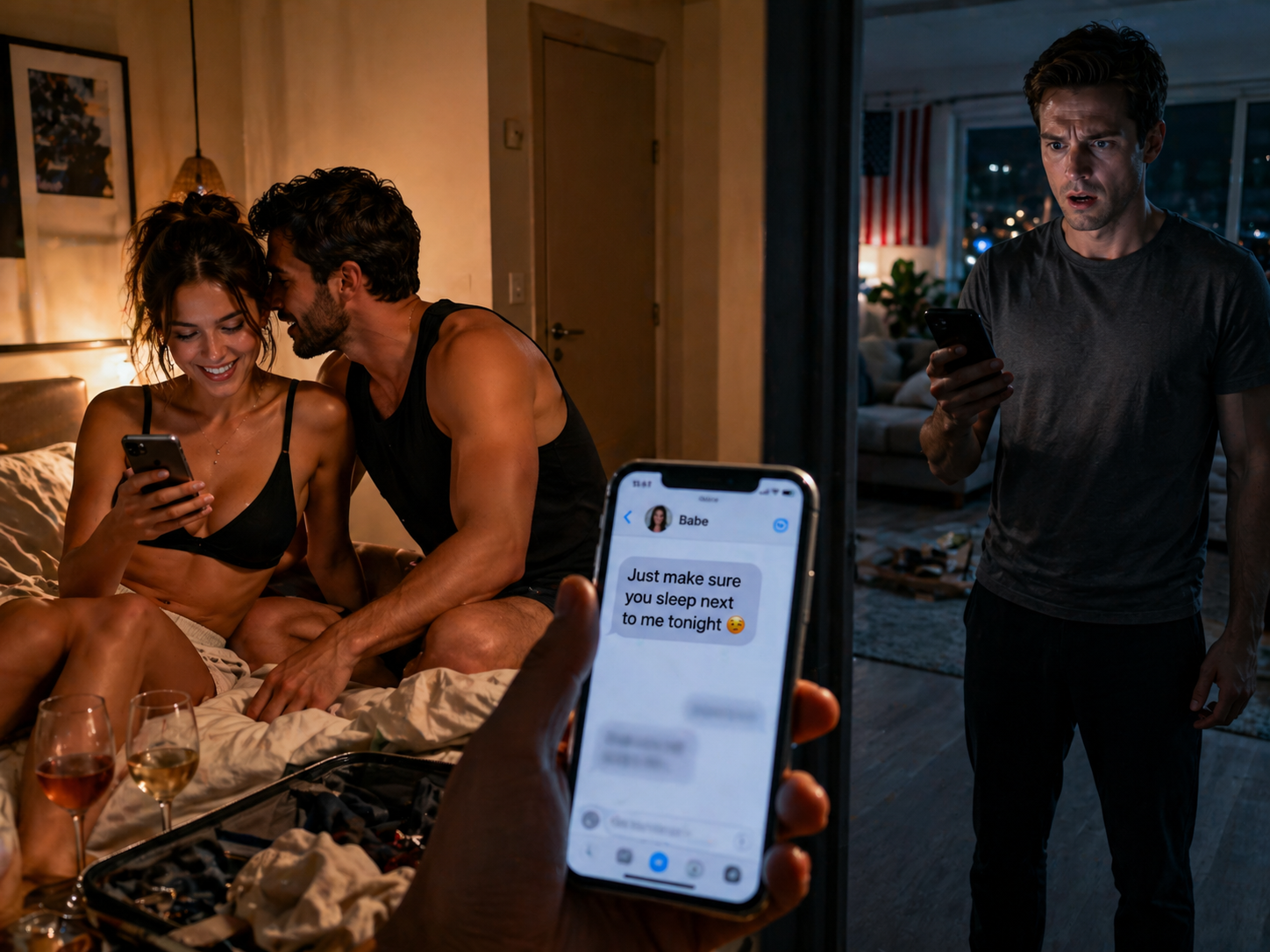

The man cleared his throat. “Natalie, what’s going on?”
I looked at him. “That’s what I’d like to know.”
He stared at me for a moment, then at her left hand. Her engagement ring was there. My grandmother’s ring. The ring I had given her under a canopy of lights in the botanical garden where she once said she wanted to bring our children someday.
His face changed.
“You’re engaged?” he asked.
Natalie closed her eyes.
That answered more than anything she could have said.
The man stepped back as if she had become contagious. “You told me you ended it months ago.”
Months.
The word slid into me like a blade.
I turned to Natalie. “Months?”
She reached for my arm. I moved away before she touched me.
“Ethan, I can explain.”
“Then explain here.”
“Not here,” she pleaded. “Please. People are watching.”
“They should,” I said. “Maybe they’ll understand the story better than I do.”
Her mouth trembled. “My father really is sick.”
I waited.
She swallowed. “But not every weekend.”
The man laughed once, bitter and humorless. “You told me your fiancé was emotionally abusive and wouldn’t move out.”
My head turned slowly toward him.
Natalie whispered, “No.”
He looked at her with disgust. “You did. You said he used money to control you. You said you were trapped until after the wedding because your families were involved.”
I felt something inside me separate quietly from the woman standing in front of me. It was not rage yet. Rage would come later. In that moment, it was more like watching a bridge collapse in slow motion from far away.
“Natalie,” I said carefully, “what is his name?”
She didn’t answer.
The man did.
“Julian Mercer.”
Of course he had a name that sounded like a hotel reservation.
I nodded once. “How long?”
Julian looked at her, then back at me. “Since February.”
It was August.
Six months.
The same six months she had been taking care of her sick father.
The same six months I had covered wedding deposits, rescheduled vendors, sent food to a house no one answered, and apologized for not understanding her burden.
I picked up my phone from the bar. My hand was steady in a way that felt unnatural.
Natalie began crying then. Real tears, maybe. Or maybe just the best tool she had left.
“I was overwhelmed,” she said. “Dad was sick, and the wedding was too much, and you were always so perfect. I felt like I couldn’t breathe.”
I looked at her, stunned by the audacity of it. “So you checked into hotels with another man?”
“It wasn’t like that at first.”
Julian gave a sharp laugh. “Don’t insult us both.”
That was the moment I realized he was not the villain I wanted him to be. He was guilty of sleeping with a woman who had apparently lied to him too, but he wasn’t standing there smirking. He looked humiliated. Angry. Used.
Natalie had built two separate stories and lived between them like a person moving through adjoining rooms.
I stepped around her.
“Ethan, wait.”
I kept walking.
She followed me through the lobby, her heels clicking against marble.
“Please don’t do this here,” she whispered.
I stopped near the front doors and turned. “Do what?”
“Make a scene.”
That was when anger finally arrived. Not loud. Not explosive. Cold.
“You made the scene, Natalie. I just showed up in it.”
She flinched.
I walked out of the hotel.
She didn’t follow me outside.
Maybe she knew better. Maybe Julian stopped her. Maybe she went back upstairs to gather whatever pieces of her double life could still be saved.
I sat in my car for almost twenty minutes before I could drive.
The worst part was not the cheating itself. Cheating is brutal, but it is simple in its cruelty. Someone betrays you. Someone lies. Someone chooses desire over loyalty.
The worst part was the sick father.
She had used illness as armor.
Every time I felt lonely, I silenced myself because her father needed her. Every time she missed a wedding appointment, I felt guilty for being disappointed. Every time she came home tired, smelling faintly of perfume and hotel soap, I rubbed her shoulders and told her she was a good daughter.
I drove home with my hands locked on the steering wheel and realized I had been comforting her after she betrayed me.
When I got to the apartment, I did not smash anything. I did not throw her clothes into the hallway. I did not call her mother or my friends or post anything online. I opened my laptop.
As I said, I notice patterns.
And now that I knew the pattern existed, I needed to see all of it.
First, I checked our shared credit card account. Natalie had her own card, but we used the shared one for wedding expenses and household costs. There were no hotel charges. No obvious dinners. Nothing careless.
Then I checked our wedding spreadsheet.
That was where I found the first crack.
Three vendor payments had been delayed because Natalie claimed her bank had flagged a transfer. I had covered them from my savings. She promised to pay me back when things settled.
She never did.
I opened our shared savings account for the house down payment. My stomach tightened.
There had been withdrawals.
Not huge ones. Not enough to trigger immediate panic. Eight hundred dollars. Twelve hundred. Fifteen hundred. Always labeled as transfers to Natalie’s personal account. When I had asked about one months earlier, she said it was for her father’s medication and home repairs after a pipe leak.
I had believed her.
By the time I finished adding everything, almost nine thousand dollars was missing from the house fund.
I sat back in my chair and stared at the number.
Nine thousand dollars.
Not just betrayal. Theft dressed as family emergency.
My phone buzzed.
Natalie.
I didn’t answer.
Then came the texts.
Please let me explain.
I love you.
It got out of control.
Julian meant nothing.
Dad really did need me sometimes.
Please don’t throw away four years.
That last message made me stare at the screen for a long time.
Please don’t throw away four years.
As if I had been the one carrying our life into hotel rooms under a false name.
I took screenshots of everything. The messages. The bank transfers. The canceled delivery notice. The hotel name from my conference invitation. I emailed copies to myself and saved them in cloud storage.
Then I did something I probably should have done months earlier.
I called her father.
Robert answered on the fourth ring.
“Ethan?” he said, surprised. “Everything all right?”
His voice sounded strong. Tired, maybe, but not fragile.
“Mr. Whitaker,” I said, forcing my voice to remain calm. “I’m sorry to bother you. I wanted to check how you’re feeling.”
A pause.
“How I’m feeling?”
“Yes. Natalie said your heart condition has been difficult lately.”
Another pause. Longer this time.
“My what?”
The room seemed to tilt.
I closed my eyes.
“Your heart condition,” I repeated quietly. “She said she’s been coming to take care of you on weekends.”
Robert exhaled slowly. “Ethan, I had a mild blood pressure issue last winter. Changed medication. That’s it. Natalie hasn’t spent a weekend here in months.”
Months.
Again, that word.
I heard movement on his end, like he had sat down.
“What’s going on?” he asked.
I did not want to tell him. Not over the phone. Not like that. But I also couldn’t keep protecting her lies when he had been made part of them without consent.
“I saw her at the Harrington Hotel today with another man,” I said.
Silence.
Then Robert said, very quietly, “I see.”
That was all.
No shouting. No disbelief. No defense.
Just a tired old man absorbing the fact that his daughter had used his name as cover for an affair.
“I’m sorry,” I said, because somehow I felt sorry for him too.
“You don’t owe me an apology,” he replied. “She does.”
His voice cracked slightly on the last word.
That broke something in me more than Natalie’s tears had.
Robert asked if I was safe. I said yes. He asked if I needed anything. I almost laughed at the reversal. The allegedly sick father offering support to the man his daughter had betrayed.
Before we hung up, he said, “Ethan, I love my daughter. But don’t let love make you stupid. I did that with her mother for too long.”
I never forgot that.
Natalie came home at 9:40 that night.
I know because I was sitting at the kitchen table with the bank statements printed in neat stacks in front of me.
She opened the door slowly, as if entering a house where someone had died. Her makeup was gone. Her hair was pulled back. She had changed out of the cream dress into jeans and a sweater, as if costume could rewrite memory.
Her overnight bag hung from her shoulder.
She saw the papers and stopped.
“Ethan,” she said.
I gestured to the chair across from me. “Sit down.”
For once, she did exactly what I asked.
Her eyes moved over the printed statements.
“I can explain the money,” she whispered.
“I’m sure you can.”
“It wasn’t all for him.”
I almost smiled. “For Julian?”
She flinched at his name.
“Some of it was for Dad at first,” she said quickly. “Not the heart thing, but he did need help with a few bills. Then things got complicated.”
“Complicated means you used our house fund for hotel weekends?”
“No.” Her voice sharpened. “It wasn’t like that.”
I leaned back. “Stop saying that.”
She pressed her lips together.
“Every time you say it wasn’t like that, what you mean is that it was exactly like that, but you want better lighting.”
Her tears returned. “I was scared.”
“Of what?”
“Of marrying you and disappearing into your life.”
That sentence landed strangely.
“My life?” I asked.
“You’re so stable, Ethan. Everything is planned. The house, the kids, the savings, the retirement accounts. Everyone thinks you’re perfect. And I kept thinking, is this it? Is this the rest of my life? Being your wife? Going to dinner with your parents? Having babies on schedule?”
I stared at her.
For years, she had asked for those things. She picked neighborhoods. She saved nursery ideas on Pinterest. She cried when I proposed. She told my mother she wanted three children and a garden.
Now our future had become a cage she blamed me for building.
“So Julian made you feel free?” I asked.
Her face crumpled. “He didn’t know the real me. That was the point. With him, I wasn’t someone’s fiancée. I wasn’t a daughter. I wasn’t planning centerpieces or mortgage rates. I was just…”
“Available,” I said.
She looked away.
I pushed the bank statements toward her.
“You stole from me.”
Her head snapped back. “I didn’t steal. That money was ours.”
“It was for our house.”
“Our house,” she said, suddenly defensive. “Our future. Which apparently I’m not allowed to question.”
I stood so quickly the chair scraped against the floor.
She recoiled.
I didn’t yell. I didn’t need to.
“You don’t get to turn theft and cheating into self-discovery.”
Her mouth opened, then closed.
I removed my engagement ring from the small dish near the sink where I kept it when washing dishes. Men’s rings are less dramatic, less symbolic in movies, but that simple band suddenly felt impossibly heavy.
I placed it on the table.
Her eyes widened.
“Ethan, please.”
“The wedding is off.”
“No.” She stood too. “No, you don’t get to decide that tonight. We’re hurt. We’re emotional. We need counseling.”
I looked at her in disbelief. “Counseling?”
“Yes. Couples survive affairs.”
“Couples survive affairs when the person who cheated tells the truth. You didn’t confess. A bartender recognized you.”
She covered her face with both hands.
“And you didn’t just cheat,” I continued. “You built a lie around your father’s health. You let me worry about him. You let me send food to an empty house. You let me pay vendors alone while you used our savings.”
Her hands dropped. “I made mistakes.”
“No. You made decisions.”
That sentence ended the conversation.
She slept on the couch that night. Or maybe she didn’t sleep at all. I didn’t either. I lay in bed staring at the ceiling, listening to occasional muffled sobs from the living room, and felt nothing as clean as satisfaction. Pain does not become easier just because you are right.
The next morning, I called my sister, Mara.
She arrived forty minutes later with coffee, a duffel bag, and the expression of someone prepared to commit crimes on my behalf.
I told her everything.
She listened without interrupting, except once, when I mentioned the hotel bartender.
“God bless service workers,” she said.
By noon, Mara had helped me pack Natalie’s things into labeled boxes. Not thrown. Not destroyed. Labeled. Sweaters. Shoes. Work materials. Bathroom. Wedding items.
Natalie emerged from the bathroom with swollen eyes.
“You’re really doing this?” she asked.
Mara looked at her. “He is. And you’re going to make it easy.”
Natalie’s face hardened. “This is between me and Ethan.”
Mara smiled without warmth. “You made it between families when you let my parents spend money on wedding deposits while you were playing weekend wife at a hotel.”
Natalie went pale again.
That was another thing I had not fully processed. My parents had contributed to the wedding. Her father had too, in smaller ways. People had spent money, time, emotion. Our marriage had been a community project built around a private lie.
Natalie left that afternoon to stay with a friend.
Before leaving, she stood in the doorway and said, “I still love you.”
I looked at the woman I had planned to marry and realized love, by itself, had become a meaningless word. It was too small to cover what she had done and too easy for her to say.
“I believe you love something about me,” I said. “But it was never enough to make you honest.”
She cried again.
This time, I closed the door.
Canceling a wedding is not one heartbreak. It is a hundred small public humiliations.
It is calling the venue and hearing the coordinator’s cheerful voice turn cautious.
It is emailing guests who already booked flights.
It is telling your mother that no, you do not want to explain details right now.
It is watching your future disappear one vendor invoice at a time.
Some deposits were nonrefundable. Some vendors were kind. Some were not. The venue offered to convert part of the payment into credit for a future event, which felt like being handed a coupon for a life I no longer had.
Natalie initially promised to help cover the losses.
Then her tone changed.
Three days after she left, I received a long email from her. It was written with the careful emotional structure of someone who had rehearsed victimhood.
She said I had become “financially controlling.” She said she had felt “emotionally trapped.” She said calling off the wedding so suddenly was “punitive.” She said the savings account withdrawals were “shared relationship expenses” and that I had no right to accuse her of theft.
At the end, she wrote, I hope one day you can take accountability for the environment that made honesty feel unsafe.
I read that sentence three times.
Then I forwarded the email to an attorney.
My uncle recommended a family lawyer named Denise Carver, though technically I didn’t need a divorce lawyer because we were not married. Denise specialized in broken engagements, property disputes, and civil claims between former partners. I sat in her office two days later with a folder full of documents and the dead-eyed exhaustion of a man who had not slept properly in a week.
She read everything quietly.
When she finished, she looked over her glasses and said, “You’re lucky you found out before the wedding.”
People kept saying that.
They were right, of course. But luck felt like a strange word for standing in the ruins before the roof was installed.
Denise explained that recovering the wedding losses might be difficult depending on what had been paid jointly and what agreements existed. The house fund withdrawals were more promising because we had written messages clearly discussing that account as a down payment fund. The engagement ring depended on state law and circumstances, but since I had given it in contemplation of marriage and the marriage did not occur, I had a strong claim.
“The ring is with her?” Denise asked.
I nodded.
Natalie had left wearing it.
Denise’s mouth tightened. “Ask for it back once in writing. Calmly. No threats. If she refuses, we proceed.”
So I did.
Natalie replied two hours later.
I’m not ready to take it off. It still means something to me.
For the first time in days, I laughed out loud.
Not because it was funny.
Because the alternative was screaming.
Denise sent a formal letter.
That changed Natalie’s softness into fury.
She called me seventeen times in one evening. I didn’t answer. She texted that I was humiliating her, that I was turning into someone she didn’t recognize, that Julian had already blocked her and she had “lost everything.”
That last part told me exactly what I needed to know.
She was not grieving me.
She was grieving the collapse of all her options.
Then came the final insult.
A week after the hotel incident, Julian contacted me.
His message was short.
You don’t know me, and I know I’m probably the last person you want to hear from. But Natalie told me things about you that I now believe were lies. I have receipts for hotel stays and messages where she claimed you two were separated. If you need them for legal reasons, I’ll cooperate.
I sat with that message for a long time.
There is a strange humiliation in being pitied by the other man.
But I replied.
Thank you. I may need them.
Julian sent everything.
Hotel confirmations. Screenshots. Messages where Natalie described me as controlling, cold, and unwilling to “let her go.” Messages where she claimed we were only keeping up appearances until after her father’s health improved. Messages where she told Julian she had given back my ring.
She had been wearing it in bed with him.
That detail destroyed me in a way I did not expect.
Not because of the ring itself, but because my grandmother had worn it for forty-seven years. My grandfather gave it to her after returning from Vietnam. She left it to me because she believed I would know when I found “a woman with a loyal heart.”
I had placed that ring on Natalie’s finger with trembling hands.
She had carried it into another man’s hotel room like it was costume jewelry.
When Natalie finally returned it, she did not come herself. She mailed it in a padded envelope with no note.
I opened it at my kitchen table. The diamond caught the light exactly as it had the night I proposed. For a second, I saw Natalie crying under the garden lights, saying yes over and over again.
Then the memory shifted, and I saw her in the hotel lobby.
I put the ring in a small box and drove it to my mother.
She opened the door, saw my face, and said nothing. She just pulled me into her arms.
I am not ashamed to say I cried then.
Not politely. Not quietly. I cried like a man whose body had finally realized it had been holding up a collapsing house for too long.
My mother held me the way she had when I was a boy, one hand on the back of my head, the other pressed between my shoulders.
“She didn’t take your future,” she whispered. “She only proved she didn’t belong in it.”
I wanted to believe her.
Eventually, I did.
The legal process took months. Natalie tried to negotiate, then delay, then accuse, then apologize, then accuse again. Denise remained calm through all of it. With Julian’s documentation, Robert’s statement confirming he had not required weekend care, and the bank records, Natalie eventually agreed to repay most of the withdrawn house funds in installments and cover a portion of the wedding cancellation losses.
It was not perfect justice.
Real life rarely offers that.
But it was enough.
The emotional fallout was harder to settle.
Friends chose sides, though not as many chose hers as she expected. Her story lost power once details emerged. The sick father lie disgusted people more than the affair itself. Even her own relatives were furious that she had used Robert’s health as a shield.
Robert called me once during the process.
“I’m sorry,” he said.
“You don’t have to apologize for her.”
“I know,” he replied. “But I raised her. A father always wonders where he failed.”
That hurt to hear.
“You didn’t make her do this,” I said.
“No,” he answered. “But I appreciate you saying it.”
We spoke for nearly thirty minutes. Not about Natalie mostly, but about work, weather, and the old Mustang he was restoring in his garage. When we hung up, I realized I would miss the version of the family I thought I was joining.
That was part of the grief too.
You do not just lose a person after betrayal. You lose the holidays you imagined, the children you named in private, the house you almost bought, the father-in-law you hoped to know better, the version of yourself who still trusted without checking.
For a while, I became someone I didn’t like.
Suspicious. Quiet. Easily startled by kindness. I hated romantic songs. I hated hotel lobbies. I hated Friday evenings most of all.
Every Friday at 5:30, my body remembered Natalie packing her overnight bag.
So I built a new ritual.
At first, it was accidental. One Friday, Mara dragged me to a boxing gym because she said I looked like a haunted accountant. I hated the first class. I was terrible. My footwork was embarrassing, and a woman half my size nearly knocked me backward holding pads.
But for one hour, I did not think about Natalie.
So I went back.
Then I started cooking for myself instead of ordering takeout. Then I repainted the apartment. Then I took the wedding venue credit and used it for my parents’ anniversary party, which felt strange and beautiful and painful all at once.
The first time I laughed freely again was at that party.
My father gave a speech about marriage, and for a moment I worried it would hurt. Instead, he looked at my mother and said, “The secret is simple. Don’t lie to the person who knows how you drink your coffee.”
Everyone laughed.
I did too.
A year after the hotel lobby, I passed the Harrington Hotel on my way to a client meeting. I had avoided that street for months without admitting it to myself. That day, traffic forced me past the entrance.
The doorman opened the front doors for a couple walking out hand in hand. For half a second, I felt the old coldness in my chest.
Then it passed.
Not completely. Maybe it never completely passes.
But it passed enough.
A week later, I received the final repayment from Natalie.
No message. Just the transfer.
Denise emailed me confirmation that everything was closed.
I expected to feel triumphant. Instead, I felt quiet.
That evening, I poured a drink and sat on my balcony watching the city lights come on. My phone buzzed with a message from an unknown number.
It was Natalie.
I almost deleted it unread.
But I opened it.
I heard you got the final payment. I know this doesn’t fix anything. I know I don’t deserve forgiveness. I just wanted to say I’m sorry for all of it. Not because I lost you. Because I finally understand that I used your goodness against you. You loved me in a way I wasn’t mature enough to honor. I hope one day you find someone who is.
I read it twice.
Then I set the phone down.
A year earlier, that message might have pulled me back into the wreckage. I would have searched every sentence for sincerity, every apology for a doorway. I would have wondered if broken things could be rebuilt stronger.
But healing had taught me something hard and useful.
An apology does not require a reunion.
Forgiveness does not require access.
I typed only one sentence back.
I hope you become someone who never does this to anyone again.
Then I blocked her.
Not out of rage.
Out of peace.
Two years later, I bought a house on my own.
Not the house Natalie and I had planned. That one had too many ghosts before it even existed. This house was smaller, older, with uneven floors and a backyard that flooded when it rained too hard. But it was mine. Every payment came from money I had earned. Every repair was honest. Every room belonged to a future no one else had lied their way into.
On moving day, Mara brought pizza. My parents brought champagne. My mother brought my grandmother’s ring.
She handed me the box carefully.
“I can keep it longer,” she said.
I opened it.
The diamond still looked beautiful.
For the first time, it didn’t hurt.
“No,” I said. “I’ll keep it.”
“Are you sure?”
I nodded.
“It wasn’t the ring’s fault.”
My mother smiled sadly.
That night, after everyone left, I placed the box in the top drawer of my dresser. Not as a shrine to what I lost, but as proof that something valuable can survive being carried through the wrong story.
I don’t know when I’ll use it again.
Maybe I never will.
Maybe someday I’ll meet someone who understands that love is not proven by grand speeches or beautiful tears or how convincingly someone can play the role of devotion. Maybe I’ll meet someone whose stories remain the same when no one is watching. Someone who does not need a sick father, a hotel room, and a second life to feel free.
Until then, I am not lonely in the way I used to fear.
I have learned the difference between being alone and being deceived.
Alone is quiet.
Deceived is crowded with ghosts.
And sometimes, the sentence that destroys your life is not shouted in anger or confessed through tears. Sometimes it comes from a stranger behind a hotel bar, smiling politely as he wipes down a glass.
“Welcome back. Good to see you two again.”
Seven words.
That was all it took to end the wrong future.
And, though I couldn’t see it then, to begin the right one.
![[FULL STORY] She Said She Didn’t Need a Man — So I Gave Her the Independence She Wanted](https://social-media.rabedo.com/thumbnails/1776413522_673448384_980125811206288_5683334781328475942_n.jpg)
![[FULL STORY] She Said “Wifey” Was Just an Inside Joke, So I Left Her the Punchline](https://social-media.rabedo.com/thumbnails/1777820785_688057210_1930110601275439_1490263052810432387_n.jpg)