The blood drained from my face.
“No,” I said. “No, I can explain.”
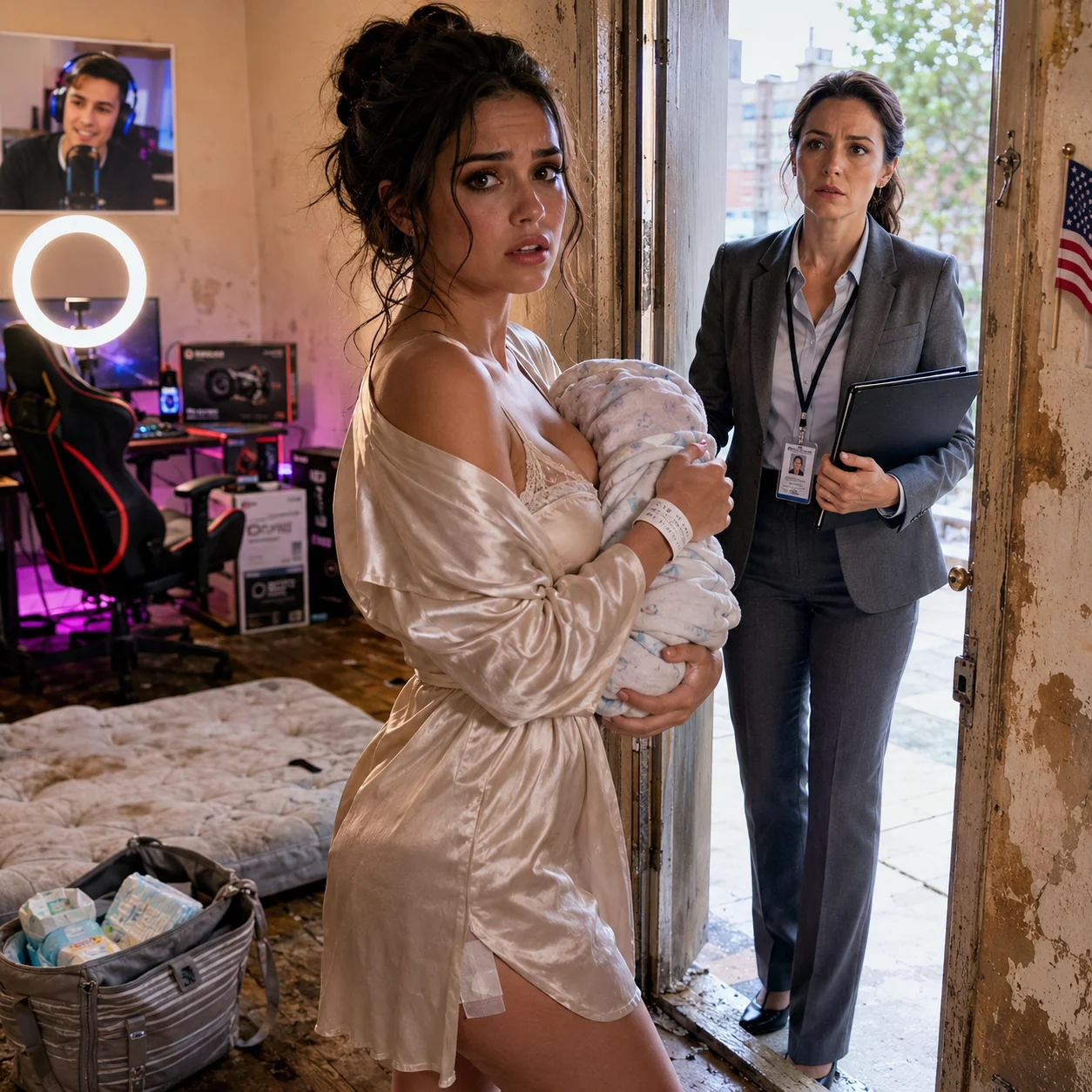
She looked past me at the mattress on the floor, the mold on the wall, the open diaper bag, my pale face, my shaking hands.
“I need to ask you some questions.”
I leaned against the wall so I wouldn’t fall.
“Who made the report?”
The woman opened her folder.
And when I saw the name written on the first page, I understood my family had not only thrown me out.
They had also tried to take my son from me.
The name on the form was my mother’s.
Martha Elena Vargas.
Underneath, in cold, formal language, it said:
“The mother shows emotional instability, refuses family support, and keeps the newborn in unsanitary conditions by her own choice. She posts photos of the minor to obtain money and attention.”
It felt like my scar opened from the inside.
“That’s a lie,” I said, but my voice came out small. “They brought me here. They left me here.”
The social worker looked at me with a seriousness that was not cruelty. It was the exhaustion of someone who had heard too many tragedies.
“I need to verify that, Daniela.”
I held Emiliano tighter.
“Please don’t take him. I don’t have anyone, but I haven’t hurt him.”
Her eyes dropped to my stained bandage.
“When was your C-section?”
“Two days ago.”
Her expression changed.
Suddenly, she was no longer just looking at the mattress, the mold, or the open bag of diapers. She was looking at me. At my dry lips. My trembling hands. The sweat on my forehead.
“Do you have a fever?”
I didn’t answer.
Because I thought if I said yes, she would take my baby.
She closed the folder.
“Daniela, listen to me carefully. Being poor, being alone, or needing help is not a reason to take a baby away from his mother. But if you faint here, both of you are at risk.”
That was when I broke.
I leaned against the wall and sobbed with Emiliano pressed to me. It was not pretty crying. It was ugly, shaking, breathless crying. It was rage and shame and pain that did not belong to me.
“It hurts so much,” I confessed. “I can barely stand. I haven’t eaten since yesterday.”
The woman stepped closer slowly.
“My name is Teresa. I’m calling medical support. You’re going to the hospital with your baby. After that, we’re going to talk about your family.”
“You won’t take him?”
Teresa shook her head.
“I didn’t come here today to punish you. I came to see the truth.”
Fifteen minutes later, I heard a siren outside.
Neighbors came out to look through their doors and windows, the way people do in the city when pain becomes loud enough for everyone to hear.
An older woman from the apartment across the hall came over with a clean blanket.
“Cover the baby, mija,” she said. “It’s cold on the stairs.”
She was the first person who had spoken to me with tenderness since Emiliano was born.
“Thank you,” I whispered.
“My name is Chela,” she said. “And I saw when your parents left you here. Don’t worry. If anyone asks, I’ll tell the truth.”
They lifted me into the ambulance.
Every bump on the road to the hospital made me see stars. Iztapalapa was waking up around us. Tamale stands were opening, packed buses rumbled past, people rushed toward the Metro, and the Cablebús moved above the rooftops as if life could not stop for any broken woman.
I looked down at my son and thought, Hold on, Emiliano. Hold on with me.
At the emergency room, they examined me.
My wound was infected.
I was dehydrated.
My blood pressure was low.
A young doctor scolded me with tears in her eyes.
“Who let you climb stairs like that?”
I didn’t know what to say.
Teresa answered for me.
“Her family.”
The doctor tightened her jaw.
They cleaned my wound, changed the bandage, and started an IV. Emiliano stayed beside me in a clear hospital bassinet, sleeping with the impossible peace newborns have even when the world around them is falling apart.
When I finally closed my eyes, my phone vibrated again.
It was Sergio.
“Enough, Daniela. Delete the post or I swear you’re going to lose the baby.”
Then another message came.
“My mom already called DIF. Nobody will believe you if you say we kicked you out. You’re crazy.”
I showed the messages to Teresa.
She took screenshots.
“Thank you,” she said.
The words felt strange.
For the first time, someone was collecting evidence instead of excuses.
Later that day, my father came to the hospital.
He did not come worried.
He came furious.
He walked in with my mother behind him and Sergio holding his phone low near his chest, trying to record without being noticed.
“Where is my grandson?” my mother demanded, as if she suddenly cared.
Teresa stood up.
“You can’t enter without authorization.”
My father let out a dry laugh.
“And who are you to keep us away from our own family?”
“The person who received a false report signed by your wife.”
My mother went white.
Sergio lowered his phone.
“It wasn’t false,” he said. “She’s unstable. Look at her.”
I pushed myself up slightly. Even breathing hurt.
“I look like this because you left me in an empty room two days after surgery.”
My father pointed at the hospital bed.
“We gave you a roof.”
“You gave me mold, a mattress on the floor, and three flights of stairs with no elevator.”
My mother crossed her arms.
“Always exaggerating. All because you’re jealous of your brother.”
Something inside me stopped shaking.
I looked at her in a way I had never looked at her before.
“No, Mom. It’s not jealousy. It’s exhaustion. I’m tired of paying for electricity, groceries, and medicine while Sergio played at being famous. I’m tired of my pregnancy being treated like a burden because it didn’t bring likes. I’m tired of my son being called a problem before anyone called him Emiliano.”
Sergio stepped forward.
“Don’t drag me into this. I’m working.”
I laughed.
It hurt my wound, but I laughed.
“Working? You sold my bed to buy that gaming chair.”
Silence fell heavily.
My mother turned to him.
“Sergio…”
He didn’t answer.
Neither did my father.
That was when I understood something else.
They had not moved my things to storage.
They had sold them.
Teresa wrote something in her folder.
“I need you all to leave.”
My father slapped the wall with his open hand.
“She’s my daughter!”
“That is exactly why you should be ashamed,” Teresa replied.
I had never seen my father run out of words before.
The video Sergio tried to record to defend himself only buried him deeper.
He never posted it.
A nurse in the hallway, who had heard the shouting, recorded the moment Teresa said “false report.” Within hours, people connected everything: my post, Sergio’s livestream from my room, my mother’s voice messages, his threats.
The “room of success” became a national joke.
People made memes.
But I couldn’t laugh.
Because behind every joke was my sold bed, my blood on a bandage, and my son sleeping in a borrowed hospital bassinet.
A microphone brand canceled Sergio.
Then the gaming chair company.
Then the platform suspended his monetization for harassment and threats.
My mother sent another voice message, but this time she was crying.
“Daniela, please. Tell them it was a misunderstanding. Your brother hasn’t eaten. Your father is very upset.”
I listened to the message with Emiliano against my chest.
“How strange,” I whispered. “When I didn’t eat, nobody cried.”
I did not respond.
On the third day in the hospital, Teresa returned with a thicker folder.
“There is a neighbor willing to give a statement,” she said. “We also have the messages. And the doctor has documented that you required rest and care.”
I swallowed hard.
“What’s going to happen to Emiliano?”
“He will stay with you. But we need to build you a real support network.”
I felt embarrassed.
“I don’t have one.”
“Sometimes it appears where you least expect it.”
That afternoon, Doña Chela came to the hospital with chicken broth in a plastic container, tortillas wrapped in a napkin, and guava atole.
“It’s not restaurant food, mija,” she said, “but it brings the dead back to life.”
I cried before I even took the spoon.
She adjusted my pillow, held Emiliano while I ate, and told me she had raised three children alone selling quesadillas near Parque Cuitláhuac.
“Family isn’t always the one written on your birth certificate,” she told me. “Sometimes it’s the one that stays when everyone else leaves.”
When I was discharged again, I did not return to the empty apartment.
Teresa helped connect me with a temporary shelter for mothers facing family violence. It was not luxurious. There were rules, schedules, shared rooms, and other women with stories that hurt in different ways.
To me, it felt like a palace.
There was a bed.
There was hot water.
There was a woman who taught me how to lift Emiliano without hurting myself.
There was a shared room where no one called me dramatic when I cried in the middle of the night.
From the window, I could see the hills of Iztapalapa and, in the distance, the lights of the city. Some afternoons, when I could finally walk slowly, Doña Chela took me to a nearby community center where women attended workshops, children ran through the courtyard, and older ladies stood in line for activities.
I looked at those spaces and realized that the city, despite all its hardness, still had corners where a woman could breathe.
My family did not give up.
First, they tried apologizing in public.
Sergio went live with red eyes.
“Honestly, guys, this was taken out of context. My sister has always been complicated, but we love her.”
The comments destroyed him.
Then my father came to the shelter.
They did not let him in.
He left a letter.
“Daniela, enough has happened. Your mother is sick from stress. Sergio lost everything because of your post. Come home. We’ll give you space in the living room.”
The living room.
Not even my room.
I tore the letter into four pieces.
Not out of anger.
For my health.
Weeks later, I had to attend a family hearing.
All three of them were there.
My mother held a rosary in her hands. My father wore a freshly ironed shirt. Sergio stared at the floor, without the confidence of his camera.
Teresa presented her report. The doctor explained my condition. Doña Chela testified that she saw me arrive with my baby, pale and unsupported, while my parents drove away.
Then it was my turn to speak.
I stood slowly. My wound no longer bled, but it still pulled with every movement.
“I don’t want revenge,” I said. “I want them to stop calling abandonment drama. I want my son to grow up far away from people who think a woman fresh out of surgery is worth less than a desk with lights. I want them to understand that I did not leave the family. They threw me out.”
My mother cried.
Before, her tears would have bent me.
That day, they did not.
Sergio lifted his face.
“I’m sorry,” he murmured.
I looked at him.
I wanted to feel something big. Rage. Relief. Love.
But all I felt was distance.
“Your apology came after you lost sponsors,” I said. “Not after you saw your nephew on the floor.”
He looked down again.
My father did not apologize.
He said he had done “what was necessary.”
That sentence finished freeing me.
Because I finally understood that some people would rather lose a daughter than lose an argument.
The authorities ordered protective measures. My family could not approach me or Emiliano without authorization. The false report was officially documented. It was not a movie ending with handcuffs and applause. It was a signed paper, a folder closing, and my body breathing properly for the first time in weeks.
Sometimes justice does not arrive with music.
Sometimes it arrives at a government desk, with copies, stamps, and a tired woman who still chooses to believe you.
Over time, I found remote work handling orders for an online store. It didn’t pay much, but it was enough for diapers, shared rent, and a secondhand bassinet Doña Chela found through a neighbor.
The first night Emiliano slept in that bassinet, I sat on the floor and cried.
Not from sadness.
From peace.
Months later, I passed by my parents’ house.
I did not go inside.
From the sidewalk, I could see my old bedroom window. The LED lights were still there, but they were off. The “room of success” sign was crooked, as if it too had grown tired of pretending.
My mother came outside carrying a trash bag.
She saw me.
For one second, I thought she might run to hug me.
She didn’t.
She only said, “You look stronger.”
I adjusted Emiliano in his stroller.
“You didn’t leave me a choice.”
Her eyes filled with tears.
“Can I see him?”
I looked down at my son.
He was sleeping, smiling faintly, innocent to everything.
“Maybe someday,” I said. “When you understand that he is not a reward for good behavior. He is a person.”
My mother pressed the trash bag to her chest.
“Daniela…”
“I won’t teach my son to stay where he gets hurt just because he shares blood with someone.”
Then I walked away before she could answer.
At the corner, a man was selling esquites with the kind of chili that really burns. I bought one, more out of craving than hunger, and kept pushing the stroller beneath the gray Mexico City sky that always looks like it is about to rain.
Emiliano woke up.
He opened his eyes and looked at me as if I were his whole world.
Me.
The woman they called dramatic.
The woman they called unstable.
The woman they called a problem.
The woman who climbed three flights of stairs with a fresh wound because no one cared enough to offer an arm.
The woman who almost believed asking for help made her a bad mother.
I leaned down and kissed his forehead.
“We’re not alone, my love,” I whispered. “Not anymore.”
And it was true.
Because a woman in a gray suit had decided to read beyond a lie.
Because a neighbor with chicken broth had held me together when my own blood family let me fall apart.
Because strangers on the internet screamed the truth I could barely whisper.
My family lost a room.
But I gained a life.
A small, warm, sleepy life that smelled like milk and held my finger with tiny hands.
My son did not need the “room of success.”
He needed a place where no one would ever call him an inconvenience.
And I was going to build it for him.
Brick by brick.
Day by day.
Even with a scar.
Even while trembling.
Even if I had to begin from a mattress on the floor.
![[FULL STORY] My Fiancée Took A Guy’s Number At A Bar And Said I Didn’t Own Her. She Came Home To An Empty Place..](https://social-media.rabedo.com/thumbnails/1777187307_R15.png)