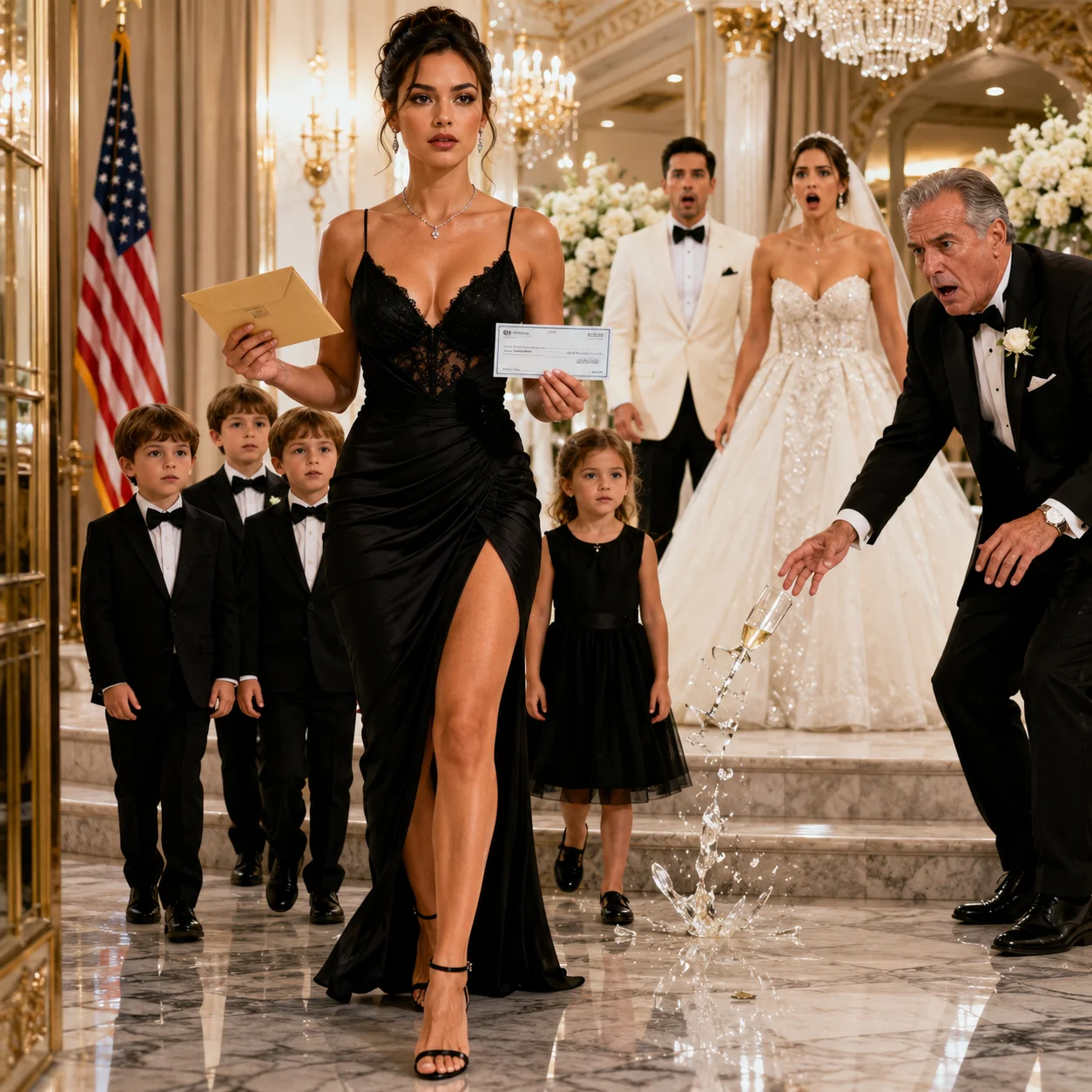
Signed by Don Héctor.
Dated the exact same day he forced me to leave.
And when Rodrigo read the clause marked in red, he understood that his father had not only separated us.
He had also sold his own family name in exchange for money.
Rodrigo read the clause once.
Then again.
His fingers shook so badly that the paper crumpled.
“Grupo Salgado acknowledges receiving bridge financing from Banco Alcázar, conditioned upon the elimination of any inheritance, family, or financial claim arising from the relationship between Rodrigo Salgado and Valeria Montes,” he read quietly.
Renata stood completely still.
Don Héctor closed his eyes.
I did not.
I wanted to see him awake for this.
I wanted Rodrigo to read every word the way I had spent five years reading his abandonment.
“Keep going,” I said.
Rodrigo swallowed.
“In the event of unrecognized descendants, Mr. Héctor Salgado agrees to guarantee their removal from the family circle through financial compensation and absolute confidentiality…”
The entire room turned cold.
A woman in a silver dress dropped her glass.
No one bent down to pick it up.
My lawyer, Julián Arriaga, opened the folder to another page.
“This document does not only prove that Don Héctor pushed Valeria out. It proves that the marriage alliance with the Alcázar family was part of a financial operation. Her disappearance, the check, and Rodrigo’s silence were used to rescue Grupo Salgado from debt.”
Renata turned toward her father, who sat in the front row with a hardened expression.
“Did you know about this?”
Don Ernesto Alcázar did not answer.
He did not need to.
His silence smelled like a contract.
Renata slowly removed her veil.
Rodrigo was still staring at the page as if it were burning his hands.
“I didn’t sign this,” he murmured.
Don Héctor opened his eyes.
“Rodrigo, do not say another word.”
“Did I know?”
The old man clenched his jaw.
“I did what was necessary to protect you.”
That was when I laughed.
Dry.
Sharp.
“No. You did what was necessary to sell him at a higher price.”
Don Héctor looked at me with hatred.
But his hatred could no longer reach me.
Five years earlier, it would have destroyed me. Back then, I had been a trembling young woman with one hand over her stomach, standing inside a marble office while everyone looked at me as if I had dirtied the carpet.
But that night, beneath the chandeliers of the St. Regis, facing Paseo de la Reforma and only a short distance from the Diana the Huntress Fountain, his hatred looked small.
Very small.
My children pressed closer to me.
Mateo, the oldest by three minutes, held my hand. Sofía lifted her chin with that fearless little expression that sometimes scared me. León stared at Rodrigo as if he were trying to find an answer in his face. Emiliano, the quietest one, hugged a blue folder of drawings against his chest.
Four five-year-old children.
Four breathing truths.
Rodrigo lowered his gaze to them.
“Valeria,” he said. “I didn’t know there were four.”
“You didn’t know there was even one.”
“They told me you left.”
“They bought me.”
“I thought you cashed it.”
I lifted the check.
“You thought whatever helped you sleep at night without looking for me.”
The words hit him directly.
I saw something fold inside his face.
And I did not enjoy it.
That was the worst part.
I had imagined this moment so many times. I thought I would feel victory, peace, maybe even a dark kind of joy. But seeing him there in his wedding suit, understanding that his father had sold his life and that he had helped through cowardice, only made me sad.
Renata walked to the main table.
She picked up the contract.
She read it with a dangerous calm.
“My wedding was a bank guarantee.”
No one answered.
She looked at her father.
“You were going to marry me to him to close an old debt?”
Don Ernesto Alcázar stood slowly.
“Renata, do not make a scene.”
She laughed.
“A scene? Four children just walked into my wedding, and you are worried about a scene?”
Don Héctor slammed his hand on the table.
“Enough! This will be handled in private.”
I stepped toward him.
“No. You threw me out in private. My children enter in public.”
The journalists were already at the ballroom doors. Security tried to hold them back, but it was useless. The giant screen still showed my name and Nova Aurea Tech, the company born in a borrowed kitchen in Querétaro, with four cribs around me and an old laptop that shut down whenever I used the microwave.
Nova Aurea was not born from a check.
It was born from not cashing one.
It was born from selling my car, sleeping two hours a night, coding with a baby on my chest, taking calls while the washing machine roared, and convincing investors who told me, “Come back when you’re not so busy being a mother.”
It was born from hunger.
But not hunger for money.
Hunger to never beg again.
Don Héctor pointed at the screen.
“You did this to humiliate us.”
I looked at him.
“You sent me to the right school.”
“What?”
“You taught me that in your world, the person who wins is not the person who is right. It is the person who arrives with proof.”
My lawyer removed another sheet.
“And we have more.”
Rodrigo lifted his head.
“More?”
Julián placed four small envelopes on the table.
“Genetic test results. Conducted under chain-of-custody standards. We did not come here to ask permission to confirm the obvious. We came to establish that the children are the biological children of Rodrigo Salgado.”
Rodrigo’s mother, Doña Clara, covered her mouth with both hands.
She had not spoken since I entered.
She had always been elegant and silent, the kind of woman who smiled without showing too much and suffered without ever letting a strand of hair fall out of place. Five years earlier, she had watched me leave the Grupo Salgado building from a hallway. I saw her. She had hidden too.
That night, she stood.
She walked toward the children.
I raised one hand.
“No.”
She stopped as if I had struck her.
“Valeria, please.”
“Do not come to meet them with tears. Tears are not a grandmother’s identification.”
Doña Clara closed her eyes.
“I know.”
“You knew they threw me out.”
“Yes.”
The confession fell softly.
But it broke more than a scream.
Rodrigo looked at her.
“You too?”
His mother cried silently.
“Your father told me it was for the best. He said she had accepted the money. He said if we told you, you would destroy your future. I… I was a coward.”
Rodrigo stepped back.
“Everyone decided for me.”
I looked at him.
“No, Rodrigo. You decided too. You decided to believe without searching. You decided not to knock on my door. You decided to get married today without ever asking why the woman you swore you loved disappeared overnight.”
He lowered his head.
“You’re right.”
That answer disarmed me for one second.
Not because I forgave him.
Because five years earlier, I would have sold my soul to hear him admit even one piece of guilt.
Renata removed her ring.
She did not throw it.
She placed it carefully on the table beside the contract.
“The wedding is canceled.”
Don Ernesto Alcázar turned red.
“Renata, think about the consequences.”
She looked at him as if she had just met him.
“That is exactly what I’m doing, Father.”
Don Héctor tried to interrupt.
“Miss Alcázar, this benefits no one.”
Renata lifted her chin.
“It benefits me. It benefits me not to marry a man whose family can sell him for financing.”
Rodrigo closed his eyes.
He did not contradict her.
The mariachi band, which had been waiting for a signal, lowered their instruments. One violinist crossed himself. Outside, cars continued passing along Reforma as if the city had no idea a dynasty was collapsing inside a ballroom filled with imported flowers.
My children watched everything in silence.
Too much silence.
I bent down in front of them.
“Are you okay?”
Sofía wrinkled her nose.
“That angry man shouted a lot.”
“Yes.”
“Can we get ice cream after this?”
For the first time that night, I truly smiled.
“Yes, my love.”
Don Héctor heard and took an unsteady step forward.
“Valeria, you cannot take them away like this. They are Salgados.”
I stood slowly.
“Do not say that again.”
“They carry our blood.”
“They carry mine every day. Yours only in a laboratory.”
Rodrigo stepped toward his father.
“Do not talk about them as if they are property.”
Don Héctor turned on him with fury.
“You be quiet! Everything you have is because of me!”
Rodrigo looked at him.
“Then maybe I have nothing.”
For the first time, Don Héctor looked old.
Not powerful.
Old.
A man who had moved money, signatures, family names, and destinies like chess pieces, but never imagined that a pregnant woman could walk out of his building with an untouched check and return with a trillion-dollar company.
Julián opened the last section of the folder.
“There is another contractual consequence.”
Don Ernesto Alcázar stood immediately.
“That must not be read here.”
“How interesting,” I said. “Everyone wants privacy once the shame is no longer mine.”
Julián read aloud.
“If it is proven that Grupo Salgado concealed direct descendants of Rodrigo Salgado for the purpose of altering inheritance agreements, any trust, voting rights, or benefits agreed upon regarding family shares shall be subject to review for fraud, deception, and simulation.”
Benjamín, one of Grupo Salgado’s board members, went pale.
“That could freeze the operation.”
“It already has,” Julián said. “The request was filed this afternoon.”
Don Héctor staggered.
“You cannot do that.”
“I already did.”
“I gave you one hundred and twenty million dollars!”
I lifted the check.
“No. You tried to buy a disappearance. I was not for sale.”
Then I tore it.
Once.
Then again.
Then again.
The pieces fell over the white tablecloth like ashes from an old fire.
The entire ballroom held its breath.
Don Héctor stared at the fragments as if he had just watched his only argument die.
“It was a fortune,” he murmured.
“My children are worth more.”
Mateo looked up at me.
“Mom, was that paper a lot of money?”
I stroked his hair.
“Yes.”
“Then why did you tear it?”
I thought for a moment.
“Because sometimes there are papers that weigh more when they are whole.”
Rodrigo covered his face with one hand.
Renata cried, but she remained standing.
Doña Clara sat down as if her legs could no longer hold her.
My lawyer closed the red folder.
“Tomorrow we begin the formal process for recognition, retroactive child support, identity rights, and financial protection for the minors. We are not here to negotiate affection. We are here to protect four children.”
Rodrigo lifted his gaze.
“I won’t fight it.”
Don Héctor glared at him.
“Don’t be an idiot.”
“I already was one for five years.”
The old man raised his hand.
For one second, I thought he might strike him.
Security took a step forward.
Rodrigo did not move.
“It’s over, Father.”
Don Héctor lowered his hand.
Not because he regretted anything.
Because everyone was watching.
That night, I left the ballroom without running.
My children walked beside me over the polished marble floors of the hotel. We passed the King Cole Bar, waiters frozen with trays in their hands, and guests pretending not to stare. Outside, the cold air of Reforma hit my face like a clean slap.
The city lights glowed against the buildings.
The Diana the Huntress statue seemed to aim at a truth no one could avoid.
Sofía asked for ice cream.
We went for churros instead.
Not to an expensive restaurant.
To a small place near Roma, where my children could get sugar on their hands without anyone looking at them like future shareholders. They laughed. They argued over chocolate. Emiliano fell asleep in my lap before finishing his food.
That was my victory.
Not the screen.
Not the public offering.
Not the pale faces of the Salgado family.
My victory was four children eating churros after I returned a check that could have bought my silence but never my motherhood.
The next day, the scandal was national news.
The headlines spoke of the canceled wedding, Nova Aurea, the quadruplets, the secret contract, and the crisis at Grupo Salgado. On the stock exchange, the company’s shares fell before noon. On social media, everyone had an opinion. Some said I was vengeful. Some said I was brilliant. Some said I was cruel. Some said I was a mother defending what was hers.
I did not read much.
I had breakfast to make.
My children still wanted pancakes shaped like animals, even if their mother was appearing on international finance channels.
The first hearing took place two weeks later.
Rodrigo arrived without his father.
That surprised me.
He came in a simple suit, with dark circles under his eyes and a folder in his hand. He did not bring aggressive lawyers, a spokesperson, or image consultants.
When he saw the children, he did not rush toward them.
That surprised me too.
He stayed at a distance.
He waited.
The judge reviewed documents, genetic tests, birth certificates, medical expenses, school records, insurance, therapy, housing, everything. Julián spoke about identity, child support, safety, and protective measures. Rodrigo’s lawyer only said that his client would voluntarily acknowledge paternity.
The judge lifted her gaze.
“Do you acknowledge that you are the father of these four minors?”
Rodrigo took a deep breath.
“Yes.”
My chest tightened.
Not for him.
For them.
The judge continued.
“Are you willing to assume the corresponding obligations?”
“Yes.”
“Are you requesting immediate visitation?”
Rodrigo looked at the children.
Mateo hid his face against my arm.
Sofía watched him with suspicion.
León did not blink.
Emiliano squeezed his blue folder.
Rodrigo lowered his gaze.
“No. I request to begin with therapy and supervised visitation, if they are ready.”
Julián looked at me.
I said nothing.
But a small part of my rage loosened its teeth.
After the hearing, Rodrigo caught up with me in the courthouse hallway, between beige walls, case files, tired mothers, angry fathers, and children playing on phones while adults decided their world.
“Valeria.”
I stopped.
“Don’t make this difficult.”
“I’m not here to ask you for anything.”
I looked at him.
“That would be new.”
He accepted the blow.
“I only wanted to tell you that I did go looking for you.”
I laughed.
“Five years late.”
“No. That week.”
I froze.
“What?”
“I went to the apartment where you lived. You were already gone. My father said you had cashed the check and moved to Miami. He showed me a copy of it. He told me that if I looked for you, you would sue me for harassment. I… I wanted to believe him.”
“Because believing him was easier than admitting you had failed yourself.”
“Yes.”
His honesty made me uncomfortable.
“What do you want now?”
Rodrigo looked toward the room where the children were waiting with my assistant.
“To learn their names before I deserve to hear them call me anything.”
That hurt.
Because it was a good answer.
And I did not want good answers from him.
“I am not going to hand you a packaged family,” I said. “I am not going to explain to them that you are good because you recognized late what you should have protected from the beginning.”
“I know.”
“You will not show up with expensive gifts.”
“I know.”
“You will not use the Salgado name as a key.”
“I don’t even know if I want that name to open anything anymore.”
I looked at him more carefully.
Rodrigo looked tired in a way money could not fix.
“Your children do not need a remorseful prince,” I said. “They need a consistent adult.”
“I want to try.”
“They will decide how much.”
He nodded.
He did not ask for a hug.
He did not ask for forgiveness to make himself feel clean.
He simply stepped aside when we passed.
That was the first decent thing I had seen from him in years.
Don Héctor did not appear at the hearings.
He appeared in newspapers.
Countersuits.
Internal investigations.
Board members resigning.
The Alcázar agreement dissolving like sugar in hot coffee.
Renata gave a brief statement.
“I was part of an operation whose full scope I did not know. I canceled my wedding because no alliance justifies erasing children.”
I found that fair.
Not saintly.
Fair.
Doña Clara asked to see me one month later.
I agreed to meet her at a café in Polanco, not in my home. She arrived without a visible driver, without large jewelry, carrying a simple handbag and a shame that did not match her last name.
“I am not here to ask for access to the children,” she said.
“Good.”
“I am here to ask your forgiveness.”
“That changes nothing.”
“I know.”
“Then why?”
Her eyes filled with tears.
“Because for five years, I prayed for grandchildren who already existed, and I did not have the courage to look for them.”
I said nothing.
She took out a small box.
“These belonged to my mother. They are not meant to buy anything. Not forgiveness, not time, not entry. They are for Sofía, whenever you want. If you never want that, I understand.”
I did not take the box.
“Do not bring inheritances to a little girl who does not yet know your embrace.”
Doña Clara lowered her head.
“You are right.”
She stood.
She left only a letter.
I did not open it until that night.
It was not for me.
It was for my children.
It did not speak of money.
It spoke of cowardice.
I kept it.
Maybe one day.
Months later, supervised visits began.
At the first meeting, Rodrigo arrived without gifts.
My children entered together, like a small pack.
The psychologist asked if they wanted to say hello.
Mateo said no.
Sofía asked, “Why didn’t you protect Mom?”
Rodrigo froze.
I was behind the glass.
I could not save him.
I should not.
“Because I was a coward,” he said.
León tilted his head.
“Is coward bad?”
“Yes,” Rodrigo answered. “But it is also something a person can stop being by doing the right thing many times.”
Emiliano opened his blue folder.
He took out a drawing.
It was the wedding ballroom.
Flowers.
A torn check.
Four children.
A mother in a black dress.
And a man white as paper.
“You are this one,” he said.
Rodrigo took the drawing carefully.
“Yes.”
“I drew you small because you weren’t there when we were babies.”
Rodrigo cried.
Not loudly.
Not for attention.
He cried like a man receiving a sentence written in crayons.
“It’s a good drawing,” he said.
Emiliano nodded.
“I’m good.”
For the first time, Rodrigo smiled.
“Yes. Very good.”
There was no hug that day.
But there were seven minutes of truth.
And sometimes seven minutes of truth are worth more than five years of a family name.
Life did not become simple.
It never does.
Nova Aurea grew faster than I could celebrate. Investors, interviews, meetings with foreign accents, trips to New York, London, Monterrey, Singapore. But my calendar still had untouchable hours: breakfast with my children, therapy, school meetings, birthdays, vaccinations, end-of-year performances.
Wealth did not make me invincible.
It made me more responsible.
Because I knew what it felt like to be pregnant, alone, with a check that could buy everything except dignity.
I created a fund for entrepreneurial mothers who had been pushed out of homes, companies, or families because they did not belong to someone’s “level.”
I called it Zero Intact, for all the zeros on the check I never touched.
Every time I signed a grant, I thought of Don Héctor.
Not with hatred.
With bitter gratitude.
He had tried to erase me.
And by doing so, he forced me to write myself larger.
One year after the canceled wedding, Don Héctor asked to see me.
I said no.
Then he became ill.
He asked again.
I said no.
When he insisted a third time, Rodrigo told me, “You don’t have to go.”
“I know.”
“Then why are you considering it?”
I looked at my children playing in the garden.
“Because I don’t want my peace to depend on avoiding ghosts.”
So I went.
Don Héctor was in his house in Las Lomas, thinner now, sitting in a huge room that smelled like old wood and expensive medicine. He no longer looked like the man who had thrown a check across a desk. He looked like what he had always been beneath the power.
Fear in a suit.
“Valeria,” he said.
“Don Héctor.”
It hurt him that I did not call him anything else.
“I lost a lot.”
I looked out the window toward the perfect garden.
“I did not come to comfort you.”
“I know.”
He coughed.
“I saw photos of the children.”
“Without my permission, I assume.”
He lowered his eyes.
“They are beautiful.”
“They were beautiful when you tried to make them disappear before they were born too.”
He closed his eyes.
“I thought I was protecting my son.”
“No. You were protecting your name.”
“It is the same thing.”
“That is why you lost both.”
He fell silent.
Then he took an envelope from a side table.
“I want to leave them something.”
I did not take it.
“My children do not need your money.”
“Everyone needs money.”
“No. Everyone needs not to be bought.”
His hand trembled.
“Will you never forgive me?”
I thought of the young woman from five years earlier, one hand over her stomach, listening to zeros as if they were a sentence.
“I did not come here to forgive you. I came to tell you that your grandchildren exist, they are happy, and they owe you nothing.”
His eyes filled with tears.
“Can I see them someday?”
“If they want to when they grow up. Not before. Not because of your illness. Not because of your guilt. Not because you discovered too late that blood cannot be filed away.”
Don Héctor nodded.
For the first time, he did not order.
He only accepted.
When I walked out of that house, I breathed as if I were leaving a prison I had never physically entered.
Rodrigo kept showing up.
Not perfectly.
But consistently.
He came to school performances without cameras. He learned who hated broccoli, who got carsick, who slept with a light on, who needed silence before speaking. One day, Mateo took his hand to cross the street. Rodrigo stood frozen, as if someone had handed him a company greater than any empire.
I saw it.
I said nothing.
Some scenes do not need approval.
Only time.
Sometimes Rodrigo looked at me the way he used to.
I did not return that look.
What we had been died in an office with a check on the table.
What might exist afterward had no name yet.
And I was in no hurry.
One afternoon, Sofía asked me, “Mom, why did you keep the check for so long if you were going to tear it up?”
We were in the kitchen making cookies. Flour covered her nose.
“Because I needed to remember that I didn’t cash it.”
“So you wouldn’t forget?”
“So I wouldn’t sell myself.”
She thought about that for a moment.
“And now you don’t need it anymore?”
I smiled at her.
“No. Now I have you. And I have myself.”
She went back to kneading the dough.
“Then it’s good you tore it. It was ugly.”
I laughed.
Five years of pain, summarized by a little girl with flour on her hands.
Life can be so wise when it stops asking permission.
Now, whenever I pass by Paseo de la Reforma and see the St. Regis, I no longer feel the blow of that night the way I used to. I see lights, traffic, tourists, office workers, couples taking photos near Diana the Huntress, the enormous city swallowing tragedies and returning them as memory.
That hotel was supposed to be the place where two families married over my silence.
Instead, it became the place where my children walked in with tiny shoes and enormous truths.
Don Héctor paid me one hundred and twenty million dollars to disappear while pregnant.
I did not cash it.
I did not disappear.
I only went far enough away to return standing.
And when I came back, I did not carry revenge in my arms.
I brought four children.
Four names to be recognized.
Four laughs that no contract could erase.
I also brought an untouched check, not as wealth, but as proof.
Proof that a woman can be left without a husband, without support, without a powerful family name, and still build an entire world.
Proof that money can buy weak silences, but not determined mothers.
Proof that there are zeros worth nothing when compared to a single word spoken by a child before sleep.
“Mom.”
That was always my fortune.
And that, no Salgado could ever take from me.

![[FULL STORY] She Said She Was “Settling for Less” With Me—So I Left Her to Settle Alone](https://social-media.rabedo.com/thumbnails/1777474556_31ceb3be-a925-49f0-9c91-b9c6b7556f3c.png)