
She only handed him the marker.
He wrote his name on his things.
ANDRÉS.
On Saturday night, he tried softening his voice.
“Love, don’t exaggerate. What’s mine is yours, and what’s yours is mine.”
Valeria closed the wine-colored folder before he could see inside.
“No. You changed the rules.”
His eyes moved toward the folder.
“What’s that?”
“A memory.”
He gave a tense laugh.
“You’re so dramatic.”
Valeria smiled faintly.
“Not yet.”
On Sunday, they arrived two by two.
As always.
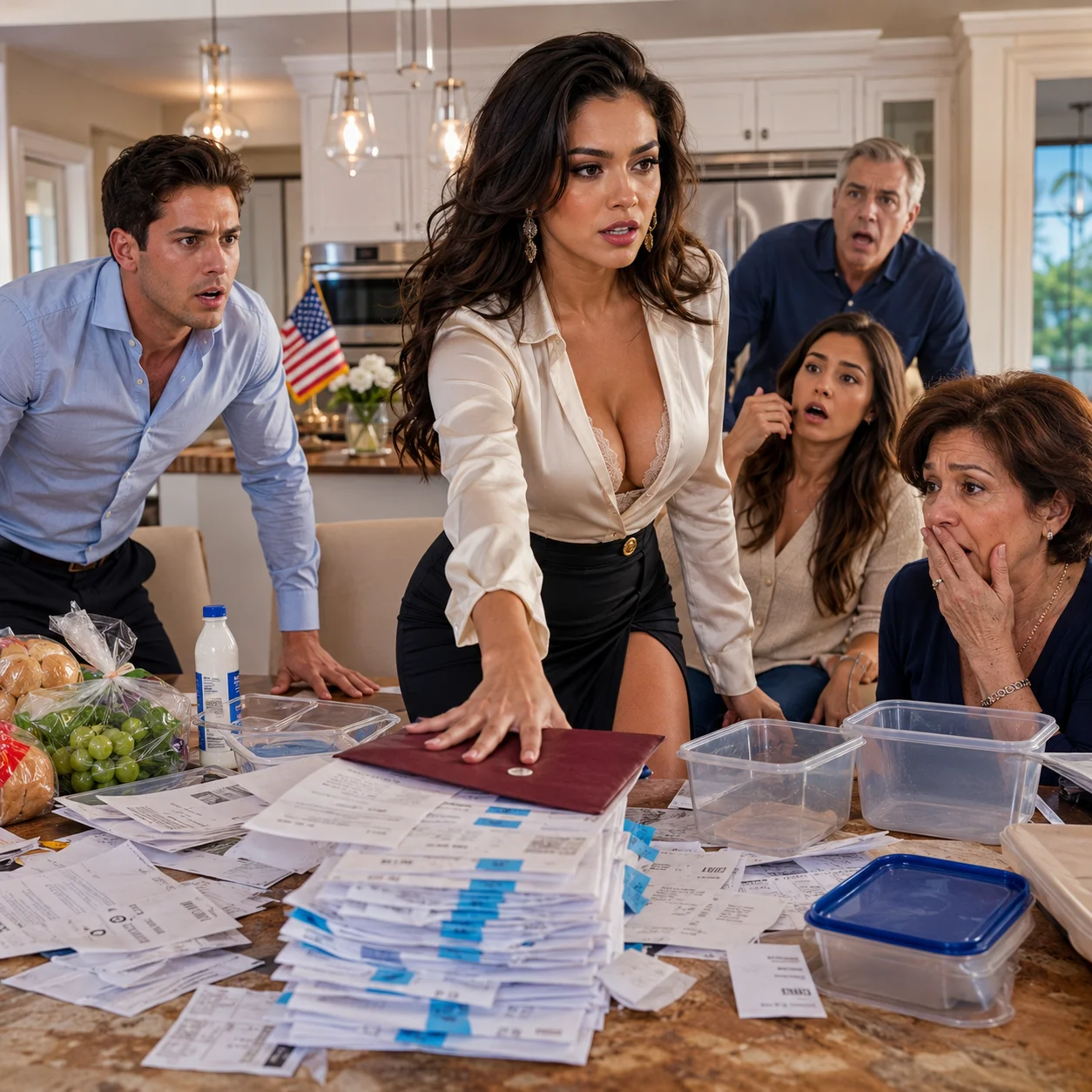
Doña Teresa came first, wearing her sweet perfume and carrying a bag full of empty containers.
Beto followed behind her, scratching his stomach.
Then Marisol, Valeria’s sister-in-law, came in with the children.
The kids ran straight toward the refrigerator.
“Aunt Vale, I want juice!”
Valeria didn’t move.
Andrés came out of the living room pale.
“Mom, you didn’t tell me you were coming today.”
Doña Teresa kissed his cheek.
“Ay, son, since when do I need an appointment to come to your house?”
Valeria placed one single chair at the table.
Then she set the wine-colored folder in the center.
Doña Teresa frowned.
“And the food?”
“I didn’t cook.”
Silence.
Beto laughed like he hadn’t heard correctly.
“What do you mean you didn’t?”
“I don’t cook for guests who don’t contribute.”
Her mother-in-law looked at Andrés as if Valeria had just insulted the Virgin Mary.
“What’s wrong with your wife?”
Andrés swallowed.
“Vale is going through a weird phase.”
Valeria raised one eyebrow.
“No, Andrés. I’m going through a fair phase.”
Doña Teresa placed her empty containers on the table. Clean. Ready. Waiting to carry away food she had not bought.
“Look, little girl,” she said, voice sharpening. “Don’t talk to me like that. My son has supported you long enough for you to be closing the kitchen on his family.”
There it was.
The lie.
Complete.
Spoken out loud.
In front of everyone.
Valeria reached into the folder.
Andrés took a quick step toward her.
“Okay, don’t start.”
She pulled out the first bundle of receipts, held together with a red rubber band.
Then another.
Then another.
Then one more.
She placed them on the table like cards from a deadly deck.
“Groceries. Electricity. Gas. Internet. Medicine. Cookouts. Transfers to Beto. Gifts. Taxis. Boiler repair. Christmas dinner. Mother’s Day meal. Sunday after Sunday after Sunday.”
Doña Teresa stiffened.
Marisol stopped laughing.
Beto looked at the floor.
Andrés whispered, “Put that away.”
Valeria opened the folder wider.
“No.”
His voice dropped lower.
“You’re humiliating yourself.”
Valeria gave a dry little laugh.
“No, Andrés. Today I’m returning every lie to its owner.”
Doña Teresa tried to grab one of the receipts.
Valeria pulled it back before she could touch it.
“Don’t even think about it.”
The children went quiet.
The wall clock ticked once.
Valeria pulled out a printed sheet with a number highlighted in yellow.
At the top, it said:
TOTAL PAID BY VALERIA FOR THE BENEFIT OF ANDRÉS’ FAMILY: 160,438 PESOS.
Doña Teresa’s face lost color.
“That’s false.”
Valeria slid the paper toward her.
“Read it.”
Andrés was sweating.
“Valeria, enough.”
But Valeria picked up the first receipt.
The smallest one.
Not for food.
The one Andrés didn’t know she had saved.
She placed it face up in front of everyone and said, “This receipt is for your blood pressure medicine, Doña Teresa. You called me at eleven at night crying because Andrés wasn’t answering.”
Her mother-in-law opened her mouth.
Nothing came out.
Valeria slid the receipt across the table.
“Eight hundred seventy-four pesos. Farmacia Guadalajara, Chapultepec branch. I remember because that day I had just left work, I hadn’t eaten, and I still drove to your house to drop off the pills.”
Doña Teresa looked at Andrés.
Andrés looked at the wall.
“That was an emergency,” the older woman murmured.
“Of course,” Valeria said. “That’s why I paid without complaining. The strange part is that later, you told your sisters I lived off your son.”
Beto coughed.
Marisol lowered her eyes.
For the first time, the children did not ask for juice.
Valeria took another receipt.
“This is for the meat for Beto’s birthday. Three thousand two hundred pesos. Arrachera, chorizo, cheese, charcoal, non-alcoholic beer for the kids, and sodas. That day you all said I was ‘too special’ because I didn’t want to wash the cooler before cutting the cake.”
Beto shifted in his chair.
“Ay, sister-in-law, it wasn’t that serious.”
Valeria looked at him.
“Not for you. You didn’t pay for it.”
The kitchen felt smaller.
Outside, a street vendor passed by shouting, “Elotes! Esquites!”
The normal sound of a normal Sunday made everything hurt more.
Guadalajara was still moving beyond that house. Families were eating birria, people were lining up for tortas ahogadas in salty birote, grandmothers were warming tortillas. Meanwhile, in that kitchen, a family lie was rotting on the table.
Andrés slapped his palm lightly over the folder.
“Enough.”
Valeria didn’t flinch.
“Do not touch my papers again.”
“These are private things.”
“No. Private was when I paid for your family to eat while you let them call me a freeloader in my own kitchen.”
Doña Teresa stood.
“Listen, girl. A decent woman doesn’t keep accounts of what she does for love.”
Valeria nodded slowly.
“You’re right. You don’t keep accounts for love. But this was not love. This was abuse with a tablecloth.”
The sentence landed like a slap.
Marisol squeezed her youngest child’s hand.
“Okay, Valeria, don’t make us look like beggars. If we ever took food, it was because you insisted.”
Valeria laughed once.
“I insisted?”
She opened another section.
Yellow labels shone like little warning lights.
“Here are the messages. ‘Vale, save some meat for tomorrow.’ ‘Vale, did you have rice left?’ ‘Vale, Beto is short, can you lend him a thousand?’ ‘Vale, my mom needs you to pay her Uber because Andrés is busy.’”
Beto raised his face.
“That doesn’t prove anything.”
Valeria pulled out another sheet.
“Transfers. With notes. Dates. Times. Destination account.”
Beto turned red.
“I was going to pay you back.”
“When? In another life?”
Doña Teresa hit the table.
“Don’t talk to my son like that!”
Valeria looked at her with a calm so cold it frightened everyone more than shouting would have.
“You should ask him why he keeps asking money from the freeloader.”
Andrés stood abruptly.
“Valeria!”
“Sit down,” she said.
She said it quietly.
But Andrés sat down.
And everyone saw it.
Valeria didn’t feel pleasure.
She felt sadness.
Because in that instant she understood that her husband had always been capable of silencing his family.
He had simply never wanted to do it for her.
She picked up another sheet.
“Let’s make this easy. From today on, nobody enters this house without calling first. Nobody opens the refrigerator. Nobody takes food home. Nobody asks me for money. Nobody uses my card, my membership, or my time as if they inherited it.”
Doña Teresa let out a bitter laugh.
“Your house? Forgive me, but this house belongs to my son.”
Andrés closed his eyes.
Valeria saw it.
“Tell her.”
“Vale…”
“Tell her, Andrés.”
His mother frowned.
“Tell me what?”
Valeria pulled the deed from a clear plastic sleeve and placed it on the table.
“This house does not belong to Andrés. It is in both our names. And the down payment came from my severance when the old clinic closed. One hundred eighty thousand pesos.”
Doña Teresa froze.
“That is not true.”
“Read it.”
She didn’t.
Because she already knew it was true.
Marisol looked at Andrés as if seeing him for the first time.
“You told us you bought the house by yourself?”
Andrés rubbed his face.
“There was no need to explain everything.”
“No,” Valeria said. “There was a need to lie less.”
The silence filled with shame.
Valeria remembered the day they signed the papers. She had worn a simple blouse. Andrés had worn a new shirt. They had both been nervous at the notary’s office, promising each other the house would be a beginning.
Not a trench.
Not a free restaurant for a family that bit her while chewing the food she served them.
“And since we’re talking about the house,” she continued, “this section is repairs. Boiler: four thousand five hundred. Water tank leak: one thousand eight hundred. Front paint because Doña Teresa said the house ‘looked embarrassing’: seven thousand two hundred. New lock after Beto lost the keys: nine hundred.”
Beto lifted both hands.
“That was an accident.”
“Apparently the debt was also an accident.”
One of the children almost laughed, but Marisol silenced him.
Andrés was sweating through his shirt.
“Valeria, we can talk later.”
“No. Later was this entire year. Later was every Sunday. Later was every night I went to bed at midnight washing pots while you watched soccer with your brother.”
“I work.”
“So do I.”
“But I earn more.”
Valeria tilted her head.
“And that’s why I paid more?”
He didn’t answer.
Valeria pulled out the last sheet.
It did not have receipts taped to it.
It had a table.
Andrés’ income.
Valeria’s income.
Real household expenses.
Contributions.
Family loans.
Unreimbursed purchases.
Doña Teresa stared at the numbers and swallowed.
“You did this to destroy us.”
Valeria shook her head.
“No. You did this because you thought I would never add it up.”
Then something happened that nobody expected.
Marisol began to cry.
Not loudly.
She only wiped her face with her sleeve.
“I knew we were asking too much from you,” she said. “But Andrés always said you handled the shopping because you were controlling.”
Andrés turned toward her.
“Don’t start.”
“No,” Marisol said. “You don’t start. You also told me Valeria didn’t want children because she was selfish. And then I heard from Mom that you were saying she couldn’t have them.”
Valeria felt something strike her stomach.
The kitchen shifted.
“What?”
Andrés turned pale.
Doña Teresa closed her eyes like someone watching a crash happen in slow motion.
Marisol regretted it too late.
“I’m sorry. I thought she knew.”
Valeria looked at Andrés.
“What did you say about me?”
He stood.
“We’re not talking about that here.”
“Yes, we are.”
“Valeria.”
“What did you say about me?”
Andrés clenched his fists.
“I said you didn’t want kids. That’s all. That you preferred working, spending money, being out all day. Are you happy now?”
Valeria’s breathing shortened.
She had lost a pregnancy two years earlier.
Nobody at that table knew.
It had been early, painful, and silent. Andrés had asked her not to tell anyone so they wouldn’t “make drama.” She had bled through an entire night in the bathroom, a towel pressed between her legs and her soul broken open.
The next day, she went to work because there was payroll to close, and nobody had ever taught her how to stop the world for her own pain.
And he had turned her grief into gossip.
“I didn’t want to keep quiet,” Valeria said, her voice breaking for the first time. “You asked me to keep it between us.”
Andrés didn’t look at her.
Doña Teresa sat down slowly.
“What are you talking about?”
Valeria opened a small pouch inside the folder.
There was a folded paper inside.
Not a supermarket receipt.
A lab result.
Beta hCG.
And a medical note from the hospital.
Threatened miscarriage.
Pregnancy loss.
Date: August 14.
The same week Doña Teresa had organized a cookout in that kitchen and criticized Valeria for not tasting the salsa.
“That day,” Valeria said, “I was bleeding. And I still served all of you food because Andrés said if we canceled, you would ask questions.”
Doña Teresa covered her mouth.
Marisol cried harder.
Beto no longer raised his eyes.
Andrés reached for the paper.
Valeria pulled it away.
“No. This pain doesn’t belong to you either.”
Her mother-in-law spoke in a low voice.
“I didn’t know.”
“No,” Valeria said. “But you also didn’t ask. It was easier to say freeloader, dry, dramatic, difficult.”
Doña Teresa lowered her head.
For the first time in years, she had no answer.
Andrés stepped closer to Valeria.
“I’m sorry.”
It did not sound like remorse.
It sounded like panic.
Valeria knew him too well.
That apology wasn’t because he had hurt her.
It was because his family had finally seen him naked.
“I don’t want your public apology,” she said. “I needed it in the emergency room bathroom. I needed it when your mother mocked my body. I needed it when you called me a freeloader while the food I bought was on the stove.”
He swallowed.
“I made a mistake.”
“No. You got used to it.”
That hurt him more.
You got used to it.
Used to seeing her run.
Used to seeing her pay.
Used to seeing her cook.
Used to seeing her stay silent.
Used to watching her carry an entire house while he stood in the middle of it pretending to own what he did not even protect.
Valeria closed the folder.
“Today there is no food. But there are accounts.”
She pulled out five printed copies.
One for Andrés.
One for Doña Teresa.
One for Beto.
One for Marisol.
One for herself.
“I’m not charging you the 160,000 pesos. It would be useless and exhausting. But from today on, it is clear who supported what you all called Andrés’ generosity.”
Beto muttered, “Then what do you want?”
Valeria looked at him.
“I want you to leave my house with the containers empty. Exactly as you arrived.”
Doña Teresa stood with difficulty.
She looked older.
“Valeria, I…”
Valeria raised one hand.
“Not today. If you ever want to apologize, do it without an audience and without hunger.”
Her mother-in-law picked up her empty containers.
One fell.
The plastic bounced against the floor like a miserable applause.
Nobody picked it up.
Marisol approached Valeria.
“I’m sorry,” she whispered. “I was comfortable too. It benefited me to believe him.”
Valeria took a breath.
“I’ll listen to you another day.”
Marisol nodded, gathered her children, and left.
Beto walked out afterward, muttering something about families that couldn’t take anything anymore.
Doña Teresa was the last.
Before crossing the door, she looked at Andrés.
“Son, fix this.”
Valeria almost smiled.
The woman still spoke as if Valeria were a leaking sink.
When the door closed, the house felt strange.
No children running.
No plates clattering.
No voices asking for salsa, ice, napkins, more tortillas.
Only the quiet stove, the folder on the table, and Andrés standing there like a man who had just lost his stage.
“You went too far,” he said.
Valeria looked at him.
There he was.
The real Andrés.
Not sorry.
Not ashamed.
Offended because he had been exposed.
“That’s all you can say?”
“You humiliated my family.”
“Your family humiliated me for a year while you asked for more tortillas.”
He ran both hands through his hair.
“We could have solved this between us.”
“No. ‘Between us’ meant you denying and me swallowing.”
“And now what? You’re going to divorce me over an argument?”
Valeria walked to the refrigerator.
She took out a bottle of water with a blue label.
VALERIA.
She poured herself a glass.
She drank slowly.
“It was not an argument. It was a diagnosis.”
Andrés gave a nervous laugh.
“Oh, don’t start with your dramatic phrases.”
“I already started with lawyers.”
The laugh died in his throat.
“What?”
Valeria opened the folder to the last section.
He had not seen it before.
There were copies of bank accounts, deeds, receipts, transfer records, messages where he acknowledged she had paid certain expenses, and an appointment scheduled with a family lawyer near Plaza Patria.
“I’m not running out tonight,” Valeria said. “I’m not making a scene. I’m not breaking plates. But tomorrow, I’m going to ask what belongs to me, what belongs to you, and how this house gets divided without you ever saying again that you support me.”
Andrés looked at her with hatred.
Brief.
Ugly.
Enough.
“You’re ungrateful.”
Valeria felt something inside her lock shut.
“No, Andrés. I’m an accountant who finally counted herself.”
That night, they slept in separate rooms.
He slammed doors.
She did not.
He called his mother.
She called her sister.
He said, “Valeria went crazy.”
She said, “I finally woke up.”
The next morning, before work, Valeria stopped by Mercado San Juan de Dios. She didn’t need anything, but she wanted to walk through aisles full of voices, fruit, bags, shoes, toys, food, and real life.
She bought a torta ahogada to go, the kind a woman eats with too many napkins and too little dignity, and sat on a bench to breathe.
The chile made her eyes water.
For once, she was grateful to say she was crying because of the salsa.
Later that morning, she went to the Women’s Justice Center.
At first, she felt embarrassed.
She thought maybe what happened to her did not count. Nobody had hit her. Maybe it was just an ugly marriage. Maybe she was exaggerating.
The woman who spoke to her did not judge.
“Economic violence exists,” she said. “Patrimonial violence exists too. And the emotional exhaustion of supporting everyone while being called a freeloader also matters.”
Valeria heard those words and felt someone lift a sack from her back.
She did not make heroic decisions that same day.
Life does not change like videos online.
First, she gathered documents.
Then she opened a new account.
Then she stopped depositing money into the shared fund where Andrés contributed little and withdrew freely.
She canceled the additional card he had requested “for emergencies.”
She changed passwords.
She asked payroll to deposit her salary into her private account.
And every small action tasted like air.
Andrés tried everything.
Flowers on Tuesday.
Silence on Wednesday.
Shouting on Thursday.
Victimhood on Friday.
“My mother hasn’t slept because of you.”
“How strange,” Valeria replied. “I slept badly for a year and nobody cared.”
The following Sunday, nobody arrived with Tupperware.
Valeria cooked for one person.
Zucchini with corn, rice, and grilled chicken breast.
She served it on the pretty plate.
She ate slowly.
For the first time, the house smelled like peace instead of obligation.
At five, someone knocked on the door.
It was Doña Teresa.
She came alone.
No sweet perfume.
No containers.
Only a small bag of sweet bread.
“I didn’t come to eat,” she said quickly. “I came to talk.”
Valeria did not immediately let her in.
She looked at her from the doorway.
“Talk.”
Her mother-in-law squeezed the bag.
“I was hard on you. Very hard. And cowardly. Because I knew Andrés wasn’t everything he claimed to be, but I liked bragging that my son could handle everything.”
Valeria said nothing.
“The baby…” Doña Teresa’s voice broke. “If I had known…”
“If you had known, maybe you would have stayed quiet for one week. But the problem wasn’t only that.”
The older woman nodded, crying.
“Yes.”
She pulled out an envelope.
“It isn’t everything. It isn’t enough. But it’s what I could gather.”
Valeria did not take it.
“I don’t want money today.”
“Then what do you want?”
Valeria breathed in.
“I want you never to call me a freeloader again. I want you not to enter this house without permission. I want you not to use your son to hurt me. And if you are going to apologize, I want you to do it by changing, not by crying.”
Doña Teresa lowered her head.
“I’ll try.”
“Try away from my kitchen for a while.”
Her mother-in-law accepted it.
She placed the bread on the ground like a sad offering and left.
Valeria did not pick it up until she saw the woman turn the corner.
Not because she wanted to humiliate her.
Because she no longer ran after anyone.
Three months later, Andrés signed a temporary agreement.
It was not easy.
He cried.
He threatened.
He said she was destroying the family.
Valeria learned not to answer every verbal blow. Her lawyer taught her that not every provocation deserves blood. Some only deserve a screenshot.
Andrés moved in with his mother.
The house went into the process of being sold.
Valeria rented a small apartment close to work, with a tiny kitchen where only two pans and a coffee maker fit. Still, it felt enormous to her.
Because nobody opened the refrigerator without asking.
Nobody checked how much cheese was left.
Nobody arrived hungry and contemptuous at the same time.
On the first night, she stuck a blue label on the door.
It did not say VALERIA.
It said:
MINE.
And then she cried.
This time, she let herself.
She cried for the woman who had served plates while feverish.
For the woman who smiled when they insulted her softly.
For the woman who lost a baby and still paid for soda for people who never asked why her eyes were swollen.
She cried until she was exhausted.
Then she showered, put on an old T-shirt, and had sweet bread with café de olla for dinner.
It tasted like victory.
One year later, Valeria saw Andrés again at the final hearing.
He looked thinner.
Less arrogant.
He did not ask her to come back.
He only said, “I never understood how much you did until I had to buy my own toilet paper.”
Valeria almost laughed.
But she didn’t.
“I’m glad you learned from something so basic.”
He lowered his eyes.
“I’m sorry about the baby.”
That apology sounded different.
It arrived late.
But it was not dressed as an excuse.
Valeria received it with a small nod.
She did not absolve him.
She did not hug him.
She did not open a door.
She only let the sentence fall somewhere less painful in her memory.
When she left the courthouse, she bought a torta ahogada near downtown and stained her blouse with salsa.
Before, it would have annoyed her.
That day, she laughed alone.
She walked under the Guadalajara sun with her wine-colored folder under her arm, lighter than ever even though it still held copies, receipts, and wounds.
Sometimes justice does not arrive like thunder.
Sometimes it arrives as a blue label stuck to a water jug.
As a separate bank account.
As a table without empty Tupperware containers.
As a woman learning to say:
“I paid for this.”
“I decide this.”
“I no longer carry this.”
Valeria never cooked again for anyone who arrived with hunger and contempt.
But she did cook again for joy.
For her sister.
For her friends.
For herself.
And every time she put zucchini with corn in the pan, she remembered the night Andrés called her a freeloader while she was still wearing a sweat-stained work blouse.
It no longer hurt the same way.
Because that word had tried to bury her.
But instead, it forced her to search for receipts.
To add.
To look at the truth.
And the truth, properly told, gave her back the most important house of all:
Her own body.
Her own money.
Her own life.