
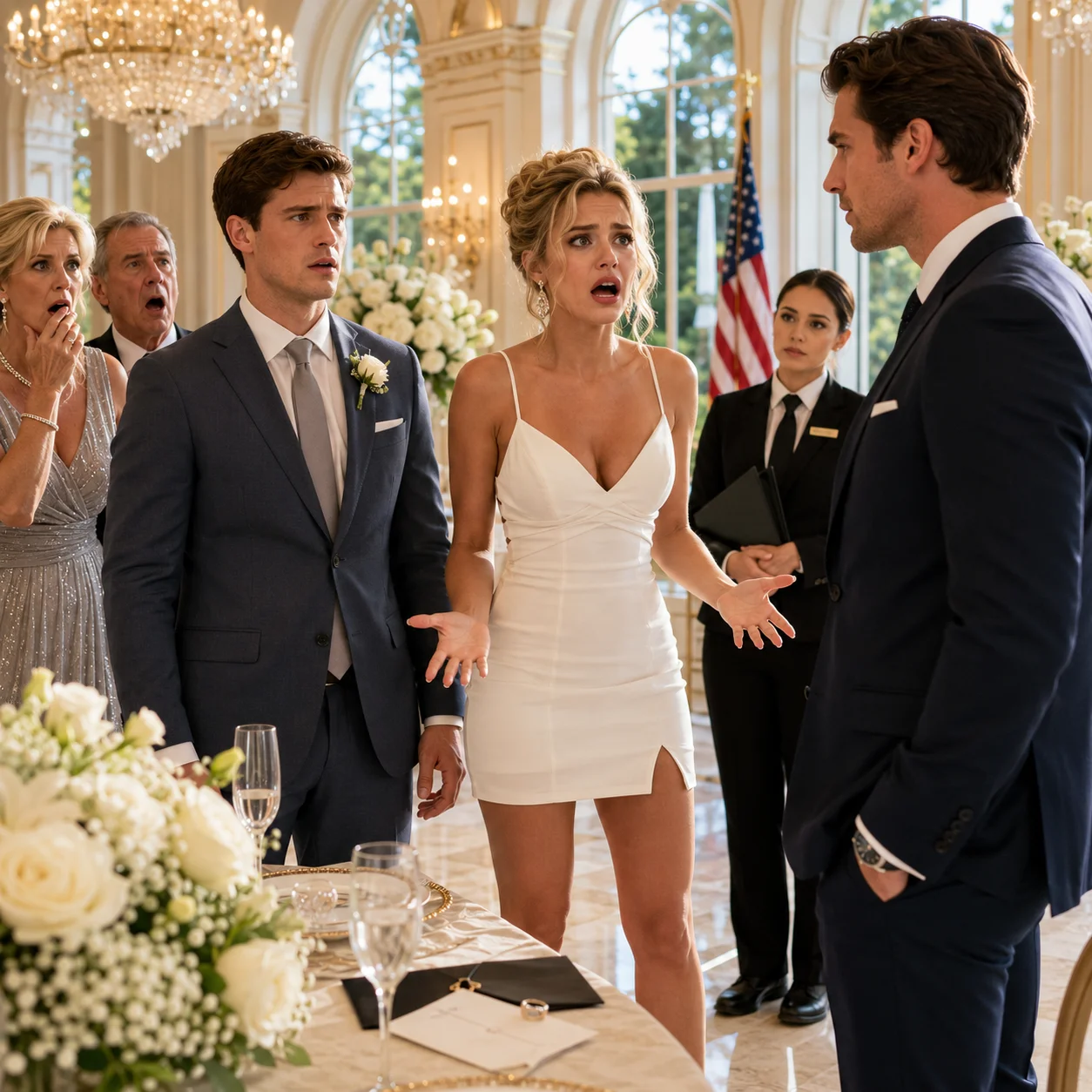
I stared at the woman I was supposed to marry in six weeks.
She kept going, her voice rising. “This wedding is at The Harrington Estate, Daniel. Do you understand what that means? People wait years to get married there. My family has worked very hard to secure that venue. We are not doing some backyard barbecue where your brother can just wander around in a wrinkled jacket.”
The room went silent.
Even Patricia looked at Vanessa, as if she had said the quiet part too loudly.
I stood up.
Vanessa blinked. “Where are you going?”
“To call my brother.”
Her face flickered with panic. “Don’t drag him into this.”
“You already did.”
I walked out before anyone could stop me.
The night air outside her parents’ house felt colder than it should have. I stood beside my car under the yellow glow of the porch light and called Evan.
He answered on the third ring.
“Hey,” he said. “Everything okay?”
That was Evan. Not hello. Not what’s up. Just straight to whether I needed him.
I looked back at the house. Through the dining room window, I could see Vanessa pacing while her mother gestured with both hands.
“Did Vanessa or anyone from her family talk to you about the wedding party?” I asked.
There was a pause.
Not long.
But long enough.
“Evan.”
He exhaled softly. “She called yesterday.”
My grip tightened around the phone. “What did she say?”
“She said they were restructuring the wedding party for symmetry.”
“Symmetry?”
“Yeah.”
My chest burned. “Why didn’t you tell me?”
Another pause.
“Because you sounded happy lately.”
That hurt more than I expected.
“Evan, they removed you as my best man.”
“I figured.”
“You figured?”
“I’m not stupid, Dan.”
I closed my eyes. “I’m sorry.”
“Don’t apologize for someone else.”
“She said you weren’t important enough.”
The words slipped out before I could soften them.
The line went quiet.
For a moment, all I could hear was the faint hum of traffic on his end.
Then Evan said, “Did she use those words?”
“Close enough.”
He gave a small laugh, but there was no humor in it. “That sounds about right.”
“She doesn’t know you.”
“She knows what she wants to know.”
I leaned against the car. “I told them you’re staying as my best man.”
“You didn’t have to do that.”
“Yes,” I said. “I did.”
“Dan, listen to me. I don’t need to stand up there. I don’t need a title. I’m coming because you’re my brother. I’ll sit in the back if that makes your day easier.”
“That does not make my day easier.”
“It might make your marriage easier.”
That sentence landed heavily between us.
I looked back at the bright house, at the polished windows and expensive landscaping and the people inside who had already started treating my family like an inconvenience.
“My marriage shouldn’t require me to erase you,” I said.
Evan was quiet again.
Then he said, “No. It shouldn’t.”
I stayed outside for ten minutes after the call ended, trying to calm down. By the time I returned to the dining room, Vanessa’s family had rearranged their faces into polite concern.
Vanessa came toward me first. “Can we talk like adults now?”
I looked at the binder. “Is Evan back in?”
She pressed her lips together. “Daniel, we need to compromise.”
“No.”
“You haven’t even heard the compromise.”
“I don’t need to. My brother is my best man.”
Martin placed both hands on the table. “Young man, you should be very careful about letting pride damage a good thing.”
I met his stare. “A good thing doesn’t ask me to disrespect my family.”
Patricia made a soft, wounded sound. “No one is disrespecting anyone.”
“You just sat here while your daughter said my brother didn’t belong in a wedding party because he doesn’t fit your photos.”
Vanessa’s eyes flashed. “I said he doesn’t fit the tone.”
“That’s worse.”
She stepped closer, lowering her voice. “Do not ruin this wedding over your brother’s ego.”
I almost couldn’t believe it.
“His ego?” I said. “He didn’t even tell me you called him.”
“Exactly. Because he understood.”
“No, Vanessa. Because he’s kind.”
She looked away.
For the first time, I saw something behind her confidence. Not guilt exactly. More like annoyance that guilt was becoming inconvenient.
The argument ended without resolution. I left her parents’ house that night with the binder still on the table and the wedding party still changed in Vanessa’s version of reality.
But I had already made my decision.
Evan would stand beside me.
Or there would be no wedding.
The strange thing was, before wedding planning began, I truly loved Vanessa.
At least, I loved who I thought she was.
We met at a charity gala two years earlier. I was there representing my firm after we helped with a public infrastructure project. Vanessa was there with her parents, floating through the room in a silver dress, laughing like every conversation had been arranged for her benefit. She was beautiful, yes, but what drew me in was how focused she seemed when we spoke. She asked about my work. She remembered details. She made me feel chosen.
For a man who had spent most of his life earning quietly, being chosen loudly was intoxicating.
In the beginning, Vanessa was warm with my family. She brought flowers to my father’s birthday. She told Evan she admired his “entrepreneurial independence,” though I don’t think she knew exactly what he did. Evan smiled politely and said thank you.
He had always been hard to explain to people like Vanessa.
He owned a private hospitality and property investment company, but he never said it that way. If someone asked what he did, he usually said, “I manage properties,” which made people assume he fixed leaky faucets or collected rent from duplexes.
He preferred that assumption.
Evan started small. After selling the motorcycle years earlier for my exam, he rebuilt his savings by working night shifts at a boutique hotel while studying commercial real estate during the day. He bought his first neglected event property with two partners, then slowly bought them out. He restored historic buildings, old estates, forgotten hotels, and turned them into venues people fought to book.
But he hated attention. He never put his face on websites. He used holding companies. He dressed simply. He drove a ten-year-old truck because he liked it. He lived in a restored carriage house behind one of his properties because he said it had “good light and no nonsense.”
Most people underestimated him.
He found it useful.
I had not told Vanessa’s family the full extent of Evan’s business because it was not my story to tell. Vanessa knew he worked in venues, but I was not sure she had ever cared enough to ask more. When she heard “property management,” she filed him under ordinary and moved on.
The Harrington Estate was the crown jewel of our wedding planning.
It sat on forty acres outside the city, with white columns, gardens, a glass conservatory, and a ballroom famous for its arched windows. Vanessa had wanted it before she even met me. She used to show me photos from influencer weddings and say, “This is what timeless looks like.”
When Patricia announced she had secured a date there, Vanessa cried.
She said it was fate.
I remember calling Evan that night to tell him.
“You booked Harrington?” he asked.
“Yeah,” I said. “Vanessa’s family handled it.”
He was quiet for a moment.
Then he said, “Interesting.”
I should have asked why.
But at the time, I was too busy being relieved that one impossible wedding task had solved itself.
The weeks after the wedding party argument were tense.
Vanessa behaved as if she was waiting for me to apologize. I behaved as if I was waiting for her to remember she had a conscience. Neither of us got what we wanted.
She texted me revised schedules where Evan’s name was absent.
I replied with his name added back.
She sent me photography notes listing “family formal groups.”
I inserted my brother into every necessary shot.
She called me controlling.
I called her dishonest.
The worst part was that she never seemed to understand the injury. To her, Evan’s removal was a design choice. To me, it was a test of whether I was marrying someone who respected the people who mattered to me.
Then came the rehearsal dinner planning meeting at Harrington Estate.
It was supposed to be a walkthrough with the venue coordinator, florist, photographer, caterer, and immediate family. Vanessa wanted everyone there because, as she said, “The space needs to feel real before the big day.”
I arrived early with my father.
Dad was seventy-two, quiet, and still wore the same brown leather dress shoes he had owned since I was in college. He looked nervous stepping out of my car in front of the estate. Not because he was ashamed, but because he had spent his life avoiding places where men like Martin looked through men like him.
“You okay?” I asked.
He nodded. “Just fancy.”
I smiled. “Too fancy?”
“For me? Yes. For your mother? She would’ve liked the gardens.”
That softened me.
“She would’ve liked Vanessa,” he added.
I did not answer.
He looked at me carefully. “Or maybe she would’ve seen things I missed.”
Before I could respond, Vanessa’s family arrived in a black SUV. Patricia stepped out first, already pointing toward the front entrance as if she had personally built the estate. Martin followed, talking into his phone. Vanessa emerged last in a pale blue dress, beautiful and composed, as though the last few weeks had not happened.
Caleb climbed out behind her wearing loafers without socks.
“Big day, man,” he said, clapping me on the shoulder. “Almost locked in.”
I stepped away just enough for his hand to fall.
Vanessa noticed.
Her smile tightened.
Inside, the Harrington Estate was even more impressive than the photos. The main hallway had black-and-white marble floors, tall mirrors, and fresh floral arrangements on antique tables. Sunlight poured through the windows and made everything look expensive enough to forgive itself.
The venue coordinator, a woman named Lydia, greeted us near the grand staircase.
“Welcome back,” she said warmly to Vanessa and Patricia. Then her eyes moved to me. “Mr. Whitaker, it’s lovely to see you.”
I frowned slightly.
I had never met Lydia.
Vanessa did not notice. She was too busy asking if the garden chairs could be changed from walnut to white.
Lydia recovered smoothly and led us through the estate. We discussed the ceremony location, cocktail hour, ballroom entrance, and dinner flow. Patricia asked questions about charger plates. Martin asked about valet capacity. Caleb asked where the bar would be.
My father stayed mostly silent, hands folded in front of him, looking at the ceiling details.
Then Evan arrived.
He came through the side entrance wearing a charcoal suit that fit him well but not loudly. No flashy watch. No polished performance. Just Evan, calm and quiet, with his hair slightly windblown like he had come from work.
I felt relief the moment I saw him.
He walked toward us and hugged my father first.
“Hey, Dad.”
Dad smiled in a way he rarely did. “You made it.”
“Wouldn’t miss it.”
Then Evan came to me.
“You okay?” he asked quietly.
“Better now.”
Vanessa stood a few feet away, expression unreadable.
Patricia’s smile became painfully polite. “Evan. How nice that you could join us.”
“Thanks for having me,” Evan said.
Caleb glanced him up and down. “Didn’t know you were part of this meeting.”
“He’s my best man,” I said.
Vanessa inhaled sharply.
Lydia looked between us, sensing the tension but saying nothing.
We moved into the ballroom.
It was stunning. High ceilings, crystal chandeliers, long windows facing the gardens. Vanessa’s eyes shone as she walked into the center of it.
“This,” she whispered, “is perfect.”
Patricia smiled. “It will be the wedding people talk about for years.”
Martin nodded approvingly. “Worth every call.”
Lydia began explaining table placement, but Vanessa interrupted her.
“Actually, before we go too far, there’s still one issue with the wedding party entrance.”
I looked at her.
She did not look back.
Instead, she addressed Lydia, the photographer, and the planner as if making a professional announcement.
“We’ll be adjusting the processional. Caleb will stand as best man for visual balance. Evan will be seated with the groom’s family.”
The room went still.
My father’s face changed.
Evan’s did not.
I felt anger rise so quickly I had to take a breath before speaking.
“Vanessa,” I said, “we discussed this.”
She finally turned to me, her smile sharp enough to cut. “No, Daniel. You refused to discuss it. So I’m making the decision now while everyone is here.”
“That is not your decision to make.”
“It is when it affects the wedding.”
“It affects my side of the wedding.”
She laughed once, softly, in disbelief. “Your side? Daniel, your side has four people.”
My father looked down.
That was the moment something in me shifted from anger to clarity.
Vanessa kept going, apparently unaware of the damage she had just done.
“My family is hosting most of this event. My parents secured this venue. My mother coordinated the vendors. My father is inviting people whose presence actually matters. I am not trying to be cruel, but we need to be realistic. Evan is not important enough to have that role in this kind of wedding.”
The words hung in the ballroom.
Not important enough.
This time, she had said it clearly.
In front of my father.
In front of my brother.
In front of the staff.
Evan lowered his eyes, not in shame, but in that quiet way he had when he was deciding whether a situation deserved his energy.
I looked at Vanessa and felt something inside me detach.
“Apologize,” I said.
Her eyebrows lifted. “Excuse me?”
“Apologize to my brother.”
Her cheeks flushed. “I will not be ordered around like a child.”
“Then act like an adult.”
Patricia gasped. “Daniel.”
Martin stepped forward. “You need to watch your tone.”
“No,” I said, turning to him. “You need to watch your daughter humiliate my family in public and decide whether that’s the person you raised her to be.”
Martin’s face darkened.
Vanessa’s eyes filled with angry tears. “You are ruining everything.”
“I’m not the one who just said my brother doesn’t matter.”
She pointed toward Evan. “He doesn’t matter to this event the way Caleb does.”
And then Lydia, the venue coordinator, spoke.
Her voice was careful, but it carried through the ballroom.
“Ms. Alden,” she said, “I’m sorry to interrupt, but I think there may be some confusion.”
Vanessa turned, irritated. “Confusion about what?”
Lydia glanced at Evan.
Evan gave the smallest shake of his head.
Lydia stopped.
For one brief second, I realized Evan had known this could happen and had hoped to avoid it.
But Vanessa noticed the exchange.
“What?” she snapped. “Why are you looking at him?”
Lydia’s professional mask faltered.
Patricia looked from Lydia to Evan. “Is there a problem with our contract?”
Evan sighed.
“Lydia,” he said quietly, “it’s okay.”
The room changed.
It was subtle, but everyone felt it.
Lydia straightened. “Of course, Mr. Whitaker.”
Vanessa froze.
Martin’s eyes narrowed. “Mr. Whitaker?”
Evan put his hands in his pockets. “This isn’t how I wanted this to come up.”
Patricia let out a nervous little laugh. “How what comes up?”
Evan looked at me first.
There was apology in his eyes, which was absurd because he had done nothing wrong.
Then he turned to Vanessa’s family.
“I own Harrington Estate.”
No one moved.
For a moment, I genuinely think Vanessa did not understand the sentence. Her face stayed fixed in annoyance, waiting for the real explanation.
Then Lydia said, “Mr. Whitaker is the principal owner of the property group that owns and operates the estate.”
Patricia’s mouth opened.
Caleb actually said, “Wait, what?”
Martin looked at Lydia as if she had betrayed him personally. “That’s impossible.”
Evan shrugged slightly. “It’s not.”
Vanessa’s eyes darted around the ballroom, then back to my brother. “You manage properties.”
“I do.”
“This venue?”
“Yes.”
“No,” she said, shaking her head. “No, my mother booked this through Alden Foundation contacts.”
Lydia cleared her throat. “The Alden Foundation requested priority consideration through our philanthropy partnership. Mr. Whitaker approved the date personally.”
Patricia went pale.
I slowly turned toward Evan. “You approved it?”
He looked uncomfortable. “Vanessa wanted the date. You sounded happy. There was a cancellation. I made it work.”
My throat tightened.
Of course he had.
Quietly. Without credit. Without making it about himself.
Vanessa stared at him like he had transformed into a stranger in front of her.
“You never said anything,” she whispered.
“You never asked,” Evan said.
That landed harder than if he had shouted.
Martin recovered first, or tried to. He adjusted his jacket and stepped forward with the stiff dignity of a man trying to rebuild authority from rubble.
“Well,” he said, “this is certainly surprising, but ownership does not change the personal dynamics of the wedding party.”
Evan looked at him calmly. “No, it doesn’t.”
Martin seemed relieved.
Then Evan continued.
“But it does change the venue dynamics.”
The air went tight.
Patricia gripped her folder. “What does that mean?”
Evan looked at Vanessa, not cruelly, not triumphantly, just directly.
“It means I’m not comfortable hosting an event where my father and brother are treated like decorative inconveniences.”
Vanessa’s face drained of color. “You can’t cancel our wedding.”
“I can cancel the venue contract if the code of conduct clause is violated or if the event organizers create a hostile environment for staff or ownership representatives.”
Patricia blinked rapidly. “Ownership representatives?”
Lydia’s voice was quiet. “Mr. Whitaker is listed as ownership on the internal event file. He has been present today in that capacity as well as personally.”
Caleb muttered, “Oh my God.”
Vanessa turned on me. “Did you know?”
“No,” I said honestly.
She searched my face, maybe hoping to find deception so she could turn the humiliation back on me.
But there was nothing there for her.
I had not known.
And somehow, that made it worse for her.
Because this was not a trap.
It was a mirror.
Patricia moved toward Evan, her voice suddenly soft in a way I had never heard before.
“Evan, dear, I think emotions are running high. Vanessa didn’t mean—”
“Yes, she did,” Evan said.
Patricia stopped.
He did not raise his voice. He did not need to.
“She meant it yesterday when she called me and told me the wedding party would look better without me. She meant it when she said Daniel needed people beside him who matched your family’s image. She meant it just now when she said I wasn’t important enough.”
My father looked up sharply.
I had not known Vanessa had said all that.
Vanessa’s eyes filled with tears, but this time they looked less like anger and more like fear.
“Evan,” she said, “I was under pressure. This wedding has been overwhelming.”
He nodded once. “I understand pressure.”
His calmness was devastating.
“I also understand character.”
Martin’s jaw tightened. “Now hold on.”
“No,” Evan said. “I’ve held on long enough.”
Silence fell again.
Evan turned to me. “Dan, I’m sorry. I should have told you about the venue.”
I shook my head. “You don’t owe me an apology.”
“I didn’t want your wedding to become about money.”
Vanessa flinched at the word.
He looked back at her. “That’s why I kept quiet. I wanted you to have the wedding you wanted because my brother loved you. I thought maybe you were just particular. Maybe anxious. Maybe caught up in the show of it. But today wasn’t about flowers or photographs. It was about whether you could respect people who didn’t impress you.”
Vanessa wiped at her cheek. “I do respect you.”
“No,” he said gently. “You respect ownership.”
That sentence broke the room.
Patricia looked like she might faint. Martin’s face went red. Caleb stared at the floor. Lydia quietly excused the florist and photographer, guiding them toward the hallway with the efficiency of someone who had seen wealthy people collapse before and knew exactly when witnesses should disappear.
Vanessa took one step toward me.
“Daniel,” she whispered. “Please. Say something.”
I looked at her, and for one painful moment, I saw the woman from the gala again. The woman who laughed at my jokes, remembered my coffee order, kissed me in the rain outside a restaurant because she said she couldn’t wait until we got home.
I wanted that woman to exist.
But she was standing in the ballroom, surrounded by proof that she only valued my brother after discovering what he owned.
“What do you want me to say?” I asked.
“That this doesn’t change us.”
I looked at my father.
His shoulders were slightly hunched, but his eyes were on me. Not pleading. Not pushing. Just watching to see what kind of man his son would choose to be.
Then I looked at Evan, who had spent his whole life showing up for me without asking for a place of honor, and had been insulted for it.
“It changes everything,” I said.
Vanessa’s face crumpled.
Patricia rushed in. “Daniel, don’t be dramatic. Every couple has conflict before the wedding. This is fixable.”
I almost laughed.
“Is it?”
“Yes,” she said, too quickly. “Of course. Evan can be best man. Obviously. We all want him there.”
Evan’s expression did not move.
I said, “Obviously?”
Patricia swallowed. “We misunderstood his role in your life.”
“No,” I said. “You misunderstood his bank account.”
Martin pointed a finger at me. “You are speaking to my wife.”
“And you stood there while your daughter insulted my father’s son.”
Martin’s mouth closed.
For the first time since I had met him, he had no immediate answer.
Vanessa grabbed my hand. “I’m sorry.”
I looked down at her fingers around mine.
“How many times did I ask you to put him back?”
She cried harder. “I was wrong.”
“How many times?”
She did not answer.
“Did you think he was wrong for the wedding,” I asked, “or did you think he was wrong for the wedding when you believed he had nothing to offer you?”
Her hand loosened.
That was answer enough.
I removed her engagement ring from my pocket.
I had started carrying it there two days earlier, after she left it on our bathroom counter during an argument and said, “Maybe you need to remember what kind of life you’re marrying into.”
At the time, I picked it up and said nothing.
Now I held it out.
Vanessa stared at it like it was a weapon.
“Daniel,” she whispered.
“I can’t marry you.”
Patricia gasped.
Vanessa shook her head. “No. No, don’t do this here.”
“You chose here.”
“That’s not fair.”
“No,” I said, my voice breaking despite my effort to keep it steady. “What wasn’t fair was making my brother feel like he had to sit quietly while you decided whether he looked good enough to love me in public.”
She covered her mouth.
I placed the ring on the nearest table, beside a sample centerpiece of white roses.
The diamond caught the ballroom light beautifully.
For a strange second, it looked exactly like the wedding Vanessa had wanted.
Perfect from a distance.
Cold up close.
I walked out with my father on one side and Evan on the other.
No dramatic music. No shouting behind us. Just the sound of our shoes against the marble floor and Vanessa crying in the ballroom she had once called timeless.
Outside, the gardens were glowing in late afternoon light.
My father stopped near the fountain and turned to Evan.
“You own this place?” he asked quietly.
Evan looked embarrassed. “Technically the company owns it.”
Dad stared at him for a long moment.
Then he said, “Your mother would have yelled at you for not telling us.”
Evan smiled faintly. “Yeah.”
“Then she would’ve been proud.”
Evan looked away.
I saw his throat move.
Dad pulled him into a hug.
It was awkward at first because our family had never been good at big physical displays. Then Evan folded into it, and I realized how long it had been since I had seen my father hold him like that.
I stood beside them, feeling the ruins of my future behind me and something older, steadier, still intact in front of me.
The cancellation spread faster than I expected.
By the next morning, Vanessa had called me seventeen times. Patricia sent a message that began with “After prayerful reflection,” though I was fairly certain Patricia had not prayerfully reflected on anything except whether the deposit was refundable. Martin left one voicemail saying I had embarrassed both families and another, six hours later, asking if we could “discuss the business implications rationally.”
I did not respond.
Evan handled the venue side professionally. He refunded the portion he could, kept the portion tied to vendor labor already performed, and sent all communication through Lydia. He did not blacklist the Aldens. He did not humiliate them publicly. He simply ended the contract according to its terms and moved on.
That was Evan’s way.
Clean.
Quiet.
Final.
Vanessa came to my apartment three days later.
I almost did not open the door, but a part of me needed one last conversation. Not for closure exactly. Maybe confirmation.
She stood in the hallway wearing no makeup, her hair pulled back, eyes swollen.
For the first time since I had known her, she looked young.
Not glamorous. Not curated. Just young and frightened and human.
“I didn’t know how to fix it,” she said.
I stepped aside and let her in.
She walked into the living room and looked around as if seeing it differently. The couch we chose together. The framed photo from our trip to Maine. The stack of wedding RSVP cards still sitting on the side table because I had not had the energy to touch them.
“I loved you,” she said.
I believed her.
That was the worst part.
“I think you did,” I said.
She looked at me hopefully.
“But you loved me in a world where I fit your image,” I continued. “And the second my family didn’t fit, you tried to edit them out.”
She sat down slowly.
“My parents are like that,” she said. “Everything is presentation. Everything is who’s watching. I grew up thinking that was normal.”
“I know.”
“I was scared the wedding wouldn’t look right.”
I nodded. “And I was scared my marriage wouldn’t be right.”
She cried then, quietly.
Not the dramatic tears from the ballroom. These were smaller. Realer.
“I’m sorry about your brother,” she whispered.
“He deserved to hear that before you knew what he owned.”
She closed her eyes.
“I know.”
We sat in silence for a while.
Then she said, “Is there any way back?”
I wanted to say yes.
A few months earlier, I would have said yes just to stop the pain in her face. I would have told myself everyone makes mistakes, weddings bring out stress, families complicate things.
But this was not a mistake.
It was a revelation.
“I don’t think so,” I said.
Her shoulders trembled.
“I hope you learn from this,” I added. “Not because of me. Because one day you’re going to meet someone who doesn’t come with the right background or the right photos or the right connections, and they may be the best person in the room.”
She wiped her eyes. “Like Evan.”
I nodded.
“Like Evan.”
She left the ring on my coffee table before she walked out.
Two weeks later, I helped Evan host a charity dinner at Harrington Estate.
It was not supposed to be symbolic, but life has a sense of humor.
The event supported vocational scholarships for students who had lost a parent. Evan had funded it anonymously for years, but after everything happened, my father convinced him anonymity was sometimes just another way of hiding from love.
So that night, for once, Evan stood on the small stage in the ballroom while two hundred people applauded him.
He looked deeply uncomfortable.
I enjoyed that more than I should have.
My father wore his old brown dress shoes and sat at the front table with tears in his eyes. I stood beside the stage, not as a groom, not as a man trying to keep peace with people who looked down on us, but as a brother watching the right person finally be seen.
When Evan finished his short speech, he looked at me and said into the microphone, “My brother Daniel taught me that family is not about where someone stands in a photograph. It’s about who stands beside you when it costs them something.”
The room applauded again.
I had to look down for a second.
Afterward, we walked through the gardens together while the guests danced inside.
“You okay?” Evan asked.
I laughed softly. “That’s my line.”
“You stole it from me.”
“Fair.”
He loosened his tie. “Do you miss her?”
I looked through the ballroom windows at the chandeliers, the flowers, the beautiful room where my life had almost gone in the wrong direction.
“Sometimes,” I said honestly. “Or I miss who I thought she was.”
Evan nodded. “That’s harder.”
“Yeah.”
We stood quietly beside the fountain.
Then I said, “Thank you.”
“For what?”
“For making the venue work. For not telling me. For telling me. For everything.”
He shrugged, uncomfortable as always with gratitude.
“You’re my brother.”
As if that explained everything.
And maybe it did.
Six months later, I received a letter from Vanessa.
Not a text. Not an email. A handwritten letter on plain stationery.
She wrote that she had started therapy. That she had moved out of her parents’ guest house. That she was working at a nonprofit outside her family’s circle because she needed to learn how to be useful without being admired. She did not ask for another chance. She did not blame me. She only said she was sorry, and that Evan’s words had stayed with her.
You respect ownership.
She said she had spent months realizing how true that was.
I showed the letter to Evan.
He read it once, handed it back, and said, “Good.”
“That’s it?”
“What else should I say?”
“I don’t know. Something wise.”
He thought about it.
Then he said, “People can grow. That doesn’t mean you have to marry their lesson.”
That was wise enough.
A year after the canceled wedding, my father turned seventy-three. We threw him a small birthday dinner in the garden behind Evan’s carriage house. Nothing fancy. Grilled food, folding chairs, string lights, old music playing from a speaker that kept cutting out.
At one point, Dad looked around at us and said, “This is better than that ballroom.”
Evan raised an eyebrow. “The ballroom is literally fifty yards away.”
Dad waved him off. “Too many chandeliers.”
I laughed.
Later that night, after Dad went inside to take a call from my aunt, Evan and I sat by the firepit.
“You ever think about getting married here someday?” he asked.
“At Harrington?”
He nodded toward the distant estate.
I smiled. “Maybe. If the owner gives me a discount.”
“He sounds difficult.”
“I heard he’s not important enough.”
Evan threw a bottle cap at me.
We laughed harder than the joke deserved, the way people do when the laughter is really relief.
I did not know what my future looked like then. I did not know who I would marry, or where, or when. But I knew something I should have known before Vanessa ever put my brother’s name in a binder and tried to erase it.
A wedding party is not about symmetry.
A family is not about presentation.
And importance is not measured by who speaks the loudest, dresses the sharpest, or owns the most impressive room.
Sometimes the most important person there is the one standing quietly in the corner, asking for nothing, ready to give everything.
My brother never needed Harrington Estate to prove his worth.
But I needed that day in the ballroom to understand mine.
![[FULL STORY] “If You Love Me, You’ll Accept My Ex” — So I Let Her Plan It… Right Into Nothing](https://social-media.rabedo.com/thumbnails/1776864571_4543fe93-ef36-4d88-bc2c-be968d2fd342.png)
![[FULL STORY] Laughing and drunk, she told her friends that she could do better than me and even called me](https://social-media.rabedo.com/thumbnails/1777003345_c20.png)
![[FULL STORY] My Wife Wanted a “Trial Separation” — While I Kept Funding Her Entire Life. So I Agreed Quietly.](https://social-media.rabedo.com/thumbnails/1777025649_46682cfb-7286-4c7e-a8f4-e605f0c0468d.png)