
“The group changed,” Emily said.
Her tone was calm, but her shoulders had gone rigid.
I waited until we were driving home to ask.
“Who’s Ryan?”
Emily looked out the passenger window. “An ex.”
“How serious?”
She gave a small shrug. “It was a long time ago.”
That wasn’t an answer.
“How long were you together?”
“Almost three years.”
I glanced at her. “That’s not exactly nothing.”
“It ended before I met you.”
“Did it end badly?”
She exhaled like I was making the conversation heavier than it needed to be. “Daniel, he meant nothing. Not anymore.”
I remember that sentence because she said it too quickly. Like she had rehearsed it for someone else before me.
He meant nothing.
I nodded and let it go.
That became my first mistake.
Ryan didn’t disappear after that. Not physically, not yet, but his name started appearing at the edges of things. A photo from a friend’s birthday five years earlier, where Emily stood beside a tall man with dark hair and a crooked smile. A casual mention from one of her college friends: “Remember when Ryan drove through that snowstorm for you?” An awkward silence when I walked into the room while Emily’s sister Lauren was saying, “I just don’t think he should hear it from someone else.”
Hear what?
Lauren changed the subject when she saw me.
Emily told me I was imagining tension.
“You’re looking for a problem,” she said one night while we folded laundry.
“I’m asking because people act strange when his name comes up.”
“Because people are dramatic.”
“Were you engaged to him?”
She stared at me.
That answer came before her words did.
“No,” she said eventually.
“Were you close to being engaged?”
She dropped one of my shirts into the basket. “What does that even mean?”
“It means did you two talk about marriage?”
Her jaw tightened. “Most people in long relationships talk about things.”
“Emily.”
She turned toward me, eyes bright with irritation. “What do you want me to say? Yes, we talked about it. Yes, we were serious. Then it ended. That’s life. Do you want a list of every man I dated before you? Should I print emotional résumés for your approval?”
“That’s not what I’m doing.”
“It feels like it.”
I looked at her for a long moment. “I’m not threatened by a man from your past. I’m bothered that everyone seems to know something I don’t.”
Her expression softened then, but not with honesty. With guilt.
She came to me, wrapped her arms around my waist, and pressed her face into my chest.
“I’m sorry,” she whispered. “I hate talking about him. That’s all. It was messy, and I don’t like who I was back then.”
“What happened?”
She was quiet.
Then she said, “I chose myself too late.”
I didn’t understand what that meant. I thought maybe he had hurt her. Maybe he had cheated. Maybe she had spent years shrinking beside someone who made her feel small. I wanted to protect her from a story she wasn’t ready to tell.
So I held her.
That was my second mistake.
The engagement party was Emily’s idea.
At first, I wanted something small. Dinner with family. A few close friends. Nothing complicated. But Emily said her parents wanted to celebrate properly, and once her mother got involved, “properly” turned into eighty guests, a rented event space at a private club downtown, a live jazz trio, floral arrangements tall enough to block conversations, and a champagne tower that looked one careless elbow away from becoming a lawsuit.
“You only get engaged once,” her mother said.
I didn’t point out that statistically, that wasn’t true.
Emily seemed excited in the weeks leading up to it. Almost too excited. She threw herself into planning with the intensity of a woman trying to prove something. She picked the menu, the table linens, the lighting, the signature cocktail. She bought a cream satin dress that clung to her like water and asked me three times if it looked bridal enough without looking like she was trying too hard.
“You look beautiful,” I told her each time.
The night of the party, she looked more than beautiful. She looked untouchable.
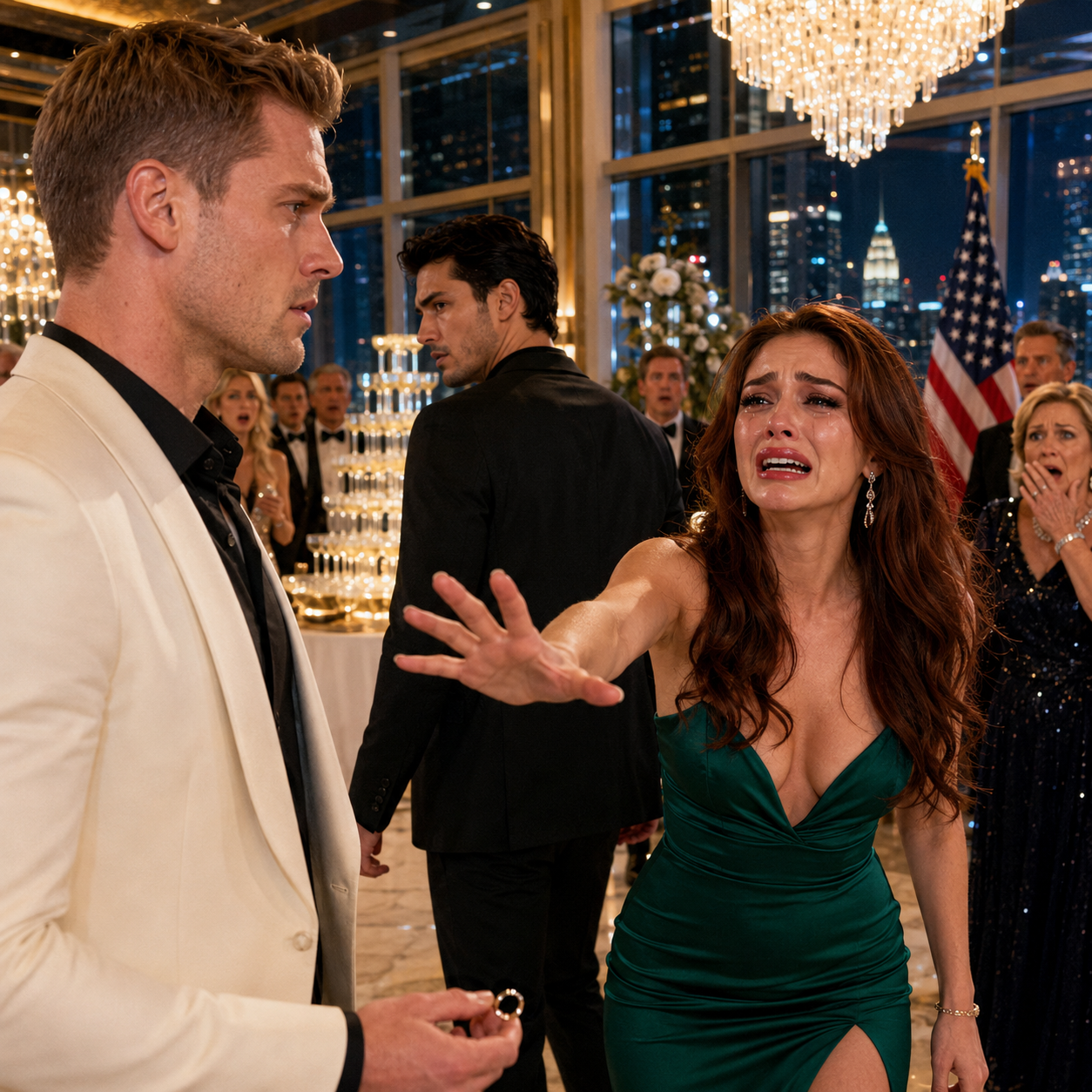
The private club occupied the top floor of an old stone building downtown, with arched windows overlooking the city and warm gold light falling over polished floors. An American flag stood near the entry beside two tall arrangements of white roses and eucalyptus, giving the room a formal, almost ceremonial weight. My parents arrived early, my mother already crying before anything had happened. Emily’s parents floated around greeting guests like hosts of a political fundraiser.
I wore a navy suit. Emily wore the cream satin dress, diamond earrings, and the ring I had given her.
For the first hour, everything was exactly what it was supposed to be.
People congratulated us. Glasses clinked. Her coworkers hugged her. My employees shook my hand too firmly and joked about whether marriage would finally make me take vacations. Emily stayed close to me, smiling, slipping her hand into mine whenever someone asked about wedding plans.
Then the room changed.
It was subtle at first. A ripple near the entrance. A few heads turning. Natalie stopped mid-sentence. Lauren’s eyes widened, then darted immediately to Emily.
I followed their gaze.
A man stood just inside the doorway.
Tall. Dark hair. Black suit. No tie. The kind of face that looked familiar because I had already seen it in old photos, beside younger versions of the woman wearing my ring.
Ryan Vale.
He wasn’t smiling. He didn’t look drunk or angry or dramatic. He looked uncomfortable, like a man who had stepped into a place he had been told he was allowed to enter but knew he shouldn’t have come.
Emily’s hand tightened around mine so hard her ring pressed into my finger.
I looked down at her.
All the color had drained from her face.
“Emily?” I said quietly.
She didn’t answer.
Ryan’s eyes found hers across the room.
For three seconds, nobody moved.
Then Emily let go of my hand.
That was the moment I knew.
Not because she walked toward him. Not because she said his name. Not because anything had happened yet. I knew because her body reacted before her mind could put on the mask. Her shoulders dropped, her lips parted, and something raw moved across her face. Not fear. Not irritation.
Pain.
Old pain.
Living pain.
She took one step forward.
Her mother appeared beside her like a guard dog in pearls.
“What is he doing here?” Mrs. Carter hissed.
Emily blinked, as if waking.
“I don’t know.”
But she did. Or part of her did. Maybe not that he would actually show up, but that the possibility existed. The door had never been fully locked.
Ryan looked around the room, clearly sensing the tension, then started toward us.
I felt every eye shift to me. That was the strange thing about public humiliation. People pretend not to watch, but silence has weight. You can feel a room feeding on the moment.
Ryan stopped a few feet away.
“Emily,” he said.
Her name in his mouth sounded like something unfinished.
She swallowed. “Ryan.”
I waited for her to introduce me.
She didn’t.
So I extended my hand.
“Daniel Mercer.”
Ryan looked at me, then down at my hand. He shook it.
“Ryan Vale.”
His grip was firm but not challenging. His eyes weren’t hostile. If anything, they held a kind of exhausted sympathy that made me want to hit him more than arrogance would have.
“What brings you here?” I asked.
Ryan glanced at Emily. “I was invited.”
Emily’s mother made a sharp sound. “By whom?”
Ryan reached into his jacket pocket and pulled out an envelope. Cream cardstock. Same as the invitations Emily had chosen. He held it out, not dramatically, just as proof.
Mrs. Carter snatched it before I could.
Her eyes moved over it. Then to Emily.
Emily whispered, “I didn’t send that.”
I believed her. Strangely, I did. But believing that didn’t make the situation better.
Natalie appeared behind us, face pale.
“I did,” she said.
Emily turned slowly. “What?”
Natalie’s eyes filled. “I’m sorry. I thought… I thought you needed closure.”
The word closure moved through the group like a match dropped into gasoline.
Mrs. Carter grabbed Natalie’s arm. “Are you insane?”
Natalie pulled away, crying now. “She’s getting married in four months. She still can’t hear his name without shutting down. Everybody acts like if we ignore it, it’ll disappear, but it hasn’t.”
Emily’s voice came out thin. “Stop.”
“No,” Natalie said, looking at me now. “I’m sorry, Daniel, but you don’t know everything.”
Something cold settled in my chest.
Emily turned to me immediately. “Don’t listen to her.”
“That’s usually something people say right before I should listen.”
Her eyes flashed with panic.
Ryan took a step back. “I shouldn’t have come.”
“No,” Natalie said. “You should have come years ago.”
Ryan’s face hardened. “That isn’t fair.”
“Fair?” Natalie laughed bitterly. “You left, Ryan.”
Emily flinched.
Ryan looked at her then, and whatever passed between them was intimate enough to make me feel like an intruder at my own engagement party.
“I didn’t leave,” he said quietly. “She asked me to.”
The room went still.
I looked at Emily.
She was staring at the floor.
“Emily,” I said. “What is he talking about?”
Her mouth opened, but no sound came out.
Mrs. Carter stepped between us. “This is inappropriate. We are not doing this here.”
I looked past her. “Emily.”
She closed her eyes.
Ryan’s voice was low. “She told me if I loved her, I’d let her go.”
I laughed once, without humor. “That’s poetic. What does it mean?”
Ryan looked at me, and for the first time, I saw anger.
“It means her family decided I wasn’t good enough.”
Emily’s father, who had been standing near the bar with a glass untouched in his hand, finally moved forward.
“That is not what happened,” he said.
Ryan turned to him. “No? You told me I was holding her back. You told her she’d ruin her future if she stayed with me. You offered to pay off my student loans if I disappeared quietly.”
A gasp came from somewhere behind us.
Emily’s father went red. “You are lying.”
Ryan reached into his pocket again, pulled out his phone, tapped the screen, and held it up. “I kept the email.”
Mrs. Carter whispered, “Ryan, don’t.”
But he wasn’t looking at her. He was looking at Emily.
“I didn’t come to ruin your night,” he said. “Natalie told me you were happy. She said you were getting married and that maybe seeing me would prove to everyone that we were done. I shouldn’t have believed that. I shouldn’t have come. But I wanted to see if you could look me in the eye and be okay.”
Emily’s lips trembled.
“Ryan,” she whispered.
That whisper broke something in me.
Not because she said his name, but because of how she said it. Like apology. Like longing. Like grief.
I turned away for a moment, staring at the champagne tower, the flowers, the laughing photos of us looping silently on the screen near the DJ booth. Engagement photos. Emily in a white sundress, leaning into me beneath oak trees. Me kissing her forehead. Her hand on my chest. My ring on her finger.
All of it suddenly looked like evidence from a crime scene.
I faced her again.
“Were you still in love with him when you said yes to me?”
Her head snapped up. “Daniel—”
“Answer me.”
Her eyes filled with tears. “It’s not that simple.”
It never is, when someone wants mercy for betrayal.
I nodded slowly.
Ryan looked sick. “I’m leaving.”
Emily moved before anyone could stop her.
She grabbed his wrist.
Not mine.
His.
“Don’t,” she said.
One word.
One small, desperate word.
And the entire room saw it.
Ryan stared down at her hand on his wrist. Then gently, painfully, he removed it.
“You’re engaged,” he said.
She started crying.
Not silent tears. Not polite emotion. She broke. Her hand went to her mouth, and a sob tore out of her so suddenly people looked away in embarrassment. Her mother whispered her name in horror. Her father stood frozen. Natalie covered her face.
I watched my fiancée cry because another man was leaving our engagement party.
That was the car crash after months of slow collapse.
Ryan didn’t comfort her. Maybe that was the only decent thing he did that night. He looked at me once, and there was no victory in his face.
“I’m sorry,” he said.
Then he walked out.
Emily took one step after him, stopped, and folded in on herself like her bones had disappeared.
People started murmuring. Someone from her office pretended to check their phone. My mother stood near the dessert table with tears in her eyes, not understanding whether to come to me or stay away. My father’s expression had gone flat in the way it did when he was trying not to interfere in something that was already bleeding.
I removed Emily’s hand from my sleeve when she reached for me.
She looked up at me, mascara streaking her face.
“Daniel, please.”
I stared at her.
For months, I had wondered what truth she was hiding.
Now I had it, and somehow it still wasn’t enough. Because the worst part wasn’t that she had loved Ryan. The worst part wasn’t that her parents had interfered, or that Natalie had detonated our party with an invitation. The worst part was that Emily had walked into my life still haunted and let me build a future inside the house of that ghost.
“Did you love me?” I asked.
Her face crumpled. “Yes.”
“More than him?”
She closed her eyes.
There are silences that answer more honestly than words.
I nodded once.
Then I reached for her hand.
For one wild second, hope flashed across her face.
I touched the ring.
Her fingers curled instinctively.
“Daniel,” she whispered. “Don’t do this here.”
I almost laughed.
Here.
As if location was the problem.
I lowered my voice so only she and the nearest witnesses could hear. “You cried when he left. In front of me. In front of everyone. What exactly do you think is left to protect?”
She shook her head, tears falling faster. “I was overwhelmed. It was shock. It doesn’t mean—”
“It means enough.”
I slid the ring from her finger.
She let out a sound so broken that for a second, my hand stopped. Because I loved her. That was the ugly truth. Even then, even with everyone watching, even with humiliation burning through me like acid, I loved her. I wanted time to reverse. I wanted Ryan never to have walked in. I wanted Natalie to have stayed quiet. I wanted Emily to have looked at me and chosen me so clearly that the whole room felt ashamed for doubting her.
But love can’t survive being someone’s consolation prize. Not if you still respect yourself.
The ring came free.
Emily stared at her bare hand as if I had cut something off.
“I need to leave,” I said.
My mother moved toward me. “Daniel—”
“I’m fine,” I lied.
I walked out past the flowers, past the flag, past Ryan’s abandoned invitation on the floor near Mrs. Carter’s heels. Behind me, Emily called my name once.
I didn’t turn around.
Outside, the city air was cold. I stood on the sidewalk beneath the private club awning, listening to traffic and muffled jazz from upstairs. My hands shook for the first time all night.
Ryan was there.
Of course he was.
He stood near the curb, one hand in his pocket, staring at nothing.
When he saw me, he straightened.
“I’m not here to fight you,” he said.
“That’s good,” I replied, “because I’m not sure I’d stop.”
He nodded, accepting that.
For a moment, neither of us spoke.
Then he said, “She did love you.”
I turned to him slowly. “Don’t.”
“I’m not defending her.”
“Then what are you doing?”
He looked up at the windows of the club. “Trying to make one thing clear. I didn’t know she hadn’t told you.”
I studied him.
“Would that have stopped you from coming?”
He looked ashamed. “It should have.”
“At least you’re honest about that.”
He winced.
I leaned against the wall, suddenly exhausted. “What happened between you two?”
Ryan rubbed a hand over his face. “We met in college. We were together almost three years. I was broke, working nights, applying to grad school. Her parents hated me. Not openly at first. They were polite in that rich way that feels like being measured for defects.”
I said nothing.
“She wanted to move in together after graduation. Her father told her she’d be throwing away opportunities. Her mother told her she was confusing struggle with romance. They pushed hard. I pushed back badly. I was proud. Angry. I said things I shouldn’t have.” He paused. “Then her father emailed me.”
“The student loans?”
Ryan nodded. “He offered money. Said if I really cared about her, I’d let her build the life she deserved.”
“And you left?”
His jaw tightened. “No. I showed Emily the email. I thought she’d be furious. She was. But not only at them. At me too. She said she was tired of fighting everyone. Tired of defending us. Tired of feeling like love had become a war. She asked me to go.”
I looked toward the street.
“She regretted it,” Ryan said quietly. “I know she did. She called me six months later, but I was already in Chicago. I didn’t answer. Not because I didn’t care. Because if I answered, I would’ve gone back, and I hated myself for still wanting to.”
A bitter smile touched his mouth.
“After that, I heard things through friends. That she was doing well. Dating. Then engaged. Natalie messaged me two weeks ago. Said Emily was happy but still couldn’t say my name. I thought maybe one adult conversation could bury it. Stupid.”
“Yes,” I said. “Very.”
He nodded.
The club doors opened behind us.
Emily stepped out.
She had wiped her face, but she still looked shattered. Her mother was not with her. No friends. No protective circle. Just Emily, standing in the cold in her satin dress, looking from me to Ryan like she had walked into the physical shape of her own dishonesty.
“Daniel,” she said.
Ryan immediately stepped back. “I’ll go.”
Emily looked at him. “Please don’t.”
I laughed softly.
She flinched.
Ryan’s expression hardened, not at me, but at her. “Emily. Stop.”
Her face crumpled again. “I just need to explain.”
“To which one of us?” I asked.
She looked at me then. “To you.”
Ryan took another step back. “Then explain to him.”
He walked away down the sidewalk.
Emily watched him go.
She tried not to, but she did.
I saw it. I think she knew I saw it.
When she turned back to me, something inside me had gone quiet.
“I’m sorry,” she said. “I am so sorry.”
“Did you know Natalie invited him?”
“No.”
I believed that.
“Did you know seeing him would do that to you?”
She wrapped her arms around herself. “I thought I was over it.”
“That wasn’t my question.”
She looked down.
“Did you know?” I repeated.
Her voice was barely audible. “I was afraid I wasn’t.”
I let out a breath.
There it was.
The truth, small and devastating.
“How long?” I asked.
She looked confused.
“How long have you been afraid you weren’t over him?”
Emily pressed her lips together.
I waited.
“Since before the proposal,” she whispered.
The sidewalk seemed to tilt beneath me.
I nodded, slowly, because if I didn’t nod, I might say something cruel enough to become the villain in my own pain.
“You said yes anyway.”
“I loved you.”
“Don’t use that word like a bandage.”
“I did love you,” she said, louder now, desperate. “I do. Daniel, what I had with Ryan was unfinished. It was trauma. It was guilt. It was—”
“It was love.”
She stopped.
I looked at her bare finger. “You don’t have to dress it up for me.”
Tears slipped down her cheeks again. “I wanted it to be gone.”
“But it wasn’t.”
“No.”
A taxi passed, headlights sliding over her face.
“I thought choosing you would make me the person I wanted to be,” she said. “You were stable. Kind. Honest. You made me feel safe. I thought that was love.”
Safe.
That word landed harder than anything else.
“So I was the shelter,” I said.
“No.”
“Yes.”
She stepped toward me. “You were more than that.”
“But not enough.”
She covered her mouth.
I looked up at the windows again. Shadows moved behind the glass. Our families were still up there, probably trying to decide what story to tell the guests.
“I need you to understand something,” I said. “You didn’t hurt me because you had a past. You hurt me because you used me to escape it.”
She sobbed once.
“I didn’t mean to.”
“I know.”
That made it worse somehow.
If she had been cruel, it would have been easier. If she had planned it, mocked me, laughed behind my back, I could have hated her cleanly. But Emily wasn’t a monster. She was weak in the exact place where honesty mattered most. She wanted healing without confession. She wanted a future without burying the past properly. She wanted me to be proof she had moved on, while never asking whether I deserved to be more than proof.
“I can’t marry you,” I said.
Her knees seemed to soften. “Please don’t decide tonight.”
“I decided when you grabbed his wrist.”
Her eyes closed.
“I need time,” she whispered.
“No. You needed time before you said yes.”
She looked at me with raw panic. “What are you going to do?”
The question was so strangely practical that I almost smiled. Even in ruin, logistics arrive. Deposits. Invitations. Family calls. Dress fittings. Canceled plans. Returned gifts. The machinery of a wedding does not care that a heart has broken.
“I’m going home,” I said. “Tomorrow I’ll call the venue. You can tell your family whatever you want.”
“I don’t want to lose you.”
“You already chose not to keep me honestly.”
I turned to leave.
She grabbed my sleeve, not like she had grabbed Ryan’s wrist, not with instinctive desperation, but with fear.
“Daniel.”
I looked at her hand until she let go.
Then I walked to my truck.
This time, she didn’t call after me.
The next morning, I woke on my couch with my suit jacket still on and the ring box on the coffee table. I didn’t remember falling asleep. My phone had seventy-three missed calls and messages. Emily. My mother. Her father. Natalie. Friends who had been at the party. Friends who had only heard rumors and wanted gossip disguised as concern.
I turned the phone facedown.
For an hour, I sat in silence.
The house looked exactly the same. Coffee mug in the sink. Emily’s blanket folded over the armchair. A wedding magazine on the table with sticky notes marking floral arrangements she liked. Her handwriting on one page: Too much? Ask D.
I picked up the magazine and threw it in the trash.
Then I made coffee.
There are things a man does when he is trying not to fall apart. Small things. Pointless things. I washed the mug. Took out the trash. Changed out of my suit. Put the ring in my desk drawer. I called the venue and asked about cancelation terms. The woman on the phone was sympathetic in the professional tone of someone who has heard every possible version of disaster.
By noon, Emily’s father came to my house.
I saw his black Mercedes pull into the driveway and considered not answering. Then I thought of him standing outside like a monument to other people’s control, and anger got me to the door.
Charles Carter looked older than he had the night before. Without the party lighting and expensive suit confidence, he seemed smaller. Still proud, but strained around the edges.
“Daniel,” he said. “May I come in?”
“No.”
He accepted that with a tight nod.
“I owe you an apology.”
“You owe several people an apology. I’m probably not first in line.”
His jaw moved. “What happened years ago with Ryan was complicated.”
“Your daughter seems to like that word too.”
“I was protecting her.”
I leaned against the doorframe. “From what? A man who was poor?”
His face tightened. “From a life of struggle.”
“You mean from a life you couldn’t brag about.”
He looked away.
There it was. Not guilt. Recognition.
“I made mistakes,” he said.
“You bribed a young man to leave your daughter.”
“I offered him help.”
“You offered him money to disappear.”
Charles inhaled sharply. “I didn’t force Emily to end it.”
“No. You just built the pressure chamber and waited for her to break.”
His eyes flashed. “You don’t understand what it is to watch your child choose instability.”
“I understand what it is to watch someone choose cowardice and call it love.”
That landed. He looked at me for a long moment.
Then he said, “Emily is devastated.”
I laughed once. “I’m sure she is.”
“She loves you.”
“Maybe. But she doesn’t love me cleanly.”
He had no answer.
“What do you want from me, Charles?”
He swallowed. “Delay the cancelation. Take a few weeks. Let emotions settle.”
“Why?”
“Because ending an engagement in one night is extreme.”
“No,” I said. “Crying over your ex at your engagement party is extreme. Ending the engagement is a reasonable response.”
His face reddened, but he controlled it.
“If this is about embarrassment—”
“It’s not.”
“Then don’t punish her publicly.”
I stared at him. “You still think this is about optics.”
He looked offended, which told me I was right.
I stepped back and started closing the door.
“Daniel,” he said quickly. “Please. She is my daughter.”
I paused.
“And she was my future wife.”
Then I shut the door.
Emily came two days later.
I knew she would. Some part of me had been waiting, which made me angry at myself. She arrived in jeans and a gray sweater, no makeup, hair pulled back. She looked younger without the polished surface, almost fragile.
I opened the door but didn’t invite her in.
“Can we talk?” she asked.
“We’re talking.”
Her eyes flickered with pain. “I deserve that.”
“No, Emily. You deserve honesty. So do I.”
She nodded, looking down. “I wrote everything out. Not as an excuse. Just… because I owe you the full truth.”
She held out several folded pages.
I didn’t take them.
“Tell me.”
Her hand dropped.
She breathed in shakily. “Ryan was my first real love. I thought I was going to marry him. My parents hated that. They didn’t scream or forbid it. They just… wore me down. Every dinner became a trial. Every plan became evidence that I was ruining my life. Ryan got defensive. I got exhausted. By the end, loving him felt like standing in a storm every day.”
I said nothing.
“When Dad sent the email, Ryan showed it to me. He expected me to choose him. I wanted to. But I was so tired. So ashamed. So angry that love had become something everyone judged. I told him maybe my father was right. I told him if he loved me, he’d let me go.”
Her voice broke.
“He left that night.”
“You called him later.”
She looked up, startled.
“He told me.”
She nodded slowly. “Six months later. I regretted everything. I called. He didn’t answer. I emailed. He didn’t respond. Eventually I stopped trying.”
“But not wanting.”
She flinched.
“No,” she whispered. “Not completely.”
The honesty hurt, but I respected it more than her earlier pleading.
“When I met you,” she said, “I thought I had healed. You were different from him. Not better. Not worse. Just different. You didn’t make love feel like a war. You made it feel peaceful. I wanted that. I wanted you.”
“Peace isn’t the same as love.”
“I know that now.”
I leaned against the doorway, suddenly tired.
“Was I a rebound?”
“No,” she said quickly. “No. Daniel, what we had was real.”
“Real enough for you to accept a ring while wondering whether another man still had part of your heart?”
Her tears returned, but she didn’t look away.
“No,” she said. “Not real enough for that. And I’m sorry.”
That was the first apology that sounded like it cost her something.
I looked past her at the bare trees along the street. Spring had not fully arrived yet. Everything was still half gray, half waiting.
“What do you want?” I asked.
She clutched the folded pages. “I want to fix it.”
“You can’t.”
“I want to try.”
“You can’t fix using someone as proof you’re over someone else.”
“I didn’t mean to use you.”
“But you did.”
She pressed a hand to her chest as if holding herself together.
“I’ll go to therapy,” she said. “I’ll cut off everyone who interfered. I’ll never speak to Ryan again. I’ll postpone the wedding. I’ll do whatever it takes.”
I looked at her then, really looked at her.
“Do you hear yourself?”
“What?”
“You’re still trying to make the right decision after someone else forces the crisis. Your parents pressured you, you left Ryan. Natalie invited him, you broke down. I ended the engagement, now you’re offering therapy and boundaries. Emily, where are you when nobody is forcing honesty out of you?”
She stared at me, devastated.
“I don’t know,” she whispered.
That answer ended us more completely than the party had.
Because love can survive confusion, but marriage cannot be built on a person who doesn’t know where her own truth lives.
“I hope you find out,” I said.
Her tears fell silently.
“But not with me.”
For a moment, she looked like she might collapse again. Then she nodded once, folded the pages carefully, and held them against her chest.
“I did love you,” she said.
“I know.”
“And I’m sorry that wasn’t enough.”
“So am I.”
She walked back to her car slowly. Before getting in, she turned as if she wanted one last look at the house where our future had almost lived. Then she drove away.
I canceled the wedding that afternoon.
The months that followed were quieter than people expect heartbreak to be.
There was no revenge campaign. No public post. No dramatic exposure thread. I didn’t send guests a detailed explanation. I didn’t leak Ryan’s email or tell people Charles Carter had tried to buy off his daughter’s boyfriend years earlier. I simply informed the venue, the planner, the vendors, and the people closest to me that the wedding was off.
Of course, people talked anyway.
They always do.
Some said Emily had cheated. She hadn’t, at least not physically, not that I knew. Some said Ryan came back to claim her. He didn’t. Some said I overreacted because men couldn’t handle women having emotional histories. Those people hadn’t watched their fiancée sob because another man walked out of their engagement party.
My mother wanted me to be angrier.
“You’re too calm,” she said one Sunday when I came for dinner and barely touched my food.
“I’m tired.”
“That’s not the same.”
“No.”
She reached across the table and took my hand. “You don’t have to be noble about this.”
“I’m not being noble.”
“Then what are you doing?”
I thought about it.
“Trying not to let one night turn me into someone I wouldn’t respect.”
My father, who had been quiet until then, nodded once.
“That’s a hard thing,” he said.
It was.
There were nights I wanted to call Emily and ask questions with no useful answers. Did she think of Ryan when I proposed? Did she compare us? Did she ever look at me and wish I were him? Did she cry after leaving my house? Did she hate me for not giving her a second chance?
But pain asks questions that dignity should not chase.
So I worked.
Work saved me in a way people did not. Concrete schedules, budget meetings, site inspections—things with edges, measurements, consequences. A beam was either level or it wasn’t. A permit was approved or delayed. A wall stood or failed. There was comfort in problems that did not ask you to interpret tears.
Three months after the broken engagement, Natalie came to my office.
My assistant buzzed me and said there was a woman named Natalie Wells asking to see me.
I almost said no.
Then I thought about the fact that she had lit the match but hadn’t created the gasoline.
“Send her in.”
Natalie looked thinner, less bright. She sat across from my desk and twisted her wedding band around her finger.
“I owe you an apology,” she said.
“You do.”
She flinched but nodded. “I thought I was helping.”
“You humiliated me in front of eighty people.”
“I know.”
“You humiliated Emily too.”
Her eyes filled. “I know.”
“Did you want closure for her, or did you want drama?”
The question hit hard. She looked down.
“I told myself it was closure,” she whispered. “But maybe part of me was angry. I watched her pretend for so long. I watched everyone pretend. I thought if Ryan showed up, she’d either feel nothing and finally move on, or feel everything and stop lying.”
“At my engagement party.”
“I’m sorry.”
I leaned back. “Why are you here?”
She wiped her cheek. “Emily left town.”
I looked at her despite myself.
“Where?”
“Portland. She took a job with another nonprofit. She’s in therapy. She isn’t with Ryan, if that’s what you’re wondering.”
“I wasn’t.”
That was half true.
Natalie gave a sad smile. “He’s engaged.”
The information landed strangely. Not as relief. Not as pain. Just as a closing door somewhere far away.
“To someone else?” I asked.
“Yes. Someone he met in Chicago.”
I nodded.
“Emily found out two weeks ago,” Natalie said. “She didn’t spiral. She said she deserved the ache. Then she blocked his number, even though they hadn’t spoken since the party.”
“Good.”
Natalie studied me. “Do you hate her?”
I looked at the painting on my office wall—the abstract one I had bought the night I met Emily. It still looked like emotional instability. I had never taken it down.
“No,” I said. “I hate what she did. That’s different.”
“She asks about you sometimes.”
“She shouldn’t.”
“I know.”
The room went quiet.
Natalie stood. “For what it’s worth, you were good to her.”
I looked back at my desk. “That was the plan.”
After she left, I sat for a long time.
Then I stood, took the painting off the wall, and carried it to the storage closet.
It was not a grand symbolic act. No music swelled. No healing washed over me. It was just time.
By autumn, my life had become my own again.
Not happier exactly. Not at first. But steadier. I started running in the mornings because sleep still broke too early. I took my father fishing twice, even though neither of us cared much about fish. I hired a new project manager who reorganized half my company and told me, without fear, that my filing system was “a crime against operational efficiency.” I went to dinners. I laughed sometimes without feeling guilty afterward.
Then one Friday evening in October, I saw Emily again.
It happened at a bookstore café downtown. I was there buying a birthday gift for my niece, who had developed a sudden obsession with astronomy. I turned from the children’s science shelf with a book about constellations in my hand, and Emily was standing near the front display.
She saw me at the same time.
For a second, we both froze.
She looked different. Her hair was shorter, just brushing her shoulders. She wore a dark green coat and no jewelry except small gold hoops. She seemed calmer, but not in the polished way from before. Softer. Sadder. More real.
“Daniel,” she said.
“Emily.”
There was no hug. No step forward.
Just the space between two people who once planned forever and now had to decide how to stand in the same aisle.
“How are you?” she asked.
“Good,” I said. Then, because I didn’t want to be cruel or fake, I added, “Better.”
She nodded. “I’m glad.”
“You?”
“Better too. Not perfect. But honest, at least.”
“That’s something.”
“It is.”
Her eyes moved to the book in my hand. “Astronomy?”
“My niece. She wants to be an astronaut this month.”
Emily smiled faintly. “Ambitious.”
“Last month she wanted to be a dragon, so this feels more practical.”
She laughed, and for a moment I remembered the woman in my kitchen burning pancakes. The memory hurt, but not like a knife. More like touching a bruise you already knew was there.
Her smile faded gently.
“I never thanked you,” she said.
“For what?”
“For ending it.”
I didn’t expect that.
She looked down, gathering words.
“I hated you for a while,” she admitted. “Not because you were wrong. Because you made the truth impossible to avoid. I wanted you to forgive me so I could believe what I did wasn’t that bad. But it was. And if you had taken me back, I think I would’ve hidden behind your mercy instead of changing.”
I said nothing.
She met my eyes. “I’m sorry, Daniel. Fully. Not for the party. Not for getting caught. For saying yes when I wasn’t whole enough to mean forever. For letting you love a version of me that wasn’t telling the truth.”
There are apologies that arrive too late to repair anything, but still matter because they return something stolen. Not the relationship. Not the future. But a piece of your own reality.
I nodded.
“Thank you for saying that.”
Her eyes shone, but she didn’t cry.
“And Ryan?” I asked, surprising myself.
She smiled sadly. “Married last month.”
“You okay?”
“Yes.” She breathed out. “I think I finally understood that what I was grieving wasn’t just him. It was who I was before I let fear make decisions for me.”
“That sounds expensive. Therapy?”
That made her laugh again, small but real. “Very.”
I smiled.
Then silence settled, not uncomfortable, just final.
Emily touched the edge of a book display. “I hope you find someone who loves you without ghosts in the room.”
I looked at her, and for the first time since the party, I felt no anger.
“I hope you become someone who doesn’t bring them.”
She nodded, accepting the truth in it.
We said goodbye.
This time, when she walked away, I didn’t feel the need to watch until she disappeared.
I bought the astronomy book, along with a glow-in-the-dark star chart I knew my niece would stick crookedly to her ceiling. Outside, the city was cool and bright, the kind of evening where windows glowed gold and strangers moved past carrying their own invisible stories.
My truck was parked two blocks away. As I walked, my phone buzzed.
A message from my mother.
Dinner Sunday? Your niece wants to explain black holes to you.
I smiled and typed back.
Wouldn’t miss it.
At the corner, I paused at a crosswalk. Across the street, through the windows of a restaurant, I saw a couple sitting close together over candlelight. The woman laughed. The man reached for her hand. Maybe they were new. Maybe they were already carrying secrets. Maybe they would make it. Maybe they wouldn’t.
Once, I would have looked at them and felt the ache of what I lost.
That night, I felt something else.
Not hope exactly.
Readiness.
The light changed.
I crossed.
And for the first time in months, I wasn’t walking away from Emily, or Ryan, or the party, or the life that almost happened.
I was just walking forward.


![[FULL STORY] They Fired Me for Fraud — Not Knowing I Had Already Sent the Real Evidence](https://social-media.rabedo.com/thumbnails/1777886484_928ea46f-5e04-464e-8f81-5beb13f8992f.png)
![[FULL STORY] My Fiancée Said: “If You Loved Me, You’d Stop Digging Into My Secrets.” I Said: “Then Pack Them Too.](https://social-media.rabedo.com/thumbnails/1777350137_B5.png)
![[FULL STORY] He Tried to Erase Me From the Company I Built, So I Let Him Lie Until the Investors Were Watching](https://social-media.rabedo.com/thumbnails/1777662296_adc3afaa-2bcc-464a-93dd-ed1dfb6a880e.png)
![[FULL STORY] She Said “We’re Taking a Break” — So I Made It Permanent and Quietly Moved On](https://social-media.rabedo.com/thumbnails/1776673875_7f20d308-4c16-41d2-9faf-e1e0cf66d39d.png)