
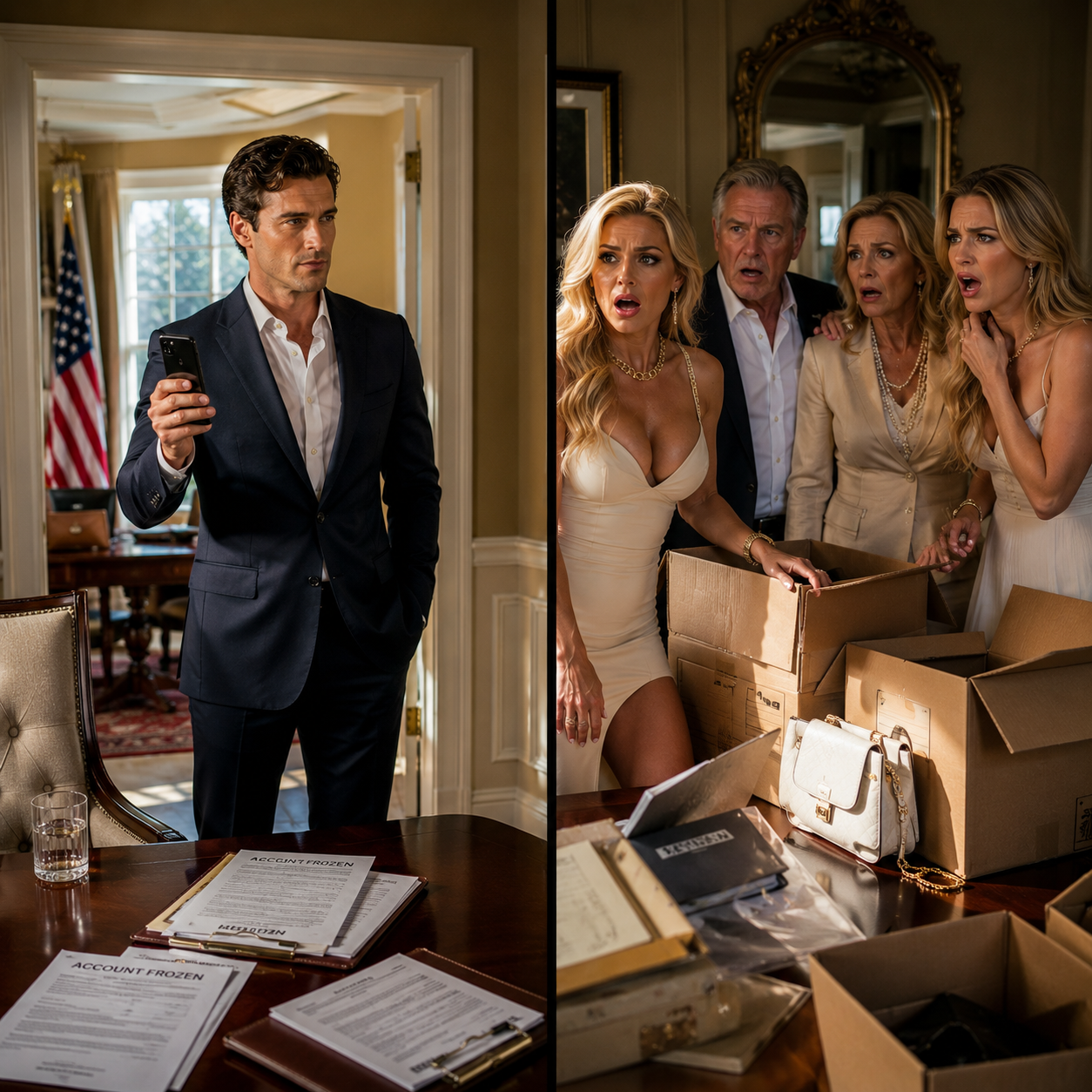
My wife told her family I was too weak to do anything about it while she was emptying our accounts.
They all nodded like it was already a fact, like my failure was not a possibility but a family-approved conclusion. Her father leaned back in my dining room chair, the same chair I bought after closing my first major distribution contract, and spoke about my life as if it were a badly managed investment. Her sister laughed at the idea of me fighting back. Her mother asked whether I would cry when I found out. And my wife, the woman I had spent eight years loving, protecting, and building beside, smiled and said I would probably beg her to come back.
I heard every word.
And I did not confront them.
I did not storm into the room. I did not throw accusations. I did not slam my fist on the table or demand explanations from people who had already decided I was beneath them. I simply stood in the hallway, listened long enough to understand exactly what they were planning, and walked away.
Then I made one phone call.
My name is Daniel Harper. I was thirty-seven years old when my marriage ended, though if I am being honest, it had been dying quietly long before that day. I owned a small distribution company I built from nothing over ten years of early mornings, late invoices, warehouse problems, truck delays, client emergencies, and the kind of stress people never see when they look at a business from the outside and assume profit means ease. It was not glamorous work. I did not wear suits to glass offices or take investor calls from rooftop bars. I moved products from manufacturers to retailers and made sure promises turned into deliveries.
It was stable. It was profitable. It was mine.
When I met Clara, she seemed to admire that.
We met at a friend’s wedding, both seated at a table where neither of us knew enough people to feel comfortable. She was beautiful in that polished, effortless way that usually comes from a lifetime of being told the world is waiting for you. Her family had money. Real money. Quiet money. The kind that came with private schools, country clubs, inherited expectations, and a father who believed every man could be measured by his balance sheet.
But that night, Clara did not seem like them.
She laughed at my dry jokes. She asked about my business with genuine interest. She told me she loved that I had built something myself. Six months later, we were engaged. By the next year, we were married.
For the first few years, I thought we were happy.
We bought a house. We traveled when work allowed. We hosted dinners. Clara decorated every room like she was preparing our life for a magazine spread, and I let her because I liked seeing her proud of our home. I worked hard, paid the bills, saved carefully, and believed I was building the kind of future any reasonable partner would value.
But Clara’s admiration faded slowly.
At first, it came disguised as concern.
“Shouldn’t the business be scaling faster by now?”
“My friend’s husband just got promoted to VP. They’re already looking at a bigger house.”
“Do you ever think about selling and doing something more stable?”
I would explain the numbers. The margins. The growth plan. The debt we had avoided. The contracts I had secured. Clara would nod, but her eyes would drift away, as if my explanations were too small to compete with whatever version of success her family had planted in her mind.
Then her family started sharpening the comments.
Her father, Richard, never asked how I was doing. He asked about revenue. Over holiday dinners, he would swirl expensive wine in a glass and interrogate me about overhead, payroll, client concentration, and whether I had “real exit potential.” Her sister, Melissa, treated my business like a cute hobby that had gotten out of hand. She once called our lifestyle “modest but charming,” then smiled like it was a compliment.
Clara never defended me.
That was the first betrayal, though I did not recognize it then.
Three years before the end, my business hit a rough patch. A major client went bankrupt owing us a significant amount of money. It hurt. I will not pretend it didn’t. For a few months, I had to restructure payments, negotiate with suppliers, and move carefully to keep cash flow steady. But the company was not failing. We had reserves. We had strong contracts. I had already built a recovery plan before the panic even reached our kitchen.
Clara did not believe me.
Or maybe she chose not to.
She began checking our accounts obsessively. She asked for updates every night like I was reporting to a board of directors instead of speaking to my wife. Worse, she reported everything back to her father. I would have a private conversation with her on Monday, and by Sunday dinner, Richard would repeat my own numbers back to me with a smirk.
That was when I realized my marriage had become a committee meeting, and I was the only person not allowed to vote.
Then I discovered the separate account.
It happened by accident. A misplaced statement. A bank alert she forgot to hide. I confronted her gently at first because some foolish part of me still wanted there to be an innocent explanation.
Clara folded her arms and said, “It’s a safety net.”
“A safety net from what?”
“From your decisions.”
That sentence landed harder than any insult from her family ever had.
Still, I tried to save the marriage.
I suggested counseling. She said she did not need a stranger teaching her how to feel safe. I suggested a weekend away. She said she was too overwhelmed. I suggested we sit down with a financial planner together so she could see the business clearly. She said my need to prove myself was exhausting.
After that, the house became cold.
We slept in the same bed but lived separate lives. She spent more time with her family. I spent more time at work. Conversations became practical, then tense, then rare. I thought we were drifting toward divorce, but I still believed there was a line Clara would not cross.
I was wrong.
One afternoon, I came home early from a business trip because a client meeting had been moved. When I walked through the front door, I heard voices in the dining room.
Clara.
Her parents.
Melissa.
And her brother, Brent.
They were gathered around my dining table with papers spread everywhere. Bank records. Property documents. What looked like printed emails. When I stepped into the room, they froze.
Clara’s face went pale for half a second before she recovered.
“You’re home early,” she said.
“So are all of you,” I replied.
Her father cleared his throat. “We’re helping Clara organize some things.”
I looked at the papers. Then at my wife. Then at each member of her family.
Something in that room was wrong.
But I did not react.
A weak man reacts when powerful people expect him to.
A patient man waits until reaction becomes strategy.
That night, I checked the accounts.
Nearly forty-five thousand dollars had disappeared in one week.
Not slowly. Not carefully. Aggressively.
For a long time, I sat alone in my office staring at the numbers. I felt the old version of myself trying to rise, the husband who wanted to storm downstairs and demand answers, the man who wanted his wife to look him in the eye and admit what she had done.
But there is no value in demanding honesty from someone already committed to deception.
So I decided to learn more.
The next day, I bought a small recording device. I will not pretend that was noble or clean. I was not proud of needing it. But I was no longer dealing with a wife having doubts. I was dealing with a coordinated financial attack inside my own home.
I placed it behind books in the dining room and told Clara I had meetings all day.
Then I parked down the street and waited.
Her family arrived less than an hour later.
That evening, while Clara was in the shower, I retrieved the device and listened.
By the end of the recording, my marriage was no longer wounded.
It was dead.
“Are you sure you secured everything from the joint accounts?” Richard asked.
“Almost everything,” Clara replied. “I’ve been moving it gradually so he wouldn’t notice, but I accelerated it this week.”
“The dummy never checks anyway,” Melissa said.
They laughed.
Then Clara laughed too.
That was what stayed with me. Not the theft. Not even the plan. The laugh.
My wife laughed at my trust.
Richard asked about the business.
Clara said, “His business is a joke, but the lawyer says I’m entitled to half.”
Melissa asked if I suspected anything.
And Clara, with the calm confidence of someone who believed cruelty had no consequences, said, “It doesn’t matter. He’s too weak to do anything about it. He’ll probably cry and beg me to come back.”
They laughed again.
I stopped the recording there.
Not because there was nothing more.
Because I had heard enough.
The next morning, I left the house as usual, but I did not go to the office. I went directly to the bank. I sat across from a manager and explained that I believed marital funds and business-related proceeds had been transferred improperly. I had documentation showing the source of several deposits and withdrawals. I had transaction histories. I had account records. I had dates.
The manager’s face changed as I spoke.
That was the first phone call.
The one Clara never thought I would make.
By the end of that meeting, the joint accounts were flagged and frozen pending investigation.
Then I called an attorney.
Not a friendly one. Not a gentle mediator. I called a man named Victor Hale, the divorce attorney a client once described as “expensive, unpleasant, and exactly who you want when someone tries to steal from you.”
Victor listened to the recording in silence.
When it ended, he leaned back and said, “We need to be careful with how this is used. But what it tells us is extremely useful.”
“What do we do?”
“We move before they do.”
For three days, I became the man they believed I could never be.
Quiet. Methodical. Unreachable beneath the surface.
At home, I acted normal. I made coffee. I answered Clara’s empty questions. I let her believe I suspected nothing. Meanwhile, I secured documents, removed copies of business records from the house, contacted key clients, changed access credentials, canceled business-linked cards, documented assets, and prepared for an emergency filing.
Clara slept beside me one of those nights like she had not sat at our table planning to strip my life for parts.
I barely slept.
But I did not break.
On the fourth day, I came home early again.
This time, they were not hiding.
Boxes lined the hallway. Clara was on the phone, speaking in that sharp, professional voice people use when they think the room belongs to them. Her father stood near the dining table like a general overseeing a successful campaign. Melissa was wrapping framed artwork in towels. Brent was carrying one of my office boxes toward the front door.
When I stepped inside, everyone stopped.
Melissa smirked first.
“There he is.”
Clara ended her call quickly. “You’re home early.”
“So I’ve been told.”
She lifted her chin. “I’m leaving you. Papers will be served tomorrow.”
Richard stepped forward. “This will be easier if you cooperate. Clara is taking what she deserves.”
I looked around at the boxes. At my wife. At her family. At the smug certainty on their faces.
And I smiled.
Not warmly.
Not kindly.
Just enough to make them uncertain.
“I wish you luck with that,” I said.
Clara narrowed her eyes. “What does that mean?”
“It means I hope your new place doesn’t require immediate payment.”
Her confidence flickered.
I continued, “Because the joint accounts have been frozen.”
The color drained from her face so quickly it almost looked theatrical.
“You can’t do that,” she whispered.
“I already did.”
Richard puffed up. “Now listen here—”
“No,” I said, cutting him off for the first time in eight years. “You listen. I have heard enough from all of you.”
Clara stared at me.
I pulled out my phone and played a short piece of the recording.
Just enough.
Her voice filled the room.
“He’s too weak to do anything about it.”
No one moved.
The silence that followed was one of the most satisfying sounds I have ever heard.
Melissa recovered first. “That’s illegal.”
“Possibly,” I said. “But very informative.”
Clara’s mouth opened, but no words came out.
I looked at her directly. “My attorney knows about the separate account. The transfers. The timing. The business proceeds. The judge will know too.”
“How did you—”
“Does it matter?”
For the first time since I had known her, Clara looked at me without contempt, without irritation, without superiority.
She looked afraid.
And that was when I understood something important.
She had never believed I was weak because I had failed.
She believed I was weak because I had been kind.
She mistook restraint for incapacity. Patience for ignorance. Loyalty for dependence.
That was her mistake.
I checked my watch.
“You have thirty minutes to leave my house,” I said. “Without the boxes. If you take anything purchased with funds currently under investigation, I will report it immediately.”
Brent stepped toward me. “You think you’re smart?”
“No,” I replied. “I think you thought I was stupid. That’s different.”
Then I walked out, got in my car, and called Victor.
The next week was chaos for Clara.
Not for me.
For her.
The apartment she had secretly secured became a problem when her deposit payment failed. The separate account she had been feeding for months was frozen while the source of funds was reviewed. Her credit cards connected to my business were canceled. The joint accounts remained locked. Her family, so eager to advise her when they thought they were winning, suddenly became cautious when legal exposure entered the conversation.
That was the first lesson Clara learned.
Rich people are generous with advice until consequences become expensive.
Two days after the confrontation, Victor called to tell me the emergency hearing had gone well. The court had issued temporary orders restricting Clara and her family from accessing or moving marital assets pending review. Because I could show that much of the money had originated from my business earnings and had been moved deceptively, her secret account would remain frozen until the transfers were fully examined.
Clara texted constantly.
At first, anger.
Then accusations.
Then panic.
Then pleading.
I did not answer.
A week after she laughed about my weakness, she appeared on my doorstep alone.
The security camera showed a woman I almost did not recognize. No polished makeup. No perfect posture. No family standing behind her. Just Clara, pale and trembling, holding her purse like it contained the last pieces of her life.
Against my attorney’s advice and my better judgment, I opened the door but stayed in the doorway.
“What do you want?”
Her eyes filled immediately. “Can I come in?”
“No.”
“Daniel, please. We need to talk.”
“No. Our lawyers can talk.”
“They froze everything,” she cried. “I can’t even buy groceries.”
I studied her face, searching for guilt. I found fear. They are not the same thing.
“My family says I need to fix this,” she added.
There it was.
Not I hurt you.
Not I betrayed you.
Not I stole from you.
My family says I need to fix this.
I almost felt sorry for her then. Almost. Because she still did not understand that she had never been the mastermind. She had been the weapon her family pointed at me, and now that the weapon had exploded in their hands, they had sent her back to absorb the damage.
“You should have thought about groceries before emptying our accounts,” I said.
“I was scared.”
“No. You were greedy.”
Her face crumpled. “My father said I had to protect myself. He said your business was failing.”
“My business was never failing. One client defaulted. The company recovered months ago.”
“I didn’t know.”
“You didn’t ask. You reported. You mocked. You stole.”
Tears ran down her face.
“I didn’t mean what I said.”
“Yes, you did. You just didn’t expect me to hear it.”
She covered her mouth with one trembling hand.
For years, Clara had treated my calm as something soft. Something lesser. But calm can be a locked door. Calm can be a blade in a drawer. Calm can be the thing standing between betrayal and destruction.
“I have nowhere to go,” she whispered. “The landlord canceled the lease. My parents say I can’t stay with them because of the court order. They don’t want to be involved.”
I looked at the woman I had once promised to protect.
And I realized protection had limits.
Love had limits.
Marriage had limits.
Self-respect did not.
“That sounds like something you and your family need to solve together,” I said.
Then I closed the door.
The divorce moved faster than Clara expected and cleaner than her family wanted. My documentation mattered. The account records mattered. The timeline mattered. Her secret transfers mattered. Most of all, her family’s sudden disappearance mattered.
At the final hearing, Clara sat beside her attorney looking smaller than I had ever seen her. Richard was not there. Neither was Melissa. Neither was her mother or Brent. The people who had encouraged her to destroy her marriage had abandoned her the moment the consequences became legally inconvenient.
The settlement was far more favorable to me than it might have been if I had waited, begged, or reacted emotionally. Clara did not receive half my business. She did not walk away with the windfall she expected. Most of the transferred money was returned. The court recognized the financial manipulation for what it was.
Afterward, in the hallway outside the courtroom, Clara approached me.
“I’m sorry,” she said quietly. “I should never have listened to them.”
I looked at her for a long moment.
There was a time when that apology would have broken me open. A time when I would have wanted to believe it was enough. But betrayal changes the shape of forgiveness. Sometimes forgiveness is not a bridge back. Sometimes it is simply setting down the weight and walking away.
“No,” I said. “You shouldn’t have.”
Her eyes filled again. “What am I supposed to do now?”
“You’ll figure it out.”
“That’s all?”
I nodded. “That’s all.”
Six months later, my life is quieter.
I still own the company. It is stronger now because I made it stronger. I restructured accounts, tightened protections, updated legal documents, and built walls around everything I had once left exposed because I believed marriage meant safety.
I also started therapy.
Not because I think Clara’s betrayal was my fault. It was not. But I needed to understand why I ignored so many warnings. Why I accepted disrespect as pressure. Why I thought endurance was the same thing as love.
Sometimes I think back to that dining room recording.
To their laughter.
To Clara saying I was too weak to do anything.
They were wrong.
But I understand why they believed it.
I had spent years being reasonable with unreasonable people. I had confused peacekeeping with strength. I had allowed insults to pass because I did not want conflict. I had smiled through disrespect because I thought dignity meant not reacting.
Now I know better.
Dignity is not silence while people rob you.
Strength is not proving yourself to people determined to misunderstand you.
And weakness is not kindness.
Weakness is betraying someone who trusted you because you think they will never defend themselves.
Clara learned that too late.
Her family learned it when the accounts froze.
I learned it the moment I made that phone call.
They thought I would cry.
They thought I would beg.
They thought I would stand helplessly in the ruins while they carried my life out in boxes.
Instead, I documented everything.
I protected what I built.
I walked away from people who mistook my patience for permission.
And when Clara came back sobbing on my doorstep, I finally understood the difference between being cruel and being done.
I was not cruel.
I was done.


![[FULL STORY] She Chose Her Ex Over Me — So I Left, Moved Overseas, and Never Looked Back](https://social-media.rabedo.com/thumbnails/1776618643_649d24e6-46a0-4d02-83eb-b1087ed5d7ad.png)


![[FULL STORY] She Presented Me as “Her Chauffeur” at a Gathering I Co Funded She Said It Loudly Enough for](https://social-media.rabedo.com/thumbnails/1776735972_14.png)