My fiancée walked into the kitchen wearing what I had come to call her announcement face.
Cordelia had several faces. There was the soft one she used when she wanted affection. The wounded one she used when she wanted an apology. The polished, academic one she used at conferences when she needed people to believe every word from her mouth had been peer-reviewed. But the announcement face was different. It was calm, rehearsed, and dangerous. It meant she had already made a decision and was only pretending to invite me into the conversation.
I was sitting at the kitchen table with a stack of wedding venue invoices spread in front of me, trying to figure out why floral arrangements cost more than my first car, when she stopped across from me and folded her hands.
“Babe,” she said, “I need to tell you something about my name after we get married.”
I looked up from the invoices. “Okay.”
I thought she wanted to keep her maiden name. That would have been fine. Cordelia Hampton had a career, publications, conference appearances, and a name people in her field recognized. I was not the kind of man who needed my wife to erase herself to prove she loved me.
Then she said, “I’m going to hyphenate.”
“Sure,” I said. “Lots of people do that.”
She hesitated for half a second.
“Not with your name,” she said. “With Ashton’s.”
I set my coffee down slowly.
“Ashton,” I repeated. “Your ex-boyfriend Ashton?”
She lifted her chin, already defensive. “It’s for professional reasons.”
That was the first crack in the room.
Cordelia and Ashton Fitzgerald had dated for four years. They broke up three years before this conversation. Cordelia and I had been together for two and a half years, engaged for six months, and our wedding was two months away. Ashton was not a distant college mistake. He was not some forgotten photo buried in an old phone. He was a name that still floated through her professional life like a ghost she refused to bury.
“You were never married to him,” I said.
“No,” she replied, too quickly. “But I started publishing under Cordelia Hampton Fitzgerald when we were together. The Fitzgerald name carries weight in academic circles.”
I stared at her.
“So you’ve been using your ex-boyfriend’s last name professionally the entire time we’ve been together?”
“It’s not like that.”
“It is exactly like that.”
“You’re making this emotional when it’s practical.”
There it was. The sentence people use when their behavior hurts you, but they want your reaction to be the problem.
Cordelia explained it like she was presenting a grant proposal. Her research papers were under Hampton Fitzgerald. Her conference appearances were under Hampton Fitzgerald. Her tenure application was being prepared under Hampton Fitzgerald. Changing it now, she said, would cause confusion, delay recognition, and potentially harm her academic future.
“And after we get married,” I asked, “what name will you use?”
“Cordelia Hampton Fitzgerald.”
“Not Morrison?”
She sighed. “Professionally, no.”
“So you won’t take my name, but you’ll keep your ex’s.”
“That is such a childish way to frame it.”
I nodded.
“Makes sense,” I said.
Relief crossed her face.
“Oh, thank God,” she said. “I thought you were going to freak out.”
“Nope,” I said, opening my laptop. “All good.”
I logged into our wedding website. The header still read Cordelia and Ethan’s Wedding in elegant gold script. I changed it to Cordelia and Ethan’s Wedding Attendance TBD.
Then I updated the invitation section.
You are invited to celebrate the union of Cordelia Hampton Fitzgerald and Ethan Morrison. Ethan is still deciding if he will attend.
Cordelia stared at the screen.
“What are you doing?”
“Making my own professional announcement.”
Her phone rang within minutes.
Phoebe, her maid of honor, called first. I could hear her voice through the speaker before Cordelia even lifted the phone properly.
“What the hell is this about Ethan maybe not showing up to the wedding?”
Cordelia grabbed the phone. “It’s nothing. He’s being petty.”
I called out clearly, “Ask her about keeping Ashton’s name.”
The room went silent.
Then Phoebe said, “Ashton? Your ex Ashton?”
That was when the first domino fell.
The bridesmaids arrived the next day like a crisis management team with better hair. Phoebe led the charge, with Jade, Ramona, and Cordelia’s sister Genevieve standing behind her in my living room as if they were there to rescue a hostage.
“You need to stop embarrassing her,” Phoebe said.
“She embarrassed herself,” I replied. “I only updated the guest list emotionally.”
Jade tried to sound reasonable. “You don’t understand academia. Publishing history matters.”
“She never married him.”
“It’s just a name.”
“Then she can stop using it.”
Ramona, the blunt one, crossed her arms. “You’re really going to blow up your wedding over this?”
“I am not blowing it up,” I said. “I am deciding whether I want to marry a woman who plans to spend the rest of her professional life under another man’s name.”
That was the problem they could not solve. Every defense they offered sounded worse once spoken aloud.
Cordelia came home in the middle of the intervention and looked furious, not because they were there, but because I had survived the ambush.
That night, we fought harder than we ever had.
“You humiliated me,” she said.
“You hid this for two and a half years.”
“I did not hide it. You never asked.”
“I never asked whether my future wife was professionally pretending to be attached to her ex-boyfriend because normal people do not think to ask that.”
Her face tightened.
“It is my career,” she said.
“And this was supposed to be our marriage.”
She slept at Genevieve’s that night.
The next day, the truth got uglier.
My friend Landon worked at the same university as Cordelia. Different department, same ecosystem. Academic circles are small, and reputation travels faster than official emails. When I told him what happened, he got quiet.
“Ethan,” he said, “you know who Ashton’s father is, right?”
I did not.
Dr. Reginald Fitzgerald was the dean of Cordelia’s department.
Ashton Fitzgerald was an associate professor there.
Every major paper Cordelia had published had been co-authored with Ashton. Every conference where she had spoken had some connection to the Fitzgerald family. Every door that had opened for her had a Fitzgerald hand somewhere near the handle.
She was not keeping the name for recognition.
She was keeping it for access.
I texted her one question.
How many of your papers would have been published without Ashton’s name attached?
She read it.
She did not answer.
Then Ashton called me.
His voice was careful, like a man stepping around broken glass.
“Ethan, I heard about the name situation. I just want to say I didn’t know she planned to keep using it after the wedding.”
“But you knew she was using it.”
A pause.
“I knew professionally, yes.”
“And you never thought that was strange?”
“My father likes her work. He thinks she’s valuable to the department.”
“So your father protects your ex-girlfriend’s career, and she keeps using your name to maintain that protection.”
Another pause.
“When you say it like that…”
“There is another way to say it?”
He hung up soon after.
Cordelia returned home two days later with what she called a compromise. She sat across from me at the kitchen table, the same table where the first announcement had been made, and slid a notebook toward me.
“I’ll hyphenate with both names,” she said. “Hampton-Morrison-Fitzgerald.”
I stared at her.
“No.”
Her eyes flashed. “Why not?”
“Because that is not a compromise. That is you getting everything you want and adding my name like a participation trophy.”
“You are being impossible.”
“I am being consistent.”
She pressed her lips together.
Then, finally, she revealed the part she had been hiding.
“I already submitted my tenure application under Hampton Fitzgerald.”
The room went still.
“You submitted your tenure application without telling me?”
“I was going to surprise you when I got it.”
“With your ex’s name attached?”
She stood up, frustrated. “Why are you so obsessed with Ashton?”
“I’m not,” I said. “You are. You are literally trying to carry his name into our marriage.”
Then I asked the question that made her go pale.
“What about our future children? Would they be Morrisons, or would Fitzgerald somehow end up there too?”
She did not answer.
Of course she did not. She had thought about her career, her publications, her applications, her access, and her reputation. She had not thought about the family we were supposed to build because the marriage was only one piece on her board.
That was when I understood Cordelia’s strategy. She did not want a husband. She wanted stability. She wanted my home, my loyalty, my support, my clean family image, my willingness to stand beside her. But professionally, she wanted the Fitzgerald name because it carried power she could not bear to lose.
Her grandmother confirmed it.
Evelyn was eighty-two years old, sharp as broken glass, and completely uninterested in protecting anyone’s ego. She called me one evening after the family explosion had already spread through both sides.
“Ethan, dear,” she said, “I need to tell you something about my granddaughter.”
I listened.
“She dated that Fitzgerald boy because of his family name. She told me herself she never would have gotten into that PhD program without his father’s recommendation.”
The words did not shock me as much as they should have. By then, they only arranged the facts into a cleaner shape.
“Why are you telling me this?” I asked.
“Because you seem like a decent young man,” Evelyn said, “and decent young men have a habit of confusing loyalty with blindness.”
That sentence stayed with me.
The wedding was two weeks away when I called the venue and withdrew my portion of the payment. Cordelia had insisted on a country club that, unsurprisingly, the Fitzgerald family belonged to. Both our cards were on file. Without mine, the venue required full payment upfront.
Cordelia called me screaming.
“They want fifteen thousand dollars by Friday.”
“Better call Ashton,” I said. “Maybe the Fitzgerald name can help.”
She actually did.
Ashton called me an hour later, sounding exhausted.
“Your fiancée just asked me to help pay for your wedding venue.”
“She is not my fiancée anymore.”
“She does not seem to know that.”
“She will.”
The final week became a circus. Cordelia sent guests an email claiming the wedding website had been hacked and that everything was proceeding as planned. I sent my own email with screenshots and the subject line: Not hacked. Just honest.
Then came her formal compromise email, copied to both families.
She wrote that she would legally become Cordelia Morrison, but would continue publishing as Cordelia Hampton Fitzgerald. She called it mature. She called it practical. She called it her final offer.
I replied all.
A marriage where you are Mrs. Morrison at home and Mrs. Fitzgerald at work is not a compromise. It is a split life. I will not be anyone’s part-time husband.
Then I added one final line.
A wedding without a groom is just an expensive party.
Her bridesmaids stopped texting after that.
On the morning of what was supposed to be our wedding day, I woke up to seventy-three messages. Some begged. Some threatened. Some told me I was ruining her life. Cordelia sent one at three in the morning.
I’m at the venue in my dress. If you don’t show up, I’ll never forgive you.
I replied, “I never forgave you for choosing Ashton’s name. I guess we’re even.”
But I did go.
Not to marry her.
To end it where she had tried to force it to survive.
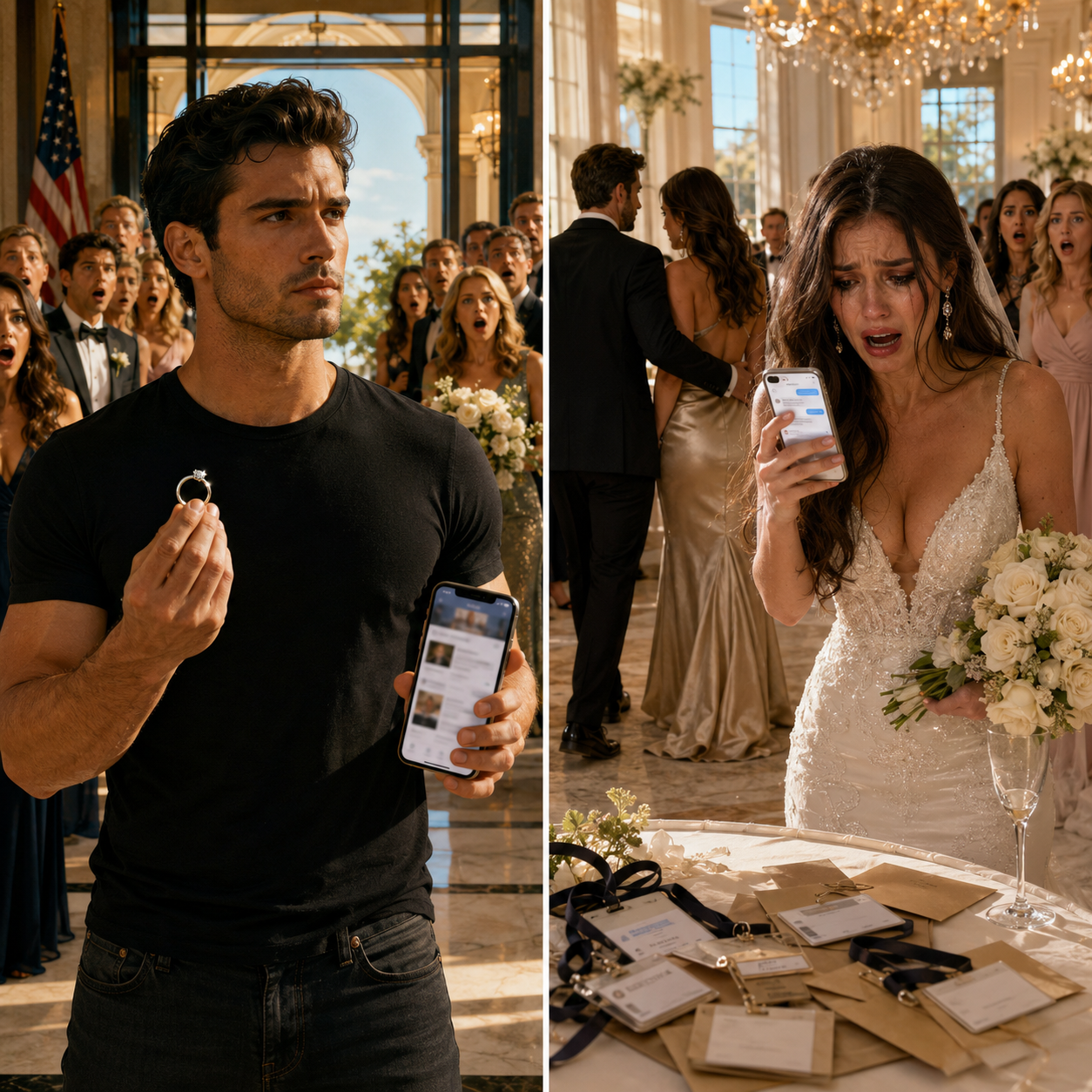
I arrived in jeans and a T-shirt. The venue was fully decorated. Flowers everywhere. Gold chairs. White aisle runner. Confused guests whispering into champagne glasses. Her father saw me first.
“You came to your senses?” he asked.
“No,” I said. “I came to return this.”
I handed him the ring.
His face hardened. “You are really doing this here?”
“She kept her ex’s name here.”
Cordelia came out minutes later in her wedding dress, full makeup, full delusion. For one second, I saw the woman I had proposed to. Beautiful. Brilliant. Controlled. Then she ran toward me with hope in her eyes, and I realized even then, she thought this was another scene she could win.
“You came,” she whispered.
“To say goodbye.”
Her smile died.
“I’m not marrying someone who values her ex’s name more than our relationship,” I said.
“It is just a name.”
“Then change it.”
“I can’t.”
“Then I can’t marry you.”
The whole room was watching.
Her final mask slipped.
“If you leave now,” she hissed, “I’ll tell everyone you’re gay.”
I laughed. Loudly. Not because it was funny, but because the threat was so desperate it deserved nothing else.
“Go ahead,” I said. “At least then they’ll understand why I refused to marry a woman obsessed with another man.”
Then Bethany stood up.
Bethany was Ashton’s girlfriend. Cordelia had invited Ashton and Bethany to prove there were “no hard feelings,” which turned out to be the worst mistake she made all month.
“Actually,” Bethany said, holding up her phone, “maybe you should tell everyone how you texted Ashton last week asking him to leave me so you could keep using his name without drama.”
Silence crushed the room.
Ashton turned to Cordelia. “You what?”
Cordelia went white.
Bethany read from the messages. “If you really cared about my career, you would understand why I need this.”
Ashton stood up slowly. Whatever sympathy he had left vanished from his face.
“We’re leaving,” he said. “And Cordelia, I’m filing paperwork with the university to remove you from all future publications. Use your own name.”
The Fitzgeralds walked out.
Then half the guests followed.
Cordelia turned on me with mascara running down her face.
“This is all your fault.”
“No,” I said. “This is the first thing you have ever done under your own name.”
Then I left.
The reception still happened, apparently. Twenty people out of two hundred stayed. Cordelia gave a speech about choosing herself, and someone posted it online. The comments were not kind. Within weeks, the university opened an ethics review into her publications. Her tenure application was denied. Ashton’s father removed her from two conferences. Her professional empire, the one built on a borrowed name, started collapsing the moment the owner of that name stopped protecting her.
A month later, she texted me from a new number.
I would have changed it eventually.
I replied, “Would have. Could have. Didn’t.”
She wrote back, “I’m keeping Fitzgerald professionally. It is who I am now.”
I answered, “Then stay single professionally too.”
Then I blocked her.
People ask if I regret walking away on the wedding day.
No.
Cordelia showed me exactly who she was before I signed my life to hers. She wanted the image of a husband, the stability of a marriage, and the prestige of another man’s name. She wanted me to be secure enough not to question it and foolish enough to fund it.
I loved her once. I will not pretend I did not. But love is not a good enough reason to become a footnote in someone else’s ambition.
She chose a name.
I chose myself.

![[FULL STORY] My Fiancée Said: "If You Loved Me, You'd Fight For Me." I Replied: "I Love You Enough To Let You Go.](https://social-media.rabedo.com/thumbnails/1777351921_B15.png)