
“You cannot unburn the sauce.”
That’s the first thing they teach you in a high-pressure kitchen. You can stir it, you can lower the heat, you can even try to mask the bitterness with sugar and cream, but a real chef knows the truth. Once that acrid, burnt tang hits the back of your throat, the dish is dead. You don’t serve it. You don’t try to save it. You throw the whole thing in the bin, scrub the pan until your knuckles bleed, and you start over.
I’ve lived by that rule for fifteen years behind a line. I never thought I’d have to apply it to the woman I promised to spend the rest of my life with.
My name is Marcus Bell. I’m thirty-four, and if you saw me on the street, you’d probably think I’m the guy you hire to move your piano or the bouncer who tells you to keep it down in the queue. I’m six-foot-four, I’ve got shoulders like a barn door, and my face looks like it’s seen a few too many rounds in a boxing ring—mostly thanks to a stray hockey puck in high school and a few kitchen accidents. I’m a chef. My hands are mapped with scars from oil pops and slips of a paring knife. I’m built for utility, not for centerpieces.
Then there was Julie Hartman.
Julie was thirty-two, a pharmaceutical sales rep, and quite frankly, the kind of woman who made rooms go silent when she walked in. She was all polished edges, silk blouses, and a laugh that sounded like expensive wind chimes. We met four years ago when she came into my bistro. She’d sent a note back to the kitchen: “The duck was divine, but I’d like to compliment the chef personally.”
I remember wiping the sweat off my forehead, straightening my apron, and walking out, expecting a polite handshake. Instead, I found Julie, swirling a glass of Pinot Noir, looking at me like I was the most interesting thing she’d ever seen. I fell for it. God, I fell for it so hard. I thought we were the perfect pairing—the fire and the silk, the cast iron and the porcelain.
For four years, I gave her everything. I worked double shifts to save for the brownstone we rented. I paid for the trips to Amalfi and Santorini because she said she needed "inspiration" for her soul. I proposed on New Year’s Eve with a ring that cost me six months of grueling overtime. When she cried and said yes, I felt like I’d finally beaten the odds. I was the rough-around-the-edges cook who’d landed the queen.
But life has a funny way of stripping back the garnish to show you what’s really on the plate.
Six weeks ago, I caught a brutal case of the flu. It felt like my bones were being ground into dust. I was stuck at home, shivering under three blankets in our bedroom, while Julie worked in her home office down the hall. Our apartment is a beautiful, drafty old brownstone with a ventilation system that acts like a literal megaphone between rooms when the heat kicks on.
I was drifting in and out of a fever dream when I heard the laughter. It wasn't Julie’s "polite" laugh. It was her real laugh—the sharp, jagged one she usually hid. She was on a Zoom call with her two best friends, Tara and Jordan.
I wasn’t eavesdropping. I was just... there. But then I heard my name.
"At least Tara isn't stuck with Kevin forever," Jordan’s voice crackled through the vent. "Julie’s the one signing up for a lifetime of settling."
I froze. The Gatorade bottle in my hand felt heavy.
Julie laughed. "God, you guys are awful. Marcus isn't that bad."
Not that bad. The words felt like a splash of ice water on my fevered skin.
"Girl, stop," Tara chimed in. "You literally told us last month you have to get drunk before you sleep with him. That is the literal definition of settling."
The silence that followed in my bedroom was deafening. I waited for Julie to defend me. I waited for her to say, "Hey, that's my fiancé you're talking about."
Instead, I heard her sigh—a long, weary sound of martyrdom.
"I was exaggerating, Tara. I don't have to get drunk. Just a little buzzed sometimes. You've seen him. He’s not exactly Brad Pitt. He’s... substantial. Like a sturdy piece of furniture you keep because it’s reliable, even if it doesn't match the decor."
The girls howled with laughter.
"He’s the human equivalent of settling for fast food when you’re starving," Tara added, clearly proud of her wit.
"Exactly," Julie said, her tone shifting into something cold and analytical. "Look, not everyone gets to marry their dream guy. David is gone. My biological clock is ticking. Marcus is stable. He has a great job, he worships the ground I walk on, and he’s too grateful to have me to ever stray. Sometimes you have to order from the McDonald’s dollar menu when the Michelin-star restaurants won’t take your reservation."
I sat up in bed, my heart hammering against my ribs so hard I thought it would crack. The fever was gone, replaced by a cold, vibrating clarity.
She didn't love me. She was using me as a safety net. I was the "stable" guy who paid the bills and provided the lifestyle, while she held her nose and endured my presence until the lights went out.
I looked at the framed photo on my bedside table—us in Tuscany. She was smiling, but now that I looked closer, she was leaning away from me. I had been a prop in her "perfect life" aesthetic.
I didn't storm into her office. I didn't scream. That’s not how a chef handles a ruined service. You stay calm, you finish the task, and you shut it down.
I reached for my phone. I hit record on the voice memo app and held it up to the vent. I captured the next ten minutes of their "girl talk." They talked about my "boring" hobbies, my "peasant" work ethic, and how she planned to "refine" me once we were legally married so I wouldn't embarrass her at corporate events.
When the call ended and I heard her office chair creak, I lay back down and closed my eyes.
An hour later, Julie walked into the bedroom. She put a hand on my forehead—the same hand that would soon be wearing my mother's heirloom diamond if I didn't act.
"How are you feeling, sweetie? Can I get you anything?" she asked, her voice dripping with that polished, fake kindness.
I looked up at her, seeing the mask for the first time. "I’m fine, Julie," I whispered. "I think the fever finally broke. I know exactly what I need to do now."
She smiled, oblivious, and kissed my cheek. I felt my skin crawl.
The next forty-eight hours were a masterclass in silent execution. I didn't say a word. I didn't change my tone. But while she was out at a "bridal brunch" the next day, I began the process of scrubbing the pan.
I called the bank. The joint savings account we’d set up for the wedding? I took exactly half—my half. I canceled the authorized user status on my credit cards. I called my landlord. The lease was in my name alone. I told him I’d be vacating in thirty days, but I paid the full remainder of the lease upfront so there would be no legal ties.
Then, I did the hardest part. I called her mother, Diane.
Diane was a tough woman who had worked two jobs to put Julie through school. She had always been kind to me, in a blunt, no-nonsense way. I asked her to meet me for coffee.
When I sat across from her, I didn't offer a preamble. I played the recording.
Diane listened in total silence. Her face didn't crumple; it hardened. When the part about the "McDonald's dollar menu" played, she actually closed her eyes and leaned back.
"I’m leaving her, Diane," I said, my voice steady. "I’m not here to ask for permission. I’m here because I respect you too much to let you find out through a text. Here is the ring."
I slid the velvet box across the table.
Diane looked at it, then at me. "Marcus," she said, her voice raspy. "I didn't raise her to be this person. I am so deeply sorry."
"It’s not your fault," I replied. "But I can't stay. I’m moving my things out today while she’s at work."
"Where will you go?"
"Away from the smoke," I said.
I went back to the apartment with a U-Haul and three of my guys from the kitchen. We were a surgical team. We took my books, my knives, my clothes, and my grandfather’s cast iron skillet. I left everything we’d bought together. I didn't want the memories.
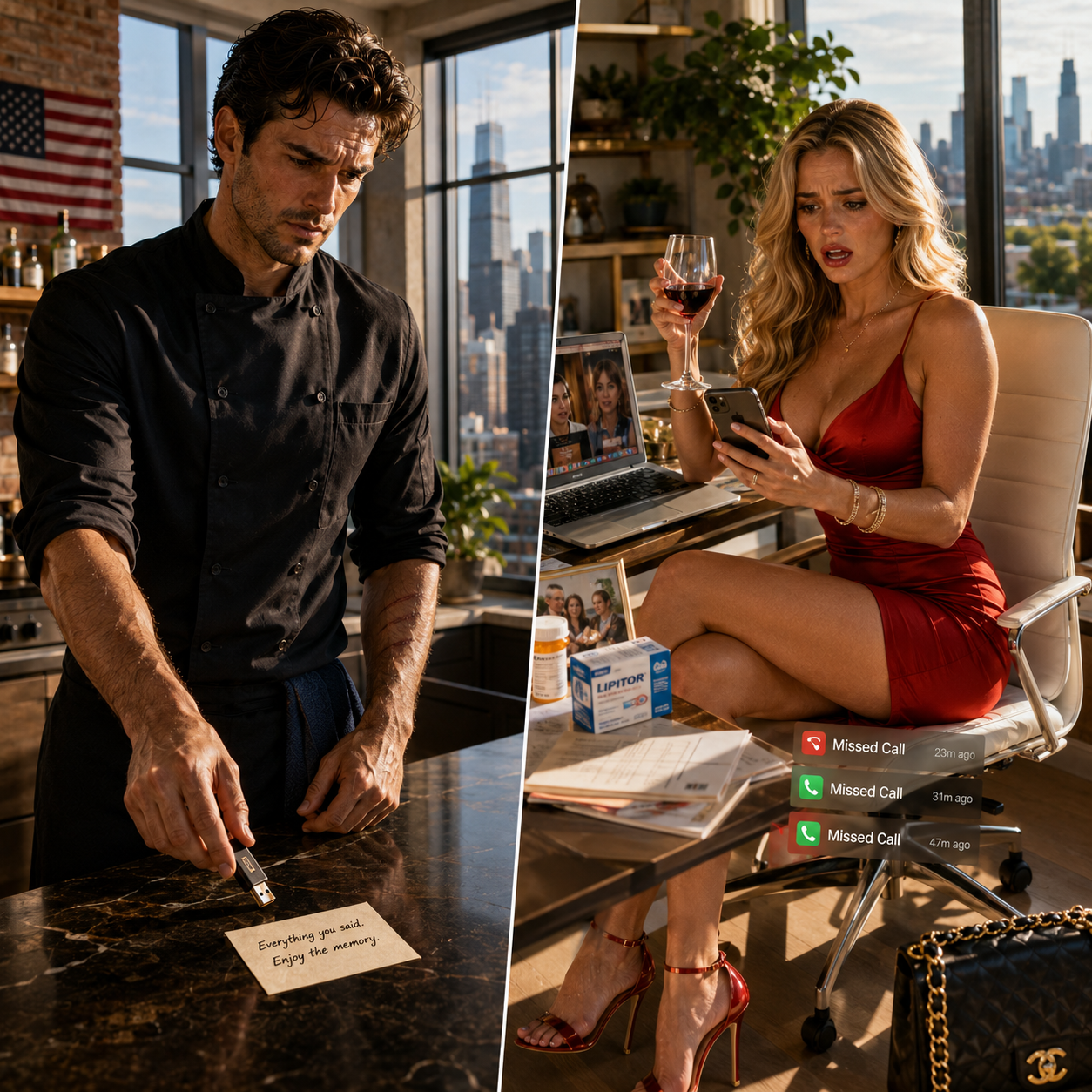
On the kitchen island, I left a single USB drive and a note.
The note said: “The sauce is burned, Julie. Your mother has the ring.”
I drove away and blocked her number before the first tear could even think about falling. I thought I was done. I thought that was the end of the story.
But I underestimated how much a woman like Julie hates losing control of the narrative. By the time I reached my hotel, my "quiet" exit was about to become a public war.
![[FULL STORY] My Bride Slapped Me at the Altar Because I Refused to Obey Her Mother](https://social-media.rabedo.com/thumbnails/1777476006_5af60eb8-8ddc-49d0-a136-b7aa0003a2ae.png)
![[FULL STORY] My Wife Said She Was Caring for Her Sick Mother — What My Daughter Showed Me Through the Window Ended Everything](https://social-media.rabedo.com/thumbnails/1777199965_453253fd-5145-4d29-86ad-11ef86897207.png)
![[FULL STORY] My Girlfriend Tried to Dump Me on Instagram Live — Then Security Told Her She Wasn’t Even on the Lease](https://social-media.rabedo.com/thumbnails/1777878259_55e931ac-5525-43ac-94dd-c64319978123.jpg)
![[FULL STORY] She Humiliated Me in Front of Her Friends — Then Came Back Crying When She Saw Who Replaced Her](https://social-media.rabedo.com/thumbnails/1777386170_04397289-deb0-48b3-85b9-ce8bf34882e9.png)