The heart was still warm when Dr. Naomi Ellis signed for it.
Not warm in the way people imagined. Not alive. Not beating. Not dramatic like the movies wanted it to be. It was sealed beneath layers of sterile protection, suspended inside a preservation chamber, locked inside a white medical transport cooler with red biohazard seals and two black straps pulled tight across the lid.
But Naomi knew what warmth meant.
It meant time.
It meant possibility.
It meant somewhere in Denver, Colorado, a man was lying beneath surgical lights with his chest already shaved, his blood typed and crossmatched, his immune system prepared, his family waiting behind glass and pretending not to look at the clock.
It meant a team of nurses had already counted instruments twice.
It meant anesthesiologists were watching monitors.
It meant perfusionists were standing by.
It meant every minute mattered in a way ordinary people never understood until the person they loved was the one on the table.
The donor heart had a clock attached to it, even if nobody could see it.
Four hours was ideal.
Six was dangerous.
Beyond that, hope became a negotiation with death.
Naomi looked at the transplant coordinator standing across from her in the dim loading bay beneath St. Catherine’s Medical Center in Atlanta.
“What’s our window?”
“Wheels up in thirty-eight minutes if airport police clears the medical corridor,” the coordinator said. “Denver team says Governor Reed is already prepped.”
Naomi did not react to the name.
She had learned early in her career that the body did not care about power.
A governor’s heart could fail as quietly as a janitor’s.
A senator could bleed out like anyone else.
A billionaire could beg God in the same cracked voice as a schoolteacher.
In the operating room, titles disappeared. Flesh told the truth.
Still, she understood the pressure.
Governor Malcolm Reed was forty-nine years old, popular, photographed, debated, loved, hated, quoted, protected, criticized, and watched by half the country after collapsing during a televised education summit two days earlier. The official statement had said exhaustion. The private medical report said viral myocarditis had destroyed enough of his heart function that the next seventy-two hours would decide whether Colorado would wake up with a governor or a vacancy.
And now his new heart was in front of Naomi.
In a cooler.
On a rolling transport cart.
With her name written on the chain-of-custody paperwork.
Dr. Naomi Ellis.
Chief Cardiothoracic Surgeon.
Emory St. Catherine’s Transplant Institute.
Courier-surgeon authorized.
She signed the final form with a steady hand.
The coordinator, a thin white woman named Paige with red-rimmed eyes and too much caffeine in her bloodstream, watched her closely.
“You don’t have to personally carry it,” Paige said.
Naomi capped the pen. “Yes, I do.”
“We can send a courier.”
“I’m operating when we land.”
“You’ve been awake for twenty-two hours.”
“Then I’m too tired to argue.”
Paige gave a humorless laugh.
Naomi lifted the cooler herself.
It was heavier than people expected. Not because of the organ, but because of everything around it. Ice packs. Monitoring device. Sterile layers. Tracker. Documentation. Responsibility.
The weight settled into her shoulder.
Familiar.
She had carried worse.
A young surgical fellow hurried into the loading bay with Naomi’s navy blazer, a small leather case, and her hospital ID badge.
“Dr. Ellis, your badge.”
Naomi took it and clipped it to the inside of her blazer instead of the outside.
The fellow blinked. “You don’t want it visible?”
Naomi smiled faintly, but there was no humor in it.
“Visible badges make people ask questions. Hidden badges make them listen after they’ve already spoken.”
The fellow did not know what to say to that.
Naomi did.
She had been a Black woman in medicine long enough to understand the choreography of doubt.
She had walked into operating rooms where patients looked past her and asked when the surgeon was coming.
She had been mistaken for transport, housekeeping, dietary services, nursing, family, administration, and once, in an especially creative moment, a florist.
She had stood in rooms wearing a white coat with her name stitched over her heart while men with half her experience explained anatomy to her slowly.
She had learned not to spend energy proving herself to people determined not to see her.
But tonight was different.
Tonight, every delay had a pulse.
A black SUV waited outside the bay doors with its engine running.
Rain tapped lightly against the pavement, not heavy enough to slow traffic, but enough to make the city shine under streetlights.
Naomi slid into the back seat with the cooler secured beside her.
Paige leaned through the open door.
“Airport liaison confirmed Gate F12. Private medical clearance corridor. TSA is aware. Delta med-priority board. Federal transplant notification already sent.”
“Good.”
“Denver keeps asking for updates every six minutes.”
“Tell them I prefer seven.”
Paige smiled despite herself. Then her face tightened.
“Naomi.”
Naomi looked up.
Paige lowered her voice.
“That’s the governor on that table.”
Naomi rested one hand on the cooler.
“No,” she said quietly. “That’s a patient.”
The SUV pulled away.
Atlanta moved past the windows in blurred ribbons of wet light. Naomi sat in silence, eyes closed but not sleeping. Her mind walked through the surgery in pieces.
Median sternotomy.
Cannulation.
Bypass.
Explant.
Implant.
Left atrium first.
Pulmonary artery.
Aorta.
Warm reperfusion.
Rhythm.
Please, God, rhythm.
Her phone buzzed.
She opened her eyes.
A text from her mother.
Call me when you land.
Naomi stared at it longer than she meant to.
Her mother always knew when something important was happening, even when Naomi did not tell her. It was a gift and a burden, like most things mothers carried.
She typed:
I will.
Then after a pause:
Love you.
Her mother replied almost instantly.
Love you more. Your brother would be proud.
Naomi’s thumb froze over the screen.
For a moment, the SUV was gone. The rain was gone. The cooler beside her was gone.
She was twenty-eight again, standing in a hospital hallway in Nashville while a resident with tired eyes told her that her little brother’s transport had been delayed.
Not canceled.
Delayed.
Such a small word.
So polite.
So clean.
Delayed sounded like traffic. Like paperwork. Like weather.
Delayed did not sound like a twenty-two-year-old man named Marcus Ellis dying because the medical aircraft carrying the vascular graft he needed was held on the tarmac for reasons nobody could explain clearly afterward.
Delayed did not sound like a mother collapsing against a vending machine.
Delayed did not sound like Naomi screaming into a hospital linen closet because she was already a doctor and still could not save him.
She locked her phone and looked out the window.
Not tonight.
She would not think about Marcus tonight.
Tonight, she had one job.
Get the heart to Denver.
The SUV reached Hartsfield-Jackson twenty-seven minutes before departure.
A medical logistics escort met her near a restricted entrance. He was young, nervous, and holding a tablet like it might protect him.
“Dr. Ellis?”
“Yes.”
“I’m Jordan May, airport medical operations. We’re taking you through the secure corridor.”
He glanced at the cooler and swallowed.
“Is that—”
“Yes.”
“Okay. Right. Sorry. This way.”
Naomi followed him through a side entrance away from the main security lines. The airport at night had a strange pulse. Not quiet, exactly. Airports were never quiet. But the energy was different after midnight. Exhausted families sleeping near charging stations. Business travelers moving like ghosts. Cleaning crews pushing carts through fluorescent corridors. Gate agents speaking gently to people whose plans had already fallen apart.
The secure corridor was supposed to avoid all of that.
Jordan badge-scanned the first door.
Green light.
They moved through.
Second door.
Green light.
Third door.
Red.
Jordan frowned and scanned again.
Red.
Naomi looked at the time.
“Problem?”
“No, ma’am. It does that sometimes.” He tapped the tablet. “Airport police has to release the corridor lock.”
“Call them.”
“I already sent the clearance packet.”
“Call them.”
Jordan’s face flushed. “Yes, doctor.”
He stepped aside and spoke quickly into his radio.
Naomi stood under the cold airport lights, cooler at her side, feeling the minutes peel away.
Her phone buzzed again.
Denver.
She answered.
“This is Ellis.”
A man’s voice came through, tight with controlled panic.
“Dr. Ellis, this is Dr. Han in Denver. Where are you?”
“Airport secure corridor. Gate F12. We’re waiting for a lock release.”
“How long?”
“Less than five minutes.”
“It needs to be less than three.”
“I know.”
“He’s stable on support, but his pressures are dropping whenever we adjust.”
“I said I know.”
There was silence.
Then Dr. Han said more softly, “Sorry.”
Naomi looked at the cooler.
“Don’t apologize. Keep him ready.”
She ended the call.
Jordan turned back toward her, visibly uncomfortable.
“They’re sending someone.”
“Who?”
“Airport police.”
Naomi closed her eyes for half a second.
That was the first moment she felt it.
Not fear.
Recognition.
The slight shift in the air before authority arrived looking for someone to use.
Bootsteps echoed from the far end of the corridor.
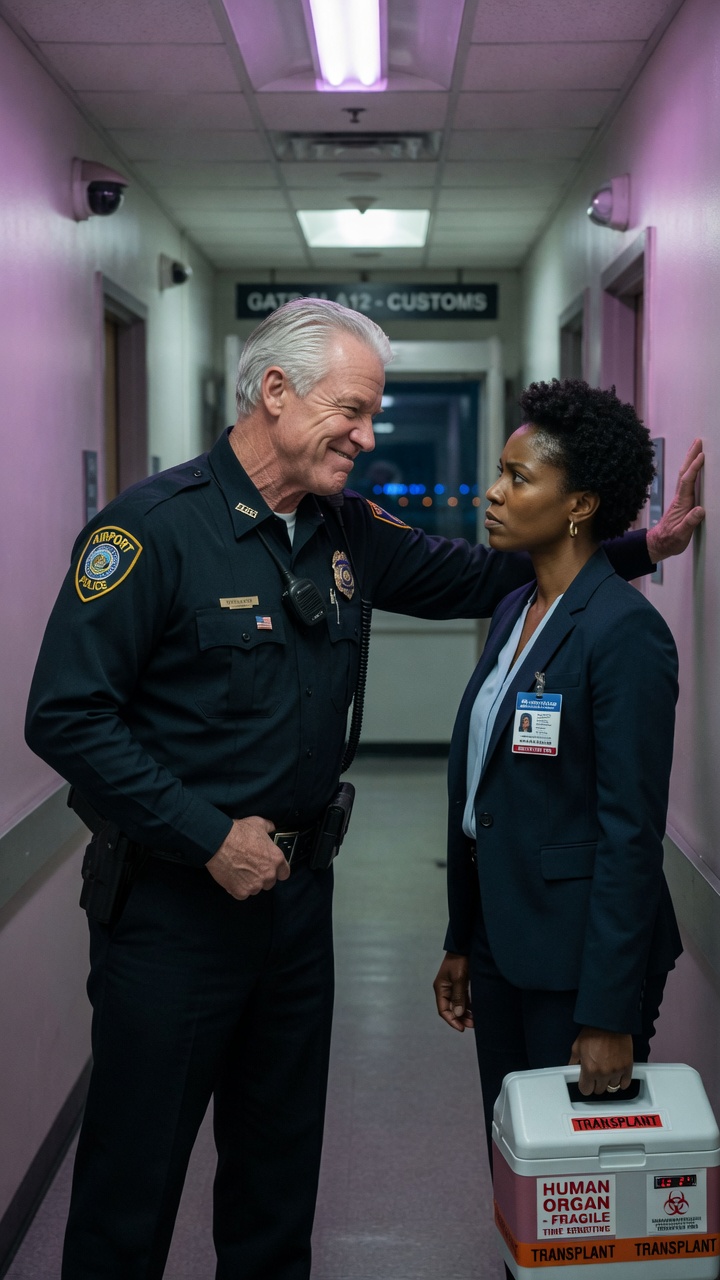
Two officers appeared first, both in airport police uniforms. Behind them walked a taller man with silver hair, a hard jaw, and the slow confidence of someone who enjoyed making people wait for his attention.
His badge read:
LIEUTENANT GRAHAM VOSS.
Naomi watched his eyes move over Jordan first.
Then the cooler.
Then Naomi.
And finally, her face.
There it was.
The pause.
Barely a second.
Long enough.
Voss stopped a few feet away.
“What’s the issue?”
Jordan rushed forward. “Lieutenant Voss, we have a medical priority transport. Clearance packet was sent to airport police and TSA. This is Dr. Naomi Ellis. She’s transporting—”
Voss lifted one hand.
Jordan stopped immediately.
Naomi noticed that too.
The lieutenant liked silence, but only when he caused it.
His gaze settled on the cooler again.
“What’s in the box?”
Naomi answered before Jordan could.
“Human donor organ. Sealed transplant cargo. Chain-of-custody documentation is inside the red folder attached to the handle. I need immediate access to Gate F12.”
Voss stared at her.
Then he smiled.
It was not a friendly smile.
It was the kind of smile men used when they had already decided the conversation would end with them being obeyed.
“You’re carrying a human organ through my airport?”
Naomi’s voice stayed even. “Through the medical corridor, yes.”
“Your airport?” Jordan repeated faintly.
Voss looked at him.
Jordan lowered his eyes.
Naomi did not.
Voss took one step closer.
“I’ll need you to open it.”
“No.”
The word landed cleanly.
Jordan inhaled sharply.
The second officer shifted.
Voss’s smile disappeared.
“What did you say?”
“I said no.”
“You don’t tell airport police no in a restricted corridor.”
“You don’t open a sealed transplant container outside approved sterile protocol without medical authorization.”
Voss looked at the cooler again.
Then at her.
“You got identification?”
“Yes.”
“Show it.”
Naomi took out her hospital badge and federal transport clearance card.
He glanced at them for less than half a second.
“This says doctor.”
“That is because I am one.”
His eyes lifted slowly.
“Cardiothoracic surgeon,” Naomi said. “The organ is time-sensitive. I have a scheduled departure in nineteen minutes. The recipient is already prepped.”
Voss tilted his head.
“Recipient?”
“Patient.”
“And who’s the patient?”
Naomi did not blink.
“You know I can’t tell you that.”
Voss laughed once.
Low.
Insulting.
“You people watch too much television.”
The corridor went still.
Jordan looked at the floor.
The younger officer behind Voss shifted his weight but said nothing.
Naomi felt the old familiar heat move behind her ribs.
Not surprise.
Not even anger.
Exhaustion.
Because it was never only the words.
It was the confidence behind them.
The assumption that he could say it in uniform, beneath government cameras, during a medical emergency, and nothing would happen.
Naomi looked directly at him.
“Lieutenant, I am going to say this once. You are delaying a federally documented transplant transport. If you continue, you will have to explain why.”
Voss stepped closer.
Now the space between them belonged to him, or so he thought.
“You threatening me?”
“No. I’m documenting consequences.”
His face hardened.
“Open the cooler.”
“No.”
“Then you’re not going anywhere.”
Naomi looked past him toward the locked door.
Fifteen minutes.
She took out her phone.
Voss’s hand shot forward.
“Don’t.”
Naomi paused.
His hand hovered near his belt.
The threat was not subtle.
“I need to call the transplant network,” she said.
“You need to follow instructions.”
“I am following medical law.”
“You’re standing in a secure corridor refusing inspection.”
“I have provided credentials and documentation.”
“You provided paper.”
“Correct. That is how documentation works.”
The younger officer’s mouth twitched before he could stop it.
Voss saw it.
That made things worse.
His pride flared like a match.
“Put the phone down.”
Naomi did not.
“I’m calling my receiving surgical team.”
Voss stepped forward and grabbed her wrist.
The corridor changed.
Jordan whispered, “Lieutenant—”
“Quiet.”
Naomi looked down at Voss’s hand wrapped around her wrist.
Then back at his face.
Her voice lowered.
“Remove your hand.”
Voss leaned in.
“You don’t give orders here.”
Naomi felt his fingers tighten.
Not enough to injure.
Enough to remind her he could.
And that was when something inside her became very still.
The stillness had come during residency the first time a senior surgeon threw an instrument tray because she corrected him.
It came when a patient’s father refused to let her operate until a white male doctor assured him she was “the best chance his daughter had.”
It came when Marcus died and every official sentence afterward used passive verbs.
Mistakes were made.
Protocols were unclear.
Communication failed.
No.
People made mistakes.
People ignored protocols.
People failed to communicate.
And some people survived by making sure nobody ever named them.
Naomi turned her wrist slightly, not pulling away, only making his grip more visible to the security camera above them.
Then she spoke carefully.
“Lieutenant Voss, for the record, you are physically restraining the authorized surgeon-courier of a donor heart during active transplant transport.”
His eyes narrowed.
“For the record?” he repeated.
“Yes.”
He glanced around.
There were cameras in the corridor.
But cameras inside institutions had a habit of disappearing when powerful people asked politely.
Voss seemed to remember that too.
He smiled again.
“You think that scares me?”
“No,” Naomi said. “I think it should.”
A radio crackled on Voss’s shoulder.
A dispatcher’s voice came through.
“Lieutenant Voss, be advised medical priority transport clearance has been confirmed by TSA command. Passenger Ellis, Naomi, authorized for expedited movement to F12.”
Naomi did not look away from him.
Voss grabbed the radio.
“Stand by.”
Jordan’s eyes widened.
“Lieutenant, they confirmed—”
“I said stand by.”
The dispatcher paused.
“Copy. Standing by.”
Voss released Naomi’s wrist.
Not because he believed her.
Because his power looked better when it pretended to be procedural.
“Bring her to secondary.”
Naomi’s pulse finally changed.
“No.”
The second officer stepped forward.
“Ma’am, let’s not make this worse.”
Naomi looked at him.
“What’s your name?”
He hesitated. “Officer Keene.”
“Officer Keene, in eleven minutes that aircraft door closes. In less than six hours, this organ becomes nonviable. If you assist him in delaying this transport, your name will be on the report too.”
Keene’s face paled slightly.
Voss snapped, “Move.”
Jordan whispered, “Dr. Ellis, maybe if we just—”
Naomi looked at him.
He stopped.
No one moved for three seconds.
Then Voss reached for the cooler.
Naomi stepped between him and the container.
The movement was small.
Protective.
Final.
Voss’s eyes flashed.
“Oh,” he said softly. “So now we’ve got obstruction.”
Naomi almost laughed.
Not because it was funny.
Because it was so predictable.
“You cannot open that container.”
“I can open anything I suspect is being used to transport contraband.”
“There is a donor heart inside.”
“So you say.”
Jordan lifted the tablet. “Lieutenant, the documentation confirms—”
Voss spun on him.
“Do you want to be removed from secure operations?”
Jordan swallowed and fell silent.
The door at the far end of the corridor opened.
A family entered by mistake from an adjoining terminal passage—mother, father, teenage boy dragging a suitcase. They slowed when they saw the uniforms. Behind them, two airport employees stopped too. Then a cleaning worker turned the corner and paused with her cart.
Attention gathered quickly in airports.
Especially around uniforms.
Voss noticed.
His shoulders squared.
His voice grew louder.
“Ma’am, I am ordering you to submit the container for inspection.”
The mother pulled her child closer.
The teenage boy lifted his phone.
Naomi saw it.
So did Voss.
Instead of calming down, he performed harder.
“This woman is refusing a lawful security order while attempting to carry an unidentified container through restricted access.”
Naomi spoke clearly.
“This container is identified, documented, sealed, tracked, and federally logged.”
“She claims,” Voss said, turning slightly toward the small audience, “that there is a human heart in there.”
The father looked horrified.
The cleaning worker whispered, “Jesus.”
Voss pointed at the cooler.
“For all I know, that box could contain narcotics, weapons, cash, or biological material intended for harm.”
Naomi stared at him.
“It is biological material intended to save a life.”
“You expect me to take your word for it?”
“No. I expected you to read.”
That did it.
His face changed.
The humiliation he intended for her had turned briefly back toward him, and men like Graham Voss could not tolerate reflection.
“Cuff her.”
Officer Keene froze.
Naomi looked at him.
He did not move.
Voss turned slowly.
“I gave you an order.”
Keene swallowed. “Lieutenant, the clearance packet—”
“Cuff her.”
The corridor seemed to tighten.
The teenager’s phone remained raised.
Jordan looked sick.
Naomi took one step back, keeping the cooler behind her.
Her voice stayed quiet.
“If you put handcuffs on me, you will be choosing this moment forever.”
Voss walked toward her himself.
“Turn around.”
“No.”
“Turn around.”
“I will not abandon this organ.”
He reached for her arm.
Naomi did not resist.
She had learned long ago that resistance was whatever men in uniforms needed it to be.
If she pulled away, he would say she fought.
If she raised her voice, he would say she escalated.
If she cried, he would say she was unstable.
So she stood still.
Officer Voss twisted her arm behind her back.
Pain shot up her shoulder.
The teenager’s mother gasped.
Jordan said, “Stop. Please, stop.”
Voss ignored him.
The first cuff clicked around Naomi’s wrist.
Cold metal.
Bright corridor.
A donor heart five feet away.
A patient in Denver waiting beneath surgical lights.
Naomi closed her eyes for one second.
Marcus.
Then she opened them.
“Jordan,” she said.
His face trembled.
“Yes?”
“Call Dr. Paige Monroe. Tell her airport police have detained me and separated me from the organ.”
Voss tightened the cuff.
“Shut up.”
Naomi continued.
“Then call the United Network for Organ Sharing emergency line. Then call Denver Presbyterian transplant OR. Tell them Lieutenant Graham Voss is delaying transport.”
Voss hissed near her ear, “I said shut up.”
Naomi turned her face just enough for the teenager’s phone to capture her profile.
“My name is Dr. Naomi Ellis,” she said clearly. “I am the authorized surgeon-courier for donor heart transport case 7-19-Red. I have been detained by airport police at Hartsfield-Jackson secure corridor six. The container remains sealed, but the flight window is closing.”
The second cuff clicked.
Voss spun her around.
His face was inches from hers.
“You done?”
Naomi met his eyes.
“No.”
For the first time, uncertainty flickered across his face.
Only for a moment.
Then he shoved her toward the wall.
The impact was not hard enough to break bone.
Just hard enough to humiliate.
Her shoulder hit the metal panel beside the locked door.
The cleaning worker cried out.
The teenager whispered, “Mom, I’m recording.”
Voss pointed at him.
“Put the phone down.”
The boy did not.
His father stepped in front of him.
“We’re just waiting for our gate.”
“Put it down,” Voss repeated.
Naomi looked at the boy.
“Keep recording.”
Voss snapped his head back toward her.
“You really want an audience?”
Naomi’s voice was calm.
“No. I want a timestamp.”
The words reached him.
Not fully.
But enough.
His mouth tightened.
He grabbed the cooler by the handle.
Naomi surged forward without thinking.
“Do not move that.”
Voss smiled.
“There she is.”
He lifted the cooler off the cart.
Too rough.
The internal monitor beeped sharply.
Naomi felt the sound in her spine.
“Keep it level,” she said.
Voss shook it slightly.
Just enough to show her he could.
The beep sharpened.
Naomi’s breath stopped.
“Lieutenant,” Officer Keene said, voice strained, “maybe don’t—”
Voss turned on him.
“Are you giving me instructions now?”
Keene said nothing.
Voss set the cooler on a metal inspection table near the wall.
Naomi stared at it.
Her cuffed hands throbbed behind her.
The monitor beeped again.
She forced herself to breathe.
The container was designed for motion. Planes, carts, vehicles. But not rough handling. Not unnecessary tilting. Not a man trying to prove dominance because he could not admit he was wrong.
Voss pulled at the first red seal.
Naomi’s voice cut through the corridor.
“If you break that seal, the organ chain-of-custody is compromised.”
Voss paused.
Then slowly looked at her.
“That sounds like your problem.”
“No,” she said. “It is your crime scene.”
Something in the air changed.
Even the people watching seemed to feel it.
Crime scene.
The words did not belong to a helpless woman.
They belonged to someone already thinking three moves ahead.
Voss heard it too.
He leaned closer to the seal anyway.
Then the locked door behind him clicked.
Green light.
It opened so suddenly that everyone turned.
A woman in a black suit stepped through first, walking fast. Behind her came two men wearing federal medical transport jackets. Behind them came Paige Monroe, pale and furious, with a phone pressed to her ear.
And behind all of them came the airport director.
No one spoke for one full second.
Then Paige saw Naomi in handcuffs.
Her face changed.
Not shock.
Rage.
“What the hell did you do?”
Voss straightened.
“Who are you?”
Paige ignored him and moved toward the cooler.
One of the federal medical officers blocked Voss from touching it again.
The airport director looked at Naomi, then at the cuffs, then at Voss.
“Lieutenant, remove those cuffs immediately.”
Voss frowned.
“Director Hall, with respect, this passenger refused security inspection.”
The woman in the black suit stepped forward.
“She is not a passenger.”
Voss looked at her.
“And you are?”
She held up credentials.
“Elena Park. Federal Transplant Emergency Response Coordinator.”
Voss blinked.
The title did not immediately register.
That made it worse when it finally did.
Elena Park’s voice was controlled, but her eyes were deadly.
“You physically detained an authorized transplant surgeon during active interstate organ transport.”
Voss opened his mouth.
No words came out.
Paige was already checking the cooler monitor.
“Temperature stable,” she said. “Tilt alarm logged twice. Seal intact. Thank God.”
Naomi exhaled for the first time in what felt like minutes.
Elena Park turned toward Officer Keene.
“Remove the cuffs.”
Keene looked at Voss.
Voss did not move.
Elena’s voice sharpened.
“Now.”
Keene stepped forward with shaking hands.
“I’m sorry, doctor,” he whispered as he unlocked the cuffs.
Naomi said nothing.
The metal fell away.
Pain moved through her wrists like heat.
She flexed her fingers once, then immediately reached for the cooler.
Paige caught her arm gently.
“Naomi.”
“I’m fine.”
“You’re not fine.”
“The heart is fine. That matters more.”
Airport Director Hall was already speaking into his phone.
“We need escort to F12 immediately. Hold the aircraft. I don’t care what the tower says. Hold it.”
Elena Park looked at Voss.
“Do you understand what you delayed?”
Voss regained enough of himself to stand straighter.
“I had no way of verifying—”
“The clearance was verified,” Jordan said suddenly.
Everyone turned.
His face was pale, but his voice had finally arrived.
“The clearance came through dispatch. He told them to stand by.”
Voss shot him a look that would have silenced him ten minutes earlier.
It did not work now.
Jordan swallowed and continued.
“He had the packet. He had the radio confirmation. TSA command confirmed. He still ordered secondary inspection.”
Elena Park’s eyes stayed on Voss.
“Is that true?”
Voss said nothing.
The teenager raised his phone slightly.
“I have that part,” he said.
His mother whispered, “Eli.”
But the boy kept filming.
“He grabbed her wrist too.”
The cleaning worker added, “And he shook the box.”
Voss turned red.
“I did not shake—”
The cooler monitor beeped as Paige pulled up the internal log.
“Two tilt events recorded at 00:42 and 00:43,” she said coldly. “Both after he removed it from the cart.”
The airport director looked as if he might be sick.
Naomi checked the time.
“Argue later,” she said. “Move now.”
That snapped everyone back to the only truth that mattered.
The heart was still moving toward death.
They ran.
Not walked.
Ran.
Airport police who had ignored the situation minutes earlier now cleared the corridor like their own lives depended on it. Jordan pushed the cart while Naomi held one side of the cooler steady. Paige jogged beside them, tablet open, reading vitals and time stamps. Elena Park spoke rapidly into a secure line.
“Transport compromised but viable. Repeat, viable. Delay caused by airport police interference. Estimated wheels up in four minutes if aircraft held.”
They burst into Terminal F near the gate.
Passengers turned.
A gate agent stood at the desk, eyes wide.
“We’ve been told to close—”
“Do not close,” Director Hall snapped behind them.
The jet bridge door was still open.
A Delta supervisor hurried forward.
“Medical transport boarding now.”
Naomi looked at Paige.
“You’re staying?”
“I’m staying.”
“You need to file the incident report.”
“I already started.”
Naomi almost smiled.
Elena Park stepped close.
“Dr. Ellis, Denver needs confirmation from you directly.”
Naomi took the phone.
“This is Ellis.”
Dr. Han’s voice came through instantly.
“What happened?”
“Delay at airport. Heart intact. Temperature stable. Seal intact. Tilt alarm twice, no breach. I am boarding now.”
There was a pause.
“How much time did we lose?”
Naomi looked at the gate clock.
“Twenty-one minutes.”
The silence after that was worse than yelling.
Then Dr. Han said, “Governor Reed’s pressure is falling.”
Naomi closed her eyes.
“I’ll be there.”
“You need to be here already.”
“I know.”
“Elena says airport police detained you?”
“I’ll explain after surgery.”
“If there is an after.”
Naomi opened her eyes.
“There will be.”
She handed the phone back.
As she stepped onto the jet bridge, a voice behind her called out.
“Doctor.”
She turned.
Voss stood at the edge of the gate area, flanked by two senior airport officers.
His confidence was badly damaged but not gone.
Men like him rarely lost it all at once.
They shed it in layers.
His jaw worked as if he wanted to say something that sounded like apology but tasted too bitter.
Instead, he said, “I was doing my job.”
Naomi looked at him.
The gate area had gone quiet.
Passengers watched.
Airport staff watched.
Paige watched with open hatred.
Naomi walked back two steps.
Not far.
Just enough for him to hear every word.
“No, Lieutenant,” she said. “You were doing what people like you always do when you meet someone you think can’t punish you.”
His face tightened.
She continued.
“You saw a Black woman carrying something valuable, and your imagination turned me into a criminal before your eyes reached the paperwork.”
Voss looked away.
Naomi’s voice lowered.
“You did not protect this airport tonight. You endangered a patient.”
She turned toward the jet bridge.
Then stopped.
“And if that patient dies, you will not get to hide behind procedure.”
She boarded.
The door closed behind her.
The plane took off nine minutes later.
Naomi spent the flight seated beside the cooler in a medical transport row cleared of passengers. A flight nurse monitored the container. A federal air marshal sat three rows back, pretending not to watch her every breath. Naomi’s wrists had started swelling. Her shoulder ached. There would be bruises by morning.
She did not care.
Her eyes stayed on the cooler.
The heart inside had traveled from one life to another through weather, bureaucracy, arrogance, and metal.
It had survived the first part.
Now it had to survive her.
Halfway through the flight, Paige called.
Naomi answered.
“Tell me only what matters.”
“The video is everywhere.”
“Not what matters.”
“Voss has been placed on administrative leave.”
“Still not what matters.”
Paige paused.
“Denver says the governor is on full support. They’re keeping him alive for you.”
Naomi closed her eyes.
“Good.”
“And Naomi?”
“What?”
Paige’s voice changed.
“We found something.”
Naomi opened her eyes.
“What?”
“I pulled Voss’s name for the incident report. Airport legal sent over prior complaints. Most are sealed or internal, but there are patterns.”
Naomi’s stomach tightened.
“What kind of patterns?”
“Medical couriers. International students. Black travelers. Latino families. People carrying documentation he claimed looked suspicious.”
Naomi said nothing.
Paige continued, quieter now.
“One complaint from six years ago involved delayed medical cargo. Nashville route. Vascular transport.”
The plane seemed to drop beneath Naomi, though it was flying smoothly.
Her hand tightened around the phone.
“Say that again.”
“Naomi…”
“Say it.”
Paige’s breath shook.
“There was an emergency vascular graft transport held at Atlanta before transfer to Nashville. The complaint says an airport police supervisor delayed release because the courier refused to open a sealed container. The courier filed a report after the patient died. The report was dismissed.”
Naomi heard her own heartbeat.
Slow.
Heavy.
Impossible.
“What was the supervisor’s name?”
Paige did not answer.
She did not have to.
Naomi looked toward the dark airplane window.
Outside, nothing existed but clouds and moonlight.
Inside, a heart waited in a cooler while her brother’s ghost stood suddenly in the aisle.
Marcus.
Her funny, stubborn, brilliant little brother who used to steal her anatomy flashcards and write rap lyrics on the back.
Marcus, who called her “Doc” before anyone else did.
Marcus, who had bled internally after a construction accident while the graft that might have saved him sat delayed somewhere inside an airport system that later claimed confusion, miscommunication, and security caution.
Naomi had begged for names back then.
No one gave her any.
She had asked who made the call.
No one knew.
She had asked why medical cargo was stopped.
No one could say.
She had buried her brother with unanswered questions folded into her chest like broken glass.
And now, six years later, on a flight carrying another man’s heart, the name had surfaced.
Graham Voss.
Naomi’s throat tightened so sharply she had to look away from the nurse.
Paige whispered, “I’m sorry.”
Naomi pressed the phone harder to her ear.
“Send everything to Elena Park.”
“I already did.”
“And Paige?”
“Yes?”
“Do not let airport police bury a single file.”
“They won’t.”
“You don’t know that.”
“No,” Paige said. “But this time, the governor’s name is attached.”
Naomi almost laughed.
It came out as nothing.
There it was.
The cruel math of the world.
Marcus Ellis had not been enough.
A twenty-two-year-old Black man with a laugh too loud for church and a future he never got to use had not been enough to force a system to tell the truth.
But a governor might be.
Naomi ended the call and sat very still.
The flight nurse leaned closer.
“Doctor, are you okay?”
Naomi looked at the cooler.
“No.”
The nurse waited.
Naomi wiped one tear with the back of her hand before it could fall fully.
“But my hands are steady.”
And they were.
By the time they landed in Denver, ambulance lights were already waiting on the tarmac.
Cold air hit Naomi’s face as soon as the aircraft door opened.
Mountain air.
Thin.
Sharp.
Awake.
A transplant ambulance took them straight from the plane. Police escorts cleared intersections. Federal vehicles followed. Naomi sat beside the cooler in silence while Denver blurred past in red and white flashes.
The hospital loading bay was open when they arrived.
Dr. Han met them at the doors in surgical scrubs.
He looked younger than his voice and more frightened than he wanted to appear.
“How’s the organ?”
“Viable,” Naomi said.
“How are you?”
“Not relevant.”
He nodded once.
That was the correct answer.
They moved directly to the OR.
Everything after that became clean.
The world narrowed to light, steel, blood, gloves, voices, numbers.
Naomi scrubbed longer than usual, not because she needed to, but because the ritual brought her back into herself.
Water over wrists.
Soap under nails.
Forearms.
Elbows.
Again.
Again.
A nurse glanced at the bruises forming where the cuffs had been.
Naomi saw her see them.
Neither spoke.
In the OR, Governor Malcolm Reed lay draped beneath blue sterile sheets, his face hidden, his chest open, his failing heart exposed beneath retractors.
For all the noise around his name, he looked exactly like every patient at the edge of death.
Fragile.
Reduced.
Human.
Naomi stepped to the table.
“Status?”
Dr. Han answered quickly.
“Pressures unstable. Bypass ready. Donor heart inspected and acceptable. Crossmatch clear. Ischemic time extended but within range if we move now.”
Naomi held out her hand.
“Scalpel.”
The room obeyed.
Surgery was the only place Naomi trusted hierarchy, because in surgery hierarchy had a purpose. Not ego. Not humiliation. Not performance.
Purpose.
Keep the patient alive.
For six hours, she gave herself to that purpose.
The old heart came out heavy and ruined.
The new heart went in pale and still.
Sutures passed through tissue thinner than forgiveness.
Naomi worked with quiet precision. Every movement had a reason. Every command was clear. Every pause mattered.
Left atrium.
Inferior vena cava.
Superior vena cava.
Pulmonary artery.
Aorta.
Warm blood returned slowly.
The heart flushed.
Pink spread through muscle.
The room grew silent in that particular way only operating rooms could be silent.
Waiting.
Naomi watched the monitor.
One second.
Two.
Three.
The heart twitched.
A nurse whispered something like a prayer.
The heart twitched again.
Then beat.
Once.
Weak.
Again.
Stronger.
Then rhythm.
Actual rhythm.
Sinus.
Steady.
Alive.
Naomi did not smile.
Not yet.
“Coming off bypass,” she said.
The team moved.
Numbers stabilized.
Pressure rose.
The governor’s new heart accepted blood like a second chance.
Only after the final closure, after the dressing, after the transfer plan, after Dr. Han exhaled like a man returning from underwater, did Naomi step back.
Her legs nearly failed.
A nurse caught her elbow.
“I’m fine,” Naomi said automatically.
The nurse looked at her bruised wrists.
“No, you’re not.”
Naomi had no energy left to argue.
She removed her gloves.
The clock on the OR wall said 7:18 a.m.
The governor was alive.
Marcus was still dead.
Both truths stood in the room with her.
Outside the OR, Governor Reed’s wife waited with two adult daughters, a son, three security agents, and the kind of fear no status could soften.
Dr. Han began the update, but his voice faltered.
Naomi stepped forward.
“Governor Reed survived the transplant,” she said.
His wife covered her mouth.
One daughter collapsed into a chair.
The son turned away, shoulders shaking.
Naomi continued gently.
“The next forty-eight hours are critical. There are still risks. But the heart is beating on its own.”
Mrs. Reed stared at her.
Then she looked down at Naomi’s wrists.
The bruises were darker now.
“What happened to you?”
Naomi glanced toward the security agents.
Noticed one of them already knew.
News traveled fast inside power.
“There was a delay at the airport,” Naomi said.
Mrs. Reed’s face changed.
“A delay?”
Naomi chose her words carefully.
“Airport police detained me during transport.”
The hallway went silent.
One of the daughters whispered, “They detained the surgeon?”
Naomi nodded once.
Mrs. Reed stepped closer.
Her voice shook.
“My husband almost died because someone stopped you?”
Naomi did not answer immediately.
Almost was a dangerous word.
Sometimes almost was mercy.
Sometimes almost was evidence of how close cruelty came to becoming permanent.
“He is alive,” Naomi said. “That is what matters right now.”
Mrs. Reed looked at her for a long moment.
Then she took Naomi’s hands carefully, avoiding the bruises.
“No,” she said softly. “That is what matters first.”
Naomi felt something inside her crack.
Just slightly.
Enough for exhaustion to leak through.
Mrs. Reed squeezed her fingers.
“What matters next is making sure they never do this to anyone again.”
By noon, Lieutenant Graham Voss’s face was on national television.
Not from an official mugshot.
From the teenager’s video.
The clip began with Naomi cuffed against the wall while Voss stood near the cooler.
It caught him saying, “For all I know, that box could contain narcotics.”
It caught Naomi calmly identifying herself.
It caught him ordering her to shut up.
It caught him lifting the cooler too roughly.
It caught the moment federal transplant officials arrived and his expression changed from authority to alarm.
People watched it millions of times.
Some saw racism.
Some saw abuse of power.
Some saw a medical emergency nearly sabotaged by ego.
Some, predictably, saw only what they wanted.
She should have complied.
He was just doing his job.
How was he supposed to know?
Naomi did not watch any of it.
She slept for four hours in an on-call room and woke to Elena Park sitting in a chair beside the bed.
Naomi blinked.
“How did you get in here?”
Elena held up a hospital visitor badge.
“Federal charm.”
Naomi sat up slowly.
Her body punished her for it.
“How’s the governor?”
“Critical but stable. Press conference in two hours.”
“Good.”
Elena studied her.
“Paige told you.”
Naomi looked down at her wrists.
“Yes.”
Elena placed a thick folder on the bed.
“I need your permission before I involve you personally.”
Naomi stared at the folder.
“What’s in it?”
“Complaints against Voss. Fourteen years. Forty-three formal. Unknown informal. Six sealed. Three involving medical transport. One involving your brother’s case.”
Naomi’s face did not move.
Inside, something old and wounded opened its eyes.
“Why was it dismissed?”
Elena’s expression hardened.
“Because the airport police internal review concluded the delay was justified by security discretion.”
“Who signed that conclusion?”
Elena hesitated.
Naomi looked up.
“Elena.”
“Deputy Commissioner Alan Greer.”
The name meant nothing to Naomi.
Elena continued.
“He now oversees regional airport security compliance.”
Naomi understood.
Voss had not survived because no one complained.
He survived because the complaints went to people who protected him.
Elena opened the folder.
“There’s more.”
Naomi almost told her to stop.
She was too tired.
Too raw.
Too aware that justice often arrived late wearing polished shoes and asking victims to relive their pain in clean conference rooms.
But Marcus had not gotten to be tired.
So she said, “Go on.”
Elena removed a printed transcript.
“This is from the courier in your brother’s case. He said Voss accused him of transporting illegal biological material and demanded the container be opened. The courier refused. Voss held him for forty-six minutes.”
Naomi looked away.
Forty-six minutes.
Her brother died after waiting for forty-two.
Elena’s voice softened.
“The hospital report said the graft arrived too late.”
Naomi laughed once.
Small.
Broken.
“They told us weather.”
“I know.”
“They said routing problems.”
“I know.”
“They said nobody was at fault.”
Elena said nothing.
Naomi reached for the folder.
Her hands shook now.
Not surgical hands.
Sister hands.
She read the first page.
Then the next.
Then the next.
By the fourth page, tears fell silently onto the paper.
Marcus’s name appeared in black type.
MARCUS ELLIS, MALE, 22.
Patient expired prior to viable graft use.
Expired.
As if he were a coupon.
As if the world had not dimmed when he left it.
Naomi pressed her fingers against the page.
Elena waited.
After a long time, Naomi said, “Does Voss know?”
“That the case resurfaced? Yes.”
Naomi looked up.
“How?”
“Because he asked for legal counsel the moment he saw your brother’s name in the complaint file.”
Naomi’s grief sharpened into something else.
“He remembered.”
“Yes.”
The word hit harder than she expected.
For six years, Naomi had imagined a faceless system.
Cold.
Careless.
Vague.
But Voss had a face.
A voice.
A hand that grabbed wrists.
A smirk that appeared before he said something cruel.
And he remembered.
Outside the on-call room, footsteps hurried past. Somewhere overhead, an announcement called for a code team. Life continued with brutal indifference.
Naomi closed the folder.
“What do you need from me?”
Elena leaned forward.
“Testimony. Medical impact statement. Permission to include your brother’s case in the federal pattern investigation.”
“You have it.”
“You should speak to counsel first.”
“I said you have it.”
“Naomi—”
“Elena.” Her voice came out quiet, but firm. “My brother is not going to be a sealed complaint anymore.”
Elena nodded.
Two hours later, Governor Reed’s press conference began from his hospital bed through a written statement read by his wife.
Naomi watched from the back of the room in borrowed scrubs and a blazer someone had found for her.
Cameras filled the hospital auditorium.
Mrs. Reed stood at the podium.
“My husband is alive today because of the donor family, the transplant teams in Atlanta and Denver, and Dr. Naomi Ellis, who carried his new heart through circumstances no physician should ever have to endure.”
Cameras shifted toward Naomi.
She hated it.
But she did not move.
Mrs. Reed continued.
“We are grateful beyond language. But gratitude is not enough. Last night, a doctor transporting a lifesaving organ was detained, handcuffed, and delayed after providing proper credentials. That delay could have cost my husband his life.”
Her voice trembled, then strengthened.
“And we have now learned it may not have been the first time.”
The room changed.
Reporters lifted their heads.
Elena Park stood near the wall, expression unreadable.
Mrs. Reed looked directly into the cameras.
“My family will not ask for special treatment. We will ask the question every family deserves to have answered: how many people were harmed before the person in danger was powerful enough for the world to notice?”
Naomi stopped breathing for a second.
Beside her, Paige quietly took her hand.
Mrs. Reed stepped back.
The hospital communications director tried to end the conference, but reporters shouted questions.
“Is this a federal investigation?”
“Was the officer fired?”
“Doctor Ellis, were you injured?”
“Is this connected to another death?”
Naomi’s name rose in the room like a wave.
She wanted to leave.
Then she saw a young Black medical student standing near the side exit, staring at her with wide eyes.
Not pity.
Recognition.
The kind Naomi had once felt watching the first Black woman surgeon she ever saw walk into an operating room like she owned the air.
Naomi let go of Paige’s hand.
She walked to the podium.
The room fell quiet with surprising speed.
Naomi adjusted the microphone.
For a moment, she said nothing.
She looked at the cameras.
At the reporters.
At Elena.
At Mrs. Reed.
At the swollen marks around her wrists.
Then she began.
“My name is Dr. Naomi Ellis. I am a cardiothoracic transplant surgeon. Last night, I transported a donor heart from Atlanta to Denver. I provided identification, medical documentation, federal clearance, and chain-of-custody verification. Lieutenant Graham Voss ignored all of it.”
Pens moved.
Cameras clicked.
Naomi continued.
“He did not stop me because the documents were unclear. He stopped me because he believed his suspicion mattered more than my credentials.”
The room was silent.
“He put me in handcuffs while a patient waited on an operating table. He handled a sealed organ container roughly enough to trigger tilt alarms. He delayed a transplant transport that had already been verified.”
Her voice remained steady.
“But this is not only about me.”
She paused.
The next words cost her.
“My younger brother, Marcus Ellis, died six years ago after an emergency medical transport was delayed at the same airport. My family was told the delay was caused by weather and routing issues. Today, I learned that Lieutenant Voss was involved in that delay too.”
The room erupted.
Questions flew.
Mrs. Reed covered her mouth.
Paige began crying silently.
Elena closed her eyes for one brief second.
Naomi lifted one hand.
The room quieted again.
“My brother did not have cameras. He did not have a governor’s security detail. He did not have national attention. He had a mother waiting in a hospital hallway and a sister who became a surgeon partly because she could not save him.”
Her throat tightened.
She breathed through it.
“I saved Governor Reed last night. But I am standing here because I could not save Marcus. And because no family should have to wait until the right person is harmed before the truth matters.”
She stepped away from the podium before anyone could ask another question.
That evening, Graham Voss was arrested.
Not suspended.
Not reassigned.
Not quietly retired with benefits.
Arrested.
The footage showed him leaving the airport police administrative building in a dark jacket, hands cuffed in front of him, eyes fixed on the ground while reporters shouted his name.
For a man who had spent years making others stand silent beneath his authority, he looked almost offended by the noise.
Naomi watched the clip once.
Only once.
Her mother watched it beside her in the hospital hotel room, one hand pressed to her chest.
She had flown in from Nashville as soon as Naomi called.
For a long time after the clip ended, neither of them spoke.
Then her mother said, “Do you think he knew Marcus died?”
Naomi looked at the dark television screen.
“Yes.”
Her mother nodded slowly.
A tear ran down her cheek.
“I used to pray it was nobody’s fault,” she whispered.
Naomi turned to her.
“Why?”
“Because if it was nobody’s fault, then there was nobody to hate.”
Naomi reached for her hand.
Her mother’s fingers felt thinner than they used to.
“And now?”
Her mother looked at the screen.
“Now I don’t want hate.” Her voice trembled. “I want his name spoken in court.”
Naomi squeezed her hand.
“It will be.”
Three months later, Naomi returned to Atlanta for the federal hearing.
The airport looked different in daylight.
Too bright.
Too ordinary.
People hurried with coffee and backpacks and boarding passes, dragging luggage over polished floors, unaware that some places could hold ghosts without changing shape.
Naomi wore a charcoal suit.
Her wrists had healed.
The marks were gone.
But she still felt the cuffs sometimes when she reached too quickly for something behind her.
Outside the federal courthouse, reporters waited behind barricades.
Naomi ignored them.
Inside, the courtroom was packed.
Graham Voss sat at the defense table in a navy suit that did not fit him well. Without the uniform, he looked smaller. Not harmless. Never harmless. But reduced.
Men like him borrowed size from systems.
Strip away the badge, the belt, the radio, the people trained to obey, and what remained was often unimpressive.
Naomi sat beside Elena Park and a federal prosecutor named Daniel Cho.
Across the aisle sat other people.
A Latino father who said Voss detained his teenage daughter over “fake papers” that were real.
A Nigerian medical resident who missed a residency interview after Voss claimed his visa documents looked suspicious.
A grandmother who had been forced to open urns containing her husband’s ashes.
A former courier whose delayed cargo had haunted him for six years because he believed Marcus Ellis died on his watch.
Naomi looked at him.
He looked back.
His eyes filled instantly.
During a recess, he approached her with trembling hands.
“Dr. Ellis?”
Naomi stood.
He was older than she expected. Gray hair. Slight stoop. A face permanently marked by guilt.
“My name is Thomas Avery,” he said. “I carried the graft for your brother.”
Naomi could not speak.
He swallowed hard.
“I tried. I swear to you, I tried. I told them what it was. I showed them the paperwork. I called dispatch. I called the hospital. He wouldn’t let me leave. He said if I moved, he’d arrest me.”
His voice broke.
“I am so sorry.”
Naomi felt the courtroom blur.
For six years, part of her had blamed everyone.
Doctors.
Couriers.
Weather.
God.
Herself.
Sometimes Marcus.
Because grief was cruel enough to make anger search every room for somewhere to sit.
She looked at Thomas Avery and saw not the man who failed her brother, but another person crushed under the same boot.
She stepped forward and hugged him.
He broke immediately.
“I’m sorry,” he kept saying.
Naomi closed her eyes.
“I know.”
Across the courtroom, Voss watched them.
For the first time since Naomi had met him, he looked afraid.
Not of prison.
Not of cameras.
Of being seen accurately.
The hearing lasted nine hours.
Evidence came in layers.
Radio logs.
Suppressed complaints.
Internal emails.
Bodycam gaps.
Medical transport records.
Security footage.
Statements from officers who had looked away.
A memo signed by Deputy Commissioner Alan Greer advising that complaints against Voss be “resolved internally to avoid public confidence concerns.”
Public confidence.
Naomi almost laughed when she heard it.
How many terrible things had been hidden behind polite phrases?
At 4:37 p.m., the prosecutor played the airport corridor video.
Naomi watched herself on screen.
Calm.
Cuffed.
Bruised.
Protecting the cooler.
Then the video paused on Voss gripping the handle.
The prosecutor turned to him.
“Lieutenant Voss, at this point, did you understand that Dr. Ellis was claiming the container held a donor heart?”
Voss shifted in his seat.
“She claimed that, yes.”
“Did you have documentation supporting her claim?”
“I had documents. I had concerns about authenticity.”
“Did dispatch confirm medical clearance?”
“I don’t recall.”
The prosecutor clicked a remote.
The radio audio filled the courtroom.
“Medical priority transport clearance has been confirmed by TSA command. Passenger Ellis, Naomi, authorized for expedited movement to F12.”
Silence.
The prosecutor looked at him.
“Does that refresh your memory?”
Voss stared at the table.
“Yes.”
“After that confirmation, did you allow Dr. Ellis to proceed?”
“No.”
“Why?”
Voss’s jaw tightened.
“I believed further inspection was necessary.”
“Because of what evidence?”
No answer.
“Because of what evidence, Lieutenant?”
Voss’s face reddened.
“She was evasive.”
Naomi felt Elena stiffen beside her.
The prosecutor’s voice stayed calm.
“She provided her name, occupation, identification, destination, clearance documents, chain-of-custody paperwork, and the nature of the cargo. What part was evasive?”
Voss said nothing.
The prosecutor let the silence grow.
Then he asked the question that changed the room.
“Did Dr. Ellis remind you of someone?”
Voss looked up.
“I don’t understand.”
The prosecutor opened a folder.
“Six years earlier, a medical courier named Thomas Avery refused to open a sealed transport container. You detained him for forty-six minutes. That delay contributed to the death of Marcus Ellis. Do you remember that incident?”
Voss swallowed.
“No.”
The prosecutor clicked the remote again.
An old internal interview recording began to play.
Voss’s younger voice filled the courtroom.
“The courier got mouthy. People think medical labels mean they can bypass security. If someone dies because their hospital cut it too close, that’s not on me.”
Naomi’s mother made a sound behind her.
A small wounded sound.
Naomi did not turn around.
If she turned, she would break.
The prosecutor stopped the recording.
Voss sat frozen.
The room seemed to breathe around him.
Then Naomi heard her brother’s name spoken again.
Not as a memory.
Not as family pain.
As evidence.
Marcus Ellis.
The judge looked down from the bench.
Her face was unreadable, but her voice was not.
“Mr. Voss, you will answer the question.”
Voss’s lips parted.
No power came out.
Only air.
Naomi watched him shrink inside his own silence.
And for the first time, the silence did not belong to the people he had hurt.
It belonged to him.
By the end of the day, Voss was denied bail pending trial due to obstruction risk, witness intimidation concerns, and evidence of coordinated suppression.
Deputy Commissioner Greer resigned before sunrise.
Three airport police supervisors were suspended.
The Department of Transportation announced a federal review of airport handling of medical transports nationwide.
The governor recovered slowly.
Marcus did not come back.
That was the part no verdict could fix.
Six months later, Naomi stood in a renovated transplant wing in Atlanta as St. Catherine’s unveiled a new emergency medical transport protocol.
No local officer could override verified organ transport clearance alone.
All medical cargo disputes required immediate physician-to-physician confirmation.
Any delay over three minutes triggered automatic federal notification.
Bodycam and corridor footage had to be preserved externally.
The policy had a name.
The Marcus Ellis Rule.
Naomi had resisted it at first.
Her mother had not.
“Let them say his name,” she said. “Let him stand at every airport door they tried to close.”
So Naomi stood beneath a small bronze plaque while cameras flashed and hospital leaders made speeches.
She barely heard them.
Her eyes stayed on the words.
MARCUS ELLIS RULE
Established to protect emergency medical transport from unlawful delay, discriminatory interference, and unauthorized breach of lifesaving cargo.
Underneath was a quote from Marcus himself, taken from an old social media post Naomi had found at three in the morning while crying over videos she should not have watched.
Don’t wait until someone important needs saving to do the right thing.
He had written it about a basketball referee.
Marcus had always been dramatic.
Naomi smiled through tears.
After the ceremony, a young Black girl approached her with her mother.
She could not have been more than twelve.
“Are you Dr. Ellis?” the girl asked.
Naomi knelt slightly.
“I am.”
The girl held out a folded piece of paper.
“I want to be a heart surgeon.”
Naomi took it carefully.
On the paper was a drawing of a woman in scrubs holding a heart like a glowing red star.
Naomi’s throat tightened.
“What’s your name?”
“Amara.”
“Well, Amara,” Naomi said, “heart surgery is hard.”
The girl nodded seriously.
“I know.”
“People will doubt you.”
“I know.”
“You’ll get tired.”
“I know.”
Naomi smiled.
“But if your hands are steady and your reason is strong, you can walk into any room you need to.”
Amara looked past her toward the plaque.
“Even if somebody blocks the door?”
Naomi followed her gaze.
For a moment, she saw Voss in the corridor.
Saw the cooler on the table.
Saw Marcus in a hospital bed.
Saw Governor Reed’s new heart beating under her hands.
Saw every locked door.
Then she looked back at the girl.
“Especially then.”
That evening, Naomi went alone to the airport.
Not to fly.
Not for work.
Just to stand in the corridor.
Secure Corridor Six had been repainted. The inspection table was gone. The camera above the door had been replaced. A new sign hung beside the entrance:
AUTHORIZED MEDICAL TRANSPORT ACCESS
INTERFERENCE SUBJECT TO FEDERAL PENALTY
People passed behind her without noticing.
Naomi stood where Voss had cuffed her.
She expected to feel anger.
She did.
But not only anger.
She felt grief.
She felt exhaustion.
She felt the strange emptiness that comes after a long fight ends and you realize winning does not return what was taken.
Her phone buzzed.
A message from her mother.
Your brother would be proud.
Naomi looked at it.
This time, she did not freeze.
She typed back:
I know.
Then she added:
I miss him.
Her mother replied:
Me too. Every day.
Naomi slipped the phone into her pocket.
At the far end of the corridor, a medical courier appeared with a sealed container on a cart. Young. Nervous. Moving fast.
An airport officer stepped aside immediately and held the door open.
The courier nodded quickly.
The officer said, “Good luck.”
Naomi watched the cooler pass through.
No questions.
No performance.
No hand on a holster.
No demand to open what should never be opened there.
Just a door held open because somewhere, someone was waiting to live.
Naomi stood still until the corridor emptied again.
Then she whispered, “That one’s for you, Marcus.”
The green light above the door blinked softly.
The lock released.
And this time, no one blocked the way.

![[FULL STORY] My Wife Said She Was Caring for Her Sick Mother — What My Daughter Showed Me Through the Window Ended Everything](https://social-media.rabedo.com/thumbnails/1777199965_453253fd-5145-4d29-86ad-11ef86897207.png)


![[FULL STORY] My Wife Got Pregnant By Her Ex, Then Begged Me To Take Her Back After He Left Her For Her Best Friend](https://social-media.rabedo.com/thumbnails/1777823705_686209225_943653805178672_1684553857711266602_n.jpg)