There is a specific kind of humiliation that only exists in the modern world.
Not betrayal in private.
Not cheating.
Not screaming matches or obvious cruelty.
I mean the quiet, calculated humiliation of being edited out of someone’s life while standing right beside them.
That was what Cassandra did to me.
And the worst part?
She smiled while explaining it.
Seven months into our relationship, I genuinely thought I knew her. Looking back now, I realize I only knew the version she allowed people to see. The polished version. The curated version. The version designed for consumption.
But the real Cassandra revealed herself the morning after her friend’s wedding while standing barefoot in her luxury apartment scrolling through Instagram with complete emotional detachment.
“Honestly,” she said casually, “I didn’t want people thinking I downgraded.”
That sentence destroyed everything.
Not immediately.
Immediately, it just stunned me.
The destruction came later, once I realized she meant every word.
I’m thirty-two years old and work as a structural engineer. My life is spreadsheets, construction sites, safety inspections, and practical decisions. I make good money, stay active, spend weekends hiking or climbing, and generally keep my life stable and low-drama.
Cassandra lived in a completely different universe.
She worked in PR for a luxury hotel brand and treated Instagram less like an app and more like oxygen support. Her entire existence revolved around aesthetics, engagement metrics, aspirational branding, and the constant maintenance of an online persona that looked expensive, glamorous, and perpetually desirable.
When we first started dating, I found it fascinating.
Then charming.
Then exhausting.
But by then, I was already emotionally invested.
Cassandra had this ability to make you feel chosen when she focused on you. At dinner, she could hold eye contact so intensely it felt intimate. She asked thoughtful questions about my work. She laughed at my dry jokes. She wrapped herself around me at night like I was the safest place in the world.
But there were warning signs everywhere.
At restaurants, we couldn’t eat until she photographed the table from six different angles. Vacations became content production schedules. She constantly refreshed her notifications during conversations. If a post underperformed, her mood darkened for hours.
And slowly, subtle criticisms started slipping through.
“That jacket doesn’t really photograph well.”
“Can you not wear hiking boots in this picture?”
“You look too normal in candid shots.”
At the time, I ignored it because people tolerate alarming behavior when attraction is involved.
Then came Alyssa’s wedding.
The event took place at an absurdly beautiful vineyard resort two hours outside the city. Cassandra talked about it for months like she had been invited to royalty.
“The photos are going to be insane,” she kept saying.
Not the wedding.
The photos.
I rented a tailored suit for the occasion. Bought new shoes. Even got a more expensive haircut than usual because some stupid part of me wanted her to feel proud standing next to me.
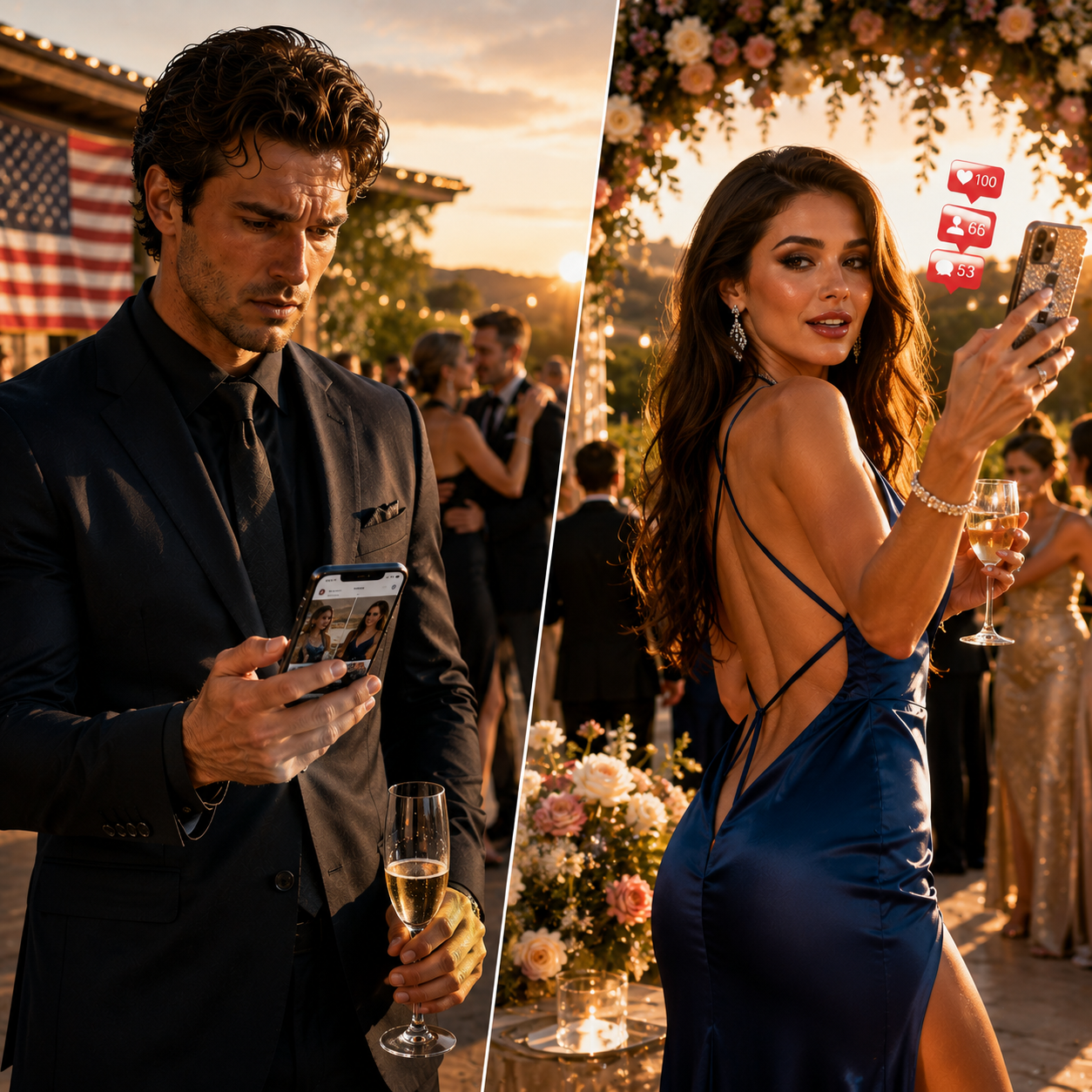
When I picked her up that Saturday afternoon, she looked stunning in a dark blue silk dress that perfectly matched the vineyard’s floral arrangement.
Later, I learned that wasn’t accidental.
She had researched the bride’s Pinterest boards weeks in advance.
That was Cassandra.
Nothing was spontaneous.
Everything was strategic.
The wedding itself felt magical. Warm lights hanging across vineyards. String music drifting through the evening air. Expensive wine flowing endlessly. We danced for hours. Took photos together. Kissed under decorative lanterns while strangers smiled at us like we were one of those couples destined to last forever.
She held my hand all night.
Introduced me proudly to friends.
Rested her head against my shoulder during speeches.
At one point, while we danced slowly near the reception stage, she looked up at me and smiled with such softness that I remember thinking maybe I had finally broken through her carefully polished exterior.
Maybe this was becoming real.
Maybe beneath the filters and branding and obsession with appearances, there was still a genuine person underneath.
I was an idiot.
The next morning, I woke up before her and made coffee while sunlight filled the apartment.
Out of curiosity, I opened Instagram.
And there it was.
Her wedding post.
Fifteen story slides.
One curated carousel post.
Hundreds of comments already pouring in.
At first glance, the photos looked beautiful.
Then my stomach dropped.
I wasn’t in any of them.
Not one.
Photos we had taken together had been cropped so precisely it looked surgical. In selfies where removing me entirely wasn’t possible, she cut the image awkwardly to keep only half her face and none of mine. In group shots where I appeared in the background, she blurred me just enough to make my face indistinct.
The caption hit even harder.
“Solo adventures at the most magical wedding. Still searching for my forever person.”
Hashtag still single.
Hashtag wedding season.
Hashtag waiting for the right one.
I stared at the screen while a cold pressure built behind my ribs.
At first, I genuinely tried to rationalize it.
Maybe it was branding.
Maybe it was some weird influencer strategy.
Maybe there was context I didn’t understand.
Then Cassandra walked into the kitchen wearing one of my shirts and glanced casually at my phone.
“Oh,” she said. “You saw the post.”
“Why did you crop me out of every photo?”
She rolled her eyes instantly.
“Mark, it’s just Instagram.”
“That doesn’t answer the question.”
She sighed heavily like I was forcing her into an exhausting conversation.
“My audience engages more with solo content. Couple posts hurt my analytics.”
I nodded slowly.
“So pretending to be single gets more engagement.”
“It’s not pretending. It’s marketing.”
The scary part was how genuinely she believed that.
Then I asked the question that changed everything.
“So this has nothing to do with being embarrassed by me?”
There was a pause.
A tiny one.
But long enough.
And then came the smirk.
That smirk still makes my skin crawl when I think about it.
“Honestly,” she said, “I didn’t want people thinking I downgraded.”
The silence afterward felt violent.
I remember hearing the refrigerator humming behind us while my brain tried to process what she had just admitted.
“Downgraded,” I repeated.
“My ex was literally a model,” she continued casually. “And the guy before him played professional lacrosse. My followers expect a certain image.”
“You mean attractive men.”
“I mean aspirational men.”
I stared at her.
Seven months together.
And this woman genuinely viewed me as a branding problem.
Not a boyfriend.
Not a partner.
An optics issue.
The frightening thing wasn’t her cruelty.
It was her complete lack of shame about it.
“Don’t make this dramatic,” she sighed while checking her phone. “It’s social media. It’s not real life.”
But that smirk had been real life.
The contempt in her voice had been real life.
And suddenly, every subtle insult from the past seven months rearranged itself into clarity.
I didn’t yell.
Didn’t argue.
Didn’t insult her.
I simply finished my coffee and left.
The entire drive home, one thought repeated itself in my head.
If social media mattered more to her than real people, then that was exactly where consequences needed to happen.
So I started digging.
First, I contacted Alyssa, the bride.
After an uncomfortable silence, she admitted Cassandra had done the same thing to her ex-boyfriend Jake.
Claimed he “preferred privacy.”
He didn’t.
Jake turned out to be an accountant who had briefly done print modeling years earlier. The “professional athlete” Cassandra bragged about before him actually managed a sporting goods store.
One by one, I tracked down five former boyfriends.
Every single one told the same story.
Privately adored.
Publicly hidden.
Carefully erased whenever they didn’t fit her aspirational aesthetic.
One ex admitted she refused to post him because he drove a Hyundai.
Another because his teeth weren’t straight enough.
Another because his fashion sense looked “too suburban.”
The more I learned, the more horrifying the pattern became.
Cassandra didn’t date people.
She curated them.
Or concealed them.
Depending entirely on how useful they were to her image.
And suddenly I stopped feeling guilty about what I planned to do next.
I created an account called The Real Cassandra Lee.
No threats.
No lies.
Just evidence.
Unedited wedding photos beside her cropped versions.
Screenshots of “still single” captions beside proof she was in committed relationships.
Statements from exes describing identical experiences.
But the final piece was the recording.
The night before exposing everything, I invited Cassandra over for dinner and deliberately steered the conversation toward relationships and social media while recording audio quietly in my pocket.
I wanted certainty before detonating her world.
What I captured instead was worse than I imagined.
“Instagram is currency,” she explained while sipping wine. “People judge you based on who you associate with.”
“So I’m embarrassing?”
“You’re not embarrassing,” she corrected impatiently. “You’re just basic.”
Basic.
She said it like a diagnosis.
“My audience wants aspiration. Luxury. Fantasy. They don’t want some normal engineer guy who shops at REI and drives a Subaru.”
Then she laughed.
Actually laughed.
“Jake was an accountant. Matt worked retail. Chris drove a Hyundai. Can you imagine posting that?”
For fifteen straight minutes, she explained her worldview with chilling honesty.
Human beings were status accessories.
Relationships were branding tools.
Love was secondary to engagement metrics.
When I uploaded that recording alongside everything else, her carefully constructed online identity exploded instantly.
By noon, influencers in her social circle were reposting clips. Brand partnerships started publicly distancing themselves. Comments flooded her page accusing her of being fake, shallow, narcissistic, cruel.
And suddenly the woman who treated everyone else like disposable props experienced public humiliation herself.
My phone started ringing nonstop.
Thirty-one missed calls.
Dozens of texts.
“You’re ruining my life.”
“This is harassment.”
“You’re obsessed.”
“My sponsors are dropping me.”
I ignored every message.
Then came the banging on my apartment door.
I watched from inside my car as Cassandra pounded against it screaming my name.
For the first time since I met her, she looked completely unfiltered.
No lighting tricks.
No careful angles.
Just panic.
I sent her one final text.
“I didn’t want people thinking I downgraded my standards by dating someone this superficial. But don’t worry. It’s just social media, right?”
Then I drove away.
The fallout lasted weeks.
Three brand deals vanished almost immediately. Old classmates and former friends started sharing their own stories about Cassandra’s obsession with image and status. Her follower count collapsed. Her carefully crafted online empire cracked apart in public.
Eventually, she sent an apology email.
Not defensive.
Not manipulative.
Just tired.
She admitted she had become addicted to validation and external approval. She admitted somewhere along the way she stopped seeing people as human beings and started seeing them as accessories.
Maybe she meant it.
Maybe it was just another performance.
Honestly, I no longer cared enough to investigate.
Three months later, my life feels peaceful again.
I changed jobs and moved into a better apartment closer to hiking trails. I’m seeing someone new now, a woman who posts blurry unfiltered photos of us laughing and never once asks whether I fit her “brand.”
And every time she casually reaches for my hand in public without shame or calculation, I realize how profoundly Cassandra distorted my understanding of affection.
The strange thing is, I don’t hate Cassandra anymore.
I pity her.
Imagine being so desperate for admiration from strangers that you erase the people who genuinely love you.
Imagine becoming so obsessed with appearing desirable that authentic connection starts feeling like a threat to your image.
That’s not confidence.
That’s loneliness wearing expensive makeup.
Last I heard, Cassandra rebuilt part of her following using a more “authentic” social media approach. Therapy posts. Vulnerability content. Discussions about growth and accountability.
Maybe she changed.
I hope she did.
Because eventually everyone reaches the same unavoidable moment.
The moment where the filters come off.
The moment where no amount of editing can save you from the truth about who you’ve become.
And when that moment finally arrives, all that remains is the real version of you.
Uncropped.
Unfiltered.
And impossible to hide anymore.
![[FULL STORY] My Girlfriend and Her Friends Staged a Fake Breakup to Humiliate Me, So I Exposed Her Four-Month Affair in Front of Everyone.](https://social-media.rabedo.com/thumbnails/1777002127_C17.png)
![[FULL STORY] She Handed Me Divorce Papers in Front of My Boss… She Didn’t Know I Owned His Company](https://social-media.rabedo.com/thumbnails/1776765378_D80.jpeg)