The morning Governor Everett Cole planned to announce the most aggressive anti-corruption campaign in state history, the woman carrying his arrest warrant entered the capitol through the public doors with rain on her coat and no one important at her side.
That was the first reason Patrick Voss underestimated her.
The second was that she did not look angry.
People who came to destroy powerful men were supposed to look dramatic, at least in Patrick’s mind. They were supposed to shout outside barricades, wave signs, wear slogans, cry into microphones, or push through crowds with desperation written all over their faces. This woman did none of that. She walked through the marble rotunda of the Harrington State Capitol at 8:17 a.m. with a calm expression, a slim black leather folder tucked beneath one arm, and a phone in her left hand displaying a message she had already read six times.
Final authorization confirmed. Do not engage until warrant threshold is triggered or subject attempts flight.
She slipped the phone into her coat pocket and kept walking.
The capitol was dressed for television. Flags stood in careful rows near the east press room. Brass railings had been polished until they glowed. Staffers in dark suits hurried across marble floors carrying clipboards, coffee trays, earpieces, and the nervous energy of people who knew the day had been designed to appear effortless. Camera crews were already setting up. Local anchors checked their reflections in black phone screens. A state police officer stood beside the main hallway with his hands folded in front of him, face blank, eyes moving.
Above the press room doors, a blue banner hung from the balcony.
A NEW ERA OF PUBLIC TRUST.
Special Agent Maya Reynolds stopped beneath it for one second.
Not long.
Just long enough to appreciate the insult.
Then she continued toward the security table.
Inside the press room, Governor Everett Cole was scheduled to speak in forty-three minutes. The official subject was ethics reform. The unofficial purpose was survival. For three weeks, rumors had spread through the capital like smoke under a door. Missing emergency funds. Federal subpoenas. Anonymous staffers talking to investigators. A nonprofit director who had vanished from public view. A construction company with no employees receiving millions in disaster recovery grants. Governor Cole had responded the way polished men often did when cornered. He organized a press conference about transparency.
Maya had seen the strategy before.
The guilty loved microphones when they still believed they controlled the sound system.
She approached the first checkpoint, where a young staff assistant looked up from a tablet.
“Name?”
“Maya Reynolds.”
The assistant scrolled. “Press outlet?”
“Not press.”
“Staff?”
“No.”
The assistant blinked and glanced toward the hallway behind her.
Maya opened her coat just enough to show the federal credential clipped inside.
The assistant’s face changed instantly.
“Oh,” she whispered.
Maya held the credential open for only a second. “I need access to the east press room and the governor’s holding area.”
“Yes, ma’am. One moment.”
The assistant reached for her radio, but before she could speak, a man’s voice cut across the hallway.
“That won’t be necessary.”
Maya did not turn immediately. She had heard that voice in recordings, on calls, and once on a hidden microphone placed inside a donor dinner where men laughed about poor neighborhoods as if poverty were a budgeting inconvenience. Patrick Voss always sounded the same: smooth, impatient, and deeply convinced that the world became orderly when people feared disappointing him.
He stepped into view wearing a charcoal suit, silver tie, and the expression of a man who had never carried his own bad news. He was forty-six, lean, handsome in a narrow way, with cold blue eyes and a statehouse pin on his lapel. His official title was Senior Communications Director. His real job was cleaner. Fixer. Gatekeeper. Threatener. The man who could make a complaint disappear before the governor had to know it existed. Or, more often, because the governor already did.
Patrick looked at the assistant first. “Lena, why are you holding up the line?”
The assistant swallowed. “She says she needs access.”
Patrick finally looked at Maya.
His eyes moved over her face, her coat, her folder, her shoes. Maya watched him inventory her and arrive at the wrong conclusion.
“She can wait outside with the public,” he said.
Maya met his eyes. “Mr. Voss, I need to enter the press room.”
His eyebrows lifted slightly. “You know my name. Congratulations.”
“I also know you received a federal preservation notice last night at 11:42 p.m.”
The assistant went still.
Patrick’s smile did not move, but something behind it sharpened.
“I receive a lot of paperwork.”
“This one required your office to preserve all communications, schedules, press materials, and internal movement logs related to today’s event.”
Patrick glanced at the folder under her arm. “And you are?”
“Maya Reynolds.”
“From?”
“Federal Office of Public Integrity.”
His smile widened.
Not because he was amused.
Because he had decided to perform amusement.
“Of course you are.”
Maya said nothing.
Patrick stepped closer and lowered his voice, though not enough to keep the assistant from hearing. “Do you know how many people walk into this building claiming to be federal something? Federal auditor. Federal investigator. Federal monitor. Half of them are bloggers. The other half are activists with printed badges from the internet.”
“You can verify my credentials with the U.S. attorney’s office.”
“I’m sure I can.”
“Then do it.”
He stared at her.
Maya could almost hear the gears turning. Verification was easy. One phone call. Thirty seconds. Maybe less. But verification carried risk. If she was exactly who she said she was, Patrick would lose control of the doorway. So he did what men like him always did when truth threatened procedure.
He delayed.
“The governor is preparing for a live event,” Patrick said. “No unscheduled access.”
“I am scheduled.”
“Not on my list.”
“Your list is not the governing authority today.”
The assistant looked down at the tablet, terrified of being seen listening.
Patrick’s face tightened.
“Careful,” he said softly.
Maya tilted her head. “With what?”
“This building has rules.”
“So does obstruction.”
The word landed harder than Patrick expected. His eyes flicked toward the nearest camera crew, still too far away to hear clearly but close enough to notice tension. Two reporters looked over. A photographer lifted his lens halfway, instinctively hungry for anything unscripted.
Patrick noticed.
That embarrassed him.
And embarrassment was dangerous in men who built their lives around controlling rooms.
He straightened and raised his voice slightly. “Ma’am, this is a secure area. If you do not have proper press credentials, you need to leave this hallway.”
Maya’s expression remained calm. “I am not here as press.”
“Then you’re not coming in.”
“Mr. Voss, I am giving you one final opportunity to contact federal counsel before this becomes part of the record.”
He laughed once.
It was a beautiful political laugh. Warm enough for donors. Sharp enough for staff.
“The record?”
“Yes.”
“You hear that, Lena?” Patrick said, not looking away from Maya. “She’s making a record.”
The assistant did not answer.
Maya did not move.
Patrick stepped closer. “Let me explain something to you. This is the governor’s press room. This is the governor’s event. Every person in that room is cleared by this office. You do not walk in here with a folder and a serious face and start throwing around federal language because you think it makes people nervous.”
Maya looked past him toward the closed double doors.
Behind them, she could hear movement. Chairs scraping. Microphones being tested. Someone saying, “Check, check, one two.” The performance was almost ready.
“I need access to Governor Cole before he takes the podium,” she said.
Patrick’s smile disappeared.
“There it is.”
“What?”
“The real reason you’re here.” He turned slightly toward the two security officers near the wall. “She wants to confront the governor.”
Maya looked at the officers. “No. I need to serve federal documents.”
Patrick snapped his fingers at the older officer. “Tom.”
The officer approached. His nameplate read BARNES. Maya knew his name too. Retired sheriff’s deputy. Private contractor. Paid through Capitol Event Logistics, one of the shell vendors in the investigation. He had signed three false overtime statements during the governor’s reelection tour.
Barnes looked at Maya’s hands first.
Then at her folder.
“What’s the issue?”
Patrick sighed dramatically. “She’s refusing to leave a restricted hallway.”
“That is false,” Maya said.
Patrick ignored her. “No credentials. No appointment. Claims she’s federal.”
Barnes’s face hardened with the speed of someone who enjoyed being given permission.
“Ma’am, you need to come with me.”
Maya opened her coat again, slower this time, revealing the credential clipped inside.
Barnes glanced at it for less than half a second.
“Could be fake.”
Maya looked at him. “You did not examine it.”
“I don’t need to.”
“Yes,” she said. “You do.”
Patrick stepped between them, blocking the view of the badge from the hallway. “This is exactly the kind of disruption we expected today. They send someone calm-looking first, then the cameras catch a scene, then suddenly the governor is accused of hiding from questions.”
Maya studied him.
“You rehearsed that.”
His eyes flashed.
The assistant’s hand trembled over the tablet.
A woman from Channel 11 had now turned fully toward them. Her cameraman followed.
Patrick saw the lens.
His political instincts took over.
He raised both hands in a peaceful gesture and spoke louder. “Ma’am, we respect your right to protest. We respect everyone’s voice. But this is not the place to disrupt a public safety announcement.”
Maya almost admired the speed of the lie.
Almost.
“I am not protesting.”
“Then why won’t you leave?”
“Because I have lawful authority to enter.”
Patrick looked toward the camera, then back at her. His voice softened into something poisonous.
“You people always think if you say ‘lawful authority’ slowly enough, everybody else has to pretend you belong.”
The hallway changed.
Not visibly to everyone.
But Maya felt it.
The assistant looked up in shock. Barnes’s jaw tightened, not because the statement bothered him, but because Patrick had said the quiet part with a camera nearby. The Channel 11 reporter took one step closer. Maya heard the soft mechanical adjustment of a lens.
She looked at Patrick.
For a moment, she saw not him but every man who had ever spoken over her in a conference room, every supervisor who had praised her work while calling her “intense,” every defense attorney who had smiled at her on the stand as if intelligence looked unnatural on her face. She saw her father sitting at a kitchen table with bills spread out in front of him after the flood took his shop and the state relief check never came. She saw her mother saying, “Baby, don’t let them make you loud just so they can call you angry.”
So Maya did not get loud.
She gave Patrick something worse.
Silence.
Then she said, “Repeat that.”
Patrick blinked.
“What?”
“Repeat what you just said.”
He realized then that the camera was closer.
He smiled, but it had lost polish.
“I said you need to leave.”
“No,” Maya said. “You said, ‘You people.’”
Barnes shifted. “Ma’am—”
Maya did not look at him. “Mr. Voss, do you want to repeat that for the record?”
Patrick’s mouth tightened.
That was when Governor Everett Cole appeared at the far end of the hallway.
He had not entered through the main press room doors. He came from the private executive corridor with two aides, his wife, and the carefully lit confidence of a man who knew cameras loved him. He was tall, broad-shouldered, silver at the temples, wearing a navy suit and a pale blue tie. His face carried the practiced warmth of campaign posters and Sunday interviews. The kind of warmth that made people believe he listened even when he was calculating how to survive what they had said.
He paused when he saw the scene.
Patrick turned immediately.
“Governor, we have a minor disruption.”
Cole’s eyes moved to Maya.
The recognition was not instant.
Then it was.
Not of her face.
Of her name.
Maya saw the moment memory struck him. His lawyers had warned him about her. Federal Agent Maya Reynolds. Public Integrity. The woman who found the missing relief money in Northpoint County. The woman who flipped a deputy treasurer in Mercer City. The woman whose subpoenas arrived like weather warnings: calm paper before a flood.
Cole’s smile held.
Barely.
“Maya Reynolds,” he said.
Patrick turned back toward her so fast it was almost comical.
Maya looked at the governor. “Governor Cole.”
Patrick’s face lost color.
Cole walked closer, one measured step at a time. “I wasn’t aware you would be attending today.”
“You were notified through counsel.”
“Were we?” His smile remained in place. “These things sometimes get caught in legal channels.”
“No,” Maya said. “They don’t.”
A few reporters had now gathered fully. The hallway was no longer background. It was becoming the story.
Cole noticed. Of course he noticed.
He turned slightly toward the cameras with his public face restored. “Agent Reynolds, we are always happy to cooperate with lawful inquiries. My administration has been nothing but transparent.”
Maya held his gaze. “Then you won’t object to immediate access.”
“To what?”
“The press room, the holding area, and your communications director.”
Patrick swallowed.
Cole smiled. “That sounds rather broad for a press conference.”
“It is narrow for a corruption investigation.”
The words hit the hallway like a dropped glass.
Someone gasped.
The Channel 11 reporter whispered, “Are you getting this?”
The cameraman nodded.
Cole’s smile finally vanished.
Only for a second.
Then it returned, colder.
“Agent Reynolds, I suggest we speak privately.”
“No.”
Patrick stepped forward, desperate to regain his place in the room. “Governor, she’s been aggressive from the moment she arrived.”
Maya looked at him.
“You destroyed my access request.”
“I discarded a piece of paper.”
“You refused credential verification.”
“You refused to cooperate.”
“You directed security to remove me.”
“Because you were disruptive.”
“You made a racial remark on camera.”
His face went white.
Cole turned his head slowly toward Patrick.
That was when Patrick panicked.
Not dramatically. Not yet. But enough to make one final, fatal mistake.
He reached for Maya’s folder.
“I want to see what she’s carrying.”
Maya pulled it back.
Patrick grabbed the edge.
The leather bent between them.
Barnes moved in.
Maya’s eyes sharpened. “Do not touch federal documents.”
Patrick yanked.
The folder snapped open.
Papers slid across the polished floor.
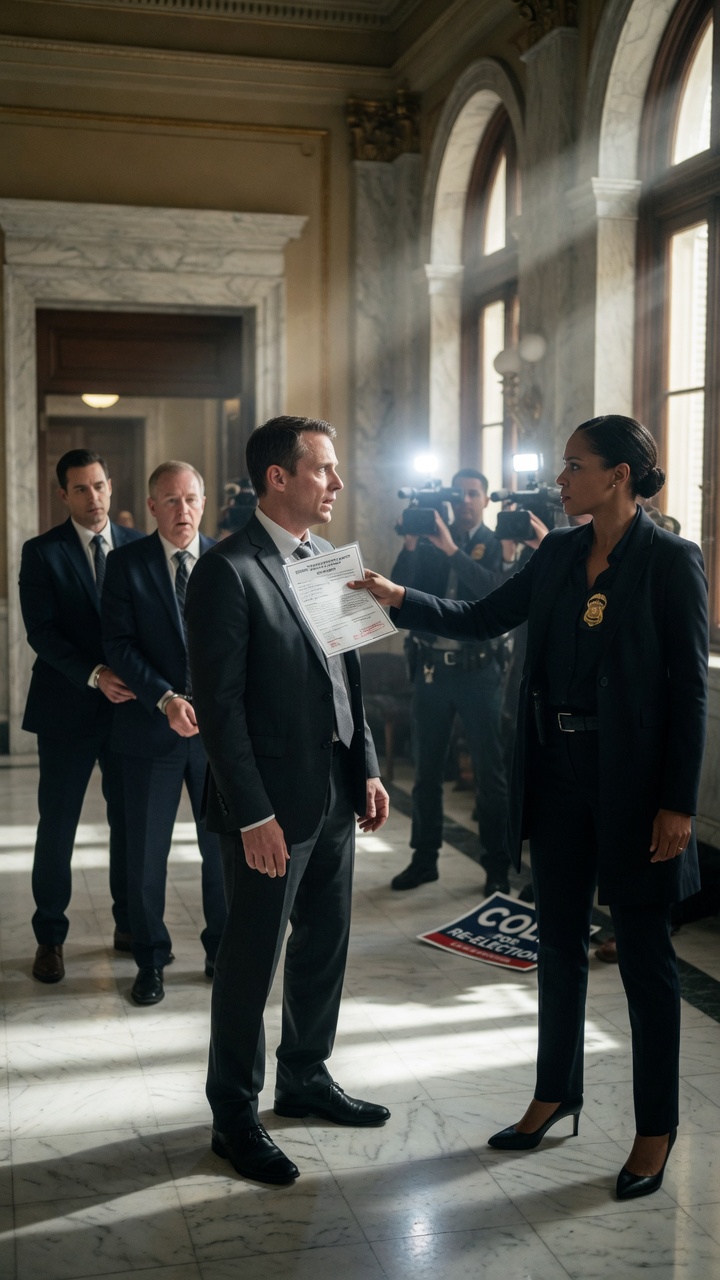
One sealed envelope landed faceup at the governor’s feet.
On the front, in black federal print, were the words:
UNITED STATES DISTRICT COURT
SEALED ARREST WARRANT
SUBJECT: EVERETT JAMES COLE
The hallway froze.
Not quieted.
Froze.
Governor Cole looked down.
His face emptied.
For the first time that morning, all the performance left him. No warmth. No smile. No practiced concern. Only a man staring at his own name on the thing he had spent fourteen months pretending would never arrive.
Patrick whispered, “Governor…”
Maya crouched and began gathering the documents.
Nobody helped.
Nobody moved.
Then, from the main stairwell, came the sound of footsteps.
Not hurried.
Coordinated.
Federal agents entered the hallway from both ends.
Dark suits. Badges visible. Radios low. Calm faces. The kind of calm that meant the argument had ended somewhere else before the room ever knew it began.
Agent Daniel Ruiz, Maya’s partner, approached first.
He looked at the papers on the floor.
Then at Patrick.
Then at Maya.
“Threshold triggered?”
Maya picked up the sealed envelope and stood.
“Yes.”
Cole found his voice. “This is outrageous.”
Maya turned to him. “Governor Everett James Cole, you are under arrest pursuant to a federal warrant for conspiracy, wire fraud, theft of federal disaster relief funds, obstruction of justice, witness intimidation, and destruction of official records.”
Cameras flashed.
Reporters shouted.
Patrick stepped backward.
Barnes looked like he wanted to disappear into the wall.
Cole raised a hand. “Everyone calm down. This is political theater.”
“No,” Maya said. “This was supposed to be private service of a federal warrant before your press event. Your aide turned it into theater.”
Cole’s eyes cut toward Patrick with pure hatred.
Patrick stammered, “I didn’t know—”
Maya looked at him. “You chose not to know.”
Agent Ruiz stepped toward the governor.
Cole lifted his chin, trying to recover dignity the cameras had already watched him lose.
“I will not be handcuffed in front of my wife.”
Maya’s voice did not change. “You should have considered that before stealing money from people who lost their homes.”
His wife flinched.
That struck him more visibly than the warrant.
Ruiz took the governor’s wrist.
Cole resisted for half a second, just enough for every camera to catch it. Then the handcuffs clicked.
The sound was small.
The hallway heard nothing else.
Patrick tried to move toward the press room. Two agents blocked him.
“What are you doing?” he snapped. “I’m staff.”
Maya turned to him. “Patrick Voss, you are being detained pending charges for obstruction of a federal investigation, intimidation of a federal officer, and destruction of federal materials.”
His mouth fell open.
“I didn’t destroy anything.”
Maya looked at the assistant. “Lena, would you please point to the trash bin where Mr. Voss placed the document?”
The young assistant stood paralyzed.
Patrick stared at her.
All her fear collected in that stare. Her job. Her rent. Her health insurance. The recommendation letter she needed for law school. The small life people like Patrick held hostage because power rarely has to be large to be cruel.
Maya softened her voice. “Lena.”
The assistant swallowed. Then she pointed.
“There,” she whispered.
Patrick looked at her as if she had betrayed him.
But betrayal requires loyalty.
Fear was not loyalty.
An agent retrieved the folded meeting confirmation from the trash with gloved hands and placed it into an evidence sleeve.
Maya looked back at Patrick.
“There it is.”
His face twisted. “This is insane. I was protecting the governor.”
“No,” Maya said. “You were protecting the lie.”
The press room doors opened behind them.
Inside, rows of reporters stood facing a podium that would never be used. The banner behind it still read A NEW ERA OF PUBLIC TRUST.
One by one, cameras turned away from the empty podium and toward the governor in handcuffs.
For the first time in his political life, Everett Cole had no microphone.
And everyone was finally listening.
The arrest should have been the end of the morning.
It was not.
Power, once cracked, tends to leak hidden things.
By noon, federal agents had sealed the governor’s executive suite, the communications office, and the emergency management records room. Staffers were separated for interviews. Phones were collected. Laptops were imaged. The press conference became continuous live coverage. Outside, protesters arrived after seeing the broadcast, though most were not chanting at first. They simply stood in the rain holding printed photographs of flooded neighborhoods, collapsed roofs, mold-covered apartments, and relatives who had waited for relief money that never came.
Maya spent the next three hours in a temporary command room set up inside a legislative conference suite. She did not eat. She drank cold coffee because someone handed it to her and because movement needed fuel. Across the table, Agent Ruiz reviewed seized communications from Patrick’s office. Another analyst pulled deleted calendar entries from a deputy chief of staff’s tablet.
At 12:41 p.m., Ruiz looked up.
“We found the donor dinner recording.”
Maya crossed the room.
On the screen was a recovered audio file from Patrick’s encrypted folder. The date was thirteen months earlier. The location matched the private dining room of the Halcyon Club. The voices were grainy but clear.
Patrick first.
“The flood money has to move before the audit cycle closes.”
Then another voice. Marcus Bell, director of the Bright Future Relief Foundation, the governor’s fake charity partner.
“We can’t keep paying families in the East Corridor. They’re not our people.”
Laughter.
Then Governor Cole.
Soft. Calm. Unmistakable.
“Pay enough to keep cameras away. Move the rest through reconstruction consulting. Nobody reads disaster contracts after the first headline.”
Maya closed her eyes for one second.
Not from surprise.
From the familiar fatigue of hearing cruelty spoken casually by people in expensive rooms.
The audio continued.
A woman’s voice entered, nervous. “Samuel Price is asking questions.”
Maya’s eyes opened.
Ruiz looked at her.
Samuel Price.
The name had lived inside her case file for months.
State emergency compliance officer. Former Army engineer. Whistleblower. Dead in a single-car crash two weeks after submitting an internal memo about irregular contractor payments. The crash report said he had been drinking. His widow said he never drank. His daughter had emailed Maya eight times before the federal investigation officially opened.
On the recording, Patrick sighed.
“Price is a problem.”
Governor Cole answered, “Then solve him administratively.”
Bell laughed. “What does that mean?”
Cole’s voice dropped.
“It means I don’t want to hear his name again.”
The room went still.
Maya stared at the waveform on the screen.
Ruiz said quietly, “That’s not enough for homicide.”
“No,” Maya replied. “But it tells us where to look.”
The analyst at the other end of the table raised a hand. “Agent Reynolds?”
Maya turned.
“I found something in Voss’s deleted texts. Same week Price died.”
The analyst projected the thread.
UNKNOWN: He copied the files.
VOSS: Where?
UNKNOWN: Personal drive. Maybe home.
VOSS: Then get to the house before the widow does.
UNKNOWN: And Price?
VOSS: He chose to be a hero. Heroes have accidents.
No one spoke.
Maya felt the room tilt, but her face stayed still.
“Trace the unknown number,” she said.
“Already running.”
Ruiz watched her carefully. “Maya.”
“I’m fine.”
“You don’t have to be.”
She looked at him then.
That was why she liked Ruiz. Not because he was gentle. He was not. He was blunt, meticulous, impossible to impress. But he never mistook composure for comfort.
Maya turned back to the screen. “Samuel Price’s widow deserves a call before this leaks.”
Ruiz nodded. “I’ll arrange it.”
“No,” Maya said. “I’ll do it.”
He did not argue.
At 1:16 p.m., Maya stepped into an empty office and called Denise Price.
The woman answered on the second ring.
“Agent Reynolds?”
“Yes, Mrs. Price.”
A pause.
“You found something.”
Maya looked through the window at the rain streaking across the capitol glass.
“Yes.”
On the other end of the line, Denise inhaled sharply. It was not relief. Not yet. It was the sound of someone afraid to hope because hope had betrayed her too many times.
“Was he drunk?” Denise asked.
Maya closed her eyes briefly.
“No.”
The silence that followed was not empty. It was eleven months of unanswered emails. It was a funeral. It was a daughter refusing to drive past the curve where her father died. It was a widow reading a police report that turned the man she loved into a careless drunk because the truth was inconvenient.
Denise began to cry.
Maya let her.
There were moments when words were just noise standing too close to grief.
Finally, Denise whispered, “I knew.”
“I know.”
“No one believed me.”
“I believe you.”
Another sob. Then, softer, “Thank you.”
Maya gripped the phone.
“Mrs. Price, this is not finished. But today, the official story ended.”
When Maya returned to the command room, Patrick Voss was sitting in a chair near the wall with an agent beside him. His tie had been removed. His hair had fallen out of place. Without the suit’s authority and the governor’s shadow, he looked like what he had always been: a frightened man who had borrowed power from someone worse.
He saw Maya and tried one last time.
“Agent Reynolds.”
She ignored him at first.
“I can help,” he said.
That made her stop.
She turned slowly.
Patrick leaned forward. “I know things. Things that aren’t in files.”
Maya studied him.
His eyes darted toward the agent beside him, then back to her.
“You want Cole? I can give you Cole.”
Maya walked closer. “You already did.”
His mouth tightened.
“I mean more.”
“You mean you want a deal.”
“I mean I was following instructions.”
Maya looked down at him. “This morning, before you knew who I was, whose instructions were you following?”
He said nothing.
“You humiliated me because you thought I had no power,” she continued. “You destroyed a document because you thought no one would punish you. You ordered security to remove me because the cameras were watching and you wanted control. That wasn’t Cole. That was you.”
Patrick’s face reddened. “You don’t understand what it’s like in that office.”
“I understand exactly what it’s like. Cowards create systems where cruelty feels like job performance.”
His eyes sharpened with hate.
There he was again.
Maya almost preferred it to the begging. At least hatred was honest.
“You think you’re better than me,” he said.
“No,” Maya replied. “I think I’m responsible for what I do. You should try it.”
He looked away first.
At 3:30 p.m., the unknown number from Patrick’s texts traced back to Aaron Kline, a former state police investigator now working for a private security firm owned by one of the governor’s donors. By 4:10, Kline was in custody. By 5:45, he confirmed that Samuel Price had been followed for six days before his crash. By 7:20, agents recovered a storage unit rented under Kline’s sister’s name. Inside were three boxes of documents taken from Price’s home.
One of those boxes contained the personal drive.
The drive contained everything.
Samuel Price had done what honest people often do when surrounded by corruption. He had made copies because he knew truth needed witnesses. Payment charts. Contract emails. Photos of unfinished rebuilding sites. Internal memos. A recording of Patrick Voss threatening him in a parking garage.
And one video.
Maya watched it alone at 10:38 p.m.
Samuel Price sat at his kitchen table wearing a faded gray sweatshirt, his face tired, his voice steady.
“If you’re watching this,” he said, “something happened to me.”
Maya did not move.
Samuel looked slightly off-camera, as if listening for his family upstairs.
“Governor Cole’s office diverted relief money. Not mismanaged. Diverted. They knew families were still displaced. They knew contractors were fake. I sent reports. They buried them. Patrick Voss told me if I kept pushing, my wife would lose her nursing license over a fabricated complaint. He said my daughter’s scholarship could disappear. I’m recording this because I don’t know who to trust anymore.”
He held up a printed ledger.
“The money was moved through Bright Future Relief Foundation and three shell vendors. Cole approved the structure. Voss enforced it. Bell moved the funds.”
Samuel swallowed.
“I’m scared. I won’t pretend I’m not. But people died in that flood. People are still living in houses that should have been condemned. If I stay quiet, I’m helping them steal twice. First the money. Then the truth.”
The video ended.
Maya sat in the dark office long after the screen went black.
She thought of her father then, though she tried not to on active cases.
Her father had not been a whistleblower. He had owned a small grocery store in West Marrow, a town drowned by the same storm system that had flooded half the state. He filed for recovery funds after the roof collapsed and the refrigeration failed. For months, he called state offices. Left messages. Filled out forms. Sent photographs. He received one letter saying his claim was under review.
Then nothing.
The store closed.
He sold his truck.
He stopped sleeping.
Six months later, he suffered a stroke behind the empty deli counter while sorting unpaid invoices.
Maya knew the governor had not personally caused her father’s stroke. She was too disciplined to build false links where evidence did not support them. But she also knew corruption was rarely clean enough to kill directly. It weakened beams. Delayed medicine. Stole repairs. Buried warnings. Turned stress into illness and poverty into early funerals. Powerful men loved distance because distance made murder look like paperwork.
Her father’s name was not in the case file.
But families like hers were everywhere inside it.
That was why she had stayed precise.
Anger could point her toward the door.
Only evidence could open it.
The indictment expanded two weeks later.
By then, the image of Governor Everett Cole in handcuffs beneath his own public trust banner had been replayed millions of times. Patrick Voss became a meme for all the wrong reasons. The clip of him saying “You people” before discovering Maya’s identity circulated with captions, outrage, debate, and the ugly little arguments people always start when they want prejudice to be anything except what it is.
Maya avoided all of it.
She testified before the grand jury. She met with prosecutors. She helped Denise Price prepare for the day the official crash narrative would be corrected. She reviewed victim impact statements from flood survivors who had slept in cars, churches, moldy duplexes, and relatives’ living rooms while public money vanished into consulting contracts.
One statement came from a woman named Althea Brooks, seventy-three, whose home had been marked repaired though no contractor ever came.
Another came from a father whose son’s asthma worsened in a FEMA trailer the state kept promising was temporary.
Another came from a teenager who wrote, “My mom cried every time the governor came on TV talking about rebuilding because our ceiling still leaked on my bed.”
Maya read every word.
Not because she needed motivation.
Because numbers were never just numbers.
Trial began the following spring.
Governor Cole arrived at court every morning in expensive suits and diminished confidence. Patrick Voss arrived through a side entrance after agreeing to cooperate partially, which meant telling enough truth to reduce his own damage while pretending every cruelty had been administrative pressure. Marcus Bell pleaded guilty before opening statements. Aaron Kline fought the charges until prosecutors played Samuel Price’s kitchen table video in pretrial hearings.
The courtroom was full the day Maya took the stand.
Cole’s attorney tried charm first.
“Agent Reynolds, you’ve built a reputation as a very determined investigator, haven’t you?”
“I do my job.”
“And sometimes that job involves targeting elected officials.”
“It involves investigating crimes.”
“Even when those officials are politically controversial?”
“Especially when they control public money.”
He smiled for the jury.
“You were physically removed from the capitol hallway that day, correct?”
“Yes.”
“Embarrassing, I imagine.”
Maya looked at him. “For them.”
A few jurors shifted.
The attorney’s smile thinned.
“You didn’t identify yourself immediately to Mr. Voss, did you?”
“I gave him my name and agency. I requested verification.”
“But you did not display your badge to every person present.”
“I displayed credentials at the checkpoint. Mr. Voss blocked further verification.”
“Isn’t it true that you allowed the confrontation to escalate?”
“No.”
“Agent Reynolds, you stood there while confusion grew.”
“There was no confusion.”
He paused.
Maya continued, “There was refusal.”
The courtroom went quiet.
The attorney recovered. “You’re saying Mr. Voss knew exactly who you were?”
“I’m saying he had multiple opportunities to know and chose the version of events that gave him power.”
“And Governor Cole?”
Maya turned toward the defense table.
Cole watched her with the same polished hatred he had worn in the hallway after the warrant landed at his feet.
“Governor Cole recognized my name,” she said. “He knew my office. He knew the investigation. And he allowed his aide to continue obstructing until the warrant threshold was triggered.”
The attorney leaned on the podium.
“You make it sound dramatic.”
Maya looked back at him.
“It was criminal. The drama was optional.”
The jury convicted Cole on twenty-two counts.
When the verdict was read, Denise Price cried without covering her face. Her daughter held her hand. Across the aisle, flood survivors sat shoulder to shoulder. Some nodded. Some wept. Some looked too exhausted to react. Justice rarely arrived looking like enough.
Cole stood very still.
Patrick Voss stared at the floor.
Maya watched from the back row.
She did not smile.
After sentencing, Denise found her in the courthouse hallway.
For a moment, neither woman spoke.
Then Denise hugged her.
Maya stiffened for half a second, then softened.
“Thank you for bringing my husband back to us,” Denise whispered.
Maya closed her eyes.
“I wish I could have done more.”
“You did what he asked.” Denise stepped back, tears in her eyes. “You made them hear him.”
Outside the courthouse, reporters waited. Maya walked past most of them, but one question followed her down the steps.
“Agent Reynolds, what did this case prove?”
She stopped.
Rain had begun again, light and cold, dotting the courthouse stone. Across the street, the capitol dome rose above the city, beautiful from a distance. Buildings like that always were.
Maya turned.
“It proved corruption is not just money moving illegally,” she said. “It is a locked door. It is a delayed check. It is a fake repair. It is a family being told to wait while someone powerful gets richer from their waiting. And sometimes it is a man in a suit deciding a woman with authority does not look like she belongs.”
The reporters went silent.
Then the questions started again, louder this time.
Maya did not answer more.
She had already said what mattered.
Months later, the east press room reopened after renovations. The state removed the banner that had read A NEW ERA OF PUBLIC TRUST. No one admitted who ordered it thrown away. In its place, near the entrance, they mounted a small plaque with the names of public employees and citizens whose complaints had helped expose the relief fund scandal.
Samuel Price’s name was first.
Maya visited once, privately, before a training session with new ethics officers.
The hallway looked different. New carpet. Brighter lights. A reconfigured checkpoint. Clear procedures posted beside the doors.
FEDERAL AND STATE OVERSIGHT ACCESS MUST BE VERIFIED BEFORE DENIAL.
Maya stood before that sign longer than she meant to.
A young staffer approached carefully.
“Agent Reynolds?”
Maya turned.
The young woman looked familiar. Then Maya recognized her.
Lena.
The assistant from the checkpoint.
She looked older somehow, though less than a year had passed. More certain. Less folded into herself.
“I wasn’t sure you’d remember me,” Lena said.
“I remember.”
Lena swallowed. “I wanted to tell you I resigned from the governor’s office after that day. I’m with the inspector general’s office now.”
Maya smiled faintly. “Good.”
“I should have spoken sooner.”
Maya looked toward the doorway where Patrick Voss had once stood.
“Yes,” she said.
Lena flinched slightly.
Maya let the truth sit there for a moment before adding, “But you spoke when it counted.”
Lena’s eyes filled. “I was scared.”
“I know.”
“I still am, sometimes.”
“That means you understand the cost.”
Lena nodded.
Maya glanced at the posted access rules. “Just don’t let fear become policy.”
Lena absorbed that like an instruction.
Maybe it was.
After the training session, Maya walked alone through the rotunda. Afternoon light spilled through the dome windows, turning the marble gold. Tourists moved quietly near the historic exhibits. A group of schoolchildren stood beneath a portrait of the state’s first governor, listening to a guide explain democracy in simple language adults kept making complicated.
Maya paused near the public doors.
For a moment, she saw that morning again.
Patrick’s smile.
Barnes’s hand.
The warrant sliding across the floor.
Cole’s face when his name appeared on sealed federal paper.
People often asked her whether it felt satisfying.
The answer was complicated.
Satisfaction was too small a word for what justice did and did not repair. It did not reopen her father’s store. It did not give Denise Price her husband back. It did not restore the years stolen from families who had lived under leaking roofs while officials toasted themselves at donor dinners. It did not erase Patrick’s words or Cole’s smile or the humiliation performed beneath cameras.
But it changed the record.
And sometimes the record was where resurrection began.
Maya stepped outside.
The rain had stopped. The pavement shone under a pale evening sky. Across the street, people moved through the city carrying groceries, briefcases, backpacks, umbrellas, ordinary burdens. None of them looked up at the capitol for long.
That was the quiet danger of public buildings.
People stopped looking at them until something inside went wrong.
Maya’s phone buzzed.
A message from Ruiz.
New referral. Harbor County. Relief contracts again. Looks ugly.
Maya stared at the screen.
Then she typed back.
Send it.
She put the phone away and descended the steps.
Behind her, the capitol doors opened for another group of visitors.
No one stopped them.
No one asked whether they belonged.
No one threw a woman into the rain to protect a man behind a podium.
Not that day.
Not in that hallway.
Not while the record still remembered what had happened there.
And somewhere deep inside the building, in a press room once prepared for lies, the microphone stands waited in silence, facing the place where Governor Everett Cole had meant to praise himself.
Instead, history had recorded the sound of his handcuffs.
And the calm voice of the woman he should have never allowed them to drag away.
![[FULL STORY] My Fiancée Said She Lost My Ring… So I Posted a Reward and Uncovered the Truth](https://social-media.rabedo.com/thumbnails/1776759317_cdac36af-927a-428f-ba64-94f09222b921.png)