
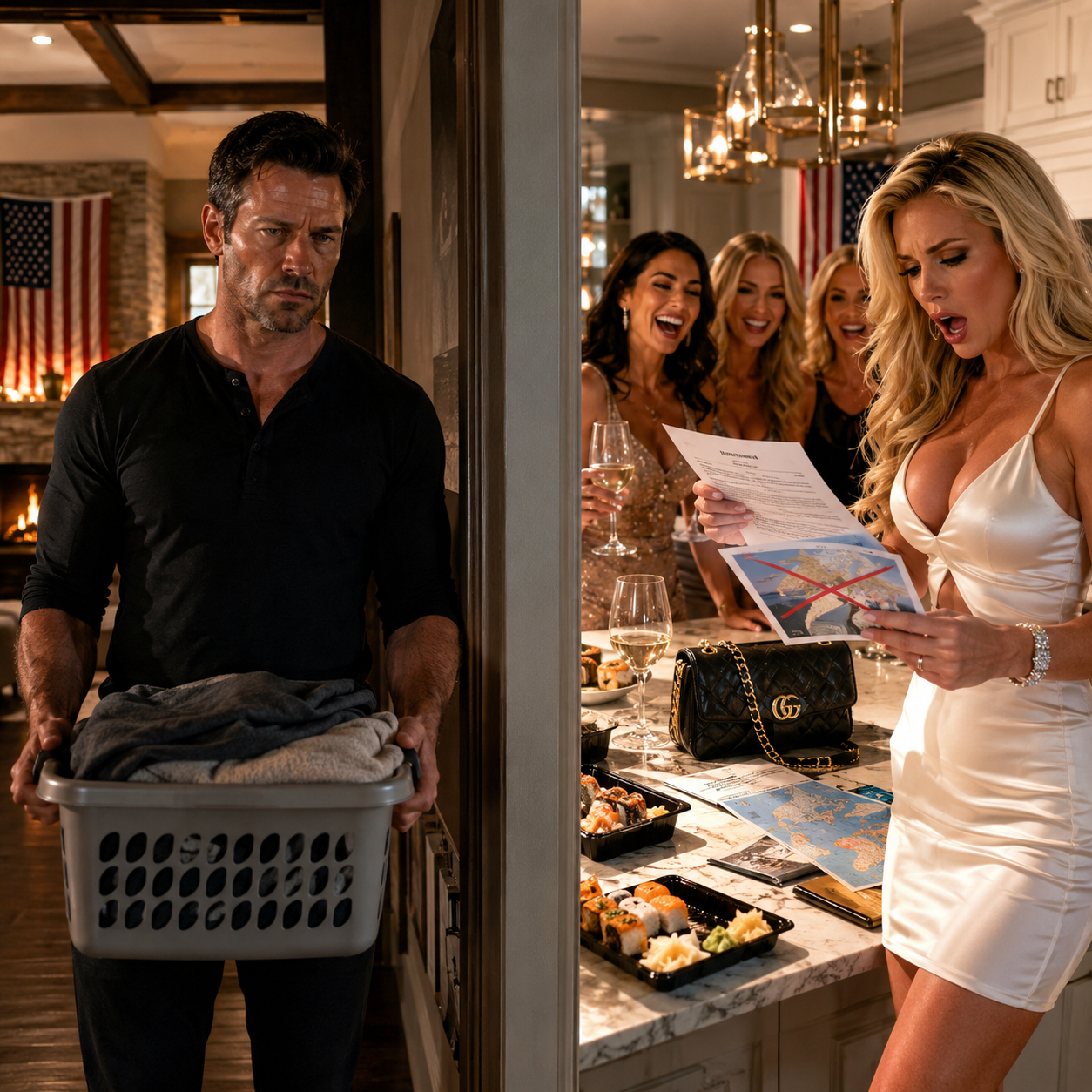
The silence after her words was worse than yelling.
If Natalie had screamed at me, insulted me directly, or thrown something across the kitchen, at least it would have felt honest. Anger is loud, but it is clear. What I heard that night, standing in the shadows of my own hallway, was something colder than anger. It was comfort. It was familiarity. It was the sound of someone reducing a human being to a function so often that eventually, it stopped feeling cruel to them.
“He’s just the provider.”
Then came the laughter. Easy, melodic laughter. The kind of sound people make when everyone in the room already agrees with the premise.
I stood there, thirty-seven years old, holding a plastic basket of warm laundry that I had just folded. Inside that kitchen, my wife was drinking wine bought with my money, sitting in a house I paid for, surrounded by four friends who looked at me like a utility bill with shoulders.
My name is Caleb Mercer. I’m the regional operations director for a medical supply company outside Charlotte, North Carolina. My entire professional life is built on solving expensive problems before they become disasters. I look at systems. I identify bottlenecks. I manage distribution breakdowns and call out vendor lies when they’re dressed up as "unforeseen delays."
The irony? I spent years doing the exact same thing in my marriage without ever admitting it. I was so busy managing the "logistics" of Natalie’s happiness that I forgot to check if I was actually a partner in the firm, or just the silent investor.
Natalie and I met five years ago. At the time, she was working the front desk at a dermatology clinic. She was polished, funny, and had this socially effortless way of making you feel like the only person in the room. On our fourth date, I remember it clearly, she insisted on splitting the bill. She looked me in the eye and said, “Caleb, I never want a relationship where money creates an imbalance. I want a partnership.”
I loved her for that. I really did. Looking back, I wonder if that was the last time she ever told the truth about money.
We got married three years later. By then, I already owned our home—a solid brick house in a quiet neighborhood with old oaks and a backyard meant for the kids and the dog we always talked about. At first, the "partnership" was real. She contributed to groceries. She bought decor. She was involved.
But then, slowly—so slowly I almost didn't notice the shift—the "partnership" turned into "entitlement."
It started with the mortgage. "It just makes more sense if you cover the big stuff since you make more," she said. Then it was the utilities. Then the car insurance. Then the "emergencies" that seemed to happen every month. Eventually, it reached a point where her entire paycheck stayed in her private account for "her things," while my income became "our money."
That was the actual formula. My money was ours; her money was hers.
Resentment in a decent man doesn't arrive like a lightning bolt. It’s more like a slow leak in a basement. You ignore the dampness for a year, then one day you realize the foundation is rotting. Natalie stopped saying thank you. She started rolling her eyes when I asked why our joint credit card had a $900 charge for a "skincare haul." She started calling me "practical" with a sneer, as if being responsible was a personality flaw.
And then there was "The Board."
That’s what Natalie’s four best friends called themselves: Morgan, Elise, Bree, and Tessa. Morgan treated failed relationships like fashion accessories. Elise judged people based on their kitchen countertops. Bree was an "influencer" with forty thousand followers and the financial stability of a raccoon in a trash can. Tessa was the quiet one—the one who dropped the match into the gasoline and then stepped back to watch it burn.
The first time I felt the sting was a year ago at Natalie’s birthday dinner. I had spent three thousand dollars on a private room, a custom menu, and a pair of diamond earrings she’d been hinting at for months.
Halfway through the steak, Elise looked at me and asked, “So, Caleb, are you still doing the traditional setup? You know, where you handle the ‘boring’ stuff like the mortgage so Natalie can focus on her brand?”
Natalie didn't defend me. She just sipped her Cabernet and laughed. “Caleb likes feeling useful, Elise. He’s very… systematic.”
The table erupted in giggles. I sat there, the man who had worked sixty hours that week to fund this very meal, and I smiled. Because as men, we’re trained to absorb humiliation if it’s wrapped in enough social polish.
But then came the Cabo trip.
Natalie’s thirty-fifth birthday was approaching, and "The Board" had decided that a simple dinner wouldn't do. It had to be a luxury villa. Private yacht. Personal chef. Coordinated outfits for every day. A professional photographer because, as Bree put it, “the content opportunities would be insane.”
“It’s my milestone, Caleb,” Natalie told me, her voice sweet as honey when she wanted something. “I just want one week where I don’t have to think about reality. Can’t you do this for me? Or are you going to be ‘practical’ again?”
By July, I had already sunk ten thousand dollars into deposits. Flights, the villa, the yacht charter—all on my cards. Morgan and Elise had promised to "Venmo me their share" for months. They never did. Every time I brought it up, Natalie acted like I was poisoning the air.
“You always ruin the mood when things are fun,” she’d say, sighing.
That brings us back to that night in the hallway. Six days before the trip.
I was upstairs, doing the mundane work of a husband—folding laundry, checking the security system, preparing for a week of work I’d have to double up on while she was away. I came down to put the clothes away and stopped when I heard voices in the kitchen.
“So,” Morgan’s voice was sharp, “are you actually going to leave him after the trip, or just keep letting him bankroll the lifestyle?”
My heart didn't race. It didn't pound. It just… stilled.
Natalie’s response was immediate. “I don’t know yet. Honestly, the house is nice and he’s so easy to manage. Let’s just get through Cabo first. He’s already paid for the villa and the yacht. It would be stupid to leave before the fun part.”
“Don’t leave until at least a month after,” Elise chimed in. “Make him pay for the fall wardrobe first. Leaving now would be financially irresponsible.”
They all laughed. It was the sound of predators discussing a kill.
“He’s just the provider,” Natalie said, her voice dripping with a casual disdain that felt like a knife. “He’s safe. He’s reliable. He’s like… the plumbing. You don’t think about him until he stops working, and as long as the water is running, who cares?”
I stood there in the dark, clutching a basket of her favorite yoga pants and silk blouses. I realized in that moment that I wasn't her husband. I wasn't her partner. I wasn't even Caleb to her. I was an "infrastructure system." I was the guy who kept the lights on so she could play-act a luxury life with people who didn't even like her.
I didn't storm in. I didn't drop the basket. I didn't make a sound.
I turned around, walked silently back up the stairs, and went into my home office. I sat down in the dark and stared at the glowing blue light of my laptop.
As an operations director, my first instinct is always the same: Gather the data.
I opened our joint bank statements. I opened my personal credit card portals. I started a spreadsheet. It took me two hours to realize the scale of the "leak." Natalie hadn't just been spending our money; she had been systematically draining our future.
But as I dug deeper into her recent history, looking for a specific charge for a "styling consultation" she had mentioned, I found something that made the "provider" comment look like a compliment.
I found a hotel reservation. One night. A Thursday three weeks ago. A boutique hotel in Miami.
Natalie had told me she was staying with her sister in Raleigh that night. But the bill—paid for on our shared "emergency" card—showed a room for two, a bottle of champagne, and a late-night room service order for two lobsters.
I felt a coldness settle over me that I had never experienced before. It wasn't just the money. It wasn't just the disrespect. It was the total, calculated fraud of our life together.
I sat there until 3:00 a.m., documenting everything. The comments I heard, the financial trail, the lies.
She thought I was the plumbing. She thought I was just the guy who kept the water running.
Well, she was about to find out what happens when the "infrastructure" decides to go offline. But as I sat there, I realized I couldn't just leave. If I left now, I’d be the "angry husband" who ruined her birthday.
No. I needed to be the "Operations Director." I needed a plan that was as systematic as she claimed I was. And as I looked at the Cabo itinerary—the yacht, the chef, the $5,000 villa—a very specific, very cold idea began to form in my mind.
She wanted one perfect week before dealing with "real life."
I decided right then and there: I was going to give her real life a little bit early.
![[FULL STORY] My Stepmother Tried to Break Into My Late Mother’s Warehouse — But She Had No Idea I Was Ready for Her](https://social-media.rabedo.com/thumbnails/1776667648_8acc6d2c-1c91-4edb-bb6d-5d2f9ea52a51.png)