
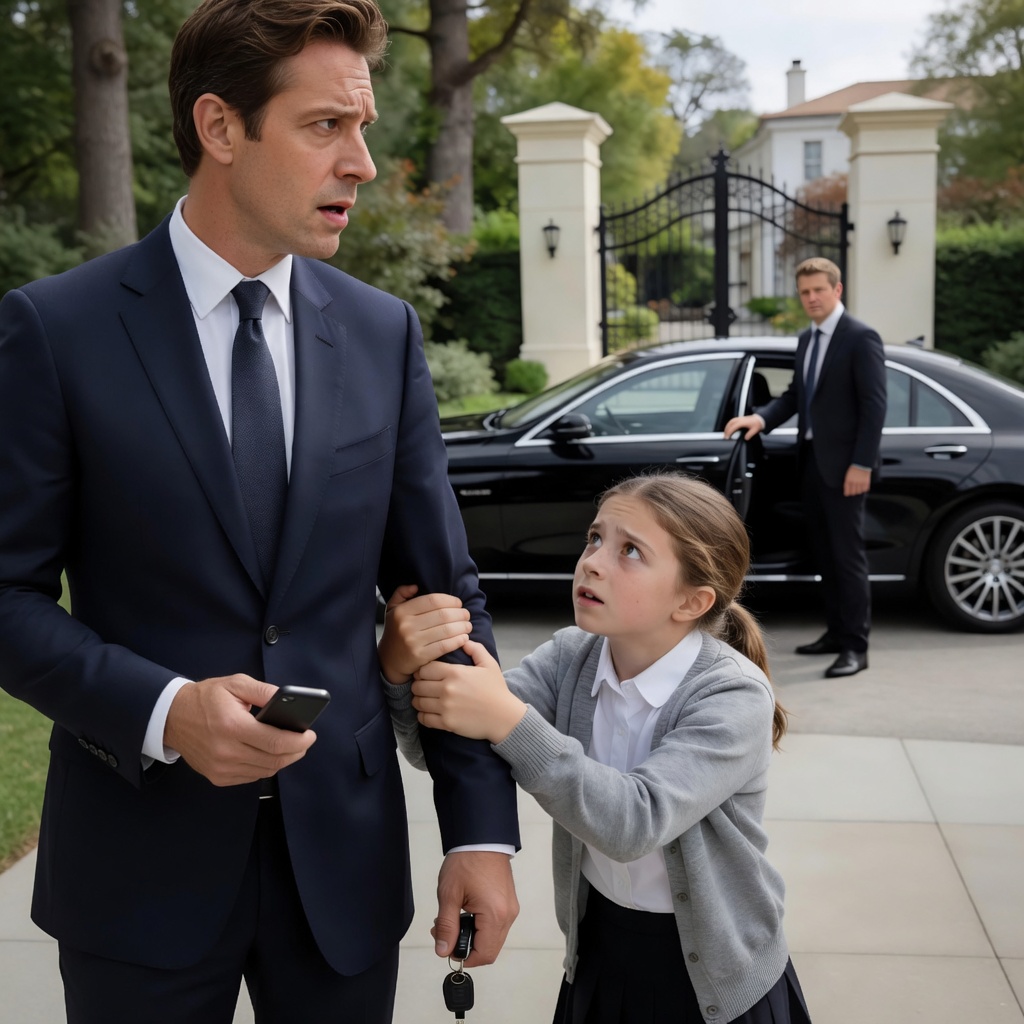
Santiago Robles walked out of his mansion dressed in a perfectly tailored charcoal suit, phone buzzing in one hand and car keys in the other. He had a flight to Monterrey in less than two hours, and a meeting worth millions waiting on the other side. His mind was already there — contracts, investors, numbers, negotiations. That was how he had built his life. By focusing. By moving fast. By refusing to be distracted.
It was also his most dangerous habit.
When Santiago was in a rush, he stopped noticing the people around him.
He crossed the front steps without looking up from his phone. At the gate, a black sedan waited with the engine running. The driver stood beside the rear door, ready to open it. Everything looked exactly the way it should have looked.
Then someone tugged his sleeve.
“Don’t say anything, sir,” a quiet voice whispered. “Just come with me.”
Santiago looked down, annoyed at first.
It was Abril, the twelve-year-old daughter of Tomás. Her hair was tied back with a red ribbon, but the ribbon had come loose, and several dark strands clung to her pale face. Usually, Abril was shy and polite, the kind of child who smiled from behind her father and disappeared into the greenhouse after school. But now her eyes were wide with terror.
“Abril, not now,” Santiago said, distracted. “I’m late.”
“Please,” she whispered. “Don’t let them see you.”
His irritation faded slightly. “Who?”
But she was already pulling him toward the edge of the driveway, guiding him behind a row of large clay pots filled with white flowers. He almost pulled away. He was a grown man, a businessman, a billionaire, crouching behind flowerpots because a child had asked him to.
Then he saw her hands.
They were shaking.
Not playfully. Not nervously.
Violently.
Something in her fear stopped him.
Santiago crouched beside her.
From where they hid, he could still see the front gate clearly. The black sedan waited outside, shining in the morning sun. The driver stood by the rear door, head slightly lowered, one hand on the handle.
Abril leaned close and whispered, “That’s not your driver.”
Santiago stared at the man. “Of course it is. Emilio has worked for me for years.”
She shook her head firmly. “No, sir. Your driver always opens the door with his right hand. He keeps his keys in his left pocket. I see him every day. That man used his left hand.”
Santiago frowned.
It sounded ridiculous.
Too small to matter.
But Abril pointed again, this time toward the license plate.
“And that’s not the same number. They changed one digit.”
Santiago leaned forward.
At first, the plate looked correct. Same letters. Same structure. The car itself was identical — same model, same dark windows, same polished body.
Then he saw it.
One number was different.
A cold chill moved through him.
He looked at the girl. “How do you know all this?”
Abril hesitated. Her eyes flicked toward the greenhouse, then toward the mansion, then back to him.
“Yesterday,” she whispered, “behind the greenhouse, I heard your wife talking to someone.”
Santiago went still.
“My wife?”
Abril nodded. “She said you wouldn’t notice because you always walk while looking at your phone. They planned to switch the car today. They said once you got in… you wouldn’t make it to the airport.”
His chest tightened.
For a moment, he felt insult before fear. The accusation was too large, too ugly. Valeria was his wife. She had known him before the mansion, before the money, before the name Robles meant power. She had sat beside him in a tiny apartment when he was still building his first company from borrowed money and sleepless nights. She had eaten cheap soup with him when he skipped meals to save for payroll.
“You’re saying my wife is involved?” he asked, voice sharpening.
Abril did not look away. “Yes, sir.”
“Do you understand how serious that accusation is?”
She nodded.
Then she pulled an old phone from her pocket.
“That’s why I recorded it.”
Before she could press play, Santiago’s phone rang.
The name on the screen made his stomach tighten.
Valeria.
He stared at it for half a second, then answered.
“Where are you, my love?” Valeria asked sweetly. “The driver says you haven’t come out yet. You’re going to miss your flight.”
Santiago looked through the leaves at the black sedan waiting outside the gate.
“I’m on my way,” he said.
“Hurry,” she replied. “That meeting is important.”
“I know.”
He ended the call slowly.
Then he stood.
“I need to go.”
Abril grabbed his hand again, this time with desperate strength.
“Sir, if I’m wrong, you can fire my father. We’ll leave today. But if I’m right and you get into that car…” Her voice broke. “You won’t come back.”
Santiago froze.
The words landed in him harder than the accusation had.
Because Abril was not asking to be believed for her own sake. She was risking her father’s livelihood, their home, everything, because she believed he was about to die.
“What else did you hear?” he asked.
Tears filled her eyes. “They said they’d take your phone and wallet. Drive you somewhere isolated. Leave you there without food… until you couldn’t fight anymore.”
His throat went dry. “And after that?”
She lowered her voice.
“Everyone will think you disappeared. And your wife will get the twenty-million-dollar insurance.”
For a moment, Santiago wanted to laugh.
Not because it was funny.
Because the alternative was unbearable.
Valeria couldn’t do this. She had been beside him through hunger and debt. She knew the man beneath the suit. She knew the frightened young husband who once counted coins in a grocery aisle. She knew the dream before it became an empire.
She couldn’t.
But Abril tugged his sleeve again.
“Come,” she whispered. “There’s more.”
She led him quietly along the hedge, past a narrow garden path, toward the greenhouse. Purple bougainvillea spilled over one side, thick enough to hide them from view. Santiago followed without speaking, his heartbeat now loud in his ears.
Behind the curtain of flowers, he saw her.
Valeria.
She stood near the greenhouse service entrance, dressed in a cream blouse and dark trousers, her hair perfectly styled. And beside her stood a younger man in an expensive shirt — handsome, polished, but with something sharp beneath the charm.
They were standing too close.
Then Valeria reached up and touched his face.
And kissed him.
Not quickly. Not nervously. Not like a mistake.
Slowly.
Intimately.
Certain.
As if Santiago already belonged to the past.
Santiago stopped breathing.
The man smiled against her mouth. Valeria rested her forehead against his and whispered, “Just a little longer. When this is over, we won’t have to hide anymore.”
The man asked, “You’re sure he won’t notice?”
Valeria gave a soft laugh.
That laugh destroyed him more than the kiss.
“Santiago notices numbers, not people.”
Abril lowered her eyes.
Valeria continued, “He’ll walk straight into the car like he always does. Phone in hand. Mind somewhere else.”
The man kissed her hand. “And the girl?”
Valeria’s voice turned careless. “She’s the gardener’s daughter. Who would believe her?”
Santiago felt something inside him go silent.
Not peaceful.
Dead silent.
The kind of silence that comes before a life breaks into two parts — before and after.
The man pulled Valeria closer. “When the insurance clears, we leave?”
Valeria closed her eyes. “Yes. Monterrey, then Miami. No more pretending.”
Then she whispered the words Santiago never imagined hearing from her mouth.
“I love you.”
Santiago stepped backward before she could see him.
Abril followed, trembling.
When they returned behind the clay pots, Santiago’s face had changed. He was no longer confused. He was no longer defending Valeria in his mind.
Now he was cold.
Focused.
Alive because a child had noticed what he did not.
He crouched before Abril. “Did anyone see you record them?”
“I don’t think so.”
“Where is your father?”
“In the rose garden.”
“Go to him. Tell him to stay near the east gate. Do not go back to the greenhouse. Do not speak to my wife. Do not come near the front gate unless I call you.”
Abril’s eyes widened. “You’re still going?”
“No,” he said quietly. “They think I am.”
He took out his phone and called Rafael, his head of security, a former federal officer who had worked for him for years.
Rafael answered immediately. “Sir?”
“Where are you?”
“Security office.”
“Check the front gate camera. Do not alert Valeria. Do not alert anyone in the house. Is Emilio on site?”
A pause.
Then Rafael’s voice changed. “No, sir. Emilio called in sick this morning.”
Santiago closed his eyes.
Valeria had lied about the driver waiting.
“Lock down the estate quietly,” Santiago said. “Send two men to the east gate. Call Detective Herrera directly. Tell him attempted kidnapping, possible conspiracy, armed suspects. And Rafael?”
“Yes, sir?”
“If I get close to that car, follow my signal.”
“Sir, don’t approach the vehicle.”
Santiago looked toward the black sedan.
For the first time, he noticed the driver’s hand hovering near his jacket.
“I want them caught.”
Abril whispered, “Please don’t.”
Santiago looked down at her.
She looked impossibly small in that moment.
A child with a red ribbon and an old phone, standing between him and death.
“You saved me once already,” he said softly. “Now trust me for five minutes.”
Abril shook her head. “Adults always say five minutes before something bad happens.”
He almost smiled, but his heart was too heavy.
“You’re smarter than most adults I know.”
She didn’t smile.
He stood and walked toward the gate.
The fake driver straightened immediately. “Good morning, Mr. Robles.”
Santiago studied him now. The uniform was right. The posture was almost right. From a distance, he could have passed for Emilio. But up close, everything Abril said became impossible to ignore.
Wrong hand.
Wrong plate.
Wrong shoes.
Wrong eyes.
“You’re not Emilio,” Santiago said.
The man’s smile flickered. “He asked me to cover for him, sir. He’s unwell.”
“Did he?”
“Yes, sir.”
The rear door opened.
Dark interior.
Tinted glass.
A trap dressed as convenience.
Santiago took one step closer.
The driver’s hand moved slightly toward his jacket.
Then Rafael’s voice came from behind him.
“Hands where I can see them.”
The driver turned sharply.
Three security guards moved in from both sides. One slammed the fake driver against the car before he could reach whatever was hidden under his jacket. Another opened the rear door and froze.
Inside the car were a black hood, duct tape, zip ties, a syringe, and a small bag with Santiago’s name printed on a luggage tag.
Abril covered her mouth from behind the hedge.
Santiago stared at the items.
They were real.
The plan was real.
He had been seconds away from vanishing.
Down the road, a second vehicle suddenly started moving. A police SUV turned in from the corner and blocked it. Tires screamed. Doors opened. Men shouted. One man ran, then fell as security tackled him near the wall.
From the greenhouse came a scream.
Santiago turned.
Valeria stood at the garden path, her face drained of color. Beside her, the younger man tried to step backward, but two guards already moved toward him.
“Santiago,” she said.
He walked toward her slowly.
Every step felt like walking through the ruins of twenty years.
She lifted her hands. “I can explain.”
He stopped a few feet away.
“Explain the car.”
Her mouth trembled.
“Explain the fake driver.”
“Santiago—”
“Explain the syringe.”
The man beside her snapped, “Don’t say anything, Valeria.”
Santiago turned his eyes toward him.
The man’s name, he would later learn, was Diego Santoro — a failed consultant with gambling debts, expensive taste, and enough charm to make a lonely woman feel chosen.
Valeria looked from Diego to Santiago, and for the first time, Santiago saw her without the softness of memory protecting her.
She was afraid.
But not ashamed.
“You weren’t supposed to see this,” she whispered.
The words cut deeper than any apology could have.
“So Abril was right.”
At the mention of the girl’s name, Valeria’s face twisted. “That little spy ruined everything.”
Santiago’s voice turned cold. “That little girl saved my life.”
Valeria’s eyes flashed. “You never noticed anything. Not me. Not this house. Not how alone I was beside you.”
He absorbed that.
Because some of it was true.
He had been absent in ways money could not excuse. He had missed dinners, forgotten conversations, answered emails during moments that deserved his full attention. He had built a kingdom and sometimes treated his marriage like furniture inside it.
But absence was not a death sentence.
“You were lonely,” he said quietly. “So you planned to kill me?”
She flinched.
“I wasn’t going to kill you.”
Santiago stared at her.
Valeria swallowed. “You would disappear. That was all. You always loved work more than life anyway.”
That sentence finished what the kiss had started.
Whatever part of him had still been searching for the woman he married went still.
Detective Herrera arrived minutes later. Abril’s recording was played in the security office while police stood silently around the room.
Valeria’s voice filled the speakers.
He won’t notice. He never notices anything without a decimal point.
Diego laughed.
And the girl?
Who cares? She’s the gardener’s daughter.
Then came the full plan.
The switched car.
The isolated warehouse.
The destroyed phone.
The insurance payout.
The fake disappearance.
The second vehicle.
Santiago stood motionless as his marriage became evidence.
Tomás held Abril beside him, both arms wrapped tightly around her shoulders. His face was pale with guilt and fear.
“I’m sorry, señor,” Tomás whispered. “I didn’t know she heard anything. I should have—”
“No,” Santiago interrupted.
Tomás looked up.
“Your daughter did what my entire security team did not.”
Abril lowered her eyes.
Santiago crouched before her once again.
“I didn’t believe you at first,” he said. “I’m sorry.”
Abril looked startled. “Adults don’t usually say sorry.”
“They should.”
Valeria was arrested before noon.
She shouted Santiago’s name as officers led her through the front drive. Diego cursed. The fake driver said nothing. The black sedan was towed away with its doors open, its dark interior exposed like the mouth of a monster that had failed to swallow him.
When the gate finally closed, the estate became painfully quiet.
Too quiet.
Santiago did not go to Monterrey. He did not call the investors himself. His assistant handled the cancellations. For the first time in years, Santiago turned his phone off.
Then he walked into the greenhouse.
The air inside was warm and damp. Roses bloomed in neat rows. Orchids hung from wooden frames. Everything had been cared for with tenderness by hands Santiago had barely noticed for years.
Tomás had built beauty here.
Abril had learned observation here.
And Valeria had used this place to betray him.
Santiago stood beneath the bougainvillea where he had watched his life collapse.
Santiago notices numbers, not people.
The words would not leave him.
Because they were cruel.
But not entirely false.
In the days that followed, the investigation revealed how carefully Valeria and Diego had planned everything. The insurance policy had been increased six months earlier. Emilio’s schedule had been manipulated. The fake driver had been paid through a shell account. A warehouse outside the city had been rented under a false name. Food, water, and restraints were found there.
They had not planned a messy crime.
They had planned a disappearance.
One designed around Santiago’s worst habit: his failure to look up.
The media found out quickly.
They always did.
Billionaire’s Wife Arrested in Kidnapping Plot.
Gardener’s Daughter Saves Mexican Tycoon.
Insurance Scheme Foiled by Twelve-Year-Old.
Reporters gathered outside the estate gates for days. They wanted pictures of Abril. Interviews. Details. Tears. A child turned into spectacle.
Santiago refused.
He walked to the gate once, stood before the cameras, and said only one thing.
“Abril is not a headline. She is a child. She saved my life because she noticed what powerful adults ignored. Respect her privacy.”
Then he returned inside.
He gave Tomás paid leave, but Tomás refused to leave the roses unattended for more than two days. Abril returned to the greenhouse slowly, nervously, as if the place had become dangerous now.
Santiago found her there one afternoon, sitting near a row of clay pots with her schoolbooks open.
“What are you studying?” he asked.
“Math,” she said.
“Do you like it?”
She shrugged. “I like when things have answers.”
Santiago nodded slowly.
“I used to like that too.”
She looked up. “You don’t anymore?”
He thought of Valeria’s kiss. The wrong license plate. The syringe. The woman who once loved him, or maybe only loved what he became.
“Some things don’t.”
Abril looked back down at her book. “But some things do. The plate was wrong. The hand was wrong. The voice recording was real.”
Santiago smiled faintly.
“You would make a good investigator.”
She looked embarrassed.
“My father says I stare too much.”
“Your father is wrong. You observe.”
The next week, Santiago replaced Abril’s cracked old phone with a new one. She refused it immediately.
“My father says not to accept expensive gifts.”
“Your father is a wise man,” Santiago said. “So it isn’t a gift. It’s equipment.”
“For what?”
“The scholarship program I’m starting.”
Her eyes narrowed. “What scholarship program?”
“The Abril Robles Observation Scholarship.”
She stared at him in horror. “That sounds terrible.”
For the first time since the incident, Santiago laughed.
A real laugh.
“Fine. We’ll choose a better name together.”
The program began quietly. It supported the children of gardeners, drivers, cooks, cleaners, security guards, and domestic workers across Santiago’s companies. Tuition. Books. Technology. Mentorship. Internships. Not charity. Recognition.
Because Santiago had learned something he should have understood years earlier:
The people closest to danger are often the people least likely to be heard.
Valeria’s trial lasted months.
Santiago testified once. He looked at her only when required. She looked thinner, harder, still beautiful in a way that now made him feel nothing but sadness. Her lawyers tried to portray her as a neglected wife manipulated by Diego. Diego’s lawyers blamed her. The fake driver blamed both.
Abril’s recording destroyed them all.
When the verdict came, Santiago felt no joy.
Only exhaustion.
That night, he returned to the estate and sat alone near the greenhouse. Tomás found him there after dark.
“I can bring coffee, señor.”
Santiago shook his head. “Sit with me.”
Tomás hesitated, then sat.
For a while, neither spoke.
Then Santiago said, “You’ve worked here fifteen years.”
“Yes, señor.”
“And I never asked where you lived before this.”
Tomás looked surprised.
Santiago continued, “I never asked what Abril wanted to become. I never asked if your wife was still alive. I never asked anything that didn’t involve work.”
Tomás was quiet for a long moment.
“My wife died when Abril was five,” he said softly. “Abril wants to be a forensic scientist this month. Last month, she wanted to be a teacher. Before that, a detective.”
Santiago smiled faintly.
“She should consider all three.”
Tomás looked at him carefully. “You were not cruel, señor.”
“No,” Santiago said. “But I was absent. Sometimes absence becomes its own kind of cruelty.”
Tomás did not disagree.
Years passed.
Abril grew taller. The red ribbon disappeared eventually, replaced by practical hair ties and later by short hair when she decided long hair was annoying. Santiago paid for her education, but Tomás made sure she worked hard enough to earn every opportunity. She became exactly what Santiago once predicted: the kind of person who noticed everything.
On the anniversary of the morning she saved him, Santiago walked with her and Tomás through the greenhouse.
The bougainvillea had grown thicker. Roses bloomed along the central path. The front gate was visible in the distance, but Santiago no longer walked toward it with his phone in his hand.
He rarely walked anywhere like that anymore.
Abril, now older and sharper, glanced at him.
“Do you still check license plates?”
“Every time.”
“And hands?”
“Every time.”
She smiled. “Good.”
Tomás laughed quietly.
Santiago looked toward the gate where a different car waited with a different driver. Then he looked back at Abril.
“You saved me because you noticed one digit.”
She shook her head.
“No, sir. I saved you because you listened.”
Santiago thought about that.
Then nodded.
She was right.
The changed number began the warning.
But listening saved his life.
And from that day forward, Santiago Robles no longer walked like a man too important to see the people around him.
He walked slower.
Head up.
Phone away.
Because once, a gardener’s daughter saw death waiting at his gate and had the courage to tug his sleeve.
And because for once in his life, he stopped long enough to hear the truth.
![[FULL STORY] She Said I Had to Impress Her Friends… Then They Chose Me and Kicked Her Out](https://social-media.rabedo.com/thumbnails/1777216657_df2ab2b8-58d8-432e-9a96-d6125241de6e.png)
![[FULL STORY] I Woke Up Alone in the ICU… and Discovered My Family Had Been Stealing My Life for Years](https://social-media.rabedo.com/thumbnails/1777221393_b26fa70c-fd12-451a-8a99-ee9b42c86233.png)


![[FULL STORY] She Said “It’s Just Dinner With My Ex” — Then Saw Me There With Another Woman and Lost Everything](https://social-media.rabedo.com/thumbnails/1776585949_025e5c0a-ce5d-446f-badb-59d700fd9214.png)